Today’s Top 10 – November 26th, 1963

The two earlier ‘Today’s Top 10’s I’ve done were pretty succesful. Thanks to all who had a look, liked and commented. I was wondering what to do with the feature going forward, and I think I’ll use it to take a deeper look at interesting periods in chart history. What can the Top 10 tell us about where pop music was at a particular time and place?

So, we’ve done the death of the ’60s, and we’ve done the Summer of Love. Now we turn to perhaps one of the most exciting times in modern popular music: late-1963. The moment when the sixties finally started to swing. Thanks, mainly, to the Beatles. But not, as this chart will hopefully prove, solely because of them. For those interested in significant world events, this was also the Top 10 on the week that JFK was assassinated.

10. Let It Rock / Memphis, Tennessee, by Chuck Berry – down 4 (7 weeks on chart)

But what’s this…? Two rock ‘n’ roll tunes first released in 1959. How the charts like to mess with us… The reason is tied to the times, though. The Godfathers of rock, Buddy Holly, Jerry Lee Lewis, and Chuck Berry, had inspired the new Beat groups that we’ll be meeting further up this chart. The Beatles early albums were full of Berry songs, while the Stones’ first hit had been a cover of ‘Come On’ earlier in 1963. Pye Records saw an opportunity, and released some of these influential tunes for the first time in the UK. Amazingly, this was Berry’s first ever visit to the UK Top 10. A runaway train might not be the most obvious topic for a rock ‘n’ roll tune, but this wasn’t Berry’s first time singing about a railroad. And the way he makes his guitar sound like a train horn is iconic.

It was paired with the more laidback ‘Memphis, Tennessee’, which had also been a hit in a version by Dave Berry & the Cruisers around the same time. It pulls the same trick as such classics as Gilbert O’ Sullivan’s ‘Clair’, and Brotherhood of Man’s ‘Save Your Kisses for Me’, by tricking the listener into thinking that the singer is singing about a girlfriend, when he is actually singing about a small child. Berry, though, consumate storyteller that he was, manages to do it in a far less creepy manner, making the song more about the messy break-up, and the father’s regret, than about dodgy double entendres.

9. I’ll Keep You Satisfied, by Billy J. Kramer & The Dakotas – up 2 (3 weeks on chart)

This one’s much more 1963. One of the big beat combos that had broken through earlier in the year (with another three to come higher up), and who had been at #1 just a few weeks earlier with the Lennon-McCartney tune ‘Bad to Me’. ‘I’ll Keep You Satisfied’ is another L&M composition and, while it would peak decently at #4, it isn’t quite as good. Still, it’s better than the Dakota’s next hit, the dubious ‘Little Children’. Watching the video above, the music may be (slightly) rocking, but Billy J. is giving good crooner energy. Nothing to worry grandma… yet.

8. I (Who Have Nothing), by Shirley Bassey – up 1 (9 weeks on chart)

A constant presence on the charts of the ’50s and ’60s: a bit of Bassey. This is three minutes of pure melodrama, as Shirley watches an old-flame woo his new girl. ‘I (Who Have Nothing)’ was adapted from an Italian hit, which was something of a theme in the early sixties. It’s a classic of its genre: an intro of swirling strings, quiet bits, and bits where she lets loose, belting out high notes like nobody else can. I always find Shirley Bassey somewhat lacking in subtlety, but then again – if you’ve got it flaunt it. If I could sing like her then I’d be belting out my Starbucks orders.

7. Blue Bayou / Mean Woman Blues, by Roy Orbison – down 3 (10 weeks on chart)

Another double-‘A’ side from an American rocker, who had been around since the ’50s. Unlike the Chuck Berry record, though, this was a new hit. ‘Blue Bayou’ is one of Orbison’s gentler numbers – for the Big ‘O’ could of course give Shirley Bassey a run for her money in the belting stakes – but it’s always been one of my favourites. Even as a young ‘un who had no idea what the hell a ‘bayou’ was. Linda Rondstadt recorded a famous cover in 1977, though that didn’t make the UK Top 10.

On the flipside of this disc was a cover of ‘Mean Woman Blues’, an Elvis track from 1957. Personally, while they are both fine singers, I prefer Elvis’s version. I prefer bombastic, overblown Orbison to rocking Orbison. On this record he tries out the famous Grrrrrr, which he’d use to great effect on his chart-topping ‘Oh, Pretty Woman’ the following year.

6. Secret Love, by Kathy Kirby – up 6 (3 weeks on chart)

We’re keeping an eye out for the bands that came along in 1963 and changed popular music forever. But for every beat combo that made it big, there were plenty of British women who were just as instrumental in making the sixties swing. Kathy Kirby’s name hasn’t lasted alongside the likes of Cilla, Dusty, Lulu or Sandie Shaw, but here she is, enjoying her biggest hit. Her take on ‘Secret Love’ starts off very bombastically, much like Doris Day’s chart-topping original from a decade earlier, but soon a groovy guitars-and-backing-singers beat takes over, nicely updating the song for a new era. Plus, she has a great voice, with a bit of bite to it. Kirby may have retired from showbusiness in the early eighties and died in relative obscurity, but for a while she was a huge name: representing the UK at Eurovision in 1965 (finishing as runner-up) and hosting her own television programme.

5. Don’t Talk to Him, by Cliff Richard & The Shadows – up 2 (3 weeks on chart)

Common knowledge would have it that with the arrival of the Beatles et al the career of Cliff Richard – the hottest star in the land just a year or so earlier – fell off a, well, cliff. But glance at any Top 40 from any random moment post-1962, and it quickly becomes clear that Cliff went nowhere. Okay, he didn’t hit #1 as regularly, but ‘Don’t Talk to Him’ was one of an astounding 33 Top 10 hits he achieved across the sixties. I’d never heard this before, but it’s actually a really good song, combining a latin rhythm with some very current, beat guitars. This could easily have been written and recorded by one of the acts a couple of places up this chart, proving that Cliff gave those young whippersnappers a stronger run for their money than the history books suggest. *Some sources disagree as to whether this was Cliff solo, or Cliff with the Shadows, but I’ve gone with the latter*

4. Be My Baby, by the Ronettes – up 1 (6 weeks on chart)

The first of two all-time great, hall of fame pop songs in this week’s Top 4. The fact that this never made it higher than number four is a shock, and I’ve already done a post on how this really Should Have Been a #1. Even on this chart, in the year that it was recorded, where girl groups like the Ronettes were common, ‘Be My Baby’ stands out as special. It would stand out as special on any chart, in any era, simply because it is better than 99.95% of anything else in the history of pop.

3. Sugar and Spice, by the Searchers – down 1 (5 weeks on chart)

Here we are then, a purely Liverpudlian Top 3. The Searchers had been the 3rd Merseybeat band to make number one that year, after the two acts ahead of them in this chart, with their cover of The Drifters’ ‘Sweets for My Sweet’. Although still on the candy theme, ‘Sugar and Spice’ was an original, written by producer Tony Hatch. The chiming guitars and harmonies, as well the almost skiffle rhythm section, are pleasant, almost proto jangle-pop. But within a year, once the Stones, Kinks and Animals started making the upper reaches of the charts, it would start to sound a bit safe. The Searchers had two much better hits to come: their majestic second #1 ‘Needles and Pins’, and their cover of ‘When You Walk in the Room’. Like so many Beat bands that didn’t, or couldn’t, write their own material, the Searchers’ chart shelf-life was limited.

2. She Loves You, by The Beatles – up 1 (13 weeks on chart)

The song that officially kicked off the swinging sixties? The way that ‘She Loves You’ barrels in, chorus-first, on a wave of tight guitars and precision drumming, and yeah yeah yeahs. In France, this style of Beat music literally became known as ‘Yé-yé’ (and surely everyone knows by now how Mr McCartney Senior thought ‘yes, yes, yes’ would have sounded much more proper…) It is utterly perfect pop, to rank alongside the Ronettes a couple of places below it on this week’s chart. Although they developed their sound so far beyond this, I would still rank ‘She Loves You’ in my personal Beatles Top 3. You can read my original post on it, as a number one, here. On this week in November 1963, it was on its way back to number one, having already spent a month there that autumn, and on its way to becoming the biggest-selling single ever, at that point, in the UK (where it remains the Fab Four’s highest seller). Also, the seven-week gap between its two runs at the top remains a record to this day.

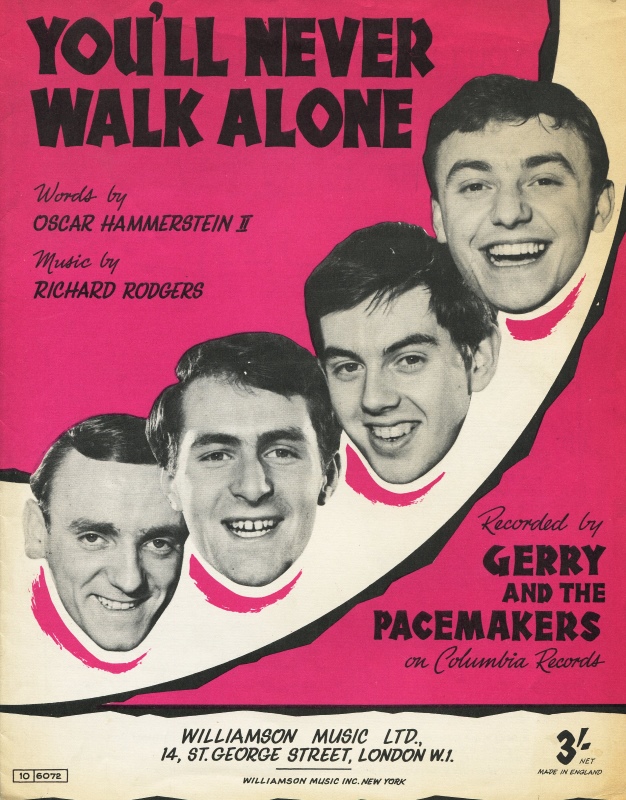
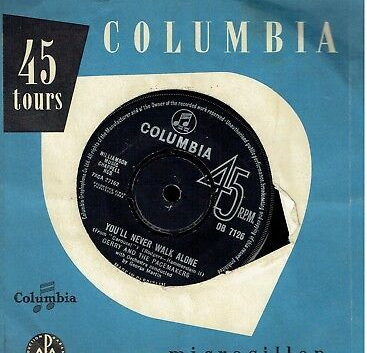
1. You’ll Never Walk Alone, by Gerry & the Pacemakers – non-mover (7 weeks on chart)

The 4th Beat group in the Top 10 on this day sixty-one years ago, Gerry & the Pacemakers had made history by being the first act to make #1 with their first three singles. This was the final week of a month-long run for ‘You’ll Never Walk Alone’, and it would also be The Pacemakers final week on top of the charts. (You can read my original post on it here.) The fact that for only their 3rd single the band had turned to a cover of a song from a 1945 musical is telling. While the Beatles were just warming up, their contemporaries were often relying on covers (or on handouts from Lennon & McCartney). Plus there was the fact that for record labels and producers, rock and roll was still a very new thing, one that many were convinced wouldn’t last. It was seen as essential for bands to branch out, and to nurture a wider appeal.

Of course we know now that rock ‘n’ roll was here to stay, even if Gerry & The Pacemakers weren’t. ‘You’ll Never Walk Alone’ was also here to stay, and by the end of its initial chart run it had already been adopted by the crowd at Anfield as Liverpool FC’s unofficial anthem, to be belted out pre-match from here to eternity. The song returned to number one in a charity version by The Crowd, following the Bradford City fire, while it also made top spot for a third time in 2020 in a version featuring Michael Ball and the 100-year-old Captain Tom Moore, a phenomenon that can only be explained by how crazy we all went during lockdown. It is nothing short of a modern-day hymn, given the song’s role in the current British psyche.

I hope you enjoyed this flashback to Today’s Top 10 in 1963. What a snapshot of popular music that was, as Britain finally cast off the shadow of the War and started to get a little groovy. Up next we’ll return to 1999, and to a country just a few months away from the terrifying uncertainty of a new millenium. Would all the computers crash? Would planes start dropping from the sky…? Nobody knew, so confused and distracted were people that they kept buying Ronan Keating records in large quantities. Stress will do that to you…

750. ‘What Becomes of the Broken Hearted’ / ‘Saturday Night at the Movies’ / ‘You’ll Never Walk Alone’, by Robson & Jerome

Robson & Jerome return for their third and final number one, and bow out with a 100% chart-topping record. Which is something that can’t be sniffed at. Unlike their records, which can. Because they stink.

What Becomes of the Broken Hearted / Saturday Night at the Movies / You’ll Never Walk Alone, by Robson & Jerome (their 3rd and final #1)

2 weeks, from 3rd – 17th November 1996

It’s more of the same: more granny-baiting covers of sixties classics, more cheap and tacky production, more dodgy vocals… Much more, in fact, because they end things with the first and only triple ‘A’-side to make #1. Three songs, give me strength… (How does a triple ‘A’ even work? It’s simple geometry: discs don’t have three sides! Was this released as a triangle?)

The ‘lead’ single from the three is a cover of Jimmy Ruffin’s ‘What Becomes of the Broken Hearted’. As with last time, and the pair’s take on ‘Up on the Roof’, there is an element of this being a good thing. ‘What Becomes…’ is an all-time classic, and even in this highly diluted version it’s good to see it having a moment on top of the charts. And this isn’t as heinous as some of their other chart-topping moments. The production is quite lush and substantial, and they sensibly rope a gospel choir in to do much of the actual singing.

If only they had left it at that… The Official Charts Company lists just the one song, though maybe they simply don’t have the space to squeeze in three fairly long titles. All other sources have this as a threesome though, and so we’ll have to give the other two a spin. Starting with a case of GBH on The Drifters’ ‘Saturday Night at the Movies’. The synthesisers are set for ‘jaunty’, as Jerome Flynn does his best Johnny Moore high-notes… The less said the better. (I will admit that the video is quite fun…)

We end with a song that’s already been #1 twice and that really didn’t need to return, especially not in a version as lightweight as this. ‘You’ll Never Walk Alone’ is a technically demanding song and, although the producers try very hard to drown out Robson & Jerome’s reedy vocals with lots of bombast, we can sadly still hear them. You can see why the OCC has been tempted to erase it from history. Elsewhere on their second album, ‘Take Two’, lurk covers of ‘Oh Pretty Woman’, ‘Keep the Customer Satisfied’ and – presumably because Christmas was just around the corner – ‘Silent Night’.

We can perhaps be glad, then, that they decided to end their music careers rather than release any further singles. They had, after all, been reluctant to do it in the first place, and not even the offer of three million pounds from Simon Cowell could persuade them to do a third album. I can forgive them almost everything, music-wise, knowing how much that must have annoyed Cowell. Unfortunately, he discovered an even more lucrative way of unleashing terrible music on the masses. More on that soon…

To be honest, it’s easy to forgive Robson and Jerome most things, as they both seem like decent blokes. Green has been a fixture on British TV ever since, both in acting and in presenting travel and fishing documentaries. Flynn laid-low for a few years, before returning to the spotlight with a scene-stealing turn as Bronn in ‘Game of Thrones’. The pair are, you’ll be very glad to hear, still firm friends.

Up next, a recap. And I have a feeling that this pair may well be up for an award…

551. ‘You’ll Never Walk Alone’, by The Crowd

It’s our third charity chart-topper in six months, after over thirty years of managing quite happily without them, and so I’m introducing a new template. For every charity single that features henceforth, I’ll first spend a paragraph detailing how terrible the tragedy that inspired it was. I’ll then spend several more paragraphs detailing how terrible the ensuing record is… Sounds good?

You’ll Never Walk Alone, by The Crowd

2 weeks, from 9th – 23rd June 1985

The serious bit, then. On 11th May 1985, at a Third Division match between Bradford City and Lincoln City, a fire broke out in the main stand of the home side’s Valley Parade stadium. A fan had dropped a cigarette butt through a hole in the floor, where it landed on a pile of litter. On a dry and windy day, the stand was engulfed with flames inside five minutes. Fifty-six people died, many horrifically burnt alive, while another two hundred and sixty five were injured.

Gerry Marsden, of Gerry & the Pacemakers fame, decided to make a record to raise money for the victims and their families, and settled on a cover of his band’s 1963 #1, ‘You’ll Never Walk Alone’, which was already a popular terrace song. He assembled a cast drawn from all corners of the British popular entertainment scene…

And the record sounds exactly as you’d expect. It is a large group of people singing along to ‘You’ll Never Walk Alone’. It’s not awful; it’s far from being particularly good. It’s karaoke, recorded solely to make money for a good cause. I’m sure Marsden’s heart was in the right place (and he wasn’t just bandwagon jumping his way back to relevance). The most interesting thing about it, by far, are the people involved. Band Aid was full of bright young things; USA for Africa was a ‘Who’s Who’ of American pop. The Crowd are, well, a crowd.

Let’s start with the musicians. There’s Gerry Marsden (becoming the first person to top the charts with the same song), there’s Jim Diamond, Kiki Dee, Denny Laine, Tony Christie and Rick Wakeman. There’s Rolf Harris… There’s Motorhead and The Nolans! (Any record that manages to feature both Motorhead and The Nolans cannot simply be dismissed…) There’s Phil Lynott of Thin Lizzy, John Entwhistle of The Who, and Frank Allen of The Searchers. There’s Black Lace!! And then there are the non-musicians… The DJ Dave Lee Travis, the boxer John Conteh, the comedian Keith Chegwin, certified national treasure Bruce Forsyth…

Frankly, there are too many to list properly. It is a mind-bender of a lineup, a walking pub quiz question of a number one… Some bloke called Paul McCartney is relegated to a spoken-word ‘B’-side (completely understandable when you’ve already booked Rolf Harris and Cheggers…)

The fact that this record gave a #1 single to so many different people makes me think it should be better remembered. Except, then I press play one more time and realise why this has been quietly forgotten. It’s neither good enough, nor bad enough, to linger very long. And, sadly, the Valley Parade fire would also be overshadowed by another disaster in a British football stadium before the decade was out… ‘You’ll Never Walk Alone’, meanwhile, has been back atop the charts fairly recently, still raising money for charity.

Advertisements

159. ‘You’ll Never Walk Alone’, by Gerry & The Pacemakers

Gerry and his gang make it three number ones in a year – three in ‘63. A feat that not many acts manage. But this is a disc light-years away from their first two chart-toppers.

gerry-and-the-pacemakers-youll-never-walk-alone-1963-8

You’ll Never Walk Alone, by Gerry & The Pacemakers (their 3rd and final #1)

4 weeks, from 31st October – 28th November 1963

It starts very simply. When you walk… A voice, a piano, a sparse drumbeat, and a bass… Through a storm, Hold your head up high, And don’t be afraid, Of the dark… Yup, we are definitely a long way from ‘I Like It’.

It’s a motivational song – a ‘never-give-up’ number about holding onto your dreams, even in your darkest hour. And Gerry Marsden certainly sells it here, building in confidence as the song progresses with his slightly rough-round-the-edges scouse crooning, and an affecting tremble in his voice. Walk on, Through the rain, Though your dreams be tossed, And blown…

Then the violins kick in, and the band and George Martin pull out all the stops to make sure there isn’t a spine left untingled. Walk on… Walk on… With hope in your heart, And you’ll never walk alone…. It’s a classic, an anthem. There’s a quick drop following the first chorus and then BOOM – we’re back for a big ol’ finish.

What on earth, though, were Gerry and The Pacemakers doing recording a version of ‘You’ll Never Walk Alone’ in the first place? It’s such a weird trio of chart-toppers: ‘How Do You Do It?’ – perky Beat-pop, ‘I Like It’ – perky Beat-pop, ‘You’ll Never Walk Alone’ – umm… It’s from a Rodger’s & Hammerstein musical, ‘Carousel’, first performed in 1945 as their follow-up to ‘Oklahoma!’ In the show, the song is sung by the lead-female character’s sister to comfort her following her death of her husband.

However, in the UK, and much of Europe, ‘You’ll Never Walk Alone’ has become completely disassociated from the original musical, and even from Gerry & The Pacemakers. Ask your average youngster in the street today if they know the song and they’ll probably say ‘yes – it’s the Liverpool Football Club song.’ It’s a record – more so than any of the other chart-toppers that we’ve covered so far – that has, for better or worse, taken on a completely new role in the decades since its release. At every Liverpool home game, just as the players run out onto the pitch, you’ll hear that piano and Gerry Marsden’s husky tones. Then, just as it arrives at the big finish, the P.A system will cut out and the crowd will take it home.

Gerry-The-Pacemakers-Youll-Never-Walk-Alone

Legend has it that in the early sixties the P.A. would play the Top 10 ahead of each match at Anfield. For four weeks in November 1963, ‘You’ll Never Walk Alone’ was the last song played due to it being atop the charts. But even after it was knocked off the top and dropped out the charts, the crowd kept singing it. The Pacemakers were hometown lads, after all, and the lyrics and melody of the song do lend themselves to being sung en-masse at a football match. So it stuck. ‘You’ll Never Walk Alone’ is the Liverpool FC song now. It’s sung at every game. It’s carved above the gates at Anfield. Liverpool supporters sign off from message boards and forums with ‘YNWA’.

But… Football being a tribal game, this means that any supporter of a club that isn’t LFC has to, basically, hate this song. Especially those who grew up in the seventies and eighties, when the buggers were winning everything. I would never particularly choose to listen to this song, as I’m not a Liverpool fan. It’s left ‘You’ll Never Walk Alone’ in a very weird position in British popular culture – a song that everybody knows; but one that only a select portion of the population will actively enjoy. And, amazingly, I’ve only just scratched the surface here. The song will top the charts again, and will become indelibly connected to two of the biggest tragedies in recent British history. All that for another day…

Away from football, ‘YNWA’ (those Liverpool fans might be on to something here) has been recorded by everyone who’s everyone: Elvis, through Roy Orbison, to Susan Boyle. It would literally take half an hour for me to type out all the artists who’ve done their take in the song. Gerry and The Pacemaker’s version remains, in the UK at least, the definitive one. But I’ve not answered my initial question from several paragraphs back… Why on earth did they take such a big step away from their Merseybeat roots, and so early in their careers? Could it have, perhaps, been their downfall? You can’t imagine The Beatles ever recording a showtune, can you? It was the band’s last #1, and they would only have three further Top 10s. By 1965 their chart-careers would be over. It’s a huge collapse (similar to the way Liverpool threw away the league title at Crystal Palace a few seasons ago… I couldn’t resist…)

Still, three #1s from their first three singles was an unprecedented achievement at the time, and one that wouldn’t be matched for over twenty years. They split up in 1966, with Gerry going into cabaret and children’s entertainment.

Before we finish, I have one big problem with this record (and it’s nothing to do with football). I’ve mentioned ‘The big finish’ a couple of times now; but the song doesn’t actually have one. The song build and builds, and builds, for two minutes and twenty seconds, and is crying out for a huge, epic, grandiose finish. But they bottle it. In the middle of the last ‘never’, Gerry pauses, the soaring violins fall away, and the song ends with a bit of an anti-climax. It’s a strange decision. I don’t know if it was Marsden’s, another band member’s, George Martin’s or maybe even Rodger’s or Hammerstein’s back in the forties. But for me it doesn’t work. It leaves me feeling a little flat. I’ll leave it to the crowd at Anfield to give this song the big finish that it deserves.