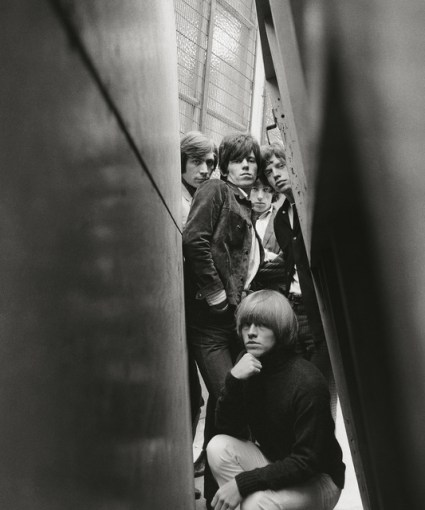
Barging Ken Dodd out of the way, snapping one of his tickling sticks and giving him the finger… It’s The Rolling Stones!
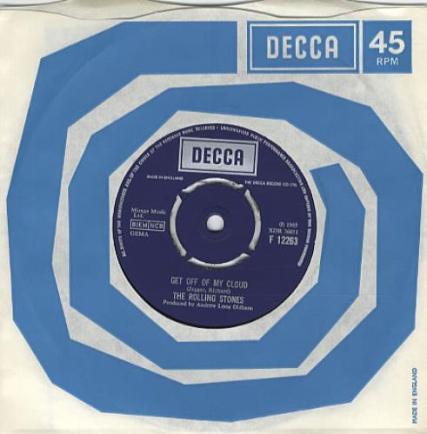
Get Off Of My Cloud, by The Rolling Stones (their 5th of eight #1s)
3 weeks, from 4th – 25th November 1965
They’re still angry, still dissatisfied with modern life, with complaining neighbours and, once again, detergent. What did Mick and Keith have against detergent…? Like ‘Satisfaction’, which was at #1 just six weeks before this, ‘Get Off of My Cloud’ tells an anti-hero’s story in three verses, against a frantic drumbeat and another scuzzily insistent riff.
It’s clearly another response to their new-found fame, their new-found position as The Beatles’ one true rivals to the throne. But all they want to do is be left alone. In each verse, Mick tries to escape the world around him: I sit at home looking out the window, Imagining the world has stopped… and I was sick and tired of this, Decided to take a drive downtown… It’s a response to, and another symptom of, their fame. This was a #1 in both the UK and the US, as well as Canada and Germany, and no other band could have taken a record as raw and aggressive as this to the top of the charts around the world.
It’s also a very hard song to sing. There are several points where I have no idea what is being sung, Charlie Watt’s drums and the guitars being so prominent in the mix, with Jagger’s vocals submerged under them. My favourite bit is when he almost starts rapping the phone-call from his neighbour, asking him and his friends to shut up because it’s 3 a.m. The telephone is ringing I say ‘Hi, it’s me, who’s there on the line? A voice says ‘Hi, hello, how are you?’ Well I guess I’m doin’ fine…
In the end, though, he finds some solace. He takes a drive downtown, where it’s nice and peaceful, and falls asleep. Whether or not he’s under the influence of something isn’t established… He wakes up to parking tickets, but I don’t think he cares – he’s Mick Jagger and he’s rich as piss. How the tickets look like flags, I don’t know. And I have no idea who the guy dressed up like a Union Jack is meant to be.
It’s a weird song. A scrappy, messy, glorious song. Apparently Keith Richards doesn’t look back on it too fondly, what with it being rushed out in order to capitalise on ‘Satisfaction’s success. And yes, the sound is a bit off, and the mix a bit bass heavy, and the lyrics pretty much cover the same ground as ‘Satisfaction’, but that’s part of this record’s charm. It really does sound like it was recorded in a garage, in one take, and while the sound is far removed from their bluesy roots, this is in keeping with The Stones as a rough and ready rock ‘n’ roll band.
But if that doesn’t convince you, at least you can’t deny the hook. Hey! – hey – You! – you – Get off of my cloud! Who hasn’t wanted to yell that at someone who’s been bringing them down, when you just want a bit of peace and quiet. Don’t hang around cos two’s a crowd…
Looking back at The Stones three #1s from this year, we have three masterpieces of attitude and anger. Gone are the blues covers, in comes ‘The Last Time’ with its disparaging swagger, ‘Satisfaction’ with that riff and it’s dissatisfaction with fame and modern living, and now this… more dissatisfaction with fame, modern living and the whole bloody world. And, taking these three discs and standing them side by side next to The Beatles three 1965 chart-toppers – ‘Ticket to Ride’, ‘Help!’ and ‘Day Tripper’, which is coming up in a couple of posts time… I’m going to go out on a limb and say The Stones’ output – solely talking about the chart-toppers, here – was, for the moment, trumping the Fab Four’s.
Not that it would last… But that’s a story for another day.
You know how, nowadays, when seen through jaded 2019 eyes, ‘The Exorcist’ isn’t that scary, and ‘Lady Chatterley’s Lover’ isn’t that shocking, and ‘Rock Around the Clock’ sounds a bit lightweight? Well, I wondered if the same might happen here. If ‘(I Can’t Get No) Satisfaction’, one of the angriest, most provocative singles of the sixties, might have lost its edge.
(I Can’t Get No) Satisfaction, by The Rolling Stones (their 4th of eight #1s)
2 weeks, from 9th – 23rd September 1965
Press play, though, and let that jackhammer of a riff run through you. That scuzzy, incessant guitar which sounds as if it’s ripping your speakers open, that doesn’t let up right through this near four-minute song. You soon realise that this fifty-five year old song is still full of spite and aggro.
Jagger’s vocals, when they come in, are – in contrast – soft, almost whispered. I can’t get no, Satisfaction… Cos I try, And I try, And I try… But he quickly build ups to the famous shout: I Can’t Get No! It’s a statement of intent. A rallying cry. I love the fact that it knocked ‘I’ve Got You Babe’ off the top spot.
Then we get to the verses. And, again, we’re treading new ground here. This is a #1 single with an attitude, and a conscience. When I’m drivin’ in my car, And a man comes on the radio, An’ he’s tellin’ me more and more, About some useless information… It’s a critique on commercialism, and capitalism, in a pop song! Later on, Mick is watching TV, and is getting fed up with all the adverts for clothes detergent and cigarettes. It’s leaving him unsatisfied, empty. We’re a long way from ‘I’m Into Something Good’ here. Now, The Stones were no hippies. That’s for certain. They’ll try their hand at psychedelica, for a while, but their hearts won’t be in it. Yet this is definitely one of the first counter-culture, ‘stick it to the man’ hit records. Hippyish in spirit; certainly not in sound.
However, it’s the final verse that, at the time, caused most of the controversy. ‘Satisfaction’ was either edited down, had its lyrics changed, or was simply not played at all on British radio and TV. Because suddenly Jagger’s not singing about existentialist ‘satisfaction’ – about being bombarded with advertising bullshit. He’s talking about the other kind of ‘satisfaction’. The girl reaction kind. This is The Stones, after all. And I had no idea, until it came to writing this post, that the line in which the girl turns him down due to her being on a losing streak was a reference to her having her period!
It ends, much like their previous #1, ‘The Last Time’, with a bit of a wig-out, with Jagger yelling the famous refrain out over the fade. Every time I write about a Stones chart-topper, I mention how ‘nasty’, or how ‘grown up’ they sound, in comparison to everyone else around at the time. And they are getting nastier by the record. Compare their jaunty, bluesy debut at the top – ‘It’s All Over Now’ – to this.
This might be their fourth number one, meaning that we are halfway through their chart-topping run, but you can argue that it wasn’t until ‘Satisfaction’ that The Stones truly arrived. Gone were the covers of old blues songs. Jagger and Richards were now the main song-writing duo, with Brian Jones ably assisting. This was their first US #1, and suddenly they were the (second) biggest band on the planet. And if you think that this is a nasty, cynical, rebellious piece of rock ‘n’ roll, just wait until you hear their next chart-topper, coming up very shortly indeed.
We reach the Stones’ third UK number one, and a theme is starting to emerge. Every one of their chart-toppers – ‘It’s All Over Now’, ‘Little Red Rooster’ and now this – has opened menacingly. Something in the clanging chords, the deep, rumbling bass, the clashing cymbals, the ever-so-slight discordance of it all… Every time they come along it’s like they’re crashing a sedate little party. We’ve just had The Seekers’ campfire singalong, and Tom Jones’s cheesy cabaret. Now the Stones have hijacked the hi-fi, cracked out the Jack Daniels and dumped a big bag of weed on the table.
The Last Time, by The Rolling Stones (their 3rd of eight #1s)
3 weeks, from 18th March – 8th April 1965
One other big difference between the Stones and everything else around at the time is the way that the vocals are blended right in amongst the other instruments. In pretty much every song since the charts began (discounting, of course, instrumental hits) the voice – the lyrics – was the most important thing. But here, Jagger’s voice is mixed right in. There are times when you can’t – shock horror – quite make out what he’s saying. My gran hated The Rolling Stones for this very reason…
Still, you can make out enough of the words to get the message. Mick is seriously considering breaking up with his girl. Well I’ve told you once and I’ve told you twice, But you never listen to my advice, You don’t try very hard to please me, With what you know it should be easy… and Sorry girl but I can’t stay, Feeling like I do today, Too much pain and too much sorrow, Guess I’ll feel the same tomorrow… Textbook treating them mean to keep them keen – a theme of early-Stones (see also ‘Heart of Stone’, ‘Play with Fire’ and the outrageous ‘Under My Thumb’.)
I love the non-committal chorus: This could be the last time, This could be the last time… I don’t know… It’s almost worse than saying ‘this is the last time’. He might break up with you, if he can be bothered. You’re probably not really worth breaking up with, though. Weren’t they awful…
The chorus is poppier than either of their previous two hits, but this is still an out and out rock song. Keith Richards lets loose in the solo, and Jagger goes wild in the fade-out – screeching and hollering as the guitars clang, the cymbals smash and parents across the land tut disapprovingly. It’s easy to forget, in 2019, as the Septuagenarian Stones shuffle out onstage at the latest super-dome, like holograms of their former selves, just how shocking they must have been at the time. Doing this countdown, and listening to them making their mark at the top of the charts in ‘real time’, I can kind of get a glimpse of it. How much fun it must have been to be fourteen in 1965, pissing your parents off by playing the latest Stones single at full-blast.
This record probably isn’t one of the band’s best-remembered hits. They’re all still to come. But it does have quite the legacy – an orchestral version by Stones producer Andrew Loog-Oldham was sampled by The Verve in 1997 as the basis for their mega-hit ‘Bittersweet Symphony’, resulting in a court case that was just resolved earlier this year. It also – and I had no idea about this before now – appeared as a sample at the top of the charts as late as 2009, in the unlikely form of ‘Number 1’, by Tinchy Stryder ft. N-Dubz. Well, there you go… The Who covered it much earlier, in 1967, in support of Mick and Keith following their imprisonment on drug charges.
More importantly than any of that, ‘The Last Time’ can perhaps be seen as the arrival of The Rolling Stones Mk II. The cover versions are out – this was the first Jagger-Richards composition to be released as a single – and beefier production is in. They were rewarded with three weeks at the top, and The Beatles suddenly had competition for the title of biggest band in the country. Their next #1 will raise the stakes even further, but that’s a story for another day…
Pack your welly boots, your straw hat and some industrial strength bug spray – we’re off to the country. To a farm somewhere in the Miss’ippi Delta. With The Rolling Stones.
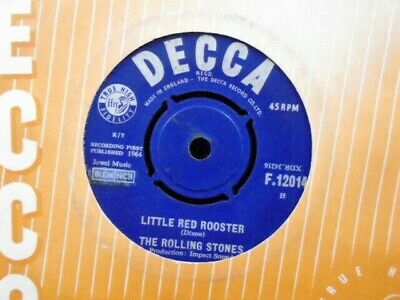
Little Red Rooster, by The Rolling Stones (their 2nd of eight #1s)
1 week, from 3rd – 10th December 1964
It feels like the Stones’ arrival, earlier this year, passed us by. ‘It’s All Over Now’ sneaked a week at the top in the summer, but surrounded as it was by some colossal pop tunes from some legendary acts I had basically forgotten about it. The first Stones #1 should have been a bigger thing, I feel. So, they’re back. And this time they’re making sure we notice them.
Their tactic? To return with a song so unlike any of the one hundred and eighty-one previous chart-toppers that you instantly sit up and start listening. A slow, woozy blues riff comes along, reeling you in, lulling you into a vision of sipping ice-tea on a farmhouse veranda, before Mick Jagger’s languorous vocals… I am the little red rooster, Too lazy to crow for days…I am the little red rooster, Too lazy to crow for days… It’s an atmospheric song – the dusty, heat-hazed farmyard unfolds before your very eyes. Dogs begin to bark, And hounds begin to howl… All the while the hypnotic, twelve-bar blues riff continues to drag you along. Watch out strange cat people, Little red rooster’s on the prowl…
1964 has been a year, by and large, of peerless pop. But this is no pop song, not by any stretch of the imagination. There are no verses, or chorus, or bubble-gum bridge here. This is low-down and dirty blues. It’s like the band pressed record on a jamming session, a warm-up before recording the actual single, and decided to release it instead. I’m listening to it on repeat as I write this, and it’s very easy to miss when the song starts over. It could be three minutes long; or thirty minutes.
While the lyrics might sound like the Mick Jagger manifesto – I am the little red rooster… Keep everything in the farmyard upset in every way… – one that he’s been following for the best part of sixty years, the real star here is Brain Jones and his slide guitar. The main rhythm is acoustic, but Jones’s electric guitar flirts, and slinks, and playfully cavorts around every line. One minute it’s making the sound of dogs barking, then horses rearing, then it’s the little red rooster itself. Jones was blues through and through, and felt some discomfort at the band ‘selling out’ and becoming a pop group. As the sixties progressed and the Stones moved further and further away from their bluesy roots, he became a marginalised figure on the edge of the band, until his tragic death. Looking back, it’s easy to forget that he was as much a part of the original Stones as Jagger and Richards. This record is perhaps his finest hour, and a kind of vindication. He had managed to get a full-on blues song to #1 in the British charts – the only time that has ever happened.
‘Little Red Rooster’ had originally been recorded by Howlin’ Wolf, one of the Stones’ biggest early influences, in 1961. But it’s a folk song at heart, handed down through the mists of time, probably from well back in the 1800s. His version is very raw, while another version by Sam Cooke is much more polished, with a snazzy organ doing the work of Brian Jones’s slide guitar. In those earlier versions the singer has a little red rooster, rather than being the little red rooster – which brings to mind some saucy connotations. I’m surprised Mick and the lads changed it…
Understandably, the band’s management was against releasing this as a single. It doesn’t exactly scream ‘#1 smash hit’. But it was. And I feel that this, along with all their earliest singles, have been somewhat erased from The Rolling Stones canon. For years I thought – according to the greatest hits CDs I had – that their career began with ‘Time Is On My Side’. But now I know. And while I would never name ‘Little Red Rooster’ as one of my favourite Stones songs, I am truly glad that they took this slice of Delta blues to the top of the charts for a cold and drizzly December’s week.
These latest thirty #1 records represent perhaps the richest vein of pop music ever to have been hit upon in this country. Much of 1961 and ’62 was spent drilling different holes – occasionally coming up with a beauty (The Tornados); largely hitting a lot of bland MOR (Cliff, Frank Ifield.) But one day, in April 1963, the motherlode was discovered. Merseybeat.
This is the Merseybeat recap. The most homogenous sounding bunch of chart-toppers we are ever likely to meet. Young guys with guitars singing perky songs about falling in love, holding hands and getting into something good. It started with a triple whammy – a call to kids across the land – as Gerry & The Pacemakers and The Beatles arrived at the top of the charts. The Searchers, Billy J. Kramer, The Tremeloes and The Dave Clark Five all soon followed. That stretch, from April ’63 through to the summer of ’64 is probably the most consistent sounding year in UK chart history, one beat-pop number followed by another, with few exceptions and very few duds.
It’s definitely the strongest bunch of #1s yet, and it’s been very hard to pick which ones are merely great and which ones are utterly transcendent. Classics like ‘From Me to You’, ‘I Like It’, ‘Glad All Over’, ‘Do Wah Diddy Diddy’, ‘Have I the Right?’ and ‘I’m Into Something Good’ – which might have made the ‘Best Of’ at any other time – will have to just get left by the wayside. Whole chart-topping careers, those of Billy J., The Searchers, The Pacemakers and Cilla Black, have come and gone in a blink of an eye. For so long we plodded through mediocrity; now we wish things could slow down a little.
Of course, nothing that good can last forever, but I was surprised by how quickly the Merseybeat wave came, conquered and then receded. By July 1964, a harder sound had arrived at the top courtesy of The Animals and The Rolling Stones (Yes, we met the Stones for the first time! What should have been a headline becomes a footnote thanks to the brilliance of those around them.) Beat pop has slowly started to fragment in recent months, into full on rock (‘You Really Got Me’), rhythm and blues (‘It’s All Over Now’), experimental electro pop (‘Have I the Right?’) and easy-listening with a hint-of-Beat (‘(There’s) Always Something There to Remind Me’.)
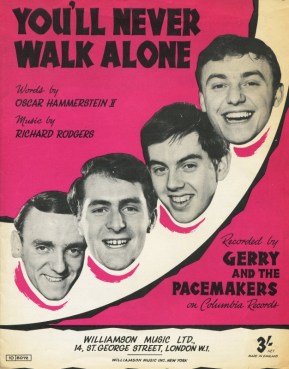
Out of the last thirty-one #1s, I can count only seven outliers. Seven discs that haven’t fit the Beat-pop/rock bill. Cilla’s two proto-power ballads, the best of which was ‘You’re My World’, The Pacemaker’s weird showtune swansong ‘You’ll Never Walk Alone’, a couple of leftovers from the previous era in Elvis’s ‘(You’re the) Devil in Disguise’ and Frank Ifield’s final, and most pleasing, #1 ‘Confessin’ (That I Love You)’. And, of course, the return of Roy Orbison. The Roynaissance. ‘Oh, Pretty Woman’ was the sound of him meeting the Beat-revolution halfway; but his earlier comeback #1, the dramatic and operatic ‘It’s Over’, sounded completely out of place, and all the better for it.
Which leads me to the latest ‘WTAF’ Award, and a truly tough decision. Do I award it to The Big O, for ‘It’s Over’, or to Gerry & The Pacemakers for the bizarre, and perhaps fatal, decision to record a version of ‘You’ll Never Walk Alone’? I’m going to edge towards The Pacemakers – ‘It’s Over’ merely sounds out of place thanks to its surroundings; in the career of Roy Orbison it makes complete sense. Whereas I’m not sure anyone saw ‘YNWA’ coming. Still, it probably gets played ten times more these days than ‘I Like It’, and it means Gerry and the lads get a nice windfall any time Liverpool win a big match.
Choosing a record to crown as both ‘Meh’ and the Very Worst Chart-Topper is also a tough decision. There simply haven’t been enough terrible records to go around. It’s basically a straight shootout between The Bachelors ‘Diane’ and The Four Pennies ‘Juliet’. Two landfill Merseybeat records, cashing in on the day’s signature sound to make bland MOR; two records named after girls. I’ll give the ‘Meh’ Award to ‘Juliet’ and the Very Worst Chart-Topper to ‘Diane’, as The Four Pennies were merely boring, while I feel there was something sinister in The Bachelors perverting Merseybeat into a record for grannies. Like when Pat Boone released his metal-covers record, or when Tom Jones did Prince…
Before we settle what was the best of the best, one thing that did surprise me as I covered the past thirty-one chart-topping discs was that only three of them were recorded by Americans. Roy Orbison, of course, and one Elvis Presley, who you may remember from previous recaps. Back in my first recap, during the pre-rock days, I commented on how few British acts there seemed to be, and how the big US stars of the day – Kay Starr, Perry Como, Eddie Fisher et al – were bringing the glamour to bombed-out, over-rationed Blighty. Well, ten years on and much has changed. The Brits are the cool ones – it was they who were invading the Billboard Hot 100 across the Atlantic. Except, they were doing so with American-written songs. All The Searchers’ #1s were originally recorded by US vocal groups. Cilla and Sandie Shaw hit big with Bacharach and David numbers. ‘Do You Love Me?’ was a Motown number, while ‘I’m Into Something Good’ was written by Goffin and King. An interesting footnote to the British Invasion.
To the crème de la crème, then… The 6thVery Best Chart-Topper award. I’ve narrowed it down to a top five. ‘How Do You Do It?’, by Gerry and the P’s, for kicking this whole shebang off. Then The Animals, for announcing the end of Merseybeat a year later with the deep-throated, bluesy ‘The House of the Rising Sun’. They’re joint fourth. 3rd place goes to ‘You Really Got Me’ – in which the Kinks invented garage rock, power-pop and, oh yes, heavy metal – and generally grabbed us all by the bollocks and kicked us up the arse. Runner-up goes to the sublime ‘Needles and Pins’ by The Searchers – a moment of sad-pop melancholy in amongst the frenzy. I really wish I could argue a case for this being the very best but… I can’t. Not when The Fab Four are looking on.
Yes, five of the past bunch of chart-toppers were by The Beatles, with a further two written and donated to other acts by Lennon & McCartney. All of which were good-to-great #1s. (Sorry to disappoint, but I won’t have too many bad words to say about any of their seventeen chart-toppers.) One though, stands out above the rest. The one hundred and fifty seventh UK chart-topper, and the moment the world realised that they were in on something spectacular: ‘She Loves You’. Yeah, yeah… Yeah!
The ‘WTAF’ Award for Being Interesting if Nothing Else: 1. ‘I See the Moon’, by The Stargazers. 2. ‘Lay Down Your Arms’, by Anne Shelton. 3. ‘Hoots Mon’, by Lord Rockingham’s XI. 4. ‘You’re Driving Me Crazy’, by The Temperance Seven. 5. ‘Nut Rocker’, by B. Bumble & The Stingers. 6. ‘You’ll Never Walk Alone’, by Gerry & The Pacemakers.
The next thirty will take us from the tail-end of 1964 through to early ’66, and I doubt there will be anything like as clear and definable a ‘sound’ to the coming months. Popular music will continue to fragment. Starting with a brand new first at the top of the UK charts. It’s Motown, baby!
Lock up your daughters, the headlines screamed. It’s The Rolling Stones! And with a discordant, clanging intro – an intro that strongly hints at this being a band about to get up to no good – here they are.
It’s All Over Now, by The Rolling Stones (their 1st of eight #1s)
1 week, from 16th – 23rd July 1964
Once the intro is out of the way, the song settles down into a jaunty, chugging rhythm. There’s a natty little bassline and jazzy drum-fills. In my previous post I billboarded this as Pt. II of the Great British Blues Invasion, following on from ‘The House of The Rising Sun’. But ‘It’s All Over Now’ sounds a little lightweight compared to The Animals’ record – a song that could have rattled the gates of hell. Anything would feel lightweight after that, to be fair.
Well baby used to stay out, All night long, She made me cry, She done me wrong… Lyrically this #1 follows a well-trodden path – the brave-face-on-a-break-up theme we’ve heard in discs like ‘That’ll Be the Day’, ‘Who’s Sorry Now’ and ‘Needles and Pins’ to name but a few. Except this is The Stones, authors of feminist anthems like ‘Heart of Stone’ and ‘Under My Thumb’, and so the barbs are aimed a little lower and hit a little harder than those fired by, say, The Searchers.
Well, She used to run around, With every man in town, Spending all my money… At this point we arrive at a momentous occasion in our countdown – the first genuine swear word!… Playing her half-assed game. (I know it’s nothing shocking in this day and age, but I bet the BBC weren’t playing it at the time.) She put me out, It was a pity how I cried, Tables turn and now, Her turn to cry…
It’s a slightly sloppily written song: note the ‘cried’ being rhymed with ‘cry’, while the line about ‘every man in town’ is also recycled in the final verse. It wasn’t originally a Stones song either, as it had been released, in the US at least, in a much more soulful, funkier version by Bobby Womack & The Valentinos. In this sense, then, it is a Stones song – the ominous, passive-aggressive, arrogance of this version is all them. It’s a song with swagger. The Stones were here, with added swearing and no time for heartache.
We reach the solo – a manic, disjointed effort from Brian Jones which I don’t think would win any technical awards but which sums up the early-Stones perfectly. This and the solo from Elvis’s ‘Devil in Disguise’ were the two solos I wanted to learn guitar in order to play, aged sixteen. (I still haven’t got round to it…) Mick Jagger squawks and squeals in the background, in a manner we just haven’t heard over the past hundred and seventy two #1s. Then we fade to black with the same clanging chords from the intro, but only after Jagger has promised that he won’t be taken for that same old clown. Because he used to love her; but it’s all over now.
There we have it. Two debut number ones. Both of which managed only a solitary week at the top of the UK singles charts; but both of which changed the direction of British pop as we know it. The bad boys were on top! Listen to ‘It’s All Over Now’ and then ‘I Like It’ by Gerry and The Pacemakers and tell me who you think would win in a fight… One thing’s for sure – pop music was evolving at an astonishing rate in the mid-sixties and we can now safely declare that – barely a year after it broke through – Merseybeat is dead, trampled under Jagger, Richards, Jones and co’s wedge-heeled brogues.










 The UK Number Ones Blog