Yee-hah! Break out the moonshine, we’re off down the Bayou for a rowdy rock ‘n’ roll shindig with CCR!
Bad Moon Rising, by Creedence Clearwater Revival (their 1st and only #1)
3 weeks, from 14th September – 5th October 1969
I love me some Creedence. And I love that they are the unlikely owners of a UK #1 single. Perhaps the most American band ever; that didn’t hold them back from hitting it big on the other side of the Atlantic. And while it does feel a bit odd that CCR was able to top the charts here; it does make sense that they’d do so with what’s probably their catchiest single.
Catchy, but also terrifying. Zager and Evans kicked us off down an apocalyptic path with our last #1, ‘In the Year 2525’, and John Fogerty and co. keep it up here. I see a bad moon rising, I see trouble on the way, I see earthquakes and lightning, I see bad time today… Something terrible is on its way… Rivers are overflowing, hurricanes are a-blowing. This song has possibly the biggest contrast between melody and lyrics of any chart-topping single. The tune: rough and ready rockabilly. The lyrics: Don’t go round tonight, It’s bound to take your life… There’s a bad moon on the rise…
It’s a short and sweet record, one that breezes in and out in just over two minutes. Apparently it was inspired by a scene involving a hurricane in an old movie, but Fogerty also claims to have written it on the day that Richard Nixon was elected president. For a decade that has been so swinging, so iconic, we’re heading for a sour and cynical finish. Maybe we have to look beyond the charts for the answer here –this is a product of a world where a whole generation of Americans were dying in Vietnam, men were landing on the moon, and Kennedys were getting shot…
By the final verse, things are getting very intense. Hope you’ve got your things together, Hope you are quite prepared to die… It’s all a bit much, and then we crash to an end. We open our eyes and breathe a sigh of relief that we’re all still here. The end hasn’t arrived, yet… Over and out from Creedence Clearwater Revival. Sadly this is their only #1 single, though we should just be glad that they managed even one. In their home country, they had far more hit singles – ‘Proud Mary, ‘Green River’, ‘Travellin’ Band’, ‘Lookin’ Out My Back Door’ and this record all hit #2 in 1969 / 70. Yet a Billboard #1 eluded them…
I love this track, in all its swamp rocking, apocalyptic glory. But, if you do find it all a bit much, a bit depressing, you can just do what John Fogerty does occasionally in concert: change the words of the chorus to There’s a bathroom on the right…
If the world were ending, you could do a lot worse than soundtracking it with this playlist:
You see the title of this next #1 hit, and you prepare yourself for something special. We’re off to the year 2525… With a duo that sound like a second-rate magic act.
In the Year 2525 (Exordium and Terminus), by Zager and Evans (their 1st and only #1)
3 weeks, from 24th August – 14th September 1969
It gets underway with a Spanish guitar and Mariachi-band backing. It reminds me of Dave Dee and Co’s ‘The Legend of Xanadu’, another Latin-flavoured glimpse into a strange world. In the year 2525, If man is still alive, If woman can survive, They may find…
In comes a relentless galloping beat, over which a terrifying vision of the future is unveiled. By the year 3535, you’ll be taking pills to tell you what to think, by 4545 you won’t need your teeth or your eyes… You won’t find a thing to chew, Nobody’s gonna look at you… In 5555, the machines will have taken all the jobs, rendering our limbs obsolete. And by 6565: Ain’t gonna need no husband, Won’t need no wife… You’ll pick your son, Pick your daughter too, From the bottom of a long glass tube… Woah-woah…
Fair to say it’s a pretty pessimistic view of the future. It has the air of a crazed evangelist, preaching angrily from his pulpit, as all the while the beat goes on, and on. The predictions change to years ending in ten, for rhyming purposes, as we go forward. And by 8510, God will have had enough, and will come down to rip it all up and start again. It’s a crazy record. I’m not sure I like it all that much, but it is entertaining…
The final verse is probably the most prescient. In the year 9595, I’m kinda wonderin’, If man is gonna be alive, He’s taken everything this old earth can give, And he ain’t put back nothin’… Woah-woah… Doesn’t that pretty much sum up the fears of 2020, with our rising temperatures, killer viruses and plastic-swilling oceans? In fact, Zager & Evans’ vision of the future hinges on its opening line: If man is still alive… Who here’s willing to put money on humans being around in 2125, let alone 2525?
We’re used to science fiction that looks into the near-future: ‘Back to the Future’ in 2015, ‘Terminator’ in 2029 and so on, so that we can chuckle when we reach the date in question and point out that none of what was predicted has come to pass. But who can actually get their head around the year 2525? It’s five hundred and five years away! And the year 9595, on which the song ends – it is practically impossible for the human mind to imagine that far forward in time. ‘In the Year 2525’ was nominated for a ‘Hugo Award’, for the best science fiction / fantasy works of the year, though, so who am I to question it?
Denny Zager and Rick Evans were a duo from Lincoln, Nebraska, and they are the purest of one-hit wonders. None of their subsequent follow-ups made the charts. This is their sole chart-topping single, on either side of the Atlantic (fittingly, it was #1 in the US as Neil Armstrong set foot on the moon.) Zager is still alive, but Evans sadly passed-away in 2018.
We’re drawing to the end of the 1960s, and this record is almost the direct antithesis of a lot of the positivity we’ve seen in pop music throughout the decade. In fact, 1969 has been a year for some pretty cynical chart-toppers: Peter Sarstedt’s cutting ‘Where Do You Go To…’, The Beatles sarcastic ‘Ballad of John and Yoko’, The Move’s melodramatic break-up in ‘Blackberry Way’. Now this anti-flower power anthem. Two years ago it was ‘All You Need Is Love’; now it’s all the ways in which we, as a race, are doomed…
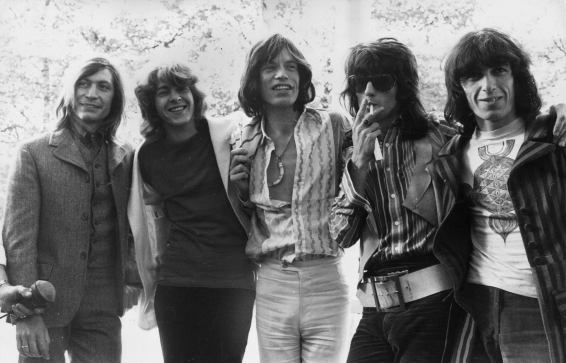
A few weeks after bidding The Beatles farewell, we’ve now reached the end of The Rolling Stones’ chart-topping career.
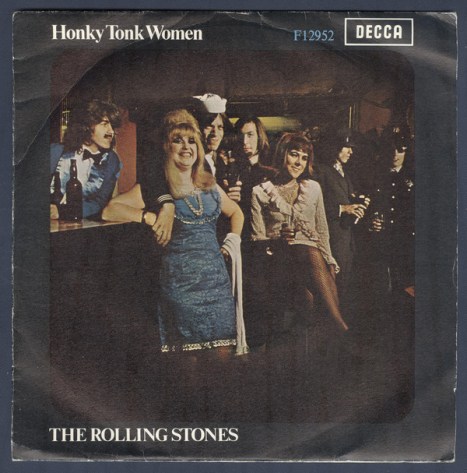
Honky Tonk Women, by The Rolling Stones (their 8th and final #1)
5 weeks, from 23rd July – 24th August 1969
But, while The Fab Four bowed out with a not-very-Beatles-sounding #1, The Stones wrap things up by doing what they do best – some low-down, dirty rhythm and blues. It starts with a cow-bell, Charlie’s drums, some filthy guitar licks, and Mick’s drawl: I met a gin-soaked bar-room queen in Memphis… (was there ever a more Stonesy opening line than that?) She tried to take me upstairs for a ride…
In my post on their last #1, I wrote that ‘Jumpin’ Jack Flash’ was a new leaf for The Stones, in that they gave up on their attempts at flower-power and psychedelica, and returned to straight-up rock ‘n’ roll. ‘Honky Tonk Women’, then, is a consolidation of that. It sets the template for the next fifty years of the band, through the twin glories of ‘Sticky Fingers’ and ‘Exile on Main St’, through to them becoming the biggest stadium fillers the world has ever seen.
It’s also, basically, Mick Jagger listing women that he’s shagged. The bar-room queen is followed by a divorcee in New York City, and the outrageous She blew my nose and then she blew my mind… line. Goodness. It’s the ho-o-o-onky tonk women, Gimme, gimme, gimme the honky tonk blues… It’s always easy to forget that Mick and Keith were from Dartford, Kent and not Tennessee or Alabama, such is the Americana that fills some of their biggest hits.
There is an elephant in the room, though. This is the first Stones’ single not to feature founding member Brian Jones, whose slow and acrimonious departure from the band had been confirmed earlier in the year. He was found dead in his swimming pool just three weeks before ‘Honky Tonk Women’ hit #1. A blues purist; we can but wonder if this song would have sounded different with him playing on it.
Who knows? As it stands we get a sax solo, and a punch the air Woooo! at the very end. It must have been a fun song to write, to record, and to perform every night for the past half-century. I love it. A pure, unadulterated blast of rock ‘n’ roll. You can hear the seventies hits-to-come buried in it – the likes of ‘Brown Sugar’, ‘Tumbling Dice’, ‘It’s Only Rock ‘n’ Roll’ and the like, right through to ‘Start Me Up’. Unfortunately, none of those records will reach top spot in the UK. The Rolling Stones bow out on eight.
Impressively, their final chart-topper gave them their longest run at number one. Quite unusual, that. Though the particularly eagle-eyed among you will notice that 23rd July to 24th August isn’t quite the five-weeks advertised. This is due to the chart publication dates, and collation methods, changing in the midst of ‘Honky Tonk Women’s’ run.
Farewell to The Rolling Stones, then. Without them and The Beatles around to hit #1 every few weeks it leaves a lot of room for some new guys to come along and dominate. The Stones would slowly fade into obscurity as their chart-topping days receded into the distance… Only joking! They remain a going concern – give or take a few changes in line-up – well into their seventies, while Keith Richards’ continued existence remains one of life’s great mysteries… Their most recent album ‘Blue and Lonesome’, even hit #1 in the UK in 2016.
I’ll maybe do a Stones Top 10 soon, covering all their UK singles, but just for fun here’s my ranking of their eight British chart-toppers – based completely on personal preference – from ‘worst’ to best. *Clears throat*:
The first number one of the post-Beatles era. One of those songs where you press play and go ah yes… I know this…
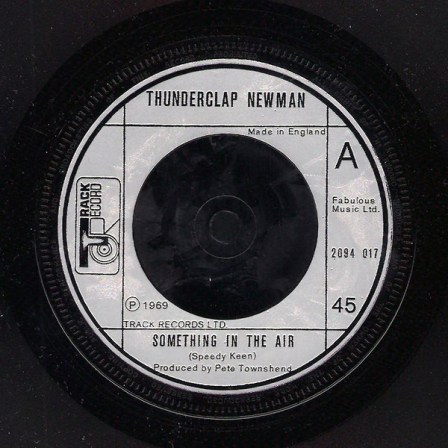
Something in the Air, by Thunderclap Newman (their 1st and only #1)
3 weeks, from 2nd – 23rd July 1969
It was in an advert for something, I realise, midway through the first listen, and it is prefect background-music-for-an-advert. Light, floaty, chords forever heading upwards… A positive sounding song. The lyrics are forward-facing too – There’s something in the air – a change is a-coming. We have got to get it together, now… They are very sixties-ish lyrics. The revolution’s here… You know it’s right… They sound more like a bunch of slogans strung together than an actual song. A gentle clarion call for young, liberal types. Hippies, but with sensible shoes.
I called it the start of the post-Beatles era, but the Fab Four’s influence is here in this record. In my last post, I mentioned all the times that a Beatle will top the charts solo. I should also have mentioned all the acts that will top the charts by channelling The Beatles’ sound. And here one is – straight away.
Midway through, and I’m starting to get a bit bored. It’s fine, it’s nice, it’s a bit bland. Thank God, then, for the demented piano solo that comes along out of nowhere, all jazzy and jarring. Like someone doing the Charleston on acid. Why? I don’t know. But it saves this record from slipping into slightly dull and forgettable territory.
Normal service is resumed for the final verse, as the revolutionary fervour is upped. Hand out the arms and ammo, We’re gonna blast our way through here… It’s a deceptively angry song. I just wish it had a little more oomph to it. (In keeping with the theme of ‘revolution’, the song apparently has a snippet of ‘La Marseillaise’ towards the end, though I can’t hear it.)
And, after a bit of research, I can confirm that ‘Something in the Air’ has been used to advertise British Airways, Austin Minis, Coca-Cola and mobile phones. It’s clearly a song that lends itself well to advertisements – make up your own mind as to whether or not this is a good thing.
Thunderclap Newman, which is a great name for a band to be fair, were the brain-child of The Who’s Pete Townshend, and he actually plays bass on this single, which is as close as a member of The Who is going to get to a #1 single, sadly. Andy ‘Thunderclap’ Newman was the man who pulled out the brilliant piano solo. Their guitarist, Jimmy McCulloch, was only fifteen when they recorded their sole chart-topper, making him a de facto member of the Youngest Chart-Toppers club. He would go on to join Wings. Which means that, in wrapping up the 1st post-Beatles chart-topper, I’ve managed to end with another Beatles reference. There really is no escaping them…
Well then. For one last time, for the 17th time in just over six years, for the 67th, 68th and 69th weeks in total… The Beatles top the UK singles chart.
The Ballad of John and Yoko, by The Beatles (their 17th and final #1)
3 weeks, from 11th June – 2nd July 1969
Coming so hot on the heels of ‘Get Back’ – only 1 week of Tommy Roe splits them – ‘The Ballad of John and Yoko’ sounds like an off-cut from the same recording session. It’s a bit rough and ready, there are the same squiggly guitars that we heard on ‘Get Back’, the same country-rock feel… Famously it features only John and Paul, no George or Ringo. I know it didn’t happen like this, but I do like to imagine the pair – the most famous song writing partners in British rock history – waiting behind after all the others had gone home for the day, putting their ever-growing differences aside and recording one last smash hit in a semi-lit studio.
As the title suggests, this is the story of John and his new wife Yoko, and the story of their marriage. They tried to get married in Paris, managed to do it in Gibraltar, and honeymooned in Amsterdam, in the face of some stiff opposition. All told over a simple riff, with Lennon’s vocals growing ever angrier as the verses rattle on.
I get about half the references… Drove from Paris to the Amsterdam Hilton, Talkin’ in our beds for a week… = the pair’s ‘Bed-In’ against the Vietnam War. The newspapers said, She’s gone to his head, They look just like two gurus in drag… = Lennon’s feelings of victimisation around his divorce and his new, foreign wife. The way things are goin’, They’re gonna crucify me… A cheeky reference to Lennon’s remarks from a few years earlier, about The Beatles being bigger than Jesus.
Other references are more obscure. The trip to Vienna, eatingchocolate cake in a bag is a reference to their ‘bagism’ phase, where they wore bags over their heads in a statement against racial prejudice (everyone looks the same in a bag, right?) The fifty acorns tied in a sack? That took some digging, but is apparently about a pair of acorn trees that John and Yoko planted in the grounds of Coventry Cathedral.
And then there’s the blasphemy. The Christ! that kicks off every chorus – I always enjoyed shouting it out in the car as a kid – with the final one being particularly venomous. Perhaps predictably, this caused a big kerfuffle in the States, with several radio stations at best bleeping the word out or, at worst, refusing to play the record at all. The BBC avoided it, too. 1969 is truly becoming the year in which swearing makes it to the top of the charts, after Peter Sarstedt’s ‘damn’ in ‘Where Do You Go To…’ Meanwhile, in Spain, ‘The Ballad of John and Yoko’ caused controversy not because of the Christ!s but because of the references to Gibraltar being ‘near’ Spain. As far as Franco was concerned, Gibraltar was very much part of Spain, muchasgracias…
Is it slightly disappointing that this song is the final Beatle’s record we get to hear in this countdown? Before writing, I would have said yes; but the more I listen and the more I find out about this record, I’m not so sure. It’s John at his spikiest, it’s Lennon and McCartney reunited, it’s quite funny in places… Sure it doesn’t sound much like The Beatles, but what Beatles #1 since 1966 has? Plus, the riff that closes out ‘The Ballad of John and Yoko’, the final notes of their final number one, is lifted from an old rock ‘n’ roll number, ‘Lonesome Tears in My Eyes’, by Johnny Burnette, which The Beatles, or The Quarrymen, used to play way back in the early days. Which is lovely.
I was going to rank all The Beatles 17 #1s in order of preference, but to be honest I can’t face it. I’d need a spare half-day to decide… Of course, this isn’t their final hit single. ‘Come Together’, ‘Something’, ‘Let It Be’ and ‘The Long and Winding Road’ are all still to come. Abbey Road hasn’t been released yet. But, the limitations of this blog are clear: if it doesn’t get to #1 then it doesn’t get a look-in.
And, of course, John, Paul and George will pop up many, many more times in this countdown as solo stars, as part of new bands, in re-releases and in amongst charity singles, well into the 2000s. There is only one man we need to bid farewell to here, then. Ringo. He will go on to achieve great things without bothering over the trifling business of topping the pop charts; namely narrating ‘Thomas the Tank Engine’, and becoming the most influential voice of my pre-school days… (apologies to my parents.)
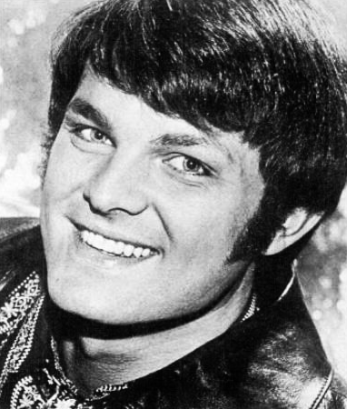
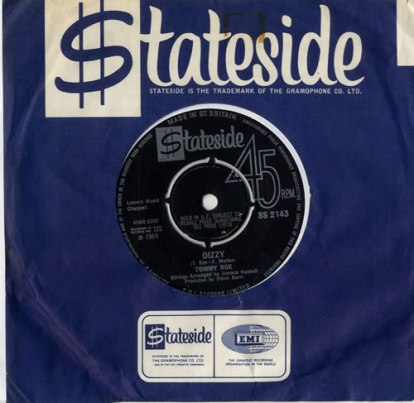
Into the next thirty #1s, with perhaps the most ‘sixties’ sounding chart-topper that we’ve come across yet. It’s pure swinging-sixties montage music, a pop song that you would use in between scenes in an Austin Powers movie. You can see swirling lava-lamp colours, and mini-skirted girls jiving. Yeah baby!
Dizzy, by Tommy Roe (his 1st and only #1)
1 week, from 4th – 11th June 1969
It’s a song that just about manages to stay on the right side of ‘cool’, rather than ‘cheesy.’ And considering that this is a song that uses terms like ‘fellas’ and ‘sweet pet’ in its lyrics, that’s a pretty impressive feat. It’s catchy, that’s for sure, and the drums are real swingin’. The strings too, have a kind of tongue-in-cheek drama to them. Plus, I keep losing count of how many key changes are crammed into its three minute run-time.
The title itself is also very sixties. ‘Dizzy’, because he’s in love, man. You’re makin’ me dizzy, My head is spinnin’, Like a whirlpool it never ends… I’d say it’s a chorus that’s entered the common tongue – though whether that’s down to this original or the comedy version that will take it back to the top of the charts in twenty years’ time I don’t know.
I prefer the pre-chorus, though – one that builds up an irresistible head of steam: Girl you’ve got control of me, Cos I’m so dizzy I can’t see, I need to call a doctor for some help… I like it. A nice palate-cleanser of a disc. A short, sweet blast of late-sixties goodness.
Tommy Roe’s story is quite interesting. ‘Dizzy’ was a huge comeback for a singer who had failed to have a chart hit of any kind in the UK since 1962-63, when he had had big success with the Buddy Holly influenced ‘Sheila’ – a US #1. Considering the massive changes in popular music that have happened in the past seven years, this was a pretty impressive feat. Not that the comeback lasted very long… One #24 follow-up single and that was that.
Still, it might go some way to explaining the winning combination of bubble-gum and mild psychedelica that makes ‘Dizzy’ such a funky pop tune. One foot in the past, one very much in the present. Tommy Roe continued to record and tour throughout the seventies and eighties, before announcing his retirement officially in 2018, aged seventy-five.
Time for a Top 10! When you think of British beat bands from the 1960s – AKA ‘British Invasion’ bands in the US – you think The Beatles, yup, then The Stones, okay, then…
Who were the 3rd biggest band of the decade? So many beat combos rose and fell during that time – The Searchers, Manfred Mann, The Tremeloes, The Hollies, the list goes on – but I’d stick my neck out and say that in the bronze medal position stand The Kinks. (There is also, of course, The Who, but they never made #1 in the UK, and so I have to pretend they never existed.)
And because of publishing rights preventing huge sixties acts like Elvis, The Beatles and The Stones from appearing on the ’60s compilations that my parents owned, The Kinks were probably the first band I truly remember being aware of, and thinking this sounds good… (Well, them and The Spice Girls…)
Led by brothers Ray and Dave Davies, The Kinks gave us some of the best pop singles, not just of the decade but, let’s be honest, of all time. And they changed and experimented like the two bigger bands of the time, in their own, unique, Kinks-y way. Here’s my Top 10. (As before, to qualify for my list a song has to have been a chart hit in the UK – no album tracks or B-sides allowed…)
10. ‘See My Friends’, 1965, reached # 10
One of their smaller, early hits, in which their trademark crunchy guitar is twinned with a droney, sitar-sounding vibe. Released a few months after ‘Ticket to Ride’, and before ‘Norwegian Wood’, it puts The Kinks right at the forefront of pop’s sonic expansion. Not a sound they would keep up for long, but proof that they were a very versatile band.
9. ‘Come Dancing’, 1982, reached #12
The Kinks released music throughout the seventies and eighties and I really tried to include more of their later singles in this list… but, to be honest, most of them just aren’t as good as their big sixties hits. With some exceptions… This slice of nostalgia, for example, – a tale of the Davies’s sister going out dancing to the ‘Pally on a Saturday night. Years later I realised that, even though he sings about his sister in the present tense – If I asked her, I wonder if she would… Come dancing… – she had in fact died when they were young boys. Which gives this swansong hit an even more bittersweet edge.
8. ‘You Really Got Me’, 1964, reached #1
A sledgehammer riff, that many have claimed invented heavy metal, punk rock and more. The band’s 3rd single and first hit, it still sounds raw and wild in 2020, and must have sounded even more wonderful at the time. Read my original post here.
7. ‘Autumn Almanac’, 1967, reached #3
One that I used to dislike, but have really grown to love in recent years… I like my football, On a Saturday, Roast beef on Sundays, All right… While many bands went psychedelic in 1967, the Kinks were singing about toasted currant buns and going to Blackpool for their holidays… And the fuzzy guitar before the chorus? Great stuff.
6. ‘Dead End Street’, 1966, reached #5
But The Kinks could also be very cynical in their takes on British society, discs like ‘Dead End Street’ the yin to ‘Autumn Almanac’s yang. There’s a crack up in the ceiling, And the kitchen sink is leaking… while the music hall pianos play. Apparently it was banned by the BBC for being too biting! You can hear the debt bands like Blur would owe to The Kinks thirty years later, too…
5. ‘Lola’, 1970, reached #2
One of their last big hits. A man falls for a ‘lady’ who walks like a woman but talks like man… It attracted some controversy at the time, and still does today. But any song with a line like Girls will be boys, And boys will be girls, It’s a mixed up muddled up shook up world, Except for Lola… is all right by me. Live your life, love who you love… Fun fact: I once performed this song live to a school-hall full of bemused looking Thai children.
4. ‘Dedicated Follower of Fashion’, 1966, reached #4
The first Kinks’ song I loved, and it’s probably higher in the list than it should be if I weren’t being so subjective. A simply skiffle riff and Ray’s arched-eyebrow, high-camp delivery. More social commentary, aimed light-heartedly at the dapper men about town in the swinging sixties. Their clothes were loud, but never square…
3. ‘All Day and All Of the Night’, 1964, reached #2
The Kinks’ second big hit single, and very much an ‘if it ain’t broke’ approach to songwriting. It sounds like ‘You Really Got Me’ Pt II, and turns the crunchy, proto-punk power chords up a notch, which is why I’m placing it higher. As a kid I loved the Oh, come on! and what sounds like someone being strangled before the frenetic solo. Imagine how thrilling / terrifying this must have sounded if you were first hearing it in October ’64.
2. ‘Sunny Afternoon’, 1966, reached #1
A song that perhaps doesn’t get the recognition it deserves in the Sixties Hall of Fame, maybe because it’s got a pantomime-y edge. Another social commentary, this time in the character of an aristocrat being squeezed by the taxman and a ‘big fat mama’, which is no way to talk about your ex-wife, really. Perfect pop. (And singing it in the snow above seems a very Kinksy thing to do.) Read my original post on this chart-topper here.
1. ‘Waterloo Sunset’, 1967, reached #2
Could it be any other? ‘Waterloo Sunset’ has a Liverpool-like lead at the top of this table. It’s atmospheric, it’s beautiful, it’s haunting. A hymn to those that observe. And somehow it manages to sound like a sunset. When I first visited London, aged eight or so, I remember looking out of my window, hoping to see a Waterloo Sunset, hoping to see Terry and Judy. Sounds ridiculous, but it shows how long this song has been part of my life. At the time, it was kept off the top-spot by the bland ‘Silence Is Golden’. An absolute crime!
I’ll do another Top 10 soon enough. Up next, the 271st UK #1 single…
Well, phew, we made it through the craziest run of number one singles yet. Time to pause and get our breath back.
The last 30 took us from the very end of 1967 through to the early summer of ’69. Through 1968, the most eclectic year for number one singles ever, I’m guessing. That’s the thing with these recaps. Sometimes there’s an overriding theme to them – the rock ‘n’ roll recap, the Merseybeat recap – sometimes there’s not. For recap #9, the very lack of an overriding theme is the theme. The eclectic recap.
Somethings about it are fairly predictable, though. This is a recap bookended by The Beatles’ 13th and 16th number one singles: ‘Hello, Goodbye’ and ‘Get Back’. They have just one more to come… Another theme that brings the last thirty together is length: our chart-toppers are getting longer. Several have gone beyond four minutes, and we broke the five minute barrier on three occasions. Hell, we even went beyond seven minutes on one memorable occasion.
We might as well get straight to it, then. Dishing out the latest WTAF Award for the records that were interesting if nothing else was always going to be a challenge this time around. I can count at least eight discs with a legitimate claim to the throne. Much easier, though, will be choosing the record that gets my ‘Meh’ Award for instant forgettability. Very few of the most recent #1s can be forgotten very quickly at all. I half-thought about ‘(If Paradise Is) Half As Nice’, by Amen Corner, as that didn’t really grab me. Or ‘Mighty Quinn’ by Manfred Mann for not being my cup of tea. ‘Ob-La-Di, Ob-La-Da’, by Marmalade for just being a super basic cover version. But no. One man shone out, duller than the rest. Step forward Des O’Connor, for re-invigorating an easy-listening genre that was so 1967. ‘I Pretend’ is our winner.
In another recap, any of these singles could easily be crowned the most bizarre: Georgie Fame’s ‘The Ballad of Bonnie and Clyde’ for the high body count. ‘Cinderella Rockefella’ for the obscene yodelling. ‘The Legend of Xanadu’, by Dave Dee and Co. for taking us on a journey to… somewhere. ‘The Good, The Bad and The Ugly’, for being a very specific, and by this point two years old, movie score that people kept buying more than any other record for a whole month. Peter Sarstedt’s ‘Where Do You Go To (My Lovely)’ for its tale of a Neapolitan street-child done good. Desmond Dekker’s ‘Israelites’ because I couldn’t understand a word of it. Even ‘Get Back’, with Paul McCartney’s giggles and sweet Loretta Martin’s struggles…
But even amongst that competition, one record stands out. A record that begins by shouting the line: I am the God of hell-fire…! Congratulations to The Crazy World of Arthur Brown, for living up to their name and for being just that little bit crazier than the rest. ‘Fire’, is our winner.
It’s been hard for a definable ‘sound’ to make it through all the noise in recent months. But every so often the ‘sound’ of the late-sixties has popped through. ‘Everlasting Love’, ‘Young Girl’, ‘Mony Mony’ – all seemed to take the best the decade has had to offer – a bit of soul, a dash of Motown, a foundation in Beat pop – to offer a glossy new vision of what’s to come.
Then there’s the newest sound on the block, reggae. Eddy Grant and The Equals previewed it. ‘Ob-La-Di, Ob-La-Da’ mimicked it. Then Desmond Dekker and The Aces finally brought it to the table. ‘Israelites’ was the rawest #1 single in many a year – thrillingly uncompromising. But not, in my opinion, one of the very best…
Before we announce the best, though, let’s drag out and shame the worst. I can’t award ‘I Pretend’ twice, that wouldn’t be fair. (It did stink, though.) So I have in my hands two records. ‘Cinderella Rockefella’, by Abi and Esther Obarim, the first Israelis to hit #1 in the UK, fact fans, and ‘Lily the Pink’, by The Scaffold. Both annoyingly catchy. Both aiming for something that was lost on me. But… Abi and Esther managed to just about stay the right side of interesting. ‘Lily the Pink’ had gotten old by the second verse. The Scaffold are this recap’s Very Worst Chart-Topper. Plus, as a novelty record, at Christmas, I think it might be the reason why novelty records at Christmas are a thing… Teletubbies, Bob the Builder, LadBaby… It’s all on The Scaffold.
In amongst all the fun, some interesting subplots might have passed you by. Cliff got his first #1 in three years with the irrepressible ‘Congratulations’. Louis Armstrong became by far the oldest chart-topping artist, well into his sixties. The Rolling Stones returned with a bang. We bid The Beach Boys farewell and met Fleetwood Mac for the first and, surprisingly, the last time with a song that sounded nothing like Fleetwood Mac.
To the best of the best, then. As I tend to, I have it down to four discs. Tommy James & The Shondells’ ‘Mony Mony’, for simply being a brilliantly fun pop record. ‘Hey Jude’ for being ‘Hey Jude’. Joe Cocker’s ‘With a Little Help From My Friends’ for reinventing the cover version. And Marvin Gaye’s ‘I Heard It Through the Grapevine’, for showing that pop can be grown up, catchy and, most of all, cool.
I thought it was a forgone conclusion. ‘Hey Jude’ is ‘Hey Jude’, and you can feel its influence in rock music, in society as a whole, to this day. In every rock band that records a lighters-up ballad. In Oasis’s most overblown moments. In bands like Coldplay, Embrace, Snow Patrol. In football stadiums. In pubs. Being murdered at karaoke nights. All these reasons have convinced me… to name ‘I Heard It Through the Grapevine’ as our latest Very Best Chart-Topper. Don’t get me wrong, ‘Hey Jude’ is an epic piece of music, but it has a lot to answer for…
To recap the recaps:
The ‘Meh’ Award for Forgettability: 1. ‘Hold My Hand’, by Don Cornell. 2. ‘It’s Almost Tomorrow’, by The Dream Weavers. 3. ‘On the Street Where You Live’, by Vic Damone. 4. ‘Why’, by Anthony Newley. 5. ‘The Next Time’ / ‘Bachelor Boy’, by Cliff Richard & The Shadows. 6. ‘Juliet’, by The Four Pennies. 7. ‘The Carnival Is Over’, by The Seekers. 8. ‘Silence Is Golden’, by The Tremeloes. 9. ‘I Pretend’, by Des O’Connor.
The ‘WTAF’ Award for Being Interesting if Nothing Else: 1. ‘I See the Moon’, by The Stargazers. 2. ‘Lay Down Your Arms’, by Anne Shelton. 3. ‘Hoots Mon’, by Lord Rockingham’s XI. 4. ‘You’re Driving Me Crazy’, by The Temperance Seven. 5. ‘Nut Rocker’, by B. Bumble & The Stingers. 6. ‘You’ll Never Walk Alone’, by Gerry & The Pacemakers. 7. ‘Little Red Rooster’, by The Rolling Stones. 8. ‘Puppet on a String’, by Sandie Shaw. 9. ‘Fire’, by The Crazy World of Arthur Brown.
The Very Worst Chart-Toppers: 1. ‘Cara Mia’, by David Whitfield with Mantovani & His Orchestra. 2. ‘The Man From Laramie’, by Jimmy Young. 3. ‘Roulette’, by Russ Conway. 4. ‘Wooden Heart’, by Elvis Presley. 5. ‘Lovesick Blues’, by Frank Ifield. 6. ‘Diane’, by The Bachelors. 7. ‘The Minute You’re Gone’, by Cliff Richard. 8. ‘Release Me’, by Engelbert Humperdinck. 9. ‘Lily the Pink’, by The Scaffold.
The Very Best Chart-Toppers: 1. ‘Such a Night’, by Johnnie Ray. 2. ‘Cherry Pink and Apple Blossom White’, by Perez ‘Prez’ Prado & His Orchestra. 3. ‘Great Balls of Fire’, by Jerry Lee Lewis. 4. ‘Cathy’s Clown’, by The Everly Brothers. 5. ‘Telstar’, by The Tornadoes. 6. ‘She Loves You’ by The Beatles. 7. ‘(I Can’t Get No) Satisfaction’, by The Rolling Stones. 8. ‘A Whiter Shade of Pale’, by Procol Harum. 9. ‘I Heard It Through the Grapevine’, by Marvin Gaye.
The next thirty #1s will take us well into a bold new decade… ¡Vamos!
P.S. The current Covid-19 situation has meant that I’ve been able to write more posts, and so I’ll aim to publish them a little more regularly! Every cloud… Take care, everyone!
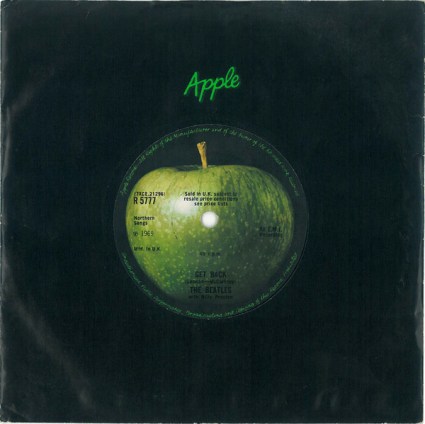
For the penultimate time – shock! horror! – it’s the Fab Four. And this time they bring with them a riff that can only be described as chugging…
Get Back, by The Beatles (their 16th of seventeen #1s) with Billy Preston
6 weeks, from 23rd April – 4th June 1969
The Beatles, since they left the Merseybeat days behind them in 1965, have gone trippy, gone heavy, gone epic. This time they’ve gone country. The guitar licks that shimmer around the main rhythm are pure C & W, while the lyrics take us straight to the wild west. JoJo was a man who thought he was a loner, But he knew it couldn’t last, JoJo left his home in Tucson Arizona, For some California grass… (Drug references! We have drug references in #1 singles, people. What a time to have been alive!)
Alongside JoJo we find sweet Loretta Martin, who thought she was a woman, but she was another man… She, or he, or they, also needs to get back, back to where she once belonged… All the girls around her say she’s got it comin’, But she gets it while she can… Pretty risqué stuff, I’d say, even for 1969. Though perhaps I just have a dirty mind.
Having not listened to it properly in several years, ‘Get Back’ is a much weirder song than I remember. There’s those lyrics for a start, then there are the squeaking noises and Paul McCartney’s very nasal, Kermit the Frog style vocals. There are also lines where he sounds close to laughter. Theories abound as to what the hell it’s actually about, including it being a satire of anti-immigrant views. I like John Lennon’s theory, though, that the get back to where you once belonged refrain was a McCartney dig at Yoko Ono.
Although it’s their sixteenth chart-topper, this record is a Beatles ‘first’ for a couple of reasons. Most importantly, it’s their first and only single to officially feature another musician. Technically this is ‘The Beatles with Billy Preston’, as he contributes the funky keyboard solo – for my money the song’s best bit. It was also the first, and only, Beatles’ #1 to enter the charts in top spot, rather than climb there, which means they finally match Elvis and Cliff’s achievements from the start of the decade.
And, though we may be scraping the barrel here, it’s the only Beatles’ single to feature a spoken-word section. Before the final chorus, the riff tightens and Loretta is urged, once again, to get on home. Your mummy’s waiting for you, Wearin’ her high-heeled shoes and a low-necked sweater… And that’s that. Looking at The Beatles’ post-1965 #1 singles… you can’t claim they ever rested on their laurels. Every one is different, every one a work of art in its own way (even ‘Hello, Goodbye’.)
‘Get Back’ also, significantly, puts The Beatles out clear in the UK #1 singles leaders table. They now sit on sixteen while Elvis, for so long miles out in front, has fifteen. The Shadows are on twelve. Cliff is on nine. The Stones on seven. No other act so far has more than four.
Finally, this is the 4th Beatles chart-topper in a row to have had Paul as the lead writer. Was he carrying them by this point? Or was he just writing the stuff they knew would sell? John will have the final say, though, when he gets the credit for their final #1 single, coming up very, very shortly. And it was he who had the final word when they closed their final ever live performance, from the roof of the Apple studios in January ‘69. ‘Get Back’ was the very last song they played, before the police spoiled the fun, with Lennon thanking their impromptu audience and adding: “I hope we’ve passed the audition.”
Every so often in this countdown – and quite frequently during the fertile late-sixties – we come across a record that sounds like a huge leap forward. This next chart-topper is one such song…
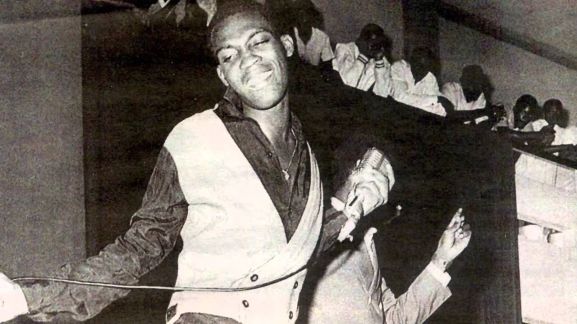
Israelites, by Desmond Dekker & The Aces (their 1st and only #1)
1 week, from 16th – 23rd April 1969
It starts with a chant: Get up in the morning, Slaving for bread… accompanied by some doo-wop harmonising. So that every mouth can be fed… Pretty bleak stuff. Oh-poor, me Israelites… Then in comes a jaunty, bouncy riff. There’s a big contrast here between the lyrics and the tune, but it works.
I have to admit – channelling my dear departed Gran here – that I have no idea what Desmond Dekker is singing for most of this disc. His Jamaican accent is uncompromising. You can picture fathers up and down the land frowning at Top of the Pops. ‘What is this nonsense? It seems that his wife and kids have left him, he has no money, and he may have to turn to a life of crime: I don’t want to end up like Bonnie and Clyde…
The title refers to Rastafarianism, which has its roots in Israel. (I never thought that I’d be getting into theology, but here goes…) Rastafarians were 2nd class citizens in a predominantly Christian Jamaica, and often had to struggle to make ends meet. But, like all the best songs-with-a-message, ‘Israelites’ doesn’t forget to be catchy. It works as well on a basic level, one that you can shake your body to, as it does as a social commentary.
We’ve had a couple of reggae false-starts over the past year. The Equals were reggae-tinted rock. Marmalade aped The Beatles aping reggae – the ‘Desmond with a barrow in the market place’ from ‘Ob-La-Di, Ob-La-Da’ was based on Desmond Dekker – but it is now official. Reggae has arrived at the top of the British charts. I have to admit that it’s a genre I struggle to enjoy – even more so when it comes to ska and two-tone – but I love this record. It’s raw, it’s cool and authentic.
Coming as it does after Marvin Gaye, ‘Israelites’ also marks the first time we’ve had consecutive chart-toppers by black artists (I’m deliberately not counting the time in 1959 when The Platters replaced Shirley Bassey). While we’ve had plenty of black artists hit the top-spot, ‘Israelites’ feels different. It was written, produced and performed by black Jamaicans. It doesn’t sound like it’s had its edges softened to sell more. It is – I’ve used this word already but it fits very well here – uncompromising in its sound.
Desmond Dekker and The Aces enjoyed a few more chart hits in the UK. ‘You Can Get It If You Really Want’ – a much more accessible record than ‘Israelites’ – made #2 the following year. He was also one of the first people to spot and promote a young Jamaican by the name of Bob Marley. He passed away in London, in 2006.
Just as interesting – if less important in the grand scheme of things – is the fact that this record marks eleven chart-toppers in a row that have been their artists one and only #1. (Do you get what I mean? I couldn’t think of a better way to phrase that sentence.) From Mary Hopkin through to The Aces, we’ve had half a year of artists enjoying their one and only moment at the top. Which I think must be – or be close to being – a record. Bringing that run to an emphatic end, however, are The Beatles, an act that have enjoyed a few more number one singles than most…









 The UK Number Ones Blog