Behind the #1s – Norrie Paramor

We’ve covered 210 chart-toppers so far in this countdown, going from the very first chart through to Nancy Sinatra and her boots in early 1966. And it’s only fair that we turn our attention to the man that, up to now, has been involved in more of these #1 singles than anybody else, more than Lennon and McCartney, Jagger and Richards, Bacharach and David…! Norrie Paramor.

A-389780-1239185483.jpeg

Born in 1913, Paramor had worked as a pianist and arranger through the thirties and forties, before being appointed recording director at EMI in 1952 – the very year that the singles chart he was to help shape began. Having developed his sound during the light-programme, easy listening days, Paramor was perfectly positioned to help the pre-rock stars sway (albeit gently). He was responsible for trumpeter Eddie Calvert’s hits, and the Northern-Irish warbler Ruby Murray’s ‘Softly, Softly’. Then there was Michael Holliday. Already a pretty impressive body of chart-topping work… And it was about to become all the more impressive, because along came Cliff.

Cliff Richard has had eight number ones so far in our countdown, all of which have been produced by Norrie Paramor. And each time I’ve complained that ‘rock ‘n’ roll Cliff’ was nowhere to be seen… Britain’s answer to Elvis etc. etc. Yeah right. He had a handful of truly rocking singles in ’58, but by the time he’d gotten down to the business of topping the charts the rock had become more of a gentle toe-tap. And a lot of that was probably down to Paramor. He wasn’t a rock ‘n’ roll producer; he was a light-entertainment, easy listening kind of guy. I get the feeling he wasn’t convinced by rock and roll, probably saw it as a fad, and was willing to allow it as long as it was successful. Still, he moulded Cliff’s sound. One wonders how Cliff would have turned out had he had someone else’s hands on the tiller…
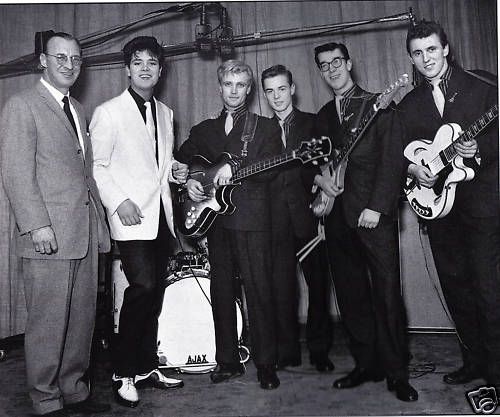
1129e96d0f0a1b4230ce73143899964e

(An early pic of Paramor, Cliff and The Shadows)

Of course, wherever Cliff went The Shadows weren’t far off. Paramor produced all of their chart-toppers too. Which makes for a more interesting comparison of styles, as discs like ‘Kon-Tiki’ and ‘Dance On!’ were actually pretty rocking little numbers. Perhaps it’s unfair, then, to write Paramor off as a dinosaur. Add to this the fact that he also oversaw Helen Shapiro’s wonderful 1961 chart-topping double – the bubbly ‘Walkin’ Back to Happiness’ and the melodramatic ‘You Don’t Know’ – and it’s clear that he wasn’t all bad…
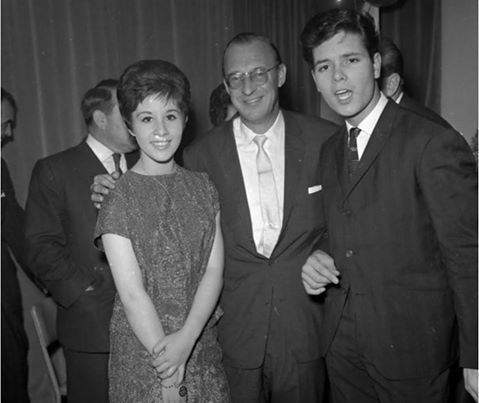
ed1197fc5e386c79ec58aef7e2fda6c8

(Paramor with Cliff, again, and Helen Shapiro in the early sixties)

Wait, though… On the flip side of this particular coin lies one Frank Ifield. Yep, Norrie Paramor produced all four #1s from ‘The Year of Ifield’, pre-rock’s final hurrah before The Beatles and The Pacemakers saved us all… The yodelling horror that is ‘Lovesick Blues’ remains, for me, far worse than anything that Cliff has inflicted.

A mixed bag, then, from Norrie Paramor, prolific producer of the chart’s early years. In total (I think, it’s hard to keep track) he put his name to around twenty five chart-topping singles before the seventies arrived. He also acted as musical director for the Eurovision Song Contest, and wrote multiple film scores, before passing away in 1979. And, in a sentimental twist, the artist that was sitting at #1 in the UK as Paramor drew his final breath, with his first chart-topper in over a decade, was… Cliff!

210. ‘These Boots Are Made For Walkin”, by Nancy Sinatra

One of the coolest intros ever – a twangy guitar that slides and droops like a wilting sunflower on a southern summer’s day – leads us into one of the coolest number one hits you’re ever likely to hear.

4zdvr1b9qpk11

These Boots Are Made For Walkin’, by Nancy Sinatra (her 1st of two #1s)

4 weeks, from 17th February – 17th March 1966

The sixties are truly swinging. There’s been attitude and swagger, even drug references (!) at the top of the charts. And now here’s Nancy, bringing the sass. The way she pauses between the lines, the way she delivers them like she can’t be bothered, as if the man she’s singing about is barely worth the oxygen.

You keep sayin’, You’ve got something’ for me… Her man’s been taking her for a ride; but Nancy ain’t no fool. You’ve been a-messin’, Where you shouldn’t’ve been messin’… He’s in for it. These boots are made for walkin’, And that’s just what they’ll do… One of these days these boots … cut the beat, leave it all to the vocals… are gonna walk all over you…

It’s a fairly minimalist record – sparse instrumentation and a lot of room for the echoey vocals to do their job. Which means there’s lots of time for all the gorgeous little details that make this such a great song to shine through. The whispered ‘yeah!’ between verses one and two, the sarcastic ‘Ha!’ after the You keep thinkin’, That you’ll never get burned… line. The way the horns come in halfway through, the same horns that will go wild for the fade-out (a very mid-sixties touch.) Then there’s the made up words – the ‘samin’ and the ‘truthin’. Nancy’s too cool to bother with proper English.

NANCY_SINATRA_THESE+BOOTS+ARE+MADE+FOR+WALKIN+-+SOLID-562479

‘These Boots…’ is a big development in terms of female-recorded #1s. In every photo-shoot from the time, Nancy Sinatra appears as a very sensual character: big, just-woken up hair, mascara-ed eyes, lots of cleavage. She’s sexy. A siren. In a way that Cilla (the girl next door) and Sandie Shaw (kooky and cute) weren’t. Helen Shapiro was still a kid, Doris Day was basically your aunt. The closest female star I can think of, from previous #1 hits, is Connie Francis, who was bringing the girl power on ‘Who’s Sorry Now’ seven years ago. But even she pales in comparison with Nancy Sinatra’s mini-skirts and thigh-high boots.

Surprisingly, this wasn’t her first attempt at a singing career. I had imagined that she simply appeared, fully-formed, as the superstar daughter of Frank Sinatra. But she had been releasing singles since 1961, to little interest on either side of the Atlantic. By 1965, she was about to get dropped by her label. It wasn’t until she paired up with Lee Hazelwood (the man with hands down the coolest voice ever committed to vinyl) that success came her way. He wrote ‘These Boots…’, and several other songs before she became his full-on muse and they recorded three albums together.

Though, I wonder … While being daughter of one of the most famous male singers of all time clearly didn’t bring her instant success, did it perhaps help mould her image? She had to distance herself from her fuddy-duddy dad, whose hit single career had stalled of late, hence the sexy looks; while her family name perhaps also gave her a safety net that meant she didn’t need to fit the ‘girl next door’ image adopted by most other female stars of the time. Was she in a constant state of teenage rebellion?

For a star who has become so synonymous with The Swingin’ Sixties TM, Nancy Sinatra wasn’t all that big a deal on the UK singles charts. But the impact left by this record alone is more noteworthy than the careers of many, more ‘successful’ stars. And she does still have one further chart-topper coming up – one of the sweetest (or should that read creepiest) #1 singles ever.

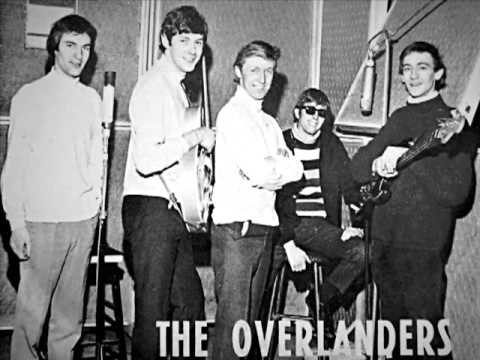
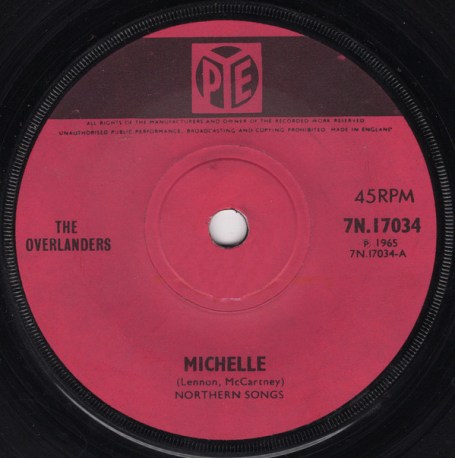
209. ‘Michelle’, by The Overlanders

For those counting, we arrive at the 3rd Beatles cover to top the UK charts. Which means that in a little under three years, Lennon & McCartney have been responsible for twelve chart-toppers! Not bad, not bad at all. A couple of posts ago I mentioned them in comparison with Bacharach and David, who recently wrote The Walker Brothers #1 ‘Make It Easy on Yourself’. But, having done some digging, it turns out that they were still way behind John and Paul with just 6 chart-topping compositions to their name, in well over double the time.

409261612b4d7aea6ffdc34e7c45d2b4

Michelle, by The Overlanders (their 1st and only #1)

3 weeks, from 27th January – 17th February 1966

Anyway, that’s all well and good; but this next chart-topper isn’t by The Beatles. Note the name at the start of this post: The Overlanders. You know, the British folk-rock-cum-pop combo? Nope? Well this was their one and only hit. And it’s a pretty faithful, note for note, cover of the original.

I’d like to write about this without comparing it to The Beatles’ version, but that would mean erasing a song that I’ve been listening to since I was a kid from my memory for the next half an hour. And I don’t have the technology to do that… Michelle, Ma belle, These are words that go together well, My Michelle… Alongside a jaunty, perky, French-salon tune. It’s slightly heavier, more deliberate version – the instruments and the vocals have a deeper finish and a gloss that the original doesn’t. The Beatles’ version is more subtle, lighter… (Oh fine, here’s a link. Compare them for yourself.)

Probably the most notable thing about this disc is that it has a full line of French in it, which is a first for a UK chart-topper. Michelle, Ma Belle, Son les mots qui vent très bien ensemble, Tres bien ensemble… Even if, like me, you have only the most basic of French abilities, you can work out that it’s just a direct translation of the preceding, English line. Still, aside from ‘Que Sera Sera’, which is actually gibberish, this is the first in a long line of ‘non-English’ #1s, or ‘not-completely-English #1s’, which will take us through ‘Je T’Aime…’ to ‘La Isla Bonita’, to, um, ‘Gangnam Style’…

R-5555535-1541595797-1010.jpeg

As a hit record, this is alright. It might as well have been done by a pub covers band for all the personality they bring to it, but it’s OK. It’s not as good as the original, you’d never choose to listen to this version over it, but the only bit I think that really lets The Overlanders down is the creaky I love you… before the solo.

What it kind of reminds me of is the electronic keyboard that I had as a kid, for the six months or so I attempted to learn, which had a bunch of famous songs pre-programmed into it. ‘Michelle’ wasn’t one of them; but if it had been I bet it would have sounded quite like this. Perhaps the problem is that, unlike the previous two Lennon & McCartney written chart-toppers, everyone thinks of ‘Michelle’ as a Beatles song. It’s a well- known track from one of their best-regarded albums, ‘Rubber Soul’, and features on several Greatest Hits compilations (which is where I first heard it all those years ago.) Whereas, Billy J. Kramer, and Peter and Gordon, could more easily pass ‘Bad to Me’ and ‘A World Without Love’ off as their own, with no ‘official’ version of those hits ever recorded by The Fab Four, The Overlanders wouldn’t be as lucky.

But then again, if you wanted a guaranteed hit in the mid-sixties, you couldn’t do any better than nabbing yourself a Beatles’ cast-off. They got their big smash; but very few people remember them for it. Like I wrote at the start, this was The Overlanders’ one and only hit record. It raises a philosophical question to finish on: What’s better, plugging away valiantly on your own with little recognition, or riding the coattails of the world’s biggest band for three weeks of reflected glory?

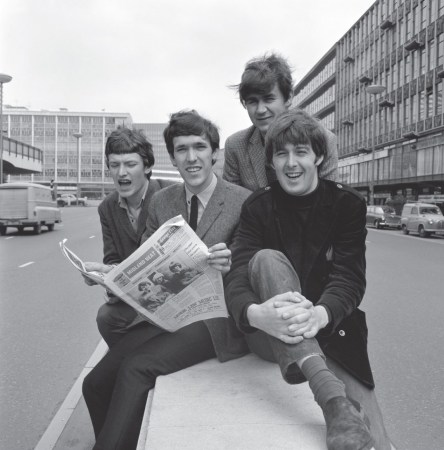
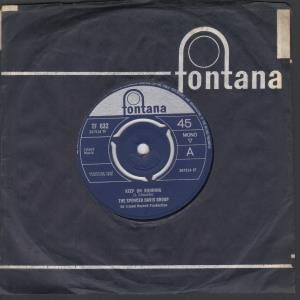
208. ‘Keep on Running’, by The Spencer Davis Group

We skip on into 1966, where the first number one is, perhaps unexpectedly, neither folkey nor baroquey. It’s a straight-up rocker!

Framed_BW_02-6

Keep on Running, by The Spencer Davis Group (their 1st of two #1s)

1 week, from 20th – 27th January 1966

A dirty drum and bass riff kicks it off, and then we get a blast of some kind of feedback-slash-scuzzy chord couplet. It makes you sit up, makes you take notice. Keep on runnin’, Runnin’ from my arms… It’s not as heavy as The Stones have been recently, but it’s not as poppy as anything from the Merseybeat days. It’s like a perfect marriage of the two…

Actually, it’s got a real soul vibe to it too, as if Sam Cooke was now fronting a Beat combo. It’s cool – catchy and funky. I love the Hey! Hey! Hey!s, and the way that the intro riff returns for the now customary wig-out at the end. It’s clear that any self-respecting rock record in 1965-66 has to fade-out with the lead singer going a little bit crazy…

I know this song, but know very little about the band – The Spencer Davis Group (don’t ‘The Spencer-Davis’s’ sound like a posh couple that you avoid in Sainsbury’s?) I would have bet they were American, with their funky soul sound, but no. They were from Birmingham (and not the one in Alabama.) Interestingly, ‘Keep on Running’ isn’t a cover of a soul song, but a cover of a reggae hit from the year before. Check it out here… Unsurprisingly, it sounds completely different. I’ve never been a huge reggae fan – something that I’m sure will crop up in this countdown as the genre grows in popularity – so I’ll take The Spencer-Davis’s version, thankyouverymuch.

image_236192_3_1_3_5_8_6_6_10_1_266708_1_118752_1_9_1_335022

It’s a great record. Though I feel, before we go much further, that the lyrics need some scrutinising. They’re a bit… overbearing? That’s putting it politely. The title refers to a woman who, try as she might, will not be able to escape the singer’s attentions. One fine day I’m gonna be the one, To make you understand, Oh yeah, I’m gonna be your man… It gets worse when you realise that he’s motivated not by love, but because his mates are laughing at him: Everyone is talkin’ about me, Makes me feel so bad, Everyone is laughin’ at me, Makes me feel so sad…

Hmmm. The more you think about them, the worse they get. But hey, this was the sixties. Different times, different levels of tolerance for possessive wierdos… File under ‘Catchy but Creepy’, with ‘What Do You Want to Make Those Eyes at Me For?’ and ‘Oh, Pretty Woman’.

The Spencer-Davis’s will be back, and very shortly, for the second part of their chart-topping brace. They had had a few low charting singles in the previous couple of years, but ‘Keep on Running’ propelled them to another level entirely. It’s not quite a classic, a standard, but it has a hook that most people could sing. And, despite what I said about the lyrics, I do really like it. It’s fun, and a little rough around the edges. Like all the best rock songs should be… A great way to kick off a new year.

207. ‘Day Tripper’ / ‘We Can Work It Out’, by The Beatles

The Fab Four claim their third straight Christmas number one (before Christmas number ones were a thing, but still), and they do so with their most straight-up rock record yet.

beatles

Day Tripper / We Can Work It Out, by The Beatles (their 9th of seventeen #1s)

5 weeks, from 16th December 1965 – 20th January 1966

There’s a riff – a riff we all know – dun-duh-duh-duh-duh-dun-dada-da-dada – (riffs never really work when written out…) which keeps on going till the end. It’s a riff record – maybe, just maybe, they’d been listening to The Stones –a great, straight-up rock song.

I like the way the intro builds: guitar, then bass, then drums, and the way that the solo is basically the riff, beefed-up. It’s a simple song – there’s no reinventing the wheel here. I guess it’s experimental, in the sense that they’re experimenting with a heavier sound, but that’s stretching it a bit. It’s a John Lennon number, and one of the things I like most about him is that he never lost his rock ‘n’ roll roots, never stopped being a fan of Chuck and Buddy, no matter how avant-garde he and his bandmates seemed to get.

Of course, like any great rock song, there’s a fair amount of raunch here too. She’s a big teaser, She took me half the way there now… Not much imagination needed. Especially after Lennon admitted that he would have made it ‘prick teaser’, had he been allowed. Tried to please her, She only played one night stands… So on and so forth. Another layer of innuendo comes when you consider the ‘trip’ aspect of the lyrics. A ‘day tripper’ would be someone who only drops acids on special occasions. A weekend hippy, a ‘Sunday driver’.

Whether it’s about drugs or sex, or both, doesn’t really matter, though. This is a cracking rock number – one that I’ve enjoyed reacquainting myself with for this post. It’s one of those Beatles songs that kind of gets lost among the mega-hits. But, actually, listen to the soooooo long growl, and the way that the solo ascends to a climax with a hint of ‘Twist and Shout’, and try telling me that this isn’t one of their best. And, come to think of it, I can think of two other songs off the top of my head in which the ‘Day Tripper’ riff makes an appearance: ‘Hair of the Dog’, which gleefully rips it off to the extent that when Guns N’ Roses covered it they gave up the pretence and by the end were just playing the Beatles’ riff, and The Wildhearts’ ‘My Baby Is a Headfuck’. So maybe I’m underestimating it…

the-beatles-day-tripper-uk-solid-centre-7-vinyl-sold-in-uk-parlo-gramo-vg_44624215

What of the flip-side? We’ve not had a double-‘A’ side #1 for a while (nearly three years to be precise) and ‘We Can Work It Out’ is the perfect companion for ‘Day Tripper’, in that it sounds pretty much the opposite. I’ve always thought that double-‘A’s should contrast, one should be the yin to the other’s yang, and so gone is the electric guitar and the bravado, replaced by acoustics and recriminating.

It’s a folk-rock waltz of a record, in which Paul McCartney muses on a failing relationship: Try to see it my way, Do I have to keep on talking till I can’t go on?… Think of what you’re saying, You can get it wrong and still you think that it’s all right… He remains positive – the title is ‘We Can Work It Out’ after all – but if you listen closely to the lyrics it becomes clear that any compromise will be on his terms: While you see it your way, There’s a chance that we might fall apart before too long… Very passive-aggressive… Actually, the more I listen, the more I realise how the singer of this song is being a bit of a dick. Life is very short, And there’s no time, For fussing and fighting my friend… (So hurry up and just admit I’m right!)

The accordion-slash-harpsichord sounding instrument which characterises this disc – the one that creates the woozy, trippy feel at the end of the bridge, and that closes the song with a little riff – is a harmonium, apparently. This is where pop music has been heading throughout 1965, with the baroque-folk stylings of The Byrds, Sonny and Cher and The Walker Brothers, and it’s nice to close out the year in this way. A sign of where The Beatles were heading. ‘Rubber Soul’ was released while this disc sat at #1, and ‘Revolver’ would be coming up very shortly after.

This was The Beatles first double-‘A’ side as they couldn’t agree on which record was the more commercial sounding. Lennon was the one who forced ‘Day Tripper’ to get equal-billing, but in terms of airplay at the time ‘We Can Work It Out’ was the winner. In the US they were released separately, with ‘We Can Work It Out’ hitting the top of the Billboard 100 and ‘Day Tripper’ only making #5. But for me rock always wins. ‘Day Tripper’ all the way…

And so we cross the midway point of The Beatles’ chart-topping run. Nine down, seven to go. To celebrate, I thought I’d do a quick rank of the hits that have gone so far. Based solely on personal preference not artistic merit. Let me know if you agree or are scandalised by my ignorance. In ascending order (worst – best), then:

We Can Work It Out > Can’t Buy Me Love > From Me To You > I Feel Fine > A Hard Day’s Night > Ticket to Ride > I Want to Hold Your Hand > Day Tripper > Help! > She Loves You

Actually, that was really hard and kind of pointless. I don’t dislike any of those songs. A ‘bad’ Beatles disc is another act’s signature song. But it’ll be interesting to add the next seven to the list, and to see where they fit in. Anyway, look! Suddenly it’s 1966. Onwards!

Listen to every number one so far – by The Fab Four or otherwise – with this playlist:

206. ‘The Carnival Is Over’, by The Seekers

Another dose of easy-listening, faux-folk from Australia’s biggest band? (That wasn’t a question – you’re getting it whether you like it or not.)

1965_music_seekers_03

The Carnival Is Over, by The Seekers (their 2nd and final #1)

3 weeks, from 25th November – 16th December 1965

I just about managed to see the positive side of The Seekers’ first number one, ‘I’ll Never Find Another You’, for all it’s tweeness. But I think I’ll have to draw the line here… The term ‘dirge’ has cropped up once or twice in recent entries – The Beatles experimented with it in the background on ‘Ticket to Ride’, while ‘I Got You Babe’, for all its cuteness, was propped up with a pretty flat bass rhythm. ‘The Carnival Is Over’, though, is A Dirge, plain and simple.

The beat plods, the backing vocals are lifeless. You can almost picture the coffin being lowered into the ground. You start wishing they’d just get on with it… Say goodbye, My own true lover, As we sing, A lover’s song, How it breaks it my heart to leave you, Now the carnival is gone… Judith Durham, the lead singer, is once again on fine Sunday school teacher round the campfire form. Don’t get me wrong, she sings it very well; but it’s painfully proper.

It’s a song about two lovers, Pierrot and Columbine. Has Columbine fallen in love with a traveller? A handsome stranger who set up camp for a week or two? It’d have to have been a sailing carnival, thanks to the line about ‘harbour lights’… So maybe not. Or is ‘the carnival’ a metaphor for love, a love that’s no longer? Though the carnival is over, I will love you ‘till I die…

This record follows the same formula as The Seekers’ first #1, in that it was written and produced by Tom (brother of Dusty) Springfield. The melody was borrowed from an old Russian folk song, and once you learn that you think ‘Yes!’, this tune would make complete sense when bellowed out by a sturdy serf, gathering hay on the steppe. Not so much as a hit single in 1965. Yes, yes, yes it’s part of the folk-rock movement that’s become huge this year, but it’s a spectacularly lifeless song. You just want to shake them by the shoulders and tell them to liven it up a bit.

Apparently Springfield was inspired to write the lyrics after seeing the Rio carnival. Which seems hard to believe, as this record doesn’t exactly scream samba and piña coladas on the beach. In the bridge, there is an attempt at livening things up, with a nifty Spanish guitar riff. But that’s it. Plus the bridge also has a line about kisses ‘sweet as wine’, which is a metaphor I’ve never understood, what with most wines not being sweet at all. It should be ‘sweet as sherry’ is all I’m saying.

Scan-from-2019-05-22-04_05_28-PM-2-500x510

And so we plod to a close. That’s that for The Seekers at the top of the UK charts. They would have three further Top 10 singles before splitting in 1968. They’ve reformed twice since then, and still perform to this day, minus Durham who retired in 2013. They were huge in their homeland, and were even voted ‘Australians of the Year’. I can see why, too, what with US and UK acts dominating since the dawn of rock ‘n’ roll, it’s always nice to feel a local connection to a successful artist.

One more thing to say about ‘The Carnival Is Over’ – it was a spectacularly high-selling record. Late 1965 seems to have been a high point for record sales as, after Ken Dodd’s ‘Tears’ had become the 3rd best-selling single of the decade, this disc also did well over a million. At last count it was sitting at No. 30 in the best-sellers of all time list. Not bad for a dirge. I’m clearly in the minority…

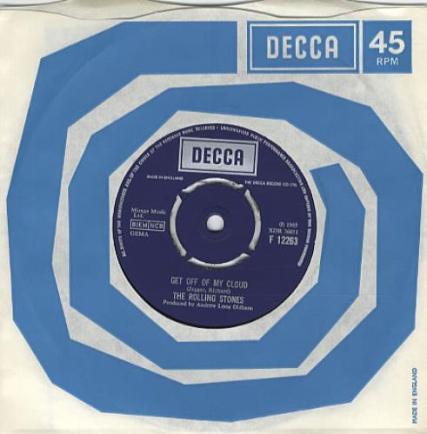
205. ‘Get Off Of My Cloud’, by The Rolling Stones

Barging Ken Dodd out of the way, snapping one of his tickling sticks and giving him the finger… It’s The Rolling Stones!

large

Get Off Of My Cloud, by The Rolling Stones (their 5th of eight #1s)

3 weeks, from 4th – 25th November 1965

They’re still angry, still dissatisfied with modern life, with complaining neighbours and, once again, detergent. What did Mick and Keith have against detergent…? Like ‘Satisfaction’, which was at #1 just six weeks before this, ‘Get Off of My Cloud’ tells an anti-hero’s story in three verses, against a frantic drumbeat and another scuzzily insistent riff.

It’s clearly another response to their new-found fame, their new-found position as The Beatles’ one true rivals to the throne. But all they want to do is be left alone. In each verse, Mick tries to escape the world around him: I sit at home looking out the window, Imagining the world has stopped… and I was sick and tired of this, Decided to take a drive downtown… It’s a response to, and another symptom of, their fame. This was a #1 in both the UK and the US, as well as Canada and Germany, and no other band could have taken a record as raw and aggressive as this to the top of the charts around the world.

It’s also a very hard song to sing. There are several points where I have no idea what is being sung, Charlie Watt’s drums and the guitars being so prominent in the mix, with Jagger’s vocals submerged under them. My favourite bit is when he almost starts rapping the phone-call from his neighbour, asking him and his friends to shut up because it’s 3 a.m. The telephone is ringing I say ‘Hi, it’s me, who’s there on the line? A voice says ‘Hi, hello, how are you?’ Well I guess I’m doin’ fine…

In the end, though, he finds some solace. He takes a drive downtown, where it’s nice and peaceful, and falls asleep. Whether or not he’s under the influence of something isn’t established… He wakes up to parking tickets, but I don’t think he cares – he’s Mick Jagger and he’s rich as piss. How the tickets look like flags, I don’t know. And I have no idea who the guy dressed up like a Union Jack is meant to be.

Rolling+Stones+Get+Off+Of+My+Cloud+-+Boxed+Lo-106573

It’s a weird song. A scrappy, messy, glorious song. Apparently Keith Richards doesn’t look back on it too fondly, what with it being rushed out in order to capitalise on ‘Satisfaction’s success. And yes, the sound is a bit off, and the mix a bit bass heavy, and the lyrics pretty much cover the same ground as ‘Satisfaction’, but that’s part of this record’s charm. It really does sound like it was recorded in a garage, in one take, and while the sound is far removed from their bluesy roots, this is in keeping with The Stones as a rough and ready rock ‘n’ roll band.

But if that doesn’t convince you, at least you can’t deny the hook. Hey! – hey – You! – you – Get off of my cloud! Who hasn’t wanted to yell that at someone who’s been bringing them down, when you just want a bit of peace and quiet. Don’t hang around cos two’s a crowd…

Looking back at The Stones three #1s from this year, we have three masterpieces of attitude and anger. Gone are the blues covers, in comes ‘The Last Time’ with its disparaging swagger, ‘Satisfaction’ with that riff and it’s dissatisfaction with fame and modern living, and now this… more dissatisfaction with fame, modern living and the whole bloody world. And, taking these three discs and standing them side by side next to The Beatles three 1965 chart-toppers – ‘Ticket to Ride’, ‘Help!’ and ‘Day Tripper’, which is coming up in a couple of posts time… I’m going to go out on a limb and say The Stones’ output – solely talking about the chart-toppers, here – was, for the moment, trumping the Fab Four’s.

Not that it would last… But that’s a story for another day.

Follow along with my Spotify playlist:

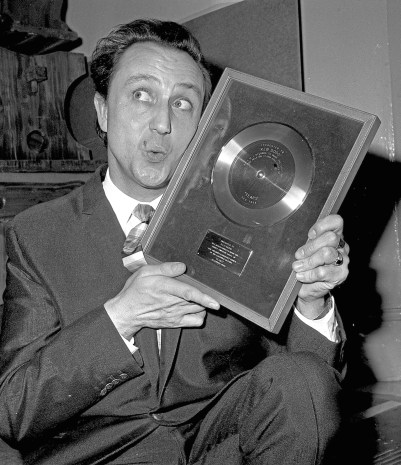
204. ‘Tears’, by Ken Dodd

The best thing about a pop chart, about a list of the best-selling songs in any given week, is that anything can, technically, get to the top. Get enough people to buy it, download it, stream it, whatever, and you get yourself a #1 single.

Ken Dodd

Tears, by Ken Dodd (his 1st and only #1)

5 weeks, from 30th September – 4th November 1965

Which means, try as you might to apply some kind of sense to the ebb and flow of number ones, to christen new eras and to identify the overall ‘sound’ of a time, you’ll always get anomalies. Which means… In amongst The Beatles and The Stones, The Byrds and the Baroque, we have comedian Ken Dodd, covering a sentimental ballad, first written in 1929.

Tears for souvenirs, Are all you left me… Mem’ries of a love, You never meant… The rhythm floats by like a placid river, the guitar trills, the strings swirl… Tears have been my only, Consolation… But tears can’t mend a broken heart, I must confess… He sings it perfectly well, but not spectacularly. I’m picturing a busker on the banks of the Seine, accompanied by an accordion (this would totally work in French, and was actually based on an old French aria from the 1870s.)

Is it a parody? A novelty? I don’t know. What it definitely is is a throwback. This is pure music hall. It’s not cool and it doesn’t care. A record for your gran. It’s almost not worth writing any more about ‘Tears.’ It is what it is. Move on.

KEN_DODD_TEARS+-+SOLID-644474

But. But, but, but… That really wouldn’t be fair. Because this isn’t a flash in the pan, one-week wonder. It’s a disc that lodged itself in at the top for five whole weeks – a length of time reserved solely these days for The Beatles. It was the biggest selling record of 1965. Let that sink in… In the year of ‘You’ve Lost That Lovin’ Feelin’’, ‘Help!’, ‘Satisfaction’, and ‘Mr. Tambourine Man’; Ken Dodd’s ‘Tears’ outsold them all. It was the 3rd best-selling single of the entire decade, the only non-Beatles single in the Top 5. As of 2017, it still sat in 39th place on the list of best-selling singles ever. The middle of the road is always the best place from which to sell a record.

And then there’s the man behind the song. The voice that guides us through this tale of heartbreak and regret. Sir Ken Dodd, of the tickling sticks and the Diddy Men. Of Saturday night telly, Christmas pantos and the Blackpool lights. Of a type of humour and a style of show that was uniquely British. I know some of my readers are not British and… I don’t know if I can even begin to explain him. Look him up. I’m a bit young to have really been ‘into’ him, but my mum liked him. I think that this was the first record she ever bought… He died last year, aged ninety, having performed his final stand-up show just a few months earlier.

Not that this was his only musical success. He was a genuine chart presence throughout the sixties, with several other Top Tens. And I have to admit that, as I listen to ‘Tears’ now for the seventh or eighth time, with a glass (or two) of wine as I write, that this is a pretty nice song. A song that actually fits in quite well with the strings, and the lush production, found in the more ‘respectable’ pop songs of the time. (Plus – whisper it – I think I might be enjoying it more than the previous, overwrought #1, ‘Make It Easy on Yourself’…)

Anyway, before I get too carried away, and claim ‘Tears’ to be the most underrated pop song of the decade, or something, I’ll finish. And glancing forward… Ah yes, normal service is about to be resumed, with a vengeance.

203. ‘Make It Easy on Yourself’, by The Walker Brothers

From an angst-ridden clarion call for disaffected youth, to this. We have strings! A full-blown orchestral section. The top of the charts lurch from one extreme to another, like a slightly edgier version of the Royal Variety Performance.

hqdefault

Make It Easy on Yourself, by The Walker Brothers (their 1st of two #1s)

1 week, from 23rd – 30th September 1965

We’re in a classy cabaret. All velvet drapes and green-shaded lamps on the tables. Where a melancholy, Spector-ish intro moves into a very melancholy opening line. Oh, breaking up, Is so, Very hard to do… A hook that we’ll keep returning to throughout the song.

If you really love him, And there’s nothing, I can do… Don’t try to spare my feelings, Just tell me that we’re through… It’s a novel twist on the break-up song – another sign that pop music is growing up – in that the singer spends the whole song encouraging his girlfriend to split up with him. And if the way I hold you, Can’t compare to his embrace… Get it over with, he says. Don’t hang around. Make it easy on yourself. He’ll feel terrible, but then breaking up is, after all, so very hard to do…

The voice is velvety, and very, very croony. Check out the O-o-o-h baby… before the final chorus. So croony that at times it sounds a little insincere. A little like he’s playing up to the cameras, like he might not really be that bothered if she goes. I like it; and I don’t like it. I’m on the fence with it. It perhaps doesn’t help that I can’t help hearing Jarvis Cocker, who has unashamedly copied Scott Walker’s singing style to great effect since the 1980s, in every line.

The Walker Brother, like the Righteous Brothers before them, weren’t really brothers. It’s a stage name, one that adds to the slightly camp, cabaret-ish feel that this record has, a feeling that this record can’t quite escape. Maybe I’m hearing it all wrong, but it’s a song that sounds as if it’s being delivered with an arched eyebrow and a knowing wink. Or maybe that’s the point. The beauty of art is in the interpretation, after all.

THE_WALKER_BROTHERS_MAKE+IT+EASY+ON+YOURSELF+-+4PR-639430

It’s another Bacharach & David number, originally written in 1962. I’ve not been keeping count, but this must put them at, or very near to, the top of the #1 record writing league. And, like so many of their compositions, it’s a song that just drips with that B & D class. It’s drenched in strings and portentous drums, and is another glowing example of Baroque pop, which is fast becoming the sound of 1965. It’s a record with a great pedigree, one of the first chart appearances by a man who has left a huge mark on popular music, from Bowie to Pulp to The Arctic Monkeys, and I just wish I could like it more…

The Walkers – Scott, Gary and John – were American but, in a sort of reverse British Invasion, enjoyed quicker and longer lasting success in the UK. They will appear one more time at the top of the charts here, with a song that – if I remember correctly – is even classier and glossier than this one, and that might just help me to ‘get’ them.

My first ever exposure to ‘Make It Easy on Yourself’, though, came long before I’d ever heard of Scott Walker, or Baroque Pop, or knew what a Wall of Sound was. In 2001, the opening strings from this #1 were sampled by Ash, on their #20 hit ‘Candy’. Ash are a great pop-rock band, who have never come anywhere near topping the charts, so I’d like to take this – my one and only chance to give them a shout-out. If you’ve never heard them, check them out.

Catch up with the previous 202 number-ones here:

202. ‘(I Can’t Get No) Satisfaction’, by The Rolling Stones

You know how, nowadays, when seen through jaded 2019 eyes, ‘The Exorcist’ isn’t that scary, and ‘Lady Chatterley’s Lover’ isn’t that shocking, and ‘Rock Around the Clock’ sounds a bit lightweight? Well, I wondered if the same might happen here. If ‘(I Can’t Get No) Satisfaction’, one of the angriest, most provocative singles of the sixties, might have lost its edge.

the-rolling-stones

(I Can’t Get No) Satisfaction, by The Rolling Stones (their 4th of eight #1s)

2 weeks, from 9th – 23rd September 1965

Press play, though, and let that jackhammer of a riff run through you. That scuzzy, incessant guitar which sounds as if it’s ripping your speakers open, that doesn’t let up right through this near four-minute song. You soon realise that this fifty-five year old song is still full of spite and aggro.

Jagger’s vocals, when they come in, are – in contrast – soft, almost whispered. I can’t get no, Satisfaction… Cos I try, And I try, And I try… But he quickly build ups to the famous shout: I Can’t Get No! It’s a statement of intent. A rallying cry. I love the fact that it knocked ‘I’ve Got You Babe’ off the top spot.

Then we get to the verses. And, again, we’re treading new ground here. This is a #1 single with an attitude, and a conscience. When I’m drivin’ in my car, And a man comes on the radio, An’ he’s tellin’ me more and more, About some useless information… It’s a critique on commercialism, and capitalism, in a pop song! Later on, Mick is watching TV, and is getting fed up with all the adverts for clothes detergent and cigarettes. It’s leaving him unsatisfied, empty. We’re a long way from ‘I’m Into Something Good’ here. Now, The Stones were no hippies. That’s for certain. They’ll try their hand at psychedelica, for a while, but their hearts won’t be in it. Yet this is definitely one of the first counter-culture, ‘stick it to the man’ hit records. Hippyish in spirit; certainly not in sound.

sat3c

However, it’s the final verse that, at the time, caused most of the controversy. ‘Satisfaction’ was either edited down, had its lyrics changed, or was simply not played at all on British radio and TV. Because suddenly Jagger’s not singing about existentialist ‘satisfaction’ – about being bombarded with advertising bullshit. He’s talking about the other kind of ‘satisfaction’. The girl reaction kind. This is The Stones, after all. And I had no idea, until it came to writing this post, that the line in which the girl turns him down due to her being on a losing streak was a reference to her having her period!

It ends, much like their previous #1, ‘The Last Time’, with a bit of a wig-out, with Jagger yelling the famous refrain out over the fade. Every time I write about a Stones chart-topper, I mention how ‘nasty’, or how ‘grown up’ they sound, in comparison to everyone else around at the time. And they are getting nastier by the record. Compare their jaunty, bluesy debut at the top – ‘It’s All Over Now’ – to this.

This might be their fourth number one, meaning that we are halfway through their chart-topping run, but you can argue that it wasn’t until ‘Satisfaction’ that The Stones truly arrived. Gone were the covers of old blues songs. Jagger and Richards were now the main song-writing duo, with Brian Jones ably assisting. This was their first US #1, and suddenly they were the (second) biggest band on the planet. And if you think that this is a nasty, cynical, rebellious piece of rock ‘n’ roll, just wait until you hear their next chart-topper, coming up very shortly indeed.