Time for another look back at a date in chart history. What were the songs and the stories at number one on December 6th through the years…
On this day in 1980, ABBA were about to begin their thirty-first and final week on top of the UK singles chart with ‘Super Trouper’. My favourite ABBA chart-topper probably changes on a weekly basis, and I could make a case for all of them (apart from ‘Fernando’, sorry). ‘Super Trouper’ is a late-era classic, with that perfect balance of upbeat melancholoy. Songs about how tiring it is being famous can be, well, tiring; but this is a colossus of the genre. I was sick and tired of everything, When I called you last night from Glasgow… is a quintessential ABBA opening line: slightly odd, poetic, beautifully to the point.
Eleven years earlier, on this day in 1969, the Rolling Stones headlined the infamous Altamont Free Concert in California. Supposed to be the West Coast’s answer to Woodstock, it ended up becoming synonymous with the end of the swinging sixties and the death of the hippy dream. Violence which had been brewing throughout the day erupted during the Stones’ delayed set, and ended in the death of an eighteen year old spectator, Meredith Hunter, stabbed by one of the Hells Angels who had been brought in as security.
The Stones are perhaps the perfect band to encapsulate that loss of ’60s innocence, as they had never been particularly innocent, and had struggled with the psychedelic, hippy side of things. Also, they’re the sixties juggernaut that has lasted, and lasted, and lasted, far beyond the decade that birthed them… Here then is their big hit from earlier that year, their final UK #1, and perhaps the ultimate rock and roll tune, ‘Honky Tonk Women’.
In recent posts I’ve been bemoaning/celebrating the end of the Golden Era of the Boyband, which I think came to an end in late 2002. There are arguments to be had for boybands dating back to the fifties, with the likes of the Teenagers, or to the Monkees in the sixties. New Edition in 1983 and Bros in 1988 could lay claim to being the first modern boyband, but for my money the true holders of that title, and the openers of the floodgates, were New Kids on the Block. Who just so happened to be sitting at #1 on this day in 1989 with ‘You Got It (The Right Stuff)’. They were the first of twelve boybands (fourteen, if we bend my rules and count Hanson and Blazin’ Squad) to provide forty (or forty-two) #1s over thirteen years…
Let’s go way back now, sixty-seven years to be exact. Number one on this day in 1958 is what I called ‘the Scottish #1’ at the time, and which I still intend to make our national anthem when I become First Minister, replacing the dirge that is ‘Flower of Scotland’. The fifties was at times a musical desert, strewn with overwrought ballads, and the occasional rock ‘n’ roll tune. Then there were the novelties. So many novelties. Of which ‘Hoots Mon’ stands out as one of the finest. It’s got a wonderful rock ‘n’ roll energy, but it’s also a relic of a much earlier music hall era, with its singalong spirit and its Hammond organ. It’s based on an old folk tune, ‘A Hundred Pipers’, and features classic phrases such as ‘och aye’, ‘there’s a moose loose aboot this hoose’ and ‘it’s a braw, bricht, moonlicht nicht’, none of which a Scotsperson has ever actually uttered.
Finally, 6th December is perhaps best known as a date in music history for being the anniversary of Roy Orbison’s untimely death. In 1988, Orbison was just getting his career back on track through the success of the Travelling Wilburys, his supergroup alongside George Harrison, Bob Dylan, Jeff Lynne and Tom Petty, whose first album had been released earlier that year. Orbison had also just put the finishing touches to his first solo album in a decade, when he died suddenly, of a heart attack. The album ‘Mystery Girl’, and the lead single ‘You Got It’, posthumously returned him to the Top 10 the following year. But to celebrate his genius, let’s go back to 1960, and enjoy his first of three UK #1s: the hauntingly dramatic ‘Only the Lonely’.
The two earlier ‘Today’s Top 10’s I’ve done were pretty succesful. Thanks to all who had a look, liked and commented. I was wondering what to do with the feature going forward, and I think I’ll use it to take a deeper look at interesting periods in chart history. What can the Top 10 tell us about where pop music was at a particular time and place?
So, we’ve done the death of the ’60s, and we’ve done the Summer of Love. Now we turn to perhaps one of the most exciting times in modern popular music: late-1963. The moment when the sixties finally started to swing. Thanks, mainly, to the Beatles. But not, as this chart will hopefully prove, solely because of them. For those interested in significant world events, this was also the Top 10 on the week that JFK was assassinated.
10. Let It Rock / Memphis, Tennessee, by Chuck Berry – down 4 (7 weeks on chart)
But what’s this…? Two rock ‘n’ roll tunes first released in 1959. How the charts like to mess with us… The reason is tied to the times, though. The Godfathers of rock, Buddy Holly, Jerry Lee Lewis, and Chuck Berry, had inspired the new Beat groups that we’ll be meeting further up this chart. The Beatles early albums were full of Berry songs, while the Stones’ first hit had been a cover of ‘Come On’ earlier in 1963. Pye Records saw an opportunity, and released some of these influential tunes for the first time in the UK. Amazingly, this was Berry’s first ever visit to the UK Top 10. A runaway train might not be the most obvious topic for a rock ‘n’ roll tune, but this wasn’t Berry’s first time singing about a railroad. And the way he makes his guitar sound like a train horn is iconic.
It was paired with the more laidback ‘Memphis, Tennessee’, which had also been a hit in a version by Dave Berry & the Cruisers around the same time. It pulls the same trick as such classics as Gilbert O’ Sullivan’s ‘Clair’, and Brotherhood of Man’s ‘Save Your Kisses for Me’, by tricking the listener into thinking that the singer is singing about a girlfriend, when he is actually singing about a small child. Berry, though, consumate storyteller that he was, manages to do it in a far less creepy manner, making the song more about the messy break-up, and the father’s regret, than about dodgy double entendres.
9. I’ll Keep You Satisfied, by Billy J. Kramer & The Dakotas – up 2 (3 weeks on chart)
This one’s much more 1963. One of the big beat combos that had broken through earlier in the year (with another three to come higher up), and who had been at #1 just a few weeks earlier with the Lennon-McCartney tune ‘Bad to Me’. ‘I’ll Keep You Satisfied’ is another L&M composition and, while it would peak decently at #4, it isn’t quite as good. Still, it’s better than the Dakota’s next hit, the dubious ‘Little Children’. Watching the video above, the music may be (slightly) rocking, but Billy J. is giving good crooner energy. Nothing to worry grandma… yet.
8. I (Who Have Nothing), by Shirley Bassey – up 1 (9 weeks on chart)
A constant presence on the charts of the ’50s and ’60s: a bit of Bassey. This is three minutes of pure melodrama, as Shirley watches an old-flame woo his new girl. ‘I (Who Have Nothing)’ was adapted from an Italian hit, which was something of a theme in the early sixties. It’s a classic of its genre: an intro of swirling strings, quiet bits, and bits where she lets loose, belting out high notes like nobody else can. I always find Shirley Bassey somewhat lacking in subtlety, but then again – if you’ve got it flaunt it. If I could sing like her then I’d be belting out my Starbucks orders.
7. Blue Bayou / Mean Woman Blues, by Roy Orbison – down 3 (10 weeks on chart)
Another double-‘A’ side from an American rocker, who had been around since the ’50s. Unlike the Chuck Berry record, though, this was a new hit. ‘Blue Bayou’ is one of Orbison’s gentler numbers – for the Big ‘O’ could of course give Shirley Bassey a run for her money in the belting stakes – but it’s always been one of my favourites. Even as a young ‘un who had no idea what the hell a ‘bayou’ was. Linda Rondstadt recorded a famous cover in 1977, though that didn’t make the UK Top 10.
On the flipside of this disc was a cover of ‘Mean Woman Blues’, an Elvis track from 1957. Personally, while they are both fine singers, I prefer Elvis’s version. I prefer bombastic, overblown Orbison to rocking Orbison. On this record he tries out the famous Grrrrrr, which he’d use to great effect on his chart-topping ‘Oh, Pretty Woman’ the following year.
6. Secret Love, by Kathy Kirby – up 6 (3 weeks on chart)
We’re keeping an eye out for the bands that came along in 1963 and changed popular music forever. But for every beat combo that made it big, there were plenty of British women who were just as instrumental in making the sixties swing. Kathy Kirby’s name hasn’t lasted alongside the likes of Cilla, Dusty, Lulu or Sandie Shaw, but here she is, enjoying her biggest hit. Her take on ‘Secret Love’ starts off very bombastically, much like Doris Day’s chart-topping original from a decade earlier, but soon a groovy guitars-and-backing-singers beat takes over, nicely updating the song for a new era. Plus, she has a great voice, with a bit of bite to it. Kirby may have retired from showbusiness in the early eighties and died in relative obscurity, but for a while she was a huge name: representing the UK at Eurovision in 1965 (finishing as runner-up) and hosting her own television programme.
5. Don’t Talk to Him, by Cliff Richard & The Shadows – up 2 (3 weeks on chart)
Common knowledge would have it that with the arrival of the Beatles et al the career of Cliff Richard – the hottest star in the land just a year or so earlier – fell off a, well, cliff. But glance at any Top 40 from any random moment post-1962, and it quickly becomes clear that Cliff went nowhere. Okay, he didn’t hit #1 as regularly, but ‘Don’t Talk to Him’ was one of an astounding 33 Top 10 hits he achieved across the sixties. I’d never heard this before, but it’s actually a really good song, combining a latin rhythm with some very current, beat guitars. This could easily have been written and recorded by one of the acts a couple of places up this chart, proving that Cliff gave those young whippersnappers a stronger run for their money than the history books suggest. *Some sources disagree as to whether this was Cliff solo, or Cliff with the Shadows, but I’ve gone with the latter*
4. Be My Baby, by the Ronettes – up 1 (6 weeks on chart)
The first of two all-time great, hall of fame pop songs in this week’s Top 4. The fact that this never made it higher than number four is a shock, and I’ve already done a post on how this really Should Have Been a #1. Even on this chart, in the year that it was recorded, where girl groups like the Ronettes were common, ‘Be My Baby’ stands out as special. It would stand out as special on any chart, in any era, simply because it is better than 99.95% of anything else in the history of pop.
3. Sugar and Spice, by the Searchers – down 1 (5 weeks on chart)
Here we are then, a purely Liverpudlian Top 3. The Searchers had been the 3rd Merseybeat band to make number one that year, after the two acts ahead of them in this chart, with their cover of The Drifters’ ‘Sweets for My Sweet’. Although still on the candy theme, ‘Sugar and Spice’ was an original, written by producer Tony Hatch. The chiming guitars and harmonies, as well the almost skiffle rhythm section, are pleasant, almost proto jangle-pop. But within a year, once the Stones, Kinks and Animals started making the upper reaches of the charts, it would start to sound a bit safe. The Searchers had two much better hits to come: their majestic second #1 ‘Needles and Pins’, and their cover of ‘When You Walk in the Room’. Like so many Beat bands that didn’t, or couldn’t, write their own material, the Searchers’ chart shelf-life was limited.
2. She Loves You, by The Beatles – up 1 (13 weeks on chart)
The song that officially kicked off the swinging sixties? The way that ‘She Loves You’ barrels in, chorus-first, on a wave of tight guitars and precision drumming, and yeah yeah yeahs. In France, this style of Beat music literally became known as ‘Yé-yé’ (and surely everyone knows by now how Mr McCartney Senior thought ‘yes, yes, yes’ would have sounded much more proper…) It is utterly perfect pop, to rank alongside the Ronettes a couple of places below it on this week’s chart. Although they developed their sound so far beyond this, I would still rank ‘She Loves You’ in my personal Beatles Top 3. You can read my original post on it, as a number one, here. On this week in November 1963, it was on its way back to number one, having already spent a month there that autumn, and on its way to becoming the biggest-selling single ever, at that point, in the UK (where it remains the Fab Four’s highest seller). Also, the seven-week gap between its two runs at the top remains a record to this day.
1. You’ll Never Walk Alone, by Gerry & the Pacemakers – non-mover (7 weeks on chart)
The 4th Beat group in the Top 10 on this day sixty-one years ago, Gerry & the Pacemakers had made history by being the first act to make #1 with their first three singles. This was the final week of a month-long run for ‘You’ll Never Walk Alone’, and it would also be The Pacemakers final week on top of the charts. (You can read my original post on it here.) The fact that for only their 3rd single the band had turned to a cover of a song from a 1945 musical is telling. While the Beatles were just warming up, their contemporaries were often relying on covers (or on handouts from Lennon & McCartney). Plus there was the fact that for record labels and producers, rock and roll was still a very new thing, one that many were convinced wouldn’t last. It was seen as essential for bands to branch out, and to nurture a wider appeal.
Of course we know now that rock ‘n’ roll was here to stay, even if Gerry & The Pacemakers weren’t. ‘You’ll Never Walk Alone’ was also here to stay, and by the end of its initial chart run it had already been adopted by the crowd at Anfield as Liverpool FC’s unofficial anthem, to be belted out pre-match from here to eternity. The song returned to number one in a charity version by The Crowd, following the Bradford City fire, while it also made top spot for a third time in 2020 in a version featuring Michael Ball and the 100-year-old Captain Tom Moore, a phenomenon that can only be explained by how crazy we all went during lockdown. It is nothing short of a modern-day hymn, given the song’s role in the current British psyche.
I hope you enjoyed this flashback to Today’s Top 10 in 1963. What a snapshot of popular music that was, as Britain finally cast off the shadow of the War and started to get a little groovy. Up next we’ll return to 1999, and to a country just a few months away from the terrifying uncertainty of a new millenium. Would all the computers crash? Would planes start dropping from the sky…? Nobody knew, so confused and distracted were people that they kept buying Ronan Keating records in large quantities. Stress will do that to you…
December 6th marks the 34th anniversary of Roy Orbison’s death, at the tragically young age of fifty-two. The ‘Big O’ stood apart from other early rock ‘n’ rollers, with his sombre stage persona, his vulnerable, melancholy songs, and his semi-operatic voice.
After his hit-making days ended in the mid-to-late sixties, a decade in the wilderness beckoned. Personal tragedies also unfolded – the deaths of his wife and his two eldest sons in a car crash and house fire respectively. The eighties saw a rediscovery of his work, with hit covers of his songs by Don McClean and Van Halen, and the formation of The Traveling Wilburys supergroup in 1988, alongside Bob Dylan, Jeff Lynne, George Harrison and Tom Petty. On the cusp of a triumphant comeback, Orbison died from a heart attack on December 6th 1988.
I’ve already written about his three chart-toppers (‘Only the Lonely’, ‘It’s Over’ and ‘Oh, Pretty Woman’) – classics the lot of them – and so to mark this day I’ll cover his five next-biggest UK hits…
‘In Dreams’ – #6 in 1963
A candy-coloured clown they call the Sandman, Tiptoes to my room every night… Only Roy Orbison could give a lyric so ridiculous-and-yet-terrifying the weight that it deserves. He dreams of his ex-lover then wakes, bathed in sweat, and alone. (Of course he’s alone – it’s a Roy Orbison song.) It’s got the same build-up as one of The Big ‘O’s very best songs, ‘Running Scared’, which barely scraped into the Top 10. ‘In Dreams’ is not quite as good, but builds to a fine crescendo. Roy, as was his way, hits a note that most humans are incapable of imagining, let along singing. ‘In Dreams’ was used to famous effect in David Lynch’s ‘Blue Velvet’, a move that initially shocked Orbison but one that he came to accept after seeing the film several times (and perhaps, if we’re being cynical, seeing the publicity it brought his music…)
‘Too Soon to Know’ – #3 in 1966
A country cover that, I must admit, I’d never heard before. And yet it’s one of his biggest UK hits. It must have sounded quite unfashionable in the swinging charts of 1966 and yet… When was Roy Orbison ever truly in fashion? Or out of fashion, for that matter? He ploughed his own, spectacular furrow. It’s sweet, but lacking the oomph of Roy’s biggest and best hits.
‘Blue Bayou’ – #3 in 1963
Another bit of country-pop, with a cool bassline. And with Orbison’s angelic tones in the chorus, this is no normal country tune. No matter what genre he turned his hand to – country, pop, rock ‘n’ roll – he couldn’t help doing it a bit different. As a kid, I had no idea what a bayou was, but always thought it sounded nice: where you sleep all day, and the catfish play… I’m still not one-hundred percent certain what a bayou is, but I’d definitely like to hang out there…
‘You Got It’ – #3 in 1989
The comeback hit that never was. Well, it was a hit – one of his biggest – but Roy wasn’t around to enjoy his return to the top end of the charts. And ‘You Got It’ is almost the perfect comeback – a slight updating of Orbison’s sound, with some help from Jeff Lynne, but still a record that could easily slip in amongst his classics from the early sixties. The video above was filmed just a few weeks before his untimely death. It feels churlish to wonder if it would have been such a big hit had he not died… Maybe it would, as it’s a great song.
‘Dream Baby (How Long Must I Dream)’ – #2 in 1962
Interesting that this rockabilly ditty is Roy Orbison’s biggest non-#1. It’s nice enough: a repetitive refrain that turns into a sort of mantra as the song progresses, and it builds to a crescendo as all the best Orbison songs do. But it’s not an all time classic. Not a ‘Crying’, a ‘Running Scared’ or a ‘Blue Angel’ (my personal favourite). The video above is worth a look if not for the song then for the spectacularly uninterested audience. What did he say just before launching into the song…?
Roy Orbison, then. One of the most original chart stars going, with one of the very best voices.
Hot on the heels of ‘Suicide Is Painless’, we are crying, crying, crying… A depressing double-whammy at the top of the charts…
Crying, by Don McLean (his 2nd and final #1)
3 weeks, 15th June – 6th July 1980
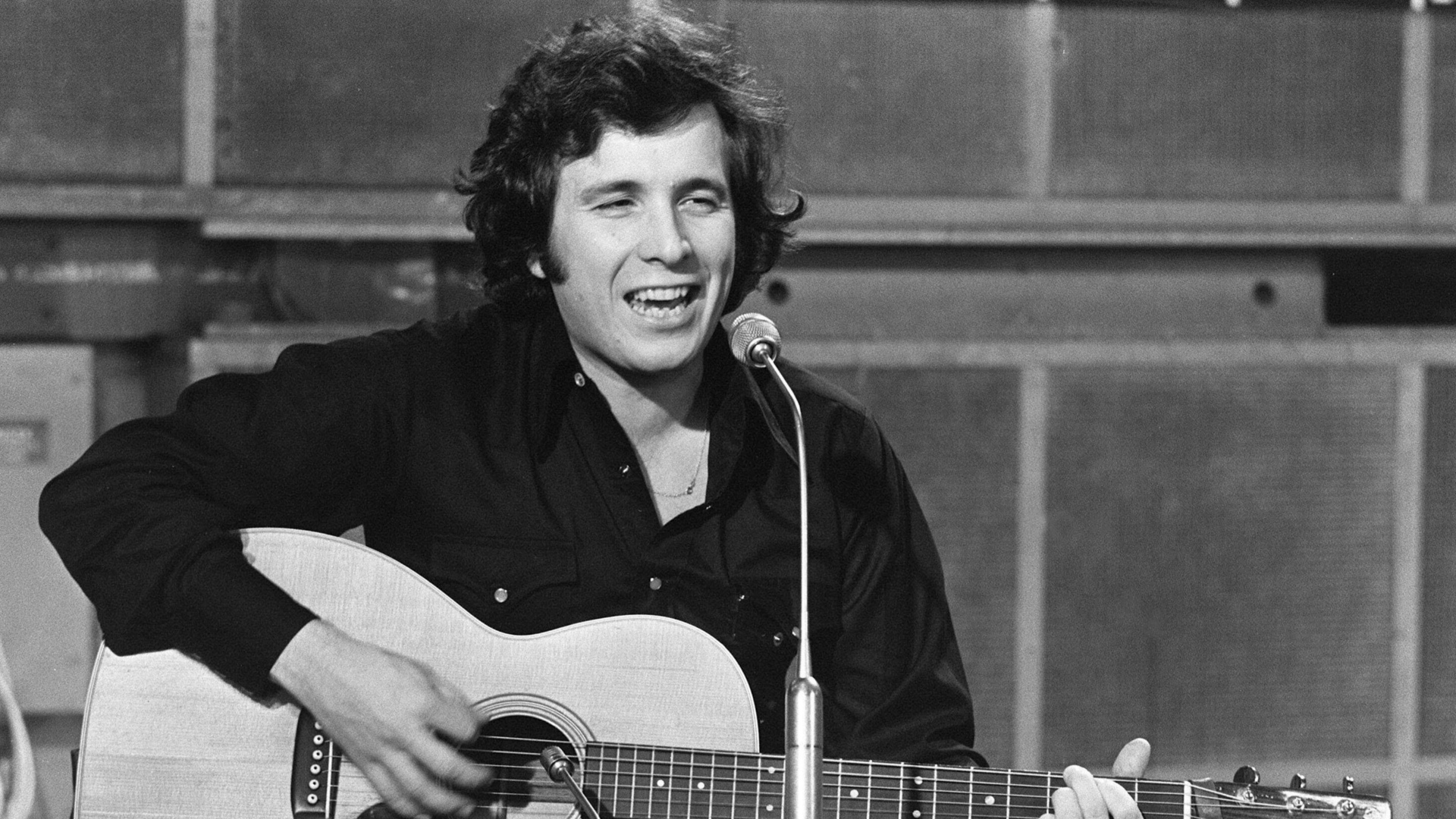
‘Crying’ was, of course, originally recorded by Roy Orbison. As I do every time I approach a cover of a famous hit, I try to blank out any knowledge of the original. Which is always hard, but especially so when said original was by The Big ‘O’. Don McLean takes what was already a ballad, and slows it down further. We are moving at treacle pace here.
I was alright, For a while, I could smile, For a while… It’s a classic Orbison theme: hiding your heartbreak behind your dark glasses. But when I saw you last night, You held my hand so tight… And it’s effective, as we’ve all been there – watching as a former crush moves on. And though you wished me well, You couldn’t tell, That I’d been crying…
My biggest problem with this take – and let’s just have it out and admit that this isn’t a patch on the original – is that all the melodrama has been stripped out. Roy had a latin beat, strings and a marimba… You could samba as you cried. Don goes for a much more straight-forward, country version, and suddenly the lyrics sound trite and basic. The music plods as you wait for it to reach the climax.
Another sizeable problem is that for all Don McLean’s skills as a singer, he isn’t Roy Orbison. The climax here is the word ‘crying’ repeated over and over. Orbison rattles the roof with it, as he does on all his big heartbreak bangers: ‘Running Scared’, ‘It’s Over’ and the like. McLean can’t, and his voice ends up sounding reedy. That’s not to say he can’t put emotion into his songs. I find his previous #1, ‘Vincent’, heartfelt and heartbreakingly sad. Here, though, he over reaches, and his Cry-y-y-ying sounds… like Miss Piggy?
It’s still a pleasant melody, and I am enjoying it to some extent, but it’s a bit of a wet-blanket of a song. And yet another country chart-topper that I can’t quite get behind. At least, quickly scanning down my list, it looks like the last one for a while… This was also Don McLean’s last hit in the UK (he had barely charted since ‘Vincent’ either) until a re-release of ‘American Pie’ in the early ‘90s. He remains active, though, and released his 22nd studio album just last year.
In comes an intro that isn’t messing around… Sturdy, confident drums… Then Dun-dun-dun-dun-dun… An intro that builds – a layer added with every repetition – until it morphs into a chain-link of a riff.
Oh, Pretty Woman, by Roy Orbison (his 3rd and final #1)
2 weeks, from 8th – 22nd October / 1 week, from 12th – 19th November 1964 (3 weeks total)
And then in comes that voice. The Big O. Reigning it in a little compared to his last, full on operetta of a #1 single, ‘It’s Over’. Pretty woman, Walkin’ down the street, Pretty woman, The kind I’d like to meet… Now, let’s pause for just a second. That ‘I’d’ right there, twenty seconds in, makes or breaks this song. ‘I’d like to meet…’ suggests that he’s been a little unlucky in love. Make it ‘I like to meet…’ as some sources do claim, and the singer suddenly becomes a player, a predator, and the song a little icky. I’m going to trust that it’s an ‘I’d’…
Anyway. Roy’s just hanging out, chilling, watching the girls go by. Pretty woman… I don’t believe you, You’re not the truth, No-one could look as good as you… And then a spoken Mercy! that is truly sublime. Pretty woman, Won’t you pardon me, Pretty woman, I couldn’t help but see… That you look lovely as can be, Are you lonely, Just like me…? He may be ogling and approaching passers-by, but he’s a perfect gentleman about it. Plus, he’s lonely. There’s a tenderness to this song that lifts it above other stalker-anthems like ‘I’m Walking Behind You’ and ‘Every Breath You Take.’
Then, though, Roy does something that even he probably can’t get away with. The grrrrrooooowwwwllllll. Let’s pretend the growl never happens, OK? We get to the bridge – a real fifties rock ‘n’ roll throwback – that seals this record’s place among the greats. Pretty woman, Stop a while, Pretty woman, Talk a while… while the drums roll, and a piano tinkles.
As with ‘It’s Over’, ‘Oh, Pretty Woman’ stands out against the musical landscape of 1964. It could have been a hit five years earlier, or ten years later. I’m not sure you could say the same of ‘Do Wah Diddy Diddy’. The Roy Orbison renaissance (the Roynaissance, if I may) of ’64 is probably the most pleasant surprise in a spectacular year of pop music. Though to be honest, he hadn’t been anywhere, and had been scoring big hits throughout the early sixties. It’s just that none of them had made it to the top of the charts.
We get to the climax of the song, and an already brilliant song is elevated even further. The rules of pop music never applied to Roy Orbison, and he bends them to great effect here. He serves us a cliff-hanger, similar to the one he dishes up at the end of ‘Running Scared’. The woman doesn’t stop, and he’s left disappointed. He slows it down, in his trademark talking-singing-freestyling style: Don’t walk away, Hey…. OK… If that’s the way it must be, OK… Then another moment of perfection – But, wait… Cut to the same drumbeat that opened the song. What’s that I see…? She’s turned around. She’s coming back! Of course she’s coming back. Was there a woman alive who could resist the Orbison charm?
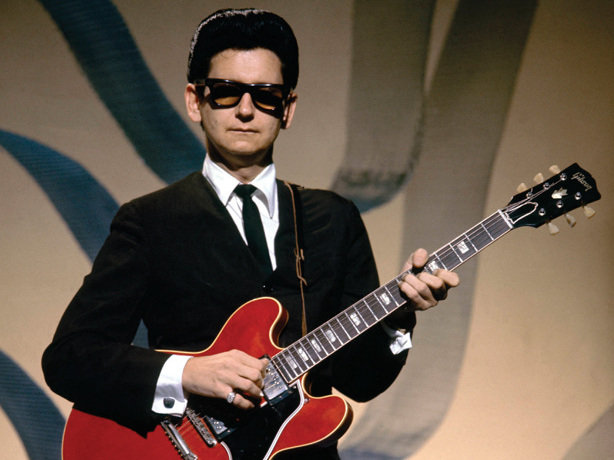
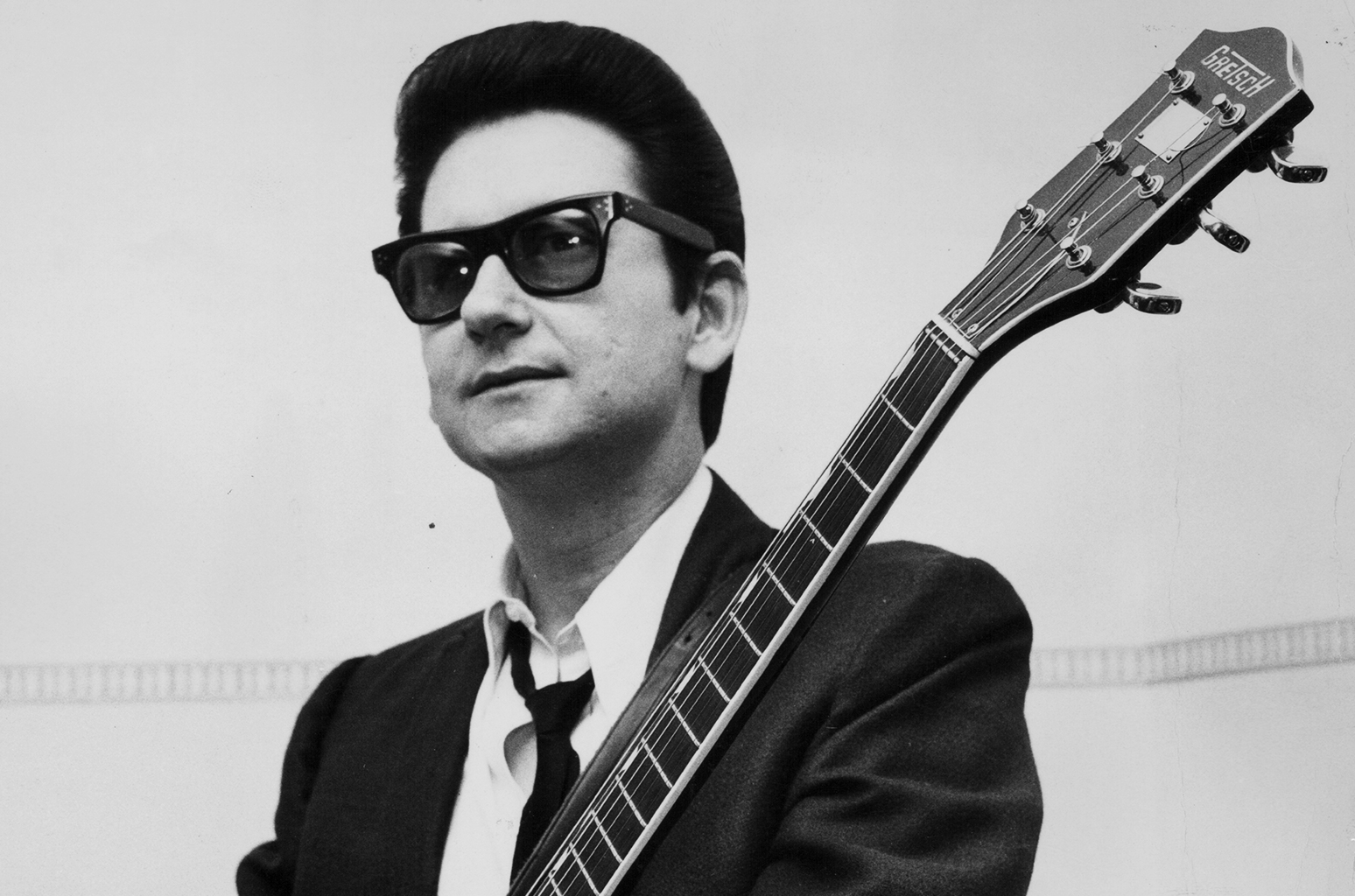
I, as I’m sure you’ve realised, love this record. It’s a Rolling Stone Top 500, Rock n Roll Hall of Fame kind of record. A song that nobody can say a bad word about. I love Roy Orbison too, and still remember getting his greatest hits as a Christmas present back as a kid. Perhaps with the exception of Elvis, no other star of the fifties and sixties had an identifiable image like Roy Orbison. Dark suit, dark glasses, guitar, quiff. It’s up there with Michael Jackson’s hat and glove, and Madonna’s pointy bra. You may think it’s superficial; but it’s a hallmark of the very best pop stars.
Following this, Orbison suffered some pretty lean years in terms of chart hits, and some unimaginable tragedies: he lost his wife and his two eldest sons in the space of two years. But, as with all the greats he came back – The Travelling Wilburys, ‘You Got It’ and all that. And then, just as his comeback was picking up speed, and in a twist befitting one of his greatest ballads, he had a heart-attack and died, in 1988, aged just fifty-two. He’s a legend – plain and simple. The songs that defied convention, the operatic voice, and the dark glasses. The Big O.
Out of nowhere, the Big ‘O’ is back. Enough of this new-fangled ‘Beat’ nonsense, he says. It’s been a little too happy at the top of the charts recently; a little too much positivity going round. Roy is here to change all that.
It’s Over, by Roy Orbison (his 2nd of three #1s)
2 weeks, from 25th June – 9th July 1964
This isn’t any kind of reinvention. Orbison hasn’t updated his sound to keep up with the kids. Last we heard from him, over three and a half years ago, it was with ‘Only the Lonely’. Now, ‘It’s Over’. And if you held any hopes that that might just be a misleading title, then the opening line crushes them. A guitar gently strums… Your baby doesn’t love you, Anymore…
And so we embark on a song absolutely drowning in melodramatic heartbreak. Roy O excelled at this kind of OTT emoting. Lines like: All the rainbows in the sky, Start to weep and say goodbye… and Setting suns before they fall, Echo to you ‘That’s all, that’s all’… are both ridiculous and perfect. While in the build-up to the chorus, when he sings She says to you, There’s someone new, Were throu-ou-ough… and then, just for good measure, another We’re through! Goosebumps.
I had never heard of a ‘bolero’ before researching this song, but it’s a term that’s been used to describe what Orbison was doing in ballads like these. A bolero being, in Latin music, a piece that ‘builds’; and in pop music a song that builds to a climax without the traditional verse, bridge, chorus structure. Not that ‘It’s Over’ is strictly a bolero. There is a latin flavour to the insistent guitars, and the occasional castanets, but there is a reset halfway through, after the first three It’s overs… For a true taste of Orbison-bolero, check out the equally sublime ‘Running Scared’.
By the end of the song, you’ve come to a startling realisation. The Big ‘O’ is bloody loving all this heartbreak. For a start, this song is written in the 2nd person – he’s singing about another person’s despair. He’s the angel of heartbreak swooping in through some poor guy’s bedroom window, as his wife slams the door behind her, singing And you’ll see lonely sunsets, After all… And then we get to the climax. It’s over, It’s over, It’s over! But it’s not. Oh no. Pause. One final breath. And Jeezo. That last It’s Over! No chart-topper, before or since – and bear in mind that we’re on around 1300 by now – has had as dramatic and emphatic an ending as chart-topper #171.
As I wrote above, this was Roy Orbison’s 2nd number one after a near four year wait. Under normal circumstances, a four year gap between chart-toppers is nothing special. But for him to span these four years, which saw Elvis kill off what remained of rock ‘n’ roll and The Beatles et al launch a musical revolution, is pretty impressive. His contemporaries at the top when ‘Only The Lonely’ was there were Ricky Valance, Cliff and Johnny Tillotson. And he’s done it without compromise. This record is The Big ‘O’ doing what The Big ‘O’ does best, and for its two minutes and forty-seven seconds you could be forgiven for forgetting that anything has changed. Back when The Beatles and The Pacemakers landed on the charts, I compared them to a meteor, killing off all the musical dinosaurs. But I forgot about Roy Orbison. I now have a mental image of him coolly lifting the meteor up with one arm, stepping out from under it and dusting himself off. And re-adjusting his shades, of course.
Interestingly, he’s the first American-that-isn’t-Elvis-Presley to top the charts since Ray Charles in July 1962. The Beat revolution has been, up to now, a strictly British affair. But that’s going to start slowly changing. As for Roy, it’s certainly not over. Not yet. He’s got one final #1 left in the tank, and it might just be his signature song.
Now this is more like it! As we try to wash the memory of that last chart-topper from our minds, a dose of the Big ‘O’ will do nicely.
Only the Lonely (Know How I Feel), by Roy Orbison (his 1st of three #1s)
2 weeks, from 20th October – 3rd November 1960
Dum-dum-dum-dumbee-doo-wa, Ooooh-yeah-yeah-yeah-yeah, Oh-woa-woa-woa-ahhh… Only the lonely… We haven’t heard many catchier intros in this countdown, have we?
Only the lonely, Know the way I feel tonight, Only the lonely, Know this feelin’ ain’t right… This is how you do heartbreak in a pop song. It feels somehow significant, the fact that this was the song to depose ‘Tell Laura I Love Her’ from the top of the charts. As if Roy Orbison had listened to Ricky Valance and his saccharine mulch and said ‘Hold my beer…’
Everything about this song feels like an upgrade from ‘Tell Laura…’ – the voice (that voice – one of the most unmistakeable in pop history), the lyrics, even the backing singers. But to paint this record solely as the yang to ‘Laura’s yin would be unfair. This is a great track in its own right, deserving of a place in this countdown regardless of the record it knocked from the top spot.
It’s a rock ‘n’ roll record, but with the operatic flourishes that were a trademark of Orbison’s career. There are the fluttering violins that dance around the end of each line, the deep bass drum that marks out the bridge – there goes my baby (dun dun dun dun) – and, of course, that high note at the end. His voice, which has been deep, and fairly manly, up to now, rises with each of the final lines: Maybe tomorrow, A new romance, No more sorrow, But that’s the chance… wait for it… youuuuuu gotta take… As someone who has listened to Roy Orbison for many years this almost passes me by as standard – that’s what he sounded like a lot of the time – but you have to remember that this was his first big, international hit. People in October 1960 didn’t know who he was, and they wouldn’t have heard the high note coming. The chart nerd in me feels compelled to point out that ‘Only the Lonely’ took what was, at the time and until 1985(!), the longest ever climb to #1 in the UK charts (eleven weeks) This was a slow-burner, a word-of-mouth hit that you heard about from your neighbour over the garden fence – ‘Have you heard that new song by the guy with the high-pitched voice…?’
Turns out that this mix of rock ‘n’ roll rhythms with operatic touches and emotive, melancholy lyrics was Roy Orbison’s new trademark, after an earlier rockabilly phase that had brought him limited success in the US but had failed to register over in Britain, and the record-buying public lapped it up. His next release, for example – the OTT ‘Blue Angel’ – makes ‘Only the Lonely’ sound stripped back and subtle. I bought my first Big ‘O’ Best Of at the same time as I was getting into Buddy, Chuck and co., so we go way back. He can be something of an acquired taste at times, but once you get him; you won’t forget him.
And we’ll hear from him again in a few years’ time – when he’ll stand up to the Merseybeat tsunami with a couple of his best known songs – but until then I’d recommend checking out his early sixties classics: the aforementioned ‘Blue Angel’, ‘Running Scared’, ‘Crying’ (as made super famous by Don McClean), ‘Workin’ for the Man’ and ‘Falling’ (a song that, to this day, I can’t work out if I like or not but which definitely shows off his unique voice).
We seem to be settling back into a nice rock ‘n’ roll groove in the autumn of 1960, this disc following on from the likes of ‘Please Don’t Tease’, ‘Shakin’ All Over’ and ‘Apache’. In fact, ‘Only the Lonely’ is something of an amalgam, of this new, easy goin’ rock ‘n’ roll and the string-laden, percussion-y chart toppers from earlier in the year – ‘Poor Me’, ‘Why’ and so on. A new type of pop song, perhaps? A subtle little game changer? We’ll see. Onwards!





 The UK Number Ones Blog