55. ‘The Garden of Eden’, by Frankie Vaughan

Before I begin my next post in this countdown, I would just like to address something. The elephant in the room, if you will. As I mentioned back when writing about Guy Mitchell’s ‘Singing the Blues’, one of its weeks in the top spot was shared with the record that’s up next: Frankie Vaughan’s ‘The Garden of Eden’. It’s the second time we’ve encountered this situation, and it won’t be the last. Which begs the question… How did records end up sharing the top spot with such regularity in the 1950s? Well, the answer’s pretty simple. But it kind of whips the rug away from under this whole countdown. You see, the charts back in the early days of their existence simply weren’t very accurate.

Way back in my intro I mentioned that the concept of a ‘singles chart’ was introduced in November 1952 by the NME. And the UK Singles Charts company has since incorporated this chart into the ‘official’ chart – even though such a thing didn’t exist at the time. There were various other charts published every week in the 1950s: the Melody Maker chart, the Record Mirror chart, the Record Retailer chart… and the NME chart, which is recognised as the most comprehensive. But not completely comprehensive. There are still many bones of contention. Which I won’t go into here – they can be easily searched for online.

The number of record stores surveyed by the NME for their chart was surprisingly low and the methods very old fashioned compared to the instant downloading and streaming databases used in 2018 – they basically called up a bunch of record stores and asked them to keep a record of what they were selling. The first chart – topped by the record we met in my earliest post, Al Martino’s ‘Here in My Heart’ – was compiled using data from only 20 (twenty!) major record stores. And thus, every so often, because they were working from such a small sample, there were ties. David Whitfield and Frankie Laine in 1953, Guy Mitchell and Frankie Vaughan in 1957… In 1960, the Record Retailer Chart became the UK Chart Company’s chart of choice and there were no further ‘joint’ number ones (though there were still several contested number ones). Then in 1969 the British Market Research Bureau took over chart-compiling duties and steadied the boat further, while in 1982 chart compilation went digital. Since then, it’s been on the straight and narrow. 100% reliable.

So, while it may be distressing to some to discover the records that you have read about during this countdown may not actually have been the best selling records in a particular week, I thought it was only correct that I address the issue. And with that, today’s sermon is brought to a close. On with the next (presumed?) Number One Single!

s-l300

The Garden of Eden, by Frankie Vaughan (his 1st of two #1s)

4 weeks, from 25th January – 22nd February 1957 (including 1 week joint with Guy Mitchell from 1st – 8th February 1957)

So I press play on this record, ‘The Garden of Eden’ by Frankie Vaughan, and pretty soon I get to thinking that, from ‘Just Walkin’ in the Rain’ to this, I don’t think we’ve encountered such a run of similar-sounding songs. Here we have yet another male singer, with yet another performance involving guitar and vocals and not much else. I’m gearing up for another recap, so I don’t want to get too introspective right now, but it seems like we are settling into a groove which – glancing ahead at what’s to come – might last for a while yet.

I am not left thinking this for too long, however. This record is slightly deceiving. It does start off with a simple guitar strum, and with understated backing singers, but halfway through someone flicks a switch. We get trumpets, and a cymbal clash. Things escalate pretty quickly. The drums go up several notches, and suddenly the vocals are accompanied by a full-on big-band swing section. It’s a never ending crescendo, a key-change drawn out for two and a half minutes, and I like it! You can imagine this being performed on TV, the curtain opening to show Frankie Vaughan alone on stage. Then, as the song progresses, the lights draw further and further back to reveal, by the end, the full-blown orchestra that are bringing us to climax. It’s not rock ‘n’ roll, in terms of the sound, but it is in terms of the frenzied tempo.

Lyrically we are in somewhat stranger territory too. Recent number ones have been lovelorn, and wry. This is… well to tell the truth I’m not entirely sure what this is: When you walk in the garden, The garden of Eden, With a beautiful woman, And you know how you care… And a voice in the garden, The garden of Eden, Tells you she is forbidden, Can you leave her there?

It goes on… When you’re yearning for loving, And she touches your hand, Can you leave her to heaven, And obey the command, Can you walk from the garden, Does your heart understand?

It’s a parable, maybe. Resist temptation? Don’t resist temptation? I don’t really know what it’s about even after several listens. My best bet is that this is Vaughan explaining his behaviour to St. Peter at the Pearly Gates. “Yes, m’lord, I should have resisted the advances of that beautiful woman but, to be honest, she was far too hot…”

hqdefault

Without knowing any of this track’s backstory, I imagine it must have been pretty risqué to have had this many religious references in a pop song back in early 1957. Remember how, back in 1953, Frankie Laine and David Mitchell had remove the ‘My Lord’ from the title of their versions of ‘Answer Me’? But I can’t find mention of any controversy online. So that’s that.

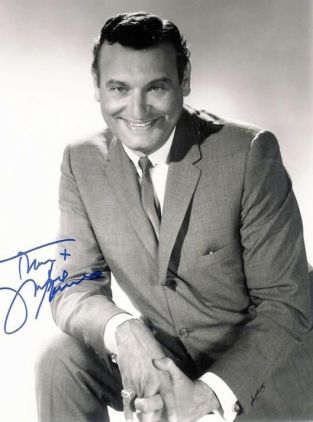
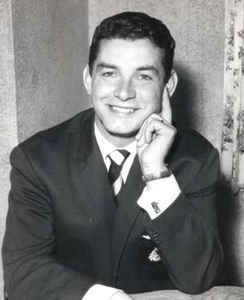
Also of note is the fact that, once again, it’s a British artist doing the rockin’ and a rollin’. Vaughan was a Liverpudlian for whom this appearance at the top of the UK charts was the culmination of a few years of growing success – he was voted ‘Showbusiness Personality of the Year’ in 1956, and was one of the biggest stars of the late fifties. Pictures show him in dickie-bows and top-hats, so we know what kind of territory we’re in. And we will meet Mr. Vaughan again, in a few years, though I feel he has been somewhat forgotten over time, considering how famous he once was.


53. ‘Singing the Blues’, by Guy Mitchell

10-78Rpm-Guy-Mitchell-Singing-The

Singing the Blues, by Guy Mitchell (his 3rd of four #1s)

1 week, from 4th – 11th January / 1 week from 18th – 25th January / 1 week joint with Frankie Vaughan, from 1st – 8th February 1957 (3 weeks total)

I feel I should post a warning ahead of this next chart-topper because, for the second song in a row: CONTAINS WHISTLING.

Well I never felt more like singin’ the blues, ‘Cause I never thought that I’d ever lose, Your love dear… Why d’you do me this way?

It’s another long gap between #1s for one of the biggest pre-rock stars – longer than the wait endured by Frankie Laine and Johnnie Ray before him – it’s been almost three and a half years since Mitchell’s second chart-topper ‘Look at That Girl’. It’s quite nice too, in a way, that the three biggest male singers of the early to mid 1950s have lined up for one last hurrah before the new guard swoop in. And it’s understandable that artists like Guy Mitchell and Johnnie Ray experienced – I don’t know if you could call it a ‘resurgence’, as they had remained popular – success at the dawn of rock ‘n’ roll. I commented on Mitchell’s rock ‘n’ roll edge way back in September 1953, and his voice is just as suited to this rockabilly number.

Like ‘Just Walkin’ in the Rain’, this is another simple little record: guitar, backing singers, Guy Mitchell, and some whistling. Whether or not the whistling is Mitchell’s is unconfirmed. A piano pitches in towards the end to give us the big finish.

Lyrically too, this song is very similar to the one it replaced at the top. He’s feeling lonesome thanks to a lost love. And, instead of taking matters into his own hands, or looking for divine inspiration, as earlier chart-topping stars might have done, he’s just going to have a good old wallow in his misery. He’s resigned to his fate. He’ll cry and cry…

The moon and stars no longer shine, The dream is gone I thought was mine, There’s nothing left for me to do, But cr-y-y-y over you…

3dfa9028eb05e4f4072a50a1d556666a--american-artists-classic-rock

I knew this song, vaguely, as a sort of ‘Heartbeat’ compilation album standard, without ever having really listened to it. It’s a nice tune – much jauntier than its subject matter would suggest – and it’s easing us into what looks like a big ol’ run of rock ‘n’ roll hits. In the ‘Guy Mitchell #1s Chart’ I’d put it in second place, behind ‘Look at That Girl’ but well ahead of the reprehensible ‘She Wears Red Feathers’. #2 out of his #1s, if that makes any sense at all.

However, perhaps the most interesting thing about this record is its bizarre chart run. I mean, just look at that title up there… 1 week on, 1 week off, 1 week one, 1 week off, 1 week joint, divorced, beheaded, survived…. It is, I believe, one of only five records in UK chart history to return to #1 more than once. Let me help you to make head and/or tail of this…

Are you sitting comfortably? Guy Mitchell’s ‘Singing the Blues’ spent four weeks on the chart before climbing to the top for a week. It was then replaced by Tommy Steele with – wait for it – a different version of ‘Singing the Blues’. Mitchell then deposed Tommy Steele after just a week and returned to the top. A week after that he was knocked off for a second time by Frankie Vaughan (thankfully not with another version of ‘Singing the Blues’). A week later it returned to the top for a final week, but had to share pole position with Vaughan, who then claimed the #1 position back for himself a week later and Mitchell’s time at the top finally ended. Phew… It’s possibly the messiest five weeks in UK Charts history. And, frankly, getting replaced at the top by a different version of the same song before returning to number one but having to share the top spot is soooo 1950s! It’s all happened before, of course – David Whitfield and Frankie Laine’s versions of ‘Answer Me’ shared #1 in 1953 while two versions of ‘Cherry Pink and Apple Blossom White’, by Perez Prado and Eddie Calvert, hit the top in 1955 – but never in such a short space of time. It’s peak 1950s! It’s 1950s AF!

51. ‘A Woman in Love’, by Frankie Laine

s-l300 (2)

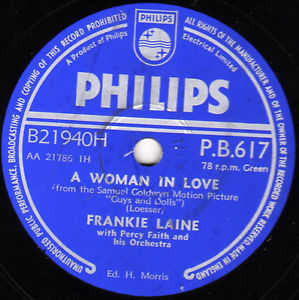
A Woman in Love, by Frankie Laine (his 4th and final #1)

4 weeks, from to 19th October to 16th November 1956

Look who’s back!

Almost three years since we last saw him, Frankie Laine is back at the top of the charts for one final hurrah. And it’s not too much of an exaggeration to say that this is something of a re-invention.

I think this is the very first ‘big band’ #1 we’ve seen. It’s from the film version of ‘Guys and Dolls’, and I think it might be a tango, or a foxtrot (I ain’t no dancer). Either way, it begins with a bang, and then it starts swinging. Frankie Laine is a-swingin’.

Your eyes are the eyes of a woman in love, And oh how they give you away… Why try to deny, You’re a woman in love, When I know very well, When I say…

Who is this woman head over heels with? Well, Frankie of course. At least that’s what he thinks: Those eyes are the eyes of a woman in love, And may they gaze ever more into mine…

Contrast these lyrics with Laine’s last chart-topping single from December ’53. ‘Answer Me’ was all about him pleading for a sign that his lover was still, well, in love with him. In ‘A Woman in Love’ he doesn’t need any reassurance, any prayers answered. He knows she’s hot for him. The times they are a-changing.

And then we have one of the best musical interludes that we’ve heard so far in this countdown. The previous chart-toppers haven’t really gone in for solos, but this one does. The whole band gets stuck into a swinging little thirty seconds. There is a lot of swagger in this record. I’m quite enjoying sticking one-word labels on these recent #1s: Pat BooneCrooner, Anne SheltonTwee, Frankie Laine – Swagger! We’ve had an eclectic run of songs hitting the top spot recently, perhaps the most varied run of this countdown so far, but in a way they’ve all been very of their time. Popular music right on the cusp of the rock ‘n’ roll invasion.

The only thing that spoils this record is the finale. Frankie may have re-invented himself, but he still loves a big ending: Crazily, ga-aze, e-ever mo-ore into MIIIIIIINNNNEEE! Every time I hear an ending like that it sounds more and more old-fashioned. I can’t imagine there’ll be many more, though. Surely. But, overall, this is a small complaint. It’s a great song. Laine’s voice is as warm and as listenable as ever. He and Doris Day should have recorded a duet (*edit* they did – ‘Sugarbush’ back in 1952).

06cab955448883c79c5103ab82addae5--arthur-godfrey-singer

And so we bid farewell to perhaps the biggest of all the pre-rock stars. Four number one singles adding up to 32 (thirty-two!) weeks at the top. That’s pretty darn impressive, and leaves him at 5th place in the all-time list behind only…. I’ll give you a few seconds to guess… Elvis, The Beatles, Cliff and The Shadows. And, actually, I’m harping on about this being a ‘re-invention’ and a ‘comeback’ for Laine, but he hadn’t been anywhere. In the three years between his 3rd and 4th #1s he had still racked up a whole pile of top ten hits. He was huge. ‘A Woman in Love’ would, though, be his penultimate top ten single in the UK.

One final thought… This track made Frankie Laine the artist with the most UK #1s at this point. With four. It’s noticeable that we haven’t yet met an artist who has scored, or will even go on to score, more than four. These early charts were a very egalitarian place – songs only got to the top because they were… I don’t want to say ‘good’ because, well… let’s say: ‘universally popular’. The days of super-star idols, of huge fan-base acts whose every release races to the top of the charts – your Take Thats, Westlifes, Spice Girls – are still not upon us. But they will be sooner than you might think, and their arrival has a lot to do with this new-fangled thing called rock ‘n’ roll.

47. ‘I’ll Be Home’, by Pat Boone

PAT_BOONE_ILL+BE+HOME+-+SILVER-562513

I’ll Be Home, by Pat Boone (his 1st and only #1)

5 weeks, from 15th June to 20th July 1956

Having just read back through my last post – poor old Ronnie Hilton – I feel I’ve been a bit harsh recently. So I’ve decided: I need to approach these records with emptier ears, by dropping all my modern inclinations and pre-conceptions and by just listening to the records. By realising the difference between a record that is bad, and one that I simply dislike. By being – and this is going to be an immense struggle for someone like me – less judgemental. Here goes…

I’ll be home… My darling… Please wait for me… We’ll stroll along together… Once more our love will be free… A piano plinks, a guitar strums, the backing singers hum. This is possibly the gentlest number one yet. And Pat Boone? Well, there’s only one word for what he’s doing. He is crooning. He is crooning the hell out of this record. This is dictionary-definition crooning

This is a post-pre rock/pre-rock n roll ballad, if you get what I mean. File it alongside ‘It’s Almost Tomorrow’ from a few posts ago. The lyrics are a little more youth-orientated (some lines about meeting at the corner drug store on a Saturday) and the chord progressions are that of a modern pop song. I do quite like what he does with the words moo-ooo-ooon light and toge-e-e-ther, and the abrupt pause after the line My mind’s made up… There’s a playful hint to the song. But it’s way too saccharine. It reminds me of that ‘Father Ted’ episode, where Mrs Doyle wins a competition to meet a Daniel O’Donnell-esque singer (Eoin McLove – I’ve just checked). Eoin McLove would definitely have sung this song.

There’s also – abruptly and brilliantly – a spoken word section. Oh yes. Midway through, Boone draws up to the mic, and talks directly to us, making this the first in a niche group of #1 hits, along with classics such as ‘Are You Lonesome Tonight’, and ‘Never Ever’ by All Saints. Darling, as I write this letter, here’s hoping you’re thinking of me… His love shouldn’t worry, he’ll be home soon (HOW MANY MORE of these male-led hits are going to be about pining for your loved one?? I get that these were days of war in Korea and of National Service but still – I doubt we’ll ever see a more dominant lyrical theme in any other era!) I’ll be home, to start serving you… That’s nice. It’s a nice (ish) song. There. Maybe not worth a 5 week stay at the top, but hey. I managed a critique without writing anything too biting. Well done me. But, wait a second…

A sinister under-belly requires tickling. You see, this particular song is an example of something that went on a lot in the fifties. Pat Boone, Frankie Laine, Elvis et al got rich and famous by recording songs written and originally recorded by black artists. Because they were white an’ wholesome, their records sold more. It was a big thing in the US; less in the UK (see Winifred Atwell and the record that succeeded this one at the top). ‘I’ll Be Home’ was originally recorded by The Flamingoes, a black doo-wop group. The B-side was a whitewashed cover of ‘Tutti Frutti.’ A sign of the times, but not great.

6a00d8341c85cd53ef01b8d06e3638970c-800wi

And the plot thickens further. Before this, I’d heard of Pat Boone for two reasons. One, was a line in a Snoop Dogg song (‘Beautiful’) where he claims a girl is too good and wants to stay home listening to Pat Boone, of all people. Two – Mr Boone (who’s still alive, aged eighty-three) is an ultra-conservative Christian. A proper Fox News, evangelising, pray-the-gay-away kind of Christian. I knew this, somehow, but didn’t know quite how bad it was. And it’s bad. Here are some of his greatest hits – all from Wikipedia, take from that what you will – which have nothing to do with his sole chart topping hit in 1956, but sure are amusing (make that terrifying):

A) He refused to star in a film with a star as sexy as Marilyn Monroe, as it would have compromised his beliefs. B) He has compared liberalism to cancer. C) He has compared gay rights activism to Islamic terrorism, and has campaigned against Democratic candidates with the claim that they want to turn Kentucky into San Francisco. D) He loves war, and has claimed that any opponents of the Vietnam War, and both Iraq wars, neither loved their country nor respect their elders. E) He – perhaps inevitably – believes that Barack Obama shouldn’t have served as President, due to his fluency in Arabic and his love for the Koran… Suddenly, all that money and recognition he stole off black artists in the ’50s starts to look even more sinister, no?

Hilariously, he was kicked off a Gospel Music show he hosted in 1997 after releasing an album of heavy metal and hard rock covers, including ‘Smoke on the Water’, ‘Paradise City’ and, oh yes, ‘No More Mr. Nice Guy’. Tragically this album doesn’t seem to be on Spotify, but I’m including the link to his version of ‘Enter Sandman’ here. You have been warned…

I could go on but don’t have all day, and that did go slightly off topic. Apologies. Basically, Pat Boone, it was nice meeting you. You sound a bit mental. Onwards.

46. ‘No Other Love’, by Ronnie Hilton

271927944821

No Other Love, by Ronnie Hilton (his 1st and only #1)

6 weeks, from 4th May to 15th June 1956

Through writing these blog posts, I’m becoming a strong believer in nominative determinism. I.e. through looking at the name of the recording artist one can anticipate what the song will sound like. Not that anyone’s been called Sax Jazzington, or anything silly like that. More like how Kay Starr sounds fun and flirty, Slim Whitman sounds grizzled and lonesome, Jimmy Young sounds… normal, and a little dull. I feel that Ronnie Hilton should fall into the latter category.

And, lo and behold, he does. It starts dramatically enough, though: a burst of cymbals, then another, then another… Then it feels like a step back in time, to the dark days of *shudder* David Whitfield. It’s semi-operatic, its over the top, it’s not a particularly easy listen. Hilton’s voice is overwrought. It’s a powerful voice, a technically very good voice, the sort of voice that your gran would have approved of; but it’s too much. It’s probably no worse than the Whitfield, Laine days of a couple years back, but it already sounds very dated coming so soon after more progressive-sounding records by Bill Haley, Alma Cogan and even Dean Martin.

Lyrically too, this is a song that’s been done before. No other love have I… Into your arms I’ll fly… Waiting to hear you say… ‘No other love have I’. He’s a little lovelorn, is Mr Hilton. I’ve mentioned it before, but why is it the girls that have all the fun in these early chart toppers? With a few exceptions (Vera Lynn, cough cough) they get to be perky and flirty while the men stay at home and stoically wait for their love to be fulfilled.

One thing I was certain of, without doing any kind of research, is that Ronnie Hilton was British. His voice has that properness, that stoicism, void of any kind of vulgar, American swagger. One other thing that I was pretty certain of, again before delving into Wikipedia and around, is that ‘No Other Love’ must have been from a soundtrack, such is its unnervingly bombastic approach to what is an otherwise very basic love song. And yes, it’s a Rogers & Hammerstein number, from their 1953 show ‘Me and Juliet’.

A-439529-1148657608.jpeg

Actually, the most surprising thing I could uncover about Ronnie Hilton – this is his only appearance at the top so let’s give him a moment in the sun – is that ‘Ronnie Hilton’ was his stage name. He was born Adrian Hill. Let that sink in for a second: he, or somebody advising him, thought Adrian Hill was a little too boring, a little too staid, and that ‘Ronnie Hilton’ would get the girls swooning. I think that just sums him, this song, and this whole pre-rock era up… If you’re going to change your name in an attempt to gain fame and glory for God’s sake try to come up with something slightly sexy. No?

And – perhaps just as interestingly – Hilton recorded a fairly successful (in the UK at least) version of ‘The Wonder of You’, eleven years before Elvis Presley made it a standard. But… listen to Hilton’s version, then Presley’s version, and it becomes clear why the latter was one of the most famous voices, and personalities, of the 20th Century and the former wasn’t.

I’m being a little down on Ronnie Hilton, really, so let’s give him a break and end with something completely unrelated. Something that just occurred to me as I wrote the intro to this post. The only reason that my nominative determinism theory works is because I have heard so few of these early number one hits. I write the title down, search them out on Spotify, and take a step into the unknown. But, looking down the list of UK #1s through the remainder of 1956, through ’57 and ’58, this is going to become less and less of a thing. I know several of the next twenty or thirty records. Soon I’ll know the majority of them. Of course, every so often, even as we get to the eighties and nineties, there will be songs I simply have never heard before (I have no idea how ‘Doop’, by Doop, goes for example – and it had 3 weeks at the top in 1994) but, on the whole, we are slowly stepping out of the mist and onto firmer, better known ground.

44. ‘Rock and Roll Waltz’, by Kay Starr

371636453311

Rock and Roll Waltz, by Kay Starr (her 2nd of two #1s)

1 week, from 30th March to 6th April 1956

You remember how, in my last post, I single-handedly invented a new era in popular music – ‘The Post-Pre-Rock Age? You do? Excellent.

Well, the 44th UK #1 single perfectly encapsulates this brave new age. The Rock and Roll (New! Exciting! Sexy!) Waltz (Old! Boring! Not very sexy!) And it’s a fun little record. A record that tells a story:

One night I was late, came home from a date, slipped out of my shoes at the door…          Then from the front room, I heard a jump-tune, I looked in and here’s what I saw…

What is it that she sees…? Well…

There in the night, was a wonderful scene… Mom was dancing with dad, to my record machine… And while they danced only one thing was wrong… They were trying to waltz to a rock and roll song!

Mum! Dad! You silly old squares! All the cool cats know you can’t waltz to a rock ‘n’ roll song!

This, lyrically at least, is rock and roll. Old people not getting this hip new music. Young people rejecting the music of their parents. The chorus is a simple cluster of catchphrases: 1, 2 and then rock… 1, 2 and then roll… It’s good for your soul… It’s old but it’s new… And what is rock ‘n’ roll but a load of nonsensical catchphrases? 1, 2, 3 o’clock, 4 o’clock rock… Whop Bop a Loo Bop a Whop Bam Boo… Goodness! Gracious! Great Balls of Fire!

Musically, though, this isn’t rock ‘n’ roll. There are no guitars, there’s a slightly waltzy rhythm, a boogie-woogie bass and a great big jazzy swing. It’s fun, it’s perky and you can certainly dance to it, but it ain’t rock. It’s a novelty, and Kay Starr sings it in manner that suggests she knows exactly what a piece of throwaway fluff it is.

1ae274ad8f446f05b76cdbb6860e5a35--kay-starr-music-publishing

I mentioned in her last entry, the flirty and fun ‘Comes A-Long A-Love’, that Starr has a magnetic voice. You can tell that ‘Rock and Roll Waltz’ isn’t perhaps the type of record that she’s used to singing – it’s easy to imagine that she wasn’t impressed by the suggestion that she move away from her usual style – but she sells it with warmth and with playfulness. It feels like a long time since I wrote about ‘Comes A-Long A-Love’, and I suppose three years and two months is quite a long gap to have between your two number one hits. Two number ones – the 3rd and the 44th in UK chart history – both spending a solitary week at the top. And both very different records. I’m glad that writing this countdown introduced me to Ms Starr, though, and it’s a shame that we won’t be hearing from her again.

One final thing about this record, though, is very rock ‘n’ roll. At least ‘rock ‘n’ roll’ in a 1956 sense. The song may be a story told through the eyes of a teenager; but Kay Starr certainly wasn’t one. She was, in fact, coming up for thirty-four when this song hit the top spot. As was the similarly decrepit Bill Haley as he rocked around the clock. This new style of music may have been for teenagers, but it wasn’t being recorded by teenagers just yet.

And to finish on a personal note – this was number one on the day my dad was born. Fitting, perhaps, that it’s a song about two uncool parents attempting to dance around their living room. Or not, seeing as my father has never danced a step in his life, I don’t think. Still, it’s not a bad song to have as your birthday #1. OK, it’s a strange little number that nobody has actually listened to for many years; but there are far, far worse songs to have been born under…

43. ‘It’s Almost Tomorrow’, by The Dream Weavers

R-4052394-1471122223-8022.jpeg

It’s Almost Tomorrow, by The Dream Weavers (their 1st and only #1)

2 weeks, from 16th – 30th March / 1 week, from 6th – 13th April 1956 (3 weeks total)

Perhaps it’s time to christen a brand new era in popular music. I’ll call it: the ‘post-pre-rock age’! We’ve had the first wave of the rock ‘n’ roll explosion – the very first rock ‘n’ roll number one – but the waves have receded and we are stood on soggy sand waiting for them to return. And they will, they will… Just not yet.

What I mean is that, to all intents and purposes, we are still in the pre-rock age but that the rules have changed ever so slightly. Of course, the very top of the charts is never where you look for music’s cutting edge. You get to the top of the pop charts by being, well, popular, and by appealing to the largest number of people. But… even if you look at the Top 20 from the week in March ’56 that this latest song hit #1, there are very few records that stand out as being rock songs: Bill Haley is at #7 with ‘See You Later Alligator’, Lonnie Donegan is at #9 with ‘Rock Island Line’ (a skiffle track, admittedly, but still) and there’s a song called ‘Pickin’ a Chicken’ by Eve Boswell which sounds like a rock song involving a funky dance move (a la ‘The Twist’) but is actually just a pretty dull song about having a picnic. The rest is Sinatra, Jimmy Young, Slim Whitman

And, as with ‘Memories Are Made of This’ which preceded it, ‘It’s Almost Tomorrow’ has elements of rock ‘n’ roll in it – enough, perhaps, to attract the youngsters but not enough to put off the old folks. Thus the gap between the worlds of Eddie Fisher and Elvis is deftly bridged.

Anyway, to the song. And after that big build-up, all that stuff about it being a brand new era in popular music, ‘It’s Almost Tomorrow’ is a bit dull. The idea behind it is that the singer’s sweetheart is falling out of love with him, and that she will leave him ‘tomorrow’. And yet he hopes it will be otherwise… My dearest, my darling, tomorrow is near, The clouds will bring showers of sadness, I fear… ‘Emotions As Weather’ – the first chapter in ‘Cheesy Love Songs 101’. It’s almost tomorrow, but what can I do? Your kisses all tell me that, your love is untrue…

It’s a bit cloying, what with its backing singers and plinky-plonky pianos. A bit of a nursery rhyme, too – I can’t decide if it sounds more like ‘Puff the Magic Dragon’ or ‘Away in a Manger’. And again, it’s another very simple #1. The production is very rich – the piano and backing singers turned up to 11 – but there isn’t much there. And, unfortunately, there’s a bit of a THIS IS THE END OF THE SONG ending: You’ll always be miiiiiiiiiiiine!

0c35382efac3ea5f3d8299d3381300a1

But, in the ‘pros’ column there is a rather wonderful key-change – a very rock ‘n’ roll touch. I’m a big fan of a well constructed key-change. I can’t resist them. Who can? Its inbuilt in most people, I think. A Pavlovian reaction. And this is not just a key change, but a mid-note key change… Your love is untruuuu *key change* uuuueeeee. I’m not going to lie – it did give me a mild covering of goose bumps the first time I heard it. But that’s far and away the best thing about this song. A song which we could brand the very first rock ballad to hit the top of the UK Singles Chart, if it didn’t feel a bit of a waste to use up such an honorific title on such an average record.

This is The Dream Weavers only appearance in this countdown, and in the charts. They were big ol’ one hit wonders, you see. Though we should give them a shout out for being one of the few acts so far to have hit the top with an original composition. The Dream Weavers consisted of two high school friends – Gene Adkinson and Wade Buff (great name!) – and a rotating cast of back-up singers. Adkinson and Buff wrote ‘It’s Almost Tomorrow’ themselves, and so are pretty unique among the forty-two songs that we’ve written about previously.

And we’ll leave it there for now. A simple love song – all key changes and not an orchestra in sight – but with familiarly mopey lyrics about rain and heartache, as well as a silly, bombastic ending. One leg in the new world; one leg stuck firmly in the past.

42. ‘Memories Are Made of This’, by Dean Martin

Memories-Are-Made-Of-This-Dean-Martin

Memories are Made of This, by Dean Martin (his 1st and only #1)

4 weeks, from 17th February to 16th March 1956

Sweet sweet mem’ries you gave to me…

This is one of those #1s that fall into the ‘I can sing a line or two before listening to it’ category. See also ‘That Doggie in the Window’ and ‘This Ole House’. At first I thought I might have sung this in my days as a primary school choirboy. But then, after listening more closely, I realised that the lyrics are perhaps a bit rich for a group of eight year olds.

Take one fresh and tender kiss, add one stolen night of bliss…

So, yeah… Then I got to thinking that the intro sounds a lot like the intro to ‘King of the Road’ – that sliding da dum dum dum guitar – which I definitely did sing in my primary school choir. So maybe that’s what I was thinking of.

Anyway. I wrote in the last post that we were having a bit of a minimalist phase in terms of our chart topping records, after the bombast of ’53 and ’54, and this track follows suit. There’s a guitar, some backing singers, and Dean Martin. It’s nice.

Lyrically, the song describes the ‘recipe’ for a happy life. Lots of ‘taking’, ‘adding’ and ‘folding’. With His blessings from above, Serve it generously with love… Which is fine. It actually reminds me a bit of ‘Christmas Alphabet’, in a way – another pop song as step by step guide. It is, though, a metaphor which can only go so far. The lines: Then add the wedding bells, One house where lovers dwell, Three little kids for the flavour… Stir carefully through the days, See how the flavour stays… Are either a little too saccharine, or a little too cannibalistic, to really work.

These lines, however, come during the middle-eight in which – and I may be going out on a limb here but bear with me – we have a bit of a rock ‘n’ roll chord progression. I am completely incapable of describing it in words, having no musical ability on which to base my idea, so you’ll just have to take a listen below to see what I mean. The very fact that this is a Verse Chorus Verse Chorus Middle Eight Verse Chorus (Ok, the chorus is one line, but still) kind of song is interesting in itself. It’s by no means a ‘rock’ song; but there’s a whiff of something there.

deanmartin

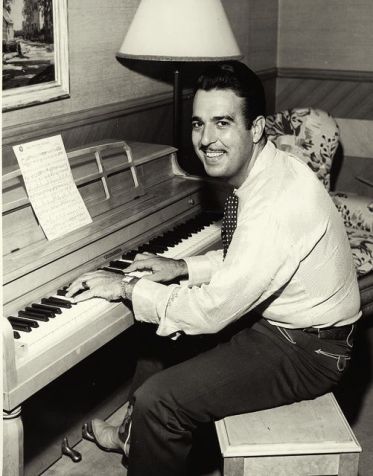
And it’s another one of those occasions in which we tick off a musical legend’s sole moment at the top of the UK charts. Vera Lynn’s had her moment, Tony Bennett’s had his, now it’s Dean’s turn. It just seems right that he got there at least once. To be honest, I know very few concrete facts about about Dean Martin – I tend to get all the rat-pack type singers muddled up together – but I see that he sang songs that are probably more famous than he now is: ‘Volare’, ‘That’s Amore’, ‘Sway’… In fact, it seems safe to say that ‘Memories Are Made of This’ is Dean Martin’s most famous song in which he wasn’t hamming up his eye-talian side. It sounds like I imagine all Dean Martin records to sound like: laidback, slightly louche, very nonchalant… He sounds as if he’s phoning it in, to an extent, but that just adds to the appeal. ‘The King of Cool’, indeed.

41. ‘Sixteen Tons’, by Tennessee Ernie Ford

s-l300

Sixteen Tons, by Tennessee Ernie Ford (his 2nd of two #1s)

4 weeks, from 20th January to 17th February 1956

Hmmm… What’s going on here, then?

It is more interesting, I suppose, approaching these distant number ones – apart from the handful that I already knew – and not knowing what I’m going to get. It wasn’t always like this – for most of 1953 and ’54 the chart toppers followed a rather overwrought formula. Now they are growing much more eclectic.

But, at the same time, I feel ‘Sixteen Tons’ has been done before. We’re back on ‘Man from Laramie’, ‘Hernando’s Hideaway’ territory here – back in the cheesy Western soundtrack album. This is what I expected from a man named Tennessee Ernie Ford, much more so than his earlier, bombastic #1: ‘Give Me Your Word’.

It’s a song about loading something… coal, I think… Loading sixteen tons of it, to be precise. You load sixteen tons, what d’ya get? Another day older and deeper in debt. St Peter don’t you call me cos I can’t go, I owe my soul to the company store… The singer is a hard man; shovellin’ sixteen tons ain’t nothin’ to him, no Sir.

After describing his working day, he goes on to big himself up: raised by a lion, fightin’ and trouble are his middle names, if you see him coming then you better step aside etc. etc. One fist of iron, the other of steel, If the right one don’t get you then the left one will… It’s all a bit silly, but Ford sings it with tongue firmly in cheek. He even giggles at one point, as he delivers the line: Can’t no high-toned woman make me walk the line… He knows it’s silly – and the listener can enjoy it for what it is. But, importantly, he doesn’t disrespect the song. It’s skilfully done. I kind of wish it had been Tennessee Ernie singing ‘The Man from Laramie’, rather than stiff old Jimmy Young, as what that song dearly needed was a slightly looser delivery; a delivery with the eyebrows raised. I’ve had a look, but unfortunately can’t find any sign that he ever recorded a version.

The only musical accompaniment to the lyrics is a guitar/clarinet combo, some light drumming, and some finger clicks. It’s minimalist. In fact, almost all of the most recent number ones have toned down the orchestral accompaniment and the backing singers (‘Rose Marie’ and ‘Christmas Alphabet’, the simple guitar riff of ‘The Man from Laramie’ and ‘Hernando’s Hideaway’s castanets). Unfortunately, at the same time, ‘Sixteen Tons’ resurrects a technique that we haven’t heard for a while – the THIS IS THE END OF THE SONG! technique. We end on a long, drawn out repetition of the final I OOOOOWWWWEEEEEE MY SOOUULLL blah blah blah… line. It spoils the whole song, truly it does. The sooner this trick dies a death the better!

123e46cdd35aa14e0ccd46e41eaa78ee

Each time I’ve listened to this track over the past half hour, somewhere in the back of my mind is the nagging suspicion that I’ve heard this somewhere before. I probably have – it is Ford’s signature hit, after all. And it’s a simple song. So simple that it sounds like it might be… Nope, I can’t place it.

And on that note, we will bid farewell to Tennessee Ernie Ford. But don’t you worry about him. He had a long and distinguished career back in the US, in the Country & Western world, releasing albums such as ‘This Lusty Land’, ‘Great Gospel Songs’, ‘Civil War Songs of the North’ and, er, ‘Civil War Songs of the South’ (maybe it was a ‘Use Your Illusion’ I & II kind of thing?) Whatever, he had clearly found his niche. He also had a TV show – ‘The Ford Show’ – and a catchphrase: ‘Bless your pea-pickin’ heart.’

Yee-hah! Let’s leave it there…

38. ‘Hernando’s Hideaway’, by The Johnston Brothers

R-2051517-1415453457-1359.jpeg

Hernando’s Hideaway, by The Johnston Brothers (their 1st and only #1)

2 weeks, from 11th to 25th November 1955

It’s starting to feel like, rather than passing comment on each UK #1 single, I’m actually reviewing a soundtrack album. The soundtrack album to a very cheesy Western. ‘Rose Marie’ was the big ballad, ‘The Man from Laramie’ was the theme song, and now ‘Hernando’s Hideaway’ is…

What exactly is this? It’s hard to tell. Gone are the days when you could file pretty much every UK #1 under ‘overwrought ballad’ or ‘perky novelty. It’s another song that tells a story, about a drinking den – a dark secluded place, a place where no-one knows your face – and, again, has lyrics so obscure and specific that it must be from a film, or musical… There are silhouettes, and castanets, glasses of wine, and fast embraces. Hernando’s may actually be (whisper it!) more than just a bar…

Two lines in particular really set the scene: Just knock three times and whisper low, That you and I were sent by Joe, Then strike a match and you will know, You’re in Hernando’s Hideaway! It’s a very quirky song. And I mean that in the best possible way: the first forty seconds, for example, consist simply of voices and castanets. Then the violins kick in and we’re into a swaying, sweeping tango. Whereas ‘The Man from Laramie’ just sounded silly away from the context of the film; this song actually makes me want to watch whatever film or musical that it’s from.

And I could resist no longer – I had to Google and find out just where this funny little song originated. And it was indeed a show tune! (I’ve still got the knack!) A show tune from ‘The Pajama Game’: a musical about – wait for it – labour disputes in a pyjama factory… Seriously. It opened on Broadway in ’54, in the West End a year later, and thus explains the popularity of this track in the autumn of 1955. And when I say ‘popularity’, I mean ‘popularity’. Wikipedia lists 33 (thirty-three!) different recordings of the song. Contemporaneous to the Johnston Brother’s hit were versions from our friends Alma Cogan, Johnnie Ray and Mantovani, as well as versions yet to come from stars as varied as Ella Fitzgerald and The Everly Brothers.

the-johnston-brothers-join-in-and-sing-no-1-decca

And what of the Johnston Brothers themselves? I had an image of identical twins, sharp suited and shiny-teethed. Bob and Billy Johnston, perhaps. Except, there were actually four members in the band – only one of whom was called Johnston. Johnny Johnston (great name!) formed the band and gave them their title. As the picture shows, they don’t look especially sharp or glossy (they were British, after all), and they faded away after a handful of hits.

‘Hernando’s Hideaway’ is proving to be one of those songs that improves with every listen. At first it was a curiosity; now I’m rather taken with the bizarreness of it. It is, I can say with complete confidence, the strangest UK #1 since The Stargazers hit the top with their barroom sing-along ‘I See the Moon’. Actually, 1955 has proven to be quite the eclectic year for chart-topping singles – the crazed sway of ‘Mambo Italiano’, the raunchy trumpets of Perez Prado, the lone-star yodelling of Slim Whitman. It hasn’t always been great, but at least it’s been interesting. Which wasn’t something we were saying back when David Whitfield and Frankie Laine were out-snoozing each other with their soporific ballads. 1955 has also been the year of the soundtrack hit, with this being the 6th chart-topper to emerge from a film or musical. Given that, as I write this, the UK Charts are filled with songs from ‘The Greatest Showman’ soundtrack, there’s a nice symmetry here. In some ways the charts of 2018 are unrecognisable from those topped by the Johnston Brothers; in other ways very little has changed.

Anyway, if this last bit has sounded like a round-up of sorts, well, it was kind of unavoidable. This has been the 38th UK Number One; and the end of an era. The ‘pre-rock’ era, that is…