The 4th chart-topping single of 1965 is a bit of a Ctrl-Alt-Del moment. The first three #1s have felt like a mini revolution in all their Latin-soul, jazzy, glossy-pop glory. You could have been forgiven for asking: Is the Beat movement dead already?
Tired of Waiting for You, by The Kinks (their 2nd of three #1s)
1 week, from 18th – 25th February 1965
Of course it isn’t. The Kinks are swooping in to save the day for all the boys with guitars out there. A wonky, woozy intro – it feels kind of like you’re floating on a swing on a hot summer’s day – then in comes Ray Davies… So tired, Tired of waiting, Tired of waiting for you… (On a side note, I’ve always thought that Davies sings with a strange accent – as if English wasn’t his first language. Kind of Indian sounding. It’s really noticeable here…)
Anyway, he’s being kept waiting by a girl. And not ‘waiting’ as in she’s late for a movie. Waiting as in waiting. I was a lonely soul, I had nobody till I met you, But you keep-a me waiting, All of the time, What can I do? He might be waiting for a declaration of love; or waiting for you-know-what, like a horny teenager. Who knows?
I mentioned in my post on ‘You Really Got Me’ that that song, while being one of The Kink’s biggest and best known hits, isn’t really indicative of their sound. ‘Tired of Waiting for You’ is much more Kinks-y to me, especially when the band harmonise on the bridge: It’s your life, And you can do what you want… There are hints of ‘Waterloo Sunset’ there – and I can mention/link to that song now as it – unbelievably – won’t be featuring in this countdown. One of the great chart-travesties, that. I’m also getting a Searchers-vibe in the song’s chiming melancholy, too.
The edge is still there, though. The crunchy guitars that blasted their way through ‘You Really Got Me’ are barking in the background, especially in the build-up to the final chorus, as Davies pleads Please don’t keep me waiting… It’s a song about frustration, albeit politely voiced frustration. It’s like the polite cousin of ‘(I Can’t Get No) Satisfaction’… (Now there’s a song which we will be meeting on this countdown – hurrah!)
The Kinks will have one more number one, and several more famous songs that don’t make the chart summit. But I’ve enjoyed re-hearing this one. I had a Kinks’ Greatest Hits on CD as a kid, and while I knew this song I’ve never really listened to it in much detail. It’s a nicely forgotten chart-topper from an ever so slightly under-rated band. And coming as it does, in early 1965, as pop music races to evolve and improve at a staggering pace, it already sounds like a bit of a throwback.
Oh baby, baby… For our next chart-topper, we take a step into the realm of the super-cool. An empty stage… A sole spotlight shining its beam through the dusty air… A mic on a stand… Thick curtains part, and on step two men…
You’ve Lost that Lovin’ Feelin’, by The Righteous Brothers (their 1st of two #1s)
2 weeks, from 4th – 18th February 1965
And then that voice. Sonorous. Rich. Velvety and comforting, but authoritative too. You never close your eyes, Anymore when I kiss, Your li-ips… It’s a voice that is somehow both low and high within the same line – sometimes within the same word. And there’s no tenderness like before, In your fingerti-ips… A voice that goes from velvety soft to a gravelly rasp in seconds (see that Baby! Something beautiful’s dying! line.) Said voice is Bill Medley’s, and it’s unlike anything we’ve heard before in this countdown. Apparently, at the time, it was so deep and treacly that people thought they were listening to the record on the wrong speed. I’d rate it instantly alongside Roy Orbison and Shirley Bassey as the best voice to have topped the charts, up to now. It’s a voice that it’s almost impossible to mimic… Anyone can pretend to be Elvis, or Mick Jagger, and just about get away with it. Not this voice.
The backing music is way off in the background, too – a softly shaken out drum and some ethereal strings. This record, to start with anyway, is all about the voice. Apparently Bobby Hatfield, the other Righteous Brother (they weren’t biological brothers – something I just found out…) was pissed off that they weren’t starting the song by singing together. But you’d have to say the producer got it right on that front. That producer, by the way…? One Phil Spector.
Hatfield soon gets his moment, though. Come the chorus, the two voices ring out: You’ve lost that lovin’ feelin, Now it’s gone, gone, gone, Woah-woah-oh… Then they intertwine for the superb crescendo that leads to the final chorus. You know, the bit that starts with an angelic Baby, baby, I’ll get down on my knees for you… and soars into call-and-response Babys! and Pleases! and I need your loves! It is pop perfection… as trite as that phrase sounds. Time-capsule pop, as I coined it in an earlier post. Two voices that are as good as The Everly Brothers; but that are completely different too.
In keeping with more recent #1s, ‘You’ve Lost That Lovin’ Feeling’ is a very sophisticated song. It’s pop for adults. A world away from the teeny-bopping Mersey sound that encapsulated 1963-’64. It’s perhaps the first example of the American response to the British invasion – a record, like The Supremes from a few weeks earlier, which has that US gloss. You just know that the Righteous Brothers had perfectly white teeth…
Some of this is to do with the lyrics. With lines like And now your starting to, Criticise little things that I do… it’s looking at love in a way that Herman’s Hermits, or Billy J. Kramer, or even The Beatles, weren’t. But it’s more to do with Spector’s soaring, crashing, grandiose Wall of Sound production. The strings. The drums. The stereo sound that fills the room. I wrote a post recently on how it was a crime that ‘Be My Baby’ didn’t make #1. But, while that is a peerless pop disc; I hadn’t noticed that this record was coming up. I knew that this was a good song – a classic – but I had forgotten (or perhaps had never realised) just how good it was. Listening to it now… Oh boy. Phil Spector may be many things (most of them awful), but nobody – nobody I say! – knew their way around a pop record like him back in his heyday.
Like most eighties kids, my first exposure to ‘You’ve Lost That Lovin’ Feeling’ was in, ahem, ‘Top Gun’. Maverick and Goose, all in white, serenading Kelly McGillis… And this is just one of the ways in which this song has grown its own legend. It’s been covered by everyone: Cilla Black, Dionne Warwick, Hall & Oates… It caused Brian Wilson to tell the writers – Barry Mann and Cynthia Weil – that he had been “ready to quit the music business, but this has inspired me to write again”… We are in Rolling Stone Top 10, BMI most-played songs of all time territory here. We won’t meet many bigger songs than this one as we move on. Finally, and perhaps most excitingly of all, mixed in amongst the backing singers on the disc, was an up-and-coming young woman by the name of Cher.
We will hear from The Righteous Brothers again. But not for a long time, and in somewhat specific circumstances. It’s a lifetime away – one of the biggest gaps between #1 singles in history. This was, then, to all intents and purposes, their only chart-topping hit in their ‘lifetime’. Relish it, appreciate it… Just be grateful that it exists…
Hot on the heels of Georgie Fame & The Blue Flames’ snazzy ‘Yeh Yeh’, an equally quirky record pops up for a week at the top of the UK charts.
Go Now!, by The Moody Blues (their 1st and only #1)
1 week, from 28th January – 4th February 1965
We’ve already sa-id… I like records that just get on with it – no drawn out intro, no nothing – and this is one such disc. Goodbye… Voice, then piano. A thumpingly, clumpingly unsubtle piano. I mean this with no disrespect, but the piano here sounds like it’s being played by an elephant. I’d bet they overlaid several tracks one on top of the other to get the rich, heavy sound. I love it. Since you gotta go, Oh you better go now…!
It’s a song about a break up. The singer doesn’t want to break up, but if it has to be done then he’d rather his S.O. just got on with it. Cos darlin, darlin’, Can’t you see I want you stay, yeah-ah-yeah-ah… The singer – Denny Laine – has a voice every bit as soulful as Georgie Fame before him, and he holds nothing back. The way he sings/spits out lines like I don’t want you to tell me just what you intend to do now…, for example, is great, and deceptively hard to recreate.
The production too is thick and soulful, with hints of Phil Spector’s Wall of Sound and the baroque minor keys that were about to become a big thing in sixties pop. (It’s actually a cover of an American R&B hit from earlier in the decade.) It’s also a very rough-and-ready recording – not perfect – with lots of crackly patches, as if the tape were struggling to contain the volume and the power of this band. I love the piano solo, one that rolls and cascades – a cross between a ship being tossed on stormy seas and Dante’s descent into hell. The ending is also a lot of fun, with a huge finish – the whole band appearing to shout out the title of the song before a very quick, slightly wonky fade.
‘Go Now!’ is another grown-up pop record – make that two in a row – and one that perfectly encapsulates the way pop music is now fragmenting and moving away from the Beat sound that has dominated for most of the past two years. New year, new sound etc. etc. It’s also a record that I’ve loved for many years – The Moody Blues being a staple of long family car journeys as a child. But, here’s the ironic bit… I really, really can’t stand any of The Moody Blues’ other songs…
You see, after this – their one and only chart-topper – they started getting all experimental. Denny Laine left the band and a bloke called Justin Hayward came in, they ditched the pop/R&B and they went… (shudder)… progressive. Now, I love rock music. To me ‘rock’ is the foundation upon which all great music is made. Stick ‘garage’, or ‘hard’, or ‘glam’, or ‘electronic’, or ‘punk’, or ‘surf’, or even ‘yacht’, in front of ‘rock’, and I’m usually in. ‘Prog-rock’, though? I run a mile. Jethro Tull, Marillion, Pink Floyd, Yes!… No, no, no! Lock me in and call it ‘Room 101’. You can be experimental, and forward-thinking, as avant-garde as you like… but ‘Prog’? The minute you call yourself prog then your head’s gone too far up your arse. And The Moody Blues are the worst culprits for me because A) They started it and B) I had to sit through their ‘Best Of’ on many a long car journey, aged eleven.
It would start off well enough. Track 1 was ‘Go Now!’. Three minutes of pop bliss. But then there were nineteen other songs to sit through before it was over – none of which sounded anything like ‘Go Now!’. And prog-rock songs are never, ever as short as they should be… ‘Give me ABBA’, I would cry, ‘The Eagles or The Stones. Even Fleetwood Mac if you must. Anything but this.’ But my dad would stand firm, and we’d listen to the bitter end… I have especially painful memories of ‘Nights in White Satin’… And ‘Tuesday Afternoon‘…
Having studied The Moody Blues history ahead of this post, it seems that the blame can be laid squarely at this Justin Hayward fellow’s feet. Once he was in and Laine was out (Laine later joined Wings), ‘Go Now!’ seems to have been written out of the band’s history. They rarely performed it live, and it didn’t appear on any of their ‘Greatest Hits’ until the mid-1990s. (Which was precisely when my dad bought said CD for the car… Just think – there might easily have been no good songs on that album…)
Yes, let’s end this post on a positive note. Nineteen of the twenty tracks on The Moody Blues ‘Greatest Hits’ album may well be terrible songs. But the one good song on that album also happens to be their only #1 single. We won’t hear from them again on this countdown! We can just pretend that they were one-hit wonders! Pretend that the glorious ‘Go Now!’ was the only piece of music that the band ever offered to the world. Isn’t that a comforting thought…
No sooner have I mentioned that 1965 might be a more eclectic year in terms of its chart-topping singles, when along comes one Georgie Fame with a swaying slice of Latin soul.
Yeh Yeh, by Georgie Fame (his 1st of three #1s) & The Blue Flames (their 1st of two #1s)
2 weeks, from 14th – 28th January 1965
Wham and then Bam. In the space of three #1s we’ve gone Blues–Beat rock-Latin. I might even go so far as to describe this as a Bossanova, if I was at all certain what exactly a ‘Bossanova’ was… Whatever it is, it’s not a sound that we’ve heard very often at the top of the UK charts. After months of Merseybeat things are really starting to splinter in different directions.
The song is about a guy who, after finishing work every evening, calls up his baby and asks her what she wants to do… I mention movies, But she don’t seem to dig that, And then she asks me, Why don’t I come to her flat… ‘Yeh Yeh’ is his response. The words are spat out at a rapid pace, half-rapped (this might be the hardest number one yet in terms of making out the lyrics). But it still becomes clear just what his baby’s game is. She suggests supper and listening to some records, and soon the kissing starts: And when she kisses, I feel the fire get hot, She never misses, She gives it all that she’s got…
I love the break in the middle, when one long tongue twister line – We’ll play a melody and turn the lights down low so that none can see… – ascends to a natty drum fill and lots of We gotta do that’s! and Yeh Yehs! Then there’s a full-blown sax solo for all you hip cats out there.
It’s a cool record, there’s no doubting that. I can imagine it as the soundtrack to a lot of groovy, hipster parties during the winter of ’64 – ’65. And Georgie Fame – before googling him I pictured him in a turtle neck and a pork pie hat, and after googling him I was slightly disappointed to find that he favoured suits and sharp ties. (He did like a cigarette, dangling all loose and louche, from the corner of his mouth, however.) Plus, finding out that he was born Clive Powell, in Lancashire, rather than Georgie Fame, New York City, took the shine off even further.
Still, despite being Clive from Lancashire, Fame has a real soulful voice. He goes fast then slow, loud then quiet, and – while the band are really tight – his voice is the most impressive instrument in the record. The way it blends together with the organ and the sax to draw out the final note is particularly cool. The Blue Flames had been the backing band for British rock ‘n’ roller Billy Fury, and Georgie Fame their piano player, but when they parted ways Clive AKA Georgie Fame became their leader and they went off down the path of R&B-slash-soul.
‘Yeh Yeh’ is nice, and funky; but it’s a hard record to classify. The best way I can describe is that it would sit perfectly next to ‘Green Onions’ by Booker T. & The MGs on a compilation called ‘Sexy Sixties’, or something. Plus, both Fame and The Flames will pop up sporadically as the sixties progress, so we’ll save any further bios for another day. In the meantime, sit back, grab a glass, and enjoy the sound of the swinging, sexy sixties floating through your earholes. Yeh Yeh!
Never miss a number one single with this playlist…
And so we hit the mid-point of the swinging sixties. Slap bang in the middle, and The Beatles are knocking The Stones off the #1 spot. How very 1960s. Peak sixties!
I Feel Fine, by The Beatles (their 6th of seventeen #1s)
5 weeks, from 3rd December 1964 – 14th January 1965
But this is a new version of the Beatles. I mentioned when covering their last chart-topper, ‘A Hard Day’s Night’, that that was the sound of the MerseyBeatles being killed off – their last pure pop hit. And, as if to make sure of that, their sixth UK number one enters to the sound of feedback. A deliberately jarring intro, one that’s been done to death by now but at the time must have sounded strange indeed.
Their voices, too, have changed. They’re deeper, huskier… manlier? The mop-top boys have grown up. Baby says she’s mine you know, She tells me all the time you know, She said so… There’s an arrogance to it. The girl doesn’t have a name – she’s just ‘baby’. Tomorrow there’ll be a new one. That’s what happens when you’re in the world’s most popular band. She’s in love with me and I feel fine…
The guitar is rocking – apparently the riff came first when Lennon and McCartney were writing it – and drives the song along. The bridge, though, is still pure bubble-gum. Old habits die hard, I guess. I’m so glad, That’s she’s my little girl, She’s so glad, She’s tellin’ all the world… The relationship doesn’t seem to be built on the strongest of foundations, though – it’s more about buying diamond rings to keep his little girl happy.
This disc is a world away – both lyrically and sonically – from The Beatles earlier chart-toppers. Think the innocent ‘From Me to You’ and the earnest ‘I Want to Hold Your Hand’. It’s a cool record, the first Beatles record that your older brother would have admitted to liking.
There’s been a lot of discussion, for years, over when and where the band first started taking drugs. As far as I know Bob Dylan thought they must have been smoking as early as 1963, as he misheard the ‘I can’t hide’ lyric in ‘I Want to Hold Your Hand’ as ‘I get high…’ And they definitely were by October 1965, as Paul McCartney admitted to smoking a joint in the toilets of Buckingham Palace when they collected their MBEs.
If I had to guess, I’d narrow it down to the few months between ‘A Hard Day’s Night’ and this release. There’s a glazed, detached air to their voices here… They sound pretty stoned. Plus the name of the song just sounds like something you’d say when you’re high… ‘Dude, I feel fine…’ Then there are the mmmmhhs as the song fades out. The Beatles MK II are here.
It’s the perfect way to end 1964 – by far the best year yet in terms of the quality of its #1s. It has felt like walking through Madame Tussaud’s at times – look there’s Diana Ross, and Roy Orbison, and over there, The Kinks and Cilla Black! So to end it with The Stones and then The Fab Four –the decade’s two biggest bands – is perfect. 1965 looks like being a much more eclectic year, though the overall standard of chart-topper might drop off slightly… Onwards!
Pack your welly boots, your straw hat and some industrial strength bug spray – we’re off to the country. To a farm somewhere in the Miss’ippi Delta. With The Rolling Stones.
Little Red Rooster, by The Rolling Stones (their 2nd of eight #1s)
1 week, from 3rd – 10th December 1964
It feels like the Stones’ arrival, earlier this year, passed us by. ‘It’s All Over Now’ sneaked a week at the top in the summer, but surrounded as it was by some colossal pop tunes from some legendary acts I had basically forgotten about it. The first Stones #1 should have been a bigger thing, I feel. So, they’re back. And this time they’re making sure we notice them.
Their tactic? To return with a song so unlike any of the one hundred and eighty-one previous chart-toppers that you instantly sit up and start listening. A slow, woozy blues riff comes along, reeling you in, lulling you into a vision of sipping ice-tea on a farmhouse veranda, before Mick Jagger’s languorous vocals… I am the little red rooster, Too lazy to crow for days…I am the little red rooster, Too lazy to crow for days… It’s an atmospheric song – the dusty, heat-hazed farmyard unfolds before your very eyes. Dogs begin to bark, And hounds begin to howl… All the while the hypnotic, twelve-bar blues riff continues to drag you along. Watch out strange cat people, Little red rooster’s on the prowl…
1964 has been a year, by and large, of peerless pop. But this is no pop song, not by any stretch of the imagination. There are no verses, or chorus, or bubble-gum bridge here. This is low-down and dirty blues. It’s like the band pressed record on a jamming session, a warm-up before recording the actual single, and decided to release it instead. I’m listening to it on repeat as I write this, and it’s very easy to miss when the song starts over. It could be three minutes long; or thirty minutes.
While the lyrics might sound like the Mick Jagger manifesto – I am the little red rooster… Keep everything in the farmyard upset in every way… – one that he’s been following for the best part of sixty years, the real star here is Brain Jones and his slide guitar. The main rhythm is acoustic, but Jones’s electric guitar flirts, and slinks, and playfully cavorts around every line. One minute it’s making the sound of dogs barking, then horses rearing, then it’s the little red rooster itself. Jones was blues through and through, and felt some discomfort at the band ‘selling out’ and becoming a pop group. As the sixties progressed and the Stones moved further and further away from their bluesy roots, he became a marginalised figure on the edge of the band, until his tragic death. Looking back, it’s easy to forget that he was as much a part of the original Stones as Jagger and Richards. This record is perhaps his finest hour, and a kind of vindication. He had managed to get a full-on blues song to #1 in the British charts – the only time that has ever happened.
‘Little Red Rooster’ had originally been recorded by Howlin’ Wolf, one of the Stones’ biggest early influences, in 1961. But it’s a folk song at heart, handed down through the mists of time, probably from well back in the 1800s. His version is very raw, while another version by Sam Cooke is much more polished, with a snazzy organ doing the work of Brian Jones’s slide guitar. In those earlier versions the singer has a little red rooster, rather than being the little red rooster – which brings to mind some saucy connotations. I’m surprised Mick and the lads changed it…
Understandably, the band’s management was against releasing this as a single. It doesn’t exactly scream ‘#1 smash hit’. But it was. And I feel that this, along with all their earliest singles, have been somewhat erased from The Rolling Stones canon. For years I thought – according to the greatest hits CDs I had – that their career began with ‘Time Is On My Side’. But now I know. And while I would never name ‘Little Red Rooster’ as one of my favourite Stones songs, I am truly glad that they took this slice of Delta blues to the top of the charts for a cold and drizzly December’s week.
For the intro to this next post, I was going to go all overboard on how this was the first time in ages that two female acts had replaced one another at the top of the UK charts. Sandie Shaw making way for The Supremes’ girl-group stylings. The first time that this had happened since September 1956!!!! Except… For a week in between, ‘Oh, Pretty Woman’, by most-definitely-a-man Roy Orbison, sneaked back to the top of the charts. Ah.
So I need a new intro… How about: And so, with this next number one, Motown arrives at the top of the singles chart! And what a record with which to arrive. A piano intro that slides down the scales – in stereo it sounds as if it’s travelling right to left through your brain – and then the voice of one of the most renowned female singers in pop history:
Baby Love, by The Supremes (their 1st and only #1)
2 weeks, from 19th November – 3rd December 1964
Oooh-hooo-oo…Baby love, My baby love, I need ya, Oh how I need ya…. A girl loves a boy, but he doesn’t seem to be returning the sentiment. All he does is treat her bad, breaks her heart and leaves her sad… Baby love, My baby love, Been missin’ ya, Miss kissin’ ya…
It’s a gorgeous song, the production all warm and glossy, the drums keep swinging time, a mournful sax comes in mid-way through… And Diana Ross’s honeyed voice. A voice that sounds effortlessly perfect. It’s a world away from some of the other female voices we’ve heard so far – she doesn’t belt like Shirley Bassey or sparkle like Helen Shapiro – but it has a special quality to it. In the closing lines – Need to hold you, Once again my love, Feel your warm embrace my love… you can really feel her pleading.
The lyrics, as a whole, though, are pretty meh. Standard ‘Oh baby come back to me I’ll do what you want and give you all my love’ kind of stuff. The default setting for sixties girl-groups. And I don’t want to go all ‘woke’ here but, I’d like a little more sass and swagger from my girl groups. Look back a few years, and Rosemary Clooney and Connie Francis were serving up plenty of attitude in ‘Mambo Italiano’, say, or ‘Who’s Sorry Now’. ‘Baby Love’ comes across as soppy next to those discs.
The other two Supremes – Florence Ballard and Mary Wilson – have equal billing here but aren’t much more than backing singers. 70% of the time they’re chanting Don’t throw our love away… Which they do beautifully, but you can see why the group soon became Diana Ross & The Supremes. Ms. Ross was definitely front and centre from the start. In the UK this would be their only #1 (though we will be hearing from Ms. Ross again), while in the US they enjoyed a staggering twelve (12!) chart-toppers between 1964 and 1969. Of course, classics like ‘You Can’t Hurry Love’, ‘Stop! In the Name of Love’ and ‘The Happening’ were big British hits; but another chart-topper always eluded them.
A few weeks ago, I did a series of posts on songs that should have topped the charts, in which I included Best Pop Song Ever ™ ‘Be My Baby’, by The Ronettes. ‘Baby Love’ isn’t in the same league as that, but in hitting the top spot I feel it kind of represents for all the sixties girl groups (all of them American) that missed out. For The Ronettes, The Crystals, The Shangri-Las, The Marvelettes, The Vandellas… Plus, this is also basically ground-zero for all the girl groups that are yet to come. When I was a teen they were ten-a-penny – The Spice Girls, Eternal, En Vogue, All Saints, B*Witched… They can all be traced back through these three girls and this sweetly sung chart-topper.
A final thought: ‘Baby Love’ really stands out when you hear it in context. On a ‘Motown’s Greatest Hits Compilation’ it might have passed you by; but hearing it now, after months, years even, of boys with guitars and their beat-pop ditties, this record hits you like a crisp, clean breath of Detroit air. Inhale it, and enjoy.
These latest thirty #1 records represent perhaps the richest vein of pop music ever to have been hit upon in this country. Much of 1961 and ’62 was spent drilling different holes – occasionally coming up with a beauty (The Tornados); largely hitting a lot of bland MOR (Cliff, Frank Ifield.) But one day, in April 1963, the motherlode was discovered. Merseybeat.
This is the Merseybeat recap. The most homogenous sounding bunch of chart-toppers we are ever likely to meet. Young guys with guitars singing perky songs about falling in love, holding hands and getting into something good. It started with a triple whammy – a call to kids across the land – as Gerry & The Pacemakers and The Beatles arrived at the top of the charts. The Searchers, Billy J. Kramer, The Tremeloes and The Dave Clark Five all soon followed. That stretch, from April ’63 through to the summer of ’64 is probably the most consistent sounding year in UK chart history, one beat-pop number followed by another, with few exceptions and very few duds.
It’s definitely the strongest bunch of #1s yet, and it’s been very hard to pick which ones are merely great and which ones are utterly transcendent. Classics like ‘From Me to You’, ‘I Like It’, ‘Glad All Over’, ‘Do Wah Diddy Diddy’, ‘Have I the Right?’ and ‘I’m Into Something Good’ – which might have made the ‘Best Of’ at any other time – will have to just get left by the wayside. Whole chart-topping careers, those of Billy J., The Searchers, The Pacemakers and Cilla Black, have come and gone in a blink of an eye. For so long we plodded through mediocrity; now we wish things could slow down a little.
Of course, nothing that good can last forever, but I was surprised by how quickly the Merseybeat wave came, conquered and then receded. By July 1964, a harder sound had arrived at the top courtesy of The Animals and The Rolling Stones (Yes, we met the Stones for the first time! What should have been a headline becomes a footnote thanks to the brilliance of those around them.) Beat pop has slowly started to fragment in recent months, into full on rock (‘You Really Got Me’), rhythm and blues (‘It’s All Over Now’), experimental electro pop (‘Have I the Right?’) and easy-listening with a hint-of-Beat (‘(There’s) Always Something There to Remind Me’.)
Out of the last thirty-one #1s, I can count only seven outliers. Seven discs that haven’t fit the Beat-pop/rock bill. Cilla’s two proto-power ballads, the best of which was ‘You’re My World’, The Pacemaker’s weird showtune swansong ‘You’ll Never Walk Alone’, a couple of leftovers from the previous era in Elvis’s ‘(You’re the) Devil in Disguise’ and Frank Ifield’s final, and most pleasing, #1 ‘Confessin’ (That I Love You)’. And, of course, the return of Roy Orbison. The Roynaissance. ‘Oh, Pretty Woman’ was the sound of him meeting the Beat-revolution halfway; but his earlier comeback #1, the dramatic and operatic ‘It’s Over’, sounded completely out of place, and all the better for it.
Which leads me to the latest ‘WTAF’ Award, and a truly tough decision. Do I award it to The Big O, for ‘It’s Over’, or to Gerry & The Pacemakers for the bizarre, and perhaps fatal, decision to record a version of ‘You’ll Never Walk Alone’? I’m going to edge towards The Pacemakers – ‘It’s Over’ merely sounds out of place thanks to its surroundings; in the career of Roy Orbison it makes complete sense. Whereas I’m not sure anyone saw ‘YNWA’ coming. Still, it probably gets played ten times more these days than ‘I Like It’, and it means Gerry and the lads get a nice windfall any time Liverpool win a big match.
Choosing a record to crown as both ‘Meh’ and the Very Worst Chart-Topper is also a tough decision. There simply haven’t been enough terrible records to go around. It’s basically a straight shootout between The Bachelors ‘Diane’ and The Four Pennies ‘Juliet’. Two landfill Merseybeat records, cashing in on the day’s signature sound to make bland MOR; two records named after girls. I’ll give the ‘Meh’ Award to ‘Juliet’ and the Very Worst Chart-Topper to ‘Diane’, as The Four Pennies were merely boring, while I feel there was something sinister in The Bachelors perverting Merseybeat into a record for grannies. Like when Pat Boone released his metal-covers record, or when Tom Jones did Prince…
Before we settle what was the best of the best, one thing that did surprise me as I covered the past thirty-one chart-topping discs was that only three of them were recorded by Americans. Roy Orbison, of course, and one Elvis Presley, who you may remember from previous recaps. Back in my first recap, during the pre-rock days, I commented on how few British acts there seemed to be, and how the big US stars of the day – Kay Starr, Perry Como, Eddie Fisher et al – were bringing the glamour to bombed-out, over-rationed Blighty. Well, ten years on and much has changed. The Brits are the cool ones – it was they who were invading the Billboard Hot 100 across the Atlantic. Except, they were doing so with American-written songs. All The Searchers’ #1s were originally recorded by US vocal groups. Cilla and Sandie Shaw hit big with Bacharach and David numbers. ‘Do You Love Me?’ was a Motown number, while ‘I’m Into Something Good’ was written by Goffin and King. An interesting footnote to the British Invasion.
To the crème de la crème, then… The 6thVery Best Chart-Topper award. I’ve narrowed it down to a top five. ‘How Do You Do It?’, by Gerry and the P’s, for kicking this whole shebang off. Then The Animals, for announcing the end of Merseybeat a year later with the deep-throated, bluesy ‘The House of the Rising Sun’. They’re joint fourth. 3rd place goes to ‘You Really Got Me’ – in which the Kinks invented garage rock, power-pop and, oh yes, heavy metal – and generally grabbed us all by the bollocks and kicked us up the arse. Runner-up goes to the sublime ‘Needles and Pins’ by The Searchers – a moment of sad-pop melancholy in amongst the frenzy. I really wish I could argue a case for this being the very best but… I can’t. Not when The Fab Four are looking on.
Yes, five of the past bunch of chart-toppers were by The Beatles, with a further two written and donated to other acts by Lennon & McCartney. All of which were good-to-great #1s. (Sorry to disappoint, but I won’t have too many bad words to say about any of their seventeen chart-toppers.) One though, stands out above the rest. The one hundred and fifty seventh UK chart-topper, and the moment the world realised that they were in on something spectacular: ‘She Loves You’. Yeah, yeah… Yeah!
The ‘WTAF’ Award for Being Interesting if Nothing Else: 1. ‘I See the Moon’, by The Stargazers. 2. ‘Lay Down Your Arms’, by Anne Shelton. 3. ‘Hoots Mon’, by Lord Rockingham’s XI. 4. ‘You’re Driving Me Crazy’, by The Temperance Seven. 5. ‘Nut Rocker’, by B. Bumble & The Stingers. 6. ‘You’ll Never Walk Alone’, by Gerry & The Pacemakers.
The next thirty will take us from the tail-end of 1964 through to early ’66, and I doubt there will be anything like as clear and definable a ‘sound’ to the coming months. Popular music will continue to fragment. Starting with a brand new first at the top of the UK charts. It’s Motown, baby!
This next chart-topper is a record that you can date pretty much instantly. Pretend, for a second, that you haven’t been following this countdown, and that you don’t know we are currently in October 1964. Just drop the needle, and listen. You know, straight away – it’s just got that mid-sixties vibe…
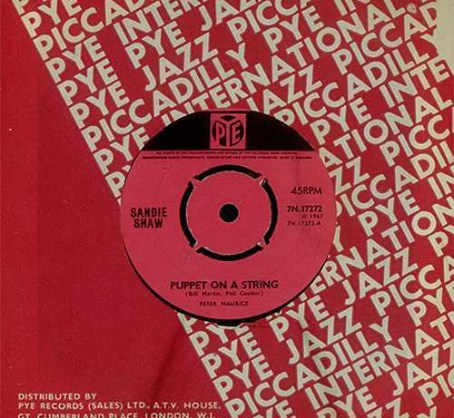
(There’s) Always Something There to Remind Me, by Sandie Shaw (her 1st of three #1s)
3 weeks, from 22nd October – 12th November 1964
There are soft, warm horns, and a little cha-cha-cha, bossanova beat. The ting of a typewriter reaching the end of a line. And a warm, playful voice… I walk along the city streets you used to walk along with me… Cute and glamorous – it kind of sounds like a French person singing in English (not that Sandie Shaw is French in any way – she’s Dagenham born and bred.)
It’s a song about a lost love, about how small things – streets and cafes – can remind you of the ones that got away. Oh how can I, Forget you, When there is always something there to remind me…? But, at the same time, it’s not a sad song. I’m not really sure what ‘kind’ of song it is…
It straddles lots of borders: it’s a bit of a ballad, a bit of a torch song, a bit of a standard pop song with a rock song looking to burst through. Listen to all the instruments involved: the horns, the orchestral strings, the twangy, Shadows-esque guitars. Plus the way Shaw sings – soft and lovelorn in the verses; shouty for the chorus. And then there’s the woah-waoh-waaaaa! and the cascading piano that bookmark either end of the violin solo.
There’s a lot going on here, but I like it. ‘(There’s) Always Something There to Remind Me’ is another song I knew – I could have sung the chorus – but had never listened to in any detail. It’s another Bacharach & David number (they’re starting to rack up) and I love the completely pointless brackets in the title. I like it because it doesn’t know, and probably doesn’t care, what kind of song it is. Everything’s been chucked in and given a good mix, and the end result is a classy little #1 hit.
The only bit that jars is the I was born to love you, And I will never be free… line, because this might have been the swinging sixties, but girls were still expected to pine after their want-away men. Still, Shaw just about sells it with vocals that are both spunky and a little vulnerable.
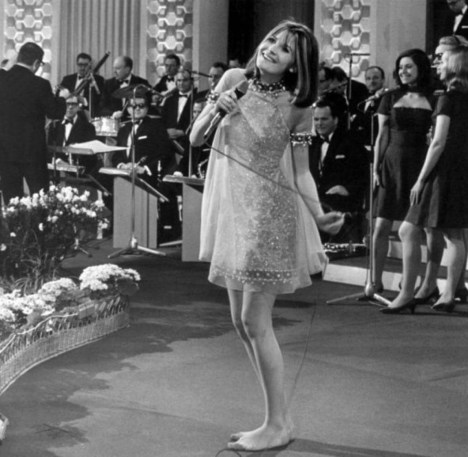
Sandie Shaw herself is, to me anyway, super-sixties. Just the name, without knowing anything about her, and its playful alliteration dates it to within a couple of years (her real name was Sandra.) And pictures of her taken in late ’64, when this was sitting atop the charts, show a foxy, mascaraed, chunky-fringed girl (she was but seventeen) in knee-high floral dresses. You can easily picture her racing around swinging London town on the back of a scooter, bouncing from glamorous party to glamorous party, from Carnaby Street to King’s Cross.
But… perhaps this tune is actually a victim its era. It’s a good record – a sad song with an upbeat vibe – and yet it pales a little in comparison to some of the era-defining records that have topped the charts recently. A nice song lost among the greats? Our next post is a recap, and so we’ll be able to wade back through all the recent #1s, and really sort the downright brilliant hits from the simply very good. Until then…
In comes an intro that isn’t messing around… Sturdy, confident drums… Then Dun-dun-dun-dun-dun… An intro that builds – a layer added with every repetition – until it morphs into a chain-link of a riff.
Oh, Pretty Woman, by Roy Orbison (his 3rd and final #1)
2 weeks, from 8th – 22nd October / 1 week, from 12th – 19th November 1964 (3 weeks total)
And then in comes that voice. The Big O. Reigning it in a little compared to his last, full on operetta of a #1 single, ‘It’s Over’. Pretty woman, Walkin’ down the street, Pretty woman, The kind I’d like to meet… Now, let’s pause for just a second. That ‘I’d’ right there, twenty seconds in, makes or breaks this song. ‘I’d like to meet…’ suggests that he’s been a little unlucky in love. Make it ‘I like to meet…’ as some sources do claim, and the singer suddenly becomes a player, a predator, and the song a little icky. I’m going to trust that it’s an ‘I’d’…
Anyway. Roy’s just hanging out, chilling, watching the girls go by. Pretty woman… I don’t believe you, You’re not the truth, No-one could look as good as you… And then a spoken Mercy! that is truly sublime. Pretty woman, Won’t you pardon me, Pretty woman, I couldn’t help but see… That you look lovely as can be, Are you lonely, Just like me…? He may be ogling and approaching passers-by, but he’s a perfect gentleman about it. Plus, he’s lonely. There’s a tenderness to this song that lifts it above other stalker-anthems like ‘I’m Walking Behind You’ and ‘Every Breath You Take.’
Then, though, Roy does something that even he probably can’t get away with. The grrrrrooooowwwwllllll. Let’s pretend the growl never happens, OK? We get to the bridge – a real fifties rock ‘n’ roll throwback – that seals this record’s place among the greats. Pretty woman, Stop a while, Pretty woman, Talk a while… while the drums roll, and a piano tinkles.
As with ‘It’s Over’, ‘Oh, Pretty Woman’ stands out against the musical landscape of 1964. It could have been a hit five years earlier, or ten years later. I’m not sure you could say the same of ‘Do Wah Diddy Diddy’. The Roy Orbison renaissance (the Roynaissance, if I may) of ’64 is probably the most pleasant surprise in a spectacular year of pop music. Though to be honest, he hadn’t been anywhere, and had been scoring big hits throughout the early sixties. It’s just that none of them had made it to the top of the charts.
We get to the climax of the song, and an already brilliant song is elevated even further. The rules of pop music never applied to Roy Orbison, and he bends them to great effect here. He serves us a cliff-hanger, similar to the one he dishes up at the end of ‘Running Scared’. The woman doesn’t stop, and he’s left disappointed. He slows it down, in his trademark talking-singing-freestyling style: Don’t walk away, Hey…. OK… If that’s the way it must be, OK… Then another moment of perfection – But, wait… Cut to the same drumbeat that opened the song. What’s that I see…? She’s turned around. She’s coming back! Of course she’s coming back. Was there a woman alive who could resist the Orbison charm?
I, as I’m sure you’ve realised, love this record. It’s a Rolling Stone Top 500, Rock n Roll Hall of Fame kind of record. A song that nobody can say a bad word about. I love Roy Orbison too, and still remember getting his greatest hits as a Christmas present back as a kid. Perhaps with the exception of Elvis, no other star of the fifties and sixties had an identifiable image like Roy Orbison. Dark suit, dark glasses, guitar, quiff. It’s up there with Michael Jackson’s hat and glove, and Madonna’s pointy bra. You may think it’s superficial; but it’s a hallmark of the very best pop stars.
Following this, Orbison suffered some pretty lean years in terms of chart hits, and some unimaginable tragedies: he lost his wife and his two eldest sons in the space of two years. But, as with all the greats he came back – The Travelling Wilburys, ‘You Got It’ and all that. And then, just as his comeback was picking up speed, and in a twist befitting one of his greatest ballads, he had a heart-attack and died, in 1988, aged just fifty-two. He’s a legend – plain and simple. The songs that defied convention, the operatic voice, and the dark glasses. The Big O.