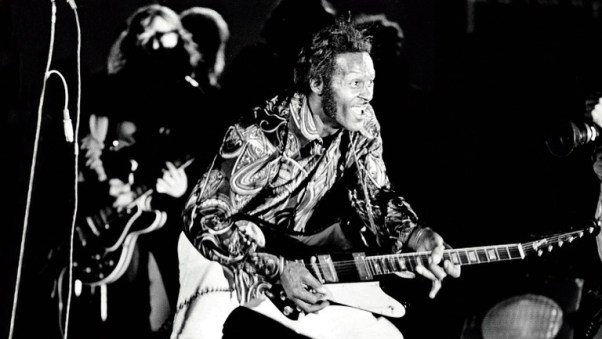
323. ‘My Ding-A-Ling’, by Chuck Berry

And so we come to our alma mater. We must do our alma mater

bb24-2017-coda-berry-billboard-1548-768x433

My Ding-a-Ling, by Chuck Berry (his 1st and only #1)

4 weeks, from 19th November – 17th December 1972

Come along one and all, for the touching tale of a young boy and his favourite childhood toy: When I was, A little bitty boy, My grandmother bought me a cute little toy… Silver bells, Hanging on a string, She told me it was my ding-a-ling-a-ling…

In this live-est of live number ones, the audience sing approximately half of the song. The girls in the audience give us My… While the boys give us Ding-a-Ling! Girls: I want you to play with my… Boys: Ding-a-Ling! While Chuck croons his encouragement: Beautiful! I think it’s a beautiful little song, really I do…

Mum takes the boy to grammar school, but he stops off in the vestibule. (Find me, if you can, another #1 single that includes the word ‘vestibule’.) Every time that bell would ring, Catch me playing with my ding-a-ling-a-ling… Life brings along many trials and tribulations for the hero of the piece but first and foremost, no matter the danger, the lad looks after his prized possession. Climbing the garden wall, swimming across Turtle Creek… All the while holding onto his ding-a-ling. You can guess where every verse is going after the first line; but that’s the beauty of it. Like all lame jokes you can see it coming a mile off, bounding over the horizon like a big dumb dog.

And Chuck Berry’s enthusiasm for this silliest of silly songs really helps to sell it. The spoken asides – the two girls singing in harmony, the guy singing in rhyme (that’s alright, brother, you gotta right baby) – are the best bits. In an extended version that runs to well over eleven minutes, Berry can be heard briefing the audience on how to sing. It is complete end-of-the-pier, pantomime smut, with lines like: We’ll teach the boy’s first, cos they’ve only got one part… (You notice how the boy’s part starts rising right there?)… Now boys you gotta come in strong with your ding-a-lings… It’s a very funny listen – those aren’t even the dirtiest bits – if your sense of humour is as underdeveloped as mine… When it comes to the verse dedicated to those who will not sing, the glee in Berry’s voice as he changes the lyrics to Your ding-a-ling, Your ding-a-ling, We saw you playin’ with your ding-a-ling…! is unmistakeable.

Chuck+Berry+My+Ding-A-Ling+-+Inj-493600

I’ve been looking forward to writing about ‘My Ding-A-Ling’ ever since I started this blog. For a start, it’s Chuck Berry finally getting a #1 single. He, more than any other artist, is rock ‘n’ roll. He’d only had one (1!) Top 20 hit in the fifties – ‘Sweet Little Sixteen’, which peaked at #16! In the sixties, when his influence on beat bands became evident, he started hitting the top 10 with discs like ‘No Particular Place to Go’. By 1972, though, he was a veteran; a legacy act. This had been recorded in February, at the Lanchester Arts Festival in Coventry, and was belatedly pushed as a single by a radio station in Boston.

The other reason I’d been looking forward to writing about this record? The controversy, of course. Radio stations refused to play it (duh). Not that there’s anything wrong with the lyrics on face-value, but the fun that Chuck and the audience are having singing along like drunks at closing time means that even the most innocent of minds can get in on the innuendo. Mary Whitehouse, last seen campaigning against Alice Cooper’s ‘School’s Out’, claimed that whole classes of young boys across the nation were lowering their trousers, ‘singing the song and giving it the indecent interpretation… that is so obvious.’ Which, if they weren’t doing before Mary made this claim; they certainly were afterwards.

This tune had been around for a long time, since the 19th century in fact, in the form of the American folk number ‘Little Brown Jug’. It was first recorded as ‘My Ding-a-Ling’ by Dave Bartholomew in 1952, and if you thought Berry’s version was bawdy then you’re in for a treat with the original (sample lyric: When you’re young and on the go, Your ding-a-ling won’t ever get sore…)

There are a lot of people who think of it as sacrilege that this was Chuck Berry’s biggest hit. Which I understand, on one level. But, at least it’s fun. Compare and contrast with Eddie Cochran – another rock ‘n’ roller who, after genre-defining hits like ‘Summertime Blues’ and ‘C’mon Everybody’ reached #1 with the soppy ‘Three Steps to Heaven’. Plus, he was dead. Chuck Berry had decades of playing with his ding-a-ling to come after this (though, given some of the allegations made against him over the years that might not be the best way to phrase it). He died in 2017, aged ninety.

To conclude, then. This may be puerile, and silly. It may not be anywhere near as momentous a record as ‘Johnny B. Goode’, or ‘Rock ‘n’ Roll Music’, or ‘Maybelline’, or hundreds of Chuck Berry’s earlier hits. But I love it for what it is. Somehow, some way, ‘My Ding-A-Ling’ is every bit as rock ‘n’ roll as his classic hits.

Follow along with my #1s Blog playlist, here.

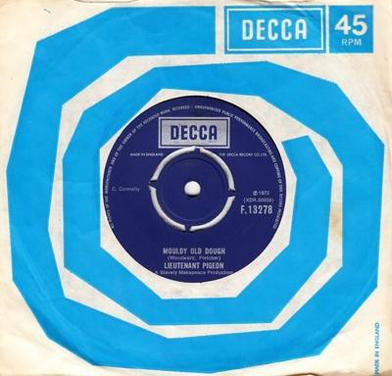
321. ‘Mouldy Old Dough’, by Lieutenant Pigeon

I’ve heard of this song before – for better or for worse – but don’t think I’d ever heard it, in full, until now. And boy, is it strange…

lieutenantpigeon000

Mouldy Old Dough, by Lieutenant Pigeon (their 1st and only #1)

4 weeks, from 8th October – 5th November 1972

It starts with a military drum beat, and for a second I’m worried that we’re getting 1972’s second pipes ‘n’ drums #1 single. Then we get a flute, and I’m picturing an orange march. Then we get a boozy, woozy, synthesised rock ‘n’ roll piano, and we’re in a crowded German beerhall.

Two immediate points of reference jump out at me. There’s Chicory Tip’s similarly stomping ‘Son of My Father’ from a few months back. And then there’s the work of Joe Meek a decade ago: The Tornados, and ‘Have I the Right?’ and so on. There’s a lot of similarities there, but they don’t fully explain what the hell is going on here.

‘Mouldy Old Dough’ is an instrumental, save for the title being growled by what sounds like a very old man with no teeth. Apparently the line Dirty old man… is also buried in there, deep within the soupy mix, but I can’t make it out. It is so rough and ready, this record. It sounds like an old demo that was burnt, buried in a shallow grave, then dug up years later, released and sent to the top of the charts…

download

Have you ever eaten durian? It’s a huge spiky fruit, really popular in south-east Asia, with a smell somewhere between sweaty socks and rotten onions. Apparently, though, if you can get past the stench the actual flesh of the fruit is quite nice. I’ve never been able to get past the stink but feel that ‘Mouldy Old Dough’ might be the durian fruit of #1 singles. Get past your initial doubts and reservations, your initial what the hell?, and by the third or fourth listen you start to find something charming buried deep within its relentless, plodding, churning beat.

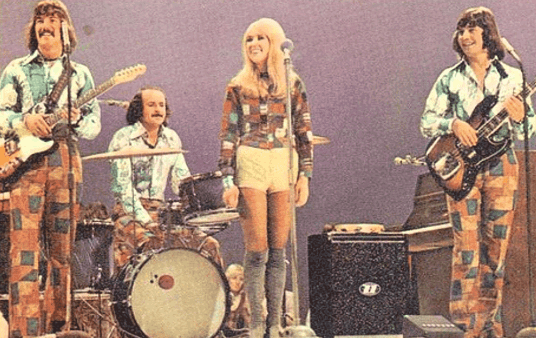
The backstory of Lieutenant Pigeon only adds to the record’s charm. They were an experimental band from Coventry, fronted by Rob Woodward, and featuring his mum, Hilda, on piano. She’s basically the star of this record, as it’s her melancholy piano line that holds it all together. ‘Mouldy Old Dough’ was recorded in their living room (what I mistook for synths is just poor sound insulation!) When asked what it was all about, Rob admitted that he had no idea… Despite being the composer. Honest. I like it. The follow-up to this, ‘Desperate Dan’, made #17 and after that the charts were a Pigeon-free zone… The Woodwards are still the only mother and son combo to ever top the UK singles chart.

And isn’t that nice? Lieutenant Pigeon still record and release music to this day, mainly online, while Hilda died twenty years back. She was fifty-eight when this record hit the top of the charts, and she’s still in the Top 10 oldest people to feature on a number one single. By the end the marching beat has transformed into a glam-rock stomp as we fade out. As weird as this record sounds – and it does sounds pretty darn weird – it still somehow fits in with the styles of the time…

308. ‘I’d Like to Teach the World to Sing (In Perfect Harmony)’, by The New Seekers

I knew the chorus of this song, as everyone does, what with it having firmly imbedded itself in our popular culture. And so, I was fully expecting a cheesy, sing-along record…

p03kyxdn

I’d Like to Teach the World to Sing (In Perfect Harmony), by The New Seekers (their 1st of two #1s)

4 weeks, from 2nd – 30th January 1972

…but was not prepared for just how sickly saccharine this song truly is. Do not play this record on a full stomach! The melody is jaunty, the vocals are twee: I’d like to build the world a home, And furnish it with love… Grow apple trees, And honey bees, And snow-white turtle doves… I mean, eeesh. (*Insert vomiting emoji*)

The singers, with their gentle acoustic guitars, sound like earnest church youth-camp leaders around a campfire. Or the bouncy volunteers that confront you on the street, asking for your signature in some worthy cause. I’d like to teach the world to sing, In perfect harmony, And I’d like to hold it in my arms, And keep it company… They sound utterly insufferable – in case I wasn’t making that clear – though I wouldn’t bet against at least two of them having a crippling drug addiction, because nobody is naturally this perky. I do like the bass-line, though.

The message is one of peace and love, obviously, which is nice and all. But the lyrics never get above ‘primary school assembly’ level. We’d all like everyone to get along better and love another, obviously, but the Summer of Love has been and gone – with far better music than this – while a couple of years ago it was all doom and gloom at the top of the charts: ‘Bad Moon Rising’ and ‘In the Year 2525’. This record is the sound of people giving up on the hippy dream and/or a cynical counter-culture, and settling for meaningless crap. And listening to this today, given the absolute shitshow that 2020 has been so far, well it’s almost unbearable.

Plus. Plus, plus, plus. The one other thing that everyone knows about ‘I’d Like to Teach the World to Sing’, other than the sugary chorus, is that it originated from a jingle in a Coca-Cola advert. I’d like to buy the world a coke… etc. etc. For this ‘anthem’ of world-peace to have stemmed from one of the world’s mega-corporations, a company that floods every corner of the globe with its spectacularly unhealthy soft drinks and subsequent litter, is the piece de resistance. It’s actually quite funny.

R-541726-1541433490-4759.jpeg

I’ll get down from my high-horse now. This record wasn’t meant to be taken so seriously. It’s just a cute little pop song aimed at the kids. But, at the same time – back on the high horse for a second – I can’t help feeling that, for people in 1972, spending a few pounds on this shite was the same as people nowadays changing their Facebook profile to reflect whatever the week’s worthy cause is. Making the doer feel better about their privilege, while making no difference whatsoever to the world’s problems.

In fact, I’ve grown to detest this record so much in the past half an hour that I’m going to make a bold, bold claim. That it is worse than ‘Chirpy Chirpy Cheep Cheep’. Yes. ‘CCCC’ was inane and annoying. ‘ILTTTWTS(IPH)’ – that’s one hell of an abbreviation – is inane, annoying, and has ideas way above its station.

Finally, one question needs answering. What relation did The New Seekers have to The (old) Seekers, the Australian folk-pop act who scored two #1s in 1965 with the average ‘I’ll Never Find Another You’ and the dirgey ‘The Carnival Is Over’. Well, both bands share one member: Keith Potger, guitarist, who founded The New Seekers in 1969. They had scored a #2 the year before with ‘Never Ending Song of Love’ and will, I’m sure you’ll be thrilled to discover, top the charts one more time before leaving us in peace forever. Till then…

Follow along through the first (almost) 20 years of the charts, with this playlist:

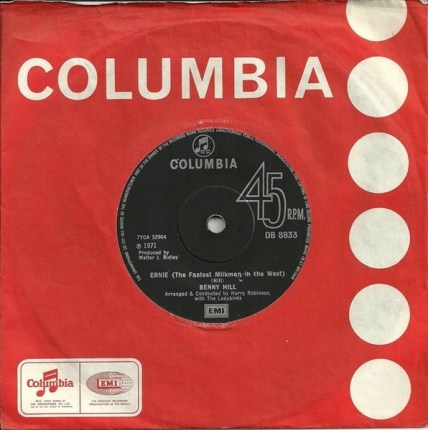
307. ‘Ernie (The Fastest Milkman in the West)’, by Benny Hill

Oh God. You know we must have reached the festive season, when a song like this comes along. Join us then, for the story of Ernie, driver of the fastest milk-cart in the west, and his sworn rival, Two-Tonne Ted, the baker…

ernie-the-fastest-milkman

Ernie (The Fastest Milkman in the West), by Benny Hill (his 1st and only #1)

4 weeks, from 5th December 1971 – 2nd January 1972

It’s set to a faux-Spaghetti Western theme, but narrated (‘sung’ would be too generous a verb) in a west-country accent by comedian Benny Hill. And did someone say ‘innuendo’? Because this song is an innuendo smorgasbord, a triple-shot of double-entendres…

Ernie comes galloping into Market Street, to meet his lady-love, a widow called Sue. They said she was too good for him, She was haughty, proud and chic, But Ernie got his cocoa there, Three times every week… Oo-er, matron, and so forth. On we go – this is a story told at breakneck speed.

Ernie can’t compete with Ted’s wide range of pastries: He tempted her with his treacle tarts, And his tasty wholemeal breads, And when she saw the size, Of his hot-meat pies, It very near turned her head… I’m smiling as I listen, even though I should really know better… He knew once she’d sampled his layer-cake, He’d have his wicked way… Meanwhile, Ernie can but offer milk, and not much else.

So Ernie and Ted have a shoot-out, as must happen in all the best Westerns. As he leapt down from his van, Hot-blood through his veins did course, And he went across to Ernie’s cart, And he didn’t ‘alf kick his ‘orse… (Do you have to be British to get this ropey wordplay?) …whose name was Trigger… Two-Tonne Ted fights dirty, of course, throwing a stale pork-pie that kills Ernie. Sob. Now it’s a pastiche of the old early sixties death-discs, ‘Tell Laura I Love Her’, ‘Johnny Remember Me’ and the like. Two piss-takes for the price of one!

bennyhill-ernie(thefastestmilkmaninthewest)(3)

But. A woman’s needs are many-fold. Sue marries Ted regardless. And on their wedding night, as they lie in their bed, they are haunted by Ernie’s ghostly gold-tops a-rattling in their crate… They won’t forget Ernie! It’s actually a bit of a dud finish to what, compared to most novelty records, has been a pretty funny song. You know, for its time. It also has what must be one of the first music videos – see below. (I do enjoy the fact that Ted still has his hat on in bed.)

For the fourth year running, then, we have a novelty #1 single at Christmas. You can blame The Scaffold for starting it, with the irritating ‘Lily the Pink’, then it was ‘Two Little Boys’, ‘Grandad’ (which hit top-spot just after New Year), and now this. And, for what it’s worth, I like ‘Ernie’ the best of the four. It’s aiming squarely for silly. Not smart, not sentimental… Just plain old pantomime, music-hall, very British, ‘silly’. Not that I’m rushing to add it to my Spotify queue, either, but still.

Benny Hill actually was a milkman, before hitting the big-time, and had written this back in the fifties. He performed it on his show – which in 1971 was pulling in 21 million viewers! (there were only three channels, to be fair) – and then released it as a single. For me, Hill is a slightly vague figure from a time before I was born. He wasn’t on TV growing up, having been pushed aside by the new wave of comedy acts in the eighties. He’s reduced, in my mind, to his famous theme tune playing as he gets chased by an irate crowd.

At the same time, though, I just watched a few of clips on YouTube, and they raised a smile. They’re old-fashioned, and ‘of their time’, but they’re funny, in the worthy tradition of Charlie Chaplin (a huge fan of Hill’s) and Mr. Bean. Plus, you’ll just have to get used to silly novelty songs cropping up every December… and not many will be as tolerable as this!

301. ‘Chirpy Chirpy Cheep Cheep’, by Middle of the Road

On with the next three-hundred! And our 301st #1 gets going with a promising glam rock stomp. Seriously, this is a great record… for the first three or four seconds.

maxresdefault

Chirpy Chirpy Cheep Cheep, by Middle of the Road (their 1st and only #1)

5 weeks, from 13th June – 18th July 1971

Then the handclaps come in, and a voice that sounds like a knock-off Lulu. Where’s your mama gone? (Where’s your mama gone?)… Little baby bird… Far, far away… Mummy bird’s gone, flown the coop. Where’s your papa gone? (Where’s your papa gone?)… Daddy bird too. That’s half the song.

Then: Last night I heard my mama singin’ a song, Woke up this morning and my mama was gone… Oo-wee, Chirpy chirpy cheep cheep! That’s the second half of the song. It gets annoying, quickly. Did anyone say ‘bubblegum’?

No, that’s harsh. ‘Bubblegum’ needn’t be a dirty word. ‘Dizzy’, for example was a fine slice of bubblegum pop. I should have asked: did anyone say ‘cloyingly irritating novelty’? This is a record that shouldn’t appeal to anyone over the age of five. And yet, we all know it. I don’t think I’ve ever heard ‘Chirpy Chirpy Cheep Cheep’ in its entirety until now, but I sure as hell knew that chorus.

The lyrics – the four lines that make up this entire song – are actually quite sad. The singer is either a bird, abandoned in her nest. Or the singer is a child, abandoned by her parents, who sees an abandoned bird and feels a sense of kinship. To her credit, though, she’s not wallowing in despair. Oh no. She sounds as if she’s determined to make something of her life regardless of the tough start. Chirpy chirpy cheep cheep chirp!

2v2JVEhh8xAqeaq

I don’t mind a novelty, but this song makes very little sense, and midway through the chorus starts repeating over and over, and over. Let’s go now! You frantically check that this record isn’t actually six minutes long. All together now! No, just forty seconds left, thank God. One more time now! Phew.

Middle of the Road were (‘are’ actually, they’re still going) a Scottish band, who had a brief burst of fame in the UK in the early seventies, with this and other hits such as ‘Tweedle Dee, Tweedle Dum’ – which I listened to and found to be not as bad as their only #1. They were huge across Europe – I guess the simple lyrics and sugary tunes translated well – and I’ve seen some sources label them as a predecessor to ABBA. (Which is like saying the first ever wheel carved from a hunk of rock by a hairy caveman is a predecessor to a Ferrari.)

Anyway, that’s that. Had Middle of the Road arrived at the top of the charts just a few weeks earlier, then Dana would have had some stiff competition for ‘Worst Chart-Topper’ last time out. But they’re safe, for now…

Enjoy all the previous 300 number ones with this playlist (I promise most of them are better than this.)

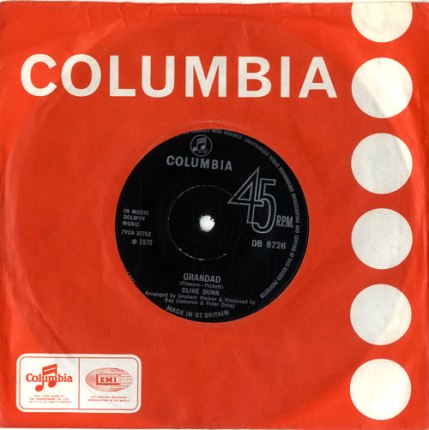
295. ‘Grandad’, by Clive Dunn

What have we here then? A Christmas novelty that made it to #1 a fortnight too late? I know this song, vaguely – well, the chorus at least – and brace myself to write a terrible review.

p03gz7y5

Grandad, by Clive Dunn (his 1st and only #1)

3 weeks, from 3rd – 24th January 1971

Grandad, Grandad, You’re lovely, That’s what we all think of you… And yep, the chorus is truly horrifying. It’s sung by little kids, to their grandpa, but in the creepily lifeless tones of horror-movie children, the sort with shining eyes that lure unsuspecting people into dark, misty forests… However, the song becomes more complex when you get to the verses. This is no saccharine ode to grandparents, oh no.

I’ve been sitting here all day, Thinking… Same old thing ten years away, Thinking… An old man sits in his rocking chair, getting all misty-eyed for days gone by. Penny-farthings on the street… Bows and hoops and spinning tops… The days when motorcars were new and scary, when happiness was a Charlie Chaplin matinee…

But there’s no resolution, no ‘oh getting old isn’t all bad’ twist at the end. In fact it gets worse. After listing all the things he misses, we get a final gut-punch: Familiar things I keep around, Near me… Mem’ries of my younger days, Clearly… Come into my mind… I’m no old man, but I can’t think of a better way to describe the feeling of getting older, of slowly losing your mind to age, of seeing death approaching over the horizon. Get beyond the banjo and the parping tuba, and this is a really depressing number one hit.

But then those bloody kids keep coming in to ruin it. Grandad, You’re lovely… What are they doing? Trying to cheer him up? If I were their grandad I’d be praying for the end to come even quicker. This would be a far, far better, and actually quite subversive, record without them. (I’m not even convinced that they’re real children, though I’m not sure that they had the technology in 1970 to computer-generate such creepy sounding voices.)

CLIVE_DUNN_GRANDAD-572221

Clive Dunn does sound quite geriatric when he sings, especially when he pronounces ‘telephones’ as ‘jelly-phones’, but he was only fifty when ‘Grandad’ hit #1 – a young grandad in anyone’s books. He was, I guess, playing upon his dotty Corporal Jones character from ‘Dad’s Army’, which was one of the biggest shows on TV at the time. Presumably the show’s popularity can explain this strange record’s huge success.

It’s a novelty; but not particularly funny. It’s a children’s record; but more complex and bittersweet than most children would be able to grasp. I can imagine thousands of them bought their grandfathers this record for Christmas, sending the old men into a depressive spiral when they sat down and actually listened to it. Plus, if we assume that the ‘Grandad’ in this record is looking back fifty years, to 1920, then isn’t it weird to think that if this were re-recorded today then the singer might reference ‘listening to Clive Dunn singing ‘Grandad’’ fifty years ago in the lyrics? Mind-bending…!

The UK Number Ones Blog Playlist is here.

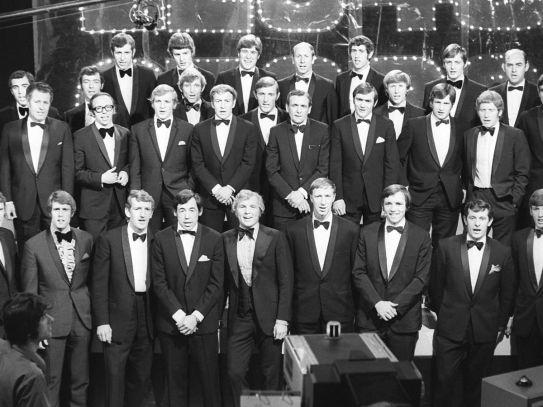
286. ‘Back Home’, by The England World Cup Squad ’70

On paper, I should love this next #1. It combines my two great passions-since-childhood: the pop charts and the World Cup. Except… Music isn’t something you enjoy on paper. It has to go in between your ears. Which is where the problems start with this song.

England-World-Cup-Squad-on-TOTP-in-1970

Back Home, by The England World Cup Squad ‘70 (their 1st and only #1)

3 weeks, from 10th – 31st May 1970

First, some history. England had hosted and won their first, and so far only, football World Cup in 1966, beating West Germany 4-2 in the final. Four years on they were off to Mexico to defend their title. This record, then, was an au revoir to the fans. And it gets going with hand claps and that beat that goes with any sporting occasion – you know: da da dadada dadadada da da. Does it even have a name? Then it’s a marching band and some rousing lyrics.

Back home, They’ll be thinking about us, When we are far away… Back home, They’ll be really behind us, In every game we play… The players put their all into it, singing it like they’re down the pub, rolling out the barrel. We’ll give all we’ve got to give, For the folks… back… home… Interestingly, there’s no explicit mention of them winning the cup, which I suppose is quite modest and sensible.

I have to admit that I’m not a neutral party here. I’m Scottish. Scotland have a fairly terrible football team, and have done for a long time. They last qualified for a major tournament when I was twelve. So for me and most of my fellow countrymen and women – and I’m not proud to admit this but here we are – much of our enjoyment during a World Cup comes from England getting beaten. I hold my hands up. I am biased when it comes to this record.

Then again, even the most ardent England fan would struggle to argue that ‘Back Home’ has much merit beyond nostalgia for a time when they were the world champions. Midway through we get a trumpet solo and some piped-in crowd noises. I half expect Kenneth Wolstenholme’s ‘They think it’s all over…’ commentary, but no.

R-2100102-1264768525.jpeg

It reminds me of a song from the trenches (unfortunately not the last time that the English will equate football with the World Wars.) There’s the simple music hall melody for a start. And the lyrics are all about the folks ‘back home’, as if the team is homesick before they’ve even left, as if they’re missing their sweethearts, as if they don’t really want to go…

And with good reason, perhaps. Their campaign in Mexico was fairly disastrous. Captain Bobby Moore was falsely arrested for stealing a bracelet, keeper Gordon Banks was knocked out by food poisoning (some have since suggested foul-play) and West Germany exacted their revenge by beating them 3-2 in the quarter-finals. Brazil went on to win an iconic final against Italy – Pele, Carlos Alberto and all that.

I accept that there would have been a lot of hype surrounding the defence of their title – they released this record a full two months before the World Cup started – and that this song is fairly inoffensive in the grand scheme of things. At least it’s short, wrapped up in exactly two minutes. But I’d happily never listen to it again. The players clearly enjoyed their experience in the recording studio though, as they went and made a whole album! Ever wondered what ‘Congratulations’, ‘Lily the Pink’ and ‘Sugar Sugar’ sound like when sung by footballers? Wonder no more – the whole album’s on Spotify.

If anybody out there actually enjoyed this latest chart-topper – and who am I to judge? – then you’ll be happy to hear that this is the first of four World Cup themed #1s (plus a European Championship themed #1 for good measure.) They will all be about England – boo! But most of them will be better than ‘Back Home’ – yay! And, just to show that I may be biased but not that biased, here’s a link to the Scotland World Cup Squad’s highest charting single: ‘We Have a Dream’, which reached #5 in 1982. (Spoiler Alert: It’s just as bad, if not worse, than ‘Back Home’.)

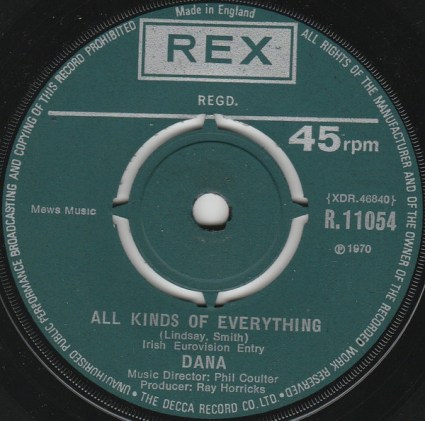
284. ‘All Kinds of Everything’, by Dana

We are only four #1 singles into the 1970s, and we already have a contender for the worst chart-topper of the decade. Prepare yourselves…

dana

All Kinds of Everything, by Dana (her 1st and only #1)

2 weeks, from 12th – 26th April 1970

The intro comes in like the theme-tune to an educational show, aimed at nursery school kids. You brace for something bad, but nothing can quite prepare you for just how bad it’s going to be. Snowdrops and daffodils, Butterflies and bees, Sailboats and fishermen, Things of the sea… The entire song is a list. A list of the things that remind the singer of her special someone. Seagulls, And aeroplanes, Things of the sky… (Seagulls? Who sees a seagull and thinks of their beloved? Maybe he saved her from one that was trying to steal her chips?) All kinds of everything, Remind me of you…

Literally everything reminds her of him. Insects, the wind, wishing wells, morning dew, neon lights, postcards, grey skies or blue… Everything. It just doesn’t work. These are lyrics that could have been written by a ten-year-old (though, actually, I teach ten-year-olds, and it’s insulting of me to think they couldn’t write something better than this.) The only way this song works is if the singer is a wide-eyed child, no older than thirteen.

And, to be fair, Dana does have a very innocent, childlike voice. She sells the drivel that she’s singing, in her lilting Irish accent, and sounds like she believes in it… (*Edit* She was eighteen when ‘All Kinds of Everything’ was released. Far too old.) Things take a slightly creepy turn when she starts to sing of dances, romances, things of the night… And you think, be careful Dana, I know what happens to young Irish girls that find themselves ‘in trouble’. I’ve seen ‘Philomena’…

R-1706278-1477809062-9075.jpeg

This was a hit thanks to the Eurovision Song Contest – an evening famous for terrible music. But not this type of terrible. Eurovision is over the top, camp, cheesy glitz. We’ve had one winner hit #1 so far – Sandie Shaw’s ‘Puppet on a String’ – as well as Cliff’s ‘Congratulations’, which took the runners-up position. Neither of those records were very credible, but they were fun. This, though, isn’t interesting terrible or fun terrible… It’s just terrible terrible. And yet… it won. The rest of Europe heard ‘All Kinds of Everything’ and thought, yeah, go on then.

‘All Kinds of Everything’ was Dana’s first big hit, though she had been releasing music since 1967, and it gave Ireland their first Eurovision win. She would have hits in Ireland, and in Europe, throughout the seventies, but her star slowly waned. By the eighties she had turned to more traditional, Christian music before she was elected as a member of the European Parliament for Connacht-Ulster in 1999. She still records music (in 2007 she released an album called ‘Good Morning Jesus!’, no less.)

Well then. It’s been a scattergun start to the seventies. Like I said, we’re only on the 4th number one and we’ve already had some catchy, no-nonsense pop, a grizzled actor and a genuine classic at the top. And now this… The charts come and go in peaks and troughs. We’re definitely hitting a bit of a trough through the tail-end of ‘69 and into the seventies. But then, the golden days of the swinging sixties couldn’t last forever, could they? We will wait with bated breath for the 1970s to spring fully into life…

275. ‘In the Year 2525 (Exordium and Terminus)’, by Zager & Evans

You see the title of this next #1 hit, and you prepare yourself for something special. We’re off to the year 2525… With a duo that sound like a second-rate magic act.

mainZAGER

In the Year 2525 (Exordium and Terminus), by Zager and Evans (their 1st and only #1)

3 weeks, from 24th August – 14th September 1969

It gets underway with a Spanish guitar and Mariachi-band backing. It reminds me of Dave Dee and Co’s ‘The Legend of Xanadu’, another Latin-flavoured glimpse into a strange world. In the year 2525, If man is still alive, If woman can survive, They may find…

In comes a relentless galloping beat, over which a terrifying vision of the future is unveiled. By the year 3535, you’ll be taking pills to tell you what to think, by 4545 you won’t need your teeth or your eyes… You won’t find a thing to chew, Nobody’s gonna look at you… In 5555, the machines will have taken all the jobs, rendering our limbs obsolete. And by 6565: Ain’t gonna need no husband, Won’t need no wife… You’ll pick your son, Pick your daughter too, From the bottom of a long glass tube… Woah-woah…

Fair to say it’s a pretty pessimistic view of the future. It has the air of a crazed evangelist, preaching angrily from his pulpit, as all the while the beat goes on, and on. The predictions change to years ending in ten, for rhyming purposes, as we go forward. And by 8510, God will have had enough, and will come down to rip it all up and start again. It’s a crazy record. I’m not sure I like it all that much, but it is entertaining…

The final verse is probably the most prescient. In the year 9595, I’m kinda wonderin’, If man is gonna be alive, He’s taken everything this old earth can give, And he ain’t put back nothin’… Woah-woah… Doesn’t that pretty much sum up the fears of 2020, with our rising temperatures, killer viruses and plastic-swilling oceans? In fact, Zager & Evans’ vision of the future hinges on its opening line: If man is still alive… Who here’s willing to put money on humans being around in 2125, let alone 2525?

ZAGER_&_EVANS_IN+THE+YEAR+2525-640089

We’re used to science fiction that looks into the near-future: ‘Back to the Future’ in 2015, ‘Terminator’ in 2029 and so on, so that we can chuckle when we reach the date in question and point out that none of what was predicted has come to pass. But who can actually get their head around the year 2525? It’s five hundred and five years away! And the year 9595, on which the song ends – it is practically impossible for the human mind to imagine that far forward in time. ‘In the Year 2525’ was nominated for a ‘Hugo Award’, for the best science fiction / fantasy works of the year, though, so who am I to question it?

Denny Zager and Rick Evans were a duo from Lincoln, Nebraska, and they are the purest of one-hit wonders. None of their subsequent follow-ups made the charts. This is their sole chart-topping single, on either side of the Atlantic (fittingly, it was #1 in the US as Neil Armstrong set foot on the moon.) Zager is still alive, but Evans sadly passed-away in 2018.

We’re drawing to the end of the 1960s, and this record is almost the direct antithesis of a lot of the positivity we’ve seen in pop music throughout the decade. In fact, 1969 has been a year for some pretty cynical chart-toppers: Peter Sarstedt’s cutting ‘Where Do You Go To…’, The Beatles sarcastic ‘Ballad of John and Yoko’, The Move’s melodramatic break-up in ‘Blackberry Way’. Now this anti-flower power anthem. Two years ago it was ‘All You Need Is Love’; now it’s all the ways in which we, as a race, are doomed…

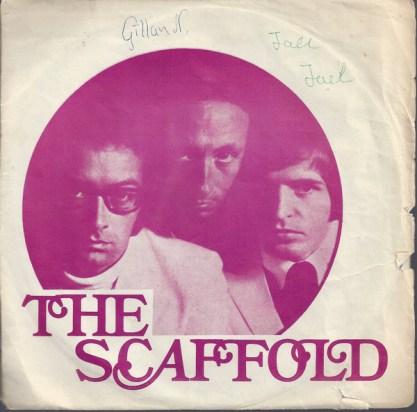
262. ‘Lily the Pink’, by The Scaffold

The final number one single of 1968! Over the course of the twenty-one records that have topped the charts this year, we’ve met a wide range of characters: Bonnie & Clyde, Quinn the Eskimo, Cinderella Rockefella, Lady Madonna… Now please welcome, last but by no means least, Lily the Pink!

Scaffold-1010482

Lily the Pink, by The Scaffold (their 1st and only #1)

3 weeks, from 11th December 1968 – 1st January 1969 / 1 week, from 8th – 15th January 1969 (4 weeks total)

We’ll drink a drink a drink, To Lily the Pink, The saviour of, The human race… The pace is frenetic, the song charges along on an oompah-band beat. For she invented, Medicinal compound, Most efficacious, In every case… And it’s not just Lily the Pink that we meet either, but the cast of poor souls that her medicinal compound has helped.

There’s Mr Frears, with his sticky-out ears… The notably bony Brother Tony… Old Ebeneezer, who thought he was Julius Caesar… Jennifer Eccles, with her terrible freckles… You get the idea. It’s a novelty song. Perfect for a Christmas party, last-orders down the pub sing-along when everybody’s a bit pissed. Pure music-hall.

It reminds me of two, very different songs. First, there’s ‘Oom-pah-pah’, from the musical ‘Oliver!’ Another rowdy bar-room tune, in which the drinkers raise their glasses to the life-giving properties of the mythical ‘oom-pah-pah’. It’s a classic. Secondly, this also reminds me, with its boing-boing rhythm, of another (in)famous Christmas #1… ‘Mr Blobby’. (Which very much isn’t a classic.)

‘Lily the Pink’ falls somewhere in between these two songs. It’s fun, for a verse or two, and then it gets pretty old pretty quick. There’s an unfortunate stuttering verse – Johnny Hammer, Had a terrible s-s-s-s-stammer… – and it’s very hammy by the end, when the medicinal compound proves too strong even for Lily the Pink, and she snuffs it. It’s definitely a song that would improve the more you drink…

R-8669325-1546580204-5379.jpeg

Speaking of which, it is based on a much older, American drinking song – ‘The Ballad of Lydia Pinkham’ – which in turn was inspired by an actual drug – Lydia E. Pinkham’s Vegetable Compound, from the 1870s, which relieved menstrual cramps. The fact that it was 40 proof alcohol meant that plenty of people not suffering from period-pains drank it anyway… And apparently the original verses were saucier even than The Scaffold’s end-of-the-pier version.

Just as interesting as the song’s origins are the musicians involved in its recording. The Scaffold were a comedy trio from Liverpool – one of whom was Peter McCartney (brother of Paul.) Musicians they were not, and so to help them on ‘Lily the Pink’ you can hear Graham Nash of The Hollies (the line about ‘Jennifer Eccles’ is a reference to a Hollies’ hit), Tim Rice and an unknown singer by the name of Reginald Dwight, who may or may not have gone on to bigger things under a different name.

What’s that? You thought that 1968 was going to finish off with some bland, run-of-the-mill pop song? Well you haven’t been paying attention, have you? This year has brought us the most eclectic bunch of #1s so far. We’ve veered from silly novelties, to bizarro fantasy epics, from spaghetti western soundtracks to the birth of shock-rock. All with healthy doses of jazz, crooning, rock ‘n’ roll, and Cliff, in between. Next up, we tick on over into the final year of the swinging sixties, and hope that it can be half as interesting as the year just gone…

Enjoy all the number ones from 1968, and earlier, here: