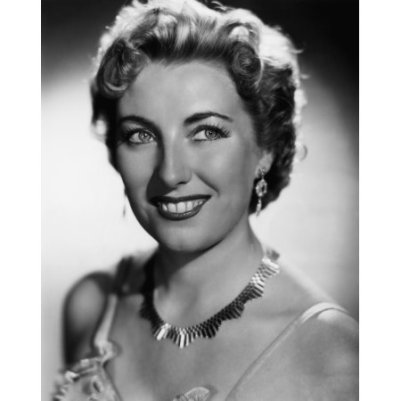
33. ‘Cherry Pink and Apple Blossom White’, by Eddie Calvert

maxresdefault

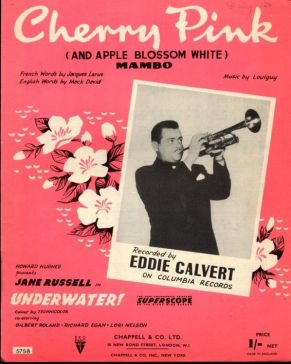
Cherry Pink and Apple Blossom White, by Eddie Calvert (his 2nd of two #1s)

4 weeks, from 27th May to 24th June 1955

And so, for the second time in chart history, two versions of the same song take their turn at the top. It’s not quite as dramatic as David Whitfield and Frankie Laine replacing one another with ‘Answer Me’ back in November 1953 (and then completing the ’50s chart bingo board by tying for the number one slot), but still.

You do have to wonder, once again, why people needed multiple versions of the same song. Was it a case of people buying every version of ‘Cherry Pink and Apple Blossom White’ going because they really loved the song? Or was it Team Perez Vs Team Eddie? As far as I’m concerned, there should only have been one winner…

This is the knock-off version, the Poundland version, the 2-bit ringtone version… you get the idea. It is the same tune: the same notes and rhythm without any of the oomph of Prado’s version. Calvert is trying all the same tricks, even doing the same drawn-out, low then high, note that Billy Regis did to such giddy effect on the original. (I know they are contemporaneous, but the Prado version will from now on be ‘the original’ to me) Even Calvert’s trumpet sounds different, reedy, not up to the task. Why on earth this lasted twice as long at number one is a mystery.

But… maybe it shouldn’t be. Calvert was British, for a start, not some moustachioed Cuban. And everything about this record that I’m filing in the ‘Against’ column – the fact that it’s a bit restrained, a bit stiff, a bit less raunchy – probably actually explains this version’s greater success. Calvert was from Preston, and he certainly did not go ‘Huh!’, ‘Ooh!’ and ‘Aah!’ during his records. Respectable households could drop this disc on to the gramophone after Sunday lunch safe in the knowledge that grandma wouldn’t be requiring the smelling salts.
cherry-pink-and-apple-blossom-white-eddie-calvert-jane-russell

There is a section, towards the end of this version, in which Calvert goes a little wild and takes it away from Prado’s version, which is commendable, but no. The ending of this version, in particular, is a complete damp squib. It’s not an awful #1 – a good tune is a good tune – but Perez Prado just did so much more with it. We won’t be hearing from Eddie Calvert again in this countdown, I’m not terribly sad to say. He burned brightly, but briefly, and didn’t have an awful lot of singles chart success beyond 1955.

It’s worth also noting here that we are in the midst of a film/musical soundtrack run here: two versions of ‘Cherry Pink and Apple Blossom White’, which featured in the Jane Russell movie ‘Underwater!’, as well as Tony Bennett’s Broadway hit ‘Stranger in Paradise’ sandwiched between. I suppose it would be hard to downplay the role cinemas had in influencing music buying tastes in the 1950s. Very few people owned a TV set, radio barely played any chart music… Films were one of the few places where people could actually hear current, popular music. Get your song in a film and hey presto! And it’s a trick that still works to this day.
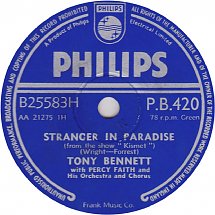
32. ‘Stranger in Paradise’, by Tony Bennett

tony-bennett-stranger-in-paradise-philips-78-s

Stranger in Paradise, by Tony Bennett (his 1st and only #1)

2 weeks, from 13th to 27th May 1955

I don’t know this song, or do I?

The opening melody sounds very familiar – familiar in a film score-ish, symphonic way. The sort of music you might here in a lift, or on a held call. Then the lyrics kick in and I’m not so sure I do know this song after all. But that melody… Are we listening to the first ever sample to top the charts? I didn’t think that was a thing until the late ’80s.

Take my hand, Tony croons. I’m a stranger in paradise… Lost in a wonderland… Starry eyed… The lyrics are all standard-issue mid-fifties. At first. Then things take an interesting turn. The singer is in love, unrequited, and can but stare from afar at his love. He is a mortal, and his love is an angel. He saw her face and ascended out of the common place, into the rare, somewhere in space… He hangs suspended, until he knows his love cares, and that she will answer his fervent prayer. It’s all quite cerebral. Probably the most complex song, lyrically, to have topped the charts so far.

It’s a well-constructed, immaculately sung, beautifully polished record. It’s no throwaway flash in the pan, yet to me it lacks something. Perhaps it just can’t step out from the shadow of the raunchy mambo that preceded it. File it under ‘Pleasant, But Dull’ – a record that I can understand others enjoying, but that I fail to really get myself. But boy, did others enjoy this record back in the spring of 1955! In the week that Mr. Bennett ‘ascended’ to the top, there were no fewer than five other versions of ‘Stranger in Paradise’ in the singles chart (by now a Top 20). The Four Aces, Bing Crosby, Tony Martin and Don Cornell all had a go. Eddie Calvert even parped a version out on his trumpet.

This is something that I fail to grasp about these early charts… While multiple hits by the same artist clogging up the charts (Sheeran! Bieber!) can be frustrating, it is ultimately an indicator of their popularity. But who needs six versions of the same bloody song? It’s not as if one version was ska, one version death metal – I’m confident that the Don Cornell version sounds pretty much like all the others. Anyway, Tony Bennett won the ‘Stranger in Paradise’ race, and it at least meant that a musical legend ticked a UK #1 off his bucket list. A still active legend too. He recently hit ninety, and released his most recent studio album in 2015. The year before that he released a duets album with Lady Gaga. And so, though we are wading through the mists of time (chart-history wise), we have a direct link here to the modern day. That’s quite cool.

1152686

I was about to leave it there, but I still had a nagging feeling that there was more to this song than I had realised. I know that melody – doo doo doo dooby dooby doo – and the lyrics are a little bit too weird to exist only for the benefit of this one hit record. And so it emerges… ‘Stranger in Paradise’ is from the musical ‘Kismet’, which is in turn adapted from the music of 19th Century Russian composer Alexander Borodin. Hence the outré lyrics, hence the familiar melody…

I want to like this song: it’s music for grown-ups. But I also want to read all seven volumes of ‘A la Recherche du Temps Perdu’ and learn Italian. Some things just aren’t going to happen.

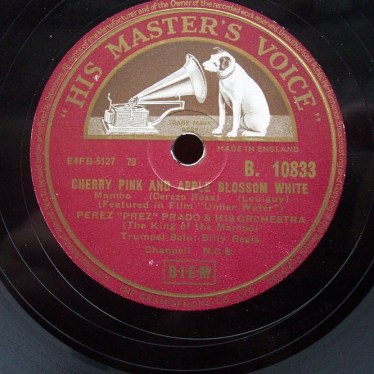
31. ‘Cherry Pink and Apple Blossom White’, by Perez ‘Prez’ Prado & His Orchestra

s-l1000

Cherry Pink and Apple Blossom White, by Perez ‘Prez’ Prado & His Orchestra (his 1st and only #1)

2 weeks, from 29th April to 13th May 1955

What a way to kick off the next thirty!

I’ve given instrumentals a hard time so far in this rundown. The lack of any lyrics creates a barrier, for me, between the song and the listener. You can listen to a Mantovani record and think “Isn’t that a nice melody”, but the fact that there are no words to tie it to a particular feeling or experience in your life means that the record is that step further removed from you. Like a film beautifully acted but in a language you cannot understand.

Having said all that… I’m going to prove myself massively wrong with this post. The fourth instrumental to top the UK Singles chart is also, by far, the sexiest record to top said singles charts. And there are no words. Well – there are no words aside from ‘Huh!’, ‘Hah!’ and ‘Oooh’. Which is a large part of this track’s said sexiness.

Following on from ‘Mambo Italiano’ (which wasn’t really a mambo, but hey), the UK was clearly in some sort of Latin fever in early 1955. Though perhaps not, as a quick glance at the chart for the week Perez ‘Prez’ hit the top shows only one other record that sounds vaguely Latino… A different version of ‘Cherry Pink and Apple Blossom White’ (which we’ll meet very soon at the top of the charts). But, for the purposes of this narrative, let’s say that the UK – finally casting off the shackles of rationing and wartime rubble – wanted to shake some booty and, while perhaps not quite ready for straight up rock ‘n’ roll, turned to some equally raunchy mambo. Further evidence towards my idea that rock ‘n’ roll didn’t just arrive with ‘Rock Around the Clock’ – it was slowly filtering in through Rosemary Clooney’s giggle, Winifred Atwell’s boogie and Johnnie Ray’s yelps. And Perez ‘Prez’ Prado’s trumpet.

Except the trumpet that makes this record isn’t being played by the man on the credits. We’ll get to that in a second. First – this record has perhaps the most intense intro we’ve heard yet. Basically it’s BOOM BOOM BOOM BOOM BOOM BOOM BOOM on a load of trumpets and cymbals, before the rhythm kicks in. The lead trumpet was played by a man called Billy Regis, who absolutely makes this record by drawing out one note in particular over and over again, by sliding it down then up in a manner that sounds a little bit drunk, a little bit woozy, and that, most importantly, would allow a couple in a Southend ballroom to draw that little bit closer for a second, before the main melody jumped back in.

R-582429-1341876426-2330.jpeg

Prado was more of a conductor, I guess, and it is his ‘Huhs’ and ‘Hahs’ that can be heard as he exerts his charges to squeeze every drop of sexiness from their instruments (that sounded ruder than I intended – you know what I mean). There are also some other trumpets (I guess they are trumpets) playing notes so low that it’s almost obscene. I recognise them from Lou Bega’s classic cover of ‘Mambo No.5’, from another golden age of Latin music in the UK charts, which we won’t be getting to for a long, long time. Incidentally, Perez Prado recorded the original version of that song, too.

But the final word has to go to Billy Regis, whose trumpet ends the record. He reimagines the bombastic ending – from which so many earlier chart-toppers have suffered – and it works so much better without lyrics. THIS IS THE END OF THE SONG becomes DOOO DOOO (pause) DOOOOOOOOO, and it again allows Janet and John from Southend to draw close and to feel one another’s bodies, taught and trembling from two and a half minutes of intense mambo.

‘Huh!’ and, indeed, ‘Hah!’

Recap: #1 – #30

A quick recap, as we hit thirty. Thirty number ones in a little under two and a half years. The prehistoric chart toppers.

Perhaps the most impressive thing about these super old #1s has been that very few of them have sounded terrible to my 21st Century ears. With the notable exceptions of David Whitfield (sorry David, but nope) and Vera Lynn (who already was from another era), they haven’t sounded too old-fashioned.

Whether I’d want to listen to that many of them ever again is another matter, however. Our very first chart-topper was the bombastic and ever-so earnest ‘Here in My Heart’, and it kind of set the template for a lot of what followed. Frankie Laine, Eddie Fisher and Tennessee Ernie Ford have spent the best part of a year at the top, in total, with overwrought and slightly silly sounding declarations of love and faithfulness. Even swingin’ Sinatra was guilty with his dull first number one ‘Three Coins in the Fountain’. Still, you have to admire their honesty. They were putting it all out there – hearts on sleeves.

It has actually been the ladies who have brought the glamour and, dare we say, the sexiness to the party. Jo Stafford, Kay Starr and Kitty Kallen all hit the top with fun, laidback slithers of fifties jazz-pop. Recently, Rosemary Clooney has taken it to another level with her breezy giggle and girl-band fervour on ‘This Ole House’ and ‘Mambo Italiano’.

And then there have been the anomalies (for what would a record chart be without those songs that make you go ‘What the actual…?’) Stand up and take a bow ‘I See the Moon’, by the Stargazers, for taking the newly conceived, first time ever, ‘WTAF’ prize.

I’m also going to christen an award for the most forgettable of the past 30 chart toppers – the not terrible but not great – the tracks that I’ve already forgotten existed… The ‘Meh’ Award. Honourable mentions for ‘Softly, Softly’ by Ruby Murray, and ‘Give Me Your Word’, the two most recent number ones, but… Take a bow, Don Cornell, with your perfectly average ‘Hold My Hand’. It really was a… Well, I’ve forgotten what it was. Which is why it won.

I’ve also made a lot of the difference so far between the UK recorded hits and those by US artists. And this is perhaps the most obvious, socio-economic, ‘lets get serious for a minute here’ point to be made from looking at the ‘pre-rock’ charts. That the US stars just had that extra level of glamour, of confidence, of razzmatazz, compared to the stuffier and more staid UK stars. And, yep, in the early ’50s the US was the daddy. Relatively undamaged by war (casualties aside), economy booming, disposable income growing; while Brits were still queuing for butter and nylons, and living in prefab houses. This clearly comes through in the records we’ve heard: compare and contrast Guy Mitchell’s swagger with David Whitfield’s clipped, repressed delivery; compare even the most basic, 1954-by-numbers song from Doris Day with old Vera Lynn (sorry to keep picking on you, Vera…) But, as I noted recently, by early ’55 things were starting to shift: Dickie Valentine and Ruby Murray were two young British singers who hit the top while sounding like Americans.

Anyway, I’ll conclude each of these round-ups by choosing the very best and very worst of the past 30 so…

Let’s start with the worst. I’ve given Vera Lynn a hard enough time, so I won’t choose ‘My Son, My Son’. And the Stargazers first number one ‘Broken Wings’ was pretty morose, but in some ways it was shit in a specifically British way – all Hammond organs and posh vocals – that it was kind of endearing. Nope, the first award for ‘Worst #1’ goes to… ‘Cara Mia’ by David Whitfield and Mantovani’s orchestra, for dragging popular music back to the 1890s. 10 weeks at the top isn’t any sort of vindication, either.

Let’s end on a high, though. The best ones – and there are more good #1s to choose from than there are terrible #1s, believe it or not. Honourable mentions for Perry Como and his ‘papayas’, for ‘I Believe’ as the record-setting juggernaut that it was… But my top 3 are: ‘Mambo Italiano’, by Rosemary Clooney’, for perfectly straddling the line between cool and crazy. ‘Look at that Girl’ by Guy Mitchell, for being the most perfectly conceived pop song that we’ve heard so far (these are ‘pop’ charts after all). And the winner is, the best chart topper from this bunch of early, early hits… *fanfare*… ‘Such a Night’, by Johnnie Ray, for being two minutes of SEX on vinyl (gay sex, no less), and for all the pearls that would have been clutched by concerned mothers when their sons and daughters dropped that record onto their turntables. Here’s to more of that sort of thing in the next 30 UK #1s!

On with the show…

30. ‘Give Me Your Word’, by Tennessee Ernie Ford

tennessee-ernie-river-of-no-return-capitol

Give Me Your Word, by Tennessee Ernie Ford (his 1st of two #1s)

7 weeks, from 11th Mar to 29th Apr 1955

Before we get down to analysing this next chart-topper, let’s just take a second to appreciate the name of the artist that recorded it. Tennessee Ernie Ford… I wonder what kind of music he might make? (*cough* country and western *cough*)

But, no. While he has the voice for a C&W hit, this isn’t the song. He drawls ‘all’ into ‘aawl’ and ‘wants’ into ‘waaonts’, yet from this second this record cracks into gear, with soaring strings and a dramatic piano, we know we ain’t gettin’ a country lament – no tumbleweeds nor howlin’ coyotes. This is a song that means business.

It’s basically a marriage proposal – a lot of talk of vows, of being beside him, of words being given for ever and always. And, to be fair, you probably wouldn’t say ‘no’ to Tennessee: he has a deep sonorous voice, the voice of a man who can chop trees and wrestle cattle. Rough hands but a warm heart, that kind of thing. The only time the voice lets him down is at the very end, when a song of this gravitas needs a slightly more powerful, and slightly less Pingu sounding finish.

And is it just me, or are these chart toppers starting to get sexier? Ruby Murray was all about softly, breathlessly, touching lips and now Mr. Ford carries on the theme. Give me your lips, he drawls, and let your lips remain. Remain where, you might ask? It’s hardly Prince at his raunchiest; but it certainly isn’t something Eddie Fisher would have sung about either.

ErnieFord

Looking at pictures of Tennessee Ernie, he looks somewhat like you would expect. Perhaps not as rugged as his voice makes him sound, but he has a natty little moustache, and clearly liked to play up his cowboy credentials, with plenty of Stetson ‘n’ rodeo-tassels popping up on a Google image search. He was really born in Tennessee, too.

But, for a song that starts of with grand intent, this is actually pretty dull. Or at least average. File it along with ‘Answer Me’ and ‘Cara Mia’ – songs that were huge, and clearly got people all weepy in their day, but whose melodramatic lyrics and OTT melodies have lost their resonance over time.

29. ‘Softly, Softly’, by Ruby Murray

ruby-murray-softly-softly-1955-3-78-s

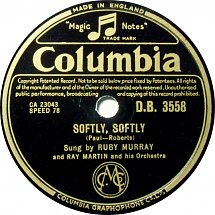
Softly Softly, by Ruby Murray (her 1st and only #1)

3 weeks, from 18th Feb to 11th Mar 1955

Aaaah…

That wasn’t a cry of anguish you just heard; more an exhalation of boredom. Or an extended pause while I tried to think of something to stop this from being my shortest post yet.

But maybe it should be a short post. Ruby Murray, claiming the twenty-ninth UK #1 with a perfectly forgettable song. It’s basically an amalgamation of what’s gone before: the string intro to ‘Secret Love’, Mantovani’s violins, Eddie Fisher’s ethereal backing singers, plus a sprinkle of Kitty Kallen and a half-teaspoonful of Kay Starr… Almost as if someone was using an algorithm specifically designed to write a mid-1950s chart hit. However they did it; it worked – ‘Softly Softly’ logged a very respectable three weeks at the top.

Softly, softly, Miss Murray purrs, come to me, touch my lips, so tenderly… The lyrics are all about kissing and caressing, about her lover taking his time to open up her heart. But it’s not a sexy song at all. It’s a bit nursery ryhme-ish, and a bit dull after ‘Mambo Italiano’.

Murray has a nice enough voice and, notably, this is the second example, after Dickie Valentine, of a British singer trying to sound like an American. She breathes and tickles the lines in a way that Vera Lynn most certainly would not have approved of. Actually, Ruby Murray was from Belfast and, by my reckoning, this makes her the first in a very long line of Irish crooners to have topped the UK Singles Chart.

2016-10-31_lif_25887021_I1

Ruby Murray is also (and this is the only thing that I knew about her prior to writing this post) cockney rhyming slang for curry. As in: It’s Friday night, we’re off dahn the Taj Mahal for a cheeky little Ruby Murray, innit. She is therefore the second chart topping artist so far, after Mantovani, to have remained enshrined in the public consciousness less for her music and more for the way her surname sounds. But her music was very popular. Though this was her sole #1, she recorded eight further Top 10 hits between 1954-59. Only two of her releases failed to make the Top 10, actually. I guess it’s a bit of a shame that she’s now remembered solely for having a name that rhymes with curry.

I’m pretty sure I could go out on a limb and declare that I’m the only person in the world who has listened to a Ruby Murray song today. ‘Softly Softly’ is by far her most listened to song on Spotify, at 104,676 plays. A quick bit of maths, dividing that number by the 70 million total users on Spotify, gives you 0.00014 plays of ‘Softly Softly’ per user. And that’s after I’ve played it five times in the past half hour.

Still – it is pretty amazing that every single one of these prehistoric chart toppers is available nowadays at the click of a button. Had I tried to do this blog a decade or so earlier I would have had to rely on wading through weird re-recordings on YouTube, or to opening my laptop up to all sorts of viruses on Pirate Bay. Had I attempted this twenty or thirty years ago (before blogging existed, I know, but bear with me) I’d have had to spend a fortune in ‘Sounds of the 50s’ compilations. These are enlightened times in which we live. And there, that wasn’t such a short post after all.

28. ‘Mambo Italiano’, by Rosemary Clooney & The Mellomen

images

Mambo Italiano, by Rosemary Clooney (her 2nd of two #1s) & the Mellomen

1 week, from 14th to 21st Jan / 2 Weeks, from 4th to 18th Feb 1955 (3 weeks total)

Just like that, Rosemary Clooney’s pops up again. She had two number ones, within a couple of months, and then she was done. (I’m being a little disingenuous here – she was a chart force for several years – but we are only concerning ourselves with number ones hits here, no room for second best).

And good old Rosie – her time at the top may have been fleeting, but at least she had a bit of fun while she was there. This is an even more frenzied bop than ‘This Ole House’. We start out with a bit of nonsense about a girl going back to Napoli, because she misses the scenery. And then… Hey Mambo!

On first listen I thought she was really singing in Italian, but she is just listing food: Hey mambo… try an enchilada with the fish bacalla and other cod-Italian phrases. Something something mozzarella, something something Calabrese… I think there’s a Como se dice in there. To be honest, Miss Clooney doesn’t know como se dice very much at all. And anyway, that’s Spanish. But it’s OK – you can’t help but want to dance to this. For the solo, the bouncy piano from ‘This Ole House’ returns, and it ends with a brilliant That’s Nice! OOH! As for ‘The Mellomen’… who knows? They do little more than your average ’50s backing singers – a few ‘Hey Mambo’s here and there – so I’m not sure why they got a credit. But, just like that, they have a UK Number One single.

clooney-94b833378517905808a9405ad88dff3bcfe05e4b-s900-c85

If this were released today, people might pick up on the gibberish mix of English and Italian, and the picture it paints of Italian-Americans, and they may perhaps view it in an unfavourable light. Remember how Justin Bieber got in trouble for singing about Doritos to the tune of ‘Despacito’? But actually, this is a song about a girl returning to a native land where she now feels confused and out of touch. The lyrics are meant to be mumbo-jumbo. We’re not meant to understand them… Kinda clever when you think about it.

The song also features the line: If you gonna be a square, you ain’t a-gonna go nowhere, ‘Square’, as far as I’m concerned, is the archetypal ’50s slang word: Be there or be square… You’re so square, baby I don’t care… So, while this is a mambo record, sung by an easy-listening singer-slash-actress, this is rock ‘n’ roll. It may be fun and funky, but it just about manages to retain an air of cool around all the silliness. While we were waiting for Bill Haley to come along and kick-off things off, the ideals and attitudes, if not the actual sounds, of rock ‘n’ roll were being sneaked in right under our noses.

As with her previous chart topper, I knew this song already. Most people do. I have vague memories of a late-90s remix. Plus, Miss Clooney is remembered nowadays as the aunt of housewives’ heartthrob George Clooney. But – remixes and celebrity descendants aside – we should all take a minute to appreciate her for the few weeks, in late ’54/early ’55, when she slapped a good dollop of fun into an otherwise pretty staid and stuffy UK singles chart.

26. ‘Let’s Have Another Party’, by Winifred Atwell

R-5006820-1381952789-2495.jpeg

Let’s Have Another Party, by Winifred Atwell (her first of two #1s)

5 weeks, from 3rd Dec. 1954 to 7th Jan. 1955

I wrote in the intro to my last post that Rosemary Clooney was finally getting our pulses racing – or our toes tapping, at least – and here comes Winifred Atwell to keep up the momentum.

It’s another piano-led song. Well, I say ‘piano-led’; it’s nothing but piano. Winnie and her piano, bashing out a selection of boogie-woogie and ragtime standards in extremely short order. According to Wikipedia we are getting classics such as ‘Broken Doll’, ‘Lily of Laguna’ and the ‘Sheik of Araby’ served up with a verse here, a snatch of chorus there, then on to the next one. I don’t recognise any of the featured tunes – though I’m pretty sure one of them was played by an ice-cream van in days of childhood yore.

It’s jaunty enough, but the effect of squeezing so many different tunes into a couple of minutes means it’s a bit of an odd listen. They’re all played in the same ragtime tempo, so there are no segues: it’s straight from one song into another with no time to draw breath, before we screech to a halt with dum-didley-dum-dum… dum-dum. But hey, it’s the first medley to top the charts, and off the top of my head, I’m not sure if there will be another one until Jive Bunny in thirty-five years’ time. On Spotify, the track is listed as having a Part I and Part II, the former being all of these old hits strung together while the latter is a much-more sedate number, even featuring a bit of guitar. I think, though I’m unable to confirm, that only the first part counts as the record that hit #1. Maybe Part II was the B-side.

1954-winifred-atwell-lets-have-another-party-1353313393-view-0

Anyway, all of this nonsense about which part is blah blah blah pales wildly into insignificance when it is revealed that Ms. Atwell was… black! Born in Trinidad & Tobago, before moving to the States and then to London, she becomes, a little over two years into their existence, the first black artist to hit the top of the charts. It’s a big moment, and worth taking a moment to reflect on this happening at a time when, say, landlords could stick a ‘No Blacks’ sign in their windows with impunity and, in the USA at least, Winifred Atwell wouldn’t have been allowed on the same public transport as her fellow chart-toppers. Just because this is the frothiest of throw-away records shouldn’t render it any less significant.

In fact, it’s almost ironic that she achieved this historic landmark with a medley full of old music-hall hits. The sort of hits that were big in even less enlightened times. The sort that might have been sung by men in black-face, to howls of laughter (seriously, Google ‘Lily of Laguna’ to see just what kind of song it is…) In a way, she is reclaiming them, and making them popular on her own terms.

And with that, I’ll descend from my high-horse, and conclude by saying that we will be hearing from Winfred Atwell again soon. She was huge in the early to mid-1950s (played for the Queen, didn’t you know!), and definitely seemed to have a winning formula. Hey, if it ain’t broke… ‘Let’s Have Another Party’ was the follow-up (somewhat inevitably) to ‘Let’s Have a Party’, and was followed up by another medley, the wonderfully titled ‘Let’s Have a Ding-Dong’. All good, (very) old-fashioned fun!


25. ‘This Ole House’, by Rosemary Clooney

R-803732-1160416687.jpeg

This Ole House, by Rosemary Clooney (her first of two #1s)

1 week, from 26th Nov. to 3rd Dec. 1954

Now this is more like it! After an incredibly sedate run of number ones – seriously, nothing since early-May of this year has been enough to get even a toe tapping – we are rocking and a-rolling!

You probably know this song. I certainly knew of it, for a couple of reasons. One is that Shakin’ Stevens revived it in the early ’80s. The other is that I can recall, way back in the mists of time, reading an ‘Oor Wullie’ comic (link provided for non-Scottish readers) in which this song was playing at a party, the words changed to something suitably Scottish (‘This ole house ain’t got no lino’, perhaps). My grandparents kept piles of old ‘Oor Wullie’ annuals lying about, and so have no idea whether it was a new-ish comic strip parodying the Shaky version, or a vintage comic parodying this version. Amazing, isn’t it? Anyone who tries to tell you that the charts don’t matter, and that the songs which make number one don’t form the backdrop to our lives, is very, very wrong. Anyway. You will know this song, I assure you – it’s got a sort of nursery rhyme feel to it and goes a little something like this:

            * raucous piano, or maybe a harpsichord (???) or an organ *

        This ole house once knew his children, This ole house once knew his wife, This ole house was home and comfort as they fought the storms of life, This ole house once rang with laughter, This ole house heard many shouts, Now he trembles in the darkness when the lightnin’ walks about…

Yes, it’s the tale of a lonely old man. Clooney then goes on to detail the repair work that this house needs – the floor, the hinges, the windowpane, even the shingles (I’m pretty confident that this is the only #1 hit to reference shingle). But he needn’t bother, this lonely old man, as he: Ain’t gonna need this house no longer, He’s getting ready to meet the saints…

This is a strange ole song. In a musical landscape of mopey, flowery, boringly chaste love-songs this is a best-selling song about a man sitting in his dilapidated house, waiting for the sweet embrace of death. The piece de resistance is the line: Oh his knees are a-gettin shaky, But he feels no fear or pain, ‘Cause he sees an angel peekin’, Through a broken windowpane…

Like, seriously. WTF? – as they most certainly didn’t say in 1954. I love it. It’s weird, morbid, almost sadistic. It’s quite modern, in a way, the juxtaposition of upbeat music with some with very downbeat, depressing lyrics. It’s interesting, anyway, and a lot better than some of the guff we’ve had to listen to recently. The gulf between this record and ‘My Son, My Son’ – its predecessor at #1 – is what makes a singles chart so interesting. The next chart-topper can always be something completely different.

thisolehouse1

Rosemary Clooney’s voice is standard, mid-1950s American. Polished, glossy, accessible. She even throws in a Westlife style key-change after the twangy piano solo which, if I’m not mistaken, is the first we’ve heard in this rundown. I, for my sins, love a good key-change. And we must mention her brilliantly deep-voiced backing singer – with his ain’t a-gonna need this house no longer, ain’t a-gonna need this house no more – who adds an even more bizarre edge to an already pretty bizarre record.

This was Clooney’s first of two number ones, the second of which will be coming up very shortly indeed. And, I can tell you now, it’s another cracker!

24. ‘My Son, My Son’, by Vera Lynn

hqdefault

My Son, My Son, by Vera Lynn (her first and only #1)

2 weeks, from 5th to 19th Nov. 1954

You don’t meet many Vera’s nowadays, do you? You’d meet a Frank, a David and a Johnnie quite easily on your local high street. But a Vera’d be hard to come by. And a song titled ‘My Son, My Son’, which sounds like the name of a hymn? Sung by a Vera? I knew before ever pressing play that this would be a crusty relic of a record.

This is ‘If’, by Rudyard Kipling, set to music. My son, my son, you’re all I hoped you’d be. My son, my son, my only pride and joy… My son, my son, just do the best you can, Then in my heart I’m sure, You’ll face life like a man… I’m fairly sure that this song stands alone, out of the thousand plus UK number ones, in taking the form of a love letter from a mother to her son. So points for originality at least.

All the British-Recorded-Hit-Song-From-The-Early-1950s hallmarks that we’ve grown oh so familiar with by now are present: cut-glass diction, earnest delivery, sombre – oh so sombre – tone. I mused last time on why so many of these early chart toppers were by Americans. And on top of all the glamour, glitz and razzamatazz it probably just boils down to them being more fun. Listen to this, then the Kitty Kallen record from a few posts ago, and tell me which of the two singers you’d rather have with you on a night out…

b84410a3-7096-4b86-980c-c8956bf65f12_1.c7c6a9a9b2e4554e552980fa76bd09ca

It’s clear, although it’s just occurred to me this very minute, that the record buying demographic in the pre-rock age were middle-aged. How else do you explain this, and David Whitfield? The music charts will soon be driven by youngsters, but not quite yet. Of course, in fairness Vera Lynn was a huge star, and had been since the 1930s. I mentioned Sinatra, and Doris Day, as still resonating today and, in the UK at least, Vera Lynn – the ‘Forces Sweetheart’ – has left a big old mark on popular culture. It’s only right that she grabbed her solitary #1 hit (she would have had a load more if charts existed for the ’40s) and I should try to find something nice to say about it. But…

One big problem with this song is that it sounds like a wartime release. A mother, tears in her eyes, watches as her son shoulders his rucksack and heads for the frontline, and mulls over how proud she is of him. But this was recorded nearly a decade after VE day! Maybe Vera knew her audience. More of that stoic ‘We’ll Meet Again’, off to the trenches stuff, eh Vera? Give ’em what they want! Maybe she was dying to re-invent herself, to try out some of this rock ‘n’ roll that everyone was banging on about, but the suits wouldn’t let her…?

Anyway, one final reason why I should try saying something nicer about this track is that Dame Vera Lynn is still alive at the impressive age of 100, and there is a chance (admittedly a very minute chance, but still) that she may read this. But… Nope, I can’t. Next!