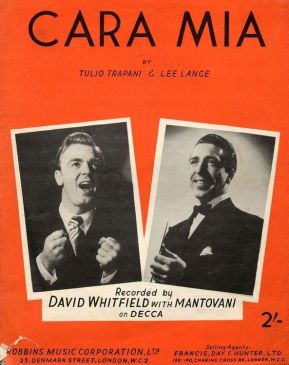
20. ‘Cara Mia’, by David Whitfield with Mantovani & His Orchestra

david-whitfield-with-mantovani-cara-mia-decca

Cara Mia, by David Whitfield with Mantovani & His Orchestra (both Whitfield and Mantovani’s 2nd of two #1s)

10 weeks, from 2nd July to 10th Sept 1954

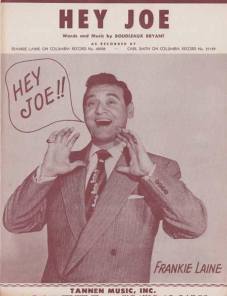
The last time I wrote about David Whitfield, when his first number one followed on from Frankie Laine’s rockabilly number ‘Hey Joe’, I might have mentioned something about it being one step forward and two steps back…

But for this to follow on from rock ‘n’ roll pioneer Johnnie Ray, and the gloriously suggestive ‘Such a Night’ (OK, yes, Doris Day did return to the top for a big old spell in between but let’s not allow that to get in the way of my indignation!) – it’s more a case of one step forward, ten steps back! One step for every week this record spent at the top! The difference between this and ‘Such a Night’ is massive. This is pre-rock. If such a thing ever existed, if it could be captured and bottled or defined in a dictionary, then this would be it. The Sex Pistols were punk, Oasis were Britpop, David Whitfield was pre-rock.

Shrill backing singers? Check. Overwrought vocals? Got it. Proper enunciation? Yep. Big bastard of an ending? Oh boy. Seriously, check out this ending. It has three stages. Whitfield comes in for the final verse like he means it, an octave up on previous lines: All I want is you, for ever more… Then comes the final line for which he amps it up even more: TILL THE END OF… And the note that he hits for the final TIIIIIMMMMMMEEEEE!!! cannot be natural. Its impressive, yet horrifying.

I have nothing new to write about David Whitfield. He’s of his time, and who am I to judge? People at the time clearly enjoyed it: very, very few records have ever reached double figures in terms of weeks at #1. ‘Such a Night’ only got one week. And he died young, unlike so few of his contemporaries, aged just fifty-four in 1980. We should also drop a mention for Mantovani, of violin and rhyming-slang fame, from whom we won’t be hearing again in this countdown. The violins in this song sound identical to those in his first chart topper. Mantovani’s signature strings.
cara-mia-song-featuring-david-whitfield-mantovani-englebert

Though the sharp-eyed among you will currently no doubt be thinking ‘Now just wait a minute here!’ Because back a few posts ago I mentioned that every record thus far had been conducted by someone and their orchestra, and that these conductors – Paul Weston, Hugo Winterhalter et al, never seemed to get credited and were deleted from any chart statistics. So why is Mantovani getting a credit here? To be brutally honest… I dunno. Maybe it’s because this, more than any, is a super operatic, orchestral record and they feel that that should be recognised. Maybe it’s because Mantovani already sneaked a week at the top with his own song, ‘Moulin Rouge’, and so was slightly more renowned than your run-of-the-mill conductors. Maybe Mantovani was just really concerned about his legacy and so paid someone to stick him in the records. Who know? But if I were Paul Weston, I’d be pretty pissed off.

Before finishing, I want to mention a thought that struck me a few posts ago. It seems that in the mid-1950s there were very few ways for people to hear the music that was in the charts without buying it. No MTV (duh!), no Top of the Pops, no YouTube, no nothing. Radio consisted of a handful of stations, very few of which played pop music. Pirate Radio hadn’t got going yet. Perhaps you could have listened to ‘Pick of the Pops’, on the BBC Light Programme, but even that wasn’t first broadcast until 1955. It just seems so alien to me, to us, that you might only know of a record as a listing in a magazine and have no idea how it sounded until you went out and bought it.

Although, this might explain how certain songs managed to top the charts in the first place…
19. ‘Such a Night’, by Johnnie Ray

s-l300

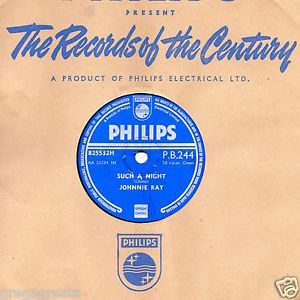
Such A Night, by Johnnie Ray (his 1st of three #1s)

1 week, from 30th April to 7th May 1954

For the first time since beginning this blog, we arrive at a song that I know. And I don’t mean ‘know’ in the way I’d heard ‘Secret Love’ without realising, or in the way I knew ‘I Believe’ because of it’s chart domination. I know this song, I actively listen to it, and I love Johnnie Ray.

It’s a jaunty (that word again), quick-tempo song with a simple enough riff and some ‘ooby dooby’s in the background. Nothing too unusual there. But what makes it, and elevates it to a classic, are Ray’s vocals. Like Doris Day before him there’s an effortlessness to his voice that draws you in and yanks you along. But his voice is nothing like the clean-cut, honeyed tones of Miss Day. ‘Such a Night’ isn’t being sung here – it’s being ridden, it’s being humped… it’s being performed.

Ray has help in this performance from some seriously risqué lyrics. This is the story – and let’s remind ourselves that we are writing here about a record that topped the charts in April 1954 – of a one-night stand.

            It was a night, Ooh what a night it was, It really was, Such a night… It was a kiss, Ooh what a kiss it was, It really was, Such a kiss…. Just the thought of her lips, Sets me afire, I reminisce and I’m filled with desire…

This is pretty saucy stuff right here. It starts out as a kiss in the moonlight, but suddenly…

            Came the dawn, And my heart and her love and the night was gone… But I’ll never forget that kiss in the moonlight, Ooh, such a kiss, Ooh, such a night!

It’s clever really. Obviously they couldn’t go writing a song with lyrics that touched on anything more than kissing, but are we really meant to believe that they just kissed all the way till sunrise? By the end, given the way Ray is ooh-ing and aah-ing, the answer is pretty obvious. Ain’t no kiss ever that good. The BBC, and various radio stations across the world, responded by banning the record. The first example, then, of a song’s infamy equalling a #1 hit? See also: Serge Gainsbourg, Frankie Goes to Hollywood, anything by Eminem…

MI0001415403

But wait, it gets even better. While the song is about a woman, and all the pronouns female, Johnnie Ray was gay. Those are gay ‘oohs’ and ‘aaahs’ and ‘mmms’, sitting at the top of the UK Singles Chart. In 1954. When that sort of thing was very much illegal, and gay men were being hunted, prosecuted and made to choose between jail or chemical castration. Now, that is something.

This is rock ‘n’ roll. OK, the music here is more jazzy, swing, whatever, but I am putting it out there that this is the first rock ‘n’ roll record to ever make the top of the charts. This is rock ‘n’ roll in all but name, surely? That’s what makes this idea of the pre-rock era so difficult to figure out, why it’s so hard to label this strange era in popular music.

Johnnie Ray will go on to hit the top spot a couple more times, so I will wait until then to write more about just how amazing he was, and how it’s a crime that he doesn’t sit alongside Elvis, Chuck Berry, Little Richard, Buddy Holly et al in the pantheon of ’50s music greats (*spoiler alert* him being gay might have had a lot to do with this.) I will, though, take the chance to recommend Elvis’s own version of ‘Such a Night’, recorded several years later. Remember a few posts ago, when I said that drums rarely define a record? Well, the King’s version of this record is one of the exceptions.

But, for now, let’s end by simply being thankful that this gloriously raunchy track sneaked a week at #1, ghosting in amongst all the schmaltzy easy-listening that preceded and followed it. Ooh. Aah. Mmm. Yes!

18. ‘Secret Love’, by Doris Day

doris-day-secret-love-1954-78-s

Secret Love, by Doris Day (her 1st of two #1s)

1 week, from 16th to 23rd April / 8 weeks from 7th May to 2nd July 1954 (9 weeks total)

A dreamy intro… Is that a harp…? And is that running water, or just the quality of the recording? It’s very soft start to the 18th chart-topping record, and it’s not immediately obvious why this song straddled the very top of the charts for three whole months.

There are some mushy lyrics about the titular ‘secret love’, about being a dreamer, about only being able to tell the stars about how deeply in love you are… So far, so 50s.

But then. Boom. The chorus. I know this song. People know this song. NOOOOOWWWW I shout it from the highest hills, even told the golden daffodils, at last my heart’s an open door, and my secret love’s not secret, anymore…

GACCALAMITYJANE

Day has a wonderful voice: with elocution as crisp and clear as any we’ve heard before, but without the stiffness and formality that has made some of the previous number ones sound old-fashioned. There’s a great warmth to it, and the way she jumps from softly purring the verse to walloping out the chorus is impressive. It’s effortless. You could say it’s star quality.

And surely she is the biggest star to have topped the charts thus far. Frankie Laine, and Guy Mitchell, were huge in their day but have largely been forgotten. People know Doris Day. Even today people will have heard of her, though they might not be able to pinpoint why. I, for example, knew this song without realising it. And everyone knows her next chart-topper, which contains some of the most famous lines in the history of popular music. But more on that later…

Probably the first time I ever heard of her was through ‘Grease’, and Rizzo’s mocking line ‘Hey, I’m Doris Day. I was not brought up that way…’ Day is held up by the Pink Ladies as straight-laced and old-fashioned – a girl who most certainly would not go to bed till she was legally wed. That, in a way, sums up this ‘pre-rock’ age and its stars who would, long before the turn of the next decade, seem painfully uncool next to Elvis and his kind.

Speaking of movies… Something about this recording gave me an inkling that it was from a movie soundtrack. Perhaps it was the orchestra, or the way the song doesn’t so much end as fade away to grey. Anyway, for each of these posts I make sure I listen to each song three or four times before doing any research on it (honest). But, lo and behold, ‘Secret Love’ is from a movie: ‘Calamity Jane’. Again: a film I’ve heard of – most people probably have – but have never seen. This is a sign of star quality, of true fame, no? When you are woven so deep into popular culture that people stop realising you’re there.

Two other little things to muse upon before we move onwards… At 3 minutes 40 seconds, this is a pretty long record. That’s pretty much the length of the average 21st century pop hit. Actually, these super-early chart toppers have routinely been hitting the three-minute mark. When I started listening to music I – no doubt influenced by the 2.5 minute wonders on my parents ‘Sounds of the ’60s’ cassettes in the car – assumed that songs started out really short and got longer and longer (at least until the 70s, when prog-rock came along and simply took the piss). But it appears that the average length of pop songs (as we know them, post-war, at least) actually started out at three minutes or longer and shrunk in the late fifties/ early sixties.

And the last thing (which is much more important than the average length of chart topping singles): you know how I keep referencing just how long these early pop stars seemed to have lived for? Well, Miss Day has only gone and topped them all. By still being alive! Ninety-five and still going strong (at the time of writing…) Well done her!

17. ‘I See the Moon’, by The Stargazers

the-stargazers-i-see-the-moon-1953-4-78

I See the Moon, by The Stargazers (their 2nd of three #1s)

5 weeks, from 12th March to 16th April / 1 week from 23rd April to 30th April 1954 (6 weeks total)

And now for something completely different…

Imagine an East-End pub, filled with smoke and ruddy cheeks, a jovial barman rings the bell and calls for last orders over the hubbub… Last orders, and one last song. Old Mrs. Fozzywinkle sits at the piano, shouting down someone who’s just said something saucy, and then… The opening bars of ‘I See the Moon’.

Over the mountain, over the sea, back where my heart is longin’ to be… Please let the light that shines down on me, shine on the one I love… Thematically, we are treading familiar ground: it’s a tale of two separated lovers, one hoping that the other still thinks of them. We’ve heard it a few times in this countdown so far. But, beyond the lyrics, this is something else entirely.

The first thing that comes to mind is the scene in ‘Oliver!’, where Nancy leads the pub in a rousing chorus of ‘Oom Pah Pah’. This song isn’t quite as rowdy, or raucous, but it has an unhinged quality that none of the previous chart toppers have had. Even the novelty tracks that have gone before it – the likes of ‘How Much is that Doggie?’ and ‘She Wears Red Feathers’ – still felt as if they had been professionally recorded, perhaps over several takes. This song doesn’t…

The first verse is sung – horribly – in a fake German (Polish? Transylvanian??) accent, the voice cracking as it fails to reach the high notes, with voices roaring in approval in the background. The second verse takes the form of a skit – a plummy voiced announcer introduces a little lady with a tambourine, who proceeds to come in at the wrong cue not once, not twice, but three times. Once she gets going, the announcer asks her to sing quieter, then louder, presumably until everyone listening at home is guffawing helplessly at the ridiculousness of it all. It’s funny(-ish), in a pantomime kind of way. We’re back in the music halls, here. Actually, it reminds me of a ‘Comic Relief’ track – you know the kind recorded by Cliff Richard and the cast of ‘The Young Ones’, or by French and Saunders as the Spice Girls. It has that same sort of anarchic energy, and in that regard it’s quite ahead of its time. It’s a truly bizarre song.

And when you look back to The Stargazers previous #1 – the morose ‘Broken Wings’ – it sounds even more crazy. What happened? What went wrong? (Or right, depending on your tastes?) What in God’s name did they take before hitting the recording studio? At least it’s an interesting song, though I’m not sure I’ll be revisiting it once I’ve finished writing this post.

5aa73dbf26f7295aa31761462f020c03

Information on The Stargazers is hard to come by. There are at least two other bands with the same name: an Irish folk trio, and a rock ‘n’ roll revival group from the ’80s. An image search requires some discerning before you can work out which band is which. But the original Stargazers were pretty popular in their day – the NME voted them ‘Best Vocal Group’ for five years in a row. But – and this is something that’s just occurred to me – ‘pre-rock’, the competition for that title wasn’t fierce. There simply weren’t very many groups going. This was an era of solo stars.

One other little titbit of interesting info. I’ve unearthed regarding this song: the lyric I see the moon and the moon sees me was first used in a nursery rhyme from the 1780s. We are then, listening to both the 17th UK Number One hit, and the very earliest UK Number One hit. Mind-bending…

16. ‘Oh Mein Papa’, by Eddie Calvert

eddie-calvert-oh-mein-papa-1953-6-78

Oh Mein Papa, by Eddie Calvert (his 1st of two #1s)

9 weeks, from 8th January to 12th March 1954

Perhaps, as we tick over into 1954, we should pause once again to take stock. Just what kinds of records were topping the charts in these distant, misty, slightly-eccentric, pre rock days…?

Actually ‘distant, misty and slightly eccentric’ might just sum up most of the records I’ve described thus far. They have been surprisingly varied in style: from proto-rock numbers to gentle instrumentals, from jaunty novelties to brow-furrowingly earnest numbers about unrequited love. In a way, though, they’ve all been a bit similar too: all very safe, very chaste and very… twee? To my modern ears, anyway.

And so, onwards – to another mammoth hit. It’s the third time in just over a year that a record has racked up nine weeks at the top, and the latest record to do so is… a trumpet instrumental.

Now. There are lots of instruments that can carry an entire song: guitars and pianos, obviously, along with saxophones and violins. Drums cannot usually carry an entire song, but I wouldn’t like to say it was impossible. Tambourines definitely cannot. And nor, it would seem, can trumpets.

I’m struggling to write much about this song. There’s a trumpet. There’s a simple guitar rhythm, with some backing singers shrilly harmonising and occasionally chanting the song title. Oh, and there’s an organ. As I wrote in my post about the last #1 to involve an organ (‘Broken Wings’), it lends a cheap, Blackpool seafront kind of vibe to proceedings. I suppose it could go down as the first ever foreign language number one, but there is only one line. Oh Mein Papa. Which I believe translates as ‘Oh My Daddy.’ Oh my, Daddy, indeed.

The tune isn’t even interesting. The one other instrumental we’ve covered so far, Mantovani’s ‘Moulin Rouge’, at least had a melody that buried itself in your brain after a few listens. So this, with no words and no melody, to my ears at least, has little going for it.

There are lyrics to ‘Oh Mein Papa’, which I searched out and listened to, courtesy of our friend Eddie Fisher – whose version reached #9 – lyrics about how lovely the singer’s father was, taking him on his knee when he was a nipper… And I suppose, when this backstory is taken into consideration, Calvert’s lone trumpet, parping out its melancholy tune, takes on a little more resonance. But then, that’s the problem with instrumentals as a whole: without lyrics, are they songs or simply pieces of music? And yes, yes, you can come at me with Beethoven, Mozart and all that lot; but we’re talking about pop music here. Pop music should be immediate and relatable, and I’m not sure it can be without lyrics. Or, at least, it’s difficult for it to be so without lyrics. Anyway, who am I to say? This track lorded it over all comers for over two months.

p03t218h

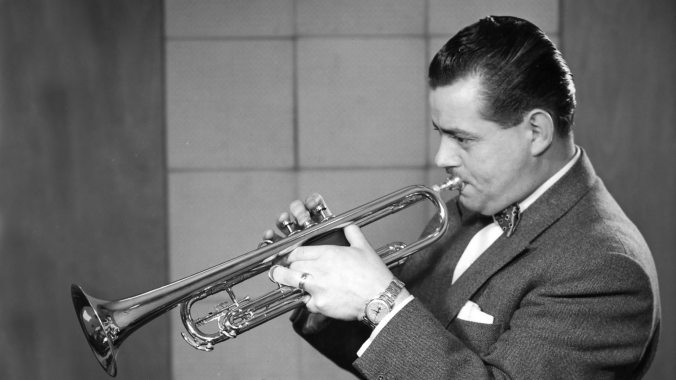
Eddie Calvert himself, looks like an interesting character. He looks old-fashioned, even in contemporary photographs from the 1950s. His hair is heavily Brylcreemed and he has a roguish moustache (Oh nein, Papa!). He’s half jazz session musician and half black-market spiv. If you were given a choice of where he was from, and the choices were A) Chicago, Illinois or B) Preston, Lancashire, you’d go for A). But you’d be wrong. In almost every picture I’ve found he is clutching his trademark trumpet. He probably had a name for it.

15. ‘Answer Me’, by Frankie Laine

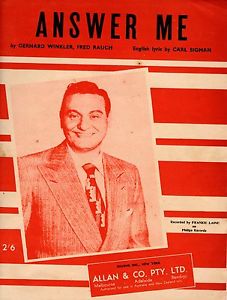
frankie-laine-answer-me-philips-78-s

Answer Me, by Frankie Laine (his 3rd of four #1s)

8 weeks, from 13th November 1953 to 8th January 1954 (including 1 week joint with David Whitfield, from 11th to 18th December 1953)

There’s something rather familiar about this record…

Having read the previous post, you know what this song is all about: heartbroken guy, on his knees, turning to the Lord as a last resort… all very melodramatic. This sticks very close to the structure of the David Whitfield version – it’s exactly the same length – but I must admit I like this version better. There’s just something about Laine’s voice: warm, beckoning, a voice I want to listen to, a voice I trust. Unlike Whitfield’s plummy whining.

Musically, this version is also a little less overwrought than its predecessor. The guitar strums that play us in are very reminiscent of ‘I Believe’, and the violins have been replaced by an organ and backing singers. It’s still pretty dull, don’t get me wrong, but it’s just that little bit more listenable. It’s got an American gloss, all glittery lapels and perfect teeth, that David Whitfield’s reserved, BBC World Service delivery was lacking. And the ending is still a bit much, though Laine holds it back until the final line rather than belting out the whole last chorus.

s-l300 (2)

We’re now a year into this countdown, believe it or not, and out of the past 37 weeks, Mr. Frankie Laine has been at number one for 28 of them. In many ways it is impossible to compare the charts of today with those of the early ’50s – in terms of how the data is collected, in terms of what data is included, in terms of how wide-ranging the chart data is – but if anyone does think that today’s streaming dominated charts are dull, slow-moving and dominated by the same handful of artists, I would suggest you tell them to thank their lucky stars they weren’t around in the autumn of 1953. Not only are the same artists dominating here; the same songs are, too.

In lieu of mentioning having anything new to say about the song, I thought I might give a little shout out here to the conductors. The ‘what’, you say? The conductors! Almost every chart-topping record by a solo act, as you may have noticed from the pictures I post at the start of every entry, has been conducted by someone and their orchestra.

So far, Monty Kelly has conducted the orchestra for ‘Here in My Heart’, Harold Mooney for ‘Comes A-Long A-Love’, Hugo Winterhalter did both Eddie Fisher’s chart-toppers, Mitch Miller was Guy Mitchell’s go-to guy for both of his, Johnny Douglas did the ‘accompaniment’ for ‘That Doggie in the Window’ (apparently it didn’t warrant a full-blown orchestra) while Stanley Black guided David Whitfield through ‘Answer Me’. Mr. Paul Weston, though, has been the most prolific so far: Jo Stafford’s ‘You Belong to Me’, as well as the Frankie Laine trio of ‘I Believe’, ‘Hey Joe’ and now ‘Answer Me’ coming under his baton. Only the Stargazers (presumably because they played their own instruments) and Perry Como haven’t had orchestral accompaniment. Mantovani got the credit as conductor for ‘Moulin Rouge’ because it was an instrumental.

If haven’t included these conductors in the titles of my blog posts it’s because, well, they aren’t included anywhere else. Most listings of UK Singles Chart #1s – Wikipedia and the Official Chart Company included – don’t mention them. And so I won’t either. I understand it from the point of view that the conductor is neither playing an instrument nor singing the song, and that if the conductor gets a credit then so should the violinist, the trombonist, the harpist etc. etc. But, at the same time, Paul Weston has been heavily involved in four number one singles so far – with more to come, presumably – totalling 30 weeks at the top. That would already be enough to make him joint 7th (with Justin Bieber) for most combined weeks at number one! It seems a little harsh that he is forever banished from the chart history books…

14. ‘Answer Me’, by David Whitfield

05bcd67666dbe25f75de8dae9ccd1bba

Answer Me, by David Whitfield (his 1st of two #1s)

1 week, from 6th to 13th November/ 1 week joint with Frankie Laine, from 11th to 18th December 1953 (2 weeks total)

This period, the immediate post-war years, 1945-55, is known musically as the ‘pre-rock era’. The time right before ‘Rock Around the Clock’, and Elvis, and teddy boys and pink ladies, created what we know as modern popular music.

Except I have a history degree, and one of the first things you learn in history class is that any labels that have been applied to certain periods of time, and the images that are conjured up when you think of, say, the ‘Tudors’ or the ‘fin de siècle’, are at best gross stereotypes and at worst just plain wrong.

And, having listened to thirteen of the biggest selling hits from this period, it’s clear that there’s no such thing as the ‘pre-rock’ sound. Rock was already here, in the playful hiccups of Kay Starr’s voice and the twangy guitar solo of ‘Hey Joe’. Plus, twenty years previously we had been right in the middle of the ‘Jazz Age’, and that was a pretty raucous time. No, rock was here. It had always been here, at least in spirit if not in sound. It just hadn’t broken through quite yet as ‘rock’. It was having what we might now call a soft landing. Every musical genre has one – nobody woke up one morning and invented heavy metal, or garage, or grime. They can all be traced back to something earlier.

But – big but – that’s not to say you’re going to find any traces of the nascent rock ‘n’ roll movement here, in the 14th UK #1. Because for every hit that was flirting with rockier elements, there was a hit like this. One step forwards, two steps back. This is pre-pre-pre rock. This is partying like it’s 1910.

David Whitfield’s ‘Answer Me’ is a proper record. And I don’t mean ‘proper’ as in substantial and fulfilling; I mean ‘proper’ as in how you should behave when the vicar comes for tea. It’s semi-operatic, it’s painfully earnest, and it’s incredibly old-fashioned.

It’s a song about heartbreak, first and foremost. The singer is asking the Lord for an answer: does his love still love him back? Answer me, Lord above, just what sin have I been guilty of?… She was mine yesterday… I believed love was here to stay… And so on. Whitfield’s voice is so clear, so technically correct, that it sounds slightly ridiculous. Here is a man at the end of his tether, laying himself at the mercy of God, begging for one more chance with the love of his life, and all the while enunciating like the Queen. Every ‘t’ pings off his teeth, every ‘r’ is rolled. It’s as if the lyrics were written down in the phonetic alphabet – If she thinks aT awll abowT me, please leT heR heaR my praiR – and that it was recorded for the benefit of foreign students.

david

And, I know I’ve mocked the dramatic endings of some of the previous records, but this one really takes the biscuit. Whitfield’s voice completely changes with thirty seconds to go, growing fuller and throatier, but losing none of his cut-glass diction, as he steels himself for the big finish. Please answer me…. Oh….. Lord…..! It’s as if he’s responding to the American singers that have gone before, the Guy Mitchells and the Frankie Laines, with all their sloppy vowels and swallowed endings: “Sir, my heart may indeed be breaking, but that’s no reason to speak like a slob.”

If anything, the chart run of ‘Answer Me’ is much more interesting than the song itself. It had a week at the top, then dropped down for a whole month before returning. That’s a pretty long gap between stints at number one. When it did eventually climb back up, it did so in a manner that has only occurred a handful of times in chart history: it tied with another record for number one. And, for added intrigue, the song that it had this little tussle with was… a different version of ‘Answer Me’. This is all very 1950s. But more on all that in the next post…

To finish, I’d like to return to the idea of the ‘pre-rock era.’ I dug up this old article from ‘The Guardian’, which name checks some of the hits covered here. And it posits an interesting idea about why this time in music was dominated by very MOR, very laid-back, very jaunty hits about prayers being answered, and girls in red feathers and huly-huly skirts. Namely, that Britain had just seen the worst conflict in history, had lost loved ones, had survived the nightly threat of the Blitz, had suffered through ten years of rationing and rubble only to emerge at the other side into a world on the verge of nuclear Armageddon… and they just wanted some bloody escapism. It’s pretty obvious when you think about it.

Then, come 1955 or thereabouts, youngsters for whom the war was a distant, childhood dream, who wanted to escape the drab post-war depression, looked across the Atlantic… and the rest is history.

But not quite yet.

13. ‘Hey Joe!’, by Frankie Laine

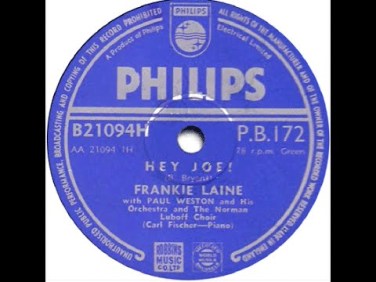
hqdefault (1)

Hey Joe!, by Frankie Laine (his 2nd of four #1s)

2 weeks, from 23rd October to 6th November 1953

One thing you soon realise as you become a seasoned chart-watcher (OK, chart-geek), is that songs don’t do well on the charts just because they’re good. Being good often has no correlation to whether or not a song is a hit.

Of course, sure, there are plenty of songs that hit the top of the charts because they’re brilliant. We’ve already seen ‘I Believe’ – a stone-cold classic – and we’ll see many, many more as we meander down this long list of Number 1s.

There are also the catchy numbers: not always classics, but songs that hit the right vein at the right time (‘Look at That Girl’ being one such) and you can completely understand why they got to the top.

Then there are the novelty hits, the so-bad-they’re-good hits, the comeback hits, the posthumous hits… Songs hit the top for a hundred and one reasons.

But one of the most interesting reasons for a song hitting the top is what I am dubbing – for the very first time, right here – the ‘shadow hit’. Example: Frankie Laine has just spent 18 weeks at #1 with a monster hit. He releases ‘Hey Joe!’, a song nowhere near as powerful, nowhere near as epic, nowhere near as good, and within a fortnight it’s hit the top spot. Had he released ‘Hey Joe!’ first, would it have performed anywhere near as well…? I’m going to have to say ‘nope’.

Not for the first time, I’ll describe this record as a bit ‘musical theatre-y’. The ‘Joe’ of the title is the singer’s love rival, and the song is basically a two-minute long pea-cocking session, a listing of why the girl should ditch Joe and get with him. I can picture the two of them having a dance-off in a barn: Frankie Vs Joe, two parts ‘Oklahoma’, one part ‘West-Side Story’.

Hey Joe! She’s got skin that’s creamy-dreamy, eyes that look so lovey-dovey, lips as red as cherry berry wine… She’s a honey, she’s a sugar pie, I’m warnin’ you I’m gonna try, to steal her from you… Lyrically it’s a bit…rich. He and Joe, it turns out, were buddies. But no longer. Girls’ll do that to a guy.

It’s not terrible. It’s up-tempo, it’s jaunty (I don’t think I’ve ever written that word so often as since I started this blog), it’s diverting and doesn’t outstay its welcome. It’s very wordy – again – and there’s another guitar solo: a genuinely trippy fifteen seconds with an effects pedal that is at least twenty years ahead of it’s time. It is completely different to ‘I Believe’, and nobody could have accused Mr. Laine of resting on his laurels.

frankie_lainehey_joe

Late 1953 was a period of utter chart domination for Frankie Laine. Having seen that he had three chart toppers in quick succession, I looked up the actual charts for this period and, in ‘Hey Joe!’s 2nd week at the top, Frankie also had brand new hit ‘Answer Me’ (more on that to follow soon) at #3, ‘Where the Winds Blow’ at #5 and the record-setting ‘I Believe’ still at #6 in its 31st week on the chart. A chart which only had 12 places! Very few artists can claim to have ever had four songs in the top six.

So, there we have it. Our first ‘shadow’ number one. More will follow, don’t you doubt it, scurrying along in the wake of bigger, better hits. As an interesting aside, some sources list this song as ‘Hey! Joe’ – the ‘Essential Frankie Laine’ album on Spotify being one. But the Official Charts Company, which I feel compelled to go along with due to years of loyalty, have done away with the exclamation mark. And I think that’s a bit of a shame. What song title isn’t enlivened by an exclamation mark?

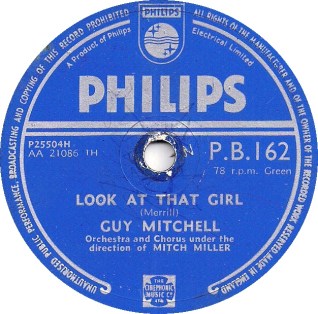
12. ‘Look at That Girl’, by Guy Mitchell

guy-mitchell-look-at-that-girl-1953-78

Look at That Girl, by Guy Mitchell (his 2nd of four #1s)

6 weeks, from 11th September to 23rd October 1953

I promise, sincerely, that there will be no mention of ‘fanny’ in this post. OK?

Anyway, ladies and gentlemen, we have something else to talk about here. We are finally rocking and rolling. The invasion is here.

Not at first, mind. We begin on familiar territory. We’ve got the jaunty guitars from ‘Don’t Let the Stars…’ and Mitchell’s previous #1, ‘She Wears Red Feathers’ (compared to which this is ten times better!), and some trumpets (or clarinets, or bassoons, whatever…), and Mitchell’s voice still sounds like he thinks he should be singing a comedy number.

Look at that girl, she’s like a dream come true… Ah look at that girl, can blue eyes be so blue…? But this is no simple song of longing. No, Sir. It turns out the girl is already his. We think. With each word my heart just skips, oh if I could kiss those lips… He’s keeping it ambiguous. Maybe they’ve got a thing going. Maybe not.

And as the song goes on – we start to rock. And I don’t mean ROCK (tongue out, fist raised). I mean ‘rock’, like it’s 1953. There are hand-claps. Mm-hmm. And a guitar. Woo! And Mitchell has a little call and response with the backing singers, when they take the lead lyric Look at that girl… and he quips back I don’t believe it they’re making it up! And then there are the lyrics: the kissing, the holding her tight… Pass the smelling salts…

GUY_MITCHELL_SHOWCASE+OF+HITS-529846

It sounds to me as if a battle is taking place here, between traditional easy-listening and the burgeoning rock ‘n’ roll movement. On the one hand you’ve got the usual twee backing singers and floaty trumpets, parping away at the end of each line; on the other you have the hand claps and the guitar solo. That’s right. Solo. In a symbolic move, the trumpets begin the solo and play it in tandem with the guitar for a couple of bars, before the guitar takes it over completely.

And having said that Mitchell sings the song with a slight giggle in his voice, after the 3rd or 4th listen it works. He’s having a good time. We’re having a good time. He’s a nice singer – he sounds like he could be belting it out if he wanted to, but he doesn’t. The song doesn’t require belting out (That’s something old Eddie Fisher could have learned to look out for…)

If you stick with this blog for long enough, you’ll soon see I’m a sucker for a straight-up, unpretentious pop song. A couple of verses, couple of choruses, a solo and a final verse. Maybe a key change. Then finish. The sort of song that sounds simple but is pretty darn hard to get right. (I say, having never even attempted to write a song in my life). This is one such song. And I like it. It’s my favourite so far.

https://www.youtube.com/watch?v=mXIhZ-xWO0k

11. The Song from ‘The Moulin Rouge’, by Mantovani and His Orchestra

s-l300

The Song from ‘The Moulin Rouge’, by Mantovani and His Orchestra (his 1st of two #1s)

1 week, from 14th to 21st August 1953

Ooh la la.

I’m less annoyed that this song helped deny Frankie Laine his record of consecutive weeks at the top. Mainly because Eddie Fisher had already done the damage; but also because this isn’t terrible.

But ‘not terrible’ isn’t really selling it either… So, let’s try again. It’s nice enough. Its pretty mellow. It’s cute. A bit heavy on the accordion, but yeah. Oh, and its an instrumental. The first ever instrumental to top the UK charts, back when instrumentals were much more of a thing than they are now.

I should probably stop getting excited about a record being the ‘FIRST EVER _____!’ to top the charts, because we’re only eleven songs in and pretty much every one of them is the first ever something. But still. This is the first ever film score to hit the top too, The Moulin Rouge being a film about Pigalle’s famously raunchy red-windmilled nightclub, starring Zsa-Zsa Gabor. And it’s the first ever #1 by a non American or Brit, Mantovani being Italian.

mantovani-663032

To the song. Well. If you’re writing a song about Paris, or France, what’s the first instrument that springs to mind? Mais oui. L’accordion. Trop cliché, non? Maybe it wasn’t a cliché in 1953. Maybe this song made it a cliché to soundtrack Paris with an accordion-led air.

There’s not much to it, really. It’s the same couple of refrains played over and over again, first by said accordion, then by violins. And as I was taking notes for this post, while listening to the track for the first time, I jotted down all that stuff about the movie, the soundtrack, the accordion, and ended it with the words ‘a bit dull.’

But now I’m on the 4th or 5th listen, I’m not so sure. It’s seeping into my brain through its repetitiveness, and actually its quite nice. Pleasant. I think the best word for it might be melancholic. It has a sense of longing for the past, of long-lost summer days beneath a sun-dappled beech tree. And I’m not just being facetious here – it really does conjure up that image in my mind. The song has a name, as you can perhaps see from the picture of the disc above: ‘Where Is Your Heart’, and there was a version with words doing the rounds. But that doesn’t really interest us here.

The song ends very sedately. Unlike the songs that have gone before it doesn’t build to a big, over the top finale. It simply melts away, and I respect that. I’m not sure what role the song played in a film about the world’s most famous strip club, though. It’s about as far removed from the can-can as you can get.

While I had never heard this song before, I had heard of Mantovani. And for a while I couldn’t quite remember how or why. But then it came to me. See, where I come from, Mantovani is rhyming slang for… well… fanny. Example sentence: “I’ve got some Tesco’s Finest aftershave on, I’ll definitely get some manto tonight!”

And what a legacy that is.

https://www.youtube.com/watch?v=aFhGS4z_PjI