It’s amazing to think that Elton John went the entirety of the eighties without a number one single. It’s amazing to think that, twenty years into a stellar career, this was his first solo UK chart-topper. But perhaps most surprisingly, it’s amazing that this particular record was a hit at all.

Sacrifice / Healing Hands, by Elton John (his 2nd of ten #1s)
5 weeks, from 17th June – 22nd July 1990
It’s a decent enough song. Elton and Bernie could still knock out a good tune, even this far into their partnership. But it’s very middle-of-the-road, very made-for-Radio-2, very much Elton John reinventing himself for middle age (he was approaching forty-five when it eventually made #1).
And, given that this is adult-oriented soft rock, the lyrics are on a fittingly grown-up theme. Into the boundary, Of each married man, Sweet deceit comes calling, And negativity lands… Ergo, men are men, and they all cheat. I’m pretty sure he blames the frigid woman: Cold, cold heart, Hard done by you… Bernie Taupin was coming to the end of his second marriage at the time of writing, and you do wonder if that might have been an influence.
Away from the lyrics, this has all the glossy touches you’d expect of a soft rock ballad in 1990. I don’t dislike it – in many ways it’s a sophisticated piece of song writing befitting of the nation’s (second?) most prolific hit making partnership – but it also gives me the feeling of mineral water poured over ice: crisp, and clear, and pretty cold. Yet it’s lingered on in the Elton John canon, seemingly held in higher regard than I afford it, and the Cold, cold heart line formed the basis of a 2021 #1, thirty-one years on…
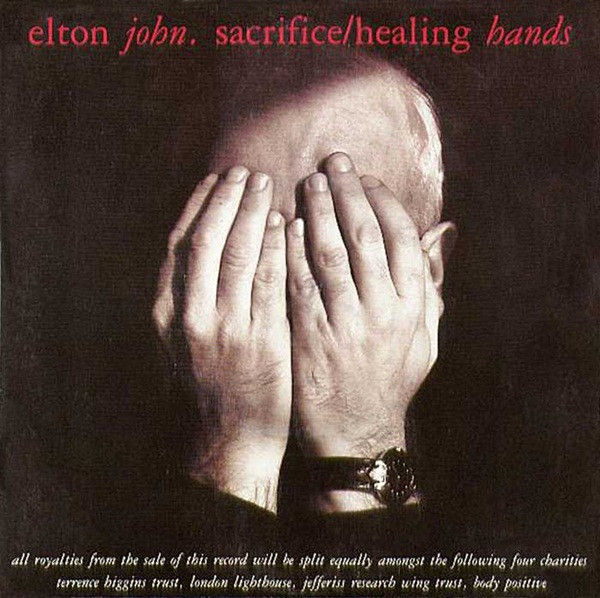
The flip side of this double-‘A’, ‘Healing Hands’, is a bit more lively. It’s a bouncy rocker: a little bluesy, a little gospel. It was apparently inspired by the Four Top’s ‘Reach Out, I’ll Be There’, and you can hear it in the chorus: Reach out, For her healing hands… Is it just me, or is he suggesting that God is a woman…? Anyway, it’s a great vocal performance from John and, while he gets plenty of praise for his showmanship and his presence, I’m not sure he always gets enough credit for his voice.
Again, though, it’s very mum-friendly. Why now? Why, on the verge of being a very old man (in pop star terms) did Elton score the biggest British hit of his career? We have time to ponder this as ‘Healing Hands’ meanders towards its conclusion (seriously, it has one of the longest fade-outs ever). ‘Sacrifice’ had been released nine months before, making a lowly #55. Steve Wright then started playing it on Radio 1 (crushing my Radio 2 theory from four paragraphs ago), it was re-released with ‘Healing Hands’, and the rest was history. Proceeds from the record’s sales went to four different AIDS charities, which again probably help boost sales.
We can perhaps see this record as a dividing point in Elton John’s career. Long gone were the hit-filled, rhinestoned, giant spectacled days of the seventies. The eighties had brought addiction, rehab, a doomed marriage, fewer hits… By 1990, he’d had one Top 10 single in five years. If this hadn’t caught fire, would Elton have faded into obscurity and the nostalgia circuits? Maybe that’s a stretch, but it definitely set him up for a huge career renaissance in the 1990s. Superstar duets, Disney themes, and the planet’s biggest-selling single of all time, were all about to follow…

 The UK Number Ones Blog