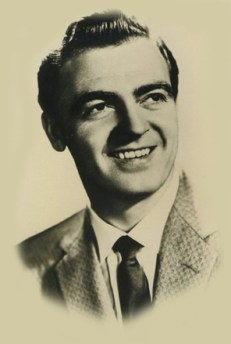
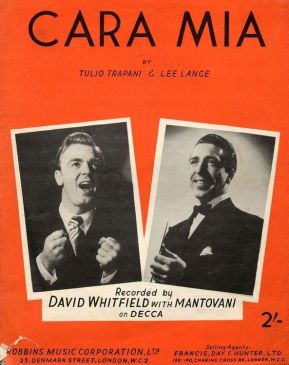
20. ‘Cara Mia’, by David Whitfield with Mantovani & His Orchestra

david-whitfield-with-mantovani-cara-mia-decca

Cara Mia, by David Whitfield with Mantovani & His Orchestra (both Whitfield and Mantovani’s 2nd of two #1s)

10 weeks, from 2nd July to 10th Sept 1954

The last time I wrote about David Whitfield, when his first number one followed on from Frankie Laine’s rockabilly number ‘Hey Joe’, I might have mentioned something about it being one step forward and two steps back…

But for this to follow on from rock ‘n’ roll pioneer Johnnie Ray, and the gloriously suggestive ‘Such a Night’ (OK, yes, Doris Day did return to the top for a big old spell in between but let’s not allow that to get in the way of my indignation!) – it’s more a case of one step forward, ten steps back! One step for every week this record spent at the top! The difference between this and ‘Such a Night’ is massive. This is pre-rock. If such a thing ever existed, if it could be captured and bottled or defined in a dictionary, then this would be it. The Sex Pistols were punk, Oasis were Britpop, David Whitfield was pre-rock.

Shrill backing singers? Check. Overwrought vocals? Got it. Proper enunciation? Yep. Big bastard of an ending? Oh boy. Seriously, check out this ending. It has three stages. Whitfield comes in for the final verse like he means it, an octave up on previous lines: All I want is you, for ever more… Then comes the final line for which he amps it up even more: TILL THE END OF… And the note that he hits for the final TIIIIIMMMMMMEEEEE!!! cannot be natural. Its impressive, yet horrifying.

I have nothing new to write about David Whitfield. He’s of his time, and who am I to judge? People at the time clearly enjoyed it: very, very few records have ever reached double figures in terms of weeks at #1. ‘Such a Night’ only got one week. And he died young, unlike so few of his contemporaries, aged just fifty-four in 1980. We should also drop a mention for Mantovani, of violin and rhyming-slang fame, from whom we won’t be hearing again in this countdown. The violins in this song sound identical to those in his first chart topper. Mantovani’s signature strings.
cara-mia-song-featuring-david-whitfield-mantovani-englebert

Though the sharp-eyed among you will currently no doubt be thinking ‘Now just wait a minute here!’ Because back a few posts ago I mentioned that every record thus far had been conducted by someone and their orchestra, and that these conductors – Paul Weston, Hugo Winterhalter et al, never seemed to get credited and were deleted from any chart statistics. So why is Mantovani getting a credit here? To be brutally honest… I dunno. Maybe it’s because this, more than any, is a super operatic, orchestral record and they feel that that should be recognised. Maybe it’s because Mantovani already sneaked a week at the top with his own song, ‘Moulin Rouge’, and so was slightly more renowned than your run-of-the-mill conductors. Maybe Mantovani was just really concerned about his legacy and so paid someone to stick him in the records. Who know? But if I were Paul Weston, I’d be pretty pissed off.

Before finishing, I want to mention a thought that struck me a few posts ago. It seems that in the mid-1950s there were very few ways for people to hear the music that was in the charts without buying it. No MTV (duh!), no Top of the Pops, no YouTube, no nothing. Radio consisted of a handful of stations, very few of which played pop music. Pirate Radio hadn’t got going yet. Perhaps you could have listened to ‘Pick of the Pops’, on the BBC Light Programme, but even that wasn’t first broadcast until 1955. It just seems so alien to me, to us, that you might only know of a record as a listing in a magazine and have no idea how it sounded until you went out and bought it.

Although, this might explain how certain songs managed to top the charts in the first place…

14. ‘Answer Me’, by David Whitfield

05bcd67666dbe25f75de8dae9ccd1bba

Answer Me, by David Whitfield (his 1st of two #1s)

1 week, from 6th to 13th November/ 1 week joint with Frankie Laine, from 11th to 18th December 1953 (2 weeks total)

This period, the immediate post-war years, 1945-55, is known musically as the ‘pre-rock era’. The time right before ‘Rock Around the Clock’, and Elvis, and teddy boys and pink ladies, created what we know as modern popular music.

Except I have a history degree, and one of the first things you learn in history class is that any labels that have been applied to certain periods of time, and the images that are conjured up when you think of, say, the ‘Tudors’ or the ‘fin de siècle’, are at best gross stereotypes and at worst just plain wrong.

And, having listened to thirteen of the biggest selling hits from this period, it’s clear that there’s no such thing as the ‘pre-rock’ sound. Rock was already here, in the playful hiccups of Kay Starr’s voice and the twangy guitar solo of ‘Hey Joe’. Plus, twenty years previously we had been right in the middle of the ‘Jazz Age’, and that was a pretty raucous time. No, rock was here. It had always been here, at least in spirit if not in sound. It just hadn’t broken through quite yet as ‘rock’. It was having what we might now call a soft landing. Every musical genre has one – nobody woke up one morning and invented heavy metal, or garage, or grime. They can all be traced back to something earlier.

But – big but – that’s not to say you’re going to find any traces of the nascent rock ‘n’ roll movement here, in the 14th UK #1. Because for every hit that was flirting with rockier elements, there was a hit like this. One step forwards, two steps back. This is pre-pre-pre rock. This is partying like it’s 1910.

David Whitfield’s ‘Answer Me’ is a proper record. And I don’t mean ‘proper’ as in substantial and fulfilling; I mean ‘proper’ as in how you should behave when the vicar comes for tea. It’s semi-operatic, it’s painfully earnest, and it’s incredibly old-fashioned.

It’s a song about heartbreak, first and foremost. The singer is asking the Lord for an answer: does his love still love him back? Answer me, Lord above, just what sin have I been guilty of?… She was mine yesterday… I believed love was here to stay… And so on. Whitfield’s voice is so clear, so technically correct, that it sounds slightly ridiculous. Here is a man at the end of his tether, laying himself at the mercy of God, begging for one more chance with the love of his life, and all the while enunciating like the Queen. Every ‘t’ pings off his teeth, every ‘r’ is rolled. It’s as if the lyrics were written down in the phonetic alphabet – If she thinks aT awll abowT me, please leT heR heaR my praiR – and that it was recorded for the benefit of foreign students.

david

And, I know I’ve mocked the dramatic endings of some of the previous records, but this one really takes the biscuit. Whitfield’s voice completely changes with thirty seconds to go, growing fuller and throatier, but losing none of his cut-glass diction, as he steels himself for the big finish. Please answer me…. Oh….. Lord…..! It’s as if he’s responding to the American singers that have gone before, the Guy Mitchells and the Frankie Laines, with all their sloppy vowels and swallowed endings: “Sir, my heart may indeed be breaking, but that’s no reason to speak like a slob.”

If anything, the chart run of ‘Answer Me’ is much more interesting than the song itself. It had a week at the top, then dropped down for a whole month before returning. That’s a pretty long gap between stints at number one. When it did eventually climb back up, it did so in a manner that has only occurred a handful of times in chart history: it tied with another record for number one. And, for added intrigue, the song that it had this little tussle with was… a different version of ‘Answer Me’. This is all very 1950s. But more on all that in the next post…

To finish, I’d like to return to the idea of the ‘pre-rock era.’ I dug up this old article from ‘The Guardian’, which name checks some of the hits covered here. And it posits an interesting idea about why this time in music was dominated by very MOR, very laid-back, very jaunty hits about prayers being answered, and girls in red feathers and huly-huly skirts. Namely, that Britain had just seen the worst conflict in history, had lost loved ones, had survived the nightly threat of the Blitz, had suffered through ten years of rationing and rubble only to emerge at the other side into a world on the verge of nuclear Armageddon… and they just wanted some bloody escapism. It’s pretty obvious when you think about it.

Then, come 1955 or thereabouts, youngsters for whom the war was a distant, childhood dream, who wanted to escape the drab post-war depression, looked across the Atlantic… and the rest is history.

But not quite yet.