On This Day… 6th December

Time for another look back at a date in chart history. What were the songs and the stories at number one on December 6th through the years…
On this day in 1980, ABBA were about to begin their thirty-first and final week on top of the UK singles chart with ‘Super Trouper’. My favourite ABBA chart-topper probably changes on a weekly basis, and I could make a case for all of them (apart from ‘Fernando’, sorry). ‘Super Trouper’ is a late-era classic, with that perfect balance of upbeat melancholoy. Songs about how tiring it is being famous can be, well, tiring; but this is a colossus of the genre. I was sick and tired of everything, When I called you last night from Glasgow… is a quintessential ABBA opening line: slightly odd, poetic, beautifully to the point.

Eleven years earlier, on this day in 1969, the Rolling Stones headlined the infamous Altamont Free Concert in California. Supposed to be the West Coast’s answer to Woodstock, it ended up becoming synonymous with the end of the swinging sixties and the death of the hippy dream. Violence which had been brewing throughout the day erupted during the Stones’ delayed set, and ended in the death of an eighteen year old spectator, Meredith Hunter, stabbed by one of the Hells Angels who had been brought in as security.

The Stones are perhaps the perfect band to encapsulate that loss of ’60s innocence, as they had never been particularly innocent, and had struggled with the psychedelic, hippy side of things. Also, they’re the sixties juggernaut that has lasted, and lasted, and lasted, far beyond the decade that birthed them… Here then is their big hit from earlier that year, their final UK #1, and perhaps the ultimate rock and roll tune, ‘Honky Tonk Women’.

In recent posts I’ve been bemoaning/celebrating the end of the Golden Era of the Boyband, which I think came to an end in late 2002. There are arguments to be had for boybands dating back to the fifties, with the likes of the Teenagers, or to the Monkees in the sixties. New Edition in 1983 and Bros in 1988 could lay claim to being the first modern boyband, but for my money the true holders of that title, and the openers of the floodgates, were New Kids on the Block. Who just so happened to be sitting at #1 on this day in 1989 with ‘You Got It (The Right Stuff)’. They were the first of twelve boybands (fourteen, if we bend my rules and count Hanson and Blazin’ Squad) to provide forty (or forty-two) #1s over thirteen years…

Let’s go way back now, sixty-seven years to be exact. Number one on this day in 1958 is what I called ‘the Scottish #1’ at the time, and which I still intend to make our national anthem when I become First Minister, replacing the dirge that is ‘Flower of Scotland’. The fifties was at times a musical desert, strewn with overwrought ballads, and the occasional rock ‘n’ roll tune. Then there were the novelties. So many novelties. Of which ‘Hoots Mon’ stands out as one of the finest. It’s got a wonderful rock ‘n’ roll energy, but it’s also a relic of a much earlier music hall era, with its singalong spirit and its Hammond organ. It’s based on an old folk tune, ‘A Hundred Pipers’, and features classic phrases such as ‘och aye’, ‘there’s a moose loose aboot this hoose’ and ‘it’s a braw, bricht, moonlicht nicht’, none of which a Scotsperson has ever actually uttered.

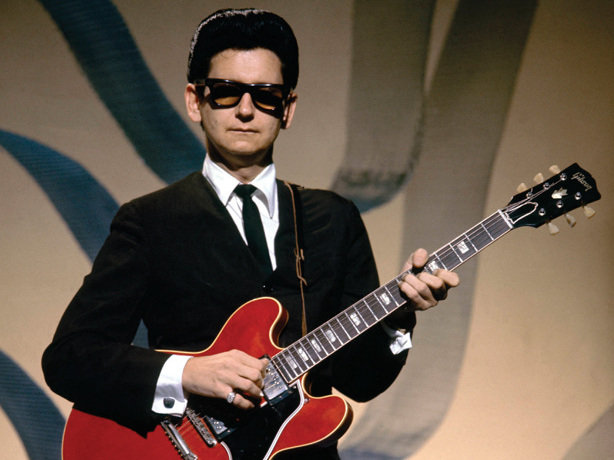
Finally, 6th December is perhaps best known as a date in music history for being the anniversary of Roy Orbison’s untimely death. In 1988, Orbison was just getting his career back on track through the success of the Travelling Wilburys, his supergroup alongside George Harrison, Bob Dylan, Jeff Lynne and Tom Petty, whose first album had been released earlier that year. Orbison had also just put the finishing touches to his first solo album in a decade, when he died suddenly, of a heart attack. The album ‘Mystery Girl’, and the lead single ‘You Got It’, posthumously returned him to the Top 10 the following year. But to celebrate his genius, let’s go back to 1960, and enjoy his first of three UK #1s: the hauntingly dramatic ‘Only the Lonely’.
On This Day… 28th August

Welcome one and all to our fourth ‘On This Day’ feature, in which we take a look back at chart-topping history through the records which have made #1. (Please feel free to check out the previous dates that we have covered here, here, and here.)

What, then, were the stories atop the UK singles chart on August 28th through the years…?

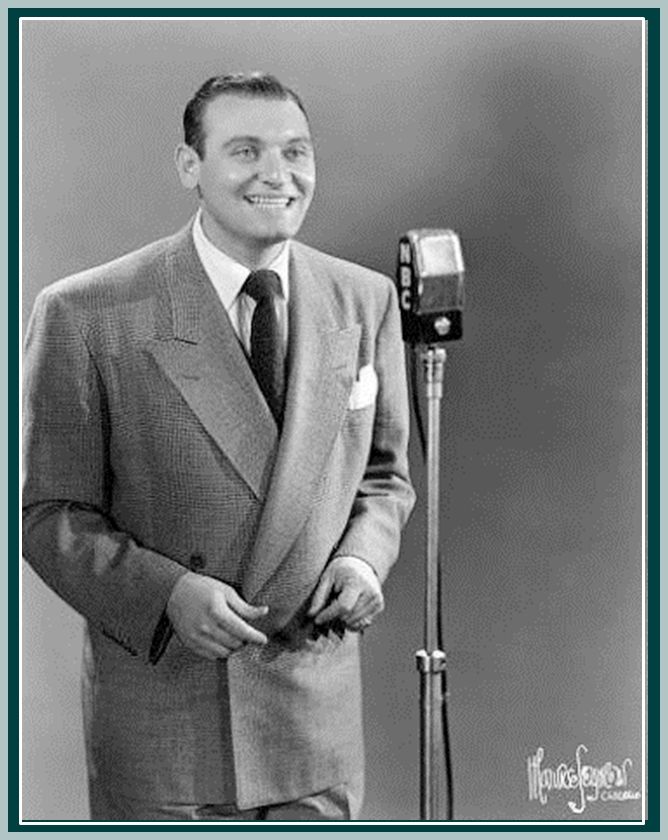
Well, way back in 1953 Frankie Laine’s ‘I Believe’ was starting its seventeenth of eighteen weeks at number one. That’s a lot of weeks. Amazingly, no other record in the intervening seventy-two years has managed to equal it. The record set by just the 9th number one single – the charts having begun less than a year earlier – still stands! Interestingly, two of the records that came closest – ‘(Everything I Do) I Do It for You’ (16 weeks, and the record holder for consecutive weeks) and ‘Love Is All Around’ (15 weeks) – were also both at number one on this date. The only other 15-weeker, Drake’s ‘One Dance’, was sadly not at #1 on the 28th August. ‘I Believe’ returned to #1 in the nineties ‘thanks’ to Robson & Jerome, but I won’t bother linking to that.

Eleven years later, and sitting at #1 was the Honeycomb’s stomping ‘Have I the Right?’ It was the third and final chart-topper produced by the visionary Joe Meek. Of the three, this is probably the most traditionally ‘pop’ sounding, though it is still crammed with wacky techniques – such as having the band stomping on the staircase outside his studio – and instruments, such as the slicing synths. It hit the charts in that glorious autumn of ’64, one of the most fertile times for British pop with ‘A Hard Day’s Night’, ‘Do Wah Diddy Diddy’, ‘You Really Got Me’, ‘I’m Into Something Good’, and this, taking turns on top.

28th August is also the birthday of The Honeycombs’ female drummer, Honey Lantree. One of few women to take up the sticks – I can only think of Karen Carpenter and Meg White – she had been discovered while working as a hairdresser. Her salon manager was in a band, let her try out, and was so impressed that he incorporated Lantree and her brother into his group. She retired from music when the Honeycombs split in 1967 following Meek’s death, but she rejoined them every so often for tours right up until 2005.

August 28th has seen not one, but two versions of ‘I Got You Babe’ sitting at number one in the singles chart. The original was, of course, by Sonny and Cher in 1965…

It was their only #1 as a duo, and Cher’s first of four, spanning thirty-three years. Exactly twenty years later, and a cover by UB40 and Chrissie Hynde was spending its solitary week on top. I gave this record a ‘Meh’ award, and my opinions on it haven’t changed much. It’s still a bit of a slog…

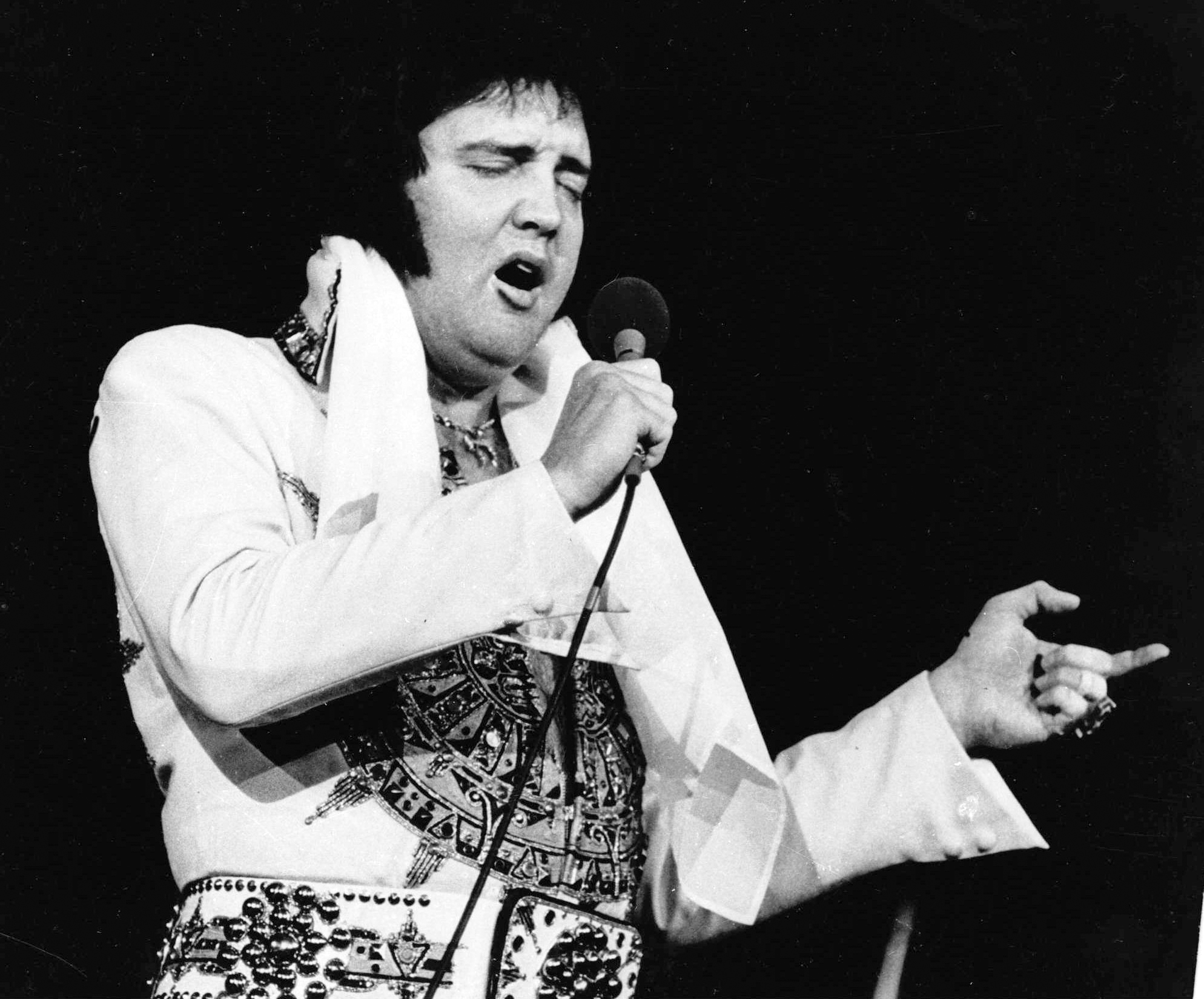
On this day in 1977, and the world still coming to terms with his death aged just forty-two, Elvis Presley’s current single climbed to #1, the first of his record five posthumous chart-toppers. ‘Way Down’ had spent its first two weeks on chart climbing from #46 to #42, so its safe to assume that it wouldn’t have been a massive hit without tragedy striking. However, it would also be wrong to suggest that The King was a spent force at this point in his career, as his previous single ‘Moody Blue’ had made it to #6. In my original post on it, I rejoiced in the fact that fate ensured Elvis’s final single was a rocker, given that he’d spent much of the ’70s releasing schmaltzy ballads. Lyrically, it’s also fitting for the recently deceased star, given that it’s called ‘Way Down’, and compares a woman’s love to prescription drugs… However, fun as the song is, and as lively as Elvis’s perfomance is, the show is stolen by JD Sumner’s astonishingly low closing note.

Finally, on this day in 1993, Culture Beat’s ‘Mr. Vain’ was enjoying its first of four weeks at #1. I bring this to your attention not just because it’s a banger – and it is – but because it was the first chart-topper in forty years not to be released as a 7″ single. Vinyl was on its way out after a century as the medium of choice, to be replaced in the space of twenty years by CDs, then digital downloads, then streaming…

Thanks for joining this delve back through the decades. Next up, we continue our journey through 2001 with a similarly retro reboot…

Remembering Connie Francis

Earlier this week the sad news of Connie Francis’ death was announced, aged eighty-seven, closing the door on yet another chapter from the earliest chart years. There can’t be many, if any, older chart-toppers than Francis still around… And there were precious few women, either, who were scoring rock ‘n’ roll hits and competing with the big male stars of the late fifties.

Francis scored two huge, six-weeks-apiece #1s in 1958, the sassy ‘Who’s Sorry Now’ and the whipcracking ‘Stupid Cupid’ (twinned with ‘Carolina Moon’). I also covered her 1960 hits ‘Mama’ and ‘Robot Man’ as a Random Runner-Up. Follow those links to hear those tunes, and to read my original posts. But since writing those posts – and this has been one of the best things about doing this blog, discovering artists’ non-chart topping back catalogues – I’ve fallen in love with many of Connie’s other hits. So let’s share some here, in her memory.

‘Lipstick on Your Collar’ – #3 in 1959

I love the camp melodrama of this bop, about a cheating boy given away by lipstick smudges. How does Connie know the lipstick isn’t hers? Well, eagle-eyed, she notices his is red, while hers is baby pink. Coleen Rooney eat your heart out. Turns out that floozy Mary Jane had been smooching her man right outside the juke joint. But, as with so many of her early records, Connie does not wallow in heartbreak. In fact, she seems almost thrilled to have rumbled him…

‘Plenty Good Lovin” – #18 in 1959

A similarly uptempo, more swinging, hit from the same year. And this one is positively raunchy by 1959 standards. In fact, I’m not sure Connie isn’t simulating orgasm during the break in the middle… She sings the praises of a man who doesn’t have a nice car, can’t play guitar, is neither intelligent nor particularly good-looking, but who’s got somethin’ that’s better by far… I mean, gurrrrlllll… Plenty of things that he don’t know, But this boy shines when the lights are low…

‘Everybody’s Somebody’s Fool’ – #3 in 1960

Her first US #1, and in fact the first Billboard Hot 100 number one by a female singer (the chart having launched well over a year earlier). Which just goes to prove how impressive Francis’s hit making was, stacked against the likes of Elvis, Pat Boone, Ricky Nelson and co. I love the honky-tonk feel to this, with the rolling organ and the rickety, country beat, and her voice drenched in echo.

‘Where the Boys Are’ – #5 in 1961

Francis made her acting debut in 1961, in the movie ‘Where the Boys Are’. And the title track gave her another big hit, proving that she could sing something a little more traditional to go along with all the rock ‘n’ roll. In 1978, as she was attempting a career comeback, Connie recorded a disco version. If that doesn’t grab you, how about a Japanese version? Today’s female stars could only dream of such versatility.

‘Vacation’ – #10 in 1962

Despite not having an original bone in its body, and already sounding dated in 1962, I love this throwaway tune. ‘Vacation’ was Francis’s last Top 10 hit in both the US and the UK, as the Merseybeat acts prepared to render so many stars obsolete. But it’s hard not to get carried along with this record’s exuberance. Maybe because I’m an English teacher in my day job, I’m instinctively drawn to songs that spell words out in the lyrics. Similarly, it’s probably why I’m drawn to songs about the summer holidays. So this one works for me on many levels.

‘Pretty Little Baby’

It would be wrong to finish without mentioning her final ‘hit’. ‘Pretty Little Baby’ was a B-side back in 1962, but in recent months you’ll surely have heard it if you’ve spent any amount of time scrolling on Instagram or TikTok. In one of her final interviews, Francis claimed to have forgotten of the song’s existence, but that she was touched by its resurgence, and how even kindergartners now know her music. Back to teaching for a moment, I can attest to this as I have a student who has been singing this to himself for several months now… Musically this is cute, and I love whatever early electronic device the solo was recorded on.

From the mid-sixties onwards the hits dried up, and Connie Francis’s personal life took several dark turns. The Guardian published a good article on her many highs and lows yesterday, and she became an advocate for mental health following various traumatic experiences. Having read that, it feels impressive that she lived such a long life and fulfilled life. She returned to music, and only officially retired a few years ago.

Connie Francis, December 12th 1937 – July 16th 2025

Remembering Johnnie Ray and Del Shannon

It’s been a while since I did a ‘Remembering’ post, so here’s two for the price of one. Two big stars of the pre-Beatles age, both of whom died within a couple of weeks in February 1990.

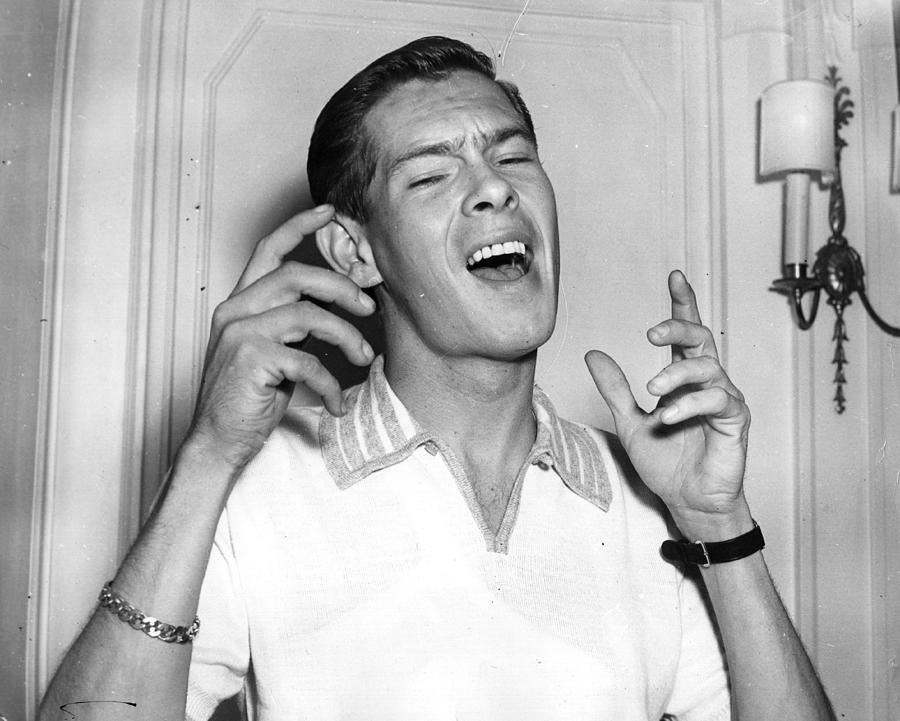
Before starting this blog, I knew Johnnie Ray by name and not much else. He after all is referenced in the opening line of ‘Come On Eileen’ (Poor old Johnnie Ray…) But I will now be forever grateful to him, for making the earliest years of the charts bearable, when it sometimes felt like one po-faced ballad after another, after another. His first #1 was the incredibly steamy (by 1954 standards) ‘Such a Night’, and he had a seven-week run with the whistle-tastic ‘Just Walkin’ in the Rain’ before ending things with the zippy ‘Yes Tonight, Josephine’. All three are well worth a listen if you’ve not heard them before, and proof that pop music could be fun in the prehistoric era. Below I’ll highlight a few of my other favourites of his.

Released in 1951, before Britain even had a singles chart, we can assume that ‘Cry’ would have been a multi-week number one. The missing link between Sinatra and Elvis, Ray’s wonderfully histrionic performance shows why he was known as the ‘Nabob of Sob’ and the ‘Prince of Wails’, surely two of pop music’s best nicknames. His exaggerated, stagey way of singing may have been linked to the fact that he was partially deaf.

‘Ain’t Misbehavin’ is a standard, recorded by everyone from Louis Armstrong and Ella Fitzgerald, to Robson & Jerome. And while I’ll admit to not having heard every version, I’d suggest that you’d struggle to find a performance more committed than Johnnie Ray’s. The man was the epitome of the phrase ‘sing it for the back row’.

Fond of a whistle, Ray made #10 with ‘You Don’t Owe Me A Thing’ in early 1958, a perfect example of how rock ‘n’ roll was making its presence felt in records that weren’t actually rock songs.

By the early 1960s, like so many fifties stars, Ray’s career had tailed off. It’s surprising that he managed to have a career in the first place, after he was arrested for soliciting an undercover policeman in a public toilet in 1951. Rumours about Ray’s sexuality continued, but didn’t seem to harm his sales until another arrest in 1959. He was openly bisexual to many in the music industry, and married a woman named Marilyn Morrison in 1952, who claimed she would ‘straighten him out’. They separated after a year.

Ray also had problems with alcohol, which worsened in the sixties. He would sporadically tour small venues and appear on television in the States, while commanding much larger audiences in the UK and Australia (where he remained most popular) right up until his death from liver failure on February 24th 1990. He was sixty-three.

Del Shannon scored his sole chart-topper a few years after Ray’s time at the top. And what a chart-topper it was. ‘Runaway’ is possibly the most inventive, most exciting, most propulsive #1 of that supposedly fallow period between Elvis and The Beatles. It made top spot in the summer of 1961, and features an innovative Musitron solo, making it arguably the first electronic hit. But even if that solo was played on a clapped out old piano it would take nothing from the record’s innate quality. Anyway, I discussed all this in more detail in my post on ‘Runaway’ here.

‘Runaway’ is so good that it tends to completely overshadow anything Del Shannon released afterwards. But ‘Little Town Flirt’ is another great slice of malt shop pop, making #4 in early 1963. He had a good line in heartbreak, and woman shaming, usually singing about runaways and flirts, and in ‘Hats Off to Larry’ he indulges in a bit of schadenfreude as his ex is dumped and left as heartbroken as he had been.

Shannon had a style, and came pretty close to shamelessly ripping himself off on some records (check out how close ‘Two Kinds of Teardrops’ is to ‘Little Town Flirt!) But on ‘So Long Baby’ he managed to recycle the energy of ‘Runaway’ into a deranged oompah beat and create a #10 hit that sounds both frivolous and terrifying.

Like Johnnie Ray, Del Shannon’s career slowed down towards the end of the sixties and into the seventies as he battled alcoholism. He worked with Tom Petty and Dave Edmunds, and by the ’80s he had sobered up and started something of a comeback. He worked with Jeff Lynne, and was touted as a replacement for Roy Orbison in The Travelling Wilburys. Sadly, though, he shot himself on February 8th 1990, apparently after having a negative reaction to the Prozac he was taking for depression. He was just fifty-five.

On This Day… 5th January

A very Happy New Year to you all, and a warm welcome back to the UK Number Ones Blog. I hope you had a good festive period, managed to celebrate, relax, and (in my case) catch up with writing about some soon-to-come number ones. Before we resume our journey through the late, late-nineties, I’m debuting a new feature!

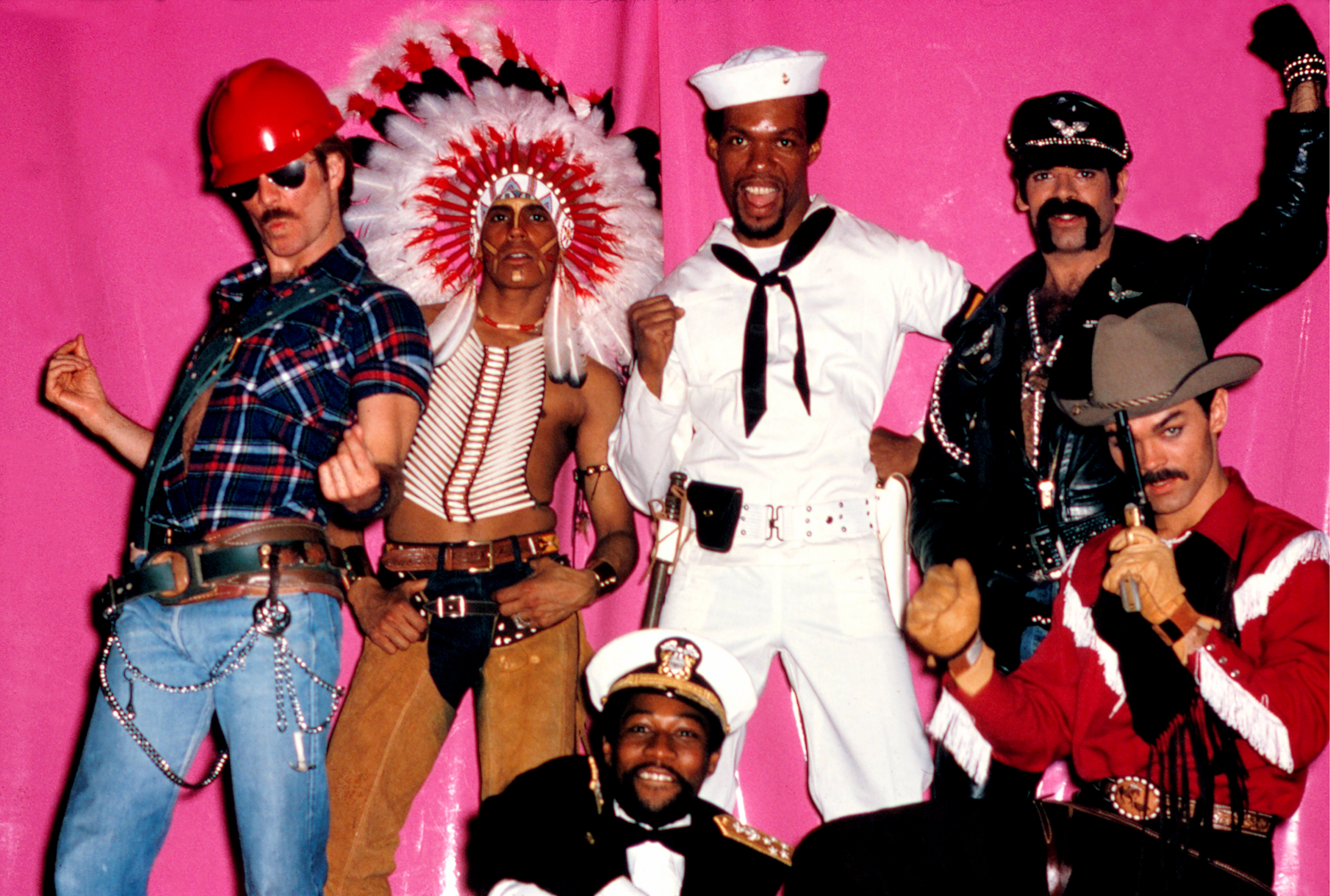
The Village People, group portrait, New York, 1978. (Photo by Michael Putland/Getty Images)

‘On This Day…’ will do pretty much exactly what it says on the tin. I’ll intro a few of the records that have been top of the charts on a particular date in history, as well as mentioning a few births, a few deaths, and a few interesting occasions that tie into a particular chart-topper. The hope is that readers will be able to delve into my back-catalogue of posts, and find something I wrote long before they started following this blog. Or people can, y’know, just enjoy the tunes!

First up, number one on this day in 1962, we have a stone-cold classic:

‘Moon River’, from the soundtrack to ‘Breakfast at Tiffany’s’ is one of the great songs of that supposedly fallow period between rock ‘n’ roll and The Beatles. In the film it is sung by Audrey Hepburn, at the Academy Awards that year it was performed by Andy Williams, while an instrumental version by the song’s composer Henry Mancini and a version by Jerry Butler were hits in the US. In the UK, however, it was left to South African-born Danny Williams to have the most succesful version of all. You can read my original post on ‘Moon River’ here.

Meanwhile on this day in 1923, radio host, record producer, and founder of the legendary Sun Records label, Sam Phillips was born in Alabama. He is most famous for his work with a young Elvis Presley, although he also produced Roy Orbison, Johnny Cash, Carl Perkins and many of the other early rock and roll stars. His only contribution to the top of the UK singles chart, however, was this banger:

Here’s my original post on ‘Great Balls of Fire’. If you’re only going to top the charts once, might as well make it good ‘un. Speaking of which, number one on this day in 1979 we have perhaps the ultimate guilty pleasure. There is not a soul alive who hasn’t done the dance to the ‘YMCA’, however grudgingly, and not even the recent gyrations of Donald Trump can truly sour this wedding reception classic. Even more recently, Village Person Victor Willis (AKA the cop) has been threatening to sue anyone who claims that ‘YMCA’ – a song with the lyric: They have everything for young men to enjoy, You can hang out with all the boys… – has any homosexual connotations. Whatsover. No sirree. To which we can all say, ‘Okay honey…’ (Original post here.)

In sadder news, on this day in 1998, Sonny Bono died following a skiing accident in Nevada. He was of course the singing partner, and former husband, of Cher, with whom he enjoyed his sole chart-topper ‘I Got You Babe’ in 1965. I wrote about it, the 201st #1 single, way back in 2019.

Finally, one of the least likely number one singles of all time was sitting astride the charts on January 5th 1991. Early January is a bit of a dead zone for chart-toppers, as in most years the Christmas leftovers are still clinging on top with little competition. Iron Maiden spotted an opportunity, and released ‘Bring Your Daughter… To the Slaughter’ in the final week of 1990. Their devoted fanbase, as well as the publicity of knocking the God-bothering Cliff Richard’s ‘Saviour’s Day’ off #1, delivered the heavy metal legends their biggest hit. (Original post here.)

I hope everyone enjoyed this new feature, and won’t mind if it pops back up ever few weeks. I’m also going to be doing more regular posts on cover versions, number two singles, ‘Remembering’ features, ‘Best of the Rests’ and ‘Today’s Top 10s’, as well as a new look at the ‘B’-sides to famous number ones. The main focus will of course still be on the chart-toppers; just a little more regularly interspersed with interesting detours through chart history!

Here’s to a great 2025!

Random Runners-Up: ‘Love Is a Many Splendored Thing’, by The Four Aces

For the fourth part of this Random Runners-Up series, we’re going back almost as far as it’s possible to go. In chart terms, at least. To the mists of November 1955… It’s over five years since I wrote my posts on the fifties number ones, discovering that for every hot slice of rock ‘n’ roll there were three rather stodgier slices of big-lunged balladry. But if you’re a more recent visitor to these pages, I would recommend a journey back to the dawn of the charts as an interesting counterpoint to the #1s we’re covering now.

‘Love Is a Many Splendored Thing’, by the Four Aces

#2 for 2 weeks, from 25th November – 9th December 1955 (behind ‘Rock Around the Clock’)

Anyway, on to the #2 at hand. And interestingly, this very record was held from top spot by ‘Rock Around the Clock’, the first rock and/or roll number one. Which goes to prove that there was no instant rock revolution; more a smattering of guitar-led hits that slowly started to break up the heavy crooning. In fairness, ‘Love Is a Many Splendored Thing’ has quite a springy bass line, but aside from that it’s a big, beefy pre-rock ballad. A dramatic intro, strings, vocal harmonies, and a lead singer who croons like his life depends on it.

I am familiar with this song, as a version of it famously plays during the opening scene of ‘Grease’, while Sandy and Danny frolic on a beach. I’d bet most people are familiar with the title line at least, from a variety of pop culture references. Away from the soaring chorus, things are slightly less memorable, and we have some classic 1950s metaphors for love: It’s the April rose, That only grows, In the early spring…

It sounds very dated, not to mention that the recording needs a remastering or two. But it’s hard to dislike a song that is belted out with such conviction. My memories of writing about the ‘50s number ones are lots of songs like this, about flowers, sunshine and morning dew, sung with operatic conviction. None of which would work for a modern audience. When did we all become so cynical…? (And thank God we did…)

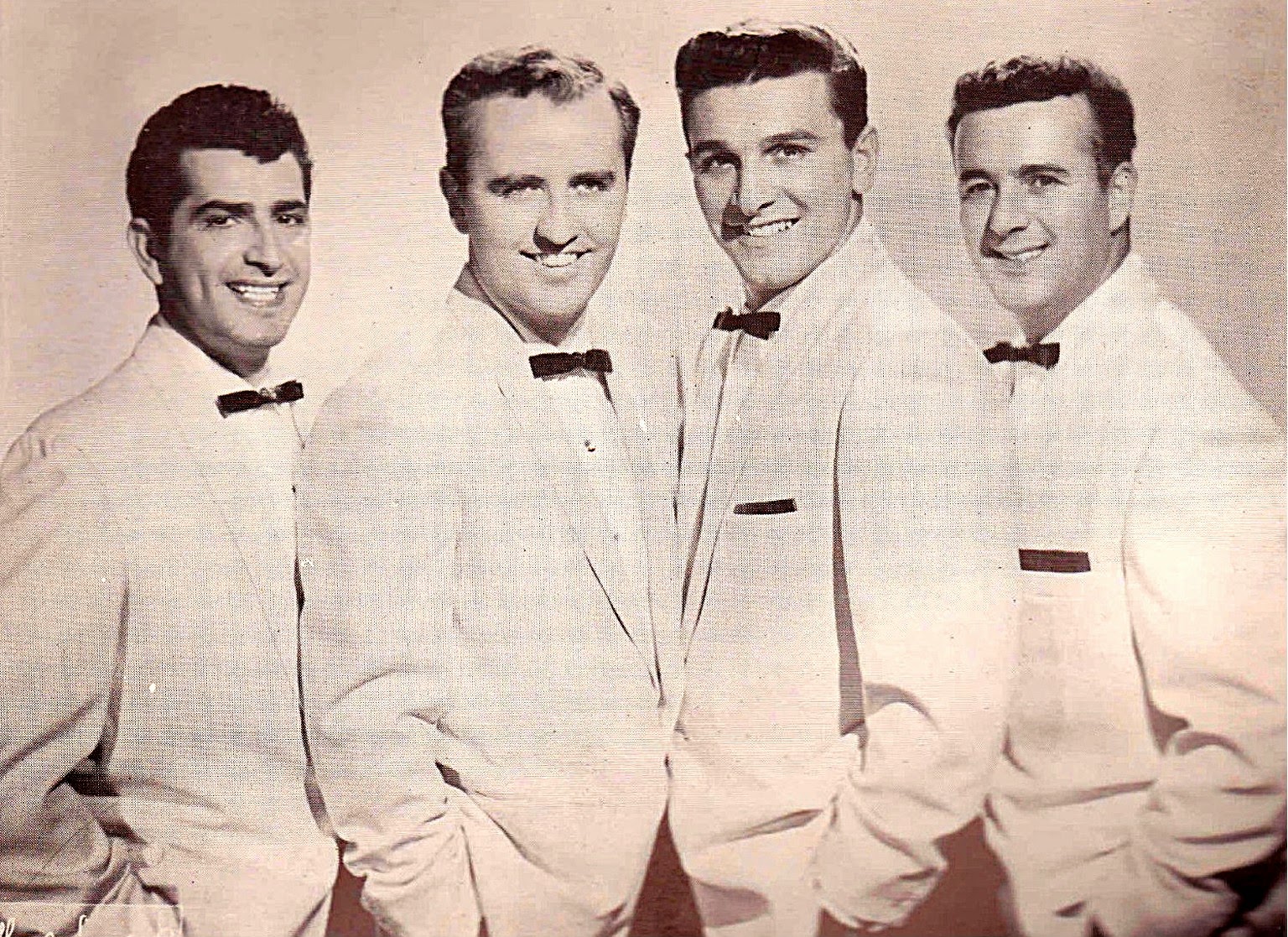
The Four Aces were a four-piece from Pennsylvania, who enjoyed decent chart success on either side of the Atlantic until, like so many pre-rock acts, 1957 or so. ‘Love Is a Many Splendored Thing’ meanwhile was the theme to a movie of the same name, and won the Oscar for Best Original Song in 1956. It was recorded by a plethora of famous names following this success, as was the style of the time, including Eddie Fisher, Doris Day, Nat King Cole, Bing Crosby, Andy Williams, Sinatra, and Connie Francis (in Italian), among others.

Our final #2 is up tomorrow! It’s the turn of the eighties, and another soundtrack classic…

#1s poll! Choose your best (and worst) Christmas Number Ones…

It’s the most wonderful time of the year, at least according to Andy Williams, which means stockings above the fireplace, geese getting fat, goodwill to all… And the annual race for Christmas Number One.

By now it’s certainly a British tradition, and the one time of the year that the singles chart is guaranteed to make the news, but most people would say that the honour of being the nation’s biggest-selling song on December 25th has lost a lot of its lustre. I’d agree. In fact, I’d say that we’ve already covered the heyday of the Christmas Number One in my regular blog… The most recent festive #1 was 1994’s: East 17’s ‘Stay Another Day’, a classic that I’ve just named one of the Very Best. From here on its a slippery slope, past The Spice Girls, endless X-Factor winners, countless charity singles, to the very bottom of the barrel, and the dreaded LadBaby.

Now it’s time for you to decide: what is the greatest Xmas #1? And, perhaps more importantly, what is the worst?? See below two polls, in which you can choose as many or as few songs as you like, for both honours.

Perhaps controversially, I’ve not listed every Xmas #1 since 1952. Until the early seventies, the idea of a ‘Christmas Number One’ wasn’t particularly relevant, so the only pre-1973 hits I’ve included in the vote are specifically Chistmassy, or novelty songs that probably wouldn’t have made #1 at any other time of year (so, sorry, no Beatles…) Even post-1973, I’ve excluded pop songs that just happened to be #1 at Christmas (so no Human League, or Pet Shop Boys). However, there is space at the bottom for you to nominate any Xmas #1 you think I’ve unfairly missed off the list. You may, for example, feel very strongly that ‘Two Little Boys’ deserves the title…

Here’s the poll for the best…

And the worst…

I’ll announce the results on Christmas Eve, so you have until then to cast your votes. Have at it!

Never Had a #1… Nat King Cole

This week, we’re celebrating the ‘unluckiest’ chart acts of all time. The four bands/artists with the most Top 10 hits, but without a number one…

Next up… We’re going way back in time, to a man who was present on the very first chart back in 1952.

Nat King Cole – 15 Top 10 hits between 1952 and 1987

‘Pretend’ – #2 in 1953

Pretend you’re happy when you’re blue… Nat’s silky tones wrap themselves around this self-help guide of a song. Not sure many modern-day mental health professionals would recommend simply pretending yourself happy and in love. But folks were made of sterner stuff back in the fifties, and apparently they could just sing themselves happy on demand. Cole may not have a number one single to his name, but chart-toppers like Marvin Gaye, Johnny Preston and Alvin Stardust have recorded versions of ‘Pretend’.

‘Smile’ – #2 in 1954

A year later, Nat was at it again. One word title, reaching #2, insisiting that You’ll find that life is still worthwhile, If you just smile… This one is much better known, to me at least. In fact, if someone asks you to name a ‘classic’, or a ‘standard’, then there’s a chance you might name ‘Smile’. The tune was written by none other than Charlie Chaplin, in 1936, before words were added in the fifties. It’s been covered by everyone from Michael Jackson (his favourite song, apparently), Judy Garland, Michael Buble (obviously) and Lady Gaga.

‘When I Fall in Love’ – reached #2 in 1957, and #4 in 1987

Completing his hattrick of #2s, another classy ballad. Nat King Cole did release uptempo tunes (I love ‘Those Lazy Hazy Crazy Days of Summer‘), but the British public loved him best when he was crooning his heart out. This one, from the movie ‘Istanbul’, tips over into ‘boring’ territory, I’m afraid. But I’m in a minority, it seems, as it also made #4 on rerelease thirty years later. By that time Cole had been dead for two decades – he passed away aged just forty-five, from lung cancer. If he’d lived longer, who knows, he may have been even higher up on this list, or may even have featured in the main countdown…

Nat King Cole might have recorded a version of Michael Jackson’s favourite song, but up next we’ll feature a lady with a slightly more concrete link to the King of Pop…

582. ‘Reet Petite (The Sweetest Girl in Town)’, by Jackie Wilson

The 1986 Christmas #1, then. And, giving Paul Heaton a run for his ‘best vocals of the year’ money, in comes Jackie Wilson. The late Jackie Wilson. With a song recorded over thirty years before…

Reet Petite (The Sweetest Girl in Town), by Jackie Wilson (his 1st and only #1)

4 weeks, from 21st December 1986 – 18th January 1987

One thing you’ve probably noticed if you’ve been following our chart-topping journey for a while is that when it comes to Christmas hits, all logic goes out the window (often along with taste and decency). Think ‘Lily the Pink’, ‘Two Little Boys’, ‘Ernie’, and ‘Long Haired Lover from Liverpool’… Think, if you can bear it, of ‘There’s No One Quite Like Grandma’. Think, too, of the festive horrors still to come…

Luckily for us, though, while the appearance of ‘Reet Petite’ at Christmas #1 is clearly a novelty, this isn’t a saccharine twee-fest, or a misguided attempt at humour. Rather it’s simply a stonking, barnstorming, a-whooping and a-hollering classic re-release. It’s got nothing to do with Christmas, nothing to do with peace, love, or the blessed infant; it’s simply an ode to an ‘A’-grade hottie…

She’s so fine, fine, fine, So fine, fa-fa-fa fine… yelps Wilson… She’s alright, She’s got just what it takes… She fills her clothes, from head to toes, as well as being a tutti frutti and a bathing beauty. I don’t know about you, but I’m imagining a cross between Marilyn Monroe and Betty Boop. While the lyrics may be largely nonsensical, and often just exclamations stitched together into pidgin sentences, Wilson sells them with his trademark energy.

Is it a bit much? Maybe. Does it verge on gimmicky when he rolls his ‘r’s on the title line? Perhaps. But who cares when it’s just so darn exuberant, when it’s bursting at the seams with such fun. Wilson competes with the brassy horns, that are just as much the lead instrument as his voice is, and that constantly threaten to outdo him while never quite managing.

So, ‘Reet Petite’ is a great song, and a welcome addition to the Christmas Number One pantheon. Back in 1957, when it was Wilson’s first single after leaving his vocal group The Dominoes, it had made #6. It was re-released thirty years on after demand had grown following the screening of a clay animation video for the song on a BBC 2 documentary. I’ve included the 1987 video below… I don’t know if I’ve been spoiled by the Aardman standard of clay-mation in the 90s and ‘00s, but it’s a bit… odd. Slightly terrifying in places, too. Clearly you had to have been there.

Sadly, by the time Jackie Wilson scored his one and only UK chart-topper he had been dead for three years. He’d seen out his final years semi-comatose in a nursing home, after suffering an on-stage heart attack in 1975, and his star had fallen so far that he was initially buried in an unmarked grave. All of which makes his posthumous return to the charts, which coincided with his body being moved to a proper mausoleum, even more bittersweet.

This will kick off a strange era of re-releases, from adverts, movies and TV shows, several of which will go to #1 in the late ‘80s and early ‘90s. But, here and now, 1986 comes to end. And a strange end it’s been: from hair metal, to indie lads, to a doo-wop classic. We head into the late-eighties next, with another abrupt change in direction…

Advertisements

Random Runners-Up: ‘Move It’, by Cliff Richard & The Drifters

Our final #2 of the week, and it’s back to the fifties. To a man we’ve met plenty of times before on these very pages…

‘Move It’, by Cliff Richard & The Drifters

#2 for 1 week, from 24th-31st Oct 1958, behind ‘Stupid Cupid’ / ‘Carolina Moon’

Cliff Richard, in 1958, was Britain’s answer to Elvis. That’s both true, and unfair. True, because he was young, good-looking, and extravagantly quiffed. And unfair, because nobody comes out well from a comparison with Elvis.

This was Cliff’s debut single, his first of sixty-eight (68!) Top 10 hits in the UK, over the course of fifty years. And if you are of a slightly snide disposition – and aren’t we all, sometimes – one could argue that this was the only true rock ‘n’ roll record from Britain’s great rock ‘n’ roll hope.

And it does rock. The opening refrain is great, reminiscent of Buddy Holly, and the purring, driving riff that succeeds it sounds genuinely exciting, almost punk-ish in its simplicity. In the autumn of 1958, it must have been thrilling to hear this growling out of some jukebox speakers, and knowing that the singer was from a London suburb, rather than Memphis.

The lyrics are pretty nonsensical, as all the best rock ‘n’ roll lyrics are… C’mon pretty baby let’s a-move it and a-groove it… while The Drifters sound the equal of any American group. (They wouldn’t become The Shadows until 1959, by which point they had accompanied Cliff on his first of many easy-listening #1s, ‘Living Doll’.)

The one thing that doesn’t quite sell this for me is Cliff himself… He just sounds a bit too nice. And I don’t know if that’s because I can’t seperate the goody-goody, God-bothering, Centre Court-serenading Cliff Richard from the eighteen-year-old version. Still, imagine Elvis mumbling and grunting his way through this…

As I referred to above, Cliff would go on to enjoy some reasonable success over the ensuing decades… I wonder if anyone who bought ‘Move It’ in October 1958 imagined that this hot young rocker would still be touring and recording in 2022, well into his ninth decade… As uncool as he is, I can’t bring myself to dislike Sir Clifford of Richard: he’s a bona-fide pop legend. I can’t say I’m looking forward to reviewing any of his three remaining #1s, though, but that’s a story for another day…

I hope you’ve enjoyed random runners-up week. The regular countdown will resume over the weekend, picking up in the summer of ’86…