Following on from The Kink’s ‘Sunny Afternoon’, and we are keeping up with the summery theme. For what could be more summery than a little getaway…?
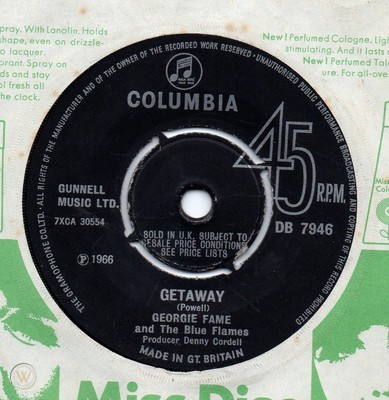
Getaway, by Georgie Fame (his 2nd of three #1s) & The Blue Flames (their 2nd and final #1)
1 week, from 21st – 28th July 1966
Gotta go, I hope you’re ready cos, Take a look outside… Georgie sings… We’ll leave the city folk, They’ll have to stay… he persuades… Don’t have to pack a thing, Just get away… It’s not as soulful, or as funky, as his previous number one, ‘Yeh Yeh’. It’s a simple enough acoustic riff, with a brass section for back-up. It’s cute. It’s catchy enough. It makes sense when you discover that it was written, initially, as an advertising jingle for a brand of petrol.
A lot of the song, around thirty percent I’d guess, is Fame chanting gotta go over the jaunty rhythm. Dig a little deeper into the remaining lyrics, though, and it turns out that his ‘getaway’ isn’t going to be a particularly luxurious one. I know a little place… A kind of pretty place… But it sounds charming: sun, sea and a bit of peace and quiet. I suppose it speaks to a time when young people didn’t have as much freedom, and perhaps could only truly ‘getaway’ once they were married…
Musically, there are two things of note. There’s an organ solo, which places this song firmly in the mid-sixties. And every few lines a horn gives out a low parp, the sort of sound that usually follows a clown’s pratfall, which lends an (unintentionally?) comic air to the record. Apart from that, there doesn’t seem to be that much to it. It’s a nice enough diversion. Both of Georgie and The Blue Flames’ #1s have been a little off the beaten path compared to the dominant sound of the time. I like that – he was doing his thing and, clearly, people were digging it.
Another point to note – this hit is referred to as both ‘Getaway’ and ‘Get Away’, with different vinyl pressings having one title or the other. The Official Charts list it as one word so that’s what I’m going with… And I’m struggling to write much more about this chart-topper, to be honest. It’s nice. The end.
Plus, Georgie Fame will be making one more appearance at the top of the charts in a year or so, minus his Blue Flames (it is a really cool name for a backing band, isn’t it: The BlueFlames), so we can skip the bio bit. Anyway, I know that I’m publishing this in late October, but close your eyes and imagine that it’s high-summer, as it was when this disc hit the top of the charts. Close your eyes and, for two minutes thirty-one seconds, getaway.
It’s high summer. The sun bakes in the sky, heat haze rises from the tarmac, a willow droops lazily by the river. ‘Sunny Afternoon’ is a record that has always, ever since I first heard it as a kid, conjured up an image in my mind. An image of a man, on the lawn of his country house, in a deckchair, with a tall, icy drink in hand.
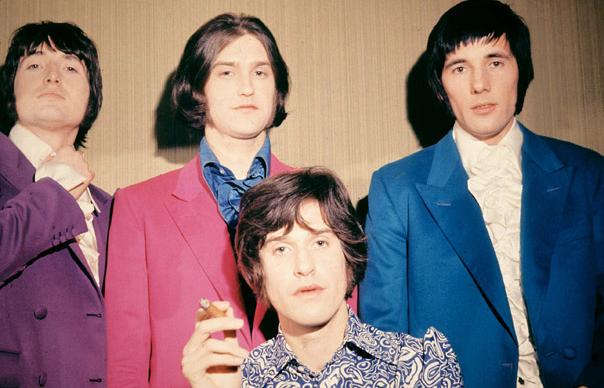
Sunny Afternoon, by The Kinks (their 3rd and final #1)
2 weeks, from 7th – 21st July 1966
The intro descends, like the weeping willow, into a tale of upper-class woe. I mentioned that the previous #1, ‘Paperback Writer’, had a satirical edge to it, and The Kinks take it up a notch here. The taxman’s taken all my dough, And left me in my stately home, Lazin’ on a sunny afternoon… A rich man has been fleeced, by the government and then by his girlfriend, and has been left with nothing. It’s standard rock star stuff: I’m famous, successful and now I’m being taxed through the nose. They’ve taken my yacht, oh woe is me…. (Another obvious Beatles comparison would be to ‘Taxman’)
Except, The Kinks were cleverer than that. Perhaps aware that people might not be too sympathetic to rich musicians moaning about tax rates, they invented a character to take us through the song. A not terribly nice character: My girlfriend’s run off with my car, And gone back to her ma and pa, Telling tales of drunkenness and cruelty… You don’t feel sorry that he’s been left with nothing but his ice cold beer… They’re complaining, sure (the progressive tax rate at the time was 83%!), but in a very palatable way.
I love this song. It’s a ‘never-skip’ whenever it pops up in a playlist. And I especially love the bridge, with its music-hall piano. Aw, Save me, Save me, Save me from this squeeze…and then a line I loved shouting out as a child… I got a big fat mama, Tryin’ to break me… Those two lines are one of the most brilliant pop moments of the decade. And the song as a whole is near-perfect: it works both as pure summery pop, and as knowing satire. And then there’s the jingly-jangly fade-out, which is very borrowed-from-The Beatles.
I also love this version of The Kinks, the one that had moved past the R&B, garage rock of ‘You Really Got Me’, into the uber-British phase of their career – the years of ‘Dedicated Follower of Fashion’, and ‘Autumn Almanac’. I’m going to go a little link-crazy here as, tragically, this is their final UK #1 single. And yes, that does mean ‘Waterloo Sunset’ in 1967, and ‘Lola’ in 1970, two of their best-known and best-loved hits, only reached #2…
It feels as if The Kinks occupy a strange place in pop music history. They were successful, and popular, and very, very good. But they seem to be permanently in the shadow of The Beatles and The Stones, and other stone-cold sixties legends. Elvis, Cliff, Dylan and The Who… Perhaps they were too British, too playful in the way they leapt between genres, and wrote songs about once-rich aristocrats, London dandies, and drag-queens. They’re big, and very well-respected; but it feels as if they should be bigger, and even better-respected. Take a moment, then, I urge you, to listen to The Kinks today. Starting with this, their final #1 single – as clever as it is catchy. The perfect kind of pop.
Catch up on the previous 217 #1s with this playlist:
If you can draw a line in the sand, between early-era Beatles #1s and late-era Beatles #1s – if you really want to locate the moment when they stopped being ‘The Fab Four’ – then I’d say this is it.
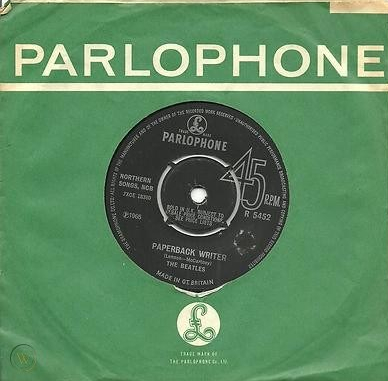
Paperback Writer, by The Beatles (their 10th of seventeen #1s)
2 weeks, from 23rd June – 7th July 1966
There’s the echoey, layered intro – Paperback writer, writer, writer… A simple, harder than anything that’s gone before, riff. A filthy bassline. It’s not a clean line in the sand – it’s not as if The Beatles hadn’t been getting progressively heavier, cooler, druggier with every chart-topper since ‘I Feel Fine’ – but this does feel like a significant step away from their earlier days. 1966 would be the year of ‘Revolver’ and their last ever stadium concerts.
The biggest difference though, for me, comes in the lyrics. All their previous #1s have been boy-meets-girl, girl treats boy well or badly, pop songs (with the exception of ‘Help!’) ‘Paperback Writer’, however, is a song about a, well, a paperback writer, written by Paul McCartney after he was challenged to write a song about anything but ‘love’.
Dear sir or madam, Will you read my book, It took me years to write, Will you take a look…? It’s a song in the form of a letter – our very first epistolary chart topper? – from a wannabe pulp-fiction writer, presumably living in a cramped attic, to some unnamed publishers. It doesn’t, to be honest, sound like a very appealing read: a dirty story of a dirty man (whose) clinging wife doesn’t understand… And the unnamed writer doesn’t sound like much of an artiste: I need a job and so I wanna be a paperback writer…
It’s actually quite a funny record, satirical even. The hero of this trashy story also wants to be a paperback writer, while the book is already a thousand pages long, with more to come in a week… In the background, the other members of the band harmonise, in falsettos, over the French nursery rhyme ‘Frere Jacques’.
It’s also a short record, just over two minutes long, which sounds loveably rough and ready, as if it were knocked out in one take over a single afternoon. And that’s not a bad thing. It’s probably The Beatles’ heaviest chart-topper, and a song that’s always felt like a bit of an anomaly in their discography. Although, if you think the lyrics to ‘Paperback Writer’ are a big change of pace, their next #1 will be about an old woman who cleans churches…
Before we finish, let’s just pause to notice that the past three chart-toppers have gone The Rolling Stones – Frank Sinatra – The Beatles… has there ever been a more illustrious run of #1s?
After the all-out nihilism of ‘Paint It, Black’, it’s time for a slight change of pace. A fifty year old crooner – a legend, even by this point in his career – with a song about the joys of a chance meeting.
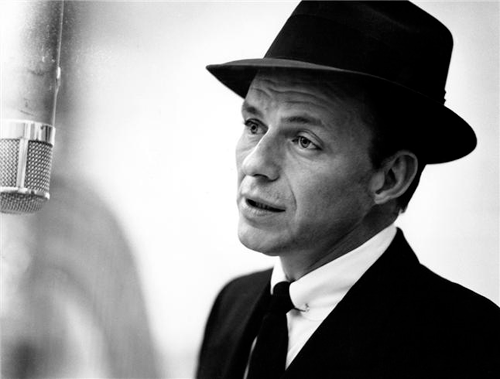
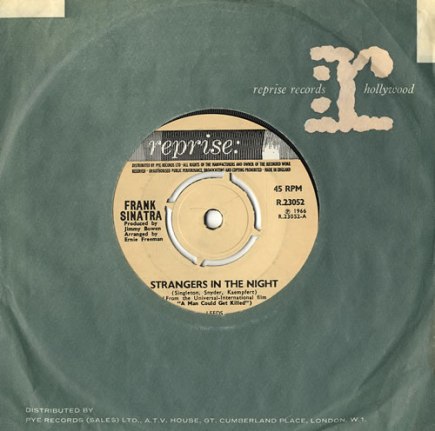
Strangers in the Night, by Frank Sinatra (his 2nd of three #1s)
3 weeks, from 2nd – 23rd June 1966
Soaring strings, a gentle sway, and Ol’ Blue Eyes… Strangers in the night, Exchanging glances, Wond’ring in the night, What were the chances… It’s timeless, traditional pop. A similar, if much classier, version of Ken Dodd’s mega-hit ‘Tears’ from the previous year. A record that might have been #1 in 1946, 56, 66, 76… you get the drift. By this point in his career, a good twenty years since he graduated from teen-idol status, Sinatra was not about to reinvent himself as a folk singer.
Strangers in the night, Two lonely people, We were strangers in the night… And, yes, there’s something in the sweep of the violins and the softness of the horns, that conjures up an image of two people, in New York, entering a darkened bar for last orders… By the end of the song, they’ve been together for years. Things turned out alright, you see, for strangers in the night.
Frank Sinatra is a weird proposition for me. He’s old, too old even for my parents to have listened to him. He released his first single in 1939, and he would be a hundred and four were he still around today. And yet, the songs are there. They reach you anyway, regardless of whether you grew up hearing him. ‘Fly Me to The Moon’, ‘New York, New York’, ‘My Way’… He’s also a weird proposition for me as I’m not convinced that he was all that great a singer. I mean, he obviously was – the way he holds the yooouuuuu before the chorus here is good – but at the same time he talks his way through certain lines. The Ever since that night… line, for example.
We have heard from Frank before in this countdown – going on twelve years ago, when he took ‘Three Coins in the Fountain’ to the top. Now, twelve years between #1 hits is a long time in any era of the charts; but this gap, straddling rock ‘n’ roll and the beat revolution, is particularly impressive. And this is the Sinatra that everybody knows, the Sinatra that wannabes cover on talent shows… the vast majority of his best known hits come from the sixties. Try naming one of his bobby-soxer hits from the early forties…
I love the pause, before we sweep into the final verse of ‘Strangers in the Night’. It’s cinematic, cocky Sinatra. And then perhaps the most famous bit of this song: do bee do bee dooo, da-da-da-da, yayayaya… So famous that it apparently inspired ‘Scooby Do.’ He sounds like your uncle, drunk at a wedding, forgetting the words… And then it hits you. That’s why Sinatra was, and still is, so popular. Because drunk uncles at weddings can just about pull off an impression!
Sinatra, though, hated this song. He couldn’t stand the record that returned him to the top of the charts after a decade. And he wasn’t ever subtle about it, either. It was ‘a piece of shit’ and ‘the worst fucking song (he’d) ever heard.’ You wonder, then, if the do-bee-do skat is simply him giving up. (Which makes the whole song even more glorious, if you ask me…)
Whatever the reason – the quality of the song, the iconic doo-be-doos, Sinatra’s vehement hatred of it – ‘Strangers in the Night’ became one of his biggest hits, one of his signatures, a song that he would have to bite the bullet on and perform every night for the rest of his life. I’d also suggest that his daughter hitting the tops of charts around the world just a few months earlier wasn’t bad publicity, either. Not that it matters. An artist of Sinatra’s stature needs to feature in this countdown. And I’m glad that he does.
Picture a mid-summer’s evening: a soft, dusty light, some people gathered around an ancient stone circle, having a sing-song. Long hair and baggy clothes. Pagans? Hippies? Look a little closer, though. They look familiar… Why, it’s The Rolling Stones! Conducting a full-blown Satanic ritual!
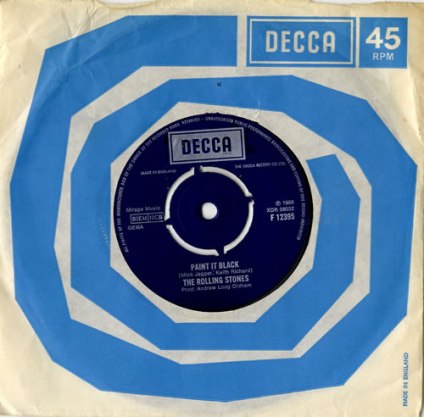
Paint It, Black, by The Rolling Stones (their 6th of eight #1s)
1 week, from 26th May – 2nd June 1966
I’ve used many words to describe the chart-toppers we’ve covered so far. Catchy, dull, quirky, God-awful… ‘Paint It, Black’, though, is the first I’ve had to consider calling ‘evil’… It’s a hulking, threatening, malignant brute of a #1 single. From the opening riff, it’s as if an evil spirit is taking up residence in your ears. Brain Jones is playing a sitar, and sitars, to me, usually sound blissed-out, and spiritual – the background soundtrack to massages and yoga sessions. Not when The Stones get their hands on one…
Then there’s the lyrics. I see a red door, And I want it painted black, No colours any more, I want them to turn black… Jagger’s voice melts into the insistent, pounding rhythm – sometimes soft and coaxing, sometimes aggressive and half-crazed. What is it about? Depression? Drug-induced psychosis? A funeral (as the line about a line of black cars suggests)? Whatever it is, it’s a bleak, bleak record. I see people turn their heads and quickly look away… or I look inside myself and see my heart is black… And then there’s the serial killer line: I see the girls walk by dressed in their summer clothes, I have to turn my head until my darkness goes…
It’s an amazing song. A song I respect a lot. I love that it was a #1 hit. But I can’t bring myself to love it. It’s not a song to put on in the background. It’s a song that you have to be in the right mood to deal with. In many ways it’s a weird song – not helped by the fact that, for years, I thought one of its lines went: No more will my green seagull turn a deeper blue… (It is, of course, ‘my green sea go’. Which makes even less sense…)
By the end, our hilltop ceremony is reaching its climax. The bass grinds, the sitar dances, the band are humming with intent, and Jagger is crowing: I wanna see it painted, Painted black, Black as night, Black as coal…! He wants to see the sun blotted out… He wants to end it all… The record slowly fades to a frenzied close. This was only top of the charts for a week. That’s probably all the country could deal with from such a relentlessly nasty disc.
Back when I first got into The Stones, with their Greatest Hits etc, ‘Paint It, Black’ (apparently the comma was just a record-company typo, though it does lend a nicely pretentious air) blended in amongst the hits. Its edge was dulled. Not here, though, doing this countdown in real-time. It really makes you stop and think… This was a best-selling single. It’s a superb piece of music; but only one act could have pulled it off and still kept it commercially viable.
I’ll say it again… The Stones’ hits might never quite have matched the Beatles in ‘musical’ terms. But they were pushing the boundaries of what could be considered ‘pop music’. The Fab Four used sitars, yes, to write cute acoustic numbers like ‘Norwegian Wood’; while Jagger, Richards and Jones were using one to summon the Devil.
This is something of an end of an era moment for the Stones, too. They’ve crammed four number one hits into just over a year – all of them towering slices of swagger, anger and petulance. But we won’t hear from them now for over two years. By which point they will have tried their hand at flower-power, gone hard on the drugs, driven Brian Jones out of the band… This is a moment. And not just for The Stones. For the singles charts. For British music. For popular music as a whole. Go on… Paint it,… Black!
Catch up with all the #1s so far – including five other Stones’ hits:
After our Dusty Springfield extravaganza last time out, we’re back with something a little more routine. A little more of its time. Guitars, drums and a husky-voiced man.
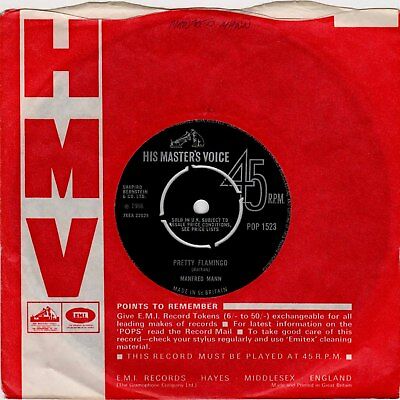
Pretty Flamingo, by Manfred Mann (their 2nd of three #1s)
3 weeks, from 5th – 26th May 1966
It’s got an intro that has always reminded me of Bob Dylan’s ‘Like a Rolling Stone’, in the way that the bass and the drums roll in, after a couple of guitar chords. It’s a song that I’ve known for quite a while, a perennial of the ‘Best of The Sixties’ tapes and CDs that accompanied long car journeys with my family. And it’s a song I’ve always liked: it’s sunny, breezy, poppy… A song that gives you a pleasant two and a half minutes; but that doesn’t linger too long afterwards.
Manfred Mann have grown up since ‘Do Wah Diddy Diddy’ gave them their first chart-topper nearly two years back. It’s a more mature sound, more laidback and a tiny bit trippy. And, though I described singer Paul Jones’s voice as husky in the intro – it’s not a regular kind of husky. It’s nasally, and a bit rough. An acquired taste. The opening line hits you: On our block, All of the guys call her flamingo… This was one of Jones’s final recordings with the Mann’s – he would leave a couple of months later.
And actually, thinking about it more closely, is calling a girl a ‘flamingo’ that much of a compliment? It kind of suggests you have scrawny legs and a big beak… Or, rather, according to the lyric, it’s: ‘Cos her hair glows like the sun, And her eyes can light the skies… I’m still not convinced. When she walks, She moves so fine, Like a flamingo… (Flamingos are lanky and walk with an old man stoop. I doubt the songwriter had ever actually seen a flamingo…)
All lyrical inconsistencies are forgiven, however, when we get to the bridge, which has a hook to die for: When she walks by, She brightens up the neighbourhood… And then we have what sounds like a flute solo, and some sha-la-las to wrap up, because it’s that kind of record. I also like the ‘Ha!’ after the If he just could… line, which suggests that deep down Jones knows it ain’t never happening with Ms Flamingo.
It’s a fun song, a cute song, a song that needs but a short post like this to do it justice. This was the middle disc in Manfred Mann’s chart-topping run, and I like that they straddled the swinging sixties with their #1s: one in 1964, one in ’66, and one to come in ’68. They’re not a name that instantly springs to mind when you think of ‘Biggest Acts of the 60s’, but perhaps they should be. Enjoy!
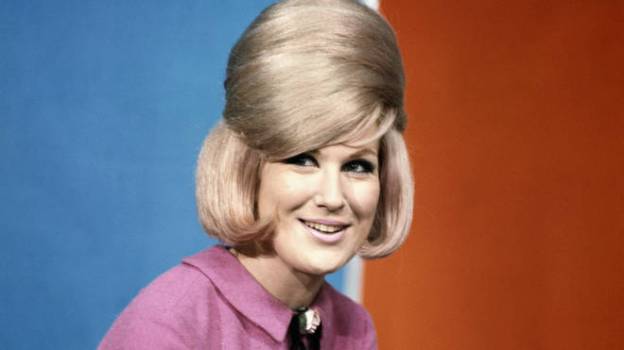
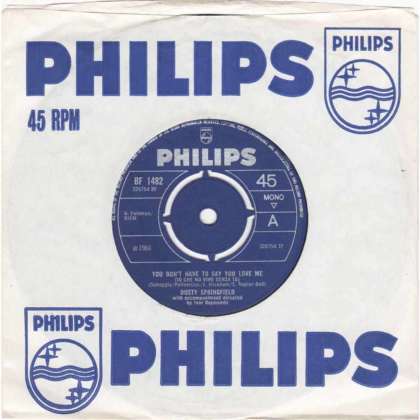
Before we get going with this next number one single, I have to go on record and state that only allowing Dusty Springfield, the greatest British female singer ever, one measly week at the top of the singles charts, is one of the British people’s greatest embarrassments. Hang your heads in shame, British record-buying public!
You Don’t Have to Say You Love Me, by Dusty Springfield (her 1st and only #1)
1 week, from 28th April – 5th May 1966
Now that’s off my chest… To the song. And what a song. I’d like to follow my earlier statement with the caveat that, if you were going to give Dusty Springfield, the greatest British female singer ever, only one #1 single, then you could do a lot worse than allowing that single to be ‘You Don’t Have to Say You Love Me’.
The intro sets a scene. It’s a throwback of an intro, straight from the melodramatic pre-rock days. It’s a Shirley Bassey intro. An intro you’d make up as a piss-take of a Bond theme. Horns blast, cymbals crash, and a choir welcomes the coming apocalypse… And then… Dusty. Whose voice, after all that, sounds kind of small.
But what a voice. I’ll have to remind myself that this is a post on ‘You Don’t Have to Say You Love Me’, the two hundred and thirteenth UK #1 single, not a post on the life and times of Dusty Springfield. But she did have a voice on her. When I said, I needed you… You said, You would always stay… It wasn’t me who changed, But you… And now you’ve gone… Away… It’s default Dusty – heartbroken, but defiant. Nobody does defiant heartbreak like her. And then comes the chorus, with it’s very rational approach to a broken relationship: You don’t have to say you love me, Just be close at hand… (For years, I though it was ‘just because you can’, which, to be fair, would also work.) You don’t have to stay forever, I will understand…
I love the dramatic way the second verse comes in… Left alone!… and the violin flourish that accompanies it. And then the two Believe me’s that prelude the final, sweeping chorus. And the key change. Because a song like this simply couldn’t finish without a key change. God, it’s a good record. I want to name it as one of the best yet. Except, my next recap is ages off. Damn. I’ve always felt that it’s a frustratingly short record, even though it comes in at not much under three minutes. They could have stuck another verse in. But no. They didn’t need to. It’s perfect as it is. It’s a complete side-step from the predominant sounds of the mid-sixties, a record that could have been a hit at any time. If Adele released a cover of it tomorrow, it would still work.
And that’s it. One song. One week. Dusty Springfield as chart-topping artist. It’s nowhere near enough, but at least she got it. And, of course, her career is not defined by this one hit. It’s just one of her sixteen UK Top 20 singles. There’s ‘I Only Want to Be With You’, her 1963 debut, ‘Stay Awhile’, ‘In the Middle of Nowhere’, ‘I Just Don’t Know What to Do With Myself’ (brilliantly covered by The White Stripes)… And then there’s her Memphis records, ‘Son of a Preacher Man’, and ‘Breakfast in Bed’, her cover of ‘The Look of Love’, one of the most sensual recordings ever made. And then there’s her late-career revival, courtesy of The Pet Shop Boys, culminating in the superb ‘What Have I Done to Deserve This’ (she loved a good long song title, did our Dusty.)
But my favourite Dusty is the one that belted out ballads like ‘Losing You’, ‘All I See Is You’, ‘I Close My Eyes and Count to Ten’, and, of course, this. ‘You Don’t Have to Say You Love Me’ was, apparently, based on an Italian pop hit from the year before, which had reduced Dusty to tears upon hearing it. Her song-writing team put together English lyrics for the melody, and she allegedly took forty-seven takes before she was happy with her vocals. The diva!
I better end this post before I go overboard on the links… One final thing, though. Dusty’s career was famously damaged by a 1970 interview in which she announced she was gay (‘bent’, in her own words.) For much of seventies and eighties she battled with alcoholism and self-harm. And listening back to the lyrics of ‘You Don’t Have to Say You Love Me’, you notice there are no pronouns used other than ‘you’ and ‘me’. And then you listen to the refrain: Believe me, Believe me, I can’t help but love you… And you realise that you are perhaps listening to a gay love song, which hit #1 in a time when it was socially unacceptable, if not illegal, to be that way. A powerful subtext, to an already very powerful record. Ladies and gentlemen: Dusty Springfield.
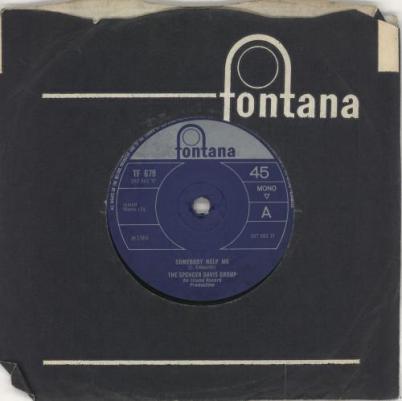
The Spencer-Davis’s return with a quick-fire #1, barely three months after the first. It’s not a record that rings a bell but, as soon as I press play, I know I’ve heard this before, somewhere, sometime…
Somebody Help Me, by The Spencer Davis Group (their 2nd and final #1)
2 weeks, from 14th – 28th April 1966
Like ‘Keep on Running’, it all kicks off with a bass riff. But one a bit mellower, a bit more understated, and not quite as filthy sounding as in their first chart-topper. Somebody help me, yeah… Somebody help me, now… Won’t somebody tell me what I’ve done wrong…
It’s a song that tells a bit of a story. The singer had a girl, his Queen, back when he was seventeen, but lost her. Since then he’s been unable to find a new one. Now I’m so lonesome, On my own… (If the stalker-ish lyrics to ‘Keep on Running’ were anything to go by, it’s easy to guess why she dumped him.) And that’s about it. A simple enough rock ‘n’ roll record.
Like its predecessor, ‘Somebody Help Me’ has got a nice soulful vibe to it – especially in the bridge – in the I need a girl, To hold me tight… – plus I like the funky guitar licks at the end of the lines. The Spencer-Davis’s liked a crunchy guitar, which gives their songs quite a Kinks-y feel. And it’s the shortest chart-topper we’ve had in a long time, coming in at bang-on two minutes. Which is fine – there’s absolutely no need for this disc to be any longer.
It’s a forgotten record, I’d say. A forgotten gem…? I’m not sure. Is it quite a ‘gem’? It’s definitely a groovy little record (we’re allowed to say ‘groovy’, by the way – it was the style of the time…) One that adds texture to the way Beat pop was splitting into different sub-genres. I’m not sure whether to go as far as calling it a ‘Shadow Number One’ – a song that only hits the top because of its more famous predecessor. Because A) it’s a good enough record to have reached the top on its own merits, and B) it managed a fortnight at the top while ‘Keep on Running’ only got a single week.
Interestingly, this song was, like ‘Keep on Running’, written by reggae singer Jackie Edwards. But he doesn’t seem to have ever recorded it. And, like so many bands of this era, The Spencer Davis Group didn’t last very long. They had a couple more Top 10s – including the classic ‘Gimme Some Lovin’, which is probably better known than either of their chart-toppers – before lead singer Steve Winwood left.
And that was all she wrote for the Spencer-Davis’s at the top of the UK Singles Chart. They’ve reformed over the years in a variety of guises. Except… Winwood would go on to have a half-decent solo career, with a handful of eighties hits. One of which – ‘Valerie’, from 1982 – went on to be noticed by Swedish DJ Eric Prydz. He loved the vocals, persuaded Winwood to re-record them, and they formed the basis for his 2004 #1 ‘Call on Me’. So… we will hear the soulful tones of Winwood one more time in this countdown, in precisely thirty-eight years’ time. Aren’t the charts fascinating?
Back to business, then. And not a bad record to get back to! Though it starts with an intro that is as folksy as anything we’ve had so far. Very of its time. Guitars round the campfire, a tambourine shakes… I’m getting Seekers flashbacks. Am I about to be underwhelmed by The Walker Brothers, for the second time…?
The Sun Ain’t Gonna Shine Anymore, by The Walker Brothers (their 2nd and final #1)
4 weeks, from 17th March – 14th April 1966
Of course not. Because in come the drums. Suddenly it’s not a folk song – it’s gorgeous, string-drenched, Wall of Sound-at-its-finest, pop. Loneliness, Is a cloak you wear… A spaghetti Western lone whistle… Because, why not? A deep shade of blue, Is always there…
Then it all comes together. The drums cascade, the voices swirl together… The sun ain’t gonna shine anymore, The moon ain’t gonna rise in the sky… It’s a song about being dumped, essentially. About being sad and lonesome. But never has sadness sounded so appealing. By the time we get to the Bay-yay-ay-bay! I’m sold. Sign me up for the misery!
It’s a brilliantly melodramatic record. All the things that I didn’t think worked on The Walker’s 1st chart-topper – the slightly knowing ‘Make It Easy on Yourself’ – come together here. I think it’s because the music is so compelling, so lush and enveloping, that the OTT lyrics work. I criticised Scott Walker’s crooning on that record, but I love it here. It all culminates in the middle-eight: Lonely, Without you, Baby… through to a glorious I can’t go o-o-o-on…! It’s a song for wallowing in, with a bottle of wine and the curtains drawn.
Everything about ‘The Sun Ain’t Gonna Shine Anymore’ points towards one man: Phil Spector. He must, you think, have produced this record. It sounds like the inside of his head. But, no. One Johnny Franz was on production duties. And yet the debt is clear. This is a Phil Spector record, even if he was nowhere near the studio.
It all builds to a climax, with the layered vocals on the fade-out working brilliantly. And it ends on a high, leaving you uplifted despite the subject matter. This could be a sad, depressing song, if you stripped it all back, but it isn’t. Thank God. It is ten, twenty times, better than the Walker’s previous chart-topper, and an early contender for best record in my next recap. It’s that good.
Interestingly, this isn’t the original version of ‘The Sun Ain’t Gonna…’ It had been recorded a year earlier by Frankie Valli. His version sounds a little heavy-handed, but surprisingly similar to this one. It, however, made no impact on the charts. It’s also been covered by Cher, in the ‘90s. She is perhaps the only person who could make this song sound more OTT than Scott Walker…
This was the peak of The Walker Brother’s success, their popularity such that their fan-club allegedly had more members than The Beatles’. They had several further hits, and yet disbanded in 1968, largely due to Scott Walker’s dissatisfaction with being seen as a mere teen-idol. I can’t say I’ve listened to that much of his solo output, though I do know it has a reputation for being ‘challenging’… That’s probably what’s putting me off. It’s also been very influential: David Bowie, Pulp, Radiohead, The Arctic Monkeys… the list is a long one. He passed away in March of this year. John Walker had died in 2011, leaving Gary as the sole surviving ‘brother’.
But we’ll leave them here. Bowing out with their crowning glory. A song I knew was good, but hadn’t realised quite how good. Yet another supreme mid-sixties pop moment. Keep ‘em coming!
We last recapped in late 1964, and the past thirty #1s have brought us right through 1965 and out the other side. The very middle of the mid-sixties. And, to be honest, we’ve been spoiled.
For example. This was a genuine, consecutive run of chart-topping singles, from the summer of ’65: ‘Mr. Tambourine Man’, by The Byrds… followed by The Beatles, with ‘Help!’… then ‘I Got You Babe’… and finally ‘(I Can’t Get No) Satisfaction’, by The Rolling Stones. No filler in between. Those singles, over the course of just nine weeks, were the top selling songs in Britain. Timeless hit after timeless hit. Songs that are still ubiquitous to this day, some fifty-five years later. Amazing.
This is why it’s good to pause, momentarily, and look back. Otherwise I’d start taking for granted the huge musical moments that are becoming almost commonplace. Dotted around elsewhere in the past year or so we’ve had non-consecutive gems too: our first Motown #1 from The Supremes, a karaoke classic from Tom Jones, the distilled essence of The Swinging Sixties TM from Nancy Sinatra and a contender for best pop song ever from The Righteous Brothers. It’s like the best all-you-can-eat buffets – you never have enough room to appreciate every morsel.
The sound of these number ones has also been moving forward at lightning speed. We’ve seen the Beat sound disintegrate into straight-up blues, folk, baroque pop, and garage rock. Glance back two years, to early 1964, and things were much more homogenous. Merseybeat followed by Merseybeat followed by – hey – more Merseybeat. And most of those discs were great. But variety is the spice of life. I’m really loathe to be one of those ‘things were much better back in the day’ types… but… compare pop music from 2019 with that of 2017 – or even 2007 – and would you see that much of a difference? Of course, everything here was new, just waiting to be discovered and experimented with. Dirges and harpsichords on hit singles? Why not!
Even the outliers, the singles that deviated from the irresistible forward thrust, had the good sense to be eclectic. Elvis returned and took us to church, Georgie Fame gave us some Latin soul, Roger Miller represented the country side of things while, in Unit 4 + 2, we had genuine one-hit wonders. We’ve also heard several more female voices than we have in past recaps: Sandie, Jackie, Nancy, Diana Ross and the gang, and a lady called Cher.
All of which means I’m struggling to dish out the more negative awards – the ‘Meh’ Award and my equivalent of a Razzie: The Very Worst Chart-Topper. But let’s not kid ourselves. I’ve not enjoyed every single song going. I struggled to get the appeal of The Seekers after hearing their bland chart-topping double. Meanwhile, Cliff returned as boring as ever… Plus there’s my unresolved childhood history with The Moody Blues, which means I want to award one to ‘Go Now!’, even though I love that one song. ‘Where Are You Now (My Love)’ was OK, though I’m struggling to really remember it, while The Overlanders’ cover of ‘Michelle’didn’t really need to exist. And then there was Ken Dodd’s ‘Tears’ – the 3rd biggest selling single of the decade. Yes, you read that correctly. But that would be like kicking a puppy, naming that as the worst record…
Ken Dodd with his golden disc for 100, 000 copies of his record sold “Tears” presented to him in his dressing room at the London Palladium.
I’ve got it. The ‘Meh’ Award goes to ‘The Carnival Is Over’, by The Seekers. A funeral dirge, plain and simple, with some cheek for having the word ‘Carnival’ in the title. I still can’t believe it sold over a million. And the very worst of the past bunch goes to Country Cliff, for the soporific ‘The Minute You’re Gone’. Compared to some of the past ‘worst #1s’ it’s fairly inoffensive. Russ Conway, David Whitfield and Elvis in Lederhosen were much worse crimes against music. It’s just that, while everybody was twisting, Cliff was sticking, even going backwards.
Before we choose the ‘good’ awards, we should mention that over the past thirty #1s, one of the greatest ‘rivalries’ in pop music has really taken off. After the last recap, everybody was trailing in The Beatles’ wake. But… The Stones have arrived. Both bands have scored four chart-toppers in this segment. In a recent post I claimed that, for the moment, The Stones were ahead of The Fabs, just. Those of you who took the bait disagreed… But I’m sticking with it. Yes, ‘I Feel Fine’, ‘Ticket to Ride’, ‘Help!’ and ‘Day Tripper’ / ‘We Can Work It Out’ are superb records. No debate. Imperious. But look at The Stones’ four: ‘Little Red Rooster’ (authentic, full-on Blues), ‘The Last Time’ (the weakest, for sure, but still a great, swaggering rock song), ‘Satisfaction’ and then ‘Get Off Of My Cloud’ (those riffs, along with a tonne of angst and venom, and general dissatisfaction with the world around them – It’s punk, metal, emo… It’s the future!) On that note, I’m going to give the ‘WTAF’ Award, the award for our more ‘out there’ #1s, to ‘Little Red Rooster’, because that’s a slice of pure Chicago blues that had no business getting to the top of the British singles charts – though I’m so glad it did.
Which just leaves the crème de la crème. As always, I’ve got it down to four. ‘You’ve Lost That Lovin’ Feelin’’, ‘Help!’, ‘Satisfaction’, and our most recent #1: ‘These Boots Are Made for Walkin’’. And I’m going to instantly eliminate The Beatles and Nancy Sinatra for being great, but just not great enough. So… Perhaps the toughest decision I’ve ever had to make. The Righteous Brothers, or The Rolling Stones. I’m listening to both songs one more time as I mull…. God, why don’t I just call a tie…? No, that sets a dangerous precedent for me (in this completely unnecessary and self-imposed situation)… Ga! I love rock music, at heart. Rock ‘n’ roll always wins. As great as ‘…Lovin’ Feelin’’ is, it ain’t rock. ‘Satisfaction’ takes it.
The Very Worst Chart-Toppers: 1. ‘Cara Mia’, by David Whitfield with Mantovani & His Orchestra. 2. ‘The Man From Laramie’, by Jimmy Young. 3. ‘Roulette’, by Russ Conway. 4. ‘Wooden Heart’, by Elvis Presley. 5. ‘Lovesick Blues’, by Frank Ifield. 6. ‘Diane’, by The Bachelors. 7. ‘The Minute You’re Gone’, by Cliff Richard.
Phew. We’ll pause for a bit, before hitting the next thirty. Thirty discs that’ll take us through the ‘Summer of Love’ and beyond. Next up, I’m going to spend a week looking at some of the people behind the #1s… Coming soon, to a blog feed near you…








 The UK Number Ones Blog