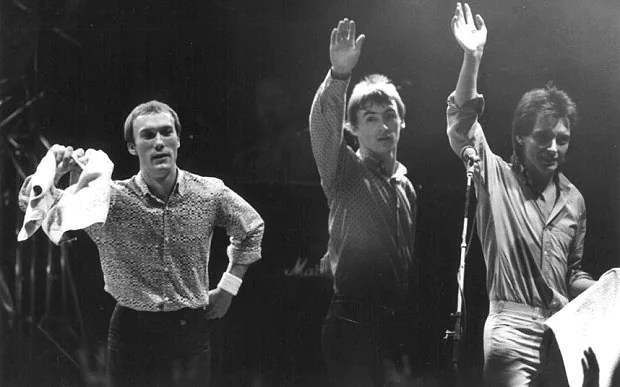
On with the next thirty. And to start, The Jam return for one final chart-topper.
Beat Surrender, by The Jam (their 4th and final #1)
2 weeks, 28th November – 12th December 1982
In my last post on them – ‘Town Called Malice’ / ‘Precious’ – Paul Weller and his bandmates had made some sonic advancements. Away from punk; into soul, funk and Motown. ‘Beat Surrender’ is more of the same. It’s intro, for a start, is the love-child of ‘I Will Survive’s piano flutter, and ‘Dancing Queen’s glissando.
I’m not even sure there’s a guitar involved here. Certainly not a lead guitar. There’s a piano, and lots of horns. It’s slick and glossy. But that’s not to suggest that The Jam have lost their edge. It’s still a great pop song, with a great hook: Come on boy, Come on girl, Succumb to the beat surrender…
And like most Jam songs, it’s lyrically dense. The title is a play on ‘Sweet Surrender’ and the idea of beating a retreat, which makes sense when you realise that this was The Jam’s final release, their farewell single. Weller intended it as a call to their fans, to young, up and coming bands: Seize the young determination, Show the fakers you ain’t foolin’…
The band also drop some pearls of wisdom from their time as one of the country’s biggest acts: Bullshit is bullshit, It just goes by different names… A line that I think – unless I’m forgetting something obvious – delivers our first example of swearing in a #1 single. Lonnie Donegan, The Stones, Billy Connolly have all flirted with it, but didn’t go all the way. It took five hundred and eleven chart-toppers, though, which is impressive. Safe to say this won’t be the last…
I do admire the way that The Jam didn’t stand still, never seemed to recycle a sound or a style, in their five years of success. Here we have a great moment, when the soulful riffs of the first two verses drops down to a galloping disco bassline. It’s a risk, for a rock act, you could alienate your fans by daring to try new things (gasp!). But it didn’t seem to hurt The Jam. ‘Beat Surrender’ entered at #1 – making them the second act to do this three times (after Slade). Of course, announcing that this record was to be their final ever release probably didn’t hurt its chances, and ensured a fair bit of demand…
Though I’d say that it hasn’t remained in the collective memory as much as their three previous number ones. It’s a good one – none of their chart-toppers are anything less than a seven-out-of-ten – but perhaps its success wasn’t just for musical reasons. Anyway, after this Paul Weller formed The Style Council, with whom he continued his chart-success (though they never made it to #1) and then found himself cast as the cool uncle of British rock in the 1990s (‘The Modfather’), enjoying a hugely popular solo career that shows no signs of ending: his latest release topped the album charts just last year. Bruce Foxton, the bassist, formed ‘From the Jam’ in the mid-2000s, and Paul Weller has guested on some of his tracks, though he seems pretty set against a full-on reformation.
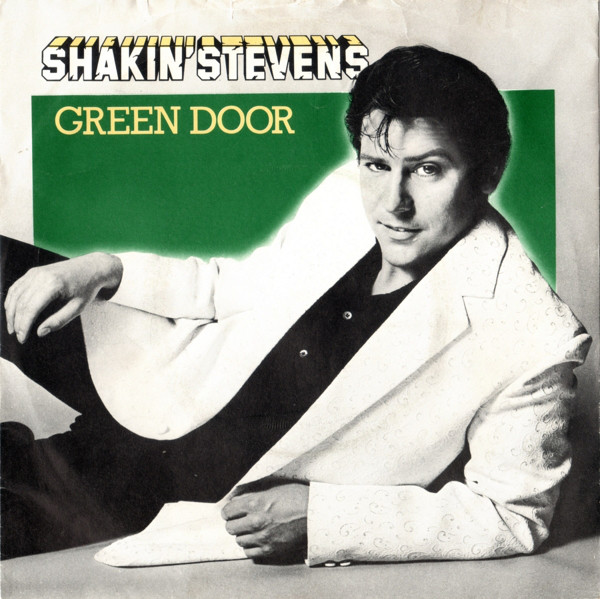
I was about to write that this is our first full eighties recap, before I remembered that the last recap actually covered January 1980-June 1981. Which just proves what I wrote in that recap, that the early months of the decade felt like a continuation of the seventies. It wasn’t until the very end of that period, when Adam Ant, Shakin’ Stevens and Bucks Fizz burst on to the scene, that the 1980s seemed to really kick off.
And those three acts play a big part in this recap, too. Shaky had two more rockabilly #1s – one great and one meh – while Adam had a big earworm hit with the Ants and another ear-worm on his own. The Fizz, meanwhile, scored a couple of low-key pop classics, which I might just return to in a bit…
In the last recap, I also wrote that it was possibly the strongest bunch of thirty chart-toppers we had encountered yet. Bowie! ABBA! Blondie!… This last thirty has been a bit more up and down. Some real highs; but some pretty low lows. Let’s start with the good bits, shall we? Some of the most illustrious names in early-eighties pop have reached the summit in the last year and a half: the Specials, Soft Cell, the Jam, Madness, Culture Club, Human League… (In fact, as a snapshot of how much has changed, Christmas 1980 saw John Lennon posthumously hogging top-spot, while Christmas ’81 brought the Human League’s electro-million seller ‘Don’t You Want Me’.)
Problem is – and this may well be a problem that haunts me throughout the eighties – I just haven’t connected with a lot of these classics. I enjoyed ‘House of Fun’ well enough, as I did ‘Come On Eileen’ (while wondering slightly what all the fuss is about). I was a bit bored by ‘Do You Really Want to Hurt Me’. I was ready to punch the air to ‘Eye of the Tiger’, but ended up tired of its pomposity. Is this decade cursed? I grew up with my parents’ sixties and seventies compilations, while the music of the nineties and noughties is the music of my youth. The 1980s is a sort of blank space in-between… If anything, reviewing every one of the decade’s chart-toppers will force me to finally make my mind up about it.
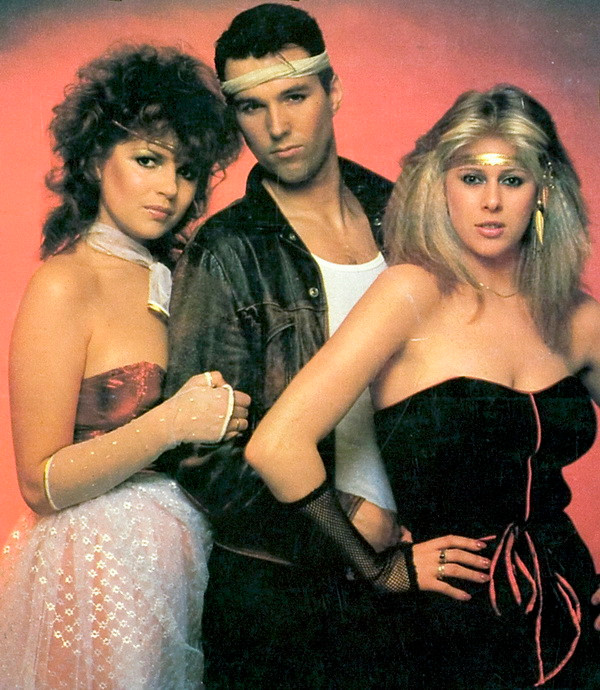
Away from the classics, there were some big swerves into cheesy pop. Some vintage camembert – ‘Japanese Boy’ and Bucks Fizz – and some plastic cheddar – Tight Fit and the Goombay Dance Band. In my posts on the latter two, I wondered if computer generated music was leading to cheaper, disposable pop, as some tunes sounded little more than quickly thrown together karaoke backing tracks. But again, disposable pop wasn’t a 1980s invention, and maybe my biases are again showing.
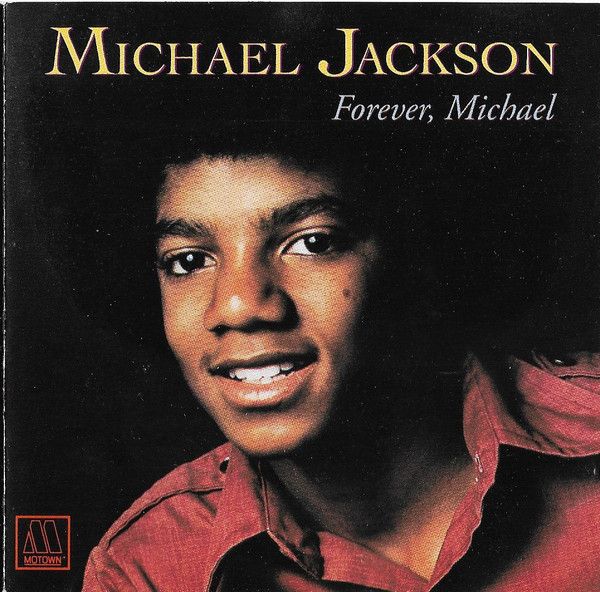
Other notable moments from the last thirty include… Michael Jackson’s first solo #1 (actually, that re-released ballad went pretty much unnoticed), Julio Iglesias making Spanish-crooner-disco a thing, Kraftwerk appearing out of nowhere (in fact, we had a bit of a run of chart-topping Germans), Paul McCartney and Stevie Wonder tackling racial inequality head-on, and our recent Reggae Autumn with the already mentioned Culture Club, alongside Musical Youth and Eddy Grant.
I suppose I should dish out some awards then. Let’s start, as is traditional, with The ‘Meh’ Award for forgettability. I’ve managed to get each award down to a neat top-three this time, and my three for the ‘Meh’ are: ‘One Day in Your Life’, by MJ, ‘Seven Tears’, by the Goombay Dance Band, and ‘A Little Peace’, by Nicole. And I know it’s a bit lazy to give it to the Eurovision ballad – it’ll be the 2nd in a row to win the ‘Meh’ – but they do tend to be pretty dull records. Nicole, sorry dear, you win. At least you’re not being crowned as the worst…
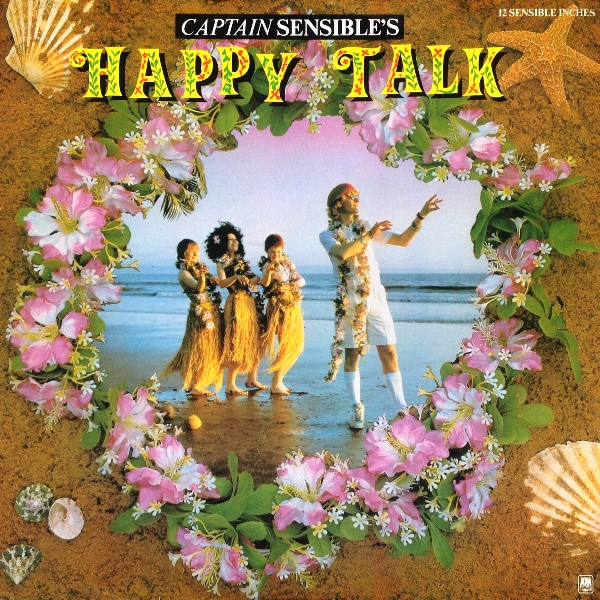
But before we get to that, here’s this recap’s ‘WTAF’ Award, for the chart-topping songs that were interesting if nothing else. The three up for this are: Dave Stewart & Barbara Gaskin’s bizarre take on ‘It’s My Party’, Captain Sensible’s bizarre take on ‘Happy Talk’, and Julio Iglesias’s smooth smooth take on ‘Begin the Beguine’. All re-imaginings of golden oldies. All a bit odd. The award, though, has to go to Dave and Babs, for what is a weird chart-topper for the ages, and not just for this recap.
To The Very Worst Chart-Topper. The winner of this can console themselves with the fact that nothing I’ve heard this time has been as bad as last recap’s ‘Very Worst’, the angelic tones of St. Winifred’s school choir. But still. There have been stinkers. The shortlist are all from 1982: Tight Fit’s ear-splitting take on ‘The Lion Sleeps Tonight’, Macca and Stevie’s well-intentioned but subtle as a brick ‘Ebony and Ivory’, and Charlene’s preachy ‘I’ve Never Been to Me’. And if you’ve been paying attention, then you know which way this award’s going. I can’t stand sanctimony – ‘No Charge’ and ‘One Day at a Time’ are previous winners – and so Charlene takes it. No amount of tongue-in-cheek covers by drag queens can save it. It’s a howler.
And finally: The Very Best Chart-Topper. I have to admit, unlike the last recap, I don’t love any of them. Not truly. But, there have been some real goodies. The Specials ‘Ghost Town’, for example. That’s the one most people might choose. It’s a great song, and a snapshot of British society in the early ‘80s. But… I would be choosing it partly out of duty, because I feel I should. Then there’s ‘Under Pressure’: David Bowie and Freddie Mercury trying to upstage one another over a classic bassline. And then there’s Bucks Fizz. Yes, Bucks Fizz.
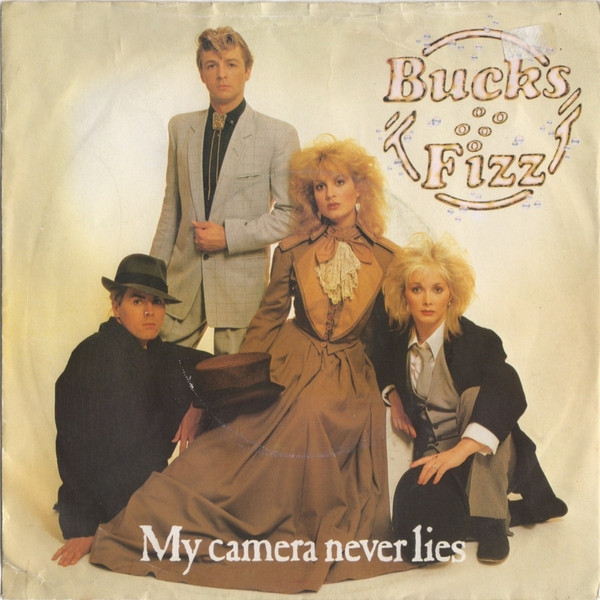
I was genuinely surprised by how good their ‘other’ #1s were. You know, the ones that aren’t ‘Making Your Mind Up’. ‘The Land of Make Believe’ was a pounding pop beauty. ‘My Camera Never Lies’ was an edgy, new-wave mini-classic. Neither was the ‘best’ of the past thirty chart-toppers, but I don’t think I enjoyed any songs more. It was probably the novelty – if ‘Tainted Love’, or ‘Don’t You Want Me’ were as forgotten as Bucks Fizz’s final two chart-toppers then maybe they’d win – but I can’t help that. Taste is subjective. Pop music isn’t meant to be taken seriously. ‘My Camera Never Lies’ is my 17thVery Best Chart-Topper. Because it’s my party, and I’ll choose who I want to!
To recap the recaps:
The ‘Meh’ Award for Forgettability:
‘Hold My Hand’, by Don Cornell.
‘It’s Almost Tomorrow’, by The Dream Weavers.
‘On the Street Where You Live’, by Vic Damone.
‘Why’, by Anthony Newley.
‘The Next Time’ / ‘Bachelor Boy’, by Cliff Richard & The Shadows.
‘Juliet’, by The Four Pennies.
‘The Carnival Is Over’, by The Seekers.
‘Silence Is Golden’, by The Tremeloes.
‘I Pretend’, by Des O’Connor.
‘Woodstock’, by Matthews’ Southern Comfort.
‘How Can I Be Sure’, by David Cassidy.
‘Annie’s Song’, by John Denver.
‘I Only Have Eyes For You’, by Art Garfunkel.
‘I Don’t Want to Talk About It’ / ‘The First Cut Is the Deepest’, by Rod Stewart.
‘Three Times a Lady’, by The Commodores.
‘What’s Another Year’, by Johnny Logan.
‘A Little Peace’, by Nicole.
The ‘WTAF’ Award for Being Interesting if Nothing Else:
‘I See the Moon’, by The Stargazers.
‘Lay Down Your Arms’, by Anne Shelton.
‘Hoots Mon’, by Lord Rockingham’s XI.
‘You’re Driving Me Crazy’, by The Temperance Seven.
‘Nut Rocker’, by B. Bumble & The Stingers.
‘You’ll Never Walk Alone’, by Gerry & The Pacemakers.
‘Little Red Rooster’, by The Rolling Stones.
‘Puppet on a String’, by Sandie Shaw.
‘Fire’, by The Crazy World of Arthur Brown.
‘In the Year 2525 (Exordium and Terminus)’, by Zager & Evans.
‘Amazing Grace’, The Pipes & Drums & Military Band of the Royal Scots Dragoon Guard.
‘Kung Fu Fighting’, by Carl Douglas.
‘If’, by Telly Savalas.
‘Wuthering Heights’, by Kate Bush.
‘Hit Me With Your Rhythm Stick’, by Ian Dury & The Blockheads.
‘Shaddap You Face’, by Joe Dolce Music Theatre.
‘It’s My Party’, by Dave Stewart & Barbara Gaskin.
The Very Worst Chart-Toppers:
‘Cara Mia’, by David Whitfield with Mantovani & His Orchestra.
‘The Man From Laramie’, by Jimmy Young.
‘Roulette’, by Russ Conway.
‘Wooden Heart’, by Elvis Presley.
‘Lovesick Blues’, by Frank Ifield.
‘Diane’, by The Bachelors.
‘The Minute You’re Gone’, by Cliff Richard.
‘Release Me’, by Engelbert Humperdinck.
‘Lily the Pink’, by The Scaffold.
‘All Kinds of Everything’, by Dana.
‘The Twelfth of Never’, by Donny Osmond.
‘The Streak’, by Ray Stevens.
‘No Charge’, by J. J. Barrie
‘Don’t Give Up On Us’, by David Soul
‘One Day at a Time’, by Lena Martell.
‘There’s No One Quite Like Grandma’, by St. Winifred’s School Choir.
‘I’ve Never Been to Me’, by Charlene.
The Very Best Chart-Toppers:
‘Such a Night’, by Johnnie Ray.
‘Cherry Pink and Apple Blossom White’, by Perez ‘Prez’ Prado & His Orchestra.
‘Great Balls of Fire’, by Jerry Lee Lewis.
‘Cathy’s Clown’, by The Everly Brothers.
‘Telstar’, by The Tornadoes.
‘She Loves You’ by The Beatles.
‘(I Can’t Get No) Satisfaction’, by The Rolling Stones.
‘A Whiter Shade of Pale’, by Procol Harum.
‘I Heard It Through the Grapevine’, by Marvin Gaye.
The final part of our autumn of reggae comes from Eddy Grant. It’s a cute, catchy tune. But, alas, Eddy does not want to dance to it…
I Don’t Wanna Dance, by Eddy Grant (his 1st and only solo #1)
3 weeks, 7th – 28th November 1982
This record has a likeable homemade feel to it. So homemade, in fact, that I had to double-check that I wasn’t listening to a cheap, karaoke version instead of the original. Once upon a time, not so long ago, the sound of synths in a chart-topper was genuinely exciting. Now they more often tend towards cheap and tacky.
‘I Don’t Wanna Dance’ is a break-up song. But it is such a perky break-up song that you don’t really notice. Eddy is tired of his girl’s flirty ways, and has had enough. I don’t wanna dance, Dance with you baby no more… He’ll remain a gentleman, though. I’ll never do something to hurt you, Though the feeling is bad…
My favourite bit is the unexpectedly scuzzy guitar solo. It’s a really raw moment in what is a pretty safe, reggae-pop number. And in the video he cuts a very Slash-esque figure, plucking it out on a floating raft. Don’t wanna dance, Don’t wanna dance… he chants for the fade-out. It’s an undemanding number, a bit slow and repetitive, but enjoyable enough.
Of the three reggae hits in a row, I’d rate the first one – ‘Pass the Dutchie’ – as my favourite, and this second. ‘Do You Really Want to Hurt Me’ was by far the most culturally significant, and best remembered, but it just didn’t grab me. Though I may be getting ahead of myself – I should save all this retrospection for the upcoming recap.
I did wonder if this was the follow-up to ‘Electric Avenue’ – the Eddy Grant solo hit that pretty much everybody knows – and perhaps rode the wave of that record’s success to top spot. But no, ‘Electric Avenue’ was actually this disc’s follow-up, making #2 in early 1983. And we mustn’t forget that Grant has been at #1 once before. Well over fourteen years earlier, in 1968, he and his band The Equals topped the charts with ‘Baby Come Back’, one of the very, very first #1s with a hint of reggae.
You could link this hit – and the gap between group and solo #1s – to Smokey Robinson, who also waited over a decade before his very own chart-topper away from his group. Eddy Grant continues to record and perform, and released his most recent album in 2017. It was titled ‘Plaisance’, after his hometown, in Guyana. Which is nice. Up next, that recap.
Part two of a three-part reggae autumn, and here’s one of the eighties’ most iconic figures…
Do You Really Want to Hurt Me, by Culture Club (their 1st of two #1s)
3 weeks, 17th October – 7th November 1982
When I think of the 1980s, as someone who didn’t live through it (OK, I lived through almost half of it, but you know what I mean) certain images spring to mind. Huge mobile phones, Thatcher’s hair, Maradona’s hand… And that’s before we get to pop music. Madonna’s blonde curls, Michael Jackson moonwalking, ‘Frankie Says Relax’.
All of which is a long-winded way of saying that the eighties has begun, thanks to a glimpse of Boy George’s long hair and beautifully sculpted eyebrows. Again. The ‘80s keep beginning. I said the same thing when we met Adam Ant, and Shakin’ Stevens, and Human League. The ‘sixties’ had a very definitive start-point: the sudden wave of Merseybeat #1s in 1963. The ‘seventies’ meanwhile actually began sometime in mid-1969, with that string of apocalyptic chart-toppers. Stretch your mind back to the fifties and it was Bill Haley who kicked all that off. The eighties, though, has been harder to pin down.
We’re here to talk about music, though, not iconography. Musically, this record isn’t announcing a new dawn. It’s nice, very gentle, reggae. The intro meanders, and the rest of the song never really picks up the pace. My attention, I’ll be honest, starts to wander. Boy George sings it beautifully, which is probably what made this song stand out at the time. That, and the fact that he looks like a girl.
Sorry, that’s obviously not a very ‘2022’ kind of thing to say. But we’re talking about forty years ago, when appearing on Top of the Pops looking like that was to become an instant national sensation. He makes Ziggy Stardust era Bowie look like Dirty Harry. The music wouldn’t have had to be anything special, it was always going to be playing a clear second fiddle. The video backs this up, with George being thrown out of a nightclub, then a swimming pool, then standing trial for simply being himself. Do you really want to hurt me, Do you really want to make me cry…? The jury of black people in blackface is presumably a comment on people acting how society demands, rather than on being true to themselves. (Completely irrelevant side note: that makes two #1s in a row with a music video featuring the artists on trial.)
I do wish I liked this more. It’s a genuine moment at the top of the charts, but I can’t really get into it. The best bit is the middle-eight, when the emotions peak: If it’s love you want from me, Then take it away… But that’s followed by an empty space where some kind of solo should be. There’s just some bass noodling, some light drumming, and an echo. It reminds me of The Police’s ‘Walking on the Moon’, which I found similarly dull.
‘Do You Really Want to Hurt Me’ was a huge breakthrough for Culture Club. Their only previous chart hit had made #100. Following this, for two years, every single they released would make #4 or higher. Maybe my take on this record is clouded by the fact that I know their monster hit is yet to come… In a year’s time they’ll score one of the biggest chart-toppers of the decade. Maybe that’s when the eighties will officially begin? Or maybe – more likely – I won’t know when the ‘eighties’ began until it’s all over, and I can look back.
It is a truth universally acknowledged, that when it comes to the UK singles chart you are never too far away from a country, or a reggae, hit. These two genres seem to withstand the vagaries of taste, and trend, to pop up time and time again.
Pass the Dutchie, by Musical Youth (their 1st and only #1)
3 weeks, 26th September – 17th October 1982
And you’ll be relieved (at least, I am) to find out that this next #1 is of a reggae persuasion, rather than a country one. The intro is exuberant: a young voice announcing that This generation, Rules the nation! Attention duly grabbed, we slip into a gentle rhythm. Pass the dutchie pon de left-hand side…
First things first: what’s a dutchie? It’s a Jamaican cooking pot, which makes sense given the song’s refrain: How does it feel when you’ve got no food…? (And which probably seemed quite relevant given unemployment rates in the early ‘80s…) Except, one of the songs on which this is based is called ‘Pass the Kouchie’, and a kouchie is a cannabis pipe. So, what we actually have here is a bunch of kids hitting #1 with a thinly-veiled ode to the pleasures of the herb! Except all drug references are now food references.
This is a really fun record. You can imagine Musical Youth as the children of Dave and Ansil Collins, or the younger brothers of Althea and Donna. They were British-Jamaicans from Birmingham, aged between eleven and fifteen when this record made top spot. I was fully prepared for this to be a cheese-fest – ‘Musical Youth’ conjures up images of an after-school theatre club – but it’s pretty authentic. Yes, it’s on the poppier side of reggae, but there’s an grittiness to it that shines through.
The star of the show is the band’s youngest member: Kelvin Grant was only ten when he recorded that memorable opening line, and his subsequent tongue-twisting raps. (Legitimate question: Is he rapping? Or is he scatting? Or is there another reggae-specific term for what he’s doing? If he is rapping, then I’d say we have our first rap chart-topper!)
Musical Youth didn’t last too long beyond their sole chart-topper. They had one further Top 10 hit, but they packed a lot into their short time together. They worked with Donna Summer, won a Grammy (‘Pass the Dutchie’ also made the Billboard Top 10) and were the first black act to be played on MTV, which seems amazing given that MTV had been around for over a year before this record came out…
Sadly, the members haven’t had the happiest of lives since their early fame. Legal troubles broke the band up, and bassist Patrick Waite ended up in prison before dying aged just twenty-four. Musical Youth are now a duo, but they have continued to record and perform. More happily for fans of the genre, we are hitting a bit of a reggae groove at the top of the charts. More to follow…
We’re meeting some of the decade’s big hitters now (pun fully intended). ‘Fame’, to ‘Eileen’, to this. And it’s another iconic intro. Synths growing, and growing, while a guitar goes chuckachuckachucka… It’s almost disco… Then Bam! Bam bam bam! The chords smash as hard as Rocky Balboa’s punches.
Eye of the Tiger, by Survivor (their 1st and only #1)
4 weeks, 29th August – 26th September 1982
I love it when the beat drops, and we settle into a groove. The bass riff is great (it’s heavily-influenced by ‘Another One Bites the Dust’). Right here, twenty-seven seconds in, this could be one of the best chart-toppers ever. Except, from this point on it’s all a bit of an anti-climax. It’s a record that shows its hand too early; and the remaining three and a half minutes are a bit of a plod.
Having not listened to this song properly in years, I was fully expecting to be won over by its poodle-rocking silliness. Big hair, power chords, even the title is ridiculous. But the vocals are too earnest. The lyrics are cheesy, and not good cheese. Cheap triangles of Dairylea cheese. It’s missing something, or maybe it’s just been ruined by its prominence in pop culture. It’s been used too many times with tongues in cheek. Hell, it’s been used too many times without tongues in cheek. (Plus, the band didn’t even that big hair…)
It’s polished. It’s glossy. But that’s not really the problem. Most pop music released in the 1980s was glossy and polished. It’s also got a great hook: away from the intro, the best bit is clearly the He’s watching us all with the eye….. Of the tiger line. But. But but but. ‘Eye of the Tiger’ is, I’m sorry, rock music for people who don’t like rock music. All the ingredients are there, but it never builds to anything. It plays it too safe. It’s just verse, chorus, verse, chorus… fade. There’s no solo! Where’s the solo? You’ve got that iconic riff, and no solo? So wrong.
It’s too earnest. That’s the problem. Earnestness in rock music never appeals to me. File it alongside other motivational classics, such as ‘Don’t Stop Believin’ and ‘You’re the Voice’, that I’d happily never hear again. Maybe it’s an American thing… We’ve just had ‘Fame’ (I’m gonna live forever…) and now this (Don’t lose your grip on the dreams of the past, You must fight just to keep them alive…) While in between a bloke in ill-fitting dungarees from Wolverhampton sang an Irish jig about getting into a girl’s pants.
For me, this song exists solely on a ‘Best Rock Album in the World’ CD that got heavy rotation in our family car way back when. I’ve never seen a Rocky film, and it definitely doesn’t feature in any of my regular playlists these days. It’s a childhood memory, and not even that fond a memory… I didn’t particularly like it even as a kid. (I do have a huge soft-spot for 80s hair-metal, though.) Sadly, ‘Eye of the Tiger’s success won’t herald many other hard-rock chart-toppers, and Survivor themselves wouldn’t have another hit until ‘Burning Heart’, from ‘Rocky IV’. Sadly for them, they weren’t invited back for ‘Rocky V’, and that was that as far as their UK chart career went.
You can imagine, when this next number one started getting airplay on radios up and down the country, people pausing for a moment. What’s this? It’s an intriguing intro, a mix of country and funk. Not something you hear every day…
Come On Eileen, by Dexys Midnight Runners (their 2nd and final #1) & The Emerald Express
4 weeks, 1st – 29th August 1982
And then a glissando. Do glissandos ever lead to anything bad? You need self-confidence to use them – you don’t just go around throwing glissandos around willy-nilly – but they always enhance. Into an Irish jigging, beer sloshing, knees-up of a song. Try not dancing to this. Just try!
Kevin Rowland’s vocals are as hard to make out as they were on ‘Geno’ (probably the only similarity between this and Dexys’ first chart-topper). I think that’s part of the appeal – when you’re drunk and jiving along you can just make them up! Come on Eileen, I swear I’ll be mean, I’ll come on less, Take off on every wing…
The line that I could always make out was the opening one: Poor old Johnnie Ray… Shout out to Mr. Ray, AKA The Prince of Wails, my favourite of the pre-rock chart-toppers. Footage of him also featured in the video. After that, it’s the story of a boy trying to seduce a well brought-up Catholic girl. You in that dress, My thoughts I confess, Verge on dirty…
I like the fact that she means everything to him… at this moment. Don’t do it, Eileen. He’s not to be trusted! And then there’s the best bit – the middle eight, where we slow down to a beer-hall stomp that gradually gets faster and faster. It’s pure music hall. It’s outrageously catchy. It’s one of the eighties’ biggest hits; but one that sounds completely out of place in this, or any, decade.
Do Irish people secretly hate this song? All the too-ra-loo-rahs might get on my nerves if I were from the Emerald Isle. We just need a ‘begorrah’ to cap it all off. Maybe it’s the Irish equivalent of ‘Hoots Mon’ (though I’m Scottish, and I loved that one). And at least Kevin Rowland is of Irish descent. Dexys had only had one further Top 10 hit since ‘Geno’, and this was the lead single from only their 2nd album. The ‘Emerald Express’ featured in the title was just for show – though the band did go through several line-up changes in their short time together.
And I’m going to end on something of a downer. As fun as ‘Come On Eileen’ is – and it is hard to write a song that is such a communal crowd-pleaser – I feel it’s been bestowed with almost mythic qualities. There’s a scene in ‘The Perks of Being a Wallflower’ where the cool kids hear the song’s opening bars and act as if they’ve heard the voice of God himself. Is it one of the greatest ever chart-toppers? Is it transcendent? Or is it just the perfect song to throw on towards the end of a wedding disco, so that your drunken uncle can do the can-can?
Disco beats and hard rock guitars meet in our next number one, one that is both a nod back to the late-seventies and a glance forward to the rest of the 1980s…
Fame, by Irene Cara (her 1st and only #1)
3 weeks, 11th July – 1st August 1982
First the retro bit: a gloriously funky and filthy disco riff. This is a song that sounds like it was recorded at the peak of the genre: part ‘Hot Stuff’ and part ‘Tragedy’. It already, in this respect, sounds a little dated. No, not dated – that sounds negative – nostalgic. Irene Cara also sounds every inch the disco diva, especially belting out lines like: You ain’t seen the best of me yet, Give me time I’ll make you forget the rest…
But when the guitars kick in, turning the synthy disco bits into soaring rock, suddenly you’re hearing all the power ballads and hair metal twiddling still to come in this decade. Irene Cara is also in on this: there’s has a rocky edge to her voice too. Listen to the way she draws out the got what it takes… line. Premonitions of Bonnie Tyler, Jennifer Rush, and other shoulder-padded eighties power-divas.
Fame! I’m gonna live forever… This could be an obnoxious-sounding song, all about how amazingly famous the singer is going to be. The soundtrack to every annoying drama-school wannabe. But it doesn’t come across that way. There’s enough grit to it, Cara selling it completely. Why the hell can’t she live forever?? I was ready to be underwhelmed by this record, for it to be a dated, cheesy film tune, but it’s not. My advice: go for the 12” mix – five minutes with lots more of the gnarly guitars. (And yes, I did just say ‘gnarly’.)
Part of the reason why this sounds a little retro is the fact that the movie ‘Fame’ – in which Irene Cara stars – was released in 1980. It took a tie-in TV series for the record to smash in the UK two years later. Cara had been a Broadway star for several years, but this was her first single. She is probably even better remembered for her other giant soundtrack hit: ‘Flashdance… What a Feeling’ (more song titles should use an ellipsis…) that would make #2, and #1 in the US, in a year’s time. For what it’s worth, I prefer ‘Fame’.
Sadly, though, Cara’s fame has not really lived forever. She is still active – she formed a band called Hot Caramel (presumably because Hot Chocolate was already taken) in 1999 – but has had few British hits outside her two biggies. Except, having performed two of the 1980’s biggest and best-remembered film tunes, who needs more hits? Why is being a one or two hit wonder a bad thing, when your two hits are classics? Come on, Irene – take it away!…. (that may or may not have been a hint as to our next #1…)
In which ‘South Pacific’ meets punk rock meets kids party singalong…
Happy Talk, by Captain Sensible (his 1st and only #1)
2 weeks, 27th June – 11th July 1982
This is a record you can’t properly imagine until you’ve heard it. If that opening sentence left you stumped, then just go ahead and press play before reading my attempts to describe it… I know, right? It’s woozy, a bit trippy, very end-of-the-pier rinky-dink. And to be honest, I quite like it.
Happy talkin’, Talkin’ happy talk, Talk about things you’d like to do… I’ve never seen ‘South Pacific’, and so wasn’t sure how faithful this cover was. But it is pretty similar to the original showtune, with the brass and strings replaced by very ‘of their time’ synths. It reminds me, a little, of Dave Stewart and Barbara Gaskin’s wild take on ‘It’s My Party’: another classic tune done up for the early eighties. Only less unhinged.
Well, slightly less unhinged. In the video, and on Top of the Pops, Captain Sensible, dressed as half pimp-half pirate, gives the impression that he is well under the influence of something a bit stronger than coffee. There’s a dancing parrot, too, and a backing girl-group called the Dolly Mixtures. You’ve got to have a dream, If you don’t have a dream, How you gonna have a dream come true?
That there is a hook I can get behind. I’m not one for motivational messages in songs, but this one can’t be argued with. No dreams = no dreams coming true. Simple. Cue the organs. It’s one of the more unexpected themes of 1981-82: chart-toppers that sound like fairground rides. ‘Ghost Town’, ‘House of Fun’, now this. Was it intentional? Or is it just that they were using cheap synths? It also calls to mind Adam Ant’s use of music hall brass from ‘Goody Two Shoes’.
Captain Sensible’s day job was as a member of The Damned (the first British punk act to release a single back in 1976) and this record featured on his first solo album. The giant shift in sound from punk to this might be explained by the fact he had become a pacifist vegetarian the year before. The punk-est moment comes when the Captain leaves a big old pause in the Golly baby I’m a lucky cu…….ss… line that has you wondering if he’s about to drop a giant ‘c’-bomb in this family-friendly single (Although you could also argue that him recording an old showtune in this novelty style is already as punk as it gets…)
I’ve said it many times before: at least make your songs interesting. This one certainly is. A harmless singalong for the kids and their grannies, that actually subverts by just existing. Captain Sensible wouldn’t have many other hits, while The Damned have reformed and disbanded several times over the years. He has also formed his own political party (the ‘Blah!’ Party), and – much more impressively – recorded the theme song for nineties snooker/quiz show ‘Big Break’.
Slowing things down considerably, after the e-numbers overdose of Madness and Adam Ant, Charlene has some life advice, some pearls of wisdom, some preaching to do…
I’ve Never Been to Me, by Charlene (her 1st and only #1)
1 week, 20th – 27th June 1982
Hey lady, she intros, You lady, Cursin’ at your life… She’s a discontented mother, this lady, and a regimented wife. It’s a bit of a harsh opening verse. Alright, Charlene, take it down a notch! Meanwhile the music is very easy listening, the softest of country lilts.
Who the ‘lady’ is is never specified. Whether she wants Charlene’s advice is neither here nor there. She’s getting it. This is a sanctimonious, humble-brag of a song. Charlene lists all the things she’s done – guzzling champagne on yachts, gambling in Monte Carlo, making love in the sun – before trying to pretend that it wasn’t all that fun. I’ve been to paradise, But I’ve never been to me… (honest!)
Some of the rhymes are true clankers: Oh I’ve been to Nice, And the isles of Greece… I’ve been undressed by kings, And I’ve seen some things, That a women should never see… At this point I’m rating this record as ‘iffy’ at best, ‘pretty crap’ at worst. Until Charlene starts talking, that is, sending this song into the realms of the truly awful.
I won’t quote the spoken word section verbatim. The gist is: paradise is actually soothing your screaming baby and arguing with your husband. Paradise is duty. Paradise is definitely not champagne and casinos. Who wrote this? It sounds as if it were commissioned by a mega-church, in order to promote Christian values through the radio-waves. I’m sure you can claim that the song is an argument for taking pleasure in the small things, in accepting happiness wherever you can find it, but I’m not having it. For a start, as Charlene lists all her escapades, she does not sound like she regrets any of it. No way has she cried for the unborn children that might have made me complete. She was too busy shagging her way around the south of France… Whoever the ‘lady’ in the song is, I hope she told Chaz to piss off after she’d finished her sermon.
Of course, ‘I’ve Never Been to Me’ was a giant hit around the world, because people will always gobble this sort of nonsense up. Though it took a while for the song to take off. Originally released in 1977, it took a DJ in Tampa to start its second wind. Charlene was in semi-retirement, and took some convincing to come back and promote the song. And imagine my surprise when I discovered that this was a Motown release! The label that sent The Supremes and The Four Tops, and ‘I Heard It Through the Grapevine’ to the top of the charts is also responsible for this… It was the label’s first big hit featuring a white female vocalist.
‘I’ve Never Been to Me’ has been recorded in Czech and German, Cantonese, Korean and several times in Japanese. It has also been re-claimed as a camp classic in the decades that have followed, beloved of drag queens and cabaret shows. It’s a silver lining, I suppose, that not everyone is taking this song seriously. But it’s still a terrible record. Next please!











 The UK Number Ones Blog