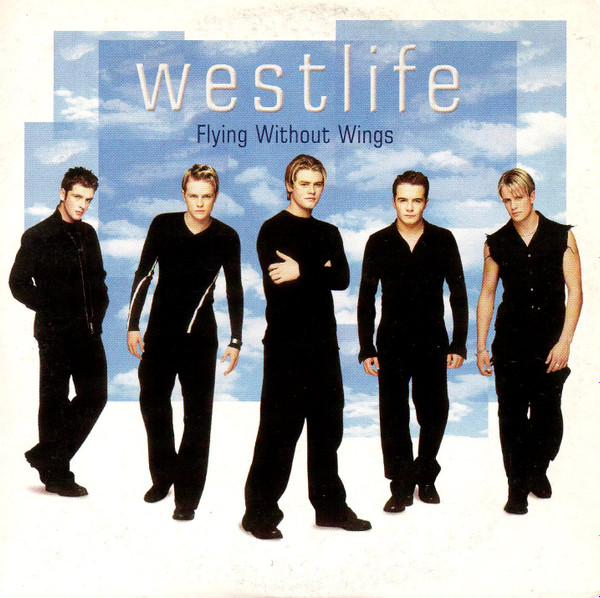
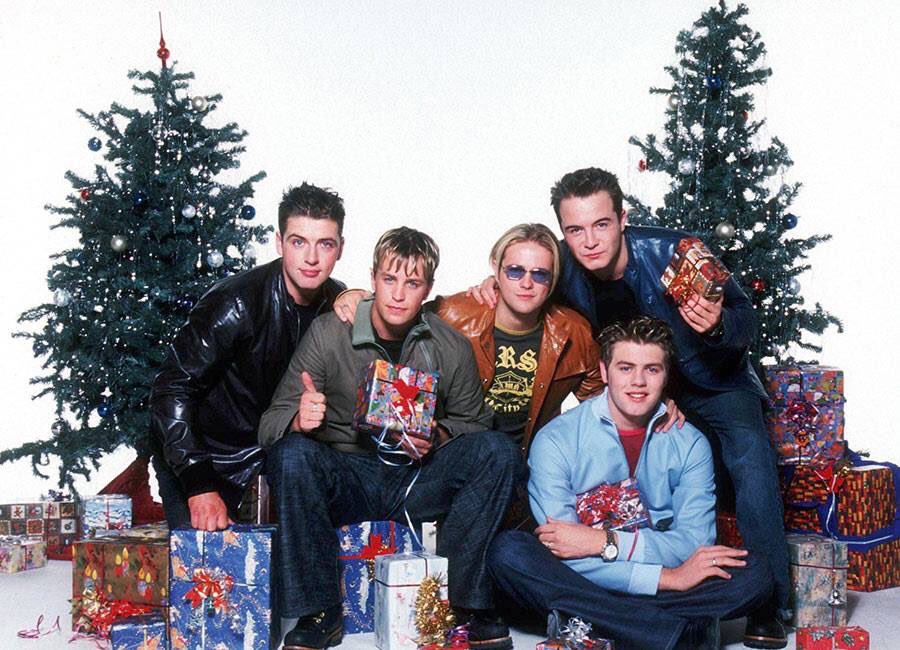
I did warn you… Just because Boyzone’s chart-topping days are over, we’re far from hearing the last of Groanin’ Ronan.
When You Say Nothing at All, by Ronan Keating (his 1st of three solo #1s)
2 weeks, from 1st – 15th August 1999
Barely three months on from ‘You Needed Me’, and before his band had even released their final single, Keating launched a solo career, with immediate success. Of course, he was helped in this by having his debut single included on the soundtrack to the year’s biggest romcom, ‘Notting Hill’, but still. I’ll admit, quietly and grudgingly, that I’ve always quite liked this…
It’s got a nice country lilt to it, and a decent chorus. Some of the production is very late-nineties bells and whistles, and it could have done without the overpowering backing singers. Plus the tin-whistle chorus is better not mentioned. Still, I’d tentatively state that this is better than at least four out of Boyzone’s six number ones.
The worst thing about it is… Yup, you guessed it. The singer. Ronan Keating is not a bad singer. He hits the right notes, he holds them, and you can make out what he’s saying (a quality my late gran held above all else). But his vocal affectations, his growls and lisps, his insistence on pronouncing his ‘ch’s and ‘sh’s like Sean Connery… He doesn’t speak like that. It’s put on when he sings. It’s annoying! And it was a huge risk for him to tempt every comedian in the land by releasing a record with the crucial line: You say it best, When you say nothing at all…
I’ve had various people commenting on Keating’s voice in previous posts. One has suggested that he might have had an alternate career as a grunge singer, which I can understand. Another has suggested that he is better on upbeat numbers, a theory that his performance on ‘When the Going Gets Tough’ doesn’t hold up but that we can put to the test again with his next chart-topper. Further thoughts on his vocal stylings are always welcome.
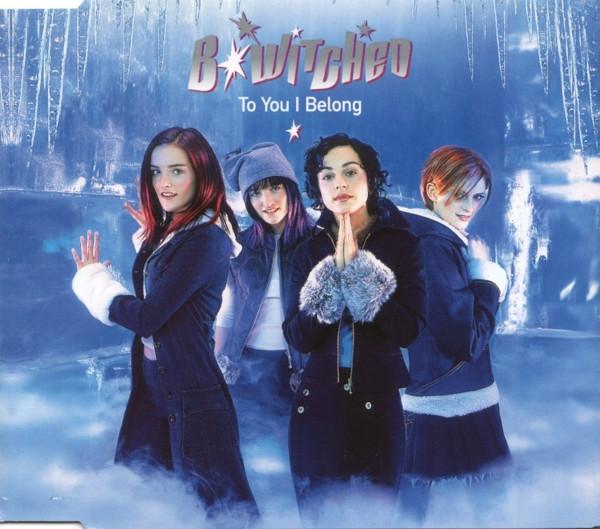
This was the fourth time in just over a decade that ‘When You Say Nothing At All’ had been a hit. Keith Whitley took it to the top of the Billboard Country Charts in 1988, while Alison Krauss & Union Station took it to the lower reaches of the Hot 100 in 1995. Both of those versions are a lot rawer, and less polished. Frances Black then took it to the Irish Top 10 in 1996, which is when Ronan first heard it. He upped the Irishness – perhaps inspired by B*Witched’s recent dedication to all things Celtic – and scored the biggest hit of all.
The two earlier ‘Today’s Top 10’s I’ve done were pretty succesful. Thanks to all who had a look, liked and commented. I was wondering what to do with the feature going forward, and I think I’ll use it to take a deeper look at interesting periods in chart history. What can the Top 10 tell us about where pop music was at a particular time and place?
So, we’ve done the death of the ’60s, and we’ve done the Summer of Love. Now we turn to perhaps one of the most exciting times in modern popular music: late-1963. The moment when the sixties finally started to swing. Thanks, mainly, to the Beatles. But not, as this chart will hopefully prove, solely because of them. For those interested in significant world events, this was also the Top 10 on the week that JFK was assassinated.
10. Let It Rock / Memphis, Tennessee, by Chuck Berry – down 4 (7 weeks on chart)
But what’s this…? Two rock ‘n’ roll tunes first released in 1959. How the charts like to mess with us… The reason is tied to the times, though. The Godfathers of rock, Buddy Holly, Jerry Lee Lewis, and Chuck Berry, had inspired the new Beat groups that we’ll be meeting further up this chart. The Beatles early albums were full of Berry songs, while the Stones’ first hit had been a cover of ‘Come On’ earlier in 1963. Pye Records saw an opportunity, and released some of these influential tunes for the first time in the UK. Amazingly, this was Berry’s first ever visit to the UK Top 10. A runaway train might not be the most obvious topic for a rock ‘n’ roll tune, but this wasn’t Berry’s first time singing about a railroad. And the way he makes his guitar sound like a train horn is iconic.
It was paired with the more laidback ‘Memphis, Tennessee’, which had also been a hit in a version by Dave Berry & the Cruisers around the same time. It pulls the same trick as such classics as Gilbert O’ Sullivan’s ‘Clair’, and Brotherhood of Man’s ‘Save Your Kisses for Me’, by tricking the listener into thinking that the singer is singing about a girlfriend, when he is actually singing about a small child. Berry, though, consumate storyteller that he was, manages to do it in a far less creepy manner, making the song more about the messy break-up, and the father’s regret, than about dodgy double entendres.
9. I’ll Keep You Satisfied, by Billy J. Kramer & The Dakotas – up 2 (3 weeks on chart)
This one’s much more 1963. One of the big beat combos that had broken through earlier in the year (with another three to come higher up), and who had been at #1 just a few weeks earlier with the Lennon-McCartney tune ‘Bad to Me’. ‘I’ll Keep You Satisfied’ is another L&M composition and, while it would peak decently at #4, it isn’t quite as good. Still, it’s better than the Dakota’s next hit, the dubious ‘Little Children’. Watching the video above, the music may be (slightly) rocking, but Billy J. is giving good crooner energy. Nothing to worry grandma… yet.
8. I (Who Have Nothing), by Shirley Bassey – up 1 (9 weeks on chart)
A constant presence on the charts of the ’50s and ’60s: a bit of Bassey. This is three minutes of pure melodrama, as Shirley watches an old-flame woo his new girl. ‘I (Who Have Nothing)’ was adapted from an Italian hit, which was something of a theme in the early sixties. It’s a classic of its genre: an intro of swirling strings, quiet bits, and bits where she lets loose, belting out high notes like nobody else can. I always find Shirley Bassey somewhat lacking in subtlety, but then again – if you’ve got it flaunt it. If I could sing like her then I’d be belting out my Starbucks orders.
7. Blue Bayou / Mean Woman Blues, by Roy Orbison – down 3 (10 weeks on chart)
Another double-‘A’ side from an American rocker, who had been around since the ’50s. Unlike the Chuck Berry record, though, this was a new hit. ‘Blue Bayou’ is one of Orbison’s gentler numbers – for the Big ‘O’ could of course give Shirley Bassey a run for her money in the belting stakes – but it’s always been one of my favourites. Even as a young ‘un who had no idea what the hell a ‘bayou’ was. Linda Rondstadt recorded a famous cover in 1977, though that didn’t make the UK Top 10.
On the flipside of this disc was a cover of ‘Mean Woman Blues’, an Elvis track from 1957. Personally, while they are both fine singers, I prefer Elvis’s version. I prefer bombastic, overblown Orbison to rocking Orbison. On this record he tries out the famous Grrrrrr, which he’d use to great effect on his chart-topping ‘Oh, Pretty Woman’ the following year.
6. Secret Love, by Kathy Kirby – up 6 (3 weeks on chart)
We’re keeping an eye out for the bands that came along in 1963 and changed popular music forever. But for every beat combo that made it big, there were plenty of British women who were just as instrumental in making the sixties swing. Kathy Kirby’s name hasn’t lasted alongside the likes of Cilla, Dusty, Lulu or Sandie Shaw, but here she is, enjoying her biggest hit. Her take on ‘Secret Love’ starts off very bombastically, much like Doris Day’s chart-topping original from a decade earlier, but soon a groovy guitars-and-backing-singers beat takes over, nicely updating the song for a new era. Plus, she has a great voice, with a bit of bite to it. Kirby may have retired from showbusiness in the early eighties and died in relative obscurity, but for a while she was a huge name: representing the UK at Eurovision in 1965 (finishing as runner-up) and hosting her own television programme.
5. Don’t Talk to Him, by Cliff Richard & The Shadows – up 2 (3 weeks on chart)
Common knowledge would have it that with the arrival of the Beatles et al the career of Cliff Richard – the hottest star in the land just a year or so earlier – fell off a, well, cliff. But glance at any Top 40 from any random moment post-1962, and it quickly becomes clear that Cliff went nowhere. Okay, he didn’t hit #1 as regularly, but ‘Don’t Talk to Him’ was one of an astounding 33 Top 10 hits he achieved across the sixties. I’d never heard this before, but it’s actually a really good song, combining a latin rhythm with some very current, beat guitars. This could easily have been written and recorded by one of the acts a couple of places up this chart, proving that Cliff gave those young whippersnappers a stronger run for their money than the history books suggest. *Some sources disagree as to whether this was Cliff solo, or Cliff with the Shadows, but I’ve gone with the latter*
4. Be My Baby, by the Ronettes – up 1 (6 weeks on chart)
The first of two all-time great, hall of fame pop songs in this week’s Top 4. The fact that this never made it higher than number four is a shock, and I’ve already done a post on how this really Should Have Been a #1. Even on this chart, in the year that it was recorded, where girl groups like the Ronettes were common, ‘Be My Baby’ stands out as special. It would stand out as special on any chart, in any era, simply because it is better than 99.95% of anything else in the history of pop.
3. Sugar and Spice, by the Searchers – down 1 (5 weeks on chart)
Here we are then, a purely Liverpudlian Top 3. The Searchers had been the 3rd Merseybeat band to make number one that year, after the two acts ahead of them in this chart, with their cover of The Drifters’ ‘Sweets for My Sweet’. Although still on the candy theme, ‘Sugar and Spice’ was an original, written by producer Tony Hatch. The chiming guitars and harmonies, as well the almost skiffle rhythm section, are pleasant, almost proto jangle-pop. But within a year, once the Stones, Kinks and Animals started making the upper reaches of the charts, it would start to sound a bit safe. The Searchers had two much better hits to come: their majestic second #1 ‘Needles and Pins’, and their cover of ‘When You Walk in the Room’. Like so many Beat bands that didn’t, or couldn’t, write their own material, the Searchers’ chart shelf-life was limited.
2. She Loves You, by The Beatles – up 1 (13 weeks on chart)
The song that officially kicked off the swinging sixties? The way that ‘She Loves You’ barrels in, chorus-first, on a wave of tight guitars and precision drumming, and yeah yeah yeahs. In France, this style of Beat music literally became known as ‘Yé-yé’ (and surely everyone knows by now how Mr McCartney Senior thought ‘yes, yes, yes’ would have sounded much more proper…) It is utterly perfect pop, to rank alongside the Ronettes a couple of places below it on this week’s chart. Although they developed their sound so far beyond this, I would still rank ‘She Loves You’ in my personal Beatles Top 3. You can read my original post on it, as a number one, here. On this week in November 1963, it was on its way back to number one, having already spent a month there that autumn, and on its way to becoming the biggest-selling single ever, at that point, in the UK (where it remains the Fab Four’s highest seller). Also, the seven-week gap between its two runs at the top remains a record to this day.
1. You’ll Never Walk Alone, by Gerry & the Pacemakers – non-mover (7 weeks on chart)
The 4th Beat group in the Top 10 on this day sixty-one years ago, Gerry & the Pacemakers had made history by being the first act to make #1 with their first three singles. This was the final week of a month-long run for ‘You’ll Never Walk Alone’, and it would also be The Pacemakers final week on top of the charts. (You can read my original post on it here.) The fact that for only their 3rd single the band had turned to a cover of a song from a 1945 musical is telling. While the Beatles were just warming up, their contemporaries were often relying on covers (or on handouts from Lennon & McCartney). Plus there was the fact that for record labels and producers, rock and roll was still a very new thing, one that many were convinced wouldn’t last. It was seen as essential for bands to branch out, and to nurture a wider appeal.
Of course we know now that rock ‘n’ roll was here to stay, even if Gerry & The Pacemakers weren’t. ‘You’ll Never Walk Alone’ was also here to stay, and by the end of its initial chart run it had already been adopted by the crowd at Anfield as Liverpool FC’s unofficial anthem, to be belted out pre-match from here to eternity. The song returned to number one in a charity version by The Crowd, following the Bradford City fire, while it also made top spot for a third time in 2020 in a version featuring Michael Ball and the 100-year-old Captain Tom Moore, a phenomenon that can only be explained by how crazy we all went during lockdown. It is nothing short of a modern-day hymn, given the song’s role in the current British psyche.
I hope you enjoyed this flashback to Today’s Top 10 in 1963. What a snapshot of popular music that was, as Britain finally cast off the shadow of the War and started to get a little groovy. Up next we’ll return to 1999, and to a country just a few months away from the terrifying uncertainty of a new millenium. Would all the computers crash? Would planes start dropping from the sky…? Nobody knew, so confused and distracted were people that they kept buying Ronan Keating records in large quantities. Stress will do that to you…
In my last post, on ATB’s ‘9PM’, I wrote about how rooted in the late-nineties that song seemed. I get a similar feeling about this number one, although they sound nothing alike. It’s just so 1999…
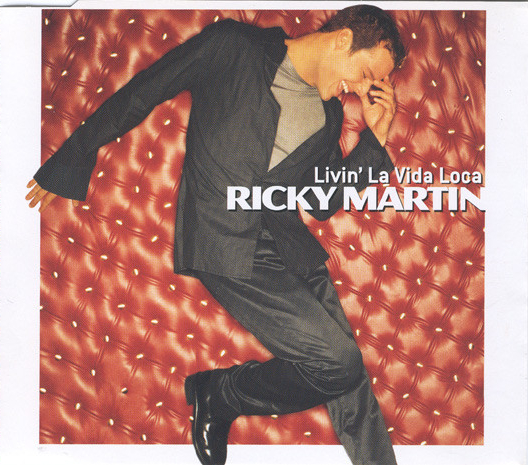
Livin’ la Vida Loca, by Ricky Martin (his 1st and only #1)
3 weeks, from 11th July – 1st August 1999
And I don’t mean that as an insult. This is a fun slice of Latin-pop, played at breakneck speed. It’s got ska horns. It’s got surf guitars. Not enough number ones feature surf guitars! In one of the most pure-pop years in chart history, ‘Livin’ la Vida Loca’ can count itself as one of its catchiest, and poppiest, number ones. But it also manages to do so with selling its soul to cheese – there is something respectably real about this, sounding like it was recorded by an actual band, with actual instruments.
It also has some memorable lyrics, about a fairly unhinged femme fatale, who’s into superstitions and voodoo dolls. She’ll make you take your clothes off, And go dancing in the rain… So fun are the words, and so fast do they rattle by – this really is a breathless song – that we don’t mind when she slips Ricky a sleeping pill and nicks his wallet in the second verse. Plus I’d argue that the title entered the wider pop culture for a good few years after this had been a hit.
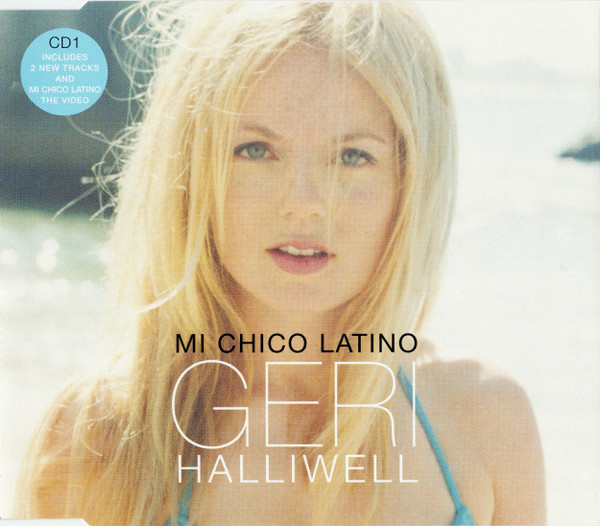
I don’t whether this sounds so of its time because a) it’s a classic, b) because it reminds me of being thirteen (that devil nostalgia again…) or c) because it kicked off a big latin pop resurgence at the turn of the century. Think Santana’s ‘Smooth’, a Geri Halliwell #1 soon to come, as well as a bit of Mambo No. 5, not to mention J-Lo, Shakira, and Enrique Iglesias. This record’s popularity cannot be denied, though, and can be proven in one simple statistic: we’re over halfway through 1999 and ‘Livin’ la Vida Loca’ is the first chart-topper to spend more than a fortnight at the top!
From Puerto Rico, Ricky Martin had been a star in the Spanish-speaking world since the age of twelve, when he’d joined boyband Menudo. They had been going since the seventies, and had a policy of chucking members out when they reached sixteen, though Martin survived until he was seventeen. He clearly had something special… In 1991 he released his first solo album, while ‘Livin’ la Vida Loca’ was from his English language debut (though he’d had a smaller hit the year before with his ’98 World Cup theme ‘The Cup of Life’.)
I have a friend who is somewhat Ricky Martin obsessed, and have been with her to see him live in concert, in the front row. He put on a great show, and my friend is still a big fan of his, despite him announcing in 2010 that she is officially not his type… Meanwhile ‘Livin’ la Vida Loca’ may be his biggest hit, and his only UK #1, but I’ve always had an even softer spot for the similarly chaotic ‘She Bangs’, a #3 in 2000.
After plenty of boyband balladry and teeth-clenchingly sweet bubblegum, what else is on our 1999 checklist…? Of course: a one-off dance hit!
9PM (Till I Come), by ATB (his 1st and only #1)
2 weeks, from 27th June – 11th July 1999
I believe the airy trance riff that holds this hit together is classed as Balearic, after the island chain in the Mediterranean, where tunes like this blast from beach bars and clubs all summer long. I have never been to Ibiza, but as I listen to this next chart-topper I can’t help but picture a beach bathed in late-afternoon sun, a cocktail glass glistening, a sunburnt Brit vomiting Stella onto a street corner…
It’s an evocative track. While I must remind readers yet again that I am no dance music afficionado, I can’t deny that this is ear-catching, and atmospheric. And sophisticated too, compared to the Vengaboys (though a Whoopee Cushion would sound sophisticated next to the Vengaboys…) The main riff was created on a guitar, and has an almost flamenco tinge to it. While I’m convinced that elsewhere in the mix there’s a banjo, which must be a first for a dance #1.
Of course the somewhat risqué title and lyrics also played a part in this becoming such a huge smash. Till I come… a breathy voice coos over and over… Change it and see… Change what and see, we’re left wondering? As examples of titillation in number one singles go, it’s pretty subtle. Which I like. As we move into the 21st century, we’ll meet plenty of chart-toppers so brazen that they make this one sound relatively prudish.
ATB is the stage name of German DJ and producer André Tanneberger, for whom ‘9PM’ was a first smash hit, the first of three-in-a-row in the UK. (Which, okay, ruins what I said in the intro about this being a ‘one-off’, but you know what I mean.) It was the year’s 5th highest-selling hit, and the 44th highest of the entire decade! The riff proved so memorable that ATB recycled part of it for the #3 follow-up ‘Don’t Stop’, while it also returned him to the Top 10 in 2021 when a remake, ‘Your Love (9PM)’, was released. He was voted the world’s #1 DJ in 2011.
Detached appreciation is the best I can muster for this sort of dance hit, though it is a nice change of pace. I will say that this song was so ubiquitous at the time that, listening to it now, ‘9PM (Till I Come)’ feels so of the ‘late-nineties’ that it’s the sort of track you’d use in a film or TV show as a setting shorthand, making sure an audience knows exactly what time period they’re in.
Back in 1995, the Outhere Brothers took a track called ‘Boom Boom Boom’ to number one. Surely, we thought, that was the limit for chart-topping songs featuring ‘Boom’ in the title? How wrong we were… Four years on, the Vengaboys did what nobody imagined possible: they added the fourth ‘Boom’…
Boom, Boom, Boom, Boom!!, by Vengaboys (their 1st of two #1s)
1 week, from 20th – 27th June 1999
If you thought our previous number one, ‘Bring It All Again’ by S Club 7, was cheap and cheesy then you might as well stop reading now. Everything here, from the title, to the lyrics, to the mid-tempo beat, is banal. There are no hidden layers, no sense of irony, no subtlety. Boom. Boom. Boom. Boom.
And yet here I am. Enjoying it. How depressingly predictable. One of history’s most moronic number one singles, and I’m having a good time. What a sad excuse for a music blogger. I will not attempt to justify it. I will not use nostalgia as an excuse. I am ashamed.
Actually no, wait. I will make a couple of attempts at justification. I’ve just discovered the first verse of ‘Boom, Boom, Boom, Boom!!’ interpolates ABBA’s seminal late-disco classic, ‘Lay All Your Love on Me’ (strain your ears and you can just about hear it). ABBA! That certainly clears off a layer of muck. Plus, it could be argued that this is actually a gritty, confrontational number one single, written from the point of view of a sex worker – If you’re alone, And you need a friend… I’ll be your lover tonight… – about which social studies theses could be written. (And if you’re not convinced with this hooker theory, just watch the video…)
Like all Eurotrash acts, Vengaboys simply had to be from either Germany or the Netherlands. Place your bets… Yes, they were Dutch. Still are, I should say, as they are going strong on the nostalgia circuit. Like most of these acts, the sexy young stars on the CD sleeves and in the videos were not the brains behind the songs, Vengaboys having been put together by two of the most Dutch sounding men in existence: Wessel van Diepen and Dennis van den Driesschen.
Before I finish, let me indulge in a spot of reminiscing. ‘Boom, Boom, Boom, Boom!!’ is forever imprinted on my conscience thanks to a school friend. (We’ll call him Richard, because that was his name.) He claimed that he had lost his virginity to a girl who had seduced him by singing a version of this song with his name in the chorus. It happened, he promised, at a summer camp for arthritic teenagers. The girl’s surname was, he swore blind, Paradise. There are very few occasions in my life in which I have laughed more than the day he tried to sell us this story.
Normal service is resumed, after the strangest of detours courtesy of Baz Luhrmann’s ‘Sunscreen’… Here’s some A-grade, late-nineties tween-pop.
Bring It All Back, by S Club 7 (their 1st of four #1s)
1 week, from 13th – 20th June 1999
I hear the Jacksons, I hear the Archies, I hear Disney themes… I hear a whole host of influences from classic sixties and seventies bubblegum. I’ve noticed that while listening to many of the recent pop number ones, I’ve ended up spending more time working out what they’re derivative of rather than hearing them as their own entities. And there isn’t a single note in ‘Bring It All Back’ that isn’t borrowed from somewhere else. Which means I want to sneer at it – my thirteen-year-old self certainly did – but dammit I can’t. It’s just too catchy, too packed with hooks, not to grudgingly admire.
Not that it’s at all clever, or that it isn’t cynical in the way it relentlessly hits each hook after hook, as if some modern day Pied Piper has designed a song that will lure in seven-year-olds across the land. I haven’t been able to listen to it for too long this morning without starting to feel queasy. Plus there’s no edge, no hint of an underlying melancholy, to the lyrics: Don’t stop, Never give up, Hold your head high and reach the top… It almost makes B*Witched sound punk. But still, as a pure pop song, it works.
Besides, I could never truly hate this. This is nostalgia. This is watching kids’ TV while still in my school uniform, looking forward to ‘Neighbours’ and ‘The Simpsons’, before, or perhaps after, playing football across the street, with my mum cooking dinner next door… Baz Luhrmann may have just warned us against the dangers of nostalgia, but I would pay a good sum of money just to spend five minutes back in that world.
This record is further evidence of a point I made a few posts ago, about British pop sounding, and looking, cheap and tacky next to the mega-watt US stars of the day. You can imagine Britney Spears’s team hearing five seconds of this, and dismissing it with a roll of the eyes and a “that’s cute”. And yet, ‘Miami 7’, the show for which this served as the theme song, was popular in the US. Clearly even their tweens had an appetite for British cheese.
S Club 7 were the brainchild of Simon Fuller, after he had been sacked by the Spice Girls in 1997. Presumably he wanted younger, more pliable charges (who wouldn’t rebel against him) which I guess fed through to the cuter, more upbeat music. It is said that the ‘S’ in the band name stands for ‘Simon’, which feels a bit cultish, but that’s never been confirmed. With Steps around at the same time, and with Hear’Say and Liberty X to come soon, it could be said that we are in the second golden age of mixed-gender pop groups, after the days of Bucks Fizz, Brotherhood of Man, and a certain quartet of Swedes (I hesitate to type out that band’s name, in case a casual skim-reader thinks I’m actually comparing them to S Club 7!)
I will happily admit, however, that S Club 7 have much better songs to come… At least two of which are genuine pop classics. Their sound matured, while their songwriters remained skilled at using strong reference points for their hits, be it Motown, disco, or even classical interpolations (see 2000’s ‘Natural’). Plus, I’ve met Bradley McIntosh – the only chart-topping artist I have ever touched – and he was cool.
Ummmm…. 1999 might not be a top-tier year from a musical standpoint, but it’s certainly turning into one of my favourite years to write about…
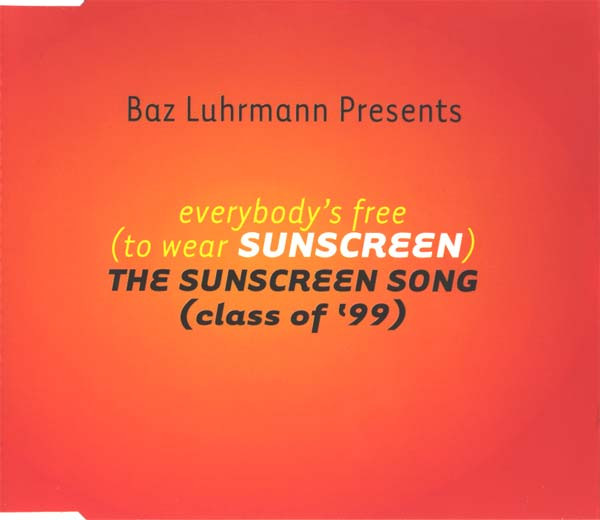
Everybody’s Free (To Wear Sunscreen), by Baz Luhrmann (his 1st and only #1)
1 week, from 6th – 13th June 1999
We’ve pinged from pop-punk, to new wave, to bubblegum, to garage, with plenty of boyband pap in between, to this… This monologue on life from an Australian film director. It is a word-for-word recital of an imagined graduation speech, written by columnist Mary Schmich for the Chicago Tribune in 1997, that had gained fame through that most late-nineties of ways: as a viral email.
The voice on the record is Australian voice actor Lee Perry, who dispenses Schmich’s pearls of wisdom with a likeably dry authority. Some are practical (Floss! Stretch!), while some are fanciful (Maybe you’ll divorce at forty, Maybe you’ll dance the funky chicken at your 75th wedding anniversary…). Some are funny (Read the directions, Even if you don’t follow them…), and some are touching (Get to know your parents, You never know when they’ll be gone for good…) All of it is bookended by the one and only piece of advice that has been proven by scientists: Wear sunscreen!
The backing track is the choral version of a dance hit from 1991, which also lends the record its title, Rozalla’s ‘Everybody’s Free (To Feel Good)’, a song Luhrmann had previously used in ‘Romeo + Juliet’. It’s got a nice laid-back, trip-hop, surf-rock feel to it. In extended mixes, a new version of the chorus from the Rozalla original is included, although the single mix skips any singing and makes this a purely spoken-word #1, to rank alongside Telly Savalas and J.J. Barrie.
Although I have an aversion anything labelled as ‘self-help’, there is something appealing about this weird, post-modern single. It’s the sort of thing Andy Warhol might have released, had he had a pop music career. Like a lot of Lurhmann’s work, it’s not half as deep as it thinks it is. Some of the lyrics are downright trite, live laugh love level bullshit (Do one thing every day that scares you…), but there are a couple of verses that verge on the profound. My favourites are the lines on the power of youth in the first verse, and on nostalgia towards the end: Advice is a form of nostalgia, Dispensing it is a way of fishing the past from the disposal, wiping it off, painting over the ugly parts, And recycling it for more than it’s worth…
I think it also appeals because it’s now twenty-five years old, and is itself a reminder of a simpler time. A time when emails went viral, when newspapers would bother publishing a piece of whimsy like this, and when a pop record this innovative could make the top of the charts. Plus, spend five minutes scrolling through Instagram today, and you’ll be bombarded with an avalanche of crappy, pop-psychology memes with captions ten times more glib and cheesy than this record. (Oops, there’s me falling into nostalgia’s sneaky trap already…)
Baz Luhrmann may have had a far more prolific career as a director, but this isn’t the only time that he has had a say in the world of music. Tracks from the soundtracks of his movies, from ‘Romeo + Juliet’, to ‘Moulin Rouge’, to ‘Elvis’, have all made the upper reaches of the singles charts, including a soon to come number one.
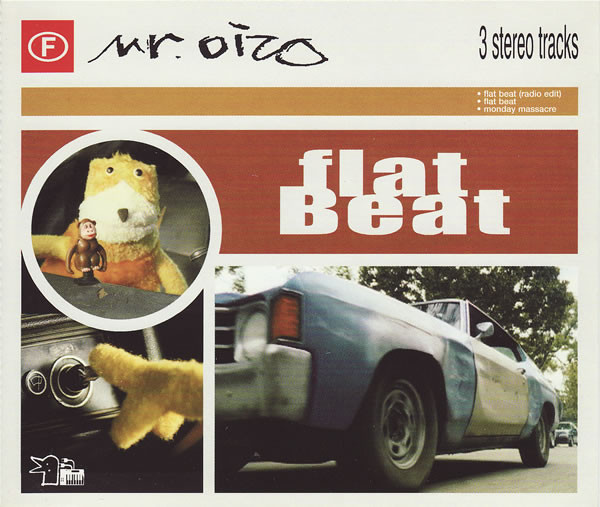
As with some of our more left-field recent chart-toppers (Mr. Oizo and Spacedust spring immediately to mind) I’m more in the ‘Whyyyyy?’ than the ‘Yayyyyy!’ camp with this record, but it makes for a fun curio. And as a fair-skinned person living in a hot climate, I can attest: Trust him on the sunscreen!
I was about to sound the random dance hit klaxon, 1999’s most used alarm, before I noticed that this next number one isn’t really dance. I was going to claim it as drum ‘n’ bass, but then realised that it was actually our first example of a very turn-of-the-century genre: garage.
Sweet Like Chocolate, by Shanks & Bigfoot (their 1st and only #1)
2 weeks, from 23rd May – 6th June 1999
Sadly this has nothing to do with garage rock. Or with car repair. The genre stems from Paradise Garage, a NYC gay nightclub popular in the ‘70s and ‘80s (and which had been built as a parking garage back in the ‘20s). From there we can trace a route from disco in the seventies, to garage house in the eighties (alongside Chicago house acts like Steve ‘Silk’ Hurley), to the 90s when it crossed the Atlantic, got sped up, and became known as UK garage. From there we can look into a future of grime, and drill… A rushed potted history I know, but I’m very amused to discover that this often misogynist and homophobic genre can trace its family tree back to a gay bar presumably full of leather queens and cock-duster moustaches…
Not that there’s anything offensive about ‘Sweet Like Chocolate’. No, our introduction to garage is as light and fluffy as they come, with some staccato strings and a gentle brass section that builds over the 2-step beat that will become one of the sounds of the next few years. I’ll readily admit that I was never – now, or at the time – the biggest fan of the genre, but also that this is as pleasant an intro as we could have wished for.
What I’ve always remember about this record are the high-pitched vocals, from a singer named Sharon Woolf. And the animated video, in which the entire world is made of chocolate (and which now looks wonderfully dated). Oh yes, and the jokes at school about how this might not actually be about chocolate… You are sweet on the tip of my tongue, You are warm like the rays of the sun… (The steamy noises that Woolf makes in the extended original mix only serve to confirm my teenage suspicions.)
Shanks & Bigfoot were a duo called Steven Meade and Danny Langsman, who had had a #20 hit the year before, ‘Straight from the Heart’, under the name Doollally. Following the success of ‘Sweet Like Chocolate’, they released the same song, as Shanks & Bigfoot, and made #9. I wonder if there are any other songs which have charted twice by ‘different’ acts?
Though I’ll probably be down on the many of the garage records which will top the charts between now and 2002, I should emphasise the authenticity of the genre. Garage relied on underground nightclubs, MCs, and pirate radio to break through. I may not much like it, but it was the sound of the streets, like skiffle and punk had been to generations before. Which is something, in an era where manufactured pop held so much sway.
You Needed Me, by Boyzone (their 6th and final #1)
1 week, from 16th – 23rd May 1999
Following on from our last post, if I’d wanted an example of how drippy late-nineties boybands from the British Isles were compared to their American counterparts, then I couldn’t have planned it better. Straight after Backstreet Boys’ era-straddling classic ‘I Want It That Way’ comes Ronan and the lads’ final, and perhaps most insipid, number one.
‘You Needed Me’ was originally a Billboard #1 in 1978 for Canadian singer Anne Murray (it made #22 in the UK). If you ever want to listen to ‘You Needed Me’, then listen to her version. And you should want to listen to it, as in its original form it’s a nice slice of Carpenters-esque, late-seventies soft rock. There are no circumstances under which you should ever need to listen to the Boyzone cover instead, unless you find yourself writing a blog in which you force yourself to listen to every single number one single…
Ronan Keating takes lead vocals (of course he does), and he goes through his full repertoire of grunts, growls, and rasps, as if well aware that this is Boyzone’s last hurrah. And it’s not that he and his bandmates completely ruin the song. It’s more that nothing here is an improvement on the original: not the vocals, not the karaoke reverb ‘n’ tinkles production, not the extra backing singers chucked in at the end. My favourite bit of both versions, and which I’m happy Boyzone kept, exaggerated even, is the overstated ending.
I say that this is Boyzone’s most insipid number one but it of course has competition. ‘No Matter What’ is their best by far, ‘A Different Beat’ at least had some interesting, world music elements, while we were simply glad that their cover of ‘When the Going Gets Tough’ was NOT A BALLAD! Maybe then ‘You Needed Me’ can tie with their cover of ‘Words’, and ‘All That I Need’ as their dullest. The video to this one, though, is worth noting as it features lots of different couples in lots of different picture frames, at least two of whom appear to be same-sex, which feels very progressive for the time. It was probably tied to the fact that Stephen Gately had just come out as gay.
Many didn’t expect ‘You Needed Me’ to make number one, as it was up against Geri Halliwell’s highly anticipated solo debut ‘Look at Me’. Boyzone, though, edged the race by a narrow 748 copies, which many put down to the fact that they released two different CD versions compared to Geri’s one. Ginger Spice would have her day at the top of the charts, but was made to wait a few months longer than she might have wanted.
Boyzone meanwhile had one final Top 10 hit after this before calling it a day for the best part of a decade. We will of course hear Groanin’ Ronan’s unmistakeable tones again at the top of the charts, as he was quick to launch a successful solo career. Stephen Gately and Mikey Thomas also tried it alone, with less success, while Keith Duffy and Shane Lynch had a go as a duo. They reformed in 2008, returned briefly to the Top 10, and have released several albums in the years since. Gately tragically died from a heart condition in 2009, aged just thirty-three.
More boyband balladry at the top of the charts, with yet more to come very soon…
I Want It That Way, by Backstreet Boys (their 1st and only #1)
1 week, from 9th – 16th May 1999
But wait, come back! Boyband ballads don’t have to be dull, repetitive, and bland. Yes, I know, Westlife will put this theory sorely to the test time and again, but believe me. In fact, don’t take my word for it, just play our next number one: ‘I Want It That Way’, by the Backstreet Boys. From the UK’s most successful boyband, to – in pure sales figures – the most successful of all time…
Like Britney Spears a few weeks earlier, ‘I Want It That Way’ has that confident, glossy-teethed American-ness, with a healthy dollop of Max Martin production (plus, of course, that quintessential late-nineties drumbeat). Comparing this to Westlife, or Boyzone, it reminds me of the 1950s, when Elvis, Jerry Lee Lewis et al were the epitome of hip-swivelling cool, and the Brits were still serving up nudge-wink music hall acts like Tommy Steele. Of course, we’re only a few years on here from the heyday of Take That – a British boyband that had global appeal – but things seem to have regressed since then.
And I’m not saying that I think British popular music was in a less appealing state than the US at the turn of the 21st century. On the contrary, I think the British charts were throwing up curios and oddities, and a mix of genres, that the Billboard chart could only dream of, while the latest Boyz II Men hit spent its seventeenth week at #1. But when it came to pure pop, the US acts of the day – Spears, Aguilera, these Backstreet Boys – had the ability to make their British counterparts look like small fry. Let’s call it the US pop-industrial complex.
Anyway, that was a bit of a tangent. Why is ‘I Want It That Way’ such a classic pop tune? Something in the minor key verses and the soaring chorus. Something in the Tell me why! hook. Definitely something in the gigantic key change, which is one of the very best of its kind. But mainly in the way that it somehow sells an opening line like You are my fire, My one desire… without making you want to press ‘skip’. Get past that line and you’re invested until the end.
The lyrics are, as many before me have pointed out, nonsense. Or, if you’re being generous, ambiguous. We’re never given an answer to the ‘tell me whys’, or any hint as to what is such a heartbreak, and a mistake. Maybe it’s just my dirty mind, but I like to think of this as a sort of Meat Loaf not telling us what he wouldn’t do for love situation, with ‘that way’ being some sort of sordid sexual act that the good ol’ Backstreet Boys can’t stomach their girlfriends asking for.
Or maybe that’s just me. Whatever the reason, ‘I Want It That Way’ was a huge hit around the world. Take it from me, as someone who’s spent many years in Asia, this is one of those English songs that everyone, from Japan to the Philippines to Cambodia, knows. It was far from the Backstreet Boys first hit in the UK, but if any of their singles was going to make number one then it was this. They would also go on to have eight more Top 10s between here and 2005, to end with an impressive total of sixteen in just under a decade. Colour me amazed, though, to have just discovered that Backstreet Boys scored precisely zero US chart-toppers!