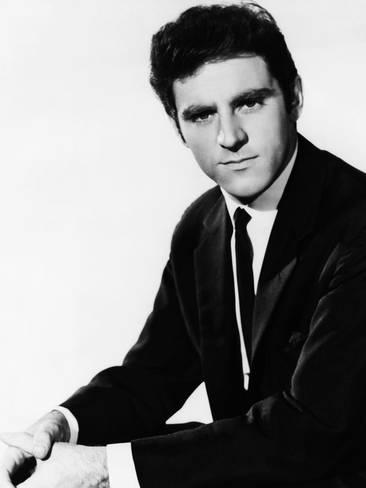
100. ‘Do You Mind’, by Anthony Newley

100 not out! A little cricket reference for you there. And I’d wager that Mr. A. Newley – the singer involved in this particular milestone – was partial to a spot of the old leather-on-willow back in his prime. Cos he’s posh, you see. Or rather, he sounds posh – and that’s half the battle, really. Anyway… He would like to ask, if it isn’t terribly impertinent of him, another question. Fresh from asking ‘Why?’, he’s now wondering ‘Do You Mind?’

newley7.jpg

Do You Mind, by Anthony Newley (his 2nd of two #1s)

1 week, from 28th April – 5th May 1960

He loves a polite question, does our Anthony. The title of this latest chart-topping record could be anything but polite – it conjures up, in my mind at least, images of a fearsome old lady grabbing the boy who’s just tried to push ahead of her in a queue: ‘Young man! Do you mind!?’. And yet, when you listen to the words, you realise that this is a song about being nothing but a perfect gentleman.

It begins with some finger snappin’, and a natty little bass line. If I say I love you… Do you mind? Make an idol of you… Do you mind? If I shower you with kisses, If I tell you honey this is, How I picture heaven… Do you mind? ‘I say, dearest, would it be OK if I begin utterly adoring you? Are you sure? Thanks ever so…’ Works a charm every time. He’s a clever rogue is Anthony Newley. Last time I pictured him as a sort of dandy-ish Bertie Wooster, posing soppy questions to his girl – the answer to which was always ‘Why? Because I love you.’ Here I’m picturing him as a sort of proto-Hugh Grant, bumbling his way into women’s hearts with his achingly proper advances.

As with ‘Why’, this is a fluffy little record of very little consequence. But I like it more than its predecessor. It’s got someone snapping their fingers, for a start. Plus there’s a sort of jazzy, music hall swing to the lines: I wanna whisper, whisper sweet nothings in your ear… Then there’s the oh-so-1960, tinny rock ‘n’ roll guitar which begins with the odd jab between lines, before growing in confidence and adding some cool little licks along the way. And I love the ending. Click click.

I also like Newley’s voice here more than I did during his first chart-topper: it’s not quite as reedy or as camp. He’s trying to add a spot of swagger by dropping his aitches – note the ‘love ya’ and the ‘ba-by’ in the closing bridge – but he isn’t really fooling anyone. I did my usual research, as this is the last time we’ll be hearing from Mr. Newley, and it turns out that he was a big vocal inspiration for none other than… David Bowie. Which makes complete sense, and which means you will forever picture a young Ziggy Stardust whenever you next hear ‘Do You Mind.’

37004-raw

Which probably won’t be any time soon, though, as Anthony Newley and his hits seem to have been erased from the public conscience. He lived a full life nonetheless: four marriages (that loveable toff schtick must have worked!), one of which was to Joan Collins – a notch in anyone’s bedpost! He also – and this makes his disappearance from the rock and pop canon seem very strange – wrote Nina Simone’s ‘Feeling Good’ (!) and Shirley Bassey’s ‘Goldfinger’ (!!) As well as all that – and this belatedly gains him a place in my childhood heroes Hall of Fame – he also wrote the soundtrack to ‘Willy Wonka & The Chocolate Factory’, i.e. the one with Gene Wilder, i.e. the film I watched on VHS at least once a month between the ages of seven and nine.

Also of note here is the fact that this track is the latest in a growing list of quick-fire doubles at the top of the charts. In the past two years Connie Francis, Russ Conway, Bobby Darin, Adam Faith, Cliff Richard and now Anthony Newley have all hit the top spot twice with a gap of only two or three months in between. I’ve mentioned the concept of a shadow #1 before – a follow-up release that does well thanks to the resonant glow from an earlier hit – but it’s really been noticeable these past months. And quite often the ‘lesser’ hit has been better, to my ears, than the bigger one… Anyway, the next #1 is also a ‘sophomore’ number one, and – I don’t usually do previews but I’m indulging myself here – a complete and utter CLASSIC.
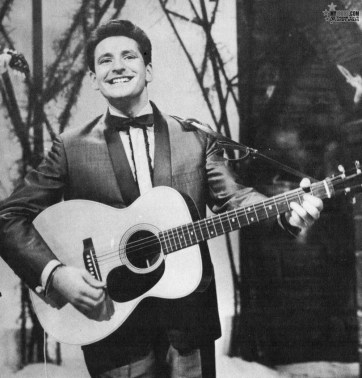
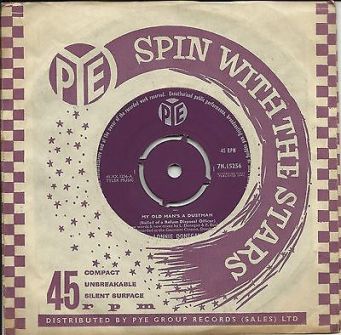
99. ‘My Old Man’s a Dustman’, by Lonnie Donegan

Back for one final fling at the top of the charts folks – live from the glamorous Gaumont Cinema, Doncaster – please welcome… the one and only… Lonnie!… DONEGAN!!!

tyls-21

My Old Man’s a Dustman, by Lonnie Donegan (his 3rd and final #1)

4 weeks, from 31st March – 28th April 1960

I had my doubts as to whether either of his previous #1s were ‘live’, as they sounded like studio recordings with some applause tacked on the end, but this is certainly the real deal. The audience are truly involved here, whooping and clapping at the end of almost every line – in fact they start cheering before the song has even really begun.

Now here’s a little story, To tell it is a must, About an unsung hero, Who moves away yer dust… Donegan tickles his guitar, as he introduces the tale of his father and then launches into some famous lines: Oh my ol’ man’s a dustman, He wears a dustman’s hat, He wears cor blimey trousers, And lives in a council flat… This is a very British number one, perhaps the most home-grown, wink-wink, nudge-nudge, how’s yer father, oo-er missus number one yet. For the benefit of non-British readers then: a ‘dustman’ is a rubbish collector, a ‘council flat’ is government built and owned housing for lower-income tenants, and ‘cor blimey trousers’ are… quick check, as even I’m not that up on old-fashioned Britishisms and was born far from the Bow Bells… old trousers unfit for wearing, possibly with a big rip across the arse.

The song bounces along, while Lonnie paints colourful scenes from his father’s life as a binman. I’ll pick out just one, shall I? Now one day whilst in a hurry, He missed a lady’s bin, He hadn’t gone but a few yards, When she chased after him, ‘What game do you think you’re playing?’, She cried right from the heart, ‘You’ve missed me am I too late?’, ‘No, jump up on the cart!’ (Cue riotous laughter)

In between the tales from the frontline, Lonnie trades dad-jokes with his fellow band member Les, in a variety of voices: I say, I say Les… Yes?… I found a police dog in my dustbin… How d’you know he’s a police dog?… He’d a policeman with him! Groan. Want another one? Course you do? I say, I say, I say, my dustbin’s absolutely full with toadstools… How d’you know it’s full?… Cos there’s not mush-room inside!

I know I’ve had a good moan in the past about British chart-toppers being silly and uncool compared to those recorded in the US. But that would be a somewhat snide and petty thing to bring up here. This is pure east-end music hall: silly jokes, accents and innuendo a-plenty. (Apparently it upset the hardcore skiffle fans of the time that their hero would stoop to recording this silly mush). I don’t find it terribly funny myself – though that one about the mushroom did take me a couple of listens to get and made me chuckle when I did – but then I’m a cynical millennial whose coming to this record sixty years too late. The song ends to rapturous applause, and it did spend a month atop the charts – so plenty of folks enjoyed it, and presumably still do.

lonnie-donegan-my-old-mans-a-dustman-original-uk-7-single-very-good_8789423

This, following hot on the heels of ‘Running Bear’, means we’ve had two novelty #1s in a row. They’re pretty easy to write about, good for a quote or two, but they don’t reveal much about where popular music was at the time of their release. ‘My Old Man’s a Dustman’ (‘Ballad of a Refuse Disposal Officer’ – to give it its full title) could have been written in 1910, for example. (It wasn’t – but the lyrics do have their origins in the 1st World War trenches.) Looking down the list, normal service at the top of the charts will resume very soon – rock ‘n’ roll ditties about falling in and out love. And maybe we’ll grow bored of that and look back fondly on these novelty number ones from the spring of 1960. Who knows?

One more thing – the line at the start of the song about the singer’s dad being ‘flippin’ skint’ is the by far closest we’ve come to hearing a swear-word in this countdown – ‘flipping’ being a very PG version of ‘fucking’, kind of like ‘freaking’ in American English but probably even milder. And it got me wondering when and what the first ever #1 to feature genuinely foul-language will be? I know all sorts of facts about the UK’s chart-toppers – longest, shortest, most weeks at the top, longest climb to the top, highest selling, lowest selling – but not that…

Lonnie Donegan bows out here. His 3rd and final chart-topper being his biggest – his signature? – hit. But it’s far from being his best. That was the punky, gonzo, gloriously messy ‘Cumberland Gap’. Donegan was a regular visitor to the top ten between 1956 and ’62, and did a lot to inspire the wave of British guitar acts that are set to explode on both sides of the Atlantic in a few years’ time. Meanwhile, his Wiki page introduces him as both ‘The King of Skiffle’ and ‘Britain’s most successful and influential recording artist before The Beatles’. A pretty decent bunch of ways to be remembered, eh?

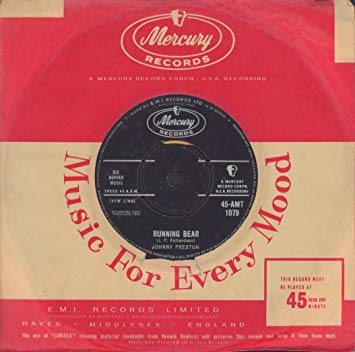
98. ‘Running Bear’, by Johnny Preston

The opening handful of sixties #1s have been pretty new to me, in contrast to the Cliffs, Buddies and Bobbies that closed out the fifties. But this latest record is a new level of new: a completely unknown entity. ‘Running Bear’? Nope. By Johnny Preston? Nope…

johnny-preston-running-bear-1960-3.jpg

Running Bear, by Johnny Preston (his 1st and only #1)

2 weeks, from 17th – 31st March 1960

It is, though, a record that catches you from the get-go – perhaps desperate to ensure that, while you may not have heard it before, you won’t go forgetting it in a hurry. It opens with a drumbeat, a deep-voiced oom-ba-doom-ba, some grunts, a whoop and a holler and a, wait… a Native American war-cry?

Oh dear… Is this going to be one of those records best described as being ‘of their time’? A record to make your grandad chuckle ruefully and mutter something about ‘not being able to get away with it nowadays.’ Remember Guy Mitchell’s ‘She Wears Red Feathers’? The story of the love between an Englishman and an oriental beauty (in a fetching huly-huly skirt)? Well, this is the same kinda deal. But with Red Injuns!

On the banks, Of the river, Stood Runnin’ Bear, Young Indian brave, On the other, Side of the river, Stood his lovely, Indian maid… Runnin’ Bear pines for lil’ White Dove, who waits oh-so patiently for him across the water. But their tribes are at war, and so their love cannot be…

It’s a romance in three verses. The first sets the scene (above), the second puts Running Bear’s tortured position into clear focus. They can’t cross the raging river, and so: In the moonlight, He could see her, Throwing kisses, Cross the waves, Her little heart, Was beating faster, Waiting there, For her brave…

The third and final verse brings resolution. Bear throws caution to the wind, dives in the river and White Dove follows suit. And they swam, Out to each other, Through the swirling, Stream they came… Their hands touch, their lips meet… they’re both pulled to the bottom and drown. Yup. Didn’t say it was a happy resolution, did I?

That’s by far the best bit of the song – the brutal killing off of the main characters in a way that would shock even George R.R. Martin. I mean, if they’d made it to the other side and lived happily ever after then so what? Who’d care? This is more memorable. It’s a novelty record, for sure, but with an ending that suggests an irreverence, a knowing wink, that I don’t think we were getting a few years ago in, say, ‘How Much is That Doggie (In the Window)?’

91tVS5JbQ5L._SX355_

Musically this song is pretty interesting too. It alternates between the tribal rhythms – the pow-wow-by-the-wigwam vibe – of the verses and the raucous sax-led choruses. It’s silly; it’s fun. And, to be fair, while the lyrics may sound a little dubious to modern ears (hey, at least Preston doesn’t put on any ‘me very wise man’ voices) there’s nothing explicitly racist here. It’s a simple little love song, with a darkly comic twist at the end.

Why it caught the British public’s imagination in the spring of 1960 isn’t so clear, however. It drags us completely away from the run of jingly-jangly, winsomely innocent chart toppers we’ve been having and back a good few years (it was written and recorded in 1958). Johnny Preston seems to have been a fairly run-of-the-mill American rock ‘n’ roller who scored a few hits in the late fifties / early sixties; and who became known as Johnny ‘Running Bear’ Preston for the releases that followed his biggest hit. But it makes complete sense to discover that ‘Running Bear’ was originally written and recorded by The Big Bopper – last seen dying in the same plane crash that claimed the life of Buddy Holly. He even contributed the oomba-doombas and the war cries to this version, meaning that this giant (and I mean that fairly literally) of rock ‘n’ roll can claim part-ownership of a UK #1 single.

A pleasant enough diversion, then, with an ending that I’ll remember – and will possibly be emotionally scarred by – for some time. And for a song that I had had no experience of whatsoever until coming to write this post, I’d say that’s a job well done!

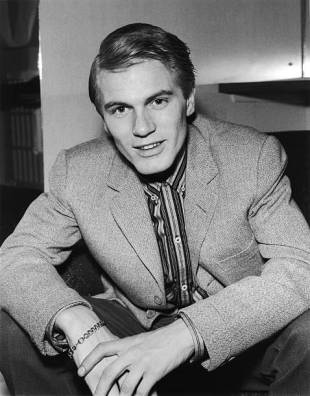
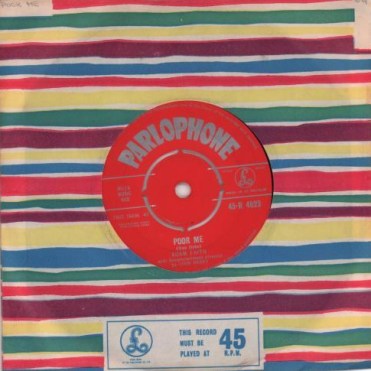
97. ‘Poor Me’, by Adam Faith

Time for another quickie with Adam Faith? Oo-er, that came out wrong. What I mean to say is that, for the second time in three months, Adam Faith has come and gone in less than two minutes. (That didn’t sound much better…)

gettyimages-112058576-612x612

Poor Me, by Adam Faith (his 2nd of two #1s)

2 weeks, from 4th – 17th March 1960

His first chart-topper – ‘What Do You Want’ – clocked in at one minute thirty eight seconds; this one goes on for a much more leisurely one forty-six. Two #1s that take less time combined than many songs do on their own. And the similarities between the two don’t end there – ‘Poor Me’ rollicks along at the same tempo, and borrows the exact same lightly plucked strings (which were, lest we forget, nicked from Buddy Holly), as Faith’s first number one.

And yet… This is a different beast altogether. ‘What Do You Want’ was a standard pop song: a perky verse-verse-bridge kind of number. ‘Poor Me’ has a much darker edge to it. For a start there are the ghostly backing singers: AaaahAaaahAAAAAAhAaaaaah, their voices rising and falling like the soundtrack to a fairground’s haunted house. Then there are Faith’s vocals. He sounds grumpy, angry even, and he mumbles his way unwillingly through the opening lines. It’s a song about a lover cursing both his luck and his ex, a man wallowing in his misery. Sorry thoughts leaping around my head, It’s been heard and it’s been said that, You tried, To date another guy, Didn’t hide, Didn’t even try, Cheating me with lies again, Making me remember when… Brutal stuff, eh? No sugar-coating here! Poor me, indeed.

In fact, Faith is so pissed off that he may have been hitting the sauce in an effort to forget. I mentioned in my post on his previous #1 that his pronunciation was unique at the best of times; but here he’s also slurring his words like a man on day five of a three-day-bender. I had to check online to make sure I had the lyrics quoted above correctly (I did) and had to give in completely when it came to the bridge: I used to hold you baby, So tight, Each night, That’s right… Because that’s not what it sounds like on record (Try ‘I used to hold you by the, Soft hands…)

Come the end, Mr Faith has really given himself over to despair and is possibly reaching for the shotgun under the bed: Why oh why, Do voices say to me, Sit and cry, That this was meant to be, Love’s unkind and love’s untrue, Oh why did love pick out you, For me, For me, Wa-ha, Poor me, Poor me… Jeez. This is by far the mopiest, whiniest, most depressing record we have met on our countdown. We’ve had some heartbreak up to now; but nobody has wallowed quite as long or as deeply as Adam Faith here. The first Emo chart-topper, decades ahead of its time? Maybe I wouldn’t go that far; but it is a fascinating record. On first listen it sounds like a hastily knocked-together and derivative follow-up to a debut #1; but repeated listens reveal it to be a much more complex and, dare I say, challenging song than ‘What Do You Want’.

ADAM_FAITH_POOR+ME-407259

And that’s that as far as Adam Faith’s chart-topping career goes. By the mid-60s he had moved into television work and made a good career out of it – acting steadily until his death in 2003. According to Wiki – and God I really hope this is true – his final words, uttered on his deathbed following a heart-attack, were: “Channel 5 is shit, isn’t it? Christ, the crap they put on there. It’s a waste of space.” As final words go they are up there with the very best, alongside “Kiss me, Hardy” and Oscar Wilde’s quip about the wallpaper, and anyone who has spent any time watching British television will surely agree with the sentiment.

The very eagle-eyed among you will perhaps also have noticed that, while ‘Poor Me’ had a fortnight in the top-spot, if you add up the days between the 4th and the 17th March you get…thirteen. Unlucky for some. There’s a simple enough explanation: on 10th March the ‘official’ chart switched from the NME to Record Retailer, which was published one day earlier, and so Adam Faith lost twenty-four hours at the top. Poor him.

96. ‘Why’, by Anthony Newley

We’ve only just started with 1960, yet suddenly it’s March! Time flies! And it seems that if the early sixties is going to have an on-running theme at the top of the charts, then said theme will be ‘Whimsical’.

ANTHONY_NEWLEY_WHY-558515

Why, by Anthony Newley (his 1st of two #1s)

4 weeks, from 5th February – 4th March 1960

Because this is another gossamer light record, as ethereal and floaty as its predecessor: ‘Starry Eyed’. Here the chimes come from a xylophone, or maybe a glockenspiel, or any other instrument with bars that you might strike with a little furry ball on a stick. I’ll never let you go, Why? Because I love you… I’ll always love you so, Why? Because you love me… There are a lot of questions in this record, lots of ‘Why?’s, and the answer to every single one is that Newley loves his girl, or that she loves him. It’s a lovey-dovey song; a song to make you gag.

The lyrics to this #1 are, quite frankly, a cheesefest. And super simple. I think you’re awfully sweet, Why? Because I love you… You say I’m your special treat, Why? Because you love me… Anthony Newley’s voice is reedy, and clipped. Slightly camp. I’m picturing him as a bit of a dandy, nice mustard chinos and a tartan jacket, something eye-catching in the buttonhole, serenading his objet au desire from the lamppost outside her bedroom window. Yet somehow he just manages to keep the song from tipping over into silly territory. He is very earnest, with buckets of boyish innocence to spare, and this just about carries the day.

let-s-get-married-anthony-newley-1960_a-G-9917305-4985769

A couple of moments do threaten to ruin things completely. When the backing singers launch into their couple of lines like a tipsy Broadway chorus you can really picture, and are almost blinded by, the shine coming off their manic grins. And Newley’s final lines are particularly cloying: I love you, And you love me, We’ll love each other dear, Forever… You can imagine twelve-year-olds up and down the land theatrically retching, fingers in mouths, when their older sisters dropped this 7” on the gramophone. It’s amazing to think that three months back – just five chart-toppers ago – Bobby Darin was singing about a mass-murderer. And now this. Who says there’s no variety at the top of the pop charts, eh?

At best this #1 could be described as ‘cute’; and at worst as ‘positively vomit-inducing’. But I’m willing to give Newley the benefit of the doubt as he is so very earnest, so utterly proper throughout, that he simply must mean what he says. The pictures thrown up by a quick image search don’t really show him as a foppish man-about-town, more as a bank clerk with hair slightly longer than his manager might think appropriate. He did, though, manage four marriages, one of them to no less a glamazonian as Joan Collins, and so who knows? Maybe this simple little love-ditty helped in that regard. He’ll be back at the top before long, so we’ll save any further bio for then.

One final thing of note… I just noticed that we are in the middle of another long run of male-led number one hits. Shirley Bassey was the last woman to top the charts, a year ago now (though there was a female member of The Platters after that), and we’re going to have to wait another year to hear the next female voice on this countdown! 1960 will join 1957 as a lady-less year at the top of the UK Singles charts. An interesting quirk? Or a sign of a crushing patriarchy? If today’s ‘Guardian’ had been around in 1960 there would have been opinion pieces, that’s for sure…

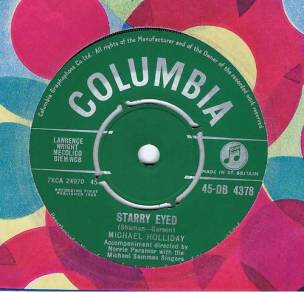
95. ‘Starry Eyed’, by Michael Holliday

Here we go then. One tentative foot in front of the other. A hop and a skip and… We’re into the 1960s! Hurrah! It’s one small step for man… as someone will quite famously say before this decade is through.

BtTnVMQBmkKGrHqEH-D8EvE9BvcOBL7ZdIM5g_12

Starry Eyed, by Michael Holliday (his 2nd of two #1s)

1 week, from 29th January – 5th February 1960

On first listen, however, the 1960s sounds suspiciously like the 1950s. Backing singers? Check. Basic rock ‘n’ roll guitar? Check. Croony male lead singer? Check. Where’s the innovation? Where are the groovy new sounds? Where are all the drugs and free love?

Bum-bam-bum-bam-bum… Why am I so starry-eyed, Starry-eyed and mystified, Every time I look at you, Fallin’ stars come into view… So far so standard. A song about being in love, and about seeing stars because you’re so in love, and to be honest it’s been done a million times before. When we touch I hear angels sing, When we kiss I hear wedding bells ring… Yeah yeah, blah blah blah.

But actually, to dismiss this song because of its unremarkable lyrics would be to do it a huge disservice. Because, on a second, third and fourth listen, this record has got a lot going for it. Firstly there are the backing singers and their Bum-bam-bums. They’re not just any old Bum-bam-bums – they sound echo-y and ethereal, like woozy church bells or a trippy version of the intro to ‘Mr. Sandman.’ It’s really cool.

Adding to this effect is the guitar, which is restricted to a few strums during the verses and chorus but which comes in nice and layered, fed through the same robotic distortions as the backing singers, during the solo. It gives the record a real dreamy quality, like the singer’s dazed after a blow to the… Wait, I get it! He’s starry-eyed. He has been whacked over the head. With love!

78964385

I could complain about Michael Holliday’s sonorous voice being a little too sombre, a little too straight-laced for this song but, after a few listens, it kind of works. His voice has an innocence to it, as he gazes into his lovers mystical eyes and his pupils morph into cartoon love-hearts. Underpinning it all there’s a groovy little rhythm – a bossanova? – that actually makes it quite a sexy record. A record to which there’s more than meets the ear and which improves with every listen. We’re not in the swinging sixties just yet; but this is a sniff of what’s to come…

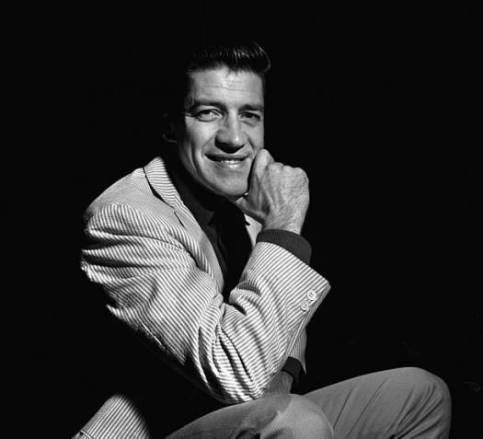
‘Starry Eyed’ is certainly a lot better than the song which first brought Mr. Holliday to our attention a couple of years back – the fairly bland and saccharine ‘The Story of My Life’. I mentioned then that he only ever scored a handful of hits in his career – in fact he managed to squeeze two #1s from just three top ten hits. The story of his life – see what I did there! – is in truth quite a tragic one. Holliday suffered from crippling stage fright and, shortly after ‘Starry Eyed’ hit the top spot, he suffered a nervous breakdown. He took drugs to keep going and sadly died of an overdose in 1963, aged just thirty-eight. He joins the ‘Died Far Too Early’ club along with the likes of Dickie Valentine and Buddy Holly, perhaps proving that pop stars have always died young and in dubious circumstances, and that it didn’t just start with Jimi Hendrix. Remember him this way: by discovering – as I’ve just done – this forgotten gem of a UK Number One.

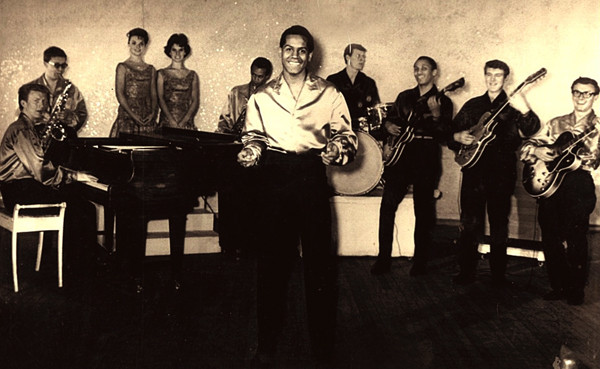
94. ‘What Do You Want to Make Those Eyes at Me For?’, by Emile Ford & The Checkmates

What’s that I hear? Tick, tick, tick, tick… Is it a clock racing to the turn of a decade? From the Fabulous Fifties to the Swinging Sixties? Tick, tick, tick, tick… Or is it just the intro to this next chart-topper?

s-l640

What Do You Want to Make Those Eyes at Me For?, by Emile Ford and The Checkmates (their 1st and only #1)

6 weeks, from 18th December 1959 – 29th January 1960 (including 1 week joint with Adam Faith from 18th – 25th December 1959)

It begins with some ticks, and then the vocals swoop in. This is a Doo-Wop record in the truest sense: in that much of it consists of the backing singers – The Checkmates, presumably – going a-doo-wop bee doo be doo be doo-wop…

I love this song, I do. What with all the doo-wops, the key changes and the brilliant false ending I can’t see how anyone could fail to enjoy it. I first heard it on a compilation called ‘Don’t Stop – Doo Wop’, which must have been released in the early ‘90s and which I picked up in a second hand CD shop years ago. I think I mentioned it in my post on The Teenagers’ ‘Why Do Fools Fall in Love’, which also featured on it.

The lyrics, though, to ‘What Do You Want to Make Those Eyes at Me For?’ (abbreviated forever more into WDYWTMTEAMF because that is a hell of a title to type out in full)… Hmmm. Questionable. What do you wanna make those eyes at me for, If they don’t mean what they say… That sounds like the justifications of a sex pest: “She was askin’ for it, guv! Those eyes!” You’re foolin’ around with me now, We-ell you lead me on and then you run away… She does sound like a tease… Of course, during these enlightened #MeToo times, we know that no means no. In 1959 it was perhaps a different story. We-ell that’s alright, I’ll get you alone tonight… Ok… And baby you’ll find, You’re messing with dynamite… Oo-er. Sexual dynamite? Or is he just going to give the disobedient hussy a black eye?

I jest, I jest… I’m willing to give Emile Ford the benefit of the doubt, as he keeps this song the right side of jaunty throughout and, to be honest, you can listen to it several times – as I did – without ever noticing the slightly sinister lyrical undertones. And, in defence of the 1950s as a whole – a decade, don’t forget, in which certain professions were closed to women, in which hotels could stick ‘No Blacks, No Irish’ in their windows, in which gay men were being slung in jail, in which people could still be sentenced to hanging – there have been very few #1 singles that stand out as troublesome for the modern listener. Very few lyrics have veered away from the catchy or the bland. I’d perhaps nominate WDYWTMTEAMF  and Guy Mitchell’s ‘She Wears Red Feathers’, from way back when (i.e. 1953) as being the most ‘of their time.’

A-347098-1418674966-5971.jpeg

As I mentioned in my last post, this disc was one of the last two records ever to share the top-spot in the UK charts. I suggested earlier that the death of the joint number one was due to a wider range of sales figures coming in but now I’ve just realised another theory: there will never be two such similarly titled #1 singles sitting at the top of the charts. Think about it: people go in to HMV looking to buy ‘What Do You Want?’ by Adam Faith, take a quick glance at the shelves, and come away with ‘What Do You Want to Make Those Eyes at Me For?’ by Emile Ford! Or vice-versa. Must have happened loads! Mystery solved.

WDYWTMTEAMF (that might actually be more of a pain to type than just writing it out in full) has quite the story, beyond this most famous of versions. It was written in 1916 (!) as a duet – in which the woman actually got to defend her wanton ways – and has been recorded by acts as varied as Shakin’ Stevens and former England, Barcelona and Tottenham manager Terry Venables. (Yes. Seriously.)

And so. We come to the end of the 1950s. And the start of the 1960s. Is this the last #1 record of the ‘50s, or the first of the ‘60s? Philosophical questions best left for another day. We are about to delve into a decade that will bring the most innovative pop ever recorded, the birth of modern rock, Merseybeat, Flower Power, psychedelica etc. and so on. So, I thought it might be interesting to gaze forward to the record that will be atop the charts on 31st December 1969, and to wonder at the advancements to come over the next ten years. Except. The final #1 of the sixties will be… ahem… ‘Two Little Boys’ by Rolf Harris. So… From a record with sex-offender lyrics to a record by an actual, convicted sex-offender. Ladies and Gentlemen, I give you the 1960s!

Let’s linger a while yet in the more innocent air of 1959, and end this post as Emile Ford (the first, and presumably only, St. Lucian to hit #1 in the UK – correct me if I’m wrong)  ended his sole chart-topping hit. Possibly the best ending we’ve heard yet. One more time, then: adoo-wop bee doo be doo be doo-wop be doo be doo be doo-wop be doo be doo be doo… Yeah!

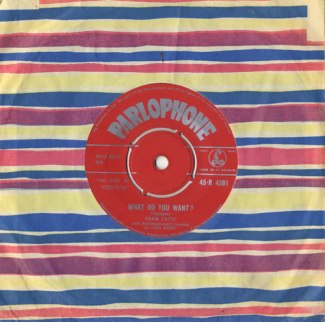
93. ‘What Do You Want?’, by Adam Faith

So. I finish writing that last post, search out the next chart-topping record on Spotify – ‘What Do You Want’ by Adam Faith – and settle down to take some notes. The song begins… And then the song finishes. I take precisely two notes, the second of which is ‘This song is short…’

ADAM_FAITH_WHAT+DO+YOU+WANT-407258

What Do You Want?, by Adam Faith (his 1st of two #1s)

3 weeks, from 4th – 25th December 1959 (including 1 week joint with Emile Ford & The Checkmates from 18th – 25th December)

It is, in fact, the shortest ever UK #1 single, clocking in at 1 minute and 38 seconds. That is seriously short. We’ve covered plenty of records thus far that have hovered around the two minute mark. This knocks a full twenty seconds off them. Adam Faith gets in and gets out, and gets his first chart-topper. (For the record, we’ll be meeting the longest UK #1 single – a nine-minutes-plus behemoth – in exactly thirty eight years’ and two months’ time. Bonus points for those who can name it.)

The first note I took upon listening to ‘What Do You Want’ was: ‘Strong whiff of ‘It Doesn’t Matter Anymore’. Now, I wouldn’t ever want to use a phrase liked ‘ripped off’… So let’s just say Mr. Faith and his song writing team were heavily influenced by Buddy Holly’s recent, posthumous hit. It’s sung at the same pace, with the same staccato strings, while Faith tries to replicate Holly’s famous hiccup.

What do you want if you don’t want money, What do you want if you don’t want gold… Say what you want and I’ll give it you darlin’, Wish you wanted my love baby… Adam loves a girl, but she isn’t feeling it. So Adam hurls all sorts of rubies and trinkets at her – ermines and pearls, amongst others – but to no avail. It’s not the best message to be sending out in a song… maybe she’s just not that into you Adam, yeah?

He even gets a little petty in the final verse: One of these days when you need my kissin’,  One of these days when you want me too, Don’t turn around ‘cos I’ll be missin’, Then you’ll want my love, baby… I get the feeling that this girl just thinks he’s a dick, no matter what he buys her.

T_What-Do-You-Want

I know, I know – I’m perhaps looking a little too hard into what is an extremely light and fluffy #1 single. It’s cute, it’s jaunty, and it certainly doesn’t outstay its welcome. Adam Faith’s voice is kind of endearing as well. He’s not a great singer; but he lends the song something distinctive (check out his ‘bay-buh’), and he’s a clear successor to the likes of Dickie Valentine and Tommy Steele in the British cheeky-chappy, teen idol stakes. I’ll delve deeper into his life and works when he scores his second chart-topper in a few months.

But for now I’m struggling to think of much more to write… Perhaps such a short song requires a short post. One final thing to note is that the penultimate #1 of the 1950s is also one of the last two songs ever to have tied for the top spot. It’s happened four times now: once each in 1953, 1957, 1958 and now ’59. It seems that the upcoming switch of the ‘official’ chart from the NME to Record Retailer will have something to do with killing off the tied number one (more record shops’ sales figures going towards the charts, perhaps?) I can confidently say that it will never happen again, such is the accuracy with which sales and streams are tracked nowadays. Apparently if it does, the song with the biggest increase in sales for that particular week will be given the #1 position – kind of like goal-difference in football. And part of me is slightly sad about that… Farewell, then, to the shared number one single. Well, after we’ve covered the record with which Adam Faith had to share, that is.

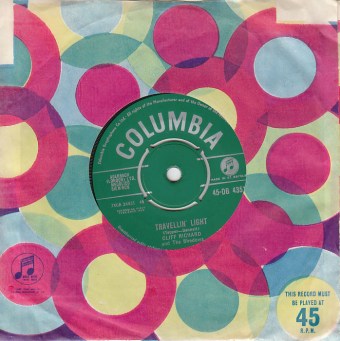
92. ‘Travellin’ Light’, by Cliff Richard & The Shadows

We waited a long time for Cliff to make his first appearance at the top of the UK singles chart; we didn’t have to wait long for him to return. Seven weeks, to be precise. You better get used to this…

cliff-richard-travellin-light-dynamite-db-4351-m--35093-p

Travellin’ Light, by Cliff Richard & The Shadows (Cliff’s 2nd of fourteen #1s / The Shadows 2nd of twelve #1s)

5 weeks, from 30th October – 4th December 1959

‘Travellin’ Light’ treads very much the same path as ‘Living Doll’ did. In fact I wouldn’t be surprised to discover that they were recorded during the same session, within minutes of one another. It’s jaunty, it’s stripped-back… It’s, again, surprisingly minimalist. It’s a cooler record than its forbear – it would be a tough struggle to be less cool, in all honesty – as seen through the missing ‘g’ at the end of ‘Travellin’. Cliff don’t need no proper pronunciation.

His voice is light and airy, with an eerie echo. Got no bags and baggage to slow me down, I’m travellin’ so fast my feet ain’t touchin’ the ground… You can imagine him strolling alongside a dusty highway, or riding with the hobos on an empty freight train carriage. It’s a very American sounding recorded, steeped in the atmosphere of the open prairie, from Britain’s foremost rock ‘n’ roller.

And there’s something quite endearing about this song, something that ‘Living Doll’ lacked. The lines: No comb an’ no toothbrush, I got nothin’ to haul… And: I’m a hoot and a holler, Away from paradise… give it a nice homely feel. Cliff sounds relaxed, as if he’s just jamming with his buddies. The one time it does veer into cheese-territory is at the end of the bridge: I’m carrying only, A pocket full of dreams, A heart full of love, An’ they weigh nothing at all… We get it, we get it – you’re racing home to the girl you love. Whatever…

32F708E500000578-0-image-a-11_1460113522164

Actually, the more I listen to this song, the more I can see an incongruity between the music and the lyrics. Music: laid-back, chilled, goin’ nowhere in a hurry. Lyrics: all about rushing to get back to ‘see my baby tonight’. The two don’t really go together. But, hey, I don’t think this type of pop song is ever designed to be put under very intense scrutiny. It is what it is; and I like it a lot better than I did ‘Living Doll.’

Still though, The Shadows (who are now properly ‘The Shadows’, having dropped ‘The Drifters’ due to legal reasons) get another chart-topping credit without having to do an awful lot. One acoustic guitar pins the whole song together. Someone shakes a tambourine. The same, dreamy surf guitar that gave us the solo in their first #1 is back, purring away in the background  with little ad-libbed guitar licks, improvised morsels of music more complex than they need to be, which suggests the guitarist – Hank Marvin, I’m guessing – may have been feeling a little restricted in his role.

To conclude, then. This is better, cooler even, than ‘Living Doll’. And yet… It’s still very safe. We are still to meet Cliff the Rock ‘n’ Roller and, by this point at the tail-end of the 1950s, looking ahead at his chart-toppers to come, I’m not sure if we will. Cliff the Rock ‘n’ Roller may already be dead and gone.

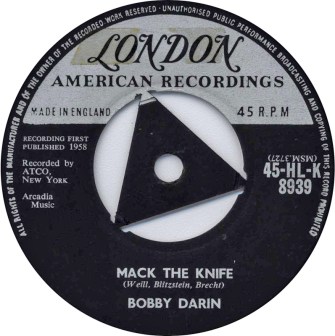
91. ‘Mack the Knife’, by Bobby Darin

We kick off the next thirty #1s in the October of ’59 – four chart-toppers away from the 1960s! And this… This is a real palate cleanser after the cheesy numbers, the Cliffs and the Jerry Kellers, that immediately preceded it. This is something different.

bobby-darin-mack-the-knife-1959-8

Mack the Knife, by Bobby Darin (his 2nd of two #1s)

2 weeks, from 16th – 30th October 1959

It begins with the softest of intros – a tickle of drum, a pluck of bass. Oh the shark, babe, Has such teeth, dear, And it shows them, Pearly white… Bobby Darin is holding back, almost sneaking the lyrics out when we’re not looking. Just a jack-knife, Has ol’ MacHeath, babe, And he keeps it, Out of sight…

The best thing about this song – and there are many great things about this song – is that the lyrics slowly unfold. You are not quite sure what it is that you are listening to, what on earth this record is about, on first listen. The title doesn’t give anything away for a start. Then the first verse alludes to ‘scarlet billows’ and ‘traces of red’. All very mysterious…

Just to make sure, then, that we’re all on the same page – this is a song, a number one selling hit no less, about a hitman. A man, MacHeath, who does murders and stuff. A proper wrong ‘un. The following verses – and this record is nothing but verses, each one ramping up the tempo both in terms of the sound and the sinister lyrics – make it clearer.

Now on the sidewalk, Sunny morning, Uh-huh, Lies a body, Just a-oozin’ life… And: There’s a tugboat, Down by the river don’t ya know, Where a cement bag’s, Just droopin’ down… We’ve got stabbings, and guys swimmin’ with the fishes. A chap that disappears not long after ‘drawin’ out all his hard-earned cash.’ And then there’s the ladies: Jenny Diver, Miss Lotte Lenya and ol’ Lucy Brown. Whether they’re MacHeath’s lovers, or his victims, is left ambiguous.

And ambiguous is a good word with which to describe this latest #1. Superficially, it’s a perky swing number with a quiet start and a loud finish. In recent years, thanks to Robbie Williams and ‘Big Band Week’ on X-Factor, ‘Mack the Knife’ has been somewhat bland-ified. Yet if you sit down and actually listen to the lyrics… They’re dark, man. How great is it, after ‘Here Comes Summer’s saccharine mulch about ‘drive-in movies’ and ‘Joe’s Café’, and Craig Douglas’s paean to puppy love, to have a chart-topper that’s about a vicious murderer. I wonder how it got past the censors of the day? If the opacity of the lyrics, or the old-fashioned big-band swing, helped Darin get away with it.

MI0002749454

It’s a brilliant number one; but also a bizarre one. A song that begs the age-old question: How did this end up on top of the charts? If the success of Darin’s earlier #1 ‘Dream Lover’ led to this, then that’s yet another feather in the earlier song’s cap. Both songs showcase how good a singer Bobby Darin was – one a traditional pop song, the other a brassy swing number. I mean it as a compliment when I say it sounds as if it were recorded live.

‘Mack the Knife’ had a circuitous route to the top of the UK charts. It was written, in German, in 1928, for a musical called ‘Die Dreigroschenoper’. Catchy title. The show was then translated into English and performed as ‘The Threepenny Opera’ in 1933, then resurrected in 1954, and ‘Mack the Knife’ cherry-picked from it for a single by Louis Armstrong in ’56, before Bobby Darin recorded this definitive version two years later.

It ends with a bang, and probably the song’s most famous line: Look out ol’ Macky is back! Which not only draws this swingin’ little record to an end; but also the chart-topping career of Bobby Darin. Which is a shame, as he really was great. I’ve been digging into his back-catalogue since writing the post on ‘Dream Lover’, and would recommend that you give the frothy ‘Splish-Splash’, the cheeky ‘Multiplication’, and the karaoke-classic ‘Beyond the Sea’ a listen. In fact, just delve in and check it all out. That he topped the charts with two such different, but equally brilliant, records -when a lot of his contemporaries were treading the same path again and again – speaks volumes.