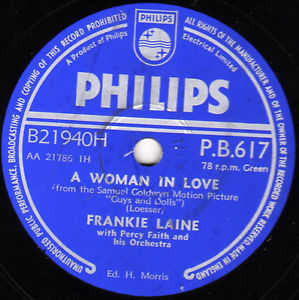
51. ‘A Woman in Love’, by Frankie Laine

s-l300 (2)

A Woman in Love, by Frankie Laine (his 4th and final #1)

4 weeks, from to 19th October to 16th November 1956

Look who’s back!

Almost three years since we last saw him, Frankie Laine is back at the top of the charts for one final hurrah. And it’s not too much of an exaggeration to say that this is something of a re-invention.

I think this is the very first ‘big band’ #1 we’ve seen. It’s from the film version of ‘Guys and Dolls’, and I think it might be a tango, or a foxtrot (I ain’t no dancer). Either way, it begins with a bang, and then it starts swinging. Frankie Laine is a-swingin’.

Your eyes are the eyes of a woman in love, And oh how they give you away… Why try to deny, You’re a woman in love, When I know very well, When I say…

Who is this woman head over heels with? Well, Frankie of course. At least that’s what he thinks: Those eyes are the eyes of a woman in love, And may they gaze ever more into mine…

Contrast these lyrics with Laine’s last chart-topping single from December ’53. ‘Answer Me’ was all about him pleading for a sign that his lover was still, well, in love with him. In ‘A Woman in Love’ he doesn’t need any reassurance, any prayers answered. He knows she’s hot for him. The times they are a-changing.

And then we have one of the best musical interludes that we’ve heard so far in this countdown. The previous chart-toppers haven’t really gone in for solos, but this one does. The whole band gets stuck into a swinging little thirty seconds. There is a lot of swagger in this record. I’m quite enjoying sticking one-word labels on these recent #1s: Pat BooneCrooner, Anne SheltonTwee, Frankie Laine – Swagger! We’ve had an eclectic run of songs hitting the top spot recently, perhaps the most varied run of this countdown so far, but in a way they’ve all been very of their time. Popular music right on the cusp of the rock ‘n’ roll invasion.

The only thing that spoils this record is the finale. Frankie may have re-invented himself, but he still loves a big ending: Crazily, ga-aze, e-ever mo-ore into MIIIIIIINNNNEEE! Every time I hear an ending like that it sounds more and more old-fashioned. I can’t imagine there’ll be many more, though. Surely. But, overall, this is a small complaint. It’s a great song. Laine’s voice is as warm and as listenable as ever. He and Doris Day should have recorded a duet (*edit* they did – ‘Sugarbush’ back in 1952).

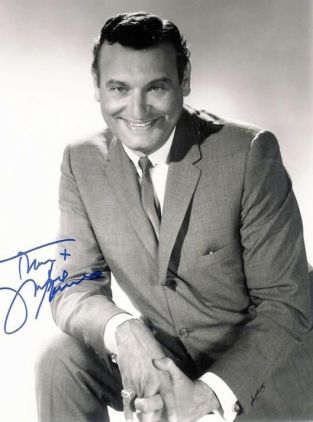
06cab955448883c79c5103ab82addae5--arthur-godfrey-singer

And so we bid farewell to perhaps the biggest of all the pre-rock stars. Four number one singles adding up to 32 (thirty-two!) weeks at the top. That’s pretty darn impressive, and leaves him at 5th place in the all-time list behind only…. I’ll give you a few seconds to guess… Elvis, The Beatles, Cliff and The Shadows. And, actually, I’m harping on about this being a ‘re-invention’ and a ‘comeback’ for Laine, but he hadn’t been anywhere. In the three years between his 3rd and 4th #1s he had still racked up a whole pile of top ten hits. He was huge. ‘A Woman in Love’ would, though, be his penultimate top ten single in the UK.

One final thought… This track made Frankie Laine the artist with the most UK #1s at this point. With four. It’s noticeable that we haven’t yet met an artist who has scored, or will even go on to score, more than four. These early charts were a very egalitarian place – songs only got to the top because they were… I don’t want to say ‘good’ because, well… let’s say: ‘universally popular’. The days of super-star idols, of huge fan-base acts whose every release races to the top of the charts – your Take Thats, Westlifes, Spice Girls – are still not upon us. But they will be sooner than you might think, and their arrival has a lot to do with this new-fangled thing called rock ‘n’ roll.

49. ‘Whatever Will Be, Will Be (Que Sera Sera)’, by Doris Day

doris-day-whatever-will-be-will-be-philips-78-s

Whatever Will Be Will Be (Que Sera Sera), by Doris Day (her 2nd of two #1s)

6 weeks, from 10th August to 21st September 1956

Following on from one super-famous song is… another super-famous song. An even more super-famous song. One of the most famous songs ever?

Que sera sera, Whatever will be will be, The future’s not ours to see, Que sera sera…

People know these lyrics. Even today, sixty-two years on, I’ll bet if you stopped someone on the streets, even a fairly young person, and started singing that line they would be able to finish it. Go on – try it today. (I won’t be held responsible for any subsequent strange looks or slaps in the face).

But, having actually listened to the song, I now wonder if the lyrics are more famous than the recording. It’s very Italiany, with a flourish of guitars (mandolins?) at the start. It’s short and very simple – just said guitar, Doris Day, some violins and the mandatory backing singers. The singer asks her mother if she’ll be pretty and rich, then asks her sweetheart what lies ahead, then fields the very same questions from her own children. It’s a mantra for life: Que sera sera.

As I noted in her previous entry, Day has an irresistible voice. A proper voice, with all the proper enunciation and pronunciation; but with enough of a giggle, and a little huskiness, to make it the sort of voice you want to listen to. She only had two chart-toppers, but ‘Secret Love’ clung to the top spot for nine weeks while this one took up residency for six. There are plenty of acts with more #1s but far less time spent at the top. And as this is the last we’ll hear from Miss Day, let me take the time to point you in the direction of her 1963 classic ‘Move Over Darling’, a song I first heard as a pup on a ‘Steve Wright’s Sunday Love Songs CD’ and which I love to this day. It’s far superior to either of her chart-toppers too, IMHO…

The_Man_Who_Knew_Too_Much_trailer_screenshot_Doris_Day_Que_Sera,_Sera

I’ve done my obligatory Wikipedia-based research and have turfed up two little interesting facts. This song, like ‘Secret Love’, was from a movie in which Day starred: Hitchcock’s ‘The Man Who Knew Too Much’ (it really doesn’t sound like a song from a Hitchcock film, but hey). And… the title is neither correct in French (which I – with a decent A-Level in said language – assumed it was), Spanish or Italian. It is, essentially, gibberish.

But, before we end, let’s step back and look at the bigger picture. I really feel that this, along with ‘Why Do Fools Fall in Love’ before it, is ushering in a new era at the top of the UK chart. Two huge, well-known songs. This song has become a football chant, still used to this day, for God’s sake! Plus, Doris Day is still going strong, aged ninety-six, as is Pat Boone from two chart-toppers ago. These songs covered in this countdown are slowly growing more and more tied to the modern world.

Perhaps this song’s influence is best summed up by this tale. Every year I go to a German beer festival in Hong Kong. And every year, without fail, before the overweight men in nipple tassels, before the ‘Big German Horn Blowing Contests’ and before we do the YMCA on the tables, the band plays ‘Whatever Will Be Will Be’. And everyone sings along.

46. ‘No Other Love’, by Ronnie Hilton

271927944821

No Other Love, by Ronnie Hilton (his 1st and only #1)

6 weeks, from 4th May to 15th June 1956

Through writing these blog posts, I’m becoming a strong believer in nominative determinism. I.e. through looking at the name of the recording artist one can anticipate what the song will sound like. Not that anyone’s been called Sax Jazzington, or anything silly like that. More like how Kay Starr sounds fun and flirty, Slim Whitman sounds grizzled and lonesome, Jimmy Young sounds… normal, and a little dull. I feel that Ronnie Hilton should fall into the latter category.

And, lo and behold, he does. It starts dramatically enough, though: a burst of cymbals, then another, then another… Then it feels like a step back in time, to the dark days of *shudder* David Whitfield. It’s semi-operatic, its over the top, it’s not a particularly easy listen. Hilton’s voice is overwrought. It’s a powerful voice, a technically very good voice, the sort of voice that your gran would have approved of; but it’s too much. It’s probably no worse than the Whitfield, Laine days of a couple years back, but it already sounds very dated coming so soon after more progressive-sounding records by Bill Haley, Alma Cogan and even Dean Martin.

Lyrically too, this is a song that’s been done before. No other love have I… Into your arms I’ll fly… Waiting to hear you say… ‘No other love have I’. He’s a little lovelorn, is Mr Hilton. I’ve mentioned it before, but why is it the girls that have all the fun in these early chart toppers? With a few exceptions (Vera Lynn, cough cough) they get to be perky and flirty while the men stay at home and stoically wait for their love to be fulfilled.

One thing I was certain of, without doing any kind of research, is that Ronnie Hilton was British. His voice has that properness, that stoicism, void of any kind of vulgar, American swagger. One other thing that I was pretty certain of, again before delving into Wikipedia and around, is that ‘No Other Love’ must have been from a soundtrack, such is its unnervingly bombastic approach to what is an otherwise very basic love song. And yes, it’s a Rogers & Hammerstein number, from their 1953 show ‘Me and Juliet’.

A-439529-1148657608.jpeg

Actually, the most surprising thing I could uncover about Ronnie Hilton – this is his only appearance at the top so let’s give him a moment in the sun – is that ‘Ronnie Hilton’ was his stage name. He was born Adrian Hill. Let that sink in for a second: he, or somebody advising him, thought Adrian Hill was a little too boring, a little too staid, and that ‘Ronnie Hilton’ would get the girls swooning. I think that just sums him, this song, and this whole pre-rock era up… If you’re going to change your name in an attempt to gain fame and glory for God’s sake try to come up with something slightly sexy. No?

And – perhaps just as interestingly – Hilton recorded a fairly successful (in the UK at least) version of ‘The Wonder of You’, eleven years before Elvis Presley made it a standard. But… listen to Hilton’s version, then Presley’s version, and it becomes clear why the latter was one of the most famous voices, and personalities, of the 20th Century and the former wasn’t.

I’m being a little down on Ronnie Hilton, really, so let’s give him a break and end with something completely unrelated. Something that just occurred to me as I wrote the intro to this post. The only reason that my nominative determinism theory works is because I have heard so few of these early number one hits. I write the title down, search them out on Spotify, and take a step into the unknown. But, looking down the list of UK #1s through the remainder of 1956, through ’57 and ’58, this is going to become less and less of a thing. I know several of the next twenty or thirty records. Soon I’ll know the majority of them. Of course, every so often, even as we get to the eighties and nineties, there will be songs I simply have never heard before (I have no idea how ‘Doop’, by Doop, goes for example – and it had 3 weeks at the top in 1994) but, on the whole, we are slowly stepping out of the mist and onto firmer, better known ground.

38. ‘Hernando’s Hideaway’, by The Johnston Brothers

R-2051517-1415453457-1359.jpeg

Hernando’s Hideaway, by The Johnston Brothers (their 1st and only #1)

2 weeks, from 11th to 25th November 1955

It’s starting to feel like, rather than passing comment on each UK #1 single, I’m actually reviewing a soundtrack album. The soundtrack album to a very cheesy Western. ‘Rose Marie’ was the big ballad, ‘The Man from Laramie’ was the theme song, and now ‘Hernando’s Hideaway’ is…

What exactly is this? It’s hard to tell. Gone are the days when you could file pretty much every UK #1 under ‘overwrought ballad’ or ‘perky novelty. It’s another song that tells a story, about a drinking den – a dark secluded place, a place where no-one knows your face – and, again, has lyrics so obscure and specific that it must be from a film, or musical… There are silhouettes, and castanets, glasses of wine, and fast embraces. Hernando’s may actually be (whisper it!) more than just a bar…

Two lines in particular really set the scene: Just knock three times and whisper low, That you and I were sent by Joe, Then strike a match and you will know, You’re in Hernando’s Hideaway! It’s a very quirky song. And I mean that in the best possible way: the first forty seconds, for example, consist simply of voices and castanets. Then the violins kick in and we’re into a swaying, sweeping tango. Whereas ‘The Man from Laramie’ just sounded silly away from the context of the film; this song actually makes me want to watch whatever film or musical that it’s from.

And I could resist no longer – I had to Google and find out just where this funny little song originated. And it was indeed a show tune! (I’ve still got the knack!) A show tune from ‘The Pajama Game’: a musical about – wait for it – labour disputes in a pyjama factory… Seriously. It opened on Broadway in ’54, in the West End a year later, and thus explains the popularity of this track in the autumn of 1955. And when I say ‘popularity’, I mean ‘popularity’. Wikipedia lists 33 (thirty-three!) different recordings of the song. Contemporaneous to the Johnston Brother’s hit were versions from our friends Alma Cogan, Johnnie Ray and Mantovani, as well as versions yet to come from stars as varied as Ella Fitzgerald and The Everly Brothers.

the-johnston-brothers-join-in-and-sing-no-1-decca

And what of the Johnston Brothers themselves? I had an image of identical twins, sharp suited and shiny-teethed. Bob and Billy Johnston, perhaps. Except, there were actually four members in the band – only one of whom was called Johnston. Johnny Johnston (great name!) formed the band and gave them their title. As the picture shows, they don’t look especially sharp or glossy (they were British, after all), and they faded away after a handful of hits.

‘Hernando’s Hideaway’ is proving to be one of those songs that improves with every listen. At first it was a curiosity; now I’m rather taken with the bizarreness of it. It is, I can say with complete confidence, the strangest UK #1 since The Stargazers hit the top with their barroom sing-along ‘I See the Moon’. Actually, 1955 has proven to be quite the eclectic year for chart-topping singles – the crazed sway of ‘Mambo Italiano’, the raunchy trumpets of Perez Prado, the lone-star yodelling of Slim Whitman. It hasn’t always been great, but at least it’s been interesting. Which wasn’t something we were saying back when David Whitfield and Frankie Laine were out-snoozing each other with their soporific ballads. 1955 has also been the year of the soundtrack hit, with this being the 6th chart-topper to emerge from a film or musical. Given that, as I write this, the UK Charts are filled with songs from ‘The Greatest Showman’ soundtrack, there’s a nice symmetry here. In some ways the charts of 2018 are unrecognisable from those topped by the Johnston Brothers; in other ways very little has changed.

Anyway, if this last bit has sounded like a round-up of sorts, well, it was kind of unavoidable. This has been the 38th UK Number One; and the end of an era. The ‘pre-rock’ era, that is…

37. ‘The Man from Laramie’, by Jimmy Young

jimmy-young-the-man-from-laramie-decca

The Man from Laramie, by Jimmy Young (his 2nd of two #1s)

4 weeks, from 14th October to 11th November 1955

He’s back. Like Rosemary Clooney earlier in 1955, Jimmy Young grabs two chart-toppers – his only two chart toppers – in pretty short order. Burning briefly but brightly.

Back in the autumn of ’53, when Frankie Laine was pounding the charts with hit after hit, I introduced the concept of the ‘shadow hit’ – the song that does well because it follows on from a massive hit record. Laine spent 18 weeks at number one with ‘I Believe’ before the somewhat less memorable ‘Hey Joe’ grabbed a fortnight in its wake. Well, we have our second ‘shadow number-one’ right here. As much as I struggled to appreciate Jimmy Young’s interpretation of ‘Unchained Melody’, I cannot argue that it isn’t a classic and a 20th Century standard. ‘The Man from Laramie’, however…

It’s a song that tells a story. The story of a man. The man from Laramie. The man with the peaceful turn of mind, kinda sociable and friendly, friendly as any man could be… BUT underestimate him at your peril. For you never saw a man outdraw – the Man from Laramie! The ladies loved him, everyone admired him, danger was this man’s speciality… You get the picture.

Musically this is very watered down, music-hall Country & Western (BBC C&W, perhaps?) compared to the record it replaced at the top. The music itself is nothing more than an irritatingly simple rhythm picked out on a guitar. It’s all about the lyrics. And lyrically we are deep in the Wild West. Shoot-outs at noon, a fearless stranger with notches on his gun…

It’s a strange song. At least, it’s a strange song to have topped the sales charts for a whole month. The lyrics are so incredibly specific that they would only really make sense if they were from a musical or a movie (*Googles frantically*) And yes – ‘The Man from Laramie’ was indeed a film, a Western (obviously) starring James Stewart and this was the theme song. Our old friend Al Martino recorded – and only reached #19 – with his version. Jimmy reined supreme.

Out of interest, I gave the Martino version a listen. And while it’s the same cheesy song, with lyrics about shoot-outs blah blah blah that just sound weird away from the context of the movie, it sounds more professional, more polished, classier… better! I’ve mentioned it before – and I’ll doubtless mention it again – but this really has been a dominant theme among these early number ones. Americans really were doing it better. Why did they sound so cool, while the Brits still sounded so uptight and stuffy? Don’t believe me? Here’s a link to the Al Martino version. Compare and contrast it with the video below.

maxresdefault (1)

I don’t need to go over again how I endured hours of Jimmy Young on the radio during my formative years (read all about it in the ‘Unchained Melody’ post). The hits dried up soon after he claimed these two chart-toppers and by the sixties he had moved into broadcasting where he remained popular and well-respected for four decades. I can’t help feeling, though, that he was someone who resented newer, more successful pop stars. I bet he loved complaining that you couldn’t make out a word Mick Jagger was singing. That music was so much better in his day. That kids these days didn’t know they were alive. He just had that air about him… (God, I clearly still have issues regarding those long car journeys that need working through.)

Anyway, if you enjoyed this latest chart-topper, this strange, time-capsule of a song with lyrical references to a movie that nobody has watched for decades, then you are in luck. Hang around for the 38th UK #1, coming shortly.

34. ‘Unchained Melody’, by Jimmy Young

s-l300

Unchained Melody, by Jimmy Young (his 1st of two #1s)

3 weeks, from 24th June to 15th July 1955

Forget ‘I Believe’, discard ‘How Much is that Doggie’, don’t mention ‘Mambo Italiano’… For the first time in this countdown, we have a song that everyone knows.

We’ve flirted with legend so far. Sinatra and Doris Day have hit the top, but not with any of their most famous recordings. Frankie Laine has set an unbeatable chart record with a song that will be unmistakeable to people of a certain age. And there have been other chart toppers that people might be able to sing a couple of lines from. But everyone, and I repeat everyone, knows ‘Unchained Melody’.

But not everyone will know this version. 4 (Four!) versions of ‘Unchained Melody’ have hit top spot in the UK charts – take a bow The Righteous Brothers, Robson & Jerome, and Gareth Gates, we shall hear from you anon. With these versions – the former especially – ingrained in popular culture, Jimmy Young’s version is a strange listen.

The tempo is faster, for a start. Then there are the Spanish guitars, when we are used to it being a piano led song. And then there is the clipped, British delivery. No glossy, American vocals here. Young’s voice is deep, sonorous even. It’s technically a good voice. But there is more than a whiff of David Whitfield about it, especially when he belts out the line Are you still MIIIIIIINE?

He still needs your love, and would like God to speed your love to him. It is the same song, but it’s not. I think that were this a more forgotten hit – a ‘Give Me Your Word’ for example -it might simply file in amongst all the other stiff, slightly overwrought, pre-rock ballads that we have sat through so far. But, unfortunately for Jimmy Young, people took this song and turned it into one of the most instantly recognisable pieces of popular music ever recorded. And his version, while still not the original (there were, inevitably, four other versions in the chart during the summer of ’55), now sounds very dated next to the more modern interpretations.

Interestingly, though, as we study the evolution of the number one record through time, we have a first here. At least, I think it’s a first (I can’t be bothered going back and listening to all the previous thirty-three). So many of these hits have favoured a bombastic THIS IS THE END OF THE SONG approach to the final chorus (to be referred to from now on as a TITEOES ending). And what song would have better suited this kind of OTT climax than ‘Unchained Melody’? But no. What we have here is Young singing the last line – God speed your love to me – the final note being held, the guitars strumming and a fade. A fade! And it works pretty well. It is, ironically – considering the time in which it was recorded – the most understated ending out of the four chart topping versions.

Why, though, is it called ‘Unchained Melody’ when the lyrics make no reference to being ‘unchained’? Is it because the singer is unchaining his heart, and pouring out his feelings to the one he loves? That would be a sensible guess, but no. We might as well address this here, though I am aware that I will have sod all to write about by the time we stumble across the Gareth Gates version. The song is from a film called ‘Unchained’, and is therefore the melody from ‘Unchained’. Kind of like Mantovani’s ‘Song from Moulin Rouge’. Simple. The film has been forgotten, but it lingers on in the title of a world-famous love song. And, it keeps up our run of film soundtrack #1s – four in a row, and counting. Of course, ‘Unchained Melody’ is also very well known for being in an ultra famous scene from another movie: ‘Ghost’. Which is turning this all very meta – kind of like the play within a play. Or not. I think I should stop writing soon.

jimmy-young-musical-career_1478869423

But I can’t finish without mentioning the man who has played barely a supporting role in this post so far: Jimmy Young himself. I’ve not so far been able to relate many of these early chart toppers to life events, experiences, or memories… But I do have a special place in my heart for Jimmy Young.

He was known by most as a Radio 2 DJ, rather than a singer. My parents love a bit of Radio 2 – as parents tend to do – and while I did put in some half-hearted protests for Radio 1, or even a commercial station (Shock! Horror!), I didn’t actually mind long car journeys with Steve Wright or Wogan or whoever. But I hated the two hours over lunch when Jimmy Young came on to talk about, ugh, politics, the world, society and the issues of the day. Then I would really protest, and my parents would usually concede to putting ‘ABBA Gold’ on for a bit.

Young just came across as a crusty old man, who thought youngsters didn’t know how easy they had it, who was definitely in favour of bringing back National Service, maybe even hanging… This is obviously all complete speculation on my part (though I see now that he had a column in the Daily Express – draw your own conclusions there…) and he’s dead so I shouldn’t be too rude. He did talk an awful lot, though. And yet I look back on those days fondly now, sitting in a car on our way to a fortnight in, I don’t know, Devon, listening to an old man chuntering on – an old man I had no idea had been a chart-topping singer.

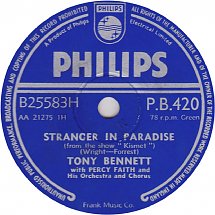
32. ‘Stranger in Paradise’, by Tony Bennett

tony-bennett-stranger-in-paradise-philips-78-s

Stranger in Paradise, by Tony Bennett (his 1st and only #1)

2 weeks, from 13th to 27th May 1955

I don’t know this song, or do I?

The opening melody sounds very familiar – familiar in a film score-ish, symphonic way. The sort of music you might here in a lift, or on a held call. Then the lyrics kick in and I’m not so sure I do know this song after all. But that melody… Are we listening to the first ever sample to top the charts? I didn’t think that was a thing until the late ’80s.

Take my hand, Tony croons. I’m a stranger in paradise… Lost in a wonderland… Starry eyed… The lyrics are all standard-issue mid-fifties. At first. Then things take an interesting turn. The singer is in love, unrequited, and can but stare from afar at his love. He is a mortal, and his love is an angel. He saw her face and ascended out of the common place, into the rare, somewhere in space… He hangs suspended, until he knows his love cares, and that she will answer his fervent prayer. It’s all quite cerebral. Probably the most complex song, lyrically, to have topped the charts so far.

It’s a well-constructed, immaculately sung, beautifully polished record. It’s no throwaway flash in the pan, yet to me it lacks something. Perhaps it just can’t step out from the shadow of the raunchy mambo that preceded it. File it under ‘Pleasant, But Dull’ – a record that I can understand others enjoying, but that I fail to really get myself. But boy, did others enjoy this record back in the spring of 1955! In the week that Mr. Bennett ‘ascended’ to the top, there were no fewer than five other versions of ‘Stranger in Paradise’ in the singles chart (by now a Top 20). The Four Aces, Bing Crosby, Tony Martin and Don Cornell all had a go. Eddie Calvert even parped a version out on his trumpet.

This is something that I fail to grasp about these early charts… While multiple hits by the same artist clogging up the charts (Sheeran! Bieber!) can be frustrating, it is ultimately an indicator of their popularity. But who needs six versions of the same bloody song? It’s not as if one version was ska, one version death metal – I’m confident that the Don Cornell version sounds pretty much like all the others. Anyway, Tony Bennett won the ‘Stranger in Paradise’ race, and it at least meant that a musical legend ticked a UK #1 off his bucket list. A still active legend too. He recently hit ninety, and released his most recent studio album in 2015. The year before that he released a duets album with Lady Gaga. And so, though we are wading through the mists of time (chart-history wise), we have a direct link here to the modern day. That’s quite cool.

1152686

I was about to leave it there, but I still had a nagging feeling that there was more to this song than I had realised. I know that melody – doo doo doo dooby dooby doo – and the lyrics are a little bit too weird to exist only for the benefit of this one hit record. And so it emerges… ‘Stranger in Paradise’ is from the musical ‘Kismet’, which is in turn adapted from the music of 19th Century Russian composer Alexander Borodin. Hence the outré lyrics, hence the familiar melody…

I want to like this song: it’s music for grown-ups. But I also want to read all seven volumes of ‘A la Recherche du Temps Perdu’ and learn Italian. Some things just aren’t going to happen.

18. ‘Secret Love’, by Doris Day

doris-day-secret-love-1954-78-s

Secret Love, by Doris Day (her 1st of two #1s)

1 week, from 16th to 23rd April / 8 weeks from 7th May to 2nd July 1954 (9 weeks total)

A dreamy intro… Is that a harp…? And is that running water, or just the quality of the recording? It’s very soft start to the 18th chart-topping record, and it’s not immediately obvious why this song straddled the very top of the charts for three whole months.

There are some mushy lyrics about the titular ‘secret love’, about being a dreamer, about only being able to tell the stars about how deeply in love you are… So far, so 50s.

But then. Boom. The chorus. I know this song. People know this song. NOOOOOWWWW I shout it from the highest hills, even told the golden daffodils, at last my heart’s an open door, and my secret love’s not secret, anymore…

GACCALAMITYJANE

Day has a wonderful voice: with elocution as crisp and clear as any we’ve heard before, but without the stiffness and formality that has made some of the previous number ones sound old-fashioned. There’s a great warmth to it, and the way she jumps from softly purring the verse to walloping out the chorus is impressive. It’s effortless. You could say it’s star quality.

And surely she is the biggest star to have topped the charts thus far. Frankie Laine, and Guy Mitchell, were huge in their day but have largely been forgotten. People know Doris Day. Even today people will have heard of her, though they might not be able to pinpoint why. I, for example, knew this song without realising it. And everyone knows her next chart-topper, which contains some of the most famous lines in the history of popular music. But more on that later…

Probably the first time I ever heard of her was through ‘Grease’, and Rizzo’s mocking line ‘Hey, I’m Doris Day. I was not brought up that way…’ Day is held up by the Pink Ladies as straight-laced and old-fashioned – a girl who most certainly would not go to bed till she was legally wed. That, in a way, sums up this ‘pre-rock’ age and its stars who would, long before the turn of the next decade, seem painfully uncool next to Elvis and his kind.

Speaking of movies… Something about this recording gave me an inkling that it was from a movie soundtrack. Perhaps it was the orchestra, or the way the song doesn’t so much end as fade away to grey. Anyway, for each of these posts I make sure I listen to each song three or four times before doing any research on it (honest). But, lo and behold, ‘Secret Love’ is from a movie: ‘Calamity Jane’. Again: a film I’ve heard of – most people probably have – but have never seen. This is a sign of star quality, of true fame, no? When you are woven so deep into popular culture that people stop realising you’re there.

Two other little things to muse upon before we move onwards… At 3 minutes 40 seconds, this is a pretty long record. That’s pretty much the length of the average 21st century pop hit. Actually, these super-early chart toppers have routinely been hitting the three-minute mark. When I started listening to music I – no doubt influenced by the 2.5 minute wonders on my parents ‘Sounds of the ’60s’ cassettes in the car – assumed that songs started out really short and got longer and longer (at least until the 70s, when prog-rock came along and simply took the piss). But it appears that the average length of pop songs (as we know them, post-war, at least) actually started out at three minutes or longer and shrunk in the late fifties/ early sixties.

And the last thing (which is much more important than the average length of chart topping singles): you know how I keep referencing just how long these early pop stars seemed to have lived for? Well, Miss Day has only gone and topped them all. By still being alive! Ninety-five and still going strong (at the time of writing…) Well done her!

11. The Song from ‘The Moulin Rouge’, by Mantovani and His Orchestra

s-l300

The Song from ‘The Moulin Rouge’, by Mantovani and His Orchestra (his 1st of two #1s)

1 week, from 14th to 21st August 1953

Ooh la la.

I’m less annoyed that this song helped deny Frankie Laine his record of consecutive weeks at the top. Mainly because Eddie Fisher had already done the damage; but also because this isn’t terrible.

But ‘not terrible’ isn’t really selling it either… So, let’s try again. It’s nice enough. Its pretty mellow. It’s cute. A bit heavy on the accordion, but yeah. Oh, and its an instrumental. The first ever instrumental to top the UK charts, back when instrumentals were much more of a thing than they are now.

I should probably stop getting excited about a record being the ‘FIRST EVER _____!’ to top the charts, because we’re only eleven songs in and pretty much every one of them is the first ever something. But still. This is the first ever film score to hit the top too, The Moulin Rouge being a film about Pigalle’s famously raunchy red-windmilled nightclub, starring Zsa-Zsa Gabor. And it’s the first ever #1 by a non American or Brit, Mantovani being Italian.

mantovani-663032

To the song. Well. If you’re writing a song about Paris, or France, what’s the first instrument that springs to mind? Mais oui. L’accordion. Trop cliché, non? Maybe it wasn’t a cliché in 1953. Maybe this song made it a cliché to soundtrack Paris with an accordion-led air.

There’s not much to it, really. It’s the same couple of refrains played over and over again, first by said accordion, then by violins. And as I was taking notes for this post, while listening to the track for the first time, I jotted down all that stuff about the movie, the soundtrack, the accordion, and ended it with the words ‘a bit dull.’

But now I’m on the 4th or 5th listen, I’m not so sure. It’s seeping into my brain through its repetitiveness, and actually its quite nice. Pleasant. I think the best word for it might be melancholic. It has a sense of longing for the past, of long-lost summer days beneath a sun-dappled beech tree. And I’m not just being facetious here – it really does conjure up that image in my mind. The song has a name, as you can perhaps see from the picture of the disc above: ‘Where Is Your Heart’, and there was a version with words doing the rounds. But that doesn’t really interest us here.

The song ends very sedately. Unlike the songs that have gone before it doesn’t build to a big, over the top finale. It simply melts away, and I respect that. I’m not sure what role the song played in a film about the world’s most famous strip club, though. It’s about as far removed from the can-can as you can get.

While I had never heard this song before, I had heard of Mantovani. And for a while I couldn’t quite remember how or why. But then it came to me. See, where I come from, Mantovani is rhyming slang for… well… fanny. Example sentence: “I’ve got some Tesco’s Finest aftershave on, I’ll definitely get some manto tonight!”

And what a legacy that is.