830. ‘Livin’ la Vida Loca’, by Ricky Martin

In my last post, on ATB’s ‘9PM’, I wrote about how rooted in the late-nineties that song seemed. I get a similar feeling about this number one, although they sound nothing alike. It’s just so 1999…

Livin’ la Vida Loca, by Ricky Martin (his 1st and only #1)

3 weeks, from 11th July – 1st August 1999

And I don’t mean that as an insult. This is a fun slice of Latin-pop, played at breakneck speed. It’s got ska horns. It’s got surf guitars. Not enough number ones feature surf guitars! In one of the most pure-pop years in chart history, ‘Livin’ la Vida Loca’ can count itself as one of its catchiest, and poppiest, number ones. But it also manages to do so with selling its soul to cheese – there is something respectably real about this, sounding like it was recorded by an actual band, with actual instruments.

It also has some memorable lyrics, about a fairly unhinged femme fatale, who’s into superstitions and voodoo dolls. She’ll make you take your clothes off, And go dancing in the rain… So fun are the words, and so fast do they rattle by – this really is a breathless song – that we don’t mind when she slips Ricky a sleeping pill and nicks his wallet in the second verse. Plus I’d argue that the title entered the wider pop culture for a good few years after this had been a hit.

I don’t whether this sounds so of its time because a) it’s a classic, b) because it reminds me of being thirteen (that devil nostalgia again…) or c) because it kicked off a big latin pop resurgence at the turn of the century. Think Santana’s ‘Smooth’, a Geri Halliwell #1 soon to come, as well as a bit of Mambo No. 5, not to mention J-Lo, Shakira, and Enrique Iglesias. This record’s popularity cannot be denied, though, and can be proven in one simple statistic: we’re over halfway through 1999 and ‘Livin’ la Vida Loca’ is the first chart-topper to spend more than a fortnight at the top!
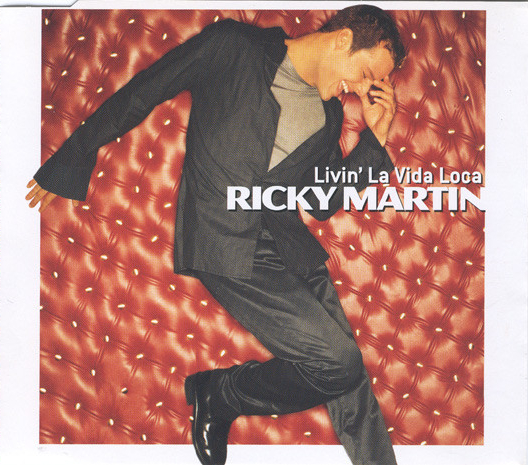
From Puerto Rico, Ricky Martin had been a star in the Spanish-speaking world since the age of twelve, when he’d joined boyband Menudo. They had been going since the seventies, and had a policy of chucking members out when they reached sixteen, though Martin survived until he was seventeen. He clearly had something special… In 1991 he released his first solo album, while ‘Livin’ la Vida Loca’ was from his English language debut (though he’d had a smaller hit the year before with his ’98 World Cup theme ‘The Cup of Life’.)

I have a friend who is somewhat Ricky Martin obsessed, and have been with her to see him live in concert, in the front row. He put on a great show, and my friend is still a big fan of his, despite him announcing in 2010 that she is officially not his type… Meanwhile ‘Livin’ la Vida Loca’ may be his biggest hit, and his only UK #1, but I’ve always had an even softer spot for the similarly chaotic ‘She Bangs’, a #3 in 2000.

712. ‘Baby Come Back’, by Pato Banton ft. Ali & Robin Campbell of UB40

I thought it was about time… Time for our semi-regular blast of nineties reggae!

Baby Come Back, by Pato Banton (his 1st and only #1) ft. Ali & Robin Campbell of UB40 (their only solo #1s)

4 weeks, from 23rd October – 20th November 1994

Bookending 1994 are two reggae number ones, both covers of sixties classics. Back in January, Chaka Demus & Pliers reinvented ‘Twist and Shout’ for the beach bars of Montego Bay, and now Pato Banton has updated The Equal’s 1968 #1 ‘Baby Come Back’, with a little help from British reggae royalty.

It’s probably more ska than reggae, given the higher tempo and the short, sharp horn blasts (and the prevalence of two-tone black and white in the video), but it barrels along happily enough. It’s lively and enjoyable, without doing anything spectacular to the source material. It certainly isn’t as drastic a reimagining as Chaka Demus & Pliers, though it is nice that it is based one of the very first chart-toppers to have had a reggae influence (it made number one just months before the first ‘official’ reggae #1: Desmond Dekker’s ‘Israelites’). My favourite part of this version is the surf guitar playing the distinctive riff from the original.

Like ‘Twist and Shout’, one of the main updates is the addition of a various raps and toasts from Pato Banton. Come back man! Don’ leave me! Bring back me CD collection! Banton was a British singer and toaster from Birmingham, who had been active since the early eighties. He had appeared on UB40’s 1985 album ‘Bagariddim’, which presumably led to the Campbell brothers repaying the favour here. They take chorus duty, and score their fourth #1 in total, though the only one they’d ever manage away from their band. After this, Banton scored a couple more minor hits before seeming to slip off the radar. He released his last album in 2008.

In the course of his toasting, Banton does manage to slip in a cheeky drug reference of the sort that might have seen this record whacked with a BBC ban, had they known what he was on about. Come back, Yes with me bagga sensi… ‘Sensi’ being short for ‘sinsemilla’ – a cannabis plant that is seedless, and therefore much stronger than normal ganja.

Other than that, there’s not an massive amount to write home about here. It’s a fun record that breezes by nicely. Quite why it became the 4th highest selling single of 1994, I’m not totally sure. Though if writing this blog has taught me anything, it’s to never be surprised by the enduring popularity of reggae.

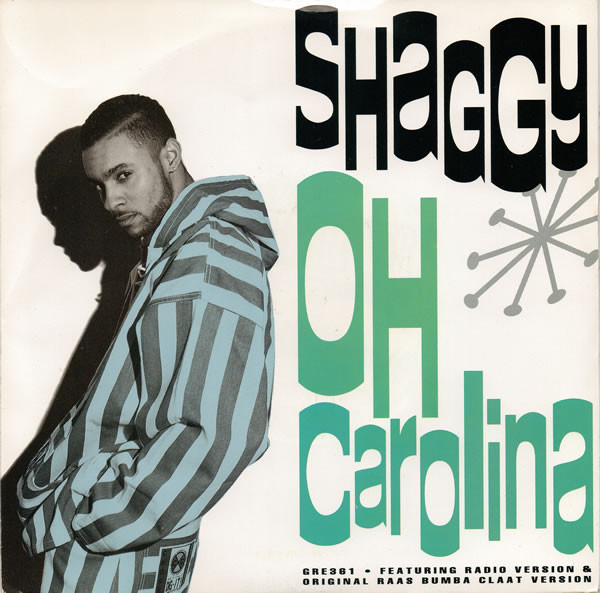
686. ‘Oh Carolina’, by Shaggy

There’s so much to unpack with this next number one… How did this unknown Jamaican, who growls and slurs his way through his breakthrough smash, go on to become one of the longer-lasting hitmakers of the decade? Why did this summery smash, that sounds like its coming to you live from a beach bar in Montego Bay, make #1 in March? And just why is reggae the chart genre that refuses to die…?

Oh Carolina, by Shaggy (his 1st of four #1s)

2 weeks, from 14th – 28th March 1993

Let’s address that last question first. For this is the purest reggae, not the pop version of UB40, or the watered down offering of Boris Gardner. It’s ragga, its dancehall; it’s rough and grimy, so much so that you almost have to wipe the sweat from the stereo after playing it. It’s a cover of an old ska song from the early sixties, by the Folkes Brothers, the opening riff of which is sampled on Shaggy’s version, giving this a folksy, distinctive edge, a world away from the polished beats of the 1990s. This doesn’t in any way answer why reggae keeps coming back to the top of the charts – other than the fact it is impossible not to dance to songs like this – but we’re entering what is perhaps the most reggae-heavy period in chart history, between 1993 and the middle of the decade.

Once the main rhythm, and the up to date production rolls in, the song still doesn’t lose its edge. And that’s mostly thanks to Shaggy’s gruff toasting. I have no idea what he’s saying, but it all sounds pretty filthy… I believe Carolina moves her body just like a squirrel, can jump and prance… And at one point I think Shaggy claims to love how she shag… (I could just Google the lyrics, but I have no desire to prove myself wrong.)

As to why it made #1 months ahead of schedule? Well aside from a need for some escapism from a misty, miserable March, it was included on the soundtrack to the movie ‘Sliver’, starring Sharon Stone (15% on Rotten Tomatoes). Whether that helped or not I don’t know, but if it did I’m glad. This is a rough and ready song, with a wonderfully raw feel. It’s certainly Shaggy’s forgotten chart-topper, but it’s probably his most credible.

Which brings us on to the very first question I posed. ‘Oh Carolina’ has one-hit wonder written all over it, and yet… I can’t adequately explain the subsequent career of Shaggy (AKA Mr Boombastic, AKA Mr Lover-Lover), even though I lived through it. He’s somehow cool – he is an ex-Marine after all – and yet completely ludicrous. By the time of his turn-of-the-century, biggest hit (you know, the one about ‘banging on the bathroom floor’) he was basically a cartoon character. He duetted with Ali G, for Pete’s sake!

Anyway, we can address all this in good time. For now, let’s enjoy his first chart-topper, in all its raunchy, mumbling glory. (I think it helps to enjoy Shaggy when you don’t understand what he’s saying…) And, for the third chart-topper in a row, I have specific memory attached to this record. A primary school friend had a (highly unrequited) crush on a girl called Caroline. Cut to our Primary 4 disco, where we requested this song on his behalf, made sure the DJ announced who it was for, and an entertaining meltdown ensued…

501. ‘House of Fun’, by Madness

On then with the next five hundred. With only the second ska act to hit top spot…

House of Fun, by Madness (their 1st and only #1)

2 weeks, 23rd May – 6th June 1982

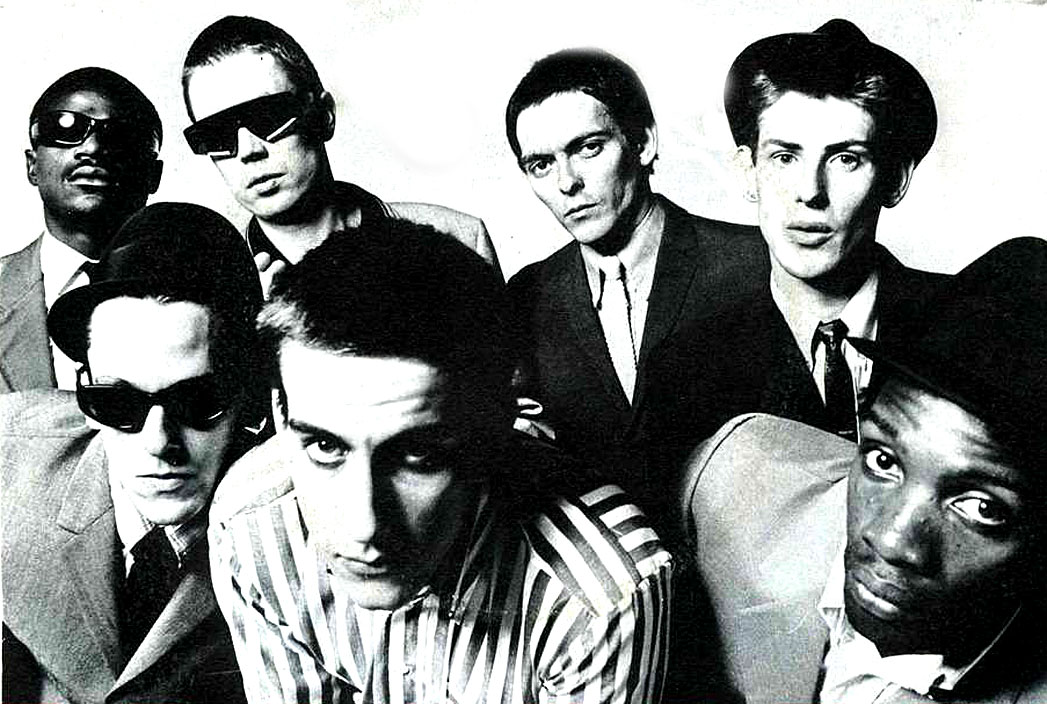
In many ways this is a world away from The Specials, both the punky snarl of ‘Too Much Too Young’ and the subtle anger of ‘Ghost Town’. And yet there are clear similarities too. There are a lot of the same instruments here, for example. They’re just being used in a more fun way. A lot of horns (‘horn’ being the key word here…)

Not many songs have been written about the ordeals of teenage boys trying to buy their first box of condoms. There may only have been one: this one. But ‘House of Fun’ is pretty definitive. After this, nobody else needed to bother. Sixteen today, And up for fun, I’m a big boy now, Or so they say… The lad knows what he wants, but he can’t bring himself to say it. He asks for ‘balloons’, ‘party poppers’ and ‘party hats with the coloured tips’…

Welcome to the house of fun, Now I’ve come of age… Fittingly, the song title itself is a double-entendre. The ‘House of Fun’ refers to the terrifying world of sex that this boy is glimpsing… Welcome to the lion’s den, Temptation’s on its way… But it’s also the name of the joke shop that the cashier packs him off to with a flea in his ear.

I’m loathe to say it, because I don’t think our sense of humour is as unique as we like to think, but this is very British. Very music-hall-for-the-1980s, pantomime, nudge nudge wink wink… It’s cheeky, and chirpy, and genuinely funny in the third verse when the boy’s nosy neighbours enter the shop and sense gossip unfolding. Madness are not a band I know especially well, away from the big hits, and I’ve always found them slightly… annoying? ‘Driving in My Car’ and ‘Our House’ are a bit too perky for my liking. Here, though, the cheekiness of the song sees it through. I’m glad that it was this record that gave the band their sole number one.

Another similarity to their chart-topping ska predecessors is the way in which this record mimics ‘Ghost Town’s fairground vibe. That was the haunted house, obviously, while this is a runaway rollercoaster. The album version in particular has a pretty cool finale in which the song crashes to an end and fades out on an old-fashioned organ. Interestingly, ‘House of Fun’ existed for a long time without the chorus, which was created in order for it be released as a single.

Madness, then, join the illustrious club of huge acts with just one #1 to their name… Dusty Springfield, Status Quo, ELO… ‘House of Fun’ was the band’s eleventh Top 10 single. I was first aware of them thanks to lead singer Suggs’ solo career in the mid-90s, when he re-introduced the world to Simon & Garfunkel’s ‘Cecilia’. But his band were untouchable in the early-‘80s, with only one release from a run of sixteen (!) failing to make the Top 10, between 1979 and 1983. They are the band with the highest number of weeks in the charts for the entire decade (tied with UB40), and were scoring hits well into the 21st century.

Advertisements

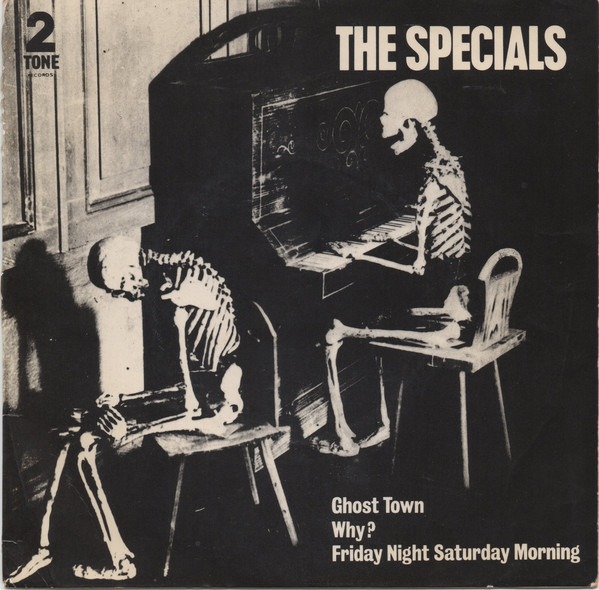
482. ‘Ghost Town’, by The Specials

When a song both begins and ends with police sirens, then you know things might just be getting a little tense at the top of the charts…

Ghost Town, by The Specials (their 2nd and final #1)

3 weeks, 5th – 26th July 1981

What makes this record great, though, is that the tension, the anger in this record, is controlled and channelled into a brilliant pop song. In The Specials’ first #1, ‘Too Much Too Young’, the message was spat out, obnoxiously. ‘Ghost Town’ still has that two-tone anarchy, but here it’s under control. They have a plan: every note and lyric is set for maximum impact, and it’s catchy as hell.

This town, Is coming like a ghost town… The band look around Coventry, their hometown, and see clubs closed down, disenchanted kids kicking lumps out of each other… Bands won’t play no more, Too much fighting on the dance floor… They look around, and they know just who to blame.

What makes this record great (Pt II) is that they perfect a ‘haunted house’ vibe with creepy organs and eerie flutes, plus the high-pitched, ghoulish backing vocals, but at no point does it sound like a novelty record. It does mean that this song is fated to be wrongly included on Halloween playlists for the rest of eternity; but that’s a small price to pay for such a unique sounding chart-topper.

Is this the most political number one single yet? The Jam might argue their case, but I think, compared to ‘Ghost Town’, ‘Going Underground’ sounds a little one-dimensional, as great as it is. Here the social commentary is blended with the funky horns and the catchy chorus line. The anger comes through slowly, peaking when Neville Staple starts chanting: Government leaving the youth on the shelf… No jobs to be found in this country… before ending with the succinct: The people getting angry!

‘Ghost Town’ was at #1 as riots broke out across the UK in the summer of 1981, with unemployment rates heading rapidly towards three million, making it sound very prescient. Sadly, the band couldn’t enjoy their ‘told you so’ moment: they split up, according to the history books, as they were waiting to record the song’s ‘Top of the Pops’ performance. Many Coventry locals weren’t too impressed either, hearing their home described as a dying town on radios across the land. Perhaps the truth hurt too much?

I’ve got to the end of this post without mentioning my two favourite bits of this song. The brassy middle-eight, that sounds completely different to the other three minutes, all swinging and upbeat, as they reminisce about the good old days inna de boomtown... And then there’s the drumbeat, that only becomes obvious as the song fades out. It sounds really modern, like ‘90s trip-hop. It sums up a very cool, and very important, moment at the top of the charts.

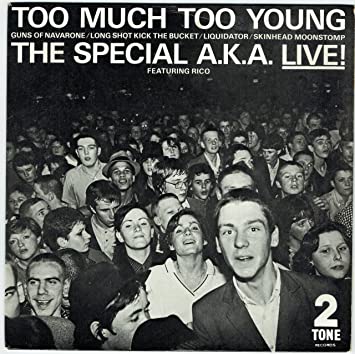
450. ‘Too Much Too Young – The Special A.K.A. Live! EP’, by The Specials

The 1980 ‘statement of intent’ continues… Following on from The Pretenders’ cool and cocky ‘Brass in Pocket’, the decade’s second #1 is some hardcore ska. Live ska.

Too Much Too Young – The Special A.K.A. Live! (EP), by The Specials (their 1st of two #1s)

2 weeks, 27th January – 10th February 1980

Too much too young! the band announce, to a drum-roll. You done too much too young, You’re married with a kid when you could be havin’ fun with me… The drums and organs skip and thump – ska is basically reggae on speed – as Terry Hall spits out the lyrics. Ain’t it cool, No it ain’t, He’s just another burden on the welfare state… I mean, it puts a different spin on rock music not being child-friendly

Musically this is ska, or two-tone, but really this is as punk as things have gotten at the top of the charts. Hall sneers at the girl who went and got pregnant… Ain’t you heard of contraception…? and lists all the reasons why getting married and having a kid was a terrible idea (number one being that she won’t come get jiggy with him). The ferocious guitar solo is also as raw and gritty as we’ve heard in a chart-topper for a long old while. As great as the disco/electro years have been, it has all been bit glossy. There’s nothing glossy about this nasty little record. (The album version is slightly slower, and longer; but there’s a lot to be said for the rawness that comes across live.)

The best bit comes at the abrupt end – this is a record that barely makes it over the two minute mark – with possibly the finest closing line to any #1 single: Try wearing a cap! Unsurprisingly, the BBC would not play this bit. We’re only two number ones into this bold new decade and we’ve already had aggressive references to contraceptives.  

While ‘Too Much Too Young’ was the hit, this is an EP – only the second ever to top the charts – and so we should give the rest of it a quick listen. The second track on side-‘A’ is an instrumental, ‘Guns of Navarone’. It’s a cover of a 1961 hit by the Skatalites – great band name alert! – which was in turn a cover of a film score. It’s another short, sharp blast of ska, with some unintelligible (to me at least) scatting from Neville Staple. The lead trombone on the song is played by Rico Rodriguez – a near fifty-year-old ska veteran, and not a full-time member of the band.

The flip-side is where my patience with ska wears thin. It’s fine in small doses – I think ‘Too Much Too Young’ is a wonderful kick up the arse – but stretched into a seven-minute, three-part ‘Skinhead Symphony’, the relentlessness of the genre starts to grate. You don’t get any downtime. The final part is the best, a full on wig-out called ‘Skinhead Moonstomp’. The band yeah-yeah-yeahs, as Staple calls on all the rude boys and rude girls to stomp their boots to an ever quickening beat.

Phew! Away from the music, this is an interesting record. TMTY is very short – the shortest #1 of the entire decade and the shortest since ‘It’s Not Unusual’ in 1965. It’s also… I think… only the 4th #1 single to have been recorded live, after ‘My Old Man’s a Dustman’, ‘The Wonder of You’, and ‘My Ding-a-Ling’ (though I’m sure I’ve forgotten one, or two.) Interestingly, half of this disc was recorded in London, and half in Coventry… where Chuck Berry had also recorded his classic (yes, I said classic) hit in 1972. Who knew Coventry was such a hot-bed of live music. Though, to be fair, The Specials were formed in Cov, so that could explain it…

This is a fun, palate-cleanser of a record, that again proves that January is often the most interesting month for chart-toppers. The Specials will be back next year, with their masterpiece. And we’ll be back, in a couple of days, with a recap.

Catch up with everything so far, before the next recap: