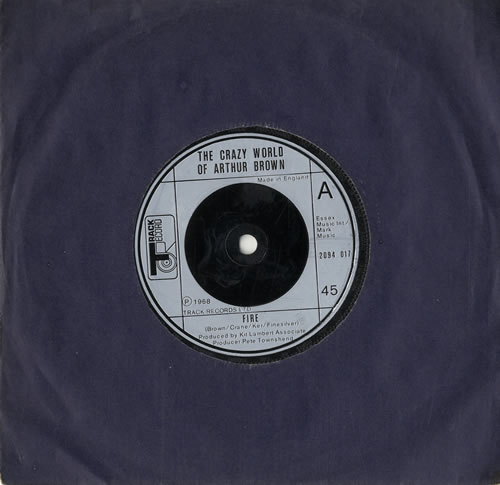
255. ‘Fire’, by The Crazy World of Arthur Brown

1968 strikes again! Our next #1 kicks off with a yell straight from the sulphurous pits. I am the God of hell-fire, And I bring you…! Well, they do say that rock ‘n’ roll is the devil’s music…

A8D9EE94-33C2-40A9-AD2A-FB394DE92EB0

Fire, by The Crazy World of Arthur Brown (their 1st and only #1)

1 week, from 14th – 21st August 1968

Fire, I’ll take you to burn…! As an opening statement, it’s pretty aggressive…. Fire, I’ll take you to learn…! Demonic horns and a Satanic organ, playing as if it were possessed, join in with the fun as the ground splits in two below our feet and we tumble into the roasting furnace. I’ll see you burn…

This is, and I mean this in the best possible way, a crazy record. The Crazy World of Arthur Brown certainly live up to their name. That it hit the top of the singles chart for a week in the summer of ’68 is something to be marvelled at, and enjoyed. It’s harsh, it’s angry… It’s an anthem dedicated to nihilism and arson: You fought hard, And you saved and earned, But all of it’s going to burn… Arthur Brown then launches into an Ohhh Noooo and a series of yelps and squawks that Axl Rose in his prime would have been proud of. Wiki lists ‘Fire’ as ‘psychedelic’, which it is… But that’s only telling a tiny part of the story. This is hair metal and shock-rock, Alice Cooper, Ozzy Osbourne and Iron Maiden, before any of that was a thing. Fire… To destroy all you’ve done…

The second verse slows down, like the soundtrack to an eerie, cheapo haunted mansion ride, before the grinding organ and horns snap back in and we head relentlessly towards the finish. We get crazed laughter, shrieks, the horns blasting ever stronger, before the winds of hell blow us on our way. You’re gonna burn…burn burn burn burnburnburn…! Apparently Brown used to perform this track while wearing a helmet that had been doused in fuel and set alight (see the pic above). Because of course he did…
ARTHUR_BROWN_FIRE-549906

They also say that the devil has the best tunes, but I’m not so sure about that being the case here. This is an amazing record, an experience; but not one that I’m desperate to repeat many more times. Perhaps it’s a truly awesome record… ‘Awesome’ in the literal sense of inspiring fear, as in the ‘awesome’ power of an atomic bomb.

I am convinced that there must have been some controversy around this disc hitting the top of the charts – that at least Mary Whitehouse and the Archbishop of Canterbury got their knickers in a twist over it – but can’t find much evidence online. It shows how far society had come in the decade or so since Elvis was getting cropped at the waist, I guess.

The Crazy World of Arthur Brown, largely Brown and organist Vincent Crane, are one-hit wonders in the truest sense. None of their other singles – either before or after – managed to chart in the UK. But their legacy lives on –  all the metal stars I listed above count them as an influence, while ‘Fire’ has been sampled by The Prodigy and Marilyn Manson. Arthur Brown still performs, aged seventy-seven, and still sets his helmet on fire…

I feel like I’ve been writing this at the end of nearly every recent post, but it bears repeating… What else has 1968 got in store for us? Surely it can’t get any weirder than this…?
252. ‘Baby Come Back’, by The Equals

I can remember very precisely the moment that I first heard this next number one, playing on our car radio when I was about fourteen. I remember it so specifically because when the DJ announced that he was about to play The Equals, my mum thought he had said The Eagles.

The_Equals_(1968)

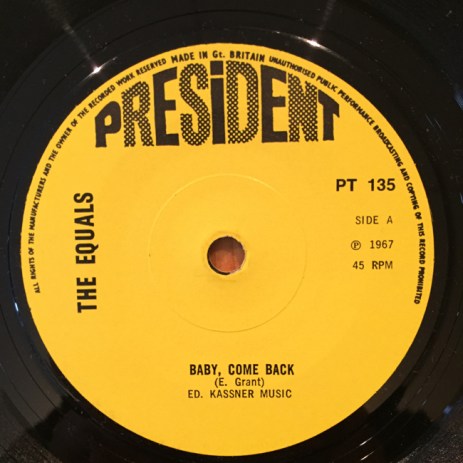
Baby Come Back, by The Equals (their 1st and only #1)

3 weeks, from 3rd – 24th July 1968

She then spent a very confused three minutes wondering why she had never heard this Eagles’ song before, and how she had managed to miss out on the band’s short-lived reggae phase. My mum can be quite dramatic when confused. Anyway… This is definitely not The Eagles. It’s The Equals, with ‘Baby Come Back.’ And we do welcome reggae to the top of the British singles charts!

Except, is this really reggae? Or is it rock? Reggae-rock? Or am I just assuming it’s some kind of reggae because it’s sung with a Jamaican-sounding accent? The opening, cut-glass riff is very rock, while the bouncy rhythm is – to my ears at least – quite reggae. Ding-ding-dinding-dung-ding! It’s a great intro, and it’s probably the best thing about the entire record.

Not that it’s a bad song other than that. It’s simple enough – a song in which a man implores a woman to not leave him. Come back baby don’t you leave me, Baby baby please don’t go… he sings. Come back, I said baby come back… goes the chorus. It all sounds very heartfelt until you listen carefully to the second verse, and notice that he admits to flirting around behind her back.

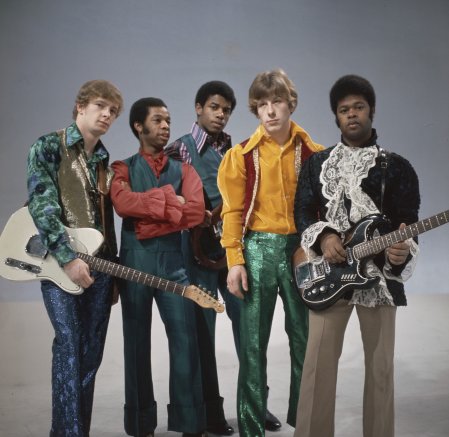
The Equals were a London-based band cut from the same interracial cloth as The Foundations. They had two white and three black members, the foremost of which was one Eddy Grant! I knew of him as an eighties star – he’ll feature again on the countdown in around fourteen years – but had no idea he was around in the sixties, until today. And he doesn’t have a Jamaican accent, as I suggested above – he’s originally from Guyana, in South America.

SAS2271

This is a fun record, one that bounces along and stays buried in your head for a while after. I like the asides as the band build towards each chorus – Hey! (Alright!) – and the free-styling towards the end, especially when one member shouts out Rude Boy! It might have stood out as even more new and refreshing, had the chart-toppers of 1968 not already been so bloody strange…

The Equals had been releasing singles since 1966 – ‘Baby Come Back’ had been released once already and done nothing. They would have a couple more Top 10s following this; but ‘Baby Come Back’ was their biggest hit by far. Not only will we meet Eddy Grant again in this countdown, but this song will top the charts again in a very different-sounding nineties version. Much more for another day, then.

I really struggled to find the original recording of this disc. YouTube has it – I think – and you can listen to it below. Spotify has every re-recording under the sun but not, as far as I’m aware, the original. Which is of no concern to anyone but me, as it has spoiled the perfection of my UK #1s Blog Playlist…

Follow my playlist below, with (almost) all the original versions of the 252 #1s encountered so far:

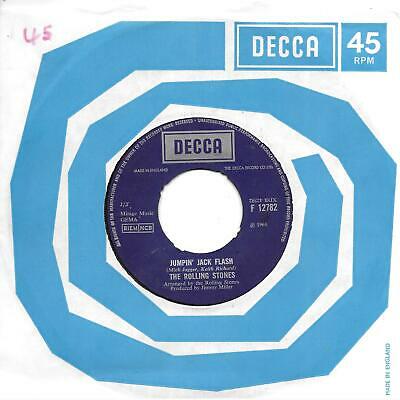
251. ‘Jumpin’ Jack Flash’ by The Rolling Stones

Normal service is resumed, with a bang. The sixties’ baddest band are back! After a mid-decade run where they never seemed to leave the top of the charts, this is The Stones’ first #1 since ‘Paint It, Black’ a little over two years ago. Has their sound changed while they’ve been away?

4524373-LKRHUBBQ-7

Jumpin’ Jack Flash, by The Rolling Stones (their 7th of eight #1s)

2 weeks, from 19th June – 3rd July 1968

Yes, and no. The second you press play you know it’s a Rolling Stones’ song. It’s got that vibe and that swagger – with an intro that begs to be turned up. But it’s heavier than what came before, heavier even than the pounding ‘Get Off Of My Cloud’, or the cynical ‘Paint It, Black.’ The one thing that we’ve been missing in recent months – years even – amongst all the eclectic, easy-listening, flower-power hits of ’67-’68, is finally here: some down and dirty rock ‘n’ roll.

Watch it! The lyrics are equally in your face: I was born, In a cross-fire hurricane, And I howled in the morning drivin’ rain… (or is it: at my ma in the drivin’ rain….?) Either way, it’s the story of a boy, a creature, who appears to have risen from the deep to terrorise the world… I was raised, By a toothless bearded hag… All told over the same simple, relentless riff. Some sources claim that Jagger and Richards were inspired by the latter’s taciturn gardener, Jack Dyer. Others that it was inspired by the poetry of William Blake. Keith Richard’s biographer claims that the opening lines – the ‘crossfire hurricane’ -refers to the fact that he was born during a German bombing raid in 1943.

Like many legendary rock songs, its origins are perhaps lost to the mist of time (and possibly because the band were too high to remember). Also like many legendary rock songs, the lyrics are pretty out there. The last verse goes all biblical: I fell down, To my feet and saw they bled… I was crowned, With a spike right through my head… ‘Jumpin’ Jack Flash’ was written around the same time as ‘Sympathy for the Devil’, in which they portrayed Satan as a man of wealth and taste. Were they doing the opposite to Jesus here? In the end, though, his tough back-story doesn’t matter. He’s Jumpin’ Jack Flash and life’s a gas, gas, gas… The overriding message being don’t sweat it? Things’ll turn out alright in the end? Enjoy it while it lasts.

The-Rolling-Stones-Jumpin-Jack-Flash-Large-Jukebox

I mentioned in a previous post – ‘The Last Time’, I think – that every time a Stones record comes along at the top it feels like your big brother’s cool but slightly terrifying friends have crashed your party. You’re floating along with your nice Manfred Mann discs and your catchy Union Gap records and then wham! – Mick and the boys rock up. They fade into ubiquity sometimes, and have certainly become caricatures of themselves in their old age, but hearing The Rolling Stones in context like this really shows how thrilling and dangerous they were. This was never my favourite song of theirs growing up, but hearing it now for the first time in a while… I’m enjoying it way more than I thought I would. And I’ve got it turned up loud.

The outro goes slightly trippy, as the band intone Jumpin Jack Flash, It’s a gas… and the organ and the guitars intertwine. At the time, this was a bit of a comeback statement. They had tried to jump on the psychedelic bandwagon with singles like ‘We Love You’ and ‘She’s a Rainbow’ and, while not commercial disasters, they weren’t monster hits like ‘Satisfaction’ either. And let’s face it, you don’t come to the Stones for hippy-love vibes, do you? You want them to rock, and rock this single certainly does. They’ve played it at pretty much every live show since. It’s their most performed song, one of their signature hits. And it’s with a tear in our eyes that we realise they only have one more chart-topper to go…

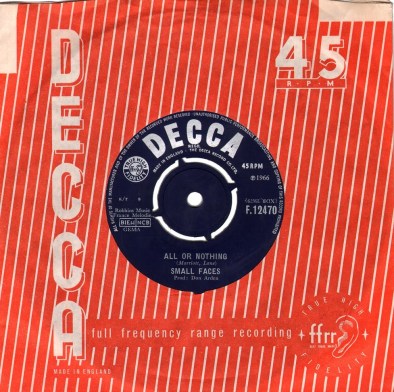
223. ‘All or Nothing’, by The Small Faces

1966 has been a pretty cool year in terms of its chart-toppers. Nancy’s boots, The Walker Brothers, the cynical Stones and Dusty finally making it… Plus a lot of soul: The Spencer Davis Group, Georgie Fame and, most enjoyably of all, Chris Farlowe. To that list you can now add The Small Faces.

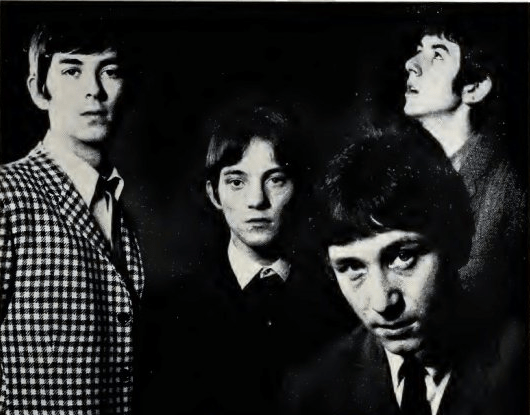
SmallFaces1966

All or Nothing, by The Small Faces (their 1st and only #1)

1 week, from 15th – 22nd September 1966

This is another cool record, and it’s cool from the very start – from the fade-in drum roll. We’ve not had one of those before at the top of the charts. Then a trippy riff, and a wistful voice: I thought you’d listen, To my reasoning, But now I see, You don’t hear a thing… Intelligent lyrics, and I do love the bravado required to rhyme ‘reasoning’ with ‘hear a thing’. The singer is trying to make his lover see that he doesn’t share. Things could work out, Just like I want them to, If I could have, The other half of you… And then an ultimatum: All or nothing, For me…

The guitars in the chorus are thick and chunky. Very forward-thinking. Very power-pop. It’s The Undertones come a decade early. I’d rank it along with ‘You Really Got Me’ and ‘Get Off Of My Cloud’ as one of the heaviest #1 singles so far. Although ‘All or Nothing’s heaviness is more subtle, not as in your face.

And it doesn’t last the whole song through. There’s a mellow ba-ba-ba-baba refrain mid-way through, and then a funky breakdown towards the end. And lots of great soul shout-outs from the lead-singer Steve Marriott. It’s amazing to think that he was just nineteen when this was recorded. Aw Yeahs, and Hear my children sing!, and Gotta keep on tryin’! And when he belts out the crucial I ain’t tellin you no lie, So don’t just sit there and cry! line, it’s a real finger-kiss moment. It’s a record that packs a lot in to its three minutes. Funky, heavy, soulful… A song I knew vaguely; but hadn’t realised just how forward facing it sounded. If you were a pop-loving kid in 1966, this is what your cool older brother would have been listening to.

7503405132_3ee2877a47_b.jpg

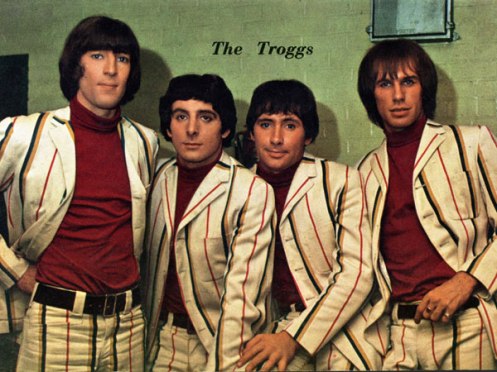
That’s the best word for this record. Cool. No point searching for a better one. Another cool chart-topper for the year. In pictures from the time, The Small Faces look the part too. Mods, with long hair and sharp suit jackets. And they crammed a lot into their four years together. (It is amazing, isn’t it, how many of these mid-sixties groups fell apart after just a few years – with a couple of obvious exceptions…) Like The Troggs from two posts back, certain other of their hits far outshine their one and only chart-topper. ‘Itchycoo Park’ made #3 the following year, and ‘Lazy Sunday’ – for many a year the only Small Faces song I knew – made the runners-up position in 1968. Neither of those songs sound anything like the heavy, soulful R&B on ‘All or Nothing’, which speaks to the band’s quality and creativity.

I have to admit that I thought I had imagined some link between The Small Faces and The Faces – assuming that it was just a coincidence in naming. But no, I was right: Marriot left, the remaining Faces dropped the ‘Small’ and recruited Rod Stewart. Rod the Mod, as he was back then. The rest is history. Marriot died tragically young, in a house-fire aged just forty-four. He’s kind of forgotten today, in the pantheon of sixties stars, which is a shame, as his legacy helped shape both punk and Britpop. The Jam and Blur certainly owe him a debt, anyway.

The Small Faces, then, with their one and only week atop the British Singles chart. Sit back, and Hear the children sing!

Keep up with this Spotify playlist:

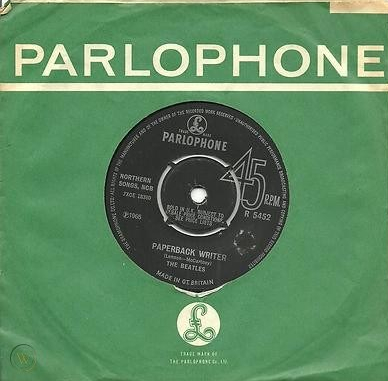
217. ‘Paperback Writer’, by The Beatles

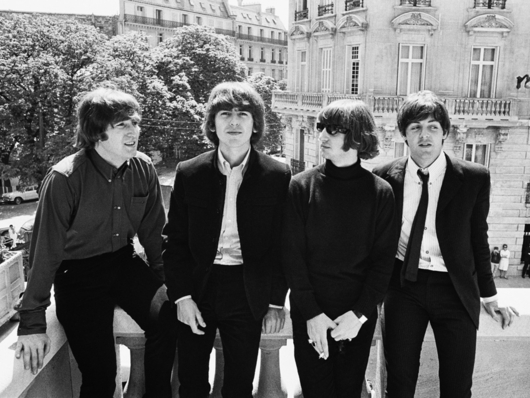
If you can draw a line in the sand, between early-era Beatles #1s and late-era Beatles #1s – if you really want to locate the moment when they stopped being ‘The Fab Four’ – then I’d say this is it.

BEATLES PICTURED IN PHOTO RELEASED BY CAPITOL RECORDS

Paperback Writer, by The Beatles (their 10th of seventeen #1s)

2 weeks, from 23rd June – 7th July 1966

There’s the echoey, layered intro – Paperback writer, writer, writer… A simple, harder than anything that’s gone before, riff. A filthy bassline. It’s not a clean line in the sand – it’s not as if The Beatles hadn’t been getting progressively heavier, cooler, druggier with every chart-topper since ‘I Feel Fine’ – but this does feel like a significant step away from their earlier days. 1966 would be the year of ‘Revolver’ and their last ever stadium concerts.

The biggest difference though, for me, comes in the lyrics. All their previous #1s have been boy-meets-girl, girl treats boy well or badly, pop songs (with the exception of ‘Help!’) ‘Paperback Writer’, however, is a song about a, well, a paperback writer, written by Paul McCartney after he was challenged to write a song about anything but ‘love’.

Dear sir or madam, Will you read my book, It took me years to write, Will you take a look…? It’s a song in the form of a letter – our very first epistolary chart topper? – from a wannabe pulp-fiction writer, presumably living in a cramped attic, to some unnamed publishers. It doesn’t, to be honest, sound like a very appealing read: a dirty story of a dirty man (whose) clinging wife doesn’t understand… And the unnamed writer doesn’t sound like much of an artiste: I need a job and so I wanna be a paperback writer…

360_214e15f9f8f054990022bb0ace81d936

It’s actually quite a funny record, satirical even. The hero of this trashy story also wants to be a paperback writer, while the book is already a thousand pages long, with more to come in a week… In the background, the other members of the band harmonise, in falsettos, over the French nursery rhyme ‘Frere Jacques’.

It’s also a short record, just over two minutes long, which sounds loveably rough and ready, as if it were knocked out in one take over a single afternoon. And that’s not a bad thing. It’s probably The Beatles’ heaviest chart-topper, and a song that’s always felt like a bit of an anomaly in their discography. Although, if you think the lyrics to ‘Paperback Writer’ are a big change of pace, their next #1 will be about an old woman who cleans churches…

Before we finish, let’s just pause to notice that the past three chart-toppers have gone The Rolling StonesFrank Sinatra – The Beatles… has there ever been a more illustrious run of #1s?

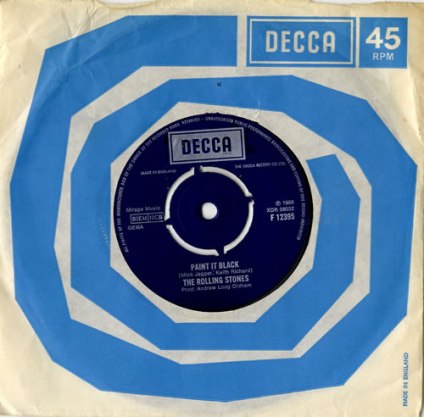
215. ‘Paint It, Black’, by The Rolling Stones

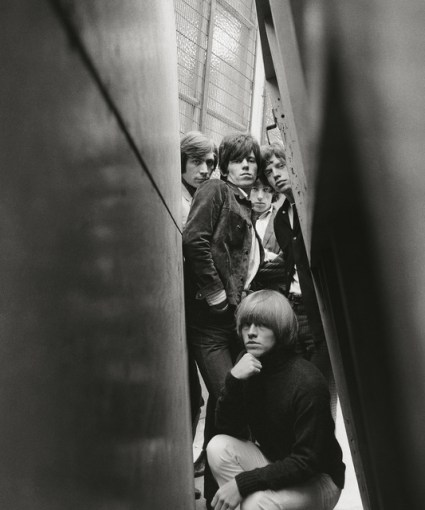
Picture a mid-summer’s evening: a soft, dusty light, some people gathered around an ancient stone circle, having a sing-song. Long hair and baggy clothes. Pagans? Hippies? Look a little closer, though. They look familiar… Why, it’s The Rolling Stones! Conducting a full-blown Satanic ritual!

mainSTONESBLC2

Paint It, Black, by The Rolling Stones (their 6th of eight #1s)

1 week, from 26th May – 2nd June 1966

I’ve used many words to describe the chart-toppers we’ve covered so far. Catchy, dull, quirky, God-awful… ‘Paint It, Black’, though, is the first I’ve had to consider calling ‘evil’… It’s a hulking, threatening, malignant brute of a #1 single. From the opening riff, it’s as if an evil spirit is taking up residence in your ears. Brain Jones is playing a sitar, and sitars, to me, usually sound blissed-out, and spiritual – the background soundtrack to massages and yoga sessions. Not when The Stones get their hands on one…

Then there’s the lyrics. I see a red door, And I want it painted black, No colours any more, I want them to turn black… Jagger’s voice melts into the insistent, pounding rhythm – sometimes soft and coaxing, sometimes aggressive and half-crazed. What is it about? Depression? Drug-induced psychosis? A funeral (as the line about a line of black cars suggests)? Whatever it is, it’s a bleak, bleak record. I see people turn their heads and quickly look away… or I look inside myself and see my heart is black… And then there’s the serial killer line: I see the girls walk by dressed in their summer clothes, I have to turn my head until my darkness goes…

It’s an amazing song. A song I respect a lot. I love that it was a #1 hit. But I can’t bring myself to love it. It’s not a song to put on in the background. It’s a song that you have to be in the right mood to deal with. In many ways it’s a weird song – not helped by the fact that, for years, I thought one of its lines went: No more will my green seagull turn a deeper blue… (It is, of course, ‘my green sea go’. Which makes even less sense…)

ROLLING_STONES_PAINT+IT,+BLACK+-+BOXED-88953

By the end, our hilltop ceremony is reaching its climax. The bass grinds, the sitar dances, the band are humming with intent, and Jagger is crowing: I wanna see it painted, Painted black, Black as night, Black as coal…! He wants to see the sun blotted out… He wants to end it all… The record slowly fades to a frenzied close. This was only top of the charts for a week. That’s probably all the country could deal with from such a relentlessly nasty disc.

Back when I first got into The Stones, with their Greatest Hits etc, ‘Paint It, Black’ (apparently the comma was just a record-company typo, though it does lend a nicely pretentious air) blended in amongst the hits. Its edge was dulled. Not here, though, doing this countdown in real-time. It really makes you stop and think… This was a best-selling single. It’s a superb piece of music; but only one act could have pulled it off and still kept it commercially viable.

I’ll say it again… The Stones’ hits might never quite have matched the Beatles in ‘musical’ terms. But they were pushing the boundaries of what could be considered ‘pop music’. The Fab Four used sitars, yes, to write cute acoustic numbers like ‘Norwegian Wood’; while Jagger, Richards and Jones were using one to summon the Devil.

This is something of an end of an era moment for the Stones, too. They’ve crammed four number one hits into just over a year – all of them towering slices of swagger, anger and petulance. But we won’t hear from them now for over two years. By which point they will have tried their hand at flower-power, gone hard on the drugs, driven Brian Jones out of the band… This is a moment. And not just for The Stones. For the singles charts. For British music. For popular music as a whole. Go on… Paint it,… Black!

Catch up with all the #1s so far – including five other Stones’ hits:

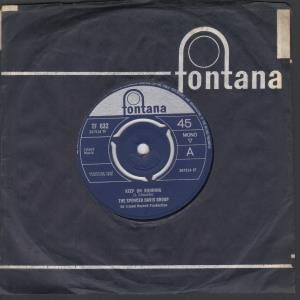
208. ‘Keep on Running’, by The Spencer Davis Group

We skip on into 1966, where the first number one is, perhaps unexpectedly, neither folkey nor baroquey. It’s a straight-up rocker!

Framed_BW_02-6

Keep on Running, by The Spencer Davis Group (their 1st of two #1s)

1 week, from 20th – 27th January 1966

A dirty drum and bass riff kicks it off, and then we get a blast of some kind of feedback-slash-scuzzy chord couplet. It makes you sit up, makes you take notice. Keep on runnin’, Runnin’ from my arms… It’s not as heavy as The Stones have been recently, but it’s not as poppy as anything from the Merseybeat days. It’s like a perfect marriage of the two…

Actually, it’s got a real soul vibe to it too, as if Sam Cooke was now fronting a Beat combo. It’s cool – catchy and funky. I love the Hey! Hey! Hey!s, and the way that the intro riff returns for the now customary wig-out at the end. It’s clear that any self-respecting rock record in 1965-66 has to fade-out with the lead singer going a little bit crazy…

I know this song, but know very little about the band – The Spencer Davis Group (don’t ‘The Spencer-Davis’s’ sound like a posh couple that you avoid in Sainsbury’s?) I would have bet they were American, with their funky soul sound, but no. They were from Birmingham (and not the one in Alabama.) Interestingly, ‘Keep on Running’ isn’t a cover of a soul song, but a cover of a reggae hit from the year before. Check it out here… Unsurprisingly, it sounds completely different. I’ve never been a huge reggae fan – something that I’m sure will crop up in this countdown as the genre grows in popularity – so I’ll take The Spencer-Davis’s version, thankyouverymuch.

image_236192_3_1_3_5_8_6_6_10_1_266708_1_118752_1_9_1_335022

It’s a great record. Though I feel, before we go much further, that the lyrics need some scrutinising. They’re a bit… overbearing? That’s putting it politely. The title refers to a woman who, try as she might, will not be able to escape the singer’s attentions. One fine day I’m gonna be the one, To make you understand, Oh yeah, I’m gonna be your man… It gets worse when you realise that he’s motivated not by love, but because his mates are laughing at him: Everyone is talkin’ about me, Makes me feel so bad, Everyone is laughin’ at me, Makes me feel so sad…

Hmmm. The more you think about them, the worse they get. But hey, this was the sixties. Different times, different levels of tolerance for possessive wierdos… File under ‘Catchy but Creepy’, with ‘What Do You Want to Make Those Eyes at Me For?’ and ‘Oh, Pretty Woman’.

The Spencer-Davis’s will be back, and very shortly, for the second part of their chart-topping brace. They had had a few low charting singles in the previous couple of years, but ‘Keep on Running’ propelled them to another level entirely. It’s not quite a classic, a standard, but it has a hook that most people could sing. And, despite what I said about the lyrics, I do really like it. It’s fun, and a little rough around the edges. Like all the best rock songs should be… A great way to kick off a new year.

207. ‘Day Tripper’ / ‘We Can Work It Out’, by The Beatles

The Fab Four claim their third straight Christmas number one (before Christmas number ones were a thing, but still), and they do so with their most straight-up rock record yet.

beatles

Day Tripper / We Can Work It Out, by The Beatles (their 9th of seventeen #1s)

5 weeks, from 16th December 1965 – 20th January 1966

There’s a riff – a riff we all know – dun-duh-duh-duh-duh-dun-dada-da-dada – (riffs never really work when written out…) which keeps on going till the end. It’s a riff record – maybe, just maybe, they’d been listening to The Stones –a great, straight-up rock song.

I like the way the intro builds: guitar, then bass, then drums, and the way that the solo is basically the riff, beefed-up. It’s a simple song – there’s no reinventing the wheel here. I guess it’s experimental, in the sense that they’re experimenting with a heavier sound, but that’s stretching it a bit. It’s a John Lennon number, and one of the things I like most about him is that he never lost his rock ‘n’ roll roots, never stopped being a fan of Chuck and Buddy, no matter how avant-garde he and his bandmates seemed to get.

Of course, like any great rock song, there’s a fair amount of raunch here too. She’s a big teaser, She took me half the way there now… Not much imagination needed. Especially after Lennon admitted that he would have made it ‘prick teaser’, had he been allowed. Tried to please her, She only played one night stands… So on and so forth. Another layer of innuendo comes when you consider the ‘trip’ aspect of the lyrics. A ‘day tripper’ would be someone who only drops acids on special occasions. A weekend hippy, a ‘Sunday driver’.

Whether it’s about drugs or sex, or both, doesn’t really matter, though. This is a cracking rock number – one that I’ve enjoyed reacquainting myself with for this post. It’s one of those Beatles songs that kind of gets lost among the mega-hits. But, actually, listen to the soooooo long growl, and the way that the solo ascends to a climax with a hint of ‘Twist and Shout’, and try telling me that this isn’t one of their best. And, come to think of it, I can think of two other songs off the top of my head in which the ‘Day Tripper’ riff makes an appearance: ‘Hair of the Dog’, which gleefully rips it off to the extent that when Guns N’ Roses covered it they gave up the pretence and by the end were just playing the Beatles’ riff, and The Wildhearts’ ‘My Baby Is a Headfuck’. So maybe I’m underestimating it…

the-beatles-day-tripper-uk-solid-centre-7-vinyl-sold-in-uk-parlo-gramo-vg_44624215

What of the flip-side? We’ve not had a double-‘A’ side #1 for a while (nearly three years to be precise) and ‘We Can Work It Out’ is the perfect companion for ‘Day Tripper’, in that it sounds pretty much the opposite. I’ve always thought that double-‘A’s should contrast, one should be the yin to the other’s yang, and so gone is the electric guitar and the bravado, replaced by acoustics and recriminating.

It’s a folk-rock waltz of a record, in which Paul McCartney muses on a failing relationship: Try to see it my way, Do I have to keep on talking till I can’t go on?… Think of what you’re saying, You can get it wrong and still you think that it’s all right… He remains positive – the title is ‘We Can Work It Out’ after all – but if you listen closely to the lyrics it becomes clear that any compromise will be on his terms: While you see it your way, There’s a chance that we might fall apart before too long… Very passive-aggressive… Actually, the more I listen, the more I realise how the singer of this song is being a bit of a dick. Life is very short, And there’s no time, For fussing and fighting my friend… (So hurry up and just admit I’m right!)

The accordion-slash-harpsichord sounding instrument which characterises this disc – the one that creates the woozy, trippy feel at the end of the bridge, and that closes the song with a little riff – is a harmonium, apparently. This is where pop music has been heading throughout 1965, with the baroque-folk stylings of The Byrds, Sonny and Cher and The Walker Brothers, and it’s nice to close out the year in this way. A sign of where The Beatles were heading. ‘Rubber Soul’ was released while this disc sat at #1, and ‘Revolver’ would be coming up very shortly after.

This was The Beatles first double-‘A’ side as they couldn’t agree on which record was the more commercial sounding. Lennon was the one who forced ‘Day Tripper’ to get equal-billing, but in terms of airplay at the time ‘We Can Work It Out’ was the winner. In the US they were released separately, with ‘We Can Work It Out’ hitting the top of the Billboard 100 and ‘Day Tripper’ only making #5. But for me rock always wins. ‘Day Tripper’ all the way…

And so we cross the midway point of The Beatles’ chart-topping run. Nine down, seven to go. To celebrate, I thought I’d do a quick rank of the hits that have gone so far. Based solely on personal preference not artistic merit. Let me know if you agree or are scandalised by my ignorance. In ascending order (worst – best), then:

We Can Work It Out > Can’t Buy Me Love > From Me To You > I Feel Fine > A Hard Day’s Night > Ticket to Ride > I Want to Hold Your Hand > Day Tripper > Help! > She Loves You

Actually, that was really hard and kind of pointless. I don’t dislike any of those songs. A ‘bad’ Beatles disc is another act’s signature song. But it’ll be interesting to add the next seven to the list, and to see where they fit in. Anyway, look! Suddenly it’s 1966. Onwards!

Listen to every number one so far – by The Fab Four or otherwise – with this playlist:

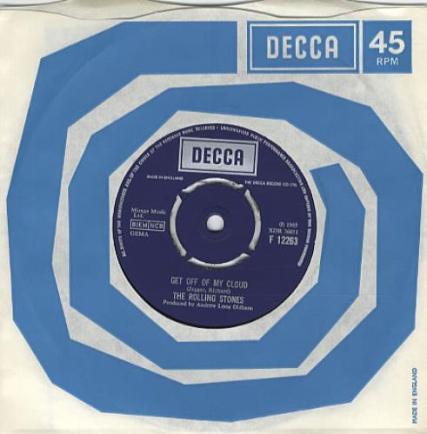
205. ‘Get Off Of My Cloud’, by The Rolling Stones

Barging Ken Dodd out of the way, snapping one of his tickling sticks and giving him the finger… It’s The Rolling Stones!

large

Get Off Of My Cloud, by The Rolling Stones (their 5th of eight #1s)

3 weeks, from 4th – 25th November 1965

They’re still angry, still dissatisfied with modern life, with complaining neighbours and, once again, detergent. What did Mick and Keith have against detergent…? Like ‘Satisfaction’, which was at #1 just six weeks before this, ‘Get Off of My Cloud’ tells an anti-hero’s story in three verses, against a frantic drumbeat and another scuzzily insistent riff.

It’s clearly another response to their new-found fame, their new-found position as The Beatles’ one true rivals to the throne. But all they want to do is be left alone. In each verse, Mick tries to escape the world around him: I sit at home looking out the window, Imagining the world has stopped… and I was sick and tired of this, Decided to take a drive downtown… It’s a response to, and another symptom of, their fame. This was a #1 in both the UK and the US, as well as Canada and Germany, and no other band could have taken a record as raw and aggressive as this to the top of the charts around the world.

It’s also a very hard song to sing. There are several points where I have no idea what is being sung, Charlie Watt’s drums and the guitars being so prominent in the mix, with Jagger’s vocals submerged under them. My favourite bit is when he almost starts rapping the phone-call from his neighbour, asking him and his friends to shut up because it’s 3 a.m. The telephone is ringing I say ‘Hi, it’s me, who’s there on the line? A voice says ‘Hi, hello, how are you?’ Well I guess I’m doin’ fine…

In the end, though, he finds some solace. He takes a drive downtown, where it’s nice and peaceful, and falls asleep. Whether or not he’s under the influence of something isn’t established… He wakes up to parking tickets, but I don’t think he cares – he’s Mick Jagger and he’s rich as piss. How the tickets look like flags, I don’t know. And I have no idea who the guy dressed up like a Union Jack is meant to be.

Rolling+Stones+Get+Off+Of+My+Cloud+-+Boxed+Lo-106573

It’s a weird song. A scrappy, messy, glorious song. Apparently Keith Richards doesn’t look back on it too fondly, what with it being rushed out in order to capitalise on ‘Satisfaction’s success. And yes, the sound is a bit off, and the mix a bit bass heavy, and the lyrics pretty much cover the same ground as ‘Satisfaction’, but that’s part of this record’s charm. It really does sound like it was recorded in a garage, in one take, and while the sound is far removed from their bluesy roots, this is in keeping with The Stones as a rough and ready rock ‘n’ roll band.

But if that doesn’t convince you, at least you can’t deny the hook. Hey! – hey – You! – you – Get off of my cloud! Who hasn’t wanted to yell that at someone who’s been bringing them down, when you just want a bit of peace and quiet. Don’t hang around cos two’s a crowd…

Looking back at The Stones three #1s from this year, we have three masterpieces of attitude and anger. Gone are the blues covers, in comes ‘The Last Time’ with its disparaging swagger, ‘Satisfaction’ with that riff and it’s dissatisfaction with fame and modern living, and now this… more dissatisfaction with fame, modern living and the whole bloody world. And, taking these three discs and standing them side by side next to The Beatles three 1965 chart-toppers – ‘Ticket to Ride’, ‘Help!’ and ‘Day Tripper’, which is coming up in a couple of posts time… I’m going to go out on a limb and say The Stones’ output – solely talking about the chart-toppers, here – was, for the moment, trumping the Fab Four’s.

Not that it would last… But that’s a story for another day.

Follow along with my Spotify playlist: