126. ‘Kon-Tiki’, by The Shadows

As we continue our slow meander along the highways and bye-ways of 1961 –it does feel that this year is taking a little longer to get through than previous ones – it’s time for a little interlude.
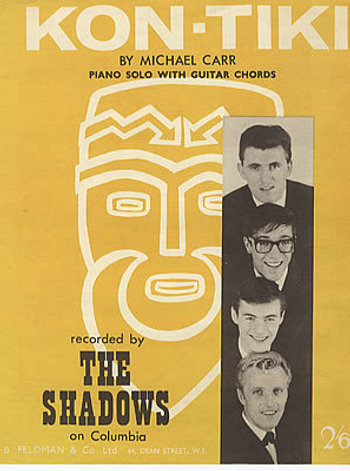
the-shadows-kon-tiki-1961-5

Kon-Tiki, by The Shadows (their 6th of twelve #1s)

1 week, from 5th – 12th October 1961

Picture, if you possibly can, the year 1961 as a TV variety show. On the bill are some huge, established stars – Elvis, the Everlys, Shirley Bassey – along with some new up and coming teen sensations – Johnny Tillotson, Helen Shapiro – and some quirky little gems – Floyd Cramer and The Temperance Seven. Maybe Cliff – who won’t actually be hitting #1 this year – can be the MC. OK? Well, to this weird mental image you can add the house band, the ones that pop up and play as the curtains drop and the scenery gets shifted. They are, of course, The Shadows.

‘Kon-Tiki’ is another instrumental. A lilting little slice of surf-rock. It’s got cool drum-fills, a nice crunchy, tinny edge to the guitars and a hint of reverb around the main riff. There’s a couple of call and response bits between the lead and the bass, and the ending has some gnarly (did they say ‘gnarly’ in the early sixties?) echo. It’s a decent enough record – I’m not sure that the Shadows made many poor ‘solo’ records – but when it ends less than two minutes in you’re left wondering… Is that it?

It’s far from being one of their bigger hits (I wasn’t particularly familiar with it before starting this post) and it kind of feels like filler. Something thrown together as the guys were jamming. A ‘B’-side, maybe? But hey, what do I know. It was a UK number one single; only the band’s second solo chart-topper.
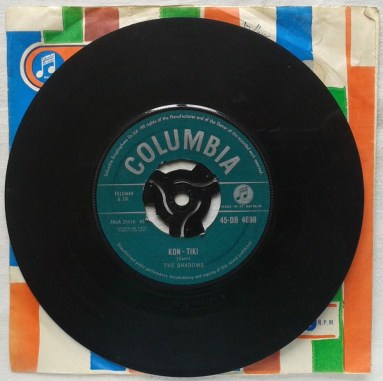
the-shadows-kon-tiki-36.jpg

The Kon-Tiki was actually a raft used in a 1947 expedition across the Pacific Ocean by the Norwegian explorer, Thor Heyerdahl. ‘Kon-Tiki’ was chosen as it was an old name for the Incan sun-god. What all this had to do in inspiring the writing of this perky guitar instrumental is, to be honest, unknown. My best guess is that it sounds kinda tropical, kinda surfy, and could work well as the soundtrack to a sunset luau on the beaches of Hawaii. Compared to ‘Apache’, which really did conjure up images of Indian braves galloping across the plains, ‘Kon-Tiki’ is a little more abstract.

Maybe that’s fine, though. It’s a nice enough tune, a pleasant one-week interlude on our journey through 1961. It reminds us that The Shadows are still around, are still the biggest British band of the time. Maybe it needs no further meaning than that.

As I mentioned at the start of this post, it does feel like we’ve been lingering in 1961 for quite a while now. In actual fact, with twenty-one number one singles, 1961 has by far the most chart-toppers of any year yet covered. But that’s OK. It’s proving a nice place to be. Jazz, rock, showtunes, instrumentals… all genres are welcome here. And, if you thought it’s been eclectic recently; just wait till you hear what’s up next!

121. ‘Temptation’, by The Everly Brothers

We kick of the next thirty chart-toppers – and a whole New Year! – with the duo that claimed Best Disc from the previous thirty. Since ‘Cathy’s Clown’ the Everly Brothers have really hit their stride in moving away from their country roots, creating a signature sound that blends their gorgeous melodies with meaty drums and beefy, rock ‘n’ roll guitars. ‘Temptation’ is the latest glorious manifestation of this…

bed398a27a573a4492467f00f2e481b3--magazine-articles-ricky-nelson

Temptation, by The Everly Brothers (their 4th and final #1)

2 weeks, from 20th July  – 3rd August 1961

We start with perhaps one of the most instant intros we’ve heard yet. Frantic drums, guitar licks, yelps from the brothers, and a dirty little bass riff. Yeah Yeah Yeah Ah! You’re hooked from the off. You came, I was alo-one, I should have known, You were temptation… Cast your mind back to the cutesy mooning of ‘All I Have to Do Is Dream’ and then listen to this. Don and Phil have truly grown-up!

Then the best bit of the whole song. They pull the same trick as on ‘Cathy’s Clown’ – after a calm, measured first verse they whip it up a notch or five… It would be… Thrilling! If you were willing… But if it can never be, Then pi-i-i-ty me… They way those lines are sung. That is temptation. It makes me want to kiss my fingers like a chef who has just tasted the perfect Béchamel sauce.

This is a song that was hidden away in the middle of the brothers’ Greatest Hits that I bought in my teens. A song that I’ve always liked but kind of allowed to pass me by whenever it popped up in a playlist. Getting the chance to properly listen to ‘Temptation’ – their fourth and (shock, horror!) final UK #1 – has allowed me to realise just how good it is. Just how good they were. This a full-on rock song: a heavy riff, banging drums and fevered lyrics about a siren leading Don and Phil astray, with the brothers going fairly willingly to their doom.

By the end, they are leaving the singing to their backing vocalists, who are possibly the most old-fashioned aspect of this record. I’m yours, Here is my heart, Take it and say, ‘We’ll never part…’ Shrill voices that we last heard on Eddie Fisher’s prehistoric early number ones. Then we end with the brothers singing about being slaves, before fading out with more frenzied, delirious Yeah Yeah Yeah Ah!s It really does sound like they are being driven mad with temptation. It really is a brilliant disc.

the-everly-brothers-temptation-7-single-vinyl-record-45rpm-warner-bros.-1961-1082-p

I was shocked – shocked I say – to discover just two minutes ago that this is yet another #1 to have been written decades earlier. ‘Temptation’ sounds so modern, so daring, that I can’t imagine it having been written in 1933 and first recorded by Bing Crosby. But it was. You can listen to the original here – it’s very Arabian Nights, and not without its charms – but it’s a wonderful illustration of how much popular music has changed since the arrival of rock ‘n’ roll.

With that, then, the Everly Brothers take their leave. It seems criminal that they didn’t have at least another couple of chart-toppers… ‘Wake Up Little Susie’? ‘(Till) I Kissed You’? ‘When Will I Be Loved’? All worthy of a shot at the top. In a way, ‘Temptation’ may have hastened their descent from the top. Their manager was opposed to the song’s release, as he didn’t stand to make any money from such an old song’s publishing rights. When the brothers forced the single’s release through, he barred them from working with the songwriters who had helped to create pretty much every one of their hits thus far. So despite, or perhaps because of, the brilliance of ‘Temptation’, the Everly Brothers will only have a couple more British Top 10s following this, and will be a spent-force by the time Merseybeat rolls around. Except. Pretty much every star with a guitar from the sixties and beyond – The Beatles, Simon and Garfunkel, Bob Dylan, The Beach Boys, The Bee Gees, The Hollies and many, many more – will owe Don and Phil a huge debt.

We’ll leave them here, then. Picture them with their guitars slung over their shoulders, harmonising as they stroll into the sunset… (until they have a huge argument and refuse to work together for most of the 1970s… but hey, let’s not spoil the nice image.)

117. ‘On the Rebound’, by Floyd Cramer

What do we have here then? A piano instrumental, with a perky little riff, strong notes of – deep breath – Russ Conway

floyd-cramer-h7i

On the Rebound, by Floyd Cramer (his 1st and only #1)

1 week, from 18th – 25th May 1961

For the first twenty seconds of this record, which I’d never heard before, I was beginning to envision myself giving it a terrible write-up. Cheesy, irritating, repetitive… And it is. But. Unlike, say, Russ Conway’s records (sorry Russ, I do end up picking on you every time an instrumental #1 comes along, but you were awful…) there is a lot more to this than just the piano.

Thirty seconds in the main riff drops away and we get a little blast of honky-tonk swagger, drenched in ‘ooohs’ from the backing singers, which acts as a prelude for the brilliant moment one minute in when it all breaks down and we’re left with drums, clapping and a natty little bassline. Russ never did anything like this… This is pretty funky. Then the violins come in for a little call-and-response with Floyd’s piano. By the time the main piano riff comes back, lifted up by the backing singers, it all makes sense. And by the end, as the riff is deconstructed piece by piece and we finish with a thump, you’ve actually enjoyed it.

I feel as if I must know this song from somewhere, that I have heard it before in an advert, or a movie… It sounds really familiar. The only thing I can find is that ‘On the Rebound’ featured in ‘An Education’, a film I saw once, years ago. It surely cannot have lingered in my subconscious for so long just from that… Or maybe this is simply a sign of well-written, nicely executed little tune – that it sounds ubiquitous even when it’s not. This is a lost gem of a number one single, its week at the top buried among the leviathans of early sixties pop: Elvis, The Everlys, Cliff. It sounds simultaneously old-fashioned – this could be 1955 and that could be Winfred Atwell at the piano – and modern – the rock ‘n’ roll swagger that the drums, the guitar and the handclaps lend means that this isn’t 1955 and that certainly isn’t Ms. Atwell. The piano instrumental, though, has proved a surprisingly resilient genre over the course of this countdown… We haven’t had a trumpet, or a violin instrumental hit the top for many a year but the piano keeps on popping back up!

FLOYD_CRAMER_ON+THE+REBOUND-420365

Anyway, now the song is done we can focus on the main event of this post – Floyd Cramer himself. This is his one and only week as a credited chart topping star. Note, though, the emphasis on the word ‘credited’… Because the list of songs on which Cramer featured as a session pianist is mighty impressive. We’ve already heard him in the background on ‘All I Have to Do Is Dream’ by The Everly Brothers, ‘That’ll Be the Day’ by The Crickets, ‘Only the Lonely’ by Roy Orbison, and on Elvis’s ‘Are You Lonesome Tonight?’ We’ll go on to hear him on pretty much every other Elvis #1 from here ‘till 1963. The list of classic hits he featured on that failed to top the UK charts is also pretty darn impressive… *clears throat*… ‘Heartbreak Hotel’, ‘Wake Up Little Susie’, ‘The End of the World’, ‘Big Hunk ‘o Love’ and, oh yes, ‘Rockin’ Around the Christmas Tree’ (which I’m providing a link for because, hey, it’s the right time of year.)

However, Cramer struggled to score another ‘solo’ hit in the UK, and so the record books will know him solely for ‘On the Rebound’. He was known for his ‘slip-note’ style of piano playing, in which he would ‘slip’ from an out of key note into the correct note (sounds like an excuse I should have tried during my ill-fated attempt at keyboard lessons – “I didn’t play the wrong note, Sir, I was just playing in the ‘slip-note’ style. Haven’t you heard of it?”) It is this trick, I think, that gives the main riff it’s annoyingly perky, jangly feel, but what do I know? Floyd obviously felt it worked for him.

One final thing… Why’s it called ‘On the Rebound’? Honest answer: who knows? If I’ve learned one thing while writing this blog it’s that you can give an instrumental whatever the hell name you want.

114. ‘Walk Right Back’ / ‘Ebony Eyes’, by The Everly Brothers

The Everly Brothers, clearly working on the ‘if it ain’t broke’ principal of hit-record making, return with their third UK chart-topper. Their second – ‘Cathy’s Clown’ – was so good, so seismically bloody brilliant, that who could blame them for trying to repeat the trick?

the-everly-brothers-walk-right-back-1961-2

Walk Right Back / Ebony Eyes, by The Everly Brothers (their 3rd of four #1s)

3 weeks, from 2nd – 23rd March 1961

And yet ‘Walk Right Back’ is not simply a blow-by-blow remake. The marching rhythm remains – albeit in a much lighter shade – and the drums are every bit as commanding. But this is great little record in its own right.

I want you to tell me why you walked out on me, I’m so lonesome every da-a-ay… I want you to know that since you walked out on me, Nothin’ seems to be the same ol’ way… Are they perhaps pining over Cathy? Has she finally quit toying with them, and moved on to another guy? (Why do I always picture the Everly Brothers dating the same woman…?)

What’s for sure is that they’ve both grown a pair since the days of ‘Cathy’s Clown’. The chorus comes, and they positively demand that she: Walk right back to me this minute, Bring your love to me don’t send it… The harmonies remain strong, this is clearly the Everly’s in mid-season form – their imperious phase – and it stands a cut above most of what we’ve heard recently on this countdown. Take, for example, ‘Poetry in Motion’: a perfectly acceptable, catchy pop song. But it’s a class below this. This is high quality pop music; better than 90% of its contemporaries in a way that’s as undeniable as it is hard to explain.

The song ends on a fade-out, the brothers bemoaning that they’re so lonesome every day… And that’s that. I apologise for rushing, but we do have the flip side of this disc to get to. A song that’s nowhere near as good; but which will be much more fun to write about. ‘Ebony Eyes’ sounds, before you listen, like pure B-side fodder. And it is. But in the best possible way…

THE_EVERLY_BROTHERS_WALK+RIGHT+BACK-546425

On a weekend pass… (yep, they’re in the army now)… I wouldn’t have had time, To get home and marry, That baby of mine, So I went to the chaplain, And he authorised, Me to send for my ebony eyes… And so, Ebony Eyes hops aboard flight 1203, to Don’s, or Phil’s (or both’s?) army base. In an hour or two, I would whisper ‘I do’, To my beautiful ebony eyes…

This is soppy drivel. We’re back in the realm of ‘All I Have to Do Is Dream’, the Everly’s first chart-topper, which was a world away from the brilliance of their current hits. But… What’s that? In an extended spoken word section, the brothers describe the ensuing events. I kind of want to type it out verbatim, it’s that good – but I’ll refrain. Here are the highlights:

The plane was way overdue, So I went inside to the airlines desk… They probably took off late, or they may have run into some turbulent weather, and had to alter their course… And then – a genuinely harrowing description of a plane-crash from the victims’ families POV: I went back outside and I waited at the gate, and I watched the beacon light from the control tower as it whipped through the dark ebony skies… he has to slow down here, to wait for the backing singers… As. If. It. Were. Searching. For… My eeeeboooony eyes… And then came the announcement over the loudspeaker, That those having relatives or friends on flight 1203…

Yup. Powerful stuff. We’ve got another death-disc here, folks. A Grade-A splatter-platter (brilliant term, that) which got banned from British radio for being a bit too graphic. We’ve had the goofy ‘Running Bear’, the toe-curlingly awful ‘Tell Laura I Love Her’, and now this. And just when you think this heartfelt and very natural sounding spoken word section is about to redeem the genre, and turn it into something with some musical merit about it, they start singing again.

If I ever get, To heaven I bet, The first angel I recognise… Yeah yeah, blah blah, it’s Ebony Eyes. Whatever. It kinda ruins it. But hey. This does what every good double ‘A’-side should do: places a big, proper hit alongside a completely different, slightly left-of-centre ditty. Apparently – and I can’t see why anyone thought this would be a good idea – ‘Walk Right Back’ was originally meant to be the ‘B’-side! Still, it’s always nice to hear from the Everlys, and it’s a bit sad to realise that we’ll only be seeing them once more on this countdown. ‘Till then, Don and Phil, ‘till then…

https://www.youtube.com/watch?v=0KUNcZj249A

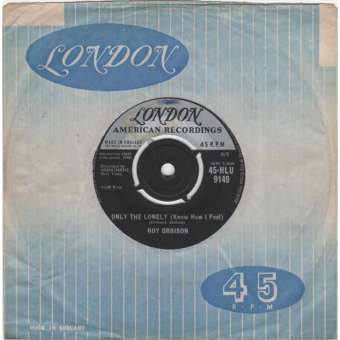
108. ‘Only the Lonely (Know How I Feel)’, by Roy Orbison

Now this is more like it! As we try to wash the memory of that last chart-topper from our minds, a dose of the Big ‘O’ will do nicely.

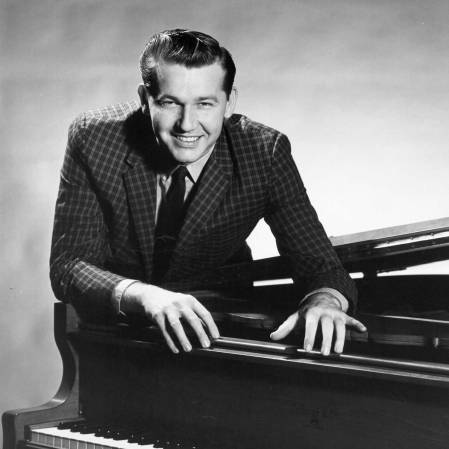
Roy-Orbison-1967-bw-portrait-billboard-1548

Only the Lonely (Know How I Feel), by Roy Orbison (his 1st of three #1s)

2 weeks, from 20th October – 3rd November 1960

Dum-dum-dum-dumbee-doo-wa, Ooooh-yeah-yeah-yeah-yeah, Oh-woa-woa-woa-ahhh… Only the lonely… We haven’t heard many catchier intros in this countdown, have we?

Only the lonely, Know the way I feel tonight, Only the lonely, Know this feelin’ ain’t right… This is how you do heartbreak in a pop song. It feels somehow significant, the fact that this was the song to depose ‘Tell Laura I Love Her’ from the top of the charts. As if Roy Orbison had listened to Ricky Valance and his saccharine mulch and said ‘Hold my beer…’

Everything about this song feels like an upgrade from ‘Tell Laura…’ – the voice (that voice – one of the most unmistakeable in pop history), the lyrics, even the backing singers. But to paint this record solely as the yang to ‘Laura’s yin would be unfair. This is a great track in its own right, deserving of a place in this countdown regardless of the record it knocked from the top spot.

It’s a rock ‘n’ roll record, but with the operatic flourishes that were a trademark of Orbison’s career. There are the fluttering violins that dance around the end of each line, the deep bass drum that marks out the bridge – there goes my baby (dun dun dun dun) – and, of course, that high note at the end. His voice, which has been deep, and fairly manly, up to now, rises with each of the final lines: Maybe tomorrow, A new romance, No more sorrow, But that’s the chance… wait for it… youuuuuu gotta take… As someone who has listened to Roy Orbison for many years this almost passes me by as standard – that’s what he sounded like a lot of the time – but you have to remember that this was his first big, international hit. People in October 1960 didn’t know who he was, and they wouldn’t have heard the high note coming. The chart nerd in me feels compelled to point out that ‘Only the Lonely’ took what was, at the time and until 1985(!), the longest ever climb to #1 in the UK charts (eleven weeks) This was a slow-burner, a word-of-mouth hit that you heard about from your neighbour over the garden fence – ‘Have you heard that new song by the guy with the high-pitched voice…?’

118953981

Turns out that this mix of rock ‘n’ roll rhythms with operatic touches and emotive, melancholy lyrics was Roy Orbison’s new trademark, after an earlier rockabilly phase that had brought him limited success in the US but had failed to register over in Britain, and the record-buying public lapped it up. His next release, for example – the OTT ‘Blue Angel’ – makes ‘Only the Lonely’ sound stripped back and subtle. I bought my first Big ‘O’ Best Of at the same time as I was getting into Buddy, Chuck and co., so we go way back. He can be something of an acquired taste at times, but once you get him; you won’t forget him.

And we’ll hear from him again in a few years’ time – when he’ll stand up to the Merseybeat tsunami with a couple of his best known songs – but until then I’d recommend checking out his early sixties classics: the aforementioned ‘Blue Angel’, ‘Running Scared’, ‘Crying’ (as made super famous by Don McClean), ‘Workin’ for the Man’ and ‘Falling’ (a song that, to this day, I can’t work out if I like or not but which definitely shows off his unique voice).

We seem to be settling back into a nice rock ‘n’ roll groove in the autumn of 1960, this disc following on from the likes of ‘Please Don’t Tease’, ‘Shakin’ All Over’ and ‘Apache’. In fact, ‘Only the Lonely’ is something of an amalgam, of this new, easy goin’ rock ‘n’ roll and the string-laden, percussion-y chart toppers from earlier in the year – ‘Poor Me’, ‘Why’ and so on. A new type of pop song, perhaps? A subtle little game changer? We’ll see. Onwards!

106. ‘Apache’, by The Shadows

The Shadows are back. But sans-Cliff. Who’s doing the singing then? Nobody! That’s who. Yep, it’s time for another instrumental interlude…

p01bqktf

Apache, by The Shadows (their 4th of twelve #1s)

5 weeks, from 25th August – 29th September 1960

I’ve struggled to place my feelings on the instrumentals featured in this countdown. We’ve veered from the decidedly pleasant Song from ‘The Moulin Rouge’, to the undeniably perky Winifred Atwell, to the Oh-God-Make-It-Stop! of Russ Conway and Eddie Calvert. And then I went and named Perez Prado’s ‘Cherry Pink and Apple Blossom White’ as one of the very best records we’ve heard thus far… I know that ‘Instrumental’ itself isn’t a genre – you can’t pigeon hole them all together. But still… Where does this latest one fit in the grand scheme of vocals-less chart-toppers?

It’s different, for a start, in that it’s a guitar-led track. I make this the 9th instrumental chart-topper (10th if you count ‘Hoots Mon’ with its sporadic shouting) and the first to use guitars as the lead instrument. Lots of pianos, trumpets and violins thus far; not many guitars. It starts, though, with drums. What might be described as ‘Injun Drums’, which would make sense in a song called ‘Apache’. Which means that this track, alongside Johnny Preston’s ‘Running Bear’, ensures that 1960 will go down as the year of the Native American in Popular Music.

It’s a song with a long and varied history – The Shadows’ version being neither the first nor the last – but it was originally inspired by a 1954 western movie, starring Burt Lancaster and entitled, funnily enough, ‘Apache.’ (A 1973 version of the song, by the Incredible Bongo Band, has become one of the most sampled tracks of all time, earning it the title of ‘hip-hop’s national anthem’, but that’s a story for another day…)

Perhaps one of the reasons that I struggle with instrumentals is that I find them so hard to write about. What are they about, for a start? ‘The Poor People of Paris’ didn’t sound like it was about poor people. ‘Moulin Rouge’ had precious little to do with the can-can. Russ Conway’s efforts were ice-cream van jingles in search of an actual melody. But ‘Apache’  -and this is a big point in its favour – does actually sound as if it’s about a Native American soldier, riding out into the sunset for one final showdown… Close your eyes as you listen and you’ll see him. Plus the bit where the guitars sound like a galloping horse is really cool.

It makes sense as a song, too. There’s a verse, a bridge, and then a chorus. You can kind of sing along to it. Plus, there’s a riff! Make that three from three! Dun-dun-Dun-dan-dun-dun-dan-dun… The guitars sound great, and just as twangy as those used in ‘Shakin’ All Over’. This is a great piece of music, actually. But subtle; its greatness taking time to become apparent.

R-562860-1476192301-4079.jpeg

I mentioned during my post on ‘Travellin’ Light’ that for their first two #1s The Shadows, or The Drifters as they were for ‘Living Doll’, had little more to do than just turn up and tickle their instruments (so to speak). They did a bit more on ‘Please Don’t Tease’, riffing and soloing and the like, but I half suspect that they went solo just so that they could let loose a little. Hank Marvin and Bruce Welch were too talented to stay as Cliff’s backing band forever. ‘Apache’ was their first ‘solo’ release to chart, and it charted in style: five weeks at the top making it, for now, the second biggest hit of 1960 behind ‘Cathy’s Clown’. And this is only the beginning – for the next three years The Shadows will utterly dominate the UK charts. I make it 33 (thirty-three!) Top 10 hits, both with and without Cliff, before the glory days draw to an end.

Even with this early hit, The Shadows already manage two very impressive feats. Firstly, they become the first ever act in UK chart history to replace themselves at #1. And they draw level with giants such as Elvis, Frankie Laine and Guy Mitchell as the artists with the most UK chart-toppers. All of this with a record that doesn’t have any lyrics! How about that! Maybe from now on I should try harder to appreciate instrumentals… Maybe instrumentals are the way forward… Down with lyrics! Yeah! Put that on a T-shirt…

105. ‘Shakin’ All Over’, by Johnny Kidd & The Pirates

Did someone order a riff? Cause we got a riff goin’ on right here!

6c51f05ee4a8d596efbd4446963c4b10

Shakin’ All Over, by Johnny Kidd & The Pirates (their 1st and only #1)

1 week, from 4th – 11th August 1960

I mentioned – without realising this song was coming up next – that our previous #1, Cliff & The Shadows ‘Please Don’t Tease’, had given us the merest hint of a riff; riffs having been fairly absent from our rundown thus far. However, this record isn’t just giving us a whiff of riff – it’s giving us full-on riffage and then whacking us over the head with it. Repeatedly.

It’s basically impossible to transcribe a riff – to turn notes from a guitar into phonemes on a page – but I will, without fail, try to do so every time one comes along at the top of the charts. Diddle-iddle-iddle-iddle-din… Diddle-iddle-iddle-iddle-din… Trust me – it sounds much cooler than it looks written down…

When you move in right up close to me… That’s when I get the shakes all over me… Johnny Kidd has a girl who is bringing on some pretty drastic symptoms. Then the best bit of the song, one of the best bits from any of the one hundred and five chart-toppers so far: the pause… and TWANG! Quivers down the backbone, I got the shakes in the knee-bone, Ye-eah the tremors in the thigh-bone… Shakin’ all over!

There are plenty of other great things about this record: the little drum fill before the solo, the gritty solo itself, and a fade-out loaded with sexual suggestion – we-ell you make me shake and I like it baby… But nothing can top that pause… and TWANG!

This is rock ‘n’ roll, and I’m feeling so invigorated by listening to this song on repeat that I might go further than that and drop the ‘n roll’. This is rock, plain and simple. Killer riff? Check. Lyrics about sex? Check. Slightly rough-round-the-edges recording? Check. Johnny Kidd & The Pirates also wore outlandish pirate costumes on stage (eye-patches, cutlasses and the like), bringing us glam a good ten years ahead of schedule. And they parted acrimoniously – as any rock ‘n’ roll band worth their salt has done at least once – The Pirates abandoning Kidd when the hits dried up.

But the most momentous thing about ‘Shakin’ All Over’? More momentous than the eye-patches and the TWANG. This is a British rock record (gasp!) – Kidd and The Pirates having formed in London. The elusive coming of age of British rock ‘n’ roll, hinted at by Tommy Steele, promised but not delivered by Cliff… It finally arrives at the top of the charts!

johnny-kidd-the-pirates-shakin-all-over.jpg

I knew the importance of this record before embarking on this post – anyone who has a passing interest in the history of rock music will surely know this song. But actually hearing it in context – listening to it arrive amongst all the Cliff hits, next to ‘Three Steps to Heaven’ and ‘My Old Man’s a Dustman’ – really hammers home how important this track is. It also consigns my claims about the castration of rock ‘n’ roll to the dust. Rock ‘n’ roll is alive and well; it just isn’t always to be found at the top of the pop charts.

Johnny Kidd even managed to die in a suitably rock ‘n’ roll fashion – in a car crash in 1966, aged just thirty. In truth, he had been struggling for hits long before that. But this one song is more of a legacy than most can hope to leave. The cover versions speak for themselves: check out those by The Who, Wanda Jackson and Rose Hill Drive – who contributed their version to the soundtrack of a mid-00s video game which I picked up second-hand on a whim years ago. Isn’t it weird how some songs find you? In truth, any aspiring rock ‘n’ roll band should be required by law to include ‘Shakin’ All Over’ in their first set-lists. It’s a song that would sound just as great being thrashed out in a garage as it would on an arena tour. And that, folks, is as sure a sign as any that we have a rock and/or roll classic on our hands. Enjoy…

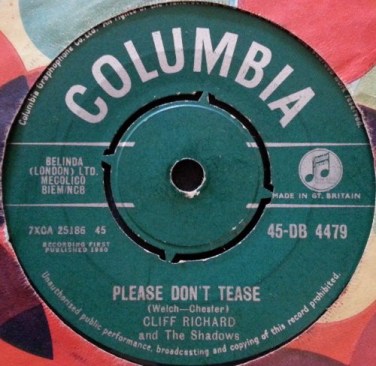
104. ‘Please Don’t Tease’, by Cliff Richard & The Shadows

Our third meeting with Sir Clifford. Just the eleven (11!) more to go…

cr1

Please Don’t Tease, by Cliff Richard (his 3rd of fourteen #1s) & The Shadows (their 3rd of twelve #1s)

1 week, from 28th July – 4th August / 2 weeks, from 11th – 25th August 1960 (3 weeks total)

I mentioned during my last post that the opening months of 1960 have seen rock ‘n’ roll undergoing a castration at the top of the charts – all the sounds and stylings of this musical revolution diluted down to a poppy mulch (see Johnny Preston, ‘Three Steps to Heaven’ and all that.) And if this latest #1 isn’t just the blandest, most castrated version of rock ‘n’ roll going. But Goddam don’t I just love it…

You tell me that you love me, baby, Then you say you don’t, You tell me that you’ll come over, Then you say you won’t… Cliff loves a girl, but she’s leading him a merry dance. That’s all you need to know lyric-wise. It’s all something something come on and squeeze me something something your tender touch. Nobody’s coming here to have their thoughts provoked. (The use of ‘doggone’ in the second verse is worthy of note, however, as the one and only time in recorded history that a British person has ever used the term.)

No, this is a record best described as ‘breezy’, bouncing along like a light-hearted summer’s picnic, carried on a chord progression that satisfies our most basic urges and by the fact that – praise be! – The Shadows finally get something to do. Having sat through Cliff’s first two chart-toppers with barely a sniff of the action, they get a rocking little solo here and lend a cool revving sound under the Oh please don’t tease… lines in the bridge.

And, lo! Is that the sound – the merest whiff – of a riff at the beginning and the end of this record? Da-dun-dun-dun-da-da-dun-dun-da-da-da…? We aren’t in the ‘riff era’ yet – the rock songs that have topped the charts thus far have been all about the solos and the rhythm rather than any memorable, 100% guitar-led riffs. But here… It’s no ‘Smoke on the Water’ that’s for sure, but it stands out as something that you could perhaps play air guitar to. I also – and this might be a bit crazy – get a sort of Merseybeat-vibe from said riff, at least three years ahead of The Searchers and Gerry & The Pacemakers, and The Beatles obv., turning it into the dominant musical movement of the mid-sixties. Or maybe that’s just me.

R-571404-1403429827-8961.jpeg

And… that’s about it for this one: with an artist as successful as Cliff you can take each of his many, many #1s as songs in their own right without needing to go into so much backstory and detail. They are all signposts on our journey through British popular music history, with Cliff at the wheel. ‘Please Don’t Tease’ is definitely one of his more forgotten hits; but one that’s worth rediscovering. And notable in its way, as Cliff and his backing group will soon be going their separate ways. The next time we hear from The Shadows – very shortly, in fact – they will be quite Cliff-less.

102. ‘Three Steps to Heaven’, by Eddie Cochran

And we’re back down to earth with a bump, after the era/career/life defining ‘Cathy’s Clown’. Which is ironic, given the title of this next number one…

eddie-cochran-1445077805-view-0

Three Steps to Heaven, by Eddie Cochran (his 1st and only #1)

2 weeks, from 23rd June – 7th July 1960

Now there, Are three, Steps to heaven… Just listen, And you will, Plainly see… The guitars click and twirl and sound for all the world like a Buddy Holly B-side – the sickly little brother of ‘Heartbeat’, perhaps. And as life, Travels on, And things do go wrong… Eddie Cochran is crooning away here in a manner that would make Perry Como proud. Just follow, Steps one, two, and three…

Now, I might not be as familiar with Eddie Cochran as I am with certain other rock ‘n’ rollers; but I do know that he was a rock ‘n’ roller. He was one hell of a rock ‘n’ roller. But if you were to base your impressions of him on his sole UK #1, you might think Eddie C. was a mere pap-peddler, a run-of-the-mill teen idol singing a cutesy ‘How To Guide’ for love. There’s nothing wrong with this song, as such, but there ain’t much that’s great about it either.

What are those three steps to heaven, then? You’re dying to know, aren’t you? Step one, You find a girl you love… Uh-huh… Step two, she falls in love with you… OK… Step three, you kiss and hold her tightly… And that’s it? Yeah that sure, Seems like heaven, To me… Oh Eddie, if only it were that simple.

EDDIE_COCHRAN_THREE+STEPS+TO+HEAVEN-548776

I’ve already mentioned that the rolling, clockwork guitars sound very Buddy Holly-lite – and this might have a lot to do with The Crickets acting as Cochran’s backing group here (and scoring their 2nd, albeit uncredited, chart-topper in the process) – but that’s not this record’s only link to ‘The Father of Modern Pop Music’. Eddie Cochran, like Buddy when he scored his only solo #1, was dead by the time this topped the charts. Two months earlier, during a UK tour, the taxi in which he had been travelling blew a tire and smashed into a lamppost. He was thrown from the car, after valiantly covering and saving his fiancé, and died in hospital the following day. He was just twenty-one. Considering that his two previous singles had stalled at #22, I think it’s safe to assume that this record was being bought as a memorial as much as it was for the actual music.

I’m torn… It’s great that a star as influential at the birth of rock and pop as Eddie Cochran got his moment in the record books. But there are so many better ways to remember him than this twee little ditty. There’s the teenage angst of his breakthrough hit ‘Summertime Blues’, the classic riff from ‘C’Mon Everybody’, or the steaming proto-punk of ‘Somethin’ Else’ (which would be turned into a proper-punk hit by Sid Vicious some twenty years later).

It’s comparable, in a way, to the fact that Chuck Berry scored his one and only UK #1 with ‘My Ding-A-Ling’. Which really winds some people up. But – and I’m sticking my neck out here – I think that ‘Three Steps to Heaven’ being Eddie Cochran’s biggest hit is the real travesty. At least my ‘My Ding-A-Ling’ was bawdy, smutty, silly, funny… It is rock ‘n’ roll, for all that it is also a dumb nursery-rhyme. This? Well this song commits a far worse crime in my book. The crime of being bland! And I, donning my judge’s cap for a moment here, order this record to be removed from my sight. Forever. Next!

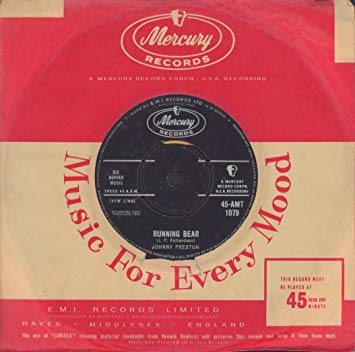
98. ‘Running Bear’, by Johnny Preston

The opening handful of sixties #1s have been pretty new to me, in contrast to the Cliffs, Buddies and Bobbies that closed out the fifties. But this latest record is a new level of new: a completely unknown entity. ‘Running Bear’? Nope. By Johnny Preston? Nope…

johnny-preston-running-bear-1960-3.jpg

Running Bear, by Johnny Preston (his 1st and only #1)

2 weeks, from 17th – 31st March 1960

It is, though, a record that catches you from the get-go – perhaps desperate to ensure that, while you may not have heard it before, you won’t go forgetting it in a hurry. It opens with a drumbeat, a deep-voiced oom-ba-doom-ba, some grunts, a whoop and a holler and a, wait… a Native American war-cry?

Oh dear… Is this going to be one of those records best described as being ‘of their time’? A record to make your grandad chuckle ruefully and mutter something about ‘not being able to get away with it nowadays.’ Remember Guy Mitchell’s ‘She Wears Red Feathers’? The story of the love between an Englishman and an oriental beauty (in a fetching huly-huly skirt)? Well, this is the same kinda deal. But with Red Injuns!

On the banks, Of the river, Stood Runnin’ Bear, Young Indian brave, On the other, Side of the river, Stood his lovely, Indian maid… Runnin’ Bear pines for lil’ White Dove, who waits oh-so patiently for him across the water. But their tribes are at war, and so their love cannot be…

It’s a romance in three verses. The first sets the scene (above), the second puts Running Bear’s tortured position into clear focus. They can’t cross the raging river, and so: In the moonlight, He could see her, Throwing kisses, Cross the waves, Her little heart, Was beating faster, Waiting there, For her brave…

The third and final verse brings resolution. Bear throws caution to the wind, dives in the river and White Dove follows suit. And they swam, Out to each other, Through the swirling, Stream they came… Their hands touch, their lips meet… they’re both pulled to the bottom and drown. Yup. Didn’t say it was a happy resolution, did I?

That’s by far the best bit of the song – the brutal killing off of the main characters in a way that would shock even George R.R. Martin. I mean, if they’d made it to the other side and lived happily ever after then so what? Who’d care? This is more memorable. It’s a novelty record, for sure, but with an ending that suggests an irreverence, a knowing wink, that I don’t think we were getting a few years ago in, say, ‘How Much is That Doggie (In the Window)?’

91tVS5JbQ5L._SX355_

Musically this song is pretty interesting too. It alternates between the tribal rhythms – the pow-wow-by-the-wigwam vibe – of the verses and the raucous sax-led choruses. It’s silly; it’s fun. And, to be fair, while the lyrics may sound a little dubious to modern ears (hey, at least Preston doesn’t put on any ‘me very wise man’ voices) there’s nothing explicitly racist here. It’s a simple little love song, with a darkly comic twist at the end.

Why it caught the British public’s imagination in the spring of 1960 isn’t so clear, however. It drags us completely away from the run of jingly-jangly, winsomely innocent chart toppers we’ve been having and back a good few years (it was written and recorded in 1958). Johnny Preston seems to have been a fairly run-of-the-mill American rock ‘n’ roller who scored a few hits in the late fifties / early sixties; and who became known as Johnny ‘Running Bear’ Preston for the releases that followed his biggest hit. But it makes complete sense to discover that ‘Running Bear’ was originally written and recorded by The Big Bopper – last seen dying in the same plane crash that claimed the life of Buddy Holly. He even contributed the oomba-doombas and the war cries to this version, meaning that this giant (and I mean that fairly literally) of rock ‘n’ roll can claim part-ownership of a UK #1 single.

A pleasant enough diversion, then, with an ending that I’ll remember – and will possibly be emotionally scarred by – for some time. And for a song that I had had no experience of whatsoever until coming to write this post, I’d say that’s a job well done!