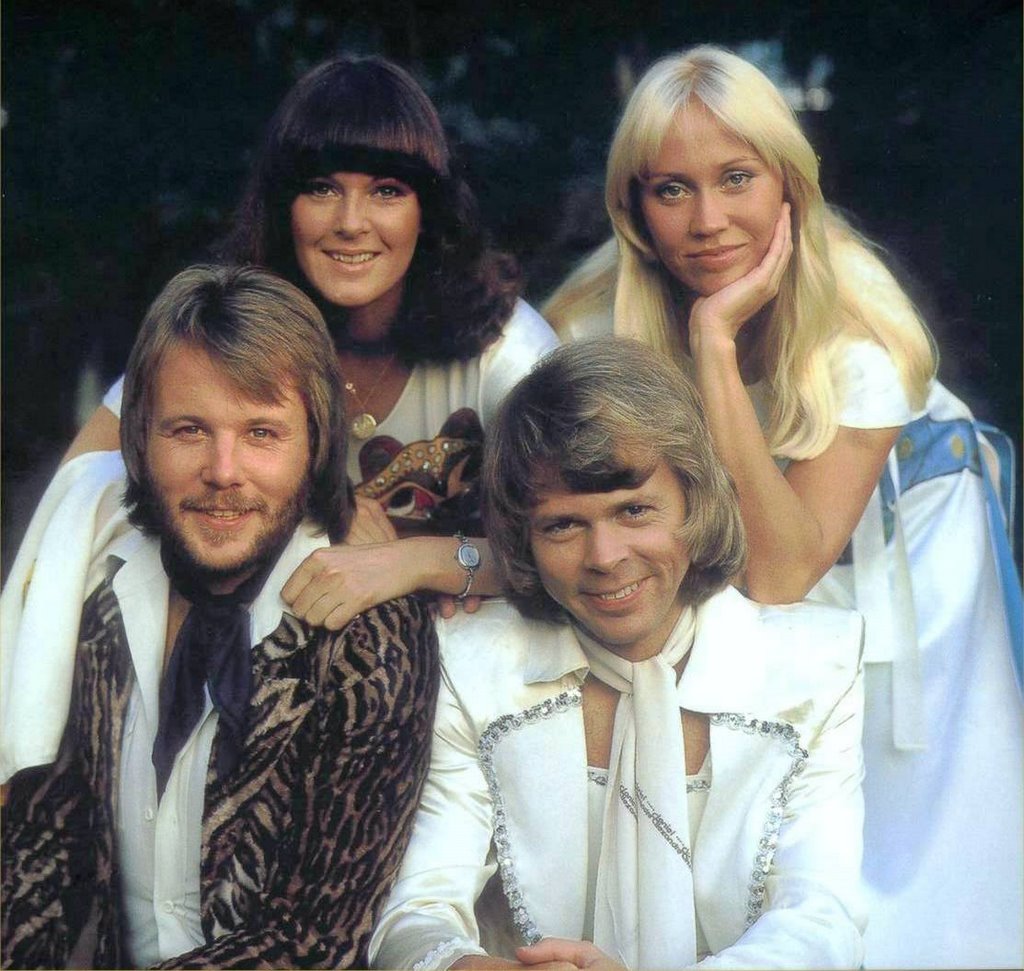
403. ‘Knowing Me, Knowing You’, by ABBA

Already we reach the mid-point of ABBA’s chart-topping run! Their fifth #1, coming from the same album (‘Arrival’) as both ‘Dancing Queen’ and ‘Fernando’. Hit packed!
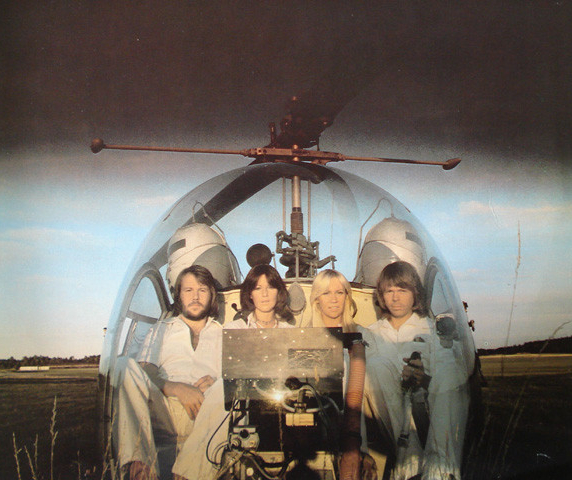
Knowing Me, Knowing You, by ABBA (their 5th of nine #1s)

5 weeks, from 27th March – 1st May 1977

Speaking of ‘Fernando’, the intro to this record sounds like a leftover from that recording session – acoustic guitars and a hint of pan-pipes. Fear not, though, for straight away that funky bass-line comes to our rescue and actually, the nearest comparison from the band’s earlier hits is to ‘SOS’. Power chords and actual hard rock guitars.

No more, Carefree, Laughter, Silence ever after… I’ve mentioned ABBA’s unique brand of English before, and I do love these rhymes that you can see coming from a mile off. Then we get a bit emo: Walkin’ through an empty house, Tears in my eyes… We are a long way from ‘Mamma Mia’s camp exclamations, or ‘Dancing Queen’s affirmation.

Knowing me, Knowing You, There is nothing we can do! It’s a break-up song, but at least it sounds like it’s mutual. A conscious uncoupling, if you will, and the intricate male backing vocals in the chorus do make it sound like a conversation. Breaking up is never easy I know but I have to go… Meanwhile the image of empty rooms in which children used to play is a powerful one.

In fact, it’s an early example of the sorts of songs ABBA would go on to make in the 80s, after their imperious phase and their disco phase. It doesn’t hit as hard as, say, ‘One of Us’, though; because the band had yet to go through their famed break-ups. Agnetha and Bjorn were still together, while Benny and Frida wouldn’t get married until 1978. Perhaps, then, we can say it’s a fictional story about a break up; while those later hits were documentaries.
I have seen ‘Knowing Me, Knowing You’ on top of several ‘ABBA – Ranked’ articles over the years, which has always surprised me a bit. It’s a cracker of a chorus (I mean, it’s ABBA, duh), but it’s never been my favourite. I have, for example, never really understood the song’s signature hook: the a-haaaaa. What does it mean? What does it signify? Meanwhile, Brits of a certain age will never now be able to listen to this song without picturing Alan Partridge.

Maybe it’s because those writers didn’t want to choose the obvious singles, or maybe the song’s slightly low-key vibe makes it a hipsters’ choice. (Though ‘SOS’ is the true hipster’s favourite ABBA single.) It is not as instant as their earlier #1s, but still a classic. Few bands have runs like ABBA did in the mid-to-late seventies. ‘Knowing Me, Knowing You’ gave them their 4th chart-topper, and their seventeenth week at #1, in little over a year. And they will be back soon enough…

394. ‘Dancing Queen’, by ABBA

As a kid my first exposure to ABBA was through ‘ABBA Gold’, the band’s early-nineties greatest hits, track 1 on which is ‘Dancing Queen’. The CD would slide in, there would be that second of scanning, the little whirr… and then bam!

Dancing Queen, by ABBA (their 4th of nine #1s)

6 weeks, from 29th August – 10th October 1976

It’s not the first song you’d think of if asked to name ‘Great Intros’, but it should be. It is a record that strides into the room – the glissando is the door slamming open – with complete confidence. ‘ABBA’s here!’, it announces, ‘With their biggest hit!’ Then the vocals come in, and it’s not just the chorus, but the middle of the chorus, the main hook, thrown out within the first twenty seconds: You can dance, You can ji-ive, Having the time of your life…

I know nothing about musical terms – I can barely tell a pre-chorus from a bridge – but whatever it is that ABBA do in the verses, at the end of every second line, when the key slips lower: Lookin’ out for a place to go… and You’ve come to look for a King… It’s gold. Then they do the opposite, swooping up on the Night is young and the music’s hi-igh… And it’s even better. It’s pure ABBA, in that most other songwriters might think it a bit obvious, going higher on the word ‘high’, while Benny and Bjorn simply shrug and say ‘nope, that’ll be catchy!’

‘Dancing Queen’ doesn’t need me to sell it. It also probably doesn’t need to be written about any more, but hey, I gotta cover them all. Throughout this blog, I’ve referred to ‘Perfect Pop’ when writing about #1s like ‘Stupid Cupid’, ‘Cathy’s Clown’, and ‘See My Baby Jive’. Up until this point, I would have had ‘She Loves You’ as the most perfect pop moment so far. But ‘Dancing Queen’ usurps The Beatles to take, if you’ll pardon the pun, the crown. A crown I’m not sure it’ll ever relinquish.

Why is that? What makes this the ultimate pop song? I think it’s the nugget of sadness beating away at the heart of the record. The main character is a seventeen-year-old girl who seems to be running away from something. She doesn’t know where she’s going, or who she’s going to be dancing with… It doesn’t sound as if she’s got any friends with her. She flirts with one guy, she leaves them burning and then she’s gone… Or maybe not. Maybe I’m misreading it completely! Maybe she’s really just having the time of her life. Maybe she doesn’t need a boy, or a friend. Maybe she just needs to dance. To dance for the sheer joy of it!

Either way, the song has layers, ones that you’re still noticing even after hearing it for the three hundredth time. I could complain about ‘Dancing Queen’ being overplayed, and it is, but when a DJ sticks this on at a party nobody sits down, even though they’re hearing it for the three hundredth and first time. Last time I was a tourist in London, watching the changing of the guard at Buckingham Palace, the band played the chorus of ‘Dancing Queen’ as the soldiers marched past.

Of course this record got to number one. ‘Dancing Queen’ is the dictionary definition of a number one hit. If you’re ever on ‘Pointless’ and the category is ‘#1 Singles of the 1970s’, don’t give ‘Dancing Queen’ as an answer. In the US it was ABBA’s one and only chart-topper (shame on you, America!) My only surprise stems from the fact that, in the UK, it took two weeks to climb to the top. If ever a song was going to enter in pole position, I’d have thought it would have been this. Click. Glissando. Bam.

393. ‘Don’t Go Breaking My Heart’, by Elton John & Kiki Dee

And so, Sir Elton John belatedly takes the stage. Much like Bowie, who finally made #1 a few months before, we’ve already missed a lot of his best stuff. But hey – better late than never. Plus, this is still a pop classic.

Don’t Go Breaking My Heart, by Elton John (his 1st of eight #1s) & Kiki Dee (her 1st and only #1)

6 weeks, from 18th July – 29th August 1976

Don’t go breaking my heart… I couldn’t if I tried… It’s a proper duet, with the singers taking different lines. Finishing one another’s lines, in fact, like an irritatingly cute couple. Oh honey if I get restless… Baby you’re not that kind… It’s the first duet to top the charts since, um, Windsor Davies and Don Estelle. Or, if you’re looking for a non-novelty duet, you’ll have to go back to Serge and Jane, or Esther and Abi OfarimAhem. The point being – genuine duets like this don’t come along too often.

I’m surprised, to be honest, just how disco this record is. It’s usually background noise, a seventies ‘Best Of’ staple, and I’d have put it down as pure pop with a nod towards classic Motown. But listening properly, you can hear that the guitars, the drums and the strings are all set to ‘Disco’. Plus, it’s got the perfect rhythm for hand-jiving.

Woohooo… Nobody knows it…. That hook cements ‘Don’t Go Breaking My Heart’s place as a gem. Is it as good as, say, ‘Rocket Man’? No, obviously not. Unlike David Bowie, Elton isn’t breaking his chart-topping duck with an all-time classic. (In fact, like Bowie, and Queen, who we’ve also met recently, Elton John is very poorly served by his #1 singles.) Still, it’s a fun record, and a karaoke classic, despite being much longer than it has any need to be, at four and a half minutes.

As for Elton’s partner in this… Who was Kiki Dee? Turns out she was the first British female to sign for Tamla Motown, which is pretty impressive. She had scored a few minor chart placings before this mega-hit, then she scored a few more minor ones in the years that followed, until she re-teamed with Elton in 1993, for #2 hit ‘True Love’. She’s still around, releasing albums and working in musical theatre. (Apparently her part in ‘Don’t Go Breaking…’ was written with Dusty Springfield in mind, but she was too sick to record it. No offence to Kiki, who sings it very well, but just imagine how darned iconic this would have been as Elton & Dusty…)

Then there’s the artist formerly known as Reg… Wonder what became of him? Well, amazingly, we won’t meet him again atop this countdown until 1990, when he will finally get a solo chart-topper! It’s not that he lacked hits – this record was his 10th Top 10 hit since breaking through with ‘Your Song’, and he would continue to have hits throughout the eighties – just that for whatever reason they rarely made it all the way to the top.

Till then, then, Elton. Before we go, though, it’s worth pausing to remembering that, as the follow-up to ‘True Love’, ‘Don’t Go Breaking My Heart’ returned to the charts, at #7, in a very ‘90s house version. Elton’s duetting partner on that occasion: RuPaul Charles.

388. ‘Fernando’, by ABBA

From one Eurovision winner to another. I mentioned in my last post the similarities between ABBA and Brotherhood of Man (they both won the contest, they both have two boys and two girls… though I’m unsure if any of the Brotherhood were ever married to one another…) It’s as if ABBA had had enough of ‘Save Your Kisses For Me’s long stay at #1 sullying Eurovision’s good name, and decided to do something about it.

Fernando, by ABBA (their 3rd of nine #1s)

4 weeks, from 2nd – 30th May 1976

This is, I must admit off the bat, my least-favourite of ABBA’s chart-toppers. It crosses the fine line between good-cheese and cheesy-cheese. It is one of the songs that people who don’t like ABBA can use to justify their idiocy. It has pan-pipes, and a marching drumbeat…

Can you hear the drums, Fernando… I remember long ago another starry night like this… I’ve always wondered where and when this song is set. From a young age, I’ve pictured Mexican rebels, in sombreros and ponchos, sheltering around a campfire on a mountainside. They’re fighting for freedom. They’re crossing the Rio Grande, into Texas apparently, to fight the Yankees at the Alamo… (my knowledge of this conflict is patchy – can you tell?) I could hear the distant drums and sounds of bugle calls were coming from afar…

To be fair, not many #1 singles trod these lyrical grounds. Kudos to Benny and Bjorn for writing outside the box. And then, because this is ABBA, the chorus is still a killer. There was something in the air that night, The stars were bright, Fernando… It’s almost enough to make up for the rest, for the pan-pipes, but not quite… And that’s not even the best bit. Every ABBA song has that golden moment, that perfect hook, and ‘Fernando’s is the: Though we never thought that we could lose, There’s no regrets… which Agnetha and Anna-Frid’s gorgeous Swedish accents sell beautifully.

I had no idea that this had originally been written for, and released by Anna-Frid, the year before. That version had nothing to do with Mexican freedom fighters; in it Fernando has lost his lover and is being consoled (I’m trusting Wiki on that, as I don’t speak a word of Swedish.) I also had no idea that the English-language version was the longest-running Australian #1 single until very recently.

In many ways, ‘Fernando’ is a strange #1. And yet in many other ways it feels like it’s existed since the dawn of time, it’s so simple and so earnest. If I had to do the same again, I would my friend, Fernando… they sing as it fades. Maybe that’s the key. It’s not a song about love; it’s about friendship. It’s completely universal. And it is this chart-topper, the band’s 3rd in Britain, that announces them as the real deal. Not many bands could pull this song off. And their next #1, coming up soon, will cement their place as the biggest band in the world…

387. ‘Save Your Kisses For Me’, by Brotherhood of Man

Oh Lordy, it’s Eurovision time again. Our 5th Eurovision chart-topper. (We need some kind of advance warning system – a Eurovision siren that I can sound to prepare you, dear listeners, for what you are about to hear…)

Save Your Kisses For Me, by Brotherhood of Man (their 1st of three #1s)

6 weeks, from 21st March – 2nd May 1976

Not that every Eurovision entry is terrible, of course. For every ‘All Kinds of Everything’ (shudder) there is a ‘Waterloo’ (hurray). ‘Save Your Kisses For Me’ is, though, more towards the Dana end of the Eurovision-ometer. It is the easiest and the cheesiest slice of seventies pop-pap. I think this might actually be the very pinnacle of the genre, and that’s not a compliment.

Though it hurts to go away, It’s impossible to stay… We’ve got all the sentimental schlager themes going on here: separation, a man doing a man’s work, a cute woman pining at home… I’m getting whiffs of ‘The Green, Green Grass of Home’ and ‘Billy, Don’t Be a Hero’, minus all the war and executions. I’m also getting more than a whiff (an almighty reeking stench, to be honest) of Dawn’s ‘Tie a Yellow Ribbon…’ The melody is uncannily similar, and lead singer Martin Lee’s ‘tache and chest-hair combination is veryTony Orlando.

Save… Your… Kisses for me, Save all your kisses for me, Bye-bye baby, Goodbye… You don’t have to dig too deep for other chart-topping comparisons, either. The ‘bye-bye baby’ line sounds mighty familiar, while Brotherhood of Man’s two boys-two girls line-up was clearly following ABBA’s successful formula from two years earlier. And it worked. Not only did ‘Save Your Kisses For Me’ win the contest, it was the biggest single of 1976, and is still one of the biggest selling singles of all time in the UK…

There are a few things to like about this record. There’s a barroom piano, which always sounds good in singalongs like this, and some ridiculous trumpet flourishes. And at least it doesn’t take itself too seriously, which would be a disaster. I’m about to admit that I’m warming to this silly little record… Until, wait a moment. There’s a plot-twist in the very last line.

Won’t you save them for me… Lee croons… Even though you’re only three… The song ends as you’re still wondering what the hell just happened. Ah, of course. He was singing to his daughter all along. Awww… Actually, no. If I were scoring each #1, then that would have just knocked five points off this one’s total. And not because it’s unintentionally creepy – making you think he’s singing about his girlfriend only to find out it’s a toddler – but because it’s dumb. And it’s been done before. Gilbert O’ Sullivan did it in ‘Clair’ four years ago, and it annoyed me then, while Chuck Berry did it in ‘Memphis, Tennessee’ way before that… It is the pop song equivalent of a TV show playing the ‘It was all just a dream…’ card.

Whatever the reason, people clearly dug this kind of cute trick in the seventies. They launched this record to the top of the charts for six long weeks. And they launched the chart-topping career of Brotherhood of Man, who managed something that not many Eurovision acts (ABBA excluded) manage… follow-up hits. Follow-up chart-toppers, even. Save your kisses until then, then, as the Brotherhood will be back. I’ll have my siren up and running by then, to give you plenty of advance warning…

385. ‘December 1963 (Oh, What a Night)’, by The Four Seasons

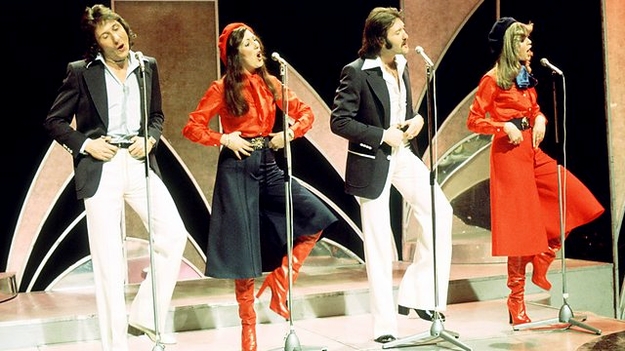
After seeing three of their songs taken to the top of the charts by different artists – The Walker Brothers, The Tremeloes and The Bay City Rollers* – and after well over a decade of hit-making, The Four Seasons finally get a #1 under their own steam.

December, 1963 (Oh, What a Night), by The Four Seasons (their 1st and only #1)

2 weeks, from 15th – 29th February 1976

Like The Tymes a year or so ago, they’ve taken their classic vocal-group sound and updated it, in this case almost drowning it in disco glitter. Oh what a night, Late December back in sixty-three… It’s the tale of a young man’s one-night stand, perhaps even his first time: You know I didn’t even know her name, But I was never gonna be the same…

Main man Frankie Valli is, unusually, not on lead vocals here, but his unmistakeable, slightly nasal voice comes in for the bridge: Oh I… I got a funny feelin’ when she walked in the room… And then, if this is indeed a song about losing your virginity, we can all have a chuckle at the line: As I recall it ended much too soon… What a lady, indeed!

I have to admit that I’m not enjoying this record quite as much as I expected. It’s another one of those: ‘I know this without ever having really sat down to listen to it’ songs that are coming along fairly often at the moment. There are some great sections: the main piano riff, the funky synth solo, the oh-so-seventies chucka-chucka guitars… But somehow it doesn’t all glue together. Still, it’s a killer chorus, one that always sounds great on a drunken dancefloor.

‘December, 1963’ is the second #1 in a little over a year to feature a month in its title, after Pilot’s ‘January’… and there hasn’t been another one since! It is also another seventies hit, along with ‘Kung Fu Fighting’ and ‘Barbados’, that I knew first and foremost through a dodgy nineties cover version, this time thanks to Clock, who made #13 with it in 1996, and which featured on the first Now That’s What I Call Music album I ever owned, aged ten.

I guess we have to see this as something of a swansong for The Four Seasons. It would be their penultimate Top 10 hit in the UK, while in the US it was their fifth and final chart-topper, after a twelve year wait, and the fifteenth Top 10 hit of a career stretching back to ‘Sherry’ in 1962. They are still a going concern, and still led by Valli at the sprightly age of eighty-six, having gone through a staggering forty-nine members in their sixty-odd years together. It feels right that they managed at least one #1 on these shores, even if I still feel slightly underwhelmed by this mixed bag of a song, which never quite adds up to the sum of its parts.

*I have to credit popchartfreak for this bit of chart expertise, which I am now passing on to you…

384. ‘Forever and Ever’, by Slik

Our recent run of number one singles has taken us past some illustrious names, some of the pillars of pop history: Art Garfunkel, David Bowie, Queen, ABBA… now Slik…

Forever and Ever, by Slik (their 1st and only #1)

1 week, from 8th – 15th February 1976

Hmm. Initially I had to do a double take, as I thought it should have been ‘Silk’. Some smooth and silky, mid-seventies soul perhaps. But no, ‘Slik’ it is, and they kick off their one and only #1 single with some church organs, and some ominous chanting. I have genuinely never heard this song before…

When the vocals come in, they come in a Scottish accent. Make that two Scottish chart-toppers out of the past four. As it was in the beginning, Then so should it end… Are we at a funeral…? Don’t let a lover, Become just a friend… It’s quite new-wave, the synthy heartbeats and the half-spoken delivery.

Come chorus time, though, I am pleased to announce: glam is back. The bridge hints at it – the guitars start to growl as the singer builds it up in his best Glaswegian: didnae ya know, didnae ya feel… Then boom. It’s a chorus straight out of 1973, worthy of Wizzard or Eurovision-era ABBA: I dedicate to you, All my love, My whole life through, I’ll love you. Forever and ever…

As a declaration of love, it’s a bit much, a bit stalkery. As a pop song, it’s great. I’m really enjoying this. Why isn’t this on all the seventies ‘Best Ofs’, alongside ‘See Me Baby Jive’ and ‘Come Up and See Me’? The way it spins on a sixpence, from verse to chorus and back again, reminds me somehow of the old Johnny Preston hit from 1960, ‘Running Bear’, which also swung from goofy verses to rocking chorus.

By the end, the rock ‘n’ roll vibe has been boosted by doo-wop backing vocals, sealing this record’s place as a hidden gem I’m very glad to have discovered. Any song that descends into doo-wop backing vocals is fine by me. Slik were a band from Glasgow, and were fronted by James ‘Midge’ Ure (all the other band members took nicknames too: Oil Slik, Lord Slik and Jim Slik… a full twenty years before the Spices!) Ure, of course, is much better known as the frontman of Ultravox, who will famously never have a #1 single, and you can definitely hear the roots of his later work in this pop hit.

Slik were marketed as a new Bay City Rollers, and their hits were written by Bill Martin and Phil Coultier, who wrote many of the Rollers’ songs. This hit was turned down by the Rollers, after being recorded by 2nd rate glam rock outfit Kenny, eventually finding its way into Slik’s hands. I’d place ‘Forever and Ever’ as head and shoulders above either of the Bay City Rollers’ chart-toppers, or indeed any of their non-chart topping singles too. It’s a cracker. Slik faded away quickly, registering just once more on the Top 40, but their lead singer will be back in this countdown, in a decade or so.

383. ‘Mamma Mia’, by ABBA

Into 1976! And we hop from one well-worn classic, to another.

Mamma Mia, by ABBA (their 2nd of nine #1s)

2 weeks, from 25th January – 8th February 1976

It’s a dramatic intro – do dee do dee do dee do dee – that sounds a bit like the soundtrack to a murder mystery. But that also, somehow, lets you know straight off the bat that this is going to be fun. It’s a different sound from their first #1 – less glam, slightly more rock – but it still has that trademark ABBA flamboyance. It’s a cliché, I know, but every one of their hits has a hint (often more than a hint) of camp.

‘Waterloo’ was almost two years ago, and since then ABBA have retreated into the background, scoring a few minor hits but looking like they might be best remembered in Britain as ‘those Swedish Eurovision winners’. Until now. ‘Mamma Mia’ kicks off an era of chart dominance: eight number one singles in under five years. The Age of ABBA begins here.

I’ve been cheated by you since I don’t know when, So I made up my mind it must come to an end… One of my favourite things about ABBA is their English: it’s perfect; yet idiosyncratic. No native English speaker speaks like an ABBA song; yet we know exactly what they mean. (Forgive me, I’m an English teacher…) Yes, I’ve been broken-hearted, Blue since the day we parted…

Like its predecessor ‘Bohemian Rhapsody’, ‘Mamma Mia’ suffers slightly from its ubiquity. Sitting down and listening to it now, I realise just how close it comes to perfect pop. Those power chords leading up to the chorus: Just! One! Look! And I forget everything… In fact, the whole song is a power chord, every note and instrument programmed to hit you right in the sweet spot. The title really should have an exclamation mark.

Mamma Mia! Here I go again! How can I resist ya…! Is there a more ridiculous chorus? First off, why are we using Italian? Do Italians even say ‘Mamma Mia’?? Then there’s the fact that the entire song is an admission of weakness: I want to walk out the door and leave you but, mamma mia, you know I ain’t gonna… It’s the musical equivalent of a knowing wink, a roll of the eyes and a theatrical shrug.

There are better ABBA songs to come in this countdown (as a band they definitely saved the best for last) but this one is undeniable. And in recent years I think it’s probably usurped ‘Dancing Queen’ as their signature tune. That’s all down to the musical (which does have the appropriate exclamation mark!) and its success on both stage and screen. Yes it’s silly, yes it’s been overplayed, but boy if it isn’t a fantastic pop song…

Catch up with all the number ones, from 1952-1975, here:

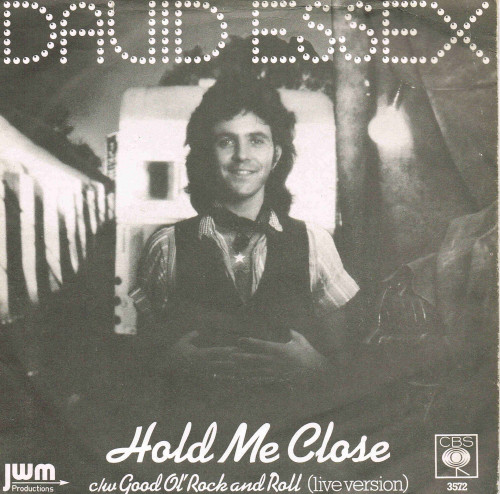
378. ‘Hold Me Close’, by David Essex

Back for another pop at the top, the teen idol of the mid-seventies, and as far as I’m aware the only chart-topping star named after an English county… David Essex!

Hold Me Close, by David Essex (his 2nd and final #1)

3 weeks, from 28th September – 19th October 1975

When I wrote about his first #1, ‘Gonna Make You a Star’, I mentioned that he wasn’t very comfortable with the teeny-bopper tag. In fact, it’s what that whole song was about. A year on, however, I’m tempted to think he’s rolled his eyes, shrugged his shoulders, given in and hopped on the pure pop bandwagon.

Hold me close, Don’t let me go, Oh no… I, Yes I love you and I fink that you know… He’s kept the cockney accent; in fact he might be playing it up here more than ever. Wiv your love loight, shi-nin’… It kind of reminds me of Dick Van Dyke in ‘Mary Poppins’, even though David Essex was genuinely from east London, and I can imagine him gurning in the corny, deliberate pauses between words. It also reminds me, somehow, of Sid Vicious’s poppy covers, ‘My Way’ and the like, though a much more PG rated version.

It’s a fun pop song, and catchy as hell. If it were an animal it would be a huge, slobbering St. Bernard, just looking for a cuddle. The perky riff flirts with becoming irritating, but just about gets away with it, while the song could have a good minute shaved off its runtime and nobody would notice. It was a deliberate choice to make a single as commercial as this to be the follow up to #5 hit ‘Rolling Stone’, which was a bit more out there.

I don’t really have much more to say about this one. It’s catchy, and simple. A solid pop single. In time, David Essex would move more into acting, although he was scoring the odd Top 10 hit well into the eighties. He has starred in various West End productions, including ‘Evita’ and ‘Tommy’, and featured heavily on Jeff Wayne’s ‘War of the Worlds’ concept album (Wayne also produced both of Essex’s chart-toppers.) He still performs, and acts, and has confirmed his place in cockney legend by appearing in ‘EastEnders’, and by having a model of himself in the West Ham United museum.

Follow my #1s Blog playlist:

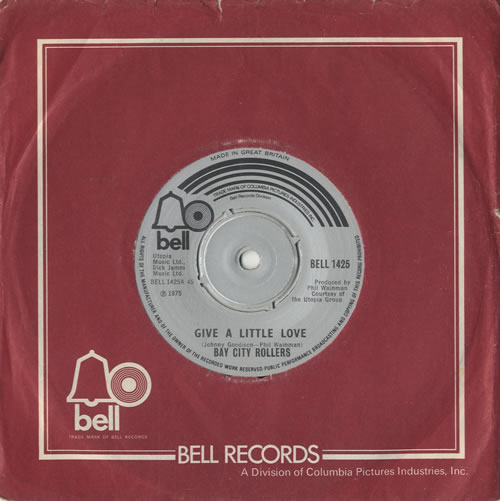
374. ‘Give a Little Love’, by The Bay City Rollers

There are certain rules that all boybands need to follow. Member wise, you need the serious one, the cute one, the bad boy, the joker… And then you need the ballads. Any boyband worth their weight in hair products needs a lighters-up (or a mobile phone with the torch function on-up) moment towards the end of a concert.

Give a Little Love, by The Bay City Rollers (their 2nd and final #1)

3 weeks, from 13th July – 3rd August 1975

It’s a teenage dream, To be seventeen, And to find you’re all wrapped up in love… Here, then, is the Bay City Rollers’ chart-topping ballad. It is every bit as saccharine and as cloying as you might imagine. Give a little love, Take a little love, Be prepared to forsake a little love… (to be fair, not many teen-ballads throw words like ‘forsake’ into their choruses) And when the sun comes shining through, We’ll know what to do… This level of smarmy cheese haven’t been seen at the top of the charts since Donny O’s imperial phase.

The intro to ‘Give a Little Love’ actually promises a very of-the-moment funky soul song, but it doesn’t last. The arrival of the first verse sees things slip into the earnest plod of a proto-power ballad. That’s not to suggest it’s terrible. Bubblegum pop is always, at the very least, catchy. I admit I’m swaying along, while the hard rock guitars sound piped in from a completely different song and the backing vocals are almost, almost, Beatles-esque.

There is, inevitably, a spoken word bit. The mid-seventies are quickly becoming the age of the earnest, spoken word break. And I know, One day, I’ll find a way, To be safe and sound, Within your heart… Cue teenage girls around the country snogging their posters. Past this point, the song does start to drag. It’s just a bit too plodding. Plus, the Rollers’ voices aren’t quite strong enough to carry it.

Of course, as I wrote in my post on their first #1 – ‘Bye Bye Baby’ – it is unfair to reduce The Bay City Rollers to a mere ‘boyband’. They were a ‘proper’ band, ‘proper’ musicians, to start with. But, by the time this was released, they, or their management, were aiming squarely for the screamy teeny market. For the US, ‘Give a Little Love’ was re-recorded with extra strings, because the original just wasn’t drippy enough…

As with most pop groups, the Rollers burned brightly but briefly. In 1976 they took the US by storm, and were causing tartan-waving riots around the world, but by the late seventies several of the members had had enough. They became the Rollers and went New Wave, although this all took place far from the top of the charts. They would reform and tour in various guises in the decades that followed.

To finish, a story that shows just how manic Roller-mania was at its height: a friend’s mum went to school in Edinburgh, in the mid-seventies, and one August was given her maths textbook for the year. Casually glancing at the names of the students who had used the book before her in the cover, she spotted Stuart ‘Woody’ Wood’s name (the cute one). She maintains that she was lucky to come out of the scrum alive; while the textbook wasn’t so fortunate…