491. ‘Don’t You Want Me’, by The Human League

1981 has had its fair share of iconic chart-topping moments: Bucks Fizz’s skirt-ripping moves, The Specials’ call to arms, Soft Cell’s re-imagining of a soul classic, Mercury and Bowie going toe-to-toe… And it ends with perhaps its most iconic tune.

Don’t You Want Me, by The Human League (their 1st and only #1)

5 weeks, 6th December 1981 – 10th January 1982

For this is one of the most recognisable riffs ever, I’d say. Up there with ‘Satisfaction’ and ‘You Really Got Me’ for chart-topping riffs. It’s dramatic and ominous, yet catchy and danceable. It’s a synth riff here, but play it on a piano, a guitar, a bloody harp, and people would know it was the intro to ‘Don’t You Want Me’.

The opening lyrics are equally iconic: You were working as a waitress in a cocktail bar… a male voice intones… When I met you… It’s sung by an overbearing – ok, creepy – bloke. A Svengali figure. He found this girl, made her a star, and now she’s outgrown him. Don’t forget it was me who put you where you are now, And I can put you back down too…

In the second verse, the starlet has her say. Yes, she was working in a cocktail bar… That much is true… She tells him politely that it’s time for her to make it on her own. The male ‘character’ is so well-formed, such a nasty sounding piece of work, that you wish his female counterpart had a little more bite. Who is she? Did she really just use him? Or maybe her niceness is the ultimate insult…?
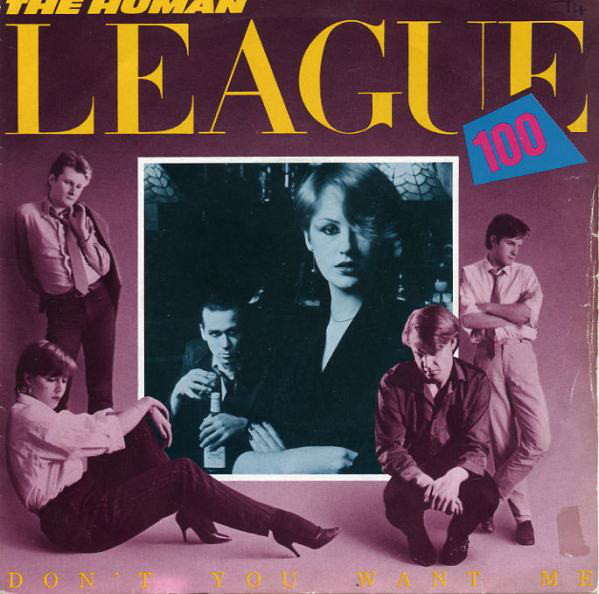
Aside from the riff, the next best bits are the lines that accelerate up to the chorus: You better change it back or we will both be sorry! This is a high-quality pop song, well worthy of being the year’s biggest-seller and a Christmas number one. But – there’s always a ‘but’ – I’m not sure if there isn’t a hint of ‘fur coat and no knickers’ about it. ‘Don’t You Want Me’ has a great riff and great hook, but on repeated listen it goes from all-time classic to simply great pop. Two years ago, Gary Numan was doing things with a synth that genuinely stood out. Now, in late-1981, synths alone are not enough to wow.

Phil Oakey, The Human League’s founder, didn’t want this released as a single, and has said in subsequent interviews that he sees the music video as a big factor in its success. And you can see why: it’s moody, noirish… dare I say, once more for luck, iconic? It’s certainly slicker and more expensive than many of the homemade looking MVs from the last couple of years, and it looks forward to a New Romantic future in the make-up, earrings and fringes. ‘Rolling Stone’ has claimed ‘Don’t You Want Me’ as the starting point for the 2nd British Invasion in the US (it hit #1 on Billboard six months after topping the charts here).

The Human League had only the one UK chart-topper, but were scoring hits well into the nineties. They still tour to this day. After I’m done writing this post, I’m going to listen to the album that birthed this hit, ‘Dare!’ to see what all the fuss us about. Maybe I’m being harsh in saying that this record lacks much substance beyond its killer riff. It’s still a great tune, but when songs come along with as much baggage and reputation as this one then I can’t help expecting great great things…

488. ‘Every Little Thing She Does Is Magic’, by The Police

Part IV of my ongoing campaign to enjoy The Police more…

Every Little Thing She Does Is Magic, by The Police (their 4th of five #1s)

1 week, 8th – 15th November 1981

I do really want to like their records, but there’s always something holding me back. Something about the production, the jaunty reggae rhythms, Sting’s voice… It just doesn’t work for me. Here, the punky edge from their late-seventies records, ‘Message in a Bottle’ in particular, has gone. In its place are synths, and a very MOR piano line.

All of The Police’s chart-toppers so far have centred on not getting what you want (‘Message…’) or what you want not lasting (‘Walking on the Moon’ and, at a stretch, ‘Don’t Stand So Close to Me’). ‘Every Little Thing She Does Is Magic’ falls into the former category. Sting wants to tell a girl all of the feelings he has for her, in his heart, but… alas.

What usually saves Police songs for me are the choruses. They sure could write a killer chorus. The verses might meander, and the fade-outs may be too long, but the choruses kick. Every little thing she does is magic, Everything she do just turn me on… Even though my life before was tragic, Now I know my love for her goes on… The lyrics may look clumsy when typed out, but it’s such an air-punching moment you don’t really notice.

The rest of the song, though? Meh. Something about the mix is quite stodgy, with the voices buried under the instruments. There’s the piano – unusual for a Police song – and African drums. A stripped-back, more guitar-based version would work better for me. But that’s just, like, my opinion. And it’s something I’ll have to get used to as the 1980s wear on: guitars taking much more of a back seat.

This record, the second single from the band’s fourth album, isn’t a giant departure from what went before, but it was different enough for guitarist Andy Summers to object, both to the piano and to the production. It’s definitely The Police’s poppiest #1. And the reason that Sting’s vocals sound so distant may be because the band played over a demo he had recorded months before. And I’m with Summers on this: something about it doesn’t quite click.

So. Four of The Police’s #1s down, one to go. Will the last one – still a year and a half away – finally be the Police song I can love? Well, actually, yes it will. Because their final chart-topper is a decade-defining classic. Until then, then…

478. ‘Making Your Mind Up’, by Bucks Fizz

In which we arrive at what is perhaps the Ultimate Eurovision Song. Everything you want and need from a Eurovision winner is present and correct: stupidly catchy, key changes a-plenty, two guys and two girls, a memorable dance routine… and the whole thing as camp as Christmas.

Making Your Mind Up, by Bucks Fizz (their 1st of three #1s)

3 weeks, 12th April – 3rd May 1981

Not that, mind you, I’m claiming this as the best Eurovision chart-topper. Oh no, no, no. There’ll always be ‘Waterloo’ (and Gina G further down the line…) But if you shoved a microphone in someone’s face and screamed ‘Name a Eurovision act!’, half the British population, of a certain age, would say Bucks Fizz.

It starts with a chugging glam-rock drumbeat, and then in come some chugging glam guitars and you suddenly realise that we’re in the midst of a mini glam revival, what with this coming hot on the heels of Shakin’ Stevens’ rockabilly and an actual glam band’s belated #1. Meanwhile the lead guitars are kind of new-wave – seriously, detach them from the rest of this and they wouldn’t sound out of place on a Police record.

You gotta speed it up, And then you gotta slow it down… Not to suggest that this is anything other than a cheese-fest, though. And the lyrics verge from incredibly dumb to bizarrely suggestive. I have no idea if they were trying for innuendo with lines like: Don’t let your indecision, Take you from behind… and You gotta turn it up, Then you gotta pull it out… or if my mind is simply in the gutter.

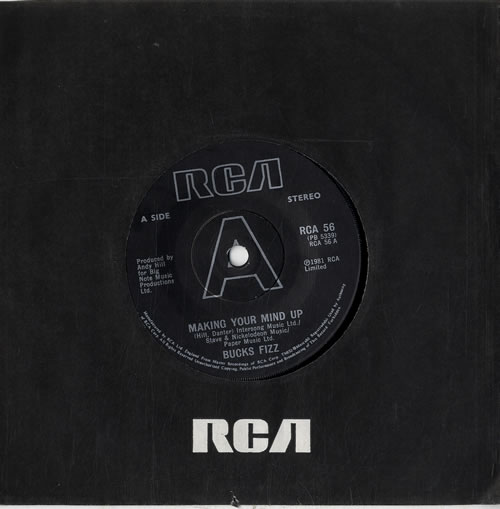
(Apparently ‘Making Your Mind Up’ was released without a picture sleeve in the UK. Very 1960s…)

For the third time in eight years, a two-guys/two-girls combo won the Eurovision Song Contest. While Bucks Fizz were not ABBA, I’d say they were a step up from Brotherhood of Man. They were only formed a couple of months before entering the contest, but this smash kicked off several years’ worth of hits. And if the song wasn’t enough to win the contest, the band had a trick up their sleeve. In the 3rd verse, on the line: If you wanna see some more… the boys ripped the girls’ long skirts off to reveal much shorter skirts underneath! The continent gasped! I mean, the word ‘iconic’ is overused these days, but…

I have to say that, as revealing as the girls’ costumes were, watching the performance in full for the first time I can say that the boys’ white trousers weren’t leaving much to the imagination either. Bucks Fizz (even their name is ridiculous…) will be back atop the charts soon. Until then, you have two options: roll your eyes and pretend you’re too cool for school; or whip out your scandalously short mini-skirt and go for it. Make your mind up!

474. ‘Woman’, by John Lennon

Part III of the Great John Lennon Mourning Period. A single from his brand new record kicks the re-released classic from top spot, only the second time an artist had replaced themselves at #1 (Lennon was also quite heavily involved when ‘I Want To Hold Your Hand’ replaced ‘She Loves You’ seventeen years earlier).

Woman, by John Lennon (his 3rd and final #1)

2 weeks, 1st – 15th February 1981

Just like ‘Starting Over’ – see what I did there –this is another love-letter to Yoko. He starts off by whispering The other half of the sky… (reminding me of the whispered ‘Happy Christmases’ on ‘Happy Xmas (War Is Over)’) and then launches into a detailed explanation of why this woman is so special: Woman, I will try to express, My inner feelings, And thankfulness…

It is a bit soppy. And a bit simplistic. Like ‘Imagine’, the message is sincere but basic. And Lennon’s voice is as close to simpering as I’ve ever heard it, especially on the Hold me close to your heart… line. While the chorus is all ooh-ooh-oohs and do-do-do-dodos. ‘Strawberry Fields Forever’ it is not. Nor is it the equal of much of Lennon’s earlier solo stuff: ‘Mind Games’, ‘Whatever Gets You Thru the Night’, ‘#9 Dream’ and the like…

That’s not to say it’s a bad song. It’s fine. It’s still a song written by John Lennon, and the quality is there. But like ‘Starting Over’, this wouldn’t have been coming anywhere close to #1 had the tragic not occurred. And I’ve always thought that calling the song ‘Woman’ was a little insulting. He could just as easily have called it ‘Yoko’ and it would still have scanned (though perhaps wouldn’t have sold quite as well…) Still, as Lennon himself said, it is a tribute to all women: Yoko, and you’d imagine his late mother, the aunt that raised him, his first wife Cynthia… That makes it a little more sincere to my ears.

I’ve never fully listened to ‘Double Fantasy’, the album from which this and ‘(Just Like) Starting Over’ came, released three weeks before Lennon’s murder. Going by the song titles there was a bit of a theme going on: ‘Dear Yoko’ and ‘Beautiful Boy (Darling Boy)’ from John, and ‘Beautiful Boys’ and ‘Every Man Has a Woman Who Loves Him’ from Yoko. It’s a celebration of love and family, against which the image of Lennon being gunned down in the doorway of his home, his wife watching on, becomes even more horrific.

But from what I have heard from the album, I’m not sure it would be so well-regarded if it hadn’t been for his soon-to-follow death. Lennon himself won’t be back on top of the charts – the 3rd single, ‘Watching the Wheels’, only made #30, which is a shame because it’s better than either of the #1s – but there is one more tribute to come before the Great Mourning Period wraps up. It must have been a sad time, and people must have been looking for some light relief. For what else would explain our next #1 single…? Gulp!

471. ‘(Just Like) Starting Over’, by John Lennon

It’s been well over a decade since we heard this voice at the top of the charts, one of rock’s most famous. It’s great to hear it again… just a shame about the circumstances.

(Just Like) Starting Over, by John Lennon (his 1st of three #1s)

1 week, 14th – 21st December 1980

Three clear notes are struck – three notes that always make me think of a yacht coming into harbour – before an old-style acoustic intro. Our life… Together… Is so precious… Together… John Lennon made no secret for his love of rock ‘n’ roll music, and this is his tribute to the stars he grew up with, those who caused him to pick up a guitar: Elvis is the one who comes across most in the vocals, but there’s Roy Orbison, Buddy Holly and Gene Vincent in there too.

It’s a love-letter too, to his second wife, Yoko Ono, who appears on the cover and on the ‘B’-side… But when I see you darling, It’s like we both are falling in love again… It’ll be, Just like starting over… As controversial as her role in The Beatles’ final years is (and I think she gets a very bad rap), Lennon loved her dearly.

When the beat kicks in, the production is very early-eighties gloss. Thick, echoey drums, noodley guitar licks and the like. It’s got a karaoke backing-track feel to it – if that isn’t a huge insult to one of the 20th century’s most revered musicians – and doesn’t scream ‘lead-single from John Lennon’s first album in five years’. He chose it as the lead, though, not because he thought it was the best song on the LP, but because the theme of ‘starting over’ fit in with his comeback.

‘(Just Like) Starting Over’ doesn’t scream ‘huge #1 hit’ either, to be honest. It’s fine, it’s catchy, it’s far from Lennon’s greatest moment. I prefer the rock ‘n’ roll covers he had put out a few years earlier: they’re rawer, cooler. This needed a push to return him to the top, and that push came on the evening of December 8th, when a deluded fan, Mark Chapman, shot him in the entrance to his apartment in New York.

This single had peaked at #8 a few weeks earlier, but had dropped to #21 the day before his death. When the news broke, fans rushed out to buy his records as a mark of respect – in those pre-download days you had to make do with what was on the shelves – and this single was waiting for them. It’s the same reason why ‘Way Down’ became Elvis’s ‘funeral number one’. And ‘… Starting Over’ must have seemed nailed-on to become Christmas #1 too… yet fate had other ideas.

Unlike Elvis’s death, this chart-topper kicks off a run of Lennon-mania at the top of the charts. Between December 1980 and the following March, four out of the six UK number ones will be by John Lennon, or a cover of. The two records that disturb this run…? Um, classics, the pair of them… The first of which is up next.

470. ‘Super Trouper’, by ABBA

I had no idea, when I wrote this post on ABBA’s final UK #1, that I would be publishing it the day after ABBA returned triumphantly to the top of the charts with their comeback album. It’s a nice bit of symmetry…

Super Trouper, by ABBA (their 9th and final #1)

3 weeks, 23rd November – 14th December 1980

In my eight earlier posts on ABBA, I believe I’ve given very short shrift to those among us that dislike Sweden’s greatest gift to the world (sorry IKEA, sorry Vikings…) Until now, that is. For I do kind of understand why ‘Super Trouper’ might get on your nerves.

That’s not to suggest anything but love for this, their final UK #1. Ask twelve-year-old me, and he’d probably name ‘Super Trouper’ as his favourite ABBA song. The chorus is pitched perfectly at a kid’s ears: the soopapa troopapa backing vocals, the computer game synths… But the chorus, unexpectedly, is the worst part of this song.

One of the reasons I loved this song as a child is that it name checks Scotland’s biggest city in its opening lines: I was sick and tired of everything, When I called you last night from Glasgow… (Glasgow! My gran and grandpa live in Glasgow!) Childhood associations aside, that line is pure ABBA. Then they go and rhyme it with ‘last show’. Most bands using English as a first language would have tossed it out with the first draft. Besides, Glasgow is hardly the first place you’d think of to encapsulate the life of a world-famous pop star…

Or maybe that’s the point. Because ‘Super Trouper’ is all about the drudgery of pop stardom. All I do is eat and sleep and sing, Wishing every show was the last show… (A super trouper is a stage light, whose beams might indeed blind those on stage.) ABBA weren’t the first, nor the last, band to write a song about how terrible it is being famous. But somehow they manage to do it without the message grating. It’s a gift, definitely, to be able to wrap lines bemoaning a success that never ends in glossy pop chords, and getting away with it.

This record might not hit the heights of some of the band’s earlier hits, but there’s still one moment of pure ABBA Gold. Frida’s vocals in the bridge: So I’ll be there, When you arrive… In ABBA’s final number one, it’s the last of many moments of pop perfection. From ‘Waterloo’s glam-rock pre-chorus, to this. Thank you, as they themselves would say, for the music. Just in case anyone’s interested, I would rank ABBA’s nine #1s thusly:

‘Fernando’ > ‘The Name of the Game’ > ‘Take a Chance On Me’ > ‘Super Trouper’ > ‘Mamma Mia’ > ‘Waterloo’ > ‘Knowing Me, Knowing You’ > ‘Dancing Queen’ > ‘The Winner Takes It All’

That list only tells half the story, though, as many of the band’s classics, and some of my favourites, never got to number one. I will do a ‘Best of the Rest’ soon, and I can’t wait. Following this final chart-topper, they would have just two more Top 10s, releasing what many think is their best album, before finally fizzling out in 1982.

I don’t know quite how true it is, but popular knowledge would have it that ABBA were done and dusted, the carpet pulled over them like an embarrassing stain, by the late eighties. My parents liked them, though they are definitely not representative of society as a whole. But then the ‘90s brought ‘ABBA Gold’, Erasure’s covers, and ‘Mamma Mia’. By the time the stage-show had been made into a movie, everyone loved ABBA again. Unless you’ve already moved to your doomsday bunker in the woods, you’ll have heard that they reformed earlier this year, and have released said #1 album, their first in forty years. Who knows, there may still yet be time for them to add to their tally of #1s…?

463. ‘The Winner Takes It All’, by ABBA

In which ABBA return, triumphant, to the top of the charts, with their best song. Shortest post ever…

The Winner Takes It All, by ABBA (their 8th of nine #1s)

2 weeks, from 3rd – 17th August 1980

OK, fine. I should write a bit more. For a song to be ABBA’s best, it has to be a pretty good song. But why is ‘The Winner Takes It All’ so good? I’m no musicologist – if indeed that’s an actual job – and so cannot talk about chord progressions, keys, and melodic shifts (though I’m sure this record is brimming with them). I’m not sure I can look at this record objectively at all. I grew up with this song. I can’t remember a time when I didn’t know this song.

It’s a song full of moments. From the opening piano line – confident, stately – which announces that yes, this is ABBA and yes, something great is coming. The moment right at the start of the second verse, when the beat kicks in. The But tell me does she kiss… start to the third verse. The spoken but you see… The fade-out, when the vocals shift to the background and the trademark piano takes over again. It’s long for a pop song, but it’s exactly as long as it needs to be. Everything that’s there – pianos, guitars, strings, synths, backing vocals – is essential. There’s nothing extravagant about it (which isn’t something you can always say about ABBA songs).

A song about love as a game, with lovers holding cards, and the Gods throwing dice. It could come across as a bit silly. A bit flowery. But it doesn’t, because Agnetha sells it. She sells it, and then some, from the opening I don’t wanna talk… line through to the closing The winner takes it all… that she belts out in a manner unlike any ABBA single before. This is pop as a stage show, as opera. It’s melodramatic, and unrepentantly sad. There’s no sign of her moving on, of a brighter tomorrow. She’s having a good old wallow. She may even be enjoying this wallow, in a self-indulgent way. Why should she complain? Yet she still does. She doesn’t want to talk… but then she sings a full-blown song about it.

It’s been well-documented that, by this stage in ABBA’s career, the personal relationships between the members of the band had collapsed. It feels lazy to suggest that that’s what makes this song so powerful. But just imagine: Bjorn writes a song – while drunk apparently – about his recent divorce. Then hands it to his ex-wife to sing! She’s the ‘bad guy’ that she’s singing about! (Although Bjorn has denied that it’s specifically about their own divorce.) Still, that’s not your usual husband-wife, singer-songwriter dynamic. You can really hear the pain in her voice, in the lines before the final, earth-shattering chorus: And I understand, You’ve come to shake my hand…

I know people who don’t like ABBA. They’re a dying breed, thankfully, as the band has long since shaken off the cheesy, gay-bar reputation they had when I was growing up. But they still walk among us, the weirdos. The lady next to you on the bus, the guy that just served you in Starbucks… might not like ABBA. It’s best not to think about it. I can’t understand how you could listen to ‘The Winner Takes It All’ and not like it, not get it, not see it for the five minutes of genius that it is. Anyway. ABBA are back at the top of the charts, after what feels like ages. But, alas, they have just one more #1 to come…

461. ‘Xanadu’, by Olivia Newton-John & Electric Light Orchestra

Finally. One of the seventies’ best groups top the charts, a few months too late. ELO and ONJ are taking us off to a mythical land…

Xanadu, by Olivia Newton-John (her 3rd and final #1) & Electric Light Orchestra (their 1st and only #1) 

2 weeks, 6th – 20th July 1980

To be honest, this has never been my favourite Electric Light Orchestra song – is it anyone’s? – but it’s still a good slice of Jeff Lynne glam-pop. The wall-of-sound production and the beefy drums take us back to the height of glam, while the tempo and the strings are very disco. It’s a throwback, already, given the spiky, new-wave chart-toppers that we’ve already heard this year.

It’s also nice to hear Olivia Newton-John warbling away on another #1, after her two ‘Grease’ mega-hits in 1978. It’s a song that requires her to sing in a pretty high pitch, but she carries it off. Her Xanad-ooh-ooh… in the chorus, twinned with the piano riff, is an effective hook, while the Now we are here… backing vocals are pure ELO.

Amazingly, this is already the second #1 single to reference ‘Xanadu’ in the title, the lost city in northern China, seat of the Mongol Khans, ‘found’ by Marco Polo… It has now been named twice as many times as any other place. A place… as Olivia tells it, Where nobody dared to go, The love that we came to know, They called it Xanadu…

All very mystical. Except, in the movie that this record soundtracks, ‘Xanadu’ is a nightclub. A roller-disco. (I, to be fair, knew several nightclubs in my youth best described as ‘places nobody should dare to go’, not without a fair amount of alcohol inside them…) I have never seen the movie: it was awarded a Golden Raspberry but has since been reclaimed as a camp classic. Both ELO and ONJ scored further hits from the soundtrack, including the brilliant ‘All Over the World’.

The one thing I can’t get behind with this record is the ending. The soaring, distorted high-note. It reminds me – and this might just be because both involve Olivia Newton-John – of the stupid ending in ‘Grease’, with the flying car. A simple fade-out would have done much more nicely. But what do I know? Jeff Lynne apparently rates this as his best song.

I started this post with the word ‘finally’, and it really did take a while for Electric Light Orchestra to score a UK #1. ‘Xanadu’ was their 14th Top 10 hit, in a run stretching back to 1972. They would only have one further Top 10, before the hits dried up. (To do them justice, I’ll have to do a ‘Best of the Rest’ at some point.) Olivia Newton-John faces a similar chart trajectory – a few more hits before a mid-eighties drought. Meanwhile, Xanadu itself is still waiting for someone to score another #1 with its name, to complete the hat-trick.

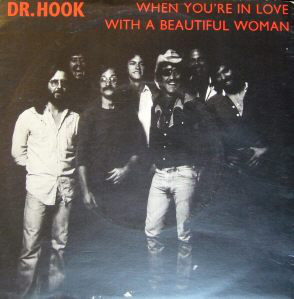
446. ‘When You’re In Love With a Beautiful Woman’, by Dr. Hook

The pre-penultimate #1 of the decade, then. And what’s this…? More country and western?

When You’re In Love With a Beautiful Woman, by Dr. Hook (their 1st and only #1)

3 weeks, from 11th November – 2nd December 1979

At least this isn’t the abrasive, twanging, Lord-have-mercy country style brought to us by Lena Martell. It’s a much softer, disco-edged kind of country. A sort of pop-Eagles. Completely against the grain of what’s topped the charts for much of 1979, but perfectly pleasant.

Let’s get one thing out of the way first: When you’re in love with a beautiful woman, It’s hard… (You know it gets so hard…) Well, quite. Stop sniggering at the back, there! Innuendo aside, it’s an interesting concept for a song, and very ‘country’ in the way a good thing – being in love with a beautiful woman – is gleaned for negatives.

You can’t trust your friends around her, you see. You watch her eyes. You wonder who that was hanging up when you answered the phone… Everybody wants her, Everybody loves her, Everybody wants to take your baby home… I like the backing vocalists – You better watch your friends, Watch your friends… – that feel as if they’re whispering devils on the singer’s shoulder.

Actually, though, if you stop and think about it, it’s a little bit sinister. Your lover’s unfaithful, your friends are backstabbers, the world is out to burst your loved-up bubble… Maybe it’s just an ego problem… sing Dr Hook. Sounds like it, yup. It’s a bit of a study in fragile masculinity, really. What’s the solution? Only go for ugly girls…? Be less of a suspicious twat…?

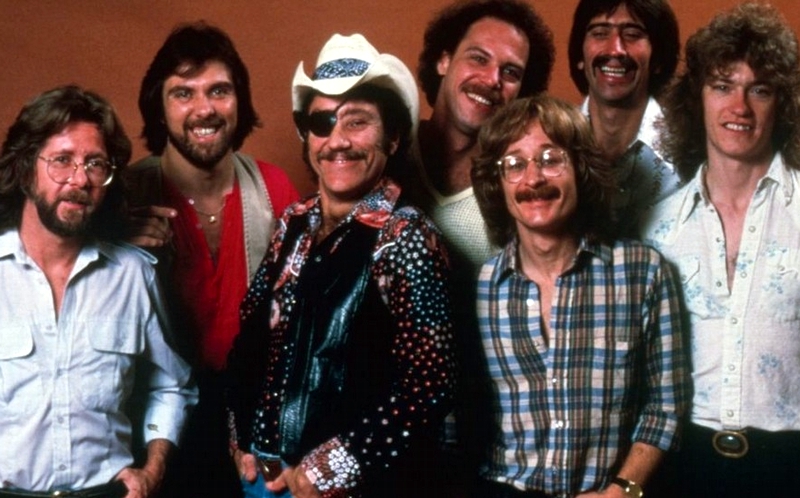
However, it’s easy to ignore the creepy undertones, and to get swept away by this light, fun, fairly inconsequential chart-topper. Dr Hook had been around since the start of the decade, popping up in the charts at regular intervals, before achieving their one and only chart-topper. The band name came from the fact that singer Ray Sawyer wore an eye-patch following a car crash. (Hook – Captain Hook – pirates – eye-patches… get it?)

This was almost their chart swan song – they would have a couple more Top 10s before splitting up in the mid-eighties. And this is almost our seventies swan song: just two more chart-toppers before the decade is out…!

441. ‘We Don’t Talk Anymore’, by Cliff Richard

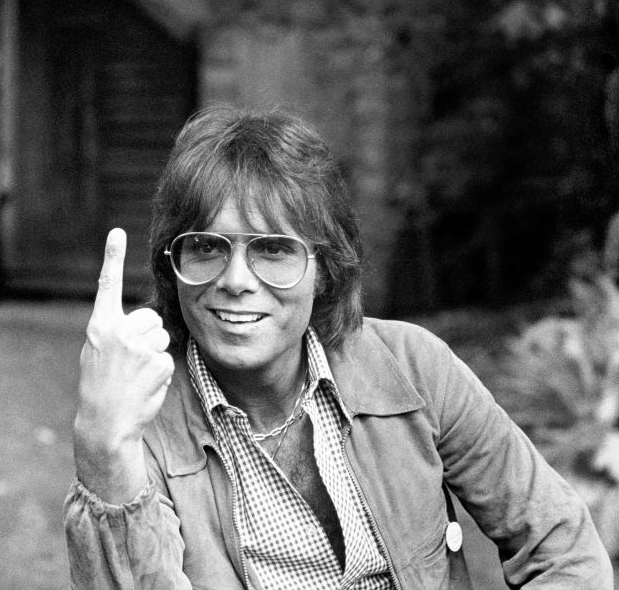
Twenty years to the day from his very first number one hit, ‘Living Doll’, and over eleven years since his last, Sir Clifford of Richard is back, back, back…

We Don’t Talk Anymore, by Cliff Richard (his 10th of fourteen #1s)

4 weeks, from 19th August – 16th September 1979

The first thing that strikes my ears is how modern this sounds – synths are now just an accepted part of the musical landscape – but also how retro. Especially in the verses, it sounds like one of his old rock ‘n’ roll hits dressed up for the late-seventies. Used to think that life was sweet, Used to think we were so complete… he sings over a simple guitar riff, while hand claps enter later on.

It’s a canny move from Cliff and his record label to release a song like this, one that straddles the sort of easy-listening cheese you expect from the man, but that also slots in perfectly with the sound of the time. The chorus is a belter: It’s so funny, How we don’t talk anymore… At certain points in the song I’m getting hints of Billy Joel, then Hall and Oates, but by the chorus Cliff’s giving us pure Elton John: No I ain’t losin’ sleep, And I ain’t countin’ sheep…!

The synths are maybe a bit tinny – though that’s perhaps because I still have the Tubeway Army ringing in my ears – but aside from that I’m not ashamed to admit that this is a tune. I knew it vaguely, because my mum is a big Cliff fan, but had never properly listened to it. Richard sounds like he’s having a lot of fun, and his falsetto after the post-chorus drop is perhaps the best five seconds from any of his fourteen chart-toppers. Damn it… Cliff sounds… Cool! And then the fade-out has actual hard rock guitars. Hard rock. Cliff Richard. What a moment…

I am amazed to discover that he was still only thirty-eight when ‘We Don’t Talk Anymore’ made the top. In my mind, Cliff was a teenage idol for a few years, before waking up one day around 1965 as an old man. Anyway, as young as he still was, this record marked a bit of a comeback for him after a decade in which he’d struggled for hits. It was his first Top 10 single since ‘Devil Woman’ in 1976, and is possibly his biggest hit internationally: a #1 across Europe, and a #7 in the US – only his 2nd release to get that high in the States.

Cliff is famous for managing UK number one singles in five consecutive decades – a feat that nobody else has ever managed – but he left it late in the ‘70s. In a nice touch, the record that kept the run going was produced by Bruce Welsh from his long-time backing band The Shadows, with whom he shared so many ‘60s hits. Amazingly, this is the decade in which Cliff has fewest chart-toppers: in both the eighties and nineties he’ll manage two, while his final #1 is another twenty years away. Whatever you think of the man, his beliefs, and his music… There’s no denying his legend.

And there’s no denying that this might be the best of his fourteen chart-toppers. I say that because none of his earlier hits truly grabbed me – though I do like the rockabilly ‘Please Don’t Tease’ and the unashamed cheese of ‘Congratulations’ – and because I know… shudder… what’s to come… Yes, Cliff’s far from done featuring in this countdown; but I will be nowhere near as generous with his final chart-toppers…!