98. ‘Running Bear’, by Johnny Preston

The opening handful of sixties #1s have been pretty new to me, in contrast to the Cliffs, Buddies and Bobbies that closed out the fifties. But this latest record is a new level of new: a completely unknown entity. ‘Running Bear’? Nope. By Johnny Preston? Nope…

johnny-preston-running-bear-1960-3.jpg

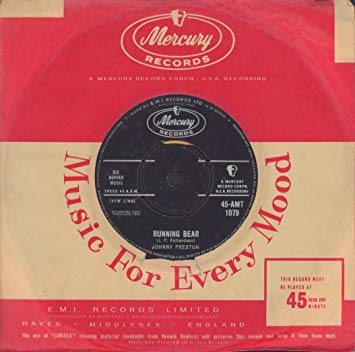
Running Bear, by Johnny Preston (his 1st and only #1)

2 weeks, from 17th – 31st March 1960

It is, though, a record that catches you from the get-go – perhaps desperate to ensure that, while you may not have heard it before, you won’t go forgetting it in a hurry. It opens with a drumbeat, a deep-voiced oom-ba-doom-ba, some grunts, a whoop and a holler and a, wait… a Native American war-cry?

Oh dear… Is this going to be one of those records best described as being ‘of their time’? A record to make your grandad chuckle ruefully and mutter something about ‘not being able to get away with it nowadays.’ Remember Guy Mitchell’s ‘She Wears Red Feathers’? The story of the love between an Englishman and an oriental beauty (in a fetching huly-huly skirt)? Well, this is the same kinda deal. But with Red Injuns!

On the banks, Of the river, Stood Runnin’ Bear, Young Indian brave, On the other, Side of the river, Stood his lovely, Indian maid… Runnin’ Bear pines for lil’ White Dove, who waits oh-so patiently for him across the water. But their tribes are at war, and so their love cannot be…

It’s a romance in three verses. The first sets the scene (above), the second puts Running Bear’s tortured position into clear focus. They can’t cross the raging river, and so: In the moonlight, He could see her, Throwing kisses, Cross the waves, Her little heart, Was beating faster, Waiting there, For her brave…

The third and final verse brings resolution. Bear throws caution to the wind, dives in the river and White Dove follows suit. And they swam, Out to each other, Through the swirling, Stream they came… Their hands touch, their lips meet… they’re both pulled to the bottom and drown. Yup. Didn’t say it was a happy resolution, did I?

That’s by far the best bit of the song – the brutal killing off of the main characters in a way that would shock even George R.R. Martin. I mean, if they’d made it to the other side and lived happily ever after then so what? Who’d care? This is more memorable. It’s a novelty record, for sure, but with an ending that suggests an irreverence, a knowing wink, that I don’t think we were getting a few years ago in, say, ‘How Much is That Doggie (In the Window)?’
91tVS5JbQ5L._SX355_

Musically this song is pretty interesting too. It alternates between the tribal rhythms – the pow-wow-by-the-wigwam vibe – of the verses and the raucous sax-led choruses. It’s silly; it’s fun. And, to be fair, while the lyrics may sound a little dubious to modern ears (hey, at least Preston doesn’t put on any ‘me very wise man’ voices) there’s nothing explicitly racist here. It’s a simple little love song, with a darkly comic twist at the end.

Why it caught the British public’s imagination in the spring of 1960 isn’t so clear, however. It drags us completely away from the run of jingly-jangly, winsomely innocent chart toppers we’ve been having and back a good few years (it was written and recorded in 1958). Johnny Preston seems to have been a fairly run-of-the-mill American rock ‘n’ roller who scored a few hits in the late fifties / early sixties; and who became known as Johnny ‘Running Bear’ Preston for the releases that followed his biggest hit. But it makes complete sense to discover that ‘Running Bear’ was originally written and recorded by The Big Bopper – last seen dying in the same plane crash that claimed the life of Buddy Holly. He even contributed the oomba-doombas and the war cries to this version, meaning that this giant (and I mean that fairly literally) of rock ‘n’ roll can claim part-ownership of a UK #1 single.

A pleasant enough diversion, then, with an ending that I’ll remember – and will possibly be emotionally scarred by – for some time. And for a song that I had had no experience of whatsoever until coming to write this post, I’d say that’s a job well done!

77. ‘Hoots Mon’, by Lord Rockingham’s XI

And so on we roll towards the United Kingdom’s seventy-seventh chart topping single. And it’s a song that I’ve never… No, wait… Ah! I know this… We all know this…

Lord-Rockingham_s-XI-Hoots-Mon-1958-7”

Hoots Mon, by Lord Rockingham’s XI (their 1st and only #1)

3 weeks, from 28th November – 19th December 1958

Dooooo-doo-doo-do-do… Dooooo-doo-doo-do-do… It’s an intro that smacks of slightly misplaced grandeur, like an aged diva swishing onto the stage before slipping on a banana. We know what follows is going to be absurd. And, oh boy, it is…

Na-nana-na-nana, Na-nana-na-nana, Nana-nanananana… Na-nana-na-nana, Na-nana-na-nana, Nananananananana… Apologies for my woeful attempts to render this riff using the medium of ‘na’s. The minute this starts playing you will know it.

It’s an instrumental, and it’s been a while since we featured an instrumental. I make Winny Atwell’s ‘The Poor People of Paris’ our most recent lyric-less number one, and that was two and a half years back. And it is undeniably catchy. It bores its way in on the first listen and will, I’m sorry, remain for days. And days. And days. There are key-changes, oh yes! And the bass! One of my main complaints about the rock ‘n’ roll numbers we’ve heard so far is that, while there have been some undeniable classics – your ‘Great Balls of Fire’s, your ‘That’ll Be the Day’s and your ‘Rock Around the Clock’s – they’ve all sounded a bit light to modern ears. Listen to this, though, especially through headphones. It fills your ears, in a way that makes it sound like a modern record. Every instrument – the throbbing bass, the slapdash drums, the natty organs – are, if you’ll forgive the cliché, turned up to eleven. And a half.

Actually, I called this an instrumental; but it’s not quite. There are a few words, shouted out above the clatter, foremost among them being: There’s a moose loose aboot this hoose… and It’s a braw, bricht, moonlicht nicht… Then there are the Och Ayes! thrown in towards the end and the big Hoots Mon! upon which the record ends. Yes, this is, as they say in theatre circles, The Scottish Number One. All we’re missing is a ‘Help ma Boab!’

large

The ringleader of Lord Rockingham’s XI was a man named Harry Robinson, a Scot if ever there was one. But, being from Scotland myself, I’m not sure how I feel about this record, and the manner in which it reduces the culture, language and heritage of my homeland to a handful of trite, drunken catchphrases…

Actually, screw it. It’s as catchy as crabs and a hell of a lot more fun than some of the more ‘official’ Scottish songs – ‘500 miles’ (Jings!), ‘Scotland The Brave’ (Crivvens!), ‘Caledonia’ (Shudder… and boak!) In fact, I think that this song I hadn’t ever properly listened to until twenty minutes ago should become our new national anthem, in place of the dirge that is ‘Flower of Scotland’. And when I fulfil my manifest destiny in replacing wee Nicky Sturgeon as First Minister, that’ll be the first act I sign into law.

Anyway, file this record under ‘complete and utter novelty’. It’s no coincidence that it hit the top spot in the weeks leading up to Christmas and New Year. Lord Rockingham’s XI wouldn’t go on to much more success and so for the first time, I think, we have two (semi) one-hit wonders replacing one another at the top of the charts. File this also under ‘British Rock ‘n’ Roll’. It’s something that I’ve long been noting – the gradual handing over of the rock ‘n’ roll baton from the US to the UK – and with this anarchic British track following soppy efforts from The Everly Brothers and The Kalin Twins the transition may be complete.

I’ll finish by reminiscing on how this song stirred in me a long-discarded, foggy memory of a commercial for something or other, way back in the late eighties or early nineties… I knew I knew this song, but I didn’t know how I knew it – if you catch my drift. I suppose whatever it was will be forever lost in the mists of time… Actually, no it won’t. The advert was for Maynard’s Wine Gums, back in 1993. Thanks, internet.

70. ‘Whole Lotta Woman’, by Marvin Rainwater

MARVIN_RAINWATER_WHOLE+LOTTA+WOMAN-570312

Whole Lotta Woman, by Marvin Rainwater (his 1st and only #1)

3 weeks, from 25th April – 16th May 1958

Our first encounter with a very specific sub-genre of pop hit: the ‘Ode to the Larger Lady’. From Queen’s ‘Fat Bottomed Girls’, through ‘Whole Lotta Rosie’ and ‘Baby Got Back’ – these songs are out there if you’re looking for them. And perhaps this is where it all began.

Although, this song might not be about a large lady at all. Is Marvin Rainwater really a chubby-chaser? Or is his girl just hard to please? The lyrics keep it ambiguous. Either way, this is pretty saucy stuff for 1958.

It takes a whole lotta lovin’ just to keep my baby happy, It takes a whole lotta kissin’ and a whole lotta holdin’ her hand… Mr. Rainwater sings. And the effects of this woman’s caresses are not quickly forgotten: Well when she loves me she loves me so hard, It almost makes me mad… She’s a handful, this lass. But Marv is up to the task: Cos she’s a whole lotta woman and she gotta have a whole lotta man… We get it buddy, we get it…

That’s pretty much it, lyrics-wise. This is fluff: goofy and silly. It rollicks by in two and a half minutes, and you’ll enjoy listening to it; but it won’t stay with you for very long afterwards. I’m tempted to call it a novelty record, given the subject matter, the singer’s name (Marvin Rainwater?) and the corny guitars and piano that lend yet another rock ‘n’ roll #1 a slight whiff of cheese. Plus, the ending is a super-basic – diddley diddley diddley diddley doo DUM DUM!

It turns out that Rainwater was as close to a one-hit wonder as you can get (i.e. a two-hit wonder). His only other UK chart success came from the follow-up to this record. He was 25% Cherokee – hence the vaguely Native American sounding surname – and liked to wear headdresses on stage. He lost part of a thumb as a teenager, and had to stop recording when his voice gave out. Hank Marvin of The Shadows adopted that very stage name in his honour. Marvin Rainwater – this was your life.

maxresdefault

I have to admit that I did know of this song before writing this post. As with a couple of earlier chart-toppers (‘Dreamboat’ was one, I think), ‘Whole Lotta Woman’ popped up as a Spotify recommendation and I enjoy listening to it whenever it appears on a shuffle playlist. Incidentally, what does it say about me that Spotify knew I’d enjoy this record…?

I mentioned, in my previous post, the ebb and flow around the top of the charts at this time. And again, after a few weeks of chilled easy-listening, rock is having a moment once again. The tide has washed back in, taking Perry Como with it. Poor Perry. It is worthwhile, though, pausing to reflect on how quickly things are moving right now. Five years earlier, in late-April 1953, the top-selling disc was the painfully twee and campy ‘(How Much Is) That Doggy in the Window’. Now we have a similarly silly record at the top, except it’s a 2nd wave rock ‘n’ roll disc (Or are we on the 3rd wave by now? I lose track) and much more concerned with sexually satisfying big women than it is with cute little pups. Fast-forward to the modern day, and the number one song from this week and the number one song from five years ago (Drake’s ‘In My Feelings’ and Avicii’s ‘Wake Me Up’) sound similar enough – without sounding anything like one another, but you know what I mean – that they could swap release dates and not raise too many eyebrows.

But, and this is something I’ve just realised, this may be a record about a woman, with the word ‘woman’ in the title; but it has been ages, and I mean ages – a whole year and a half – since we heard a woman’s voice at the top of the charts. Isn’t that amazing?

Except, oh… What do we have here…


44. ‘Rock and Roll Waltz’, by Kay Starr

371636453311

Rock and Roll Waltz, by Kay Starr (her 2nd of two #1s)

1 week, from 30th March to 6th April 1956

You remember how, in my last post, I single-handedly invented a new era in popular music – ‘The Post-Pre-Rock Age? You do? Excellent.

Well, the 44th UK #1 single perfectly encapsulates this brave new age. The Rock and Roll (New! Exciting! Sexy!) Waltz (Old! Boring! Not very sexy!) And it’s a fun little record. A record that tells a story:

One night I was late, came home from a date, slipped out of my shoes at the door…          Then from the front room, I heard a jump-tune, I looked in and here’s what I saw…

What is it that she sees…? Well…

There in the night, was a wonderful scene… Mom was dancing with dad, to my record machine… And while they danced only one thing was wrong… They were trying to waltz to a rock and roll song!

Mum! Dad! You silly old squares! All the cool cats know you can’t waltz to a rock ‘n’ roll song!

This, lyrically at least, is rock and roll. Old people not getting this hip new music. Young people rejecting the music of their parents. The chorus is a simple cluster of catchphrases: 1, 2 and then rock… 1, 2 and then roll… It’s good for your soul… It’s old but it’s new… And what is rock ‘n’ roll but a load of nonsensical catchphrases? 1, 2, 3 o’clock, 4 o’clock rock… Whop Bop a Loo Bop a Whop Bam Boo… Goodness! Gracious! Great Balls of Fire!

Musically, though, this isn’t rock ‘n’ roll. There are no guitars, there’s a slightly waltzy rhythm, a boogie-woogie bass and a great big jazzy swing. It’s fun, it’s perky and you can certainly dance to it, but it ain’t rock. It’s a novelty, and Kay Starr sings it in manner that suggests she knows exactly what a piece of throwaway fluff it is.

1ae274ad8f446f05b76cdbb6860e5a35--kay-starr-music-publishing

I mentioned in her last entry, the flirty and fun ‘Comes A-Long A-Love’, that Starr has a magnetic voice. You can tell that ‘Rock and Roll Waltz’ isn’t perhaps the type of record that she’s used to singing – it’s easy to imagine that she wasn’t impressed by the suggestion that she move away from her usual style – but she sells it with warmth and with playfulness. It feels like a long time since I wrote about ‘Comes A-Long A-Love’, and I suppose three years and two months is quite a long gap to have between your two number one hits. Two number ones – the 3rd and the 44th in UK chart history – both spending a solitary week at the top. And both very different records. I’m glad that writing this countdown introduced me to Ms Starr, though, and it’s a shame that we won’t be hearing from her again.

One final thing about this record, though, is very rock ‘n’ roll. At least ‘rock ‘n’ roll’ in a 1956 sense. The song may be a story told through the eyes of a teenager; but Kay Starr certainly wasn’t one. She was, in fact, coming up for thirty-four when this song hit the top spot. As was the similarly decrepit Bill Haley as he rocked around the clock. This new style of music may have been for teenagers, but it wasn’t being recorded by teenagers just yet.

And to finish on a personal note – this was number one on the day my dad was born. Fitting, perhaps, that it’s a song about two uncool parents attempting to dance around their living room. Or not, seeing as my father has never danced a step in his life, I don’t think. Still, it’s not a bad song to have as your birthday #1. OK, it’s a strange little number that nobody has actually listened to for many years; but there are far, far worse songs to have been born under…

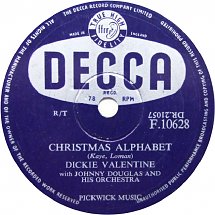
40. ‘Christmas Alphabet’, by Dickie Valentine

dickie-valentine-christmas-alphabet-decca-78-s

Christmas Alphabet, by Dickie Valentine (his 2nd of two #1s)

3 weeks, from 16th December 1955 to 6th January 1956

And so we come across something I never considered when I started this blog: the fact that I will, every so often, have to listen to Christmas songs on repeat. When it most emphatically isn’t Christmas. No matter. ‘Tis a burden I shall bear stoically.

The very first Christmas song to hit #1 in the UK is based around a simple concept – an acrostic poem as hit single. C is for the candy trimmed around the Christmas tree, H is for the happiness with all the family… All the way to the final S which is for Ol’ Santa who makes every kid his pet, Be good and he’ll bring you everything in your Christmas alphabet… Repeat. Done. Note that I am not referring to it as the very first ‘Christmas Number One’, as that wasn’t a ‘thing’ until the ’70s and, technically, Al Martino, Frankie Laine and Winifred Atwell have all already had one.

It’s kind of cute on first listen, but quickly becomes so sugary sweet that you begin to fear diabetes. As I mentioned at the time of his 1st number one, Dickie Valentine still sings like an American crooner (apart from when his ever-so-proper English accent sneaks through in the line about the ‘tree so tawl’). And while this little ditty is a world away from any kind of rock ‘n’ roll – from the record which bookended this song’s stay at the top, for example – he is cementing his image as the first British teen idol.

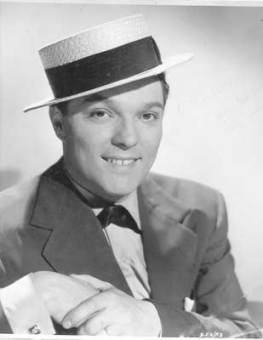
dicky-valentine

A quick look at the career of Mr. Valentine – which we should do now, as we won’t be hearing from him again – proves this to be true. He made his name singing with big bands, then by impersonating singers such as Frankie Laine and Johnnie Ray. His marriage in 1954 caused hysteria among his young fans, though it clearly didn’t kill his career. An image search throws up lots of cheeky grins, often accompanied by a boater-hat and a bow-tie – a definite ‘cheeky-chappie’. He scored the first and last #1s of 1955 but, like so many of these early chart-toppers, his recording career died a death in the ’60s, and he himself died the most rock ‘n’ roll death of all the artists featured so far: in a car crash aged just 41.

To finish, I do have a little anecdote about Dickie Valentine – and it’ll perhaps be my most tenuous link to any of the artists featuring in this rundown. Years ago (we’re talking early high school, here) I had a friend whose family loved going on cruises. I’ve never understood the appeal of cruises myself, but I suppose that’s irrelevant here. My friend mentioned a cruise they’d been on in which each cabin had – for some reason – a live feed of the ship’s ballroom that passengers could tune into any time of the day or night. My friend was watching it one night – disco night – when an old man, unimpressed by the DJs more modern tastes, walked past the camera and shouted ‘Play some Dickie Valentine!’. I have NO IDEA why my friend told me this uninteresting story; or indeed why I have remembered it to this day. I’d never heard of Dickie Valentine at the time; neither, presumably, had my friend. I suppose it is quite a funny name (‘Hur, hur… Dickie…’). But of all the things in life I’d have been better off remembering… The mind is a strange, strange thing.

25. ‘This Ole House’, by Rosemary Clooney

R-803732-1160416687.jpeg

This Ole House, by Rosemary Clooney (her first of two #1s)

1 week, from 26th Nov. to 3rd Dec. 1954

Now this is more like it! After an incredibly sedate run of number ones – seriously, nothing since early-May of this year has been enough to get even a toe tapping – we are rocking and a-rolling!

You probably know this song. I certainly knew of it, for a couple of reasons. One is that Shakin’ Stevens revived it in the early ’80s. The other is that I can recall, way back in the mists of time, reading an ‘Oor Wullie’ comic (link provided for non-Scottish readers) in which this song was playing at a party, the words changed to something suitably Scottish (‘This ole house ain’t got no lino’, perhaps). My grandparents kept piles of old ‘Oor Wullie’ annuals lying about, and so have no idea whether it was a new-ish comic strip parodying the Shaky version, or a vintage comic parodying this version. Amazing, isn’t it? Anyone who tries to tell you that the charts don’t matter, and that the songs which make number one don’t form the backdrop to our lives, is very, very wrong. Anyway. You will know this song, I assure you – it’s got a sort of nursery rhyme feel to it and goes a little something like this:

            * raucous piano, or maybe a harpsichord (???) or an organ *

        This ole house once knew his children, This ole house once knew his wife, This ole house was home and comfort as they fought the storms of life, This ole house once rang with laughter, This ole house heard many shouts, Now he trembles in the darkness when the lightnin’ walks about…

Yes, it’s the tale of a lonely old man. Clooney then goes on to detail the repair work that this house needs – the floor, the hinges, the windowpane, even the shingles (I’m pretty confident that this is the only #1 hit to reference shingle). But he needn’t bother, this lonely old man, as he: Ain’t gonna need this house no longer, He’s getting ready to meet the saints…

This is a strange ole song. In a musical landscape of mopey, flowery, boringly chaste love-songs this is a best-selling song about a man sitting in his dilapidated house, waiting for the sweet embrace of death. The piece de resistance is the line: Oh his knees are a-gettin shaky, But he feels no fear or pain, ‘Cause he sees an angel peekin’, Through a broken windowpane…

Like, seriously. WTF? – as they most certainly didn’t say in 1954. I love it. It’s weird, morbid, almost sadistic. It’s quite modern, in a way, the juxtaposition of upbeat music with some with very downbeat, depressing lyrics. It’s interesting, anyway, and a lot better than some of the guff we’ve had to listen to recently. The gulf between this record and ‘My Son, My Son’ – its predecessor at #1 – is what makes a singles chart so interesting. The next chart-topper can always be something completely different.

thisolehouse1

Rosemary Clooney’s voice is standard, mid-1950s American. Polished, glossy, accessible. She even throws in a Westlife style key-change after the twangy piano solo which, if I’m not mistaken, is the first we’ve heard in this rundown. I, for my sins, love a good key-change. And we must mention her brilliantly deep-voiced backing singer – with his ain’t a-gonna need this house no longer, ain’t a-gonna need this house no more – who adds an even more bizarre edge to an already pretty bizarre record.

This was Clooney’s first of two number ones, the second of which will be coming up very shortly indeed. And, I can tell you now, it’s another cracker!

17. ‘I See the Moon’, by The Stargazers

the-stargazers-i-see-the-moon-1953-4-78

I See the Moon, by The Stargazers (their 2nd of three #1s)

5 weeks, from 12th March to 16th April / 1 week from 23rd April to 30th April 1954 (6 weeks total)

And now for something completely different…

Imagine an East-End pub, filled with smoke and ruddy cheeks, a jovial barman rings the bell and calls for last orders over the hubbub… Last orders, and one last song. Old Mrs. Fozzywinkle sits at the piano, shouting down someone who’s just said something saucy, and then… The opening bars of ‘I See the Moon’.

Over the mountain, over the sea, back where my heart is longin’ to be… Please let the light that shines down on me, shine on the one I love… Thematically, we are treading familiar ground: it’s a tale of two separated lovers, one hoping that the other still thinks of them. We’ve heard it a few times in this countdown so far. But, beyond the lyrics, this is something else entirely.

The first thing that comes to mind is the scene in ‘Oliver!’, where Nancy leads the pub in a rousing chorus of ‘Oom Pah Pah’. This song isn’t quite as rowdy, or raucous, but it has an unhinged quality that none of the previous chart toppers have had. Even the novelty tracks that have gone before it – the likes of ‘How Much is that Doggie?’ and ‘She Wears Red Feathers’ – still felt as if they had been professionally recorded, perhaps over several takes. This song doesn’t…

The first verse is sung – horribly – in a fake German (Polish? Transylvanian??) accent, the voice cracking as it fails to reach the high notes, with voices roaring in approval in the background. The second verse takes the form of a skit – a plummy voiced announcer introduces a little lady with a tambourine, who proceeds to come in at the wrong cue not once, not twice, but three times. Once she gets going, the announcer asks her to sing quieter, then louder, presumably until everyone listening at home is guffawing helplessly at the ridiculousness of it all. It’s funny(-ish), in a pantomime kind of way. We’re back in the music halls, here. Actually, it reminds me of a ‘Comic Relief’ track – you know the kind recorded by Cliff Richard and the cast of ‘The Young Ones’, or by French and Saunders as the Spice Girls. It has that same sort of anarchic energy, and in that regard it’s quite ahead of its time. It’s a truly bizarre song.

And when you look back to The Stargazers previous #1 – the morose ‘Broken Wings’ – it sounds even more crazy. What happened? What went wrong? (Or right, depending on your tastes?) What in God’s name did they take before hitting the recording studio? At least it’s an interesting song, though I’m not sure I’ll be revisiting it once I’ve finished writing this post.

5aa73dbf26f7295aa31761462f020c03

Information on The Stargazers is hard to come by. There are at least two other bands with the same name: an Irish folk trio, and a rock ‘n’ roll revival group from the ’80s. An image search requires some discerning before you can work out which band is which. But the original Stargazers were pretty popular in their day – the NME voted them ‘Best Vocal Group’ for five years in a row. But – and this is something that’s just occurred to me – ‘pre-rock’, the competition for that title wasn’t fierce. There simply weren’t very many groups going. This was an era of solo stars.

One other little titbit of interesting info. I’ve unearthed regarding this song: the lyric I see the moon and the moon sees me was first used in a nursery rhyme from the 1780s. We are then, listening to both the 17th UK Number One hit, and the very earliest UK Number One hit. Mind-bending…

8. ‘(How Much Is) That Doggie in the Window’, by Lita Roza

R-1981783-1400074086-8543.jpeg

(How Much Is) That Doggy in the Window, by Lita Roza (her 1st and only #1)

1 week, from 17th to 24th April 1953

Before I’ve even played it, I know how this song goes!

This was one of the first pop songs I was ever aware of, actually. I have a vague memory of being two, or three, and hearing this song. Or at least the opening lines: How much is that doggie in the window? The one with the waggly tail… Looking back, I have no idea where I heard it: the TV, a toy, a grandparent… Maybe it was this version that reached number one that I heard; maybe it wasn’t. But still, this is the first song on this countdown that I was able to sing a line from before listening to it. So well done, Lita! You are officialy engrained in British popular culture.

The record sounds pretty much as expected – the same jaunty guitar and flutes that accompanied Guy Mitchell pop up at the end of every line so we know that this is a NOVELTY RECORD! There is also a barking dog, which sounds surprisingly real. Even on my third or fourth listen I can’t tell if it’s a dog with a great sense of timing, or a backing singer, or even Roza herself. In the song, the singer has to take a trip to California, and so wants to buy a dog to keep her sweetheart safe. If he has a dog he won’t be lonesome, and the doggy will have a good home… She’s heard about robbers, you see, and she’s understandably concerned. Other pets won’t do – no bunnies or kitties. Neither does she want a bowl of fish as he can’t take a goldfish for walks…

It’s quite cute, I suppose, and at a lick over two minutes long it doesn’t outstay its welcome. And it provides us with lots of UK chart firsts: first #1 by a British female, first #1 to feature brackets in the title, first #1 to feature a question in the title, first of many #1s to come out of Liverpool, first #1 about a dog…

Lita-Roza_1362708c

The strangest thing about the whole song, though, is Roza’s voice. It’s very husky, very sexy – it has a sort of giggle and a wink to it that is completely wasted on this asexual, childish nonsense. And a quick image search throws up lots of pictures of her looking very sultry, very exotic (she had Filipino heritage), and wearing dresses that would turn heads today never mind the early 1950s. So I went one step further and listened to her next biggest UK hit (‘Jimmy Unknown’, #15, three years after this). It’s a world away from ‘How Much is That Doggy?’ – a slow, seductive number to which her voice, all melted caramel, is much more suited.

It turns out that Roza hated this song. And not simply after it turned out to be her biggest hit, a millstone around her neck for the rest of her career. She had to be persuaded to record it in the first place, and only did so on the proviso that she would never have to sing it live. And she never did: “I sang it once, just one take, and vowed I would never sing it again. When it reached number one, there was enormous pressure to perform it but I always refused. It just wasn’t my style.” She lived for a long time too, dying in 2008, aged eighty-two. I have a fabulous image of her sitting in a dusty ball gown, in a dusty parlour, throwing a plate at a lackey who has just brought yet another request for her to perform her biggest hit. ‘Don’t ever mention that awful song again!’ she yells as he runs for cover. The Miss Havisham of UK pop. She even adopts a little girl, and trains her from an early to be a huge singing sensation, but with a secret plan to ensure that this starlet’s first and only hit will be a piece of throwaway tripe… Too far?

Anyway, not wanting to slander the dead too much, but it’s great to get a #1 hit with a tale behind it. And perhaps Ms Roza didn’t really hate the song all that much (or perhaps she just had a very knowing sense of humour) because she left a large chunk of her fortune to stray dogs’ homes.

And it turns out that ‘Doggy’ actually has a much more sinister legacy than that of a throwaway novelty that overshadowed its singer for the rest of her career. It was also…(gasp!)… Margaret Thatcher’s favourite record.

6. ‘She Wears Red Feathers’, by Guy Mitchell

s-l300 (1)

She Wears Red Feathers, by Guy Mitchell (his 1st of four #1s)

4 weeks, from 12th March to 10th April 1953

Oh my… I’m not sure where to begin with this one. The 6th UK number one kicks off with a cod-Arabian nights, we’re entering the harem kind of intro, and then… well, perhaps the lyrics will best describe just what territory we’re in here:

            She wears red feathers and a hooly-hooly skirt, She lives on just cokey-nuts and fish from the sea, A rose in her hair, a gleam in her eyes, And love in her heart for me.

Why is ‘she’ wearing red feathers and a hula skirt? Well… See, the singer is the respectable employee of a bank who, disenchanted with his humdrum life, goes to musical reviews of an evening. At one such performance he spies a pearl of a native girl and the very next day sets sail to find her. Again, the lyrics are best quoted verbatim:

            Goodbye to the London bank, I started in a-sailin’, The fourteenth day from Mandalay I spied her from the railin’, She knew I was on my way, waited, and was true, She said “You son of an Englishman, I’ve dreamed each night of you.”

Through what feat of clairvoyance the exotic girl knows he is coming isn’t explained. But they fall in love, and wed, and I quote: An elephant brought her in, placed her by my side, While six baboons got out bassoons and played “Here Comes the Bride.” It’s all a bit… Well, I suppose it was 1953. In the words of everybody’s slightly racist uncle: ‘You couldn’t get away with it these days, that’s for sure.’

Inaccurate racial stereotyping played for laughs aside, this is a cloying song that does what all horribly catchy songs do i.e. lodges itself in your brain from the first listen. It’s jaunty to the point of being wildly irritating, with someone going crazy on a flute and a xylophone at the end of every line. Compared with the handful of number ones that have preceded it, this sounds really old fashioned – something from a 1920s music hall, along with ‘Roll Out the Barrel’. Looking it up, I did wonder if it was a cover of an old standard, but nope: it was written for and recorded by Guy Mitchell. It’s clearly a novelty, so I suppose it does provide us with another chart debut: the first in a long line of songs to reach the top by being funny, or annoying, rather than any good. You can enjoy it in all its music-hall glory here, though. (Note that this is not the version that topped the charts – the video for that lies at the foot of this post.)

guy mitchell

By the end of the song, the singer has returned to London with his bride, and all his former co-workers stare in wonder and amusement as this foreign beauty sips her tea just like them! I don’t want to sound all woke and millennial and right on but… Jesus.

Anyway, at the very end of the song – and this is something that Perry Como did in ‘Don’t Let the Stars Get in Your Eyes’ too – Mitchell completely changes tack from the laid-back, knowing manner in which he’s delivered the previous two minutes and fifty seconds and ends with a huge, faux-operatic repeat of the final line. It jars, and seems to serve no other purpose than announcing THIS IS THE END OF THE SONG! It was the style of the time, I suppose.

Like Perry Como, Guy Mitchell was a big star, and continued to be a big star throughout the 1950s. We’ll meet him again before long; his biggest hits yet to come. And we’re yet to meet our first one hit wonder, with all the artists featured thus far enjoying some form of extended success. As I wrote with Como, it wasn’t as if people woke up one morning in November 1952 and decided to start buying 45s. Therefore, it’s slightly harder to judge the success and popularity of these early artists whose ‘debut’ hits are chart debuts rather than career debuts. Things will become clearer as we delve deeper into chart history…