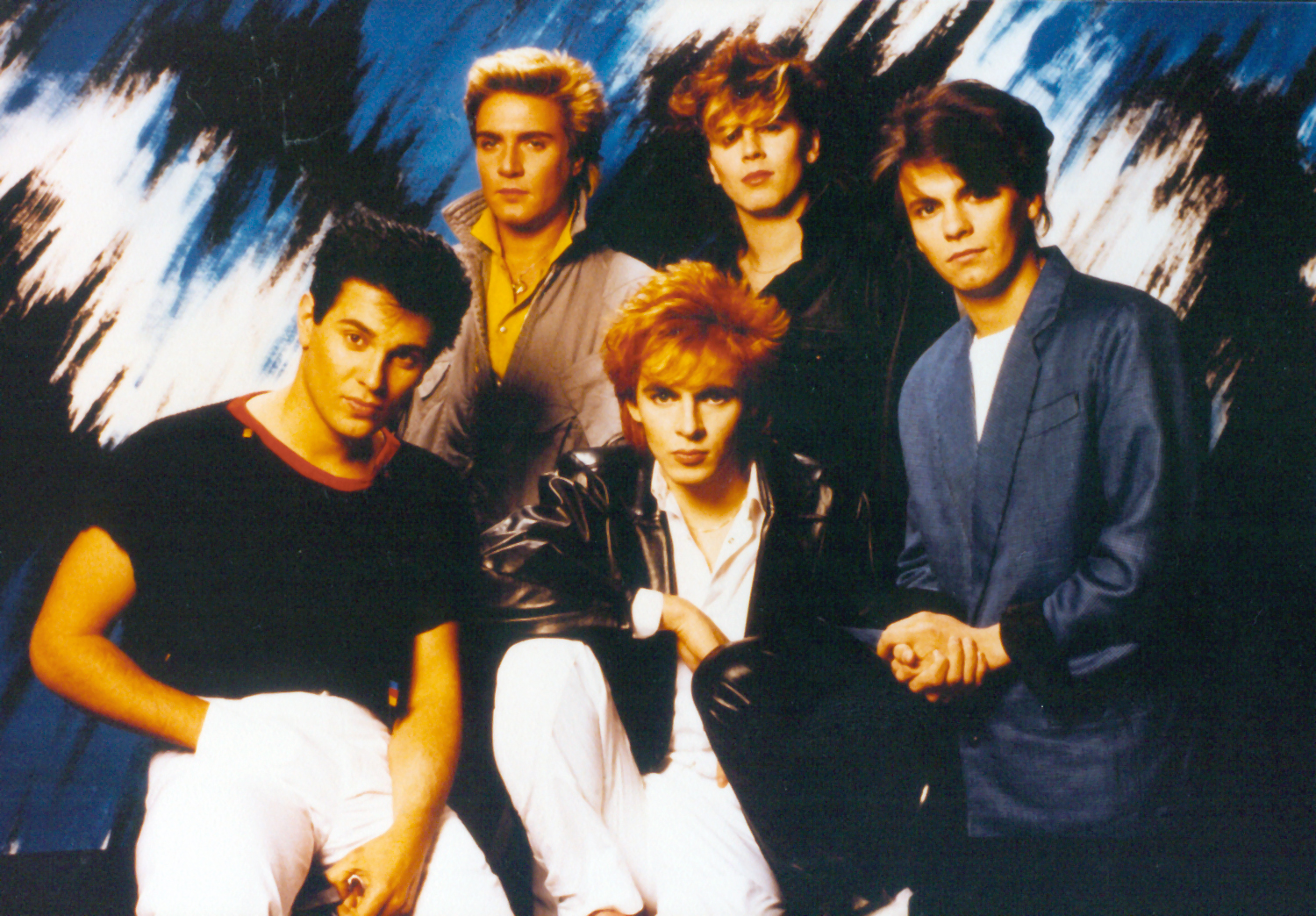
527. ‘Karma Chameleon’, by Culture Club

In which we arrive at a mega-hit. The biggest song of the year, a number one in thirty countries, the longest stay at #1 so far this decade, and the… checks notes… thirty-eighth biggest seller of all time!

Karma Chameleon, by Culture Club (their 2nd and final #1)

6 weeks, from 18th September – 30th October 1983

Right from its nifty little intro, this is a record that pulls out all the stops in its efforts to burrow into your brain. It’s jaunty, it’s fast-paced, with lots of little retro flourishes, and with a hook that just won’t quit: Karma (x5) Chameleon, You come and go… You come and go…. It’s the purest of pop, from the biggest pop group of the moment. You can see why it was so huge.

Purest pop, but not perfect pop. ‘Karma Chameleon’ falls short of the level of, say, ‘Dancing Queen’, or ‘Heart of Glass’. (Too much harmonica, for a start… And the lyrics are a kind of pretty-sounding nonsense.) But that’s a fairly unreachably high bar I’m setting. This song’s best bit – the middle-eight where Boy George’s voice soars through the Every day, Is like survival, You’re my lover, Not my rival… line – can rank among the best moments of the decade. Then it descends into a marching beat, which flirts very heavily with the cheesy side of things.

In fact, the entirety of this record is one big flirtation with cheese. It stays on the right side, though, for the most part (harmonicas excepted). In the video, Boy George sits astride a Mississippi steamboat, looking as fabulous as ever. It is interesting that a band as provocative as Culture Club have two such safe chart-toppers to their name. ‘Karma Chameleon’, as good as it is, could have been recorded by Bucks Fizz (the drum beat here is really similar to ‘Making Your Mind Up’…) while ‘Do You Really Want to Hurt Me’ was, to my ears, a little dull. Maybe, though, the fact that their music was so accessible is a good thing, meaning that Boy George was beamed into family homes around the world as they scored hit after hit. Fathers scowled, mothers tutted, and all the kids who didn’t fit in secretly saw hope…

Having said that, I’d still have taken the stomping, Motown-esque ‘Church of the Poison Mind’ to have been the mega million-selling hit over this. Culture Club did have an edge to them, it just isn’t to be found in their #1s. They were also at the peak of their powers here: between October 1982 and October ’84 the band saw seven singles chart no lower than #4…

They would split up soon afterwards though, in acrimony and drug addiction. They wouldn’t work together for twelve years, until their 1998 comeback. Which must have been a big deal, as it filtered through into the consciousness of twelve-year-old me. I remember their comeback single, ‘I Just Wanna Be Loved’ well, and liked it at the time. Boy George, meanwhile, will feature in this countdown under his own steam before too long.

I mentioned in the intro that ‘Karma Chameleon’s six-week stay was the longest run at the top since 1979, and it means that we are suddenly racing through to the finish of 1983. Our next #1 is a big ‘un too. I also mentioned this record’s ‘retro flourishes’ which, added to KC & The Sunshine Band’s disco touches, and UB40’s reggae rhythms, means the ’80s are suddenly sounding a little less ’80s’. Whether I think this is a good or a bad thing… I’ll leave that for you to decide.

Advertisements

522. ‘Every Breath You Take’, by The Police

We’re back among the classics, after a dubious (though admittedly catchy) detour with New Edition. The Police then, with their final, and their biggest, chart-topper.

Every Breath You Take, by The Police (their 5th and final #1)

4 weeks, 29th May – 26th June 1983

I press play, and before the song is halfway through questions begin to arise. Has this record been dulled by repetition? (At any given moment of the day, a radio station somewhere is playing ‘Every Breath You Take’.) Is it just that little bit too glossy, too polished? Has Sting’s voice tipped over the edge into soft-rock crooning…?

Don’t get me wrong, the opening riff, and the simple but effective chord progression thereafter, is a great hook. It can take its place among pop’s great moments. It’s a record that begins with complete confidence in itself… but I’m not sure it builds upon this strong start. It comes close with the How my poor heart aches, With every step you take… line, which is great. But the rest of the song is a bit cold, a bit clinical and, by the end, a bit boring…

Perhaps the problem’s not musical, but lyrical. It’s become a cliché to point out that this is a stalker’s anthem, but it’s true. It’s not a nice song. Every single day, Every word you say… It’s clearly about a possessive, jealous, and potentially dangerous, lover watching his ex. Yet take the title by itself, with the lines about hearts aching and people belonging to one another, and you can convince yourself that it’s a love song. Apparently it some people play it at their weddings…

I was ready for this to finally redeem The Police in my eyes, to show me why they were the biggest band of the late-seventies and early-eighties, as I’d struggled to love their previous #1s. But it hasn’t… In fact, turns out my favourite is their first: ‘Message in a Bottle’. I just didn’t realise it at the time. I’m in the minority on this, though, it seems – ‘Every Breath You Take’ is a Rolling Stone / Rock and Roll Hall of Fame Greatest of All Time kind of tune. In 2015 it was voted the UK’s favourite ‘80s #1, and in 2019 it was named the ‘most played song in radio history’, taking over from ‘You’ve Lost That Lovin’ Feeling’.

You could compare The Police with another band we’ve recently bid farewell to on this countdown: The Jam. Both rose out of the punk scene in the late seventies to become two of the biggest British new wave bands. Both left their punk roots far behind, but The Jam did so with a sense of exploration – look at the funky ‘Precious’ and the Motown influenced ‘Town Called Malice’. Whereas The Police went down a more soft-rock route, culminating in this monster hit.

And it is a good song, I’m not writing it off completely. But it’s a little too cold, too negative, and too overplayed, to be a favourite. To finish, here’s a very tenuous link between this record, and the previous #1 I mentioned in the intro. ‘Candy Girl’ was the first rap chart-topper… while ‘Every Breath You Take’ will be heavily sampled in what I believe is the best-selling rap single ever released…

Advertisements

520. ‘True’, by Spandau Ballet

Down your bottle of fizzy pop, pluck up the courage to talk to that boy or girl you’ve been avoiding all evening… For we are in last dance territory with this next number one…

True, by Spandau Ballet (their 1st and only #1)

4 weeks, 24th April – 22nd May 1983

Is ‘True’ the ultimate ‘last dance at the school disco’ tune? I’m pretty sure they were still playing it fifteen years later, when it was my turn trying to blend into the shadows at the back of the gym. The tempo is perfect for a slow clinch, and the Ha Ha Ha Ha Haaii sound like a lovestruck swoon. They work well as a hook, combined with I know this much is… true!

I also like the chiming, one-note guitars, that sound like an eighties update of the guitars from any number of fifties ballads. But, I don’t think I’ve ever listened to the verses. And, sitting down to listen to them now, they’re the sort of verses that slip right by you. They’re unremarkable, and bland to the point of incomprehensibility. Take your seaside arms and write the next line… References to sand, and Marvin Gaye, delivered in the deliberate New Romantic style. Is it even a love song?

I could say that this was a record with some great moments, floating along in a sea of gloop, and be done with it. Except the ending saves it. The way Tony Hadley finally lets loose and gives the last I’ve bought a ticket to the world… line his all is a punch the air moment. And the This much is tru-ue… fade out is perfect for finally going in for that sloppy smooch.

I’d say that any ‘Best of the ‘80s’ compilation worth its salt has to have ‘True’. In truth, the compilation would also have to have all of our past five number ones: ‘Billie Jean’, ‘Total Eclipse…’, ‘Let’s Dance’ and Duran Duran, though perhaps a better-remembered song than ‘Is There Something I Should Know?’ And while ‘True’ isn’t in the same league as the likes of ‘Billie Jean’, it deserves its place in the 1980s pantheon. In fact, the moment midway through, where there’s a pause and then BOOM: saxophone solo, is as eighties as you can ever get.

I’m enjoying this more than I thought I would. I thought it would be too gloopy, but there are enough catchy moments to see it through. The biggest problem is that it’s way too long. The album version is six and a half minutes long, for goodness sake. There is a single edit, but even that runs to 5:30. Not much of an ‘edit’… And excruciating if you’ve been roped into dancing with a girl you’d been trying to avoid all night… (I may be talking from experience, here…)

It’s surprising that this is Spandau Ballet’s one and only chart-topper. Like Duran Duran – a band they exist in complete conjunction with in my mind – they had been scoring hits since the early eighties (usually with more up-tempo songs than this one). And like Duran Duran their fortunes would fade by the end of the decade (though DD have had a couple more successful chart comebacks than Spandau…) They split up in the ‘90s, though they have reformed for tours in the past ten years or so. And I have to show my age before we finish, by admitting that for years I knew them primarily as the band Martin Kemp from ‘EastEnders’ was once in…

Advertisements

519. ‘Let’s Dance’, by David Bowie

Ah…. Ah…. Ah…. Ah….! Bowie’s back. His 4th number one might not be his very best – it would take something to outdo ‘Space Oddity’ – but it’s definitely his biggest, brightest, catchiest moment on top of the pop charts.

Let’s Dance, by David Bowie (his 4th of five #1s)

3 weeks, 3rd – 24th April 1983

I love the mix of sixties pop – the intro ripped from ‘Twist and Shout’, the background harmonising, and the woozy horns – with hard-edged eighties funk. Let’s dance! the Duke commands… Put on your red shoes and dance the blues… And you are powerless to resist. Like ‘Billie Jean’, when a DJ launches this one down your local disco then they know what they are doing.

But as with ‘Billie Jean’, this record isn’t just a simple dance number. It’s David Bowie, and there’s an edge to it, a hidden strain of weirdness. Not so much in the lyrics, more in the way he delivers them. The yelped: Tremble like a flow-er! for example, stands out, as does the Under the moonlight, The serious moonlight! There’s a gravel in Bowie’s voice here, a soulful edge that wasn’t present in any of this three earlier #1s. He sounds like he’s enjoying belting this out, reborn after the lost years of the late-seventies, but there’s also an edge to his voice you don’t often get in dance music.

There’s also some weirdness in the video, which features two Aboriginal Australians trying on the red shoes in the song, and being transported to a capitalist wonderland of jewellery shops and posh restaurants. In the end they smash the shoes, and dance their way back into the outback. I’m not sure the song needs such a statement video, and it perhaps stems from Bowie’s discomfort at releasing such a commercial record.

I fully admit to sometimes not getting David Bowie. I love his glam hits, and two of his three previous chart-toppers, ‘Space Oddity’ and ‘Under Pressure’. (‘Ashes to Ashes’ was less of a smash with me.) But I get this one. What’s not to get? If anything, I’m properly realising just how great ‘Let’s Dance’ is, in all its funky glory. The funk here is brought by the song’s producer, Nile Rodgers. His influence is all over it, and not just in the fact he plays guitar on the recording. (The solo at the end, meanwhile, is performed by Stevie Ray Vaughan.) Bowie had written it as folk number, until Rodgers came along.

As great as it is, the success of ‘Let’s Dance’ sent David Bowie off course for the rest of the decade. He confessed that the MTV success of this single and the subsequent album, and the newer, younger fans that it brought him, left him unsure of his direction. But let’s not worry about that for now. In this moment, we can celebrate what is perhaps his ultimate singles chart moment, a good fifteen years into his career as a chart star.

That’s an interesting point. We’re right in the middle of a run of era-defining singles, that are launching the 1980s as we know it. But only really Duran Duran could be described as an ‘eighties’ act, and even they were several years into their career. Bowie, Michael Jackson and Bonnie Tyler were all seventies, if not sixties, veterans. But it is they who are at the forefront of this bright new era.

Advertisements

518. ‘Is There Something I Should Know?’, by Duran Duran

From Michael Jackson, past ‘Total Eclipse of the Heart’, to Duran Duran. Our head-first jump into the heart of the 1980s continues…

Is There Something I Should Know?, by Duran Duran (their 1st of two #1s)

2 weeks, 20th March – 3rd April 1983

Please please tell me now! It’s an aggressive intro, as Simon Le Bon pleads, again and again, while those trademark eighties drums blast through the speakers. In come some jangly, filtered guitars, and an insistent, galloping beat. This is a record that grabs you from the start, and doesn’t really give you a chance to decide whether or not it’s any good…

And it is a good record. After a few listens I’ve settled into it, and am spotting some cool touches. There’s a great bassline, for example, and a nice moment when, just before the choruses, everything fades apart from a pulsing synthesiser that sounds like it’s trying to send a message by Morse Code. I also like the soulful urge in the pre-chorus: With broken glass for us to hold, And I got so far before I had to say…

There are bits I’m not so hot on, though. The weird, harmonica-led ‘solo’ feels like a missed opportunity, and the line You’re about as easy as a nuclear war… jars as much in today’s world as it probably did forty years ago. I also find Le Bon’s delivery, as much as I like it in the chorus, a bit much in the verses. Although they have very different voices, it was the same with Limahl in Kajagoogoo’s ‘Too Shy’: there’s something about the new romantic style of singing that’s a bit too arch at times…

(Possibly the worst picture-sleeve yet? It looks like it’s been printed on a school jotter…)

Speaking of ‘Too Shy’, that was actually the first #1 that a member of Duran Duran had a hand in: it was produced by Nick Rhodes. Duran Duran, though, had been around for a lot longer than Kajagoogoo – ‘Girls on Film’ was their first Top 10 hit in 1981 – and would go on to have many more hits. And to me, speaking as someone who doesn’t know them away from the big hits, they are probably the quintessential mid-eighties band. The poster boys of New Romanticism and the 2nd British Invasion. Brash, loud (both musically and in their fashion), and a triumph of style over substance.

But I’m here to have my mind changed on that. I like ‘Is There Something I Don’t Know?’ I don’t love it, but there’s an endearing urgency to the song that sees it through. And in entering the charts at #1, it announces Duran Duran as the biggest band in the nation at this moment (and, unlike many of the biggest British acts since The Beatles, they were about to be huge the whole world over, too…)

Advertisements

515. ‘Too Shy’, by Kajagoogoo

I think it may have arrived, the moment I’ve been anticipating for a while now… The official start of the 1980s.

Too Shy, by Kajagoogoo (their 1st and only #1)

2 weeks, 13th – 27th February 1983

This is the most eighties chart-topper yet. Everything here has been filtered through some kind of ‘80s-ifier: the synths, the electronic drums, the bass, the icy piano… And that’s before you get to the band’s hair-dos… Just look at those mullets! I really like the intro, though: the slow build up and funky bass riff. There’s also a killer, if slightly nonsensical, chorus: You’re too shy shy, Hush hush, Eye to eye…

Singer Limahl’s delivery is also very of its time. It’s very arch, very airy and knowing. I don’t want to plant the ‘New Romantic’ flag, as I don’t think Kajagoogoo were quite that, but that’s where we’re heading. The rest of this song, though…? It’s OK. The nice touches aren’t enough to cover up the fact that it’s a bit lightweight, and a bit dull in places. I’ve heard of ‘landfill indie’… Can this be ‘landfill eighties’?

While the song is fine, we have to take a moment to examine the band name. Potentially one of the worst band names in history? It’s based on the sounds babies make, apparently. Before Kajagoogoo they were known as ‘Art Nouveau’, which is the sort of name you’d give a fictional parody of a new-wave band. They weren’t around for very long. Limahl left after just two years as lead-singer, citing personality differences, and the band officially spilt up in 1985.

I do think this is a moment where any remnants of what went before have been ditched. There’s no disco here, no post-punk or soft rock. Just pure and unadulterated eighties. Even the big, decade-specific acts we’ve met so far – Adam Ant, Culture Club, Human League – didn’t have the mid-eighties glossiness that ‘Too Shy’ has. But I think we’re set now, and about to foray into the deepest depths of it.

And I have to admit that I’m making that statement not based solely on this one record – though it is very now. I’m also making it with one eye on the chart-toppers that will immediately follow. The next five number ones will feature either some of the decade’s biggest stars, or its biggest songs. Kajagoogoo’s ‘Too Shy’ is the appetiser to a giant ‘80s feast that is on its way…

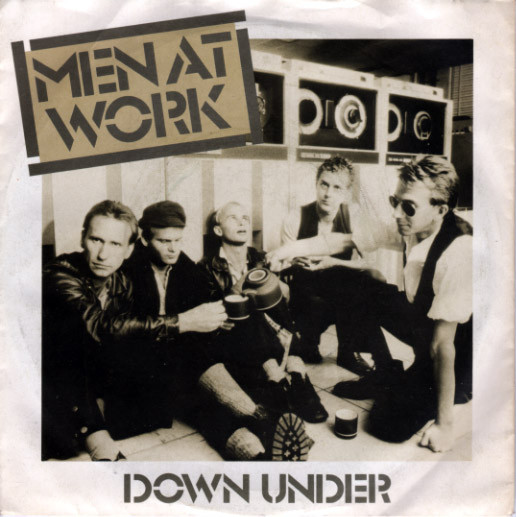
514. ‘Down Under’, by Men at Work

I have to admit, straight off the bat, that the sight of this song on the list aux number ones made me shudder… I try to approach every song with an open-mind, void of prejudice and preconception (an approach which is going to become increasingly difficult when we reach songs I’ve lived through…) But ‘Down Under’ is a song that has always got on my wick.

Down Under, by Men at Work (their 1st and only #1)

3 weeks, 23rd January – 13th February 1983

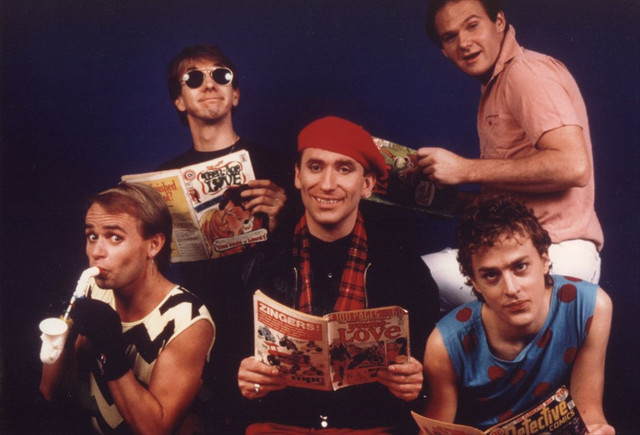
What is it that annoys me? The flutey bits, the faux-ethnic vibe, the strange accent that it’s delivered in – not an Australian accent – the fact that it isn’t funny enough to be a novelty song, but is funny enough to be irritating… (Though the video, which I had never seen before today, is very goofy, and does make the song a bit more palatable.)

I come from a land down under… Where women glow and men plunder… It is a paeon to being Australian. The singer travels the world, from Brussels to Bombay, and is beloved of all because he comes from a land down under. I once spent a holiday in Thailand with what felt like half of Sydney, all celebrating Australia Day. And every third song they sang was ‘Down Under’… I’m not sure the locals of Koh Samui were all that enamoured of their Aussie visitors, as the beer flowed, and the men chundered…

Having said that, what would improve this song in my eyes would be for it to up its Aussie-ness to the extreme. We need lines about ‘utes’, and being ‘daggy’ (actually this song is pretty damn daggy), and a ‘flaming galah’ or two for good measure. And we need it sung by Joe Mangle from ‘Neighbours’. (Yes, most of my Australian cultural references come from mid-to-late ‘90s soap operas. Strewth!)

In a nice coincidence, ‘Down Under’ is back in the charts as I write this, and the original singer Colin Hay has a credit. (It’s been as high as #5 in the UK.) This new drum ‘n’ bass version, although not the sort of thing I’d usually enjoy, ups the weirdness of the song and somehow works better. For me. I realise that this song is loved by a lot of people, people that aren’t even Australian, but I’ve never really got it.

Men at Work were from Melbourne, and had released ‘Down Under’ in their homeland back in 1981. The band actually wrote it as a comment on how Oz was being ‘Americanised’, and that the Australian things referenced in the song were under threat. While I wouldn’t want to disagree with the songwriter, I’d say that that angle has been completely lost over time. ‘Down Under’ has been voted the ‘2nd Most Australian Song’ ever, presumably just behind ‘Tie Me Kangaroo Down, Sport’. Away from this hit, Men at Work wouldn’t get back into the Top 20 in Britain. In the US and Australia, though, they enjoyed more success before splitting up in 1986. They are currently touring again, with Colin Hay.

Advertisements

511. ‘Beat Surrender’, by The Jam

On with the next thirty. And to start, The Jam return for one final chart-topper.

Beat Surrender, by The Jam (their 4th and final #1)

2 weeks, 28th November – 12th December 1982

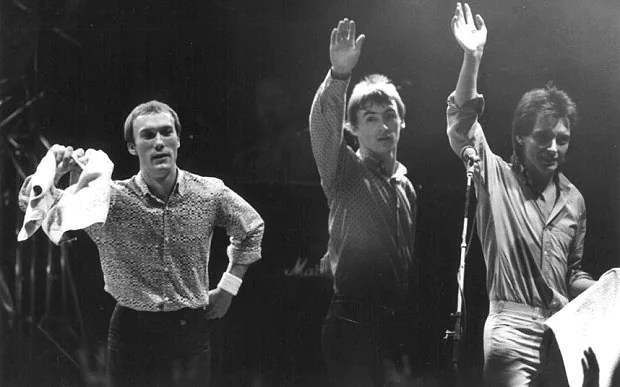
In my last post on them – ‘Town Called Malice’ / ‘Precious’ – Paul Weller and his bandmates had made some sonic advancements. Away from punk; into soul, funk and Motown. ‘Beat Surrender’ is more of the same. It’s intro, for a start, is the love-child of ‘I Will Survive’s piano flutter, and ‘Dancing Queen’s glissando.

I’m not even sure there’s a guitar involved here. Certainly not a lead guitar. There’s a piano, and lots of horns. It’s slick and glossy. But that’s not to suggest that The Jam have lost their edge. It’s still a great pop song, with a great hook: Come on boy, Come on girl, Succumb to the beat surrender…

And like most Jam songs, it’s lyrically dense. The title is a play on ‘Sweet Surrender’ and the idea of beating a retreat, which makes sense when you realise that this was The Jam’s final release, their farewell single. Weller intended it as a call to their fans, to young, up and coming bands: Seize the young determination, Show the fakers you ain’t foolin’…

The band also drop some pearls of wisdom from their time as one of the country’s biggest acts: Bullshit is bullshit, It just goes by different names… A line that I think – unless I’m forgetting something obvious – delivers our first example of swearing in a #1 single. Lonnie Donegan, The Stones, Billy Connolly have all flirted with it, but didn’t go all the way. It took five hundred and eleven chart-toppers, though, which is impressive. Safe to say this won’t be the last…

I do admire the way that The Jam didn’t stand still, never seemed to recycle a sound or a style, in their five years of success. Here we have a great moment, when the soulful riffs of the first two verses drops down to a galloping disco bassline. It’s a risk, for a rock act, you could alienate your fans by daring to try new things (gasp!). But it didn’t seem to hurt The Jam. ‘Beat Surrender’ entered at #1 – making them the second act to do this three times (after Slade). Of course, announcing that this record was to be their final ever release probably didn’t hurt its chances, and ensured a fair bit of demand…

 Though I’d say that it hasn’t remained in the collective memory as much as their three previous number ones. It’s a good one – none of their chart-toppers are anything less than a seven-out-of-ten – but perhaps its success wasn’t just for musical reasons. Anyway, after this Paul Weller formed The Style Council, with whom he continued his chart-success (though they never made it to #1) and then found himself cast as the cool uncle of British rock in the 1990s (‘The Modfather’), enjoying a hugely popular solo career that shows no signs of ending: his latest release topped the album charts just last year. Bruce Foxton, the bassist, formed ‘From the Jam’ in the mid-2000s, and Paul Weller has guested on some of his tracks, though he seems pretty set against a full-on reformation.

Advertisements

509. ‘Do You Really Want to Hurt Me’, by Culture Club

Part two of a three-part reggae autumn, and here’s one of the eighties’ most iconic figures…

Do You Really Want to Hurt Me, by Culture Club (their 1st of two #1s)

3 weeks, 17th October – 7th November 1982

When I think of the 1980s, as someone who didn’t live through it (OK, I lived through almost half of it, but you know what I mean) certain images spring to mind. Huge mobile phones, Thatcher’s hair, Maradona’s hand… And that’s before we get to pop music. Madonna’s blonde curls, Michael Jackson moonwalking, ‘Frankie Says Relax’.

All of which is a long-winded way of saying that the eighties has begun, thanks to a glimpse of Boy George’s long hair and beautifully sculpted eyebrows. Again. The ‘80s keep beginning. I said the same thing when we met Adam Ant, and Shakin’ Stevens, and Human League. The ‘sixties’ had a very definitive start-point: the sudden wave of Merseybeat #1s in 1963. The ‘seventies’ meanwhile actually began sometime in mid-1969, with that string of apocalyptic chart-toppers. Stretch your mind back to the fifties and it was Bill Haley who kicked all that off. The eighties, though, has been harder to pin down.

We’re here to talk about music, though, not iconography. Musically, this record isn’t announcing a new dawn. It’s nice, very gentle, reggae. The intro meanders, and the rest of the song never really picks up the pace. My attention, I’ll be honest, starts to wander. Boy George sings it beautifully, which is probably what made this song stand out at the time. That, and the fact that he looks like a girl.

Sorry, that’s obviously not a very ‘2022’ kind of thing to say. But we’re talking about forty years ago, when appearing on Top of the Pops looking like that was to become an instant national sensation. He makes Ziggy Stardust era Bowie look like Dirty Harry. The music wouldn’t have had to be anything special, it was always going to be playing a clear second fiddle. The video backs this up, with George being thrown out of a nightclub, then a swimming pool, then standing trial for simply being himself. Do you really want to hurt me, Do you really want to make me cry…? The jury of black people in blackface is presumably a comment on people acting how society demands, rather than on being true to themselves. (Completely irrelevant side note: that makes two #1s in a row with a music video featuring the artists on trial.)

I do wish I liked this more. It’s a genuine moment at the top of the charts, but I can’t really get into it. The best bit is the middle-eight, when the emotions peak: If it’s love you want from me, Then take it away… But that’s followed by an empty space where some kind of solo should be. There’s just some bass noodling, some light drumming, and an echo. It reminds me of The Police’s ‘Walking on the Moon’, which I found similarly dull.

‘Do You Really Want to Hurt Me’ was a huge breakthrough for Culture Club. Their only previous chart hit had made #100. Following this, for two years, every single they released would make #4 or higher. Maybe my take on this record is clouded by the fact that I know their monster hit is yet to come… In a year’s time they’ll score one of the biggest chart-toppers of the decade. Maybe that’s when the eighties will officially begin? Or maybe – more likely – I won’t know when the ‘eighties’ began until it’s all over, and I can look back.

Advertisements

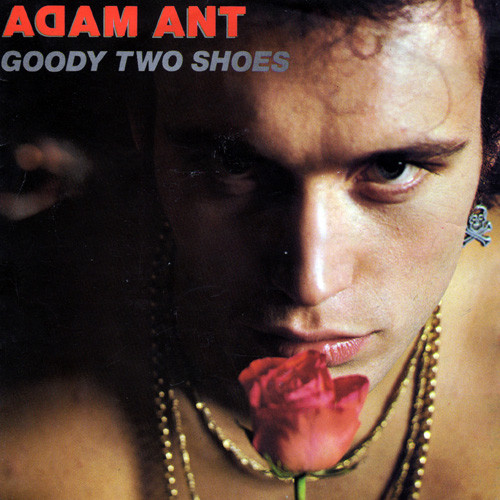
502. ‘Goody Two Shoes’, by Adam Ant

In which Adam breaks away from the Ants, and goes solo with a chilled-out, lo-fi, slow-burn debut…

Goody Two Shoes, by Adam Ant (his 1st and only solo #1)

2 weeks, 6th – 20th June 1982

Or not. ‘Goody Two Shoes’ is even more frenetic than either of his band’s chart-toppers. It’s a bit of throwback – twanging rockabilly mixed with a jiving big-band brass section – and it’s all kept galloping along by a relentlessly simple drum beat that Does. Not. Let. Up. Once.

Like ‘Prince Charming’ it is a repetitive song that you need to be in the mood for. Goody two goody two goody goody two shoes… I can see why this might get on some people’s nerves. But if you are in the mood for Adam’s hyperactive musical mind, then this is a great pop single, and the perfect song on which to launch a solo career. We don’t follow fashion, That would be a joke…

People repeat to Adam (in the video it’s a crowd of journalists) the song’s iconic hook: Don’t drink, Don’t smoke, What do you do…? He doesn’t give the press what they want! He doesn’t conform! Is he up to something…!? This might be the first chart-topping example of a ‘haters gonna hate’ hit, the art form so beloved of Taylor Swift. No-one’s gonna tell me, Who to eat with, Sleep with…

What does he do, then? In the lyrics, the answer is an ambiguous: Must be something inside… In the video it’s a little less subtle: he takes the sexiest journalist to bed and shows her just what he does do. Phwoar! It is a bit repetitive, but it’s short, and pacy, and doesn’t outstay its welcome. Of Ant’s three number ones in just over a year, I’d sandwich this nearer to ‘Stand and Deliver!’ (the best) than ‘Prince Charming’ (the worst).

For this record he kept a guitarist and the drummer from his earlier band, letting the other members go due to a ‘lack of enthusiasm’. Sadly this didn’t launch Adam Ant to a long-lasting solo career. He’d have two more Top 10s and two more albums before moving into acting later in the decade (shout out here for my favourite of his solo singles, the characteristically bonkers ‘Apollo 9’). There have been a few comeback albums, alongside some mental health issues. He still writes and performs, and has a tour ready to go when covid allows.

I may not have truly loved any of his chart-toppers, but I am glad that Adam Ant has had his moment at the top of the UK charts. A year in which he was undeniably the biggest pop star in the country. He’s a true British eccentric, always interesting, with a great sense for the theatricality of pop. Line this up alongside the preceding #1, Madness’s ‘House of Fun’, and it has made for a technicoloured, hyperactive double at the top of the charts.

Advertisements