815. ‘Maria’, by Blondie

I wonder who had this on their 1999 bingo cards? New-wave icons Blondie stage a comeback, release their first single since 1982, and it only goes and makes number one…

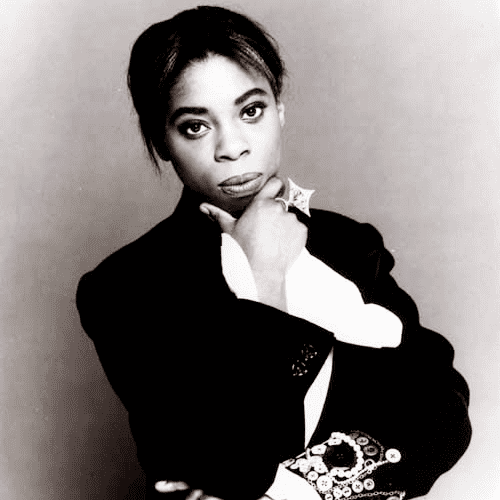
Maria, by Blondie (their 6th and final #1)

1 week, from 7th – 14th February 1999

Okay, the first part had already happened in 1997, with the band spending much of 1998 on tour. But surely nobody expected this… Exactly twenty years since ‘Heart of Glass’ became their first chart-topper, and over eighteen since ‘The Tide Is High’ became what most assumed was their last.

‘Chocolate Salty Balls’ was a recent, perfect example of how to do a novelty hit. ‘Maria’ is, then, a textbook example of how to arrange a comeback smash. They’re still new-wave punks at heart, with razor sharp guitars in the intro and solo, Harry on top vocal form (for that chorus line needs belting out), and some trademark drum fills from Clem Burke. The subject matter also calls to mind earlier Blondie hits-about-girls, like ‘Sunday Girl’ and ‘Rip Her to Shreds’. But the production is clean, crisp, late-nineties alt-rock. A perfect balance that means ‘Maria’ could have come right in the middle of Blondie’s imperial phase; but that also guaranteed radio play in 1999. Plus, there’s wedding bells, which I don’t really get but sound great.

Who is ‘Maria’, though? One of rock’s great femme fatales, she was an imaginary woman, dreamed up by keyboard player Jimmy Destri, who had fantasised about such a girl while at a Catholic school. She sounds pretty high maintenance – She moves like she don’t care, Smooth as silk, Cool as air – but also like you’d give your right eye for her to just notice you. And the line about her Walking on imported air… has to be one of the coolest descriptions in rock ‘n’ roll. Ooh it makes you wanna die…

The slightly surprising thing here is that Blondie weren’t all that old in 1999… They were in their late forties/early fifties, which in 2024, when Beyonce and Eminem can still make number one, doesn’t seem that wild. Debbie Harry was fifty-three, which means she promptly usurps Cher (eleven months her junior) as the oldest female chart-topper. It also meant that Blondie joined a very select group of acts to have made #1 in three different decades, which in 1999 only numbered Cliff, Elvis, the Bee Gees, and Queen (and Paul McCartney, under various guises).

They have gone on to release four more albums since this comeback, the most recent coming in 2017. Chart hits have been harder to come by, but I would point you in the direction of their following lead single, 2003’s cracking ‘Good Boys’. I feel like a Blondie ‘Best of the Rest’ post is overdue…

Finally, we should mention that ‘Maria’ becomes the latest in a long, long line of chart-topping women. Off the top of my head we’ve had Tiffany, Frankie, Josephine, and Eleanor Rigby, but there are many, many more. Though, interestingly, number ones named after women seem to have been much more prevalent in the fifties and sixties than in the 1990s…
687. ‘Young at Heart’, by The Bluebells

If we thought ‘Oh Carolina’ was an unpolished step away from the usual sounds of the early nineties, then what to make of this folksy jig…?

Young at Heart, by The Bluebells (their 1st and only #1)

4 weeks, from 28th March – 25th April 1993

We need to sound the ‘random re-release’ klaxon, one that has been honked fairly often during these past few chart years, for the success of this record was not completely organic. ‘Young at Heart’ was originally a #8 hit, in 1984, for Scottish jangle-pop act The Bluebells. It was their biggest hit, from the only studio album they released before disbanding in 1985. Fast-forward nearly a decade, and the song is being featured in a commercial for Volkswagen (not Levi’s, for once!)… Hey presto. Number one.

And aren’t we glad that it was! It’s distinctive, bordering on strange, and yet oh so catchy. Banjos, harmonicas, and most of all violins – the solo has to be one of the most ‘out there’ moments in a #1 for many a year – come together at the barn dance for a tale of young love: They married young, For love at last, Was their only crime…

It’s always hit me as a sort of ‘Come On Eileen’ Part II, both in terms of the Celtic sounds and the subject matter. Plus at its heart, despite all the country dressing, it has a pure pop bridge and a soaring chorus, which hint at an interesting origin story. I’ll let you in on a secret, one that raised my eyebrows when I found it out barely five minutes ago… The reason this song has such strong pop credentials is because it was written, and originally recorded by, Bananarama! I know, right…!

They recorded it for their debut album in 1983 – it was actually co-written by Siobhan Fahey (sort of giving her a second non-Bananarama number one) and the band’s guitarist Bobby Bluebell (not his real name) – and, if we’re honest, their version is fairly bland. In fact, The Bluebells’ take is a lesson in how to do a cover version right: changing the tone, the tempo, the genre, to the point where you’d have to be listening pretty closely to notice that they were the same song.

The Bluebells reformed especially for the TOTP performance brought about by the record’s unexpected success, and have continued to come back together on and off over the years. One of their former members is a lecturer in music business, while another is a golf correspondent for The Guardian.

Sadly, I make this the final ‘random re-release’ we’ll see, for a while at least. There are plenty more to come, especially in the 21st century, but this is the end of that golden spell in the late-eighties and early-nineties, when Ben E King, Jackie Wilson, The Clash, The Righteous Brothers, The Hollies and The Steve Miller Band all scored belated, sometimes posthumous, chart-toppers thanks to films, TV shows and, more often than not, adverts for Levi’s jeans. Let’s salute them, then, these random re-releases, for spicing up the charts, and breaking up all the SAW, the dance, and the movie soundtrack power ballads.

681. ‘Sleeping Satellite’, by Tasmin Archer

It’s fair to say we needed a bit of a chillout, after cutting all those mad shapes to our past couple of chart-toppers, ‘Rhythm Is a Dancer’ and ‘Ebeneezer Goode’. Enter Tasmin Archer then, with ‘Sleeping Satellite’.

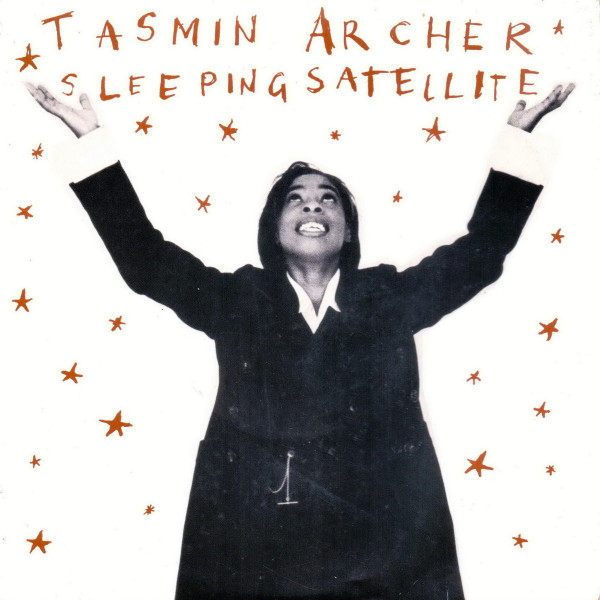
Sleeping Satellite, by Tasmin Archer (her 1st and only #1)

2 weeks, from 11th – 25th October 1992

First things first, this is just as ‘nineties’ as the rave anthem that preceded it. The trip-hop drums and light guitars, for a start, and the way Archer sings the verses quietly before ending them LOUDLY. It’s very nu-soul, in the same vein perhaps as Lisa Stansfield’s semi-recent #1, and the lyrics are quite new-age – a genre that’s been popping up ever since Enya in 1988. It’s grown up, is what it is. Your mum might say she’d heard it on the radio the other morning, and quite liked it. Certainly no schoolboy innuendo about class-A drugs here.

Archer has a great voice, with a rasp that kicks in on those loud bits. You could perhaps accuse her of over-singing, but she gives the song an energy that stops it from becoming too MOR (you know, ‘mum oriented-rock’…) Because, let’s be honest, the lyrics are wishy-washy. I blame you for the moonlit sky, And the dream that died, With the eagles’ flights… She’s referencing the moon landings – the ‘Sleeping Satellite’ of the title is our very own moon – and the fact that we’re neglecting Earth in favour of space adventure. Though, to be fair, the lines in which she seems to be predicting an apocalypse don’t seem too far off, thirty years on…

I like the organ that kicks in, and the power chords that offer some oomph as the song grows. It goes on a bit too long, though, and ultimately the message gets lost in the perfectly pleasant melody. It’s one of those songs, outside Christmas classics, and the various summer-themed number ones, that perfectly suits the time of year that it reached top spot. This was an autumn #1, ideal as the nights started to draw in. I’d also suggest that it joins the likes of ‘Baby Jump’, Slik, and Boris Gardner, as one of the most-forgotten number ones of its time.

‘Sleeping Satellite’ was Tasmin Archer’s debut release, with her having previously worked as a backing singer and recording studio assistant in Bradford. She’s labelled as a one-hit wonder, which is unfair as her follow-up single made the Top 20. In fact she has five Top 40 hits, and a 1993 Brit Award for Best Breakthrough Act. She released her most recent album in 2006, before announcing that she was going into TV and film soundtrack work.

573. ‘Papa Don’t Preach’, by Madonna

In my post on Madonna’s first UK number one single, ‘Into the Groove’, I found myself looking for controversy in the (slightly) saucy lyrics. When you grew up with Jesus-humping, cone-bra wearing, sex book Madonna then you do expect her to have been raising hackles with every release…

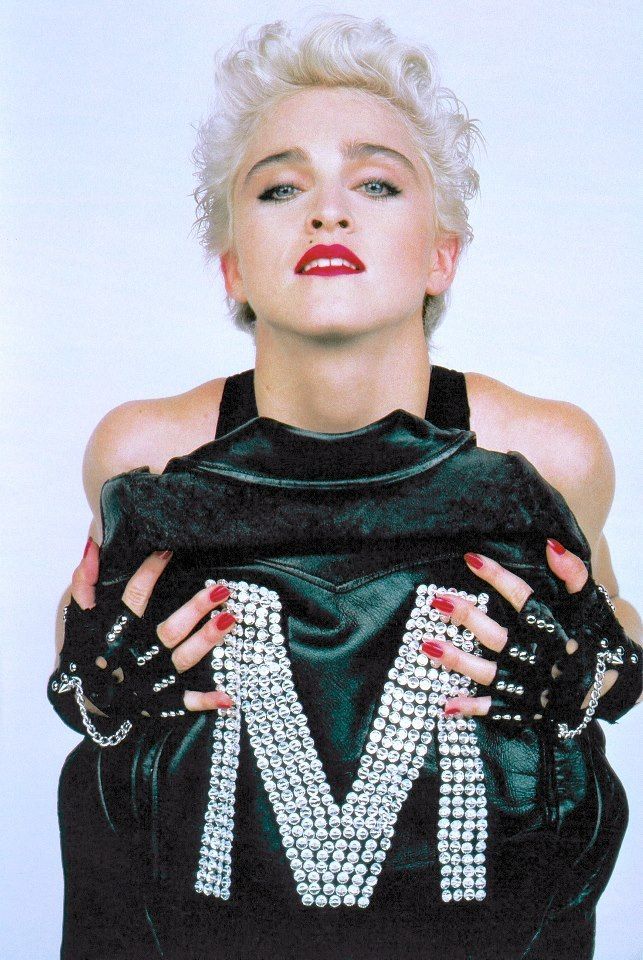
Papa Don’t Preach, by Madonna (her 2nd of thirteen #1s)

3 weeks, from 6th – 27th July 1986

‘Into the Groove’ wasn’t particularly troublesome, while ‘Like a Virgin’ missed #1 altogether, but we haven’t had to wait too long for some top-spot controversy. For her 2nd chart-topper, Madge tells the tale of a pregnant teen looking to her single-parent father for advice. Papa don’t preach, she begs, I’m in trouble deep…

Her Pa had warned her off the boy in question – the one you said I could do without – but he’s promised her a wedding ring. Her friends, meanwhile, say she’s too young. However, despite coming to him for advice, the narrator already seems certain: I’ve made up my mind, I’m keeping my baby…

It’s a grown-up pop song, any controversy is of the thought-provoking rather than the in-your-face kind. Musically, too, ‘Papa Don’t Preach’ mixes a classical intro with synth-pop, and then Latin guitars. The moment where the bass comes in after the violins have reached their crescendo is brilliant, adding another contender to 1986’s gallery of great beat drops. Her voice even sounds a little older – I love the throaty rasp in each pre-chorus ‘please!’

In the video, too, Madonna sports a new cropped hairdo, and switches between leather-jacketed tomboy and blonde-bombshell in a black basque. The song plays as an imagined speech to her father, as she returns home to tell him. At the end of the video she does finally confess, and in the end they embrace. A happy ending.

I was looking for controversy here, and controversy there was. Some claimed it encouraged teen-pregnancy; others that it was anti-abortion. Madonna and her song-writing team were smart enough to use the phrase ‘give it up’ rather than anything more explicit. Madonna has always argued that it’s pro-choice, and has at other times added a ‘not’ to the I’m keeping my baby line when performing the song live. Either way, at least the world has moved on from a time when it was considered controversial for a woman to be the one who decides if she does or doesn’t have a baby………….. (how long does an ellipsis need to be to signify huge sarcasm levels…?)

Under the morals, most importantly, there lies a great pop song. No matter who Madonna has chosen to wind up, she rarely forgets that people come to her, first and foremost, for high-grade tunes. And yet, I feel that ‘Papa Don’t Preach’ is one of her forgotten gems… Other, bigger, more controversial moments have perhaps eclipsed its standing in her back-catalogue? It’s certainly not as played as other Madonna songs. If ‘re-discovering’ is too strong a term, then you can definitely re-acquaint yourself with it, below…

Advertisements

564. ‘The Sun Always Shines on TV’, by A-ha

One of the things I liked about our last #1 – Pet Shop Boys’ ‘West End Girls’ – was the song’s slow build-up. I’m a sucker for a strong intro. That intro, though, is small fry compared to the bombast and drama offered here…

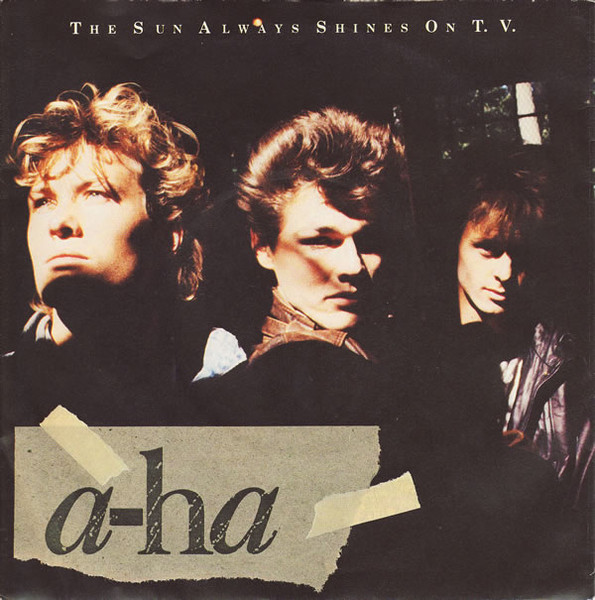
The Sun Always Shines on TV, by A-ha (their 1st and only #1)

2 weeks, from 19th January – 2nd February 1986

Before we actually get down whether this record is any good or not, I have to say that a song with a minute-long intro – featuring at least three different synth lines – has an automatic head-start towards greatness. Touch me… pleads Morten Harket in his distinctive falsetto… Give all your love… as the synths wind slowly towards the peak… To me…!

As with ‘West End Girls’, there’s another great beat drop, when chugging guitars, stabbing chords and beefy drums grab us by the scruff of the neck and whip us along. It’s fun, it’s got great energy; but it’s not everything the intro promised it would be. It’s very Duran Duran, and it emulates their most recent #1, ‘The Reflex’, by chucking every trick they can think of into the mix. At time it’s a bit much, the synths especially can be a little too flourishy.

Like much of the mid-eighties, ‘The Sun Always Shines on TV’ is simultaneously modern and cutting edge, dated and of-its-time. Lyrically, it seems to be about the falseness of fame: I reached inside myself and found, Nothing here to ease the pressure, Of my ever-whirring mind… and the music does a good job of creating the image of a chaotic paranoia. Paranoia that you can dance to.

A-ha are, of course, Norwegian. And Harket has what I’m going to call ABBA-English. Perfectly good English, just slightly off in pronunciation and stress making it somehow even more appealing. For me, his high-pitch and his accent all just add to the frenzied drama. I believe, unless I’ve forgotten someone obvious, A-ha were the very first act from Norway to hit #1 in the UK. This wasn’t, though, their first big hit. It was the follow-up to ‘Take on Me’ – undoubtedly their signature song – which had been held at #2 by ‘The Power of Love’.

Can we say that this was a ‘shadow number one’, making top spot by basking in the glow of its predecessor…? It wouldn’t be the first. And while ‘Take on Me’ is the better song, and would have been a worthy #1, ‘The Sun Always Shines…’ has enough oomph and dynamism about it to suggest that it could have been a chart-topper under its own steam. The video links the two songs by having the start of this one act as a fake ending to ‘Take on Me’.

While the intro here was extended, the ending is not. A sudden, clanging piano note slams down, as if the band is shouting ‘Enough!’ That’s all we’re getting. It draws to an end a run of #1s that appeals to my inner chart-geek: the past six chart-toppers, since Feargal Sharkey’s ‘A Good Heart’ in early November, have all spent a fortnight at the top. Without checking too thoroughly, I think that’s the longest run of its kind… (It’s been surpassed many times since by one-weekers, though).

And finally, I have to mention why this #1 has such resonance for me, why it is a ‘line in the sand’, as I put it in my last post. ‘The Sun Always Shines on TV’ is the very first number one, five hundred and sixty four songs and four and a half years of blogging in, that I was alive for. To be fair, I was two days old when it got knocked off the top, so my recollections of its time as the biggest hit in the land are hazy. But as a Birth Number One I think I got off quite lightly. (I know people born under the reigns of ‘Long Haired Lover from Liverpool’, and ‘Nothing’s Going to Change My Love for You’…)

Advertisements

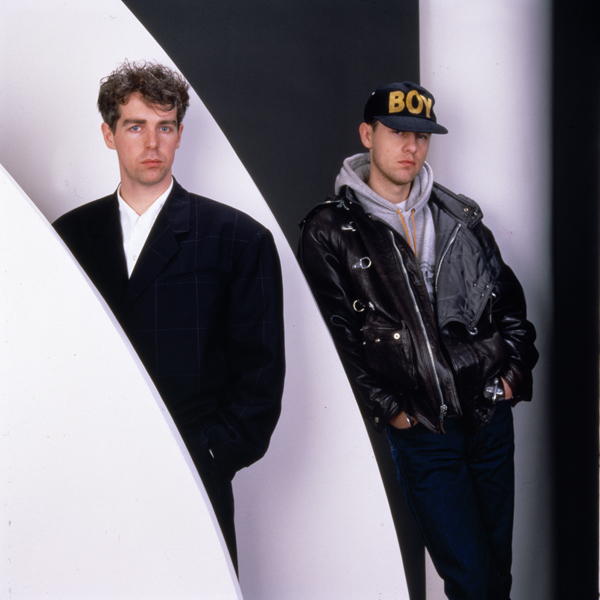
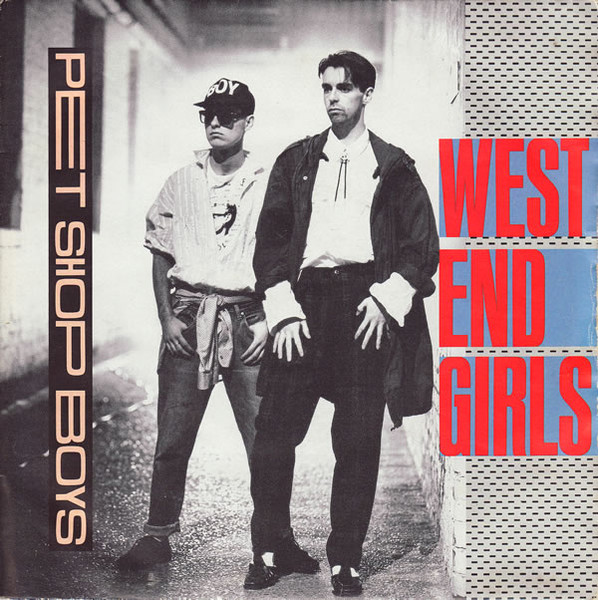
563. ‘West End Girls’, by Pet Shop Boys

I have something to confess. I’ve been putting off writing this next post. It’s been a full week since I put fingers to keyboard and mused on ‘Merry Christmas Everyone’. But why? When up next is one of the most respected and best loved #1s of the eighties, if not of all time…? Because, to be honest, I’ve never really got this one…

West End Girls, by Pet Shop Boys (their 1st of four #1s)

2 weeks, from 5th – 19th January 1986

It’s a statement first chart-topper for 1986. An enigmatic intro: footsteps, traffic, waves crashing (?)… A very slow build. And I will say that the moment the beat drops (that’s not something we’ve talked about often, beats ‘dropping’ – it feels very modern) and the squelchy bass starts slapping is great. Really great. Interestingly, for a song that sounds so new, it was almost three years old when it finally made top-spot, having already been recorded and released in various iterations (to little success).

But the rest of the song? At best it’s enigmatic, as I said in the last paragraph, and very cool. There’s a strangeness to it, a strangeness that draws you in, no matter what you think of the music. It’s got a very unique sound for a chart-topper – a very ‘January’ number one (the time of the year when oddities tend to sneak their way to the summit) – and that’s to be commended. I’m all for variety. Plus it announced the arrival of one of the most influential acts of the past forty years, and I say that as someone who will only have good things to write about Pet Shop Boys’ three remaining #1s.

This one, though. I can admire it; but I’ve never found a way into enjoying it. It’s a frosty, aloof piece of modern art, there to be pondered, and studied from different angles, but not loved. But… I freely admit that I am in the minority here, and know for a fact that some of my regular readers will disagree vehemently with this take on ‘West End Girls’. Here we are. I can only write my truth, as they say.

Is it going too far to wonder if this record might even have appealed to listeners as a novelty at the time? Nowadays British rappers are ten-a-penny. In early 1986, though, it must have been funny to near Neil Tennant drop lines like You got a heart of class, Or a heart of stone, Just you wait ‘til I get you home… like Grandmaster Flash crossed with Noel Coward. I love his arch delivery. I really like the haunting backing vocals before the chorus… How much do you need…? And I love the fact that it’s influenced by T.S. Eliot’s ‘The Wasteland’ – too few chart-topping singles are based on modernist poetry.

Yes, there are elements of this song that I really do like. It just doesn’t click as a whole. For me. Meanwhile, it’s won Brit Awards, and Ivor Novellos. It’s been named Song of the Decade. Two years ago, The Guardian claimed ‘West End Girls’ as the best number one single, ever. It’s influence has been far reaching, into just about every electronic act that’s come since. Maybe it’s because it’s the first #1 of a new year, but it feels like a line in the sand. And it is also a line in the sand for me, personally, but more on that next time…

Advertisements

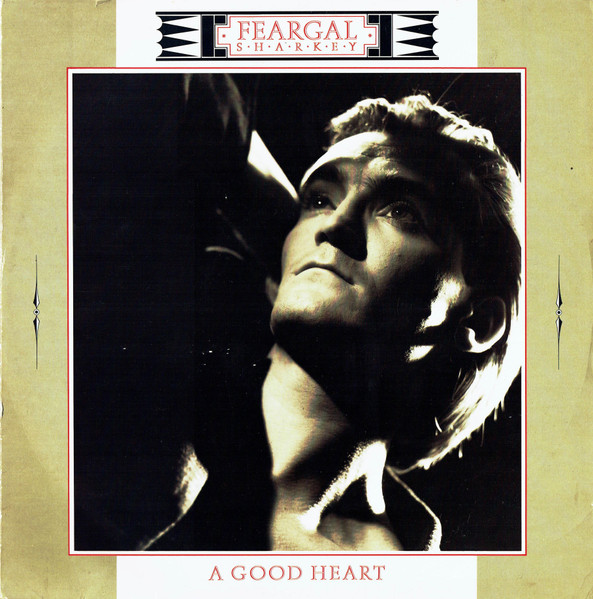
559. ‘A Good Heart’, by Feargal Sharkey

Our next number one reminds me of something… Glossy, confident synths. Broad power chords. A former frontman going solo… Ah yes… It takes me all the way back to two chart-toppers ago, and Midge Ure’s ‘If I Was’.

A Good Heart, by Feargal Sharkey (his 1st and only #1)

2 weeks, from 10th – 24th November 1985

I do like the intro here. In fact it might be my favourite part of the song, the way that it gives the feeling of racing down a motorway, with the chiming guitars sounding like cars flying past in the opposite direction. I have no idea if that’s what they were going for, but it’s great. Really great, until Feargal Sharkey starts singing.

And this is no slight on his voice, which is fine. A lovely Northern Irish tenor. But I’m a big fan of The Undertones, and to hear Sharkey’s voice so far away from the pop punk I love is just kind of weird. His blue-eyed soul in the bridge: Well I know, Cause I learn a little, Every day… is at once impressive, and disconcerting. It sort of proves the point I made last time, when writing about ‘The Power of Love’: for whatever reason, I can swallow heartfelt and earnest much more readily when it comes from a female singer.

Away from the vocals, ‘A Good Heart’ falls into the same trap as ‘If I Was’. It’s a little full of itself, a little burdened by the weight of what it wants to be. I’m not sure why everyone was getting so serious in the autumn of 1985, but AOR was clearly the order of the day. I’m starting to long for a cheesy boyband… (OK, I may have sneaked a peek at who’s up next.)

My second favourite part, after the intro, is the echoey guitar in the solo. AOR it may be, but at least the ‘R’ really does stand for ‘rock’ in this record. The bassline is pretty cool, too. On the whole, I like this. I like it better than ‘If I Was’, at least, which seems the obvious comparison. (I’m still undecided, though, on the very strange adlibs, both by Sharkey and by his backing singers, in the outro…)

But then I’m tempted to imagine if Feargal (it’s pronounced ‘Fergal’ btw – I just had to check) Sharkey’s one and only #1 had come with The Undertones. ‘My Perfect Cousin’ at number one! Or ‘Get Over You’. Or even ‘Mars Bars’! Or, of course, ‘Teenage Kicks’… And then I remember that that will get to #1, eventually, and I weep for what became of it…

This is by far Sharkey’s biggest solo hit. He moved into the business side of the music industry in the ‘90s, even turning down the chance to re-join The Undertones in 1999. He’s done OK, though, receiving an OBE for services to the industry. Meanwhile, this record also brings together a past and a future chart-topper: Dave Stewart of Eurythmics produced it, while Maria McKee – her number one still a few years away – wrote it.

Advertisements

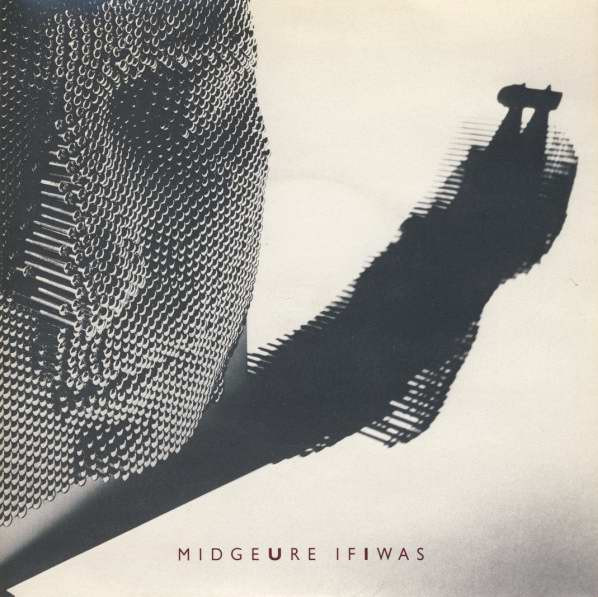
557. ‘If I Was’, by Midge Ure

Fresh from saving the world with Band Aid, the UKs very first charity chart-topper, Midge Ure returns to the day job…

If I Was, by Midge Ure (his 1st and only solo #1)

1 week, from 29th September – 6th October 1985

…with a record that is completely and utterly of its time. There are certain records that transcend, that you believe could have been a hit at any point in time. Then there are records like ‘If I Was’, that you can date almost to the week. This is the mid-1980s, in all its synthy, soaring, clinical glory.

I like the upward-moving chord progression. It gives the song purpose from the start, and gets you ready to expect something great. Something great that never comes… If I was, A better man, Would fellow men, Take me to their hearts…? It’s a very earnest song, in which Ure seems to doubt himself at every turn. If he was a soldier, a sailor, a candlestick maker (OK, one of those three may not be the actual lyrics…) would life be easier? Would he be loved?

It’s all very well being clever in a pop song. But I prefer when the cleverness is hidden behind a great tune. Here the music can’t make up for the lyrics, and it just comes across as a bit pretentious. I want to like the over-the-top-ness of it – the pure eighties-ness of it – but something’s missing. It’s not catchy enough, not silly enough, not something enough… Like I said: it’s clinical. It ends up a bit dull, and a bit long.

My favourite part is the clanging, ascending synth chords that lead up to the chorus. They remind me of a gameshow theme-tune, and are the one moment where Ure lets the silliness shine through. It doesn’t last, though, for straight off comes the chest-thumping chorus: If I was a soldier… Captive arms I’d lay before her…

I genuinely hadn’t heard this record before today, which is an increasingly rare thing as we head closer and closer to my own lifetime. Is this because ‘If I Was’ is very of its time, and hasn’t been played on radio since 1987? Or is it because it’s not very good…? A combination of both, I’d say. I’d also suggest that it only made #1 because of Ure’s Band Aid fame, but that might be a little harsh. He was a big star in Ultravox, and this was the lead single from his first solo album. Ure has been at #1 before, with the teeny-bopping, glam-rocking (and for my money much better) ‘Forever and Ever’, in 1976 with his first band Slik. This would be his last Top 10 hit, though he continues to record and tour, as well as keeping up his sterling charity work.

Advertisements

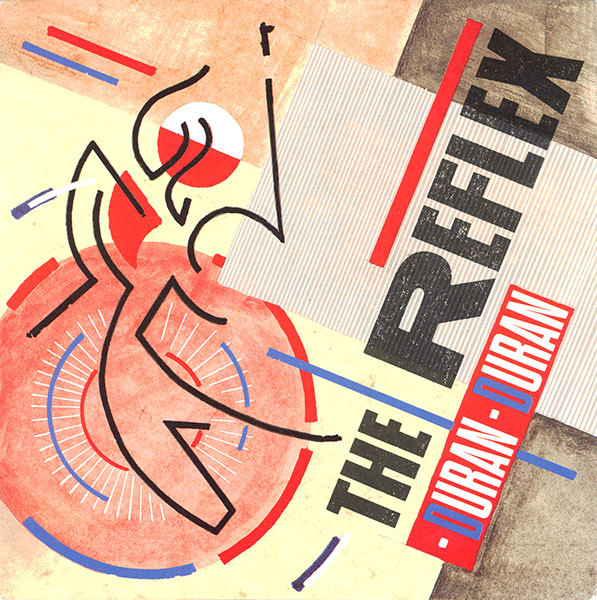
534. ‘The Reflex’, by Duran Duran

Birmingham’s finest return for their second chart-topper, with what might be the most obnoxious intro to a #1 single ever. Ta-la-la-la… The re-fle-fle-fle-fle-flex…! It’s brash, it’s in your face, it’s Duran Duran…

The Reflex, by Duran Duran (their 2nd and final #1)

4 weeks, from 29th April – 27th May 1984

I’m imagining Duran Duran as those annoying kids you’ll find in any school playground, the ones needing constant attention from whoever will give them it, demanding everyone watch as they dance and cartwheel around, while the quieter, more thoughtful kids go unnoticed… (I’m not reliving any childhood trauma here, honest…) The main hook – the wh-ay-ay-ay don’t you use it… – even sounds like a child’s taunt, as they stick their tongue out and wiggle their fingers in front of their nose. It’s also a pretty darn effective pop hook. Once it’s in your head, it’s there for the rest of the day.

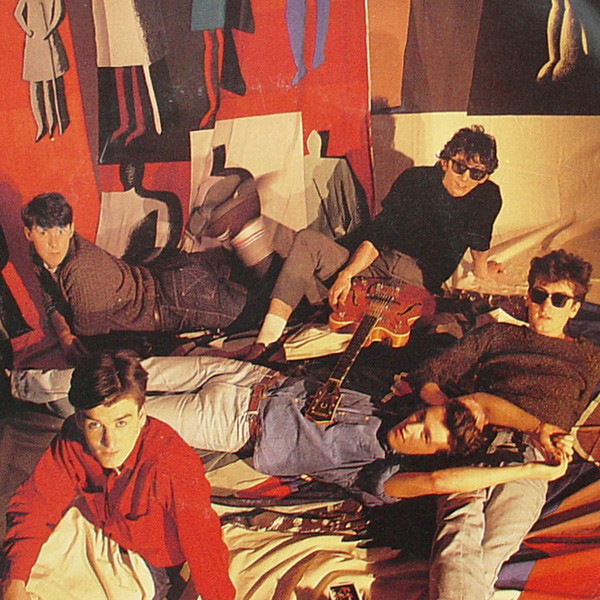
‘The Reflex’ shouldn’t work. It’s a hot mess of a record. The foundation is standard Duran Duran: a solid bass line from John Taylor, and the same guitars from ‘Is There Something I Should Know?’ Simon Le Bon’s voice remains one that you need to be in the mood for. But on top of this they’ve chucked everything plus the kitchen sink. Steel drums, horns, choppy vocal effects, explosions… Some of it grates, but a lot of it sticks. Everything about it – from the way the band has cut up samples of their own lead singer’s voice, to their perfect mullets in the video – screams peak eighties. This song might actually be as ‘eighties’ as it ever gets. And something about its pure relentlessness carries it through to being a pretty decent tune.

Just what is ‘the reflex’, though? It is a lonely child, waiting in the park… and it’s watching over lucky clover… You must, at all costs, try not to bruise it. Apparently it has something to do with gambling. Le Bon has gone on record as saying that he’s tired of having to explain it, as he thinks song lyrics should retain their mystique. I’d hazard that he’s tired of explaining it because he hasn’t a clue what he’s been prattling on about all these years.

In the end, and just as it went when I was reviewing their first #1, the frown from my first listen slowly fades. By the fifth play I’m dancing on the valentine with the rest of them. If my two posts on Duran Duran have taught me anything, it’s don’t overthink them. Just go with the flow and enjoy yourself.

You might think a band so synonymous with this decade would have had more than just the pair of #1 hits. Still, this was their 8th Top Hit in three years, and they’d have four more before the end of the decade (including one of my favourite Bond themes). They’ll also have a couple of Top 10 comebacks: in the ‘90s with one of their best songs (‘Ordinary World’) and in the mid-00s, when synth-rock had had a big resurgence in the charts and they were suddenly the elder statesmen of the genre…

Advertisements

532. ’99 Red Balloons’, by Nena

A couple of posts ago, I was a bit down on 1984. Before it had even started, I was pooh-poohing the idea that it was all that great of a year. But… with this next chart-topper following on from the assault to all five senses that is ‘Relax’, maybe 1984 wasn’t such a bad year after all.

99 Red Balloons, by Nena (their 1st and only #1)

3 weeks, from 26th February – 18th March 1984

Not that I’m going to start claiming it as the best year ever – not yet anyway – but this is another great slice of synth-pop. The slow-building intro is quite similar to ‘Relax’, and it forms the background to a story of two people in a toy shop, buying a bag of red balloons… Set them free at the break of dawn, ‘Til one by one, They were gone…

And then the beat drops – one of the great beat ‘drops’, from before beat ‘drops’ were a thing – and we have an incredibly catchy, cheese-funk synth riff. And guitars! Punk rock guitars. Forget synth-pop; it’s synth-rock. It feels like an age since we’ve had actual guitars at #1, and they drive the song along through its story of nuclear armageddon. Ninety-nine red balloons, Floating in the summer sky…

The authorities see these innocent balloons and panic. This is what we’ve waited for, This is it boys, This is war… You don’t need a degree in 20th Century history to work out what concerns this record is tapping into. The Cold War was at its height: it’s still February, and this isn’t even the first chart-topper of the year to reference war. It won’t be the last either… Incidentally, the inspiration for the song was said to have come when the band went to a Rolling Stones concert in West Berlin, and watched balloons released on stage floating towards the Wall.

Nena were themselves from West Germany – ‘Nena’ being both the name of the band and of the lead singer, in a shades of Blondie. In fact, Britain was one of the few countries where the hit version of ’99 Red Balloons’ was in English. Across Europe and Australia, even in the US, the German original soared to the upper reaches of the charts. I do like Nena’s German-accented English, especially in the worry, worry, super scurry line, though there’s a forcefulness to the German version that probably comes from her being more confident singing in her native tongue (the drums are also heavier in the original, which is another pro).

In the end we’re left with something stark, both musically and lyrically. The driving beat and catchy riff vanish, leaving the echoey synths. It’s all over and I’m standing pretty, In this dust that was a city… The singer finds one last balloon. I think of you and let it go… It’s a powerful ending from a song that sometimes gets written off as a novelty (I was thinking the same before listening to it properly a few days ago…)

Nena (the band) had a few more years of success in Germany, but struggled to score many more hits in English-speaking countries. They split up in 1987, though Nena (the singer) has continued to record, and sometimes collaborates with her former bandmates. And so. I am left to reassess my opinions on 1984, and on synth pop in general. Except, oh dear…. Our next number one will go some way to proving why this year wasn’t so great after all…

Advertisements