318. ‘You Wear It Well’, by Rod Stewart

In which Rod Stewart scores his second number one single, by releasing a song that sounds suspiciously like his first. I mean, ‘Maggie May’ had been such a huge hit, his now-signature song, that you can’t blame him for trying to re-bottle lightning.

c1lq-28tuss-_sl1000_1

You Wear It Well, by Rod Stewart (his 2nd of six #1s)

1 week, from 27th August – 3rd September 1972

Not that it’s a rip-off (can you even rip-off your own song?), but it’s similar enough to sound like an off-cut from the same recording session. The intro meanders, as it did in ‘Maggie May’, before two drumbeats – dun dun – signify that we’re ready for the song proper to get underway.

I had nothing to do, On this hot afternoon, But to settle down and write you a line… Rod’s reminiscing about a woman he once loved. Who knows, maybe it’s Maggie…? He’s been meaning to call her, but thinks a handwritten letter would tug the old heartstrings a bit more effectively. You wear it well, A little old fashioned but that’s alright…

He reminisces about basement parties, her radical views, a birthday gown he bought her in town… Then he lays on the charm: Madame Onassis got nothing on you… It’s another wordy ballad, a little more electric than acoustic this time, while the fiddle from ‘Reason to Believe’ – the flip-side of his first #1 – makes another appearance to add some homespun charm. To be honest, I’m struggling to get into ‘You Wear It Well’. It’s a bit plodding, and the words sometimes get lost in the mix.

-688033

When you look the lyrics up, though, you see that there are some nice touches. The fact that he didn’t call because he’s in Minnesota and, y’know, that’d be a bit pricey, and the line: My coffee’s gone cold and I’m getting told, That I gotta go back to work… While at the end Rod hopes that she’s still at the same address. It’s not a record without charm; you just have to give it a few listens and dig a little deeper to find it.

But, you’d have to admit that if he had been trying to recapture the magic of his debut chart-topper then he’s not quite managed it. It’s strange to think that of all Rod Stewart’s big seventies hits which didn’t make the top of the charts – ‘You’re In My Heart’, ‘Tonight’s the Night’, ‘Hot Legs’ – ‘You Wear It Well’ did.

A short post, then. A nice enough song, and a nice enough addition to 1972’s parade of chart-toppers. It seems that to hit #1 in the summer of ’72 your record either had to be glammed up to the eyeballs, soppy teenybopper fluff, or an acoustic ballad. Let’s spin the tombola and see what pops up next…!

Follow my #1s playlist on Spotify:
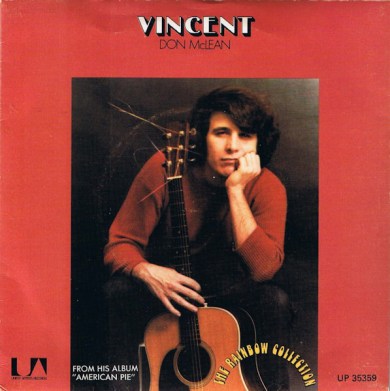
314. ‘Vincent’, by Don McLean

From the glorious, life-affirming swagger of ‘Metal Guru’… to one of the saddest #1 singles ever recorded.

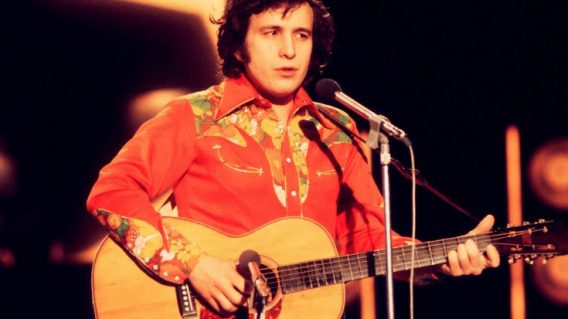
mclean-american-pie-getty--735x413

Vincent, by Don McLean (his 1st of two #1s)

2 weeks, from 11th – 25th June 1972

The ‘Vincent’ in question is the Dutch artist Vincent Van Gogh, who lived and painted in the late 19th century, to little recognition and with failing mental health until severe poverty and depression led to him shooting himself. Not the cheeriest of topics to start with, even before we get to the song itself, and certainly not the usual territory of pop singles.

It’s also one of the most articulate and descriptive chart-topping singles yet. Don McLean takes Van Gogh’s most famous works and turns them into lyrics: Starry, starry night, Paint your palette blue and grey, Look out on a summer’s day, With eyes that know the darkness in my soul…

It’s just a voice, an acoustic guitar, and some light, light backing touches. The gist of the song is that the singer sympathises with Vincent, that he recognises something of himself in the artist’s struggle (this was written before McLean hit the big time with ‘American Pie’), and that perhaps Vincent was the sane one after all. If people know one thing about Vincent Van Gogh, it’s that he cut off his ear and sent it to his brother. But that’s not all that he was. Now I understand, What you tried to say to me, And how you suffered for your sanity… It works also in the voice of Van Gogh’s brother, Theo, who was entwined in Vincent’s life, and who suffered equally under his brother’s illness. It’s strong stuff.

I love the idea that Van Gogh was too pure, too good for this ordinary world. It comes to a height midway through, as McLean describes the day Van Gogh committed suicide: For they could not love you, But still your love was true, And when no hope was left inside on that starry, starry night, You took your life as lovers often do… Some artistic license there, as he shot himself in a wheat field during the day, but it’s a powerful image – that he could have died on a night like the one in his most famous painting. But I could have told you Vincent, That this world was never built for one as beautiful as you… There’s also an urban legend that ‘Vincent’ was played to rapper Tupac on his death-bed, after he had suffered the same fate as Van Gogh. It was, apparently, his favourite song.

R-1456931-1342348675-5628.jpeg

It ends on a gut-punch. Each previous verse has ended on the hope that: They did not listen, They did not know how… Perhaps they’ll listen now…. On the final note, however, this changes to: They were not listening, They’re not listening still, Perhaps they never will… The idiots will always outnumber us. We’re all doomed…

Acoustic singer-songwriter type music is far from being my favourite genre. It’s all too easy to sound clever and profound as long as you sing softly enough and don’t plug your guitar in. Especially in the past few years, every male solo artist to hit the charts seems to have a beard, a beanie hat and observations to make. (I blame Ed Sheeran, personally, but then I’d happily blame all the world’s problems on Sheeran.) However, when a song is written and performed as beautifully as this, with a genuine message and genuine emotion, it’s very powerful. Don McLean had made his name just a few months before with ‘American Pie’, another song built around the death of a cultural icon. You have to wonder if ‘Vincent’ would have been such a big hit had ‘American Pie’ not come along first (it had reached #2 in the UK), especially as this sounds so out of place in a chart dominated by glam and bubblegum, though you’d hope it would have.

Last winter, in those final, blissful pre-coronavirus days, I visited the Van Gogh Museum in Amsterdam. If you have the chance to go one day, do! It displays his pictures in chronological order, and gives the background to his circumstances and mental state at the time of painting. When you get to the end, and see his very last works, it’s genuinely affecting. Maybe this song wouldn’t be hitting me so hard, had I not been there? Who knows. Under the museum is buried a time-capsule containing Vincent’s paintbrushes, and the sheet music to this song. Tens of thousands walk above it every year, to see the work of a once-ignored painter. People did listen, eventually.

308. ‘I’d Like to Teach the World to Sing (In Perfect Harmony)’, by The New Seekers

I knew the chorus of this song, as everyone does, what with it having firmly imbedded itself in our popular culture. And so, I was fully expecting a cheesy, sing-along record…

p03kyxdn

I’d Like to Teach the World to Sing (In Perfect Harmony), by The New Seekers (their 1st of two #1s)

4 weeks, from 2nd – 30th January 1972

…but was not prepared for just how sickly saccharine this song truly is. Do not play this record on a full stomach! The melody is jaunty, the vocals are twee: I’d like to build the world a home, And furnish it with love… Grow apple trees, And honey bees, And snow-white turtle doves… I mean, eeesh. (*Insert vomiting emoji*)

The singers, with their gentle acoustic guitars, sound like earnest church youth-camp leaders around a campfire. Or the bouncy volunteers that confront you on the street, asking for your signature in some worthy cause. I’d like to teach the world to sing, In perfect harmony, And I’d like to hold it in my arms, And keep it company… They sound utterly insufferable – in case I wasn’t making that clear – though I wouldn’t bet against at least two of them having a crippling drug addiction, because nobody is naturally this perky. I do like the bass-line, though.

The message is one of peace and love, obviously, which is nice and all. But the lyrics never get above ‘primary school assembly’ level. We’d all like everyone to get along better and love another, obviously, but the Summer of Love has been and gone – with far better music than this – while a couple of years ago it was all doom and gloom at the top of the charts: ‘Bad Moon Rising’ and ‘In the Year 2525’. This record is the sound of people giving up on the hippy dream and/or a cynical counter-culture, and settling for meaningless crap. And listening to this today, given the absolute shitshow that 2020 has been so far, well it’s almost unbearable.

Plus. Plus, plus, plus. The one other thing that everyone knows about ‘I’d Like to Teach the World to Sing’, other than the sugary chorus, is that it originated from a jingle in a Coca-Cola advert. I’d like to buy the world a coke… etc. etc. For this ‘anthem’ of world-peace to have stemmed from one of the world’s mega-corporations, a company that floods every corner of the globe with its spectacularly unhealthy soft drinks and subsequent litter, is the piece de resistance. It’s actually quite funny.

R-541726-1541433490-4759.jpeg

I’ll get down from my high-horse now. This record wasn’t meant to be taken so seriously. It’s just a cute little pop song aimed at the kids. But, at the same time – back on the high horse for a second – I can’t help feeling that, for people in 1972, spending a few pounds on this shite was the same as people nowadays changing their Facebook profile to reflect whatever the week’s worthy cause is. Making the doer feel better about their privilege, while making no difference whatsoever to the world’s problems.

In fact, I’ve grown to detest this record so much in the past half an hour that I’m going to make a bold, bold claim. That it is worse than ‘Chirpy Chirpy Cheep Cheep’. Yes. ‘CCCC’ was inane and annoying. ‘ILTTTWTS(IPH)’ – that’s one hell of an abbreviation – is inane, annoying, and has ideas way above its station.

Finally, one question needs answering. What relation did The New Seekers have to The (old) Seekers, the Australian folk-pop act who scored two #1s in 1965 with the average ‘I’ll Never Find Another You’ and the dirgey ‘The Carnival Is Over’. Well, both bands share one member: Keith Potger, guitarist, who founded The New Seekers in 1969. They had scored a #2 the year before with ‘Never Ending Song of Love’ and will, I’m sure you’ll be thrilled to discover, top the charts one more time before leaving us in peace forever. Till then…

Follow along through the first (almost) 20 years of the charts, with this playlist:

305. ‘Maggie May’ / ‘Reason to Believe’, by Rod Stewart

And so we welcome to the stage a true rock icon, a man who sells albums and fills stadiums to this day. Sir Rod Stewart. (I’m assuming he’s a ‘Sir’. Sort it out, Queenie, if he isn’t.)

image

Maggie May / Reason to Believe, by Rod Stewart (his 1st of six #1s)

5 weeks, from 3rd October – 7th November 1971

This was his very first solo single release to make the charts. Straight to the top with a bullet, with what is his most famous song? I don’t think I’ve ever heard the ‘single’ version of ‘Maggie May’, which is a full two minutes shorter than the extended version I grew up with. It’s the same intro, albeit condensed, a confident acoustic riff, then two emphatic drumbeats announcing that the story is ready to begin. Wake up Maggie, I think I got something to say to you…

Young Rod has been seduced by an older woman, spent a summer with her, and is now starting to wake up to the harsh realities of their relationship. It’s late September and I really should be back at school… ‘Maggie May’ is famously based on Stewart’s encounter with a real woman, at a Jazz festival when he was sixteen. Getting away from the slightly predatory story – imagine if the genders were reversed – the lyrics capture perfectly the voice of a callous teen, coupled with some corny rhymes: I laughed at all your jokes, My love you didn’t need to coax… And then the classic: The morning sun when it’s in your face really shows your age… Harsh!

He loves her, but wishes he’d never seen her face. We’ve all been there. Young Rod sounds like a bit of a tearaway – his options post-Maggie are either becoming a roadie or making a living out of playing pool… I’m sure he’ll be fine, and get over the heartbreak. Anyway, the whole song is basically him rehearsing what he’s going to say to Maggie. He hasn’t broke it off just yet! It hinges on the opening and closing lines: I think I’ve got something to say to you… and I’ll get on back home, One of these days…

Unfortunately, the single version cuts the best verse, the one with the: You turned into a lover and mother what a lover you wore me out! line. Maybe that would have been too ripe for daytime radio. Then comes the solo, and the mandolin outro, one of the Celtic-sounding elements that often pop up in Rod Stewart’s music. It’s an undeniable classic, one that – cliched but true – still sounds fresh today. One that no amount of terrible pub karaoke versions can ruin. And while the woman may have been real, her name wasn’t ‘Maggie May’ – she was a famous Liverpudlian prostitute. I’m sure the actual ‘Maggie’ was delighted by the comparison…

ROD_STEWART_REASON+TO+BELIEVE+-+SOLID-689258

It’s been a long old while since we had a double-‘A’ hit the top of the charts – not since Louis Armstrong in 1968. On the flip we have Rod’s cover of ‘Reason to Believe’, a song I’m certain I’ve never heard before. It opens with a lonesome piano, before the vocals come in. Both these songs are very much focused on Stewart’s voice. Which is fair enough, as he does have one of the best.

If I listen, Long enough, To you… I’d find a way, To believe, That it’s all true… In ‘Maggie May’, he was trying to convince himself to leave someone. In this song, he’s trying to talk himself into staying, despite knowing that his lover lied: straight faced, while I cried… He needs a reason to believe in her. The two songs work well together, both in terms of the sound and the lyrical theme.

A fiddle gives this record the country feel that the mandolin gave ‘Maggie May’. Then midway through, we’re left with just the voice. Someone like you, Makes it hard to live, Without, Somebody else… It’s a nice song, that slowly grows on the listener; but it’s no ‘Maggie May’. Technically, ‘Reason to Believe’ was the song first pushed to radio when the disc was released, but the song on the other side quickly won through. Maybe it was because The Carpenters had released a version of the song the year before – a classic Carpentersy-country version – while the folky original had been recorded in 1965, by Tim Hardin, that the label thought ‘Reason…’ might have caught people’s attention quicker.

For, while this was Rod Stewart’s first charting single, it wasn’t his first attempt at a solo career. He’d been releasing singles since 1964, and had spent the sixties busking, playing session gigs and jumping between bands. Then came The Jeff Beck Group, in which he met Ronnie Wood, and then The Faces (basically The Small Faces minus lead singer Steve Marriott), with whom he was having hits alongside his solo work in the early seventies. After this huge five-week #1 smash there will be no looking back for Rod – he’ll go on to become one of the decades’ biggest stars, on either side of the Atlantic, and we’ll be meeting him plenty more times in the months to come.

296. ‘My Sweet Lord’, by George Harrison

I wonder what the odds were on George Harrison being the first Beatle to score a solo chart-topper? You would have assumed it’d be Lennon, who was releasing solo stuff before the Fab Four had even split, then McCartney, with his knack for a pop hook. Then again, George had been getting more of his songs included on their albums from 1968 onwards, and some of the Beatles’ most famous late-era tunes are his – ‘While My Guitar Gently Weeps’, ‘Something’, ‘Here Comes the Sun’… So maybe it wasn’t such a surprise when he hit top spot less than a year after his former band’s last hit.

George_Harrison

My Sweet Lord, by George Harrison (his 1st of two #1s)

5 weeks, from 24th January – 28th February 1971

And in the end, it wasn’t even close. We are still seven years from a #1 by Paul, and nearly a decade away from one by John, by which time he’ll be dead. Anyway, to the song… There’s something quite ominous in the opening acoustic chords, contrasting nicely with the goofy, tropical, lead guitar riff.

My sweet lord, Mmm my lord, I really want to see you, Really wanna be with you… His voice sounds great – angelic, but gruff and growly when it needs to be. Really wanna see you lord but it takes so long, My lord… First things first, then – is this a religious song? On the face of it, yes – especially when the hallelujahs come in. And does he want proof of God’s existence or, like Clive Dunn before, is he anticipating death? (George Harrison and Clive Dunn asking the big questions at the top of the charts, who’d’ve though it…)

It’s not your typical pop song – no verse, bridge, chorus here. It’s more of a growing chant, a five-minute long mantra, that ascends through several key changes. Now, you can’t ever go wrong with key changes, but at the same time it’s a song that doesn’t really go anywhere. Maybe that’s the intention; but for me it leaves something wanting. ‘My Sweet Lord’ is a song that I loved without really considering why, and I do still really like it, but the more I listen to it the more I wonder if it’s as great as they say…

R-8501940-1587384731-4928.jpeg

Sacrilege? Maybe. Halfway through the Hallelujahs become Hare Krishna’s and other snippets of Vedic prayer. Which answers our earlier question – yes, it is a religious song. Harrison was big into his Hinduism at the time and by combining it with Christian elements he wanted to make a statement on the follies of sectarianism. We all worship the same God at the end of the day, right? (No!, shout all the atheists in the back.)

It ends on a high, like a gospel choir singing it up to the rafters. Among the backing instruments and singers you can hear Ringo, Billy Preston (from ‘Get Back’), and Eric Clapton among others. You might also hear hints of ‘He’s So Fine’ by The Chiffons… Harrison famously lost a copyright case that ruled he had ‘subconsciously copied’ the melody. (I really like this cover by The Belmonts – minus Dion – which splices the two songs together, with lots of added kazoo.)

‘My Sweet Lord’ was on Harrison’s epic triple album ‘All Things Must Pass’ – a shackles-off moment in which he stepped out of Lennon and McCartney’s combined shadow. He would continue to have commercial success throughout the seventies and eighties – by himself, in the supergroup The Travelling Wilburys – and then in the nineties with the two remaining Beatles. The eagle-eyed among you will have noticed, though, that this is his ‘1st of two #1s’… The other? A re-release of ‘My Sweet Lord’ just after his death in 2002. Till then then, George…

https://www.youtube.com/watch?v=8qJTJNfzvr8

Follow along with my Spotify playlist.

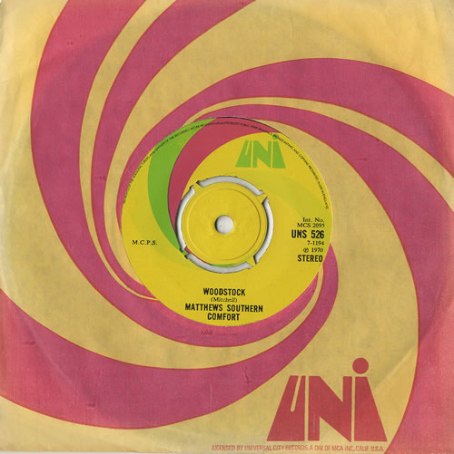
292. ‘Woodstock’, by Matthews Southern Comfort

As far as I know, I have never, ever heard this song before. I know Woodstock, the music festival, obviously, and I know Southern Comfort, the whisky flavoured liqueur that I haven’t drunk since an unfortunate incident when I was nineteen… Combining these two things in my mind, I begin to picture a Country & Western, smoke-tinged ballad…

A-507569-1425942931-2837.jpeg

Woodstock, by Matthews Southern Comfort (their 1st and only #1)

3 weeks, from 25th October – 15th November 1970

…and I’m not a million miles away. It’s a soft record – a soft voice, uber-soft rock – a comfy blanket that wraps itself around you and lulls you to sleep in its echoey rhythm. We are stardust, We are golden, And we’ve got to get ourselves, Back to the garden… The singer is a hitchhiker, on his way to Woodstock. His companion is a child of God, off to join a rock and roll band, looking to set his soul free.

It’s a song for fans of imagery. He feels like a cog, stuck in something turning… At one point he dreams of bombers in the sky that turn into butterflies above our nation, which works both as a trippy picture and as a ‘make love not war’ kind of statement. The garden could be the farm where Woodstock was held, or it could be the Garden of Eden, with the singer hoping for a return to innocence. It’s a melancholy sounding song, though; not one that sounds terribly hopeful. The sixties are over, after all, and the hippy dream has died. Contrast ‘Woodstock’ with the hope of If you’re goin’, To San Francisco, Be sure to wear, Some flowers in your hair… and All you need is love… from just three years ago.

Actually, maybe this #1 officially marks the end of the sixties. 1970 has wandered around without really knowing where it’s going – a year of eclectic chart-toppers. This record could be the gunshot that puts us out of our misery, that leads us into a bold new decade, ten months late… Or not. I have to confess that midway through my first listen to this song, I checked how long was left and my heart sank to see a full minute and a half remaining…

MATTHEWS_SOUTHERN_COMFORT_WOODSTOCK+-+1ST-493335

It’s a bit limp. A little Simon & Garfunkel, a little Eagles, a little Fleetwood Mac, a little meh… I do like the sinister, mournful reverbing solo, though. That bit can stay! Matthews Southern Comfort were a British band, led by singer Iain Matthews, who had previously been in folk band Fairport Convention. He did not, to the best of my knowledge, play at Woodstock. Neither did Joni Mitchell, the writer of this song, which surprised me. She based the lyrics on what she heard from her then boyfriend, Graham Nash of The Hollies (Crosby, Stills & Nash also did a version.) Mitchell’s original – listen here – isn’t as warm or as chart-friendly as Matthews’.

It’s cool that Joni Mitchell has a number one single by proxy, and that one of the biggest pop culture moments of the twentieth century gets a belated mention at the top of the pop charts, but I can’t really warm to this song. It’s just floated past me… And, actually, if you want a proper taste of the Woodstock Music and Arts Fair, then you would do well to hang around and catch our next number one single…

Follow my Spotify playlist with all the #1 singles so far here.

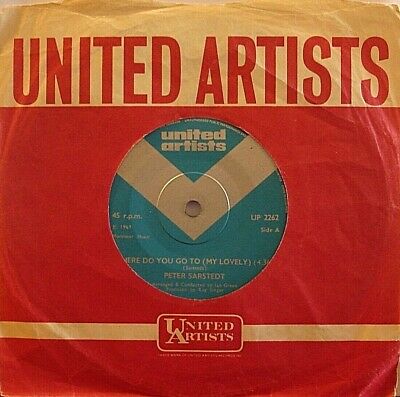
267. ‘Where Do You Go To (My Lovely)’, by Peter Sarstedt

I complained about our last #1 – Amen Corner’s ‘(If Paradise Is) Half As Nice’ – having nothing for the listener to get their teeth into. It just floated along, pleasantly enough… This next #1 though, has enough meat in it for several courses.

xxl

Where Do You Go To (My Lovely), by Peter Sarstedt (his 1st and only #1)

4 weeks, from 26th February – 26th March 1969

It’s a ballad, in the very traditional sense. An epic song – nearly five minutes in length – that tells a story. I love a song that tells a story. A story that’s introduced by some accordions, as you picture the singer strolling alongside the Seine in winter, hands thrust deep in his pockets, a cigarette dangling from the side of his mouth. Mais oui.

He’s rueful, thinking about a girl, as Frenchmen are wont to do. Where do you go to, My lovely, When you’re alone in your bed… Tell me the thoughts that surround you, I want to look inside your head… (Yes I do…) I love those little run-ons at the end of each verse. They add to the idea that this song is being made up on the spot, that it exists only in the singer’s head, as he walks the river banks.

He paints quite the picture of this girl. Beautiful, glamorous, diamonds and pearls in her hair, famous friends and a fancy apartment off the Boulevard St. Michel… She went to the Sorbonne, of course, and talks like Marlene Dietrich. She has Picassos, and a racehorse from the Aga Khan, and sips only the finest brandy… I’m paraphrasing, obviously. All this unfolds over several verses, accompanied only by an acoustic guitar. This song really is all about the lyrics, and the voice that delivers them: full of regret but still defiant.

It’s funny too. The verse about her carefully designed topless swimsuit, for example that gives her: an even suntan, On your back, And on your legs… And then suddenly it’s menacing, when he mocks her fake laugh: a-ha-ha-ha! There’s anger too: They don’t realise where you came from, And I wonder if they really care, Or give a damn… (Note the mild swear word! The worst one so far? Two hundred and sixty seven chart-toppers in.)

peter-sarstedt-where-do-you-go-to

Who is she, then? Who is this deceptive femme fatale? Don’t keep us in suspense any longer, Peter! We know we’re getting to the denouement when the violins come in. Turns out, the singer knew the girl as a child in Naples, when they were both begging in rags. Her name’s Marie-Clair… So look into my face, Marie-Clair, And remember just who you are, Then go and forget me forever, But I know you still bear the scar, Deep inside… (Yes, I do…) As with all the best stories, it leaves things open to interpretation. Were they childhood friends? Young lovers? Brother and sister? Did she betray him to escape their life of poverty…?

The final line, I think, gives it away. I know the thoughts that surround you, ‘Cause I can look inside your head… They are twins! And she did do something terrible to him! Maybe… The same accordions from the intro play us out, as we contemplate this bombshell. Apparently, the title character might have been inspired by the fashion magazine ‘Marie Claire’, or by the actress Sophia Lauren (who was from Naples), or by Sarstedt’s girlfriend… ‘Where Do You Go To (My Lovely)’ both won an Ivor Novello award, and was one of John Peel’s least favourite songs. I can see why you might either love or hate this record. It’s smug, and pretentious, and wordy. Myself, I’m leaning more to the ‘love’ side.

Peter Sarstedt was, disappointingly, not French. He just wrote a very French-sounding chart topper. Don’t worry, though – there will be a genuine French #1 before the year’s out. He was British, though born and raised in India, and was the younger brother of Eden Kane, whom we met back in 1961, when he hit top spot with ‘Well I Ask You’. Which, I think, makes them the first siblings to hit #1, following on from father and daughter Frank and Nancy. The follow-up to ‘Where Do You Go…’ made #10, and that that was that for Sarstedt’s chart career. Knowing he was on to a good thing, he wrote two further instalments of the Marie-Clair story – ‘The Last of the Breed’ and ‘Farewell Marie-Clair’ before he died in 2017.

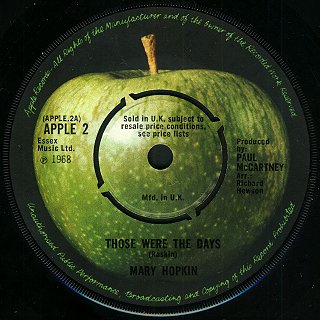
259. ‘Those Were the Days’, by Mary Hopkin

From the longest number one yet… To the second longest. Five minutes plus! Picture yourself in a tavern in Leningrad, back when it still was Leningrad. Big furry hats, sturdy men, even sturdier women…

stream_img

Those Were the Days, by Mary Hopkin (her 1st and only #1)

6 weeks, from 25th September – 6th November 1968

It reminds me of Petula Clark’s ‘This Is My Song’, an old-fashioned ballad with a sweeping intro. Instruments that I couldn’t begin to name jingle-jangle before the violins come in… Once upon a time there was a tavern, Where we used to raise a glass or two… It’s a song of longing and regret. The singer is reminiscing about happier times, dancing and singing down the pub. Those were the days, my friend, We thought they’d never end… If ‘bittersweet’ was a sound, then that sound would sound a lot like ‘Those Were the Days.’

I wasn’t just making up all that stuff about Leningrad – this really is based on an old Russian folk-tune. A Georgian folk-tune, actually, which had been around since the turn of the century. And you really can picture some Cossacks high-kicking in time to the steady beat, especially when we get to the dadadadas. That’s another thing that this record has in common with its predecessor ‘Hey Jude’: a chanted refrain. Except this one doesn’t drag on for four and a half minutes…

By the third verse, time has moved on. The singer stands outside the same tavern: In the glass I saw strange reflections, Was that lonely woman really me…? In the fourth verse she timidly enters the bar… Oh my friend we’re older but no wiser, For in our hearts the dreams are still the same… Do they get back together? Have one last fling for old time’s sake? Or do they just leave it at a smile? I guess we’ll never know…

unnamed

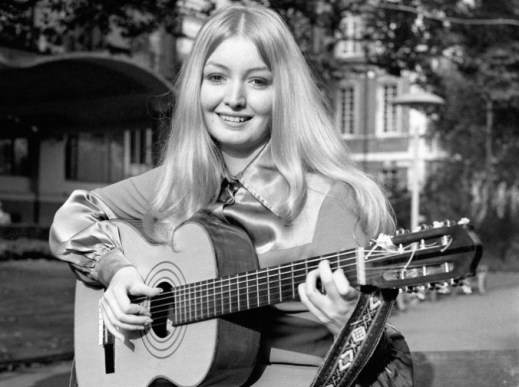
As a melody, it’s pretty irresistible, coming as it does from a time before ‘pop music’ existed. It sounds nostalgic, like you’ve heard it before, somewhere, sometime… It feels as if it should be from a musical. It was also produced by one Paul McCartney, who may have popped up once or twice already on this countdown. He’d known the tune for years, and finally chanced upon Mary Hopkin as a singer. She was barely eighteen, and looks every bit the sixties flower-power girl. Long hair, bare feet, that kind of thing. ‘Those Were the Days’ was her first, and by far her biggest hit. She would go on to have four more Top 10 singles in the next couple of years, and still records to this day.

In one way, this song stands out as odd. It’s sentimental, old-fashioned, a bit cheesy… But in another way it is very late sixties: there are folk-rock touches (the ‘B’-side was even a cover of The Byrds’ ‘Turn! Turn! Turn!’) and some very Beatlesy flourishes (the horns that come in midway through, for example). Plus, this is 1968, and anything goes at the top of the charts this year. There have been some weird chart-toppers, and some weird ones are still to come…

244. ‘Mighty Quinn’, by Manfred Mann

Our next #1 single starts with what sound suspiciously like pan-pipes. I leave that there as a word of warning. (It’s not actually pan-pipes, it’s a flute, but the tone has been set….)

1a4c5e804afbef83a43b798ba7ff7b22

Mighty Quinn, by Manfred Mann (their 3rd and final #1)

2 weeks, from 14th – 28th February 1968

Come on without, Come on within, You’ll not see nothing like the Mighty Quinn… It’s a swaying chorus that greets us as the song proper gets underway. A chorus that I knew, without ever really having listened to the song in full. A chorus that begs a question – just who is the Mighty Quinn?

He is, naturally, an Eskimo. What else? To give the song its’ full title – ‘Quinn the Eskimo.’ And when Quinn the Eskimo gets here, Everybody’s gonna jump with joy… And why will Quinn’s arrival be greeted with such jubilation? To be honest, I’m now on listen number three and I’m still not sure.

The verses have a verve and swagger to them, that really really reminds of something else that I just can’t quite put my finger on. It’s very frustrating. Anyway… Everybody’s building ships and boats, Some are building monuments, Others are jotting down notes… It seems like a comment on modernity, and the fact that something is missing from modern life. Nobody can get no sleep, There’s someone on everyone’s toes, But when Quinn the Eskimo gets here, Everybody’s gonna want a dose… Or is it ‘a doze’, as in a nap? Either way, this is pretty abstract stuff.

Boiled down, it seems like Quinn is some kind of Messiah figure, who’s going to calm everyone down and chill everyone out (as well as gathering all the pigeons around him…) Bob Dylan – for yes, ‘tis he who wrote this – has claimed that the song is nothing more than a nursery rhyme. But that’s what the writers of strange and obscure lyrics always say, isn’t it? His version is much more folky and laid-back, and wouldn’t be released until several years after Manfred Mann’s.

2f7c48bc-7c6c-43a4-8ef5-5d63d6802c51

I’m not sure what to make of this one. On the one hand it is interesting. There can’t have been many #1 singles about Eskimos. On the other it just doesn’t quite work for me. It’s Dylan’s 2nd chart-topper as a songwriter and it is certainly not anywhere near the level of his previous one, ‘Mr. Tambourine Man’.

And what of Manfred Mann? They sign off on their chart-topping account, having hit the top spot with three very different records. The Beat-pop swing of ‘Do Wah Diddy Diddy’, the sweet ‘Pretty Flamingo’ and now this. A #1 in ’64, ’66 and now ’68. A band for even-numbered years. A 2nd-tier, perhaps slightly underrated sixties band? They were soon to become Manfred Mann’s Earth Band, and to go pretty heavy on the prog-rock. They’ve kept ‘The Mighty Quinn’ as part of their concerts, and apparently live versions can go on for a good ten minutes… I’m not sure if that sounds brilliant, or terrifying…

To be honest, my first exposure to this record was probably miles away from Manfred Mann and the 1960s pop charts. Irish football fans used to sing a version of this song for their big striker, Niall Quinn. The nickname stuck to such an extent that he even named his autobiography – you guessed it – ‘The Mighty Quinn.’

238. ‘Massachusetts (The Lights Went Out In)’, by The Bee Gees

A couple of posts ago, as I wrote about Scott McKenzie’s ‘San Francisco’, I made a big deal about #1 hits that reference places, and how uncommon they were. Of course, just to prove me wrong, the charts now throw up a song about Massachusetts.

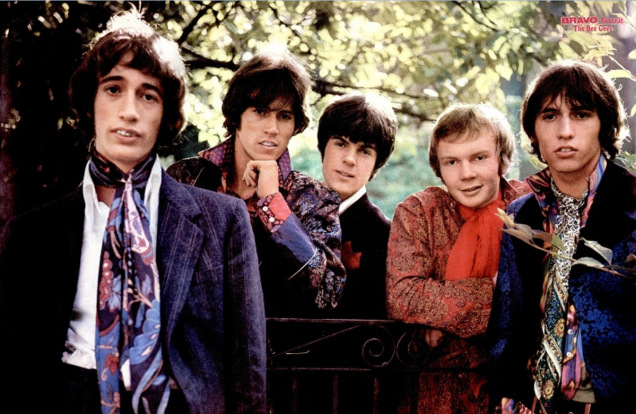
6709-bee-gees

Massachusetts (The Lights Went Out In), by The Bee Gees (their 1st of five #1s)

4 weeks, from 11th October – 8th November 1967

And that’s not all that this next chart-topper has in common with McKenzie’s hit. It also, you know, sounds a lot like it. The same light guitar and the same chimes. The same chilled-out vibes. It even references San Fran in the second verse. It’s the (Indian) Summer of Love! Is it harsh to suggest that The Bee Gees were simply jumping on the hippy bandwagon?

Actually, yeah, it would be harsh. This is a retort to songs like ‘San Francisco’. It’s being sung from the point of view of someone who has left his home, in Massachusetts, to join in the summer’s festivities, and who now feels a bit homesick. Feel I’m going back to Massachusetts, Something’s telling me, I must go home… He left his girl standing alone, as the lights all went down in Massachusetts… But he’s now seen the error of his ways: They brought me back, To see my way with you…

It’s an interesting concept, and a quick piece of song writing to get the record out and in the charts mere weeks after the hits that it references. It turns what I initially felt was a so-so, slightly bland song into one worthy of note. The lights are going down in Massachusetts because everybody’s buggering off to the West Coast! I will remember Massachusetts… I wonder if the Massachusetts Tourist Board have ever used it in an ad campaign?

Bee+Gees+Massachusetts+-+Solid-300929

Moving on – largely because ‘Massachusetts’ is a really difficult word to keep typing – let’s take a look at the band. The debutants atop the UK Singles Chart. The Bee Gees. You know, the band that in a decade’s time will take disco to the masses. I think that’s the ‘Bee Gees’ that most people think of: jumpsuits and sparkles and you should be dancing… It’s there in this record, mainly in the vocal harmonies that tremble a little higher than your regular pop record. (Though Robin Gibb sang lead on this one, while Barry sang falsetto on most of their seventies hits.)

They’re a fascinating band, actually. They will spread their five chart-toppers over exactly twenty years, covering three completely different versions of themselves, in terms of sound and image. But they’re not a band I’ve ever really been able to love, and I wish I could like their debut #1 more than I do… (Personally I think their final #1 is by far the best of the five.)

Anyway, they will be back soon enough. In between this and their next #1, they will release ‘Words’, which I can look on fondly as one of the first songs I ever learned to play on keyboard. Other interesting, and less self-revolving, bits of trivia about sixties-era Bee Gees include the fact that none of them had ever actually been to Massachusetts – they just liked the sound of it, and the fact that it was about as far away from San Francisco as you can get on the continental USA. (The Bee Gees, of course, weren’t American – they’re British/Australian.) And… I really like this one… ‘Massachusetts’ was the first ever non-Japanese #1 single on the Japanese charts! How about that…