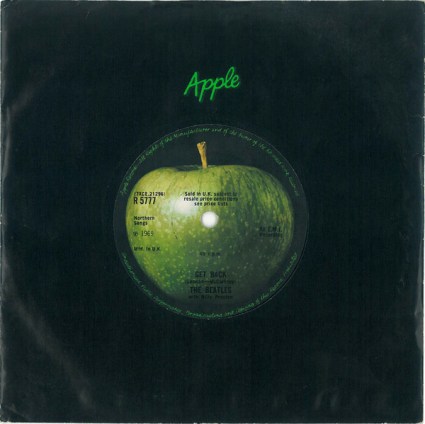
270. ‘Get Back’, by The Beatles with Billy Preston

For the penultimate time – shock! horror! – it’s the Fab Four. And this time they bring with them a riff that can only be described as chugging…

beatles-rooftop-e1548864435814

Get Back, by The Beatles (their 16th of seventeen #1s) with Billy Preston 

6 weeks, from 23rd April – 4th June 1969

The Beatles, since they left the Merseybeat days behind them in 1965, have gone trippy, gone heavy, gone epic. This time they’ve gone country. The guitar licks that shimmer around the main rhythm are pure C & W, while the lyrics take us straight to the wild west. JoJo was a man who thought he was a loner, But he knew it couldn’t last, JoJo left his home in Tucson Arizona, For some California grass… (Drug references! We have drug references in #1 singles, people. What a time to have been alive!)

Alongside JoJo we find sweet Loretta Martin, who thought she was a woman, but she was another man… She, or he, or they, also needs to get back, back to where she once belonged… All the girls around her say she’s got it comin’, But she gets it while she can… Pretty risqué stuff, I’d say, even for 1969. Though perhaps I just have a dirty mind.

Having not listened to it properly in several years, ‘Get Back’ is a much weirder song than I remember. There’s those lyrics for a start, then there are the squeaking noises and Paul McCartney’s very nasal, Kermit the Frog style vocals. There are also lines where he sounds close to laughter. Theories abound as to what the hell it’s actually about, including it being a satire of anti-immigrant views. I like John Lennon’s theory, though, that the get back to where you once belonged refrain was a McCartney dig at Yoko Ono.
R-6128850-1520005406-9513.jpeg

Although it’s their sixteenth chart-topper, this record is a Beatles ‘first’ for a couple of reasons. Most importantly, it’s their first and only single to officially feature another musician. Technically this is ‘The Beatles with Billy Preston’, as he contributes the funky keyboard solo – for my money the song’s best bit. It was also the first, and only, Beatles’ #1 to enter the charts in top spot, rather than climb there, which means they finally match Elvis and Cliff’s achievements from the start of the decade.

And, though we may be scraping the barrel here, it’s the only Beatles’ single to feature a spoken-word section. Before the final chorus, the riff tightens and Loretta is urged, once again, to get on home. Your mummy’s waiting for you, Wearin’ her high-heeled shoes and a low-necked sweater… And that’s that. Looking at The Beatles’ post-1965 #1 singles… you can’t claim they ever rested on their laurels. Every one is different, every one a work of art in its own way (even ‘Hello, Goodbye’.)

‘Get Back’ also, significantly, puts The Beatles out clear in the UK #1 singles leaders table. They now sit on sixteen while Elvis, for so long miles out in front, has fifteen. The Shadows are on twelve. Cliff is on nine. The Stones on seven. No other act so far has more than four.

Finally, this is the 4th Beatles chart-topper in a row to have had Paul as the lead writer. Was he carrying them by this point? Or was he just writing the stuff they knew would sell? John will have the final say, though, when he gets the credit for their final #1 single, coming up very, very shortly. And it was he who had the final word when they closed their final ever live performance, from the roof of the Apple studios in January ‘69. ‘Get Back’ was the very last song they played, before the police spoiled the fun, with Lennon thanking their impromptu audience and adding: “I hope we’ve passed the audition.”

230. ‘Release Me’, by Engelbert Humperdinck

An unassuming intro leads us, soft and gentle, into a swaying lullaby of a latest chart-topper. Please release me, Let me go, For I don’t love you, Anymore…

ftcms_a4559c7c-d05f-11e8-9a3c-5d5eac8f1ab4

Release Me, by Engelbert Humperdinck (his 1st of two #1s)

6 weeks, from 2nd March – 13th April 1967

Sigh. What has happened to the charts in recent weeks? We’ve gone from the pinnacle of the swinging sixties to the easy-listening doldrums… Jim Reeves, Tom Jones, Petula Clark (who’s fab, but still…) and now this. A new level of schmaltz.

I have found a new love dear… And I will always want her near… The one redeeming thing about this record is that it’s not a love song. It should be; but it’s really a break-up plea. Which gives it a slightly OTT, unintentionally comic feel. Especially with lines like Her lips are warm while yours are cold… (Ouch!) Such is the strength of the plea, I’m assuming he’s singing to his wife, and needs a divorce. Otherwise, why doesn’t he just dump her…? Or is he just too much of a gentleman to do a caddish thing like that?

When the backing singers come in, it really is a step too far. So let’s tune out for a moment, and focus on the most interesting thing about this record (apart from the singer’s name, but we’ll get to that in a bit.) ‘Release Me’, famously, held The Beatles’ ‘Penny Lane’ / ‘Strawberry Fields Forever’ double-‘A’ off the top-spot. For a fortnight, one of the most innovative and respected pop singles ever was outsold by just one disc. Engelbert’s.

ENGELBERT_HUMPERDINCK_(SINGER)_RELEASE+ME-302426

He turns it up a notch or two for the final chorus. We move from crooning to belting. He gives the final So….. some real welly. It goes without saying that, yes, he sings it well. I feel I’ve written that quite a lot recently. And frankly, it’s not enough to save this one. It’s like saying that a footballer kicks a ball well. He’s still got to find the goal! And the slow pace and pure blandness of this record means it’s one that bobbles well wide of the post.

Unlike ‘This Is My Song’, which just sounded old, ‘Release Me’ was a (fairly) old song. First written and released in 1949, and given the treatment by Patti Page, The Everly Brothers and Dean Martin among others. It goes without saying that Humperdinck’s version is the best-known. It was, inevitably, the highest-selling single of 1967.

And what of the elephant in the room? That name. Engelbert Humperdinck was a stage name, his real one being Arnold Dorsey. But, amazingly, it is an actual name. Engelbert Humperdinck I was a German composer from the turn of the century. Humperdinck II just wholesale borrowed the name – which seems cheeky to me. He was managed by the same guy as Tom Jones, and ‘Release Me’ was his breakthrough hit. His post-sixties career is pretty interesting, but I’ll hold off on the full bio as, joy of joys, he has another huge chart-topper coming up shortly…

Follow along with this handy playlist:

227. ‘The Green, Green Grass of Home’, by Tom Jones

It’s become a bit of theme recently – every so often we take a pause from pop music’s race into the future to enjoy a good, old-fashioned ballad. First with Ken Dodd, then Jim Reeves, and now Tom from the Valleys.

tom-jones8

Green, Green Grass of Home, by Tom Jones (his 2nd of three #1s)

7 weeks, from 1st December 1966 – 19th January 1967

A soft, swaying intro precedes a tale of a man returning home, from a long time away. The old home town looks the same, As I step down from the train… And doesn’t Tom sing it well? There’s something in the Welsh waters… Why are they such good singers? Why is it Welsh Male Voice choirs, and not Geordie Male Voice choirs?

He runs towards his long-lost love, Mary: Hair of gold, And lips like cherries… And then he heads home: There’s that old oak tree, That I used to play on… It’s a heart-warming song for Christmas. One for all the family. Yes, it’s good to touch, The green green grass of home… Like most Tom Jones songs, it helps if you’re a bit drunk. I love the saloon-bar piano, that really adds a ‘last-call’ vibe. And, also like most Tom Jones songs, it’s a karaoke classic. Not quite ‘Delilah’, but getting there.

I love a song that tells a story, verse by verse. Just where has this man been all this time…? And ‘Green, Green Grass of Home’, like all good stories, has one hell of a twist. We break for a spoken-word interlude, in which the singer reveals that it was all a dream. And, who’s that? Why it’s the guard… And there’s a sad, old padre, On and on we’ll walk at daybreak, Again I’ll touch, The green green grass of home… Yep, plot twist: he’s getting executed.

TOM_JONES_GREEN,+GREEN+GRASS+OF+HOME-303646

I love it. Either he’s been wrongfully convicted, which only increases the power of the earlier verses, or you’ve spent the last two minutes sympathising with a murderer. The little piano riff to end is this song’s version of a ‘badoom-tish.’ And I’m similarly in two minds about this record as a whole. On the one hand, it’s mawkish, sentimental mush. On the other, it’s a great one for belting out in the shower.

And to be fair, this was a mega-hit. Seven weeks at #1 is longer than any record in the past three and a half-years, since The Beatles’ ‘From Me to You’. And, as I mentioned earlier, I doubt that this disc being released over the festive season hurt its chances. The idea of a ‘Christmas Number One’ wasn’t really a thing this early in the charts, but I do wonder if the success of ‘Green, Green Grass of Home’ set the tone for later, similarly saccharine, festive hits.

As for Sir Tom, similar to his first #1, ‘It’s Not Unusual, I think we have to look at him as existing separately from his chart contemporaries. His other big sixties hits included ‘What’s New Pussycat?’ and ‘Help Yourself’ – nothing baroquey or folky, or Beat-poppy about them. But… If you’re never in fashion you’ll never be out of fashion. Maybe it’s this refusal to follow trends that’s allowed him all his comebacks: his Prince covers in the eighties, and his huge resurgence when I was in high-school. Looking back, how on earth did a near sixty-year old man singing ‘Sex Bomb’ become such a thing…? And he will hit the top-spot once more, briefly, in forty-two years’ time. Which, unsurprisingly, is by far the biggest gap between #1 singles, ever.

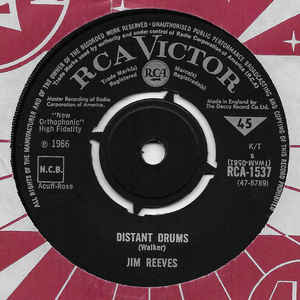
224. ‘Distant Drums’, by Jim Reeves

What to make of this, then…? Just as we were getting into a groove at the top of the charts – a rocking, modish, soulful groove with cool and forward-facing #1s following similarly cool and forward-facing #1s – The Kinks, The Blue Flames, Chris Farlowe and ‘Eleanor Rigby’, a curveball is thrown our way.

C1sLy+PlIFS._SL1000_

Distant Drums, by Jim Reeves (his 1st and only #1)

5 weeks, from 22nd September – 27th October 1966

Gentle drums, a swaying rhythm, a crooner’s voice… I hear the sound, Of distant drums, Far away, Far away… It’s the sort of country-ish ballad that was ten-a-penny in the late fifties and early sixties. (I’d perhaps call this one country-calypso, if that’s at all possible…) But it’s a sign of how far popular music has come in a very short time that ‘Distant Drums’ sticks out like a sore thumb in late 1966.

It’s a sentimental song, about a man who hears the distant drums of war… Then I must go, And you must stay… And so he begs his beloved to marry him before he gets shipped off: Let’s share all the time we can before it’s too late… If you love me Mary, Marry me… (Gettit? ‘Mary’ – ‘Marry’?) It’s sweet. Old-fashioned. Your gran would love it. I am certain, even without checking, that Daniel O’Donnell has covered this.

Why on earth it spent over a month at the top of the charts I do not know. But there’s no need to make a big fuss about it. Yes, it’s nothing like the brilliant hits that went right before, but I’m not a snob. There’s room for all in this parish. Jim Reeves sings it beautifully, in a very understated way. And it’s worth noting that exactly one year ago, Ken Dodd was at the top of the charts – for five weeks as well, no less – with the similarly saccharine ‘Tears’. And as with Doddy, ‘Distant Drums’ was, despite the strong competition, the biggest-selling single of the year! Maybe there was something in the autumn air…

R-7280842-1437917201-5702.jpeg

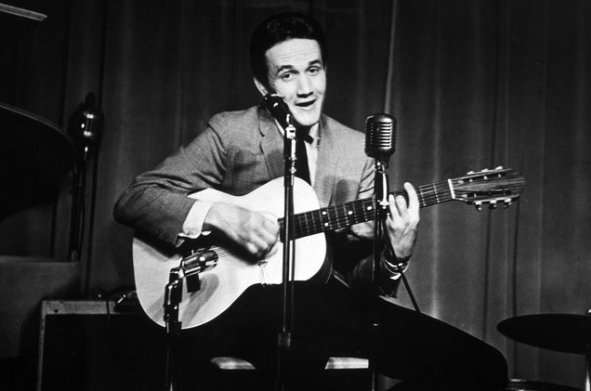
Or maybe it was because, as I’ve just discovered, Jim Reeves was dead. We have our third ever posthumous #1! But, unlike Buddy Holly and Eddie Cochran’s swansongs, Reeves had been dead for a while… A light aircraft crash, in a storm, in July 1964. Well over two years before this record hit the top spot… A bit late for a tribute, then. One other explanation is timing: that the song’s theme suddenly became prescient with escalation of the Vietnam War. Jim Reeves – ‘Gentleman Jim’ as he was known – had had plenty of chart hits before this one, both alive and dead, and so perhaps it isn’t a huge shock that one would catch the public’s imagination like this.

Whatever the reason, it means we get a little interlude in our rundown of the nation’s biggest selling songs. I’m not going to pretend that hearing this song has been a highlight of my day. If it had come in, say, 1962, in a version by Frank Ifield, I would have probably had far less patience with it… Moving on, then, without any further ado…

https://www.youtube.com/watch?v=9AqESKOaeGk

210. ‘These Boots Are Made For Walkin”, by Nancy Sinatra

One of the coolest intros ever – a twangy guitar that slides and droops like a wilting sunflower on a southern summer’s day – leads us into one of the coolest number one hits you’re ever likely to hear.

4zdvr1b9qpk11

These Boots Are Made For Walkin’, by Nancy Sinatra (her 1st of two #1s)

4 weeks, from 17th February – 17th March 1966

The sixties are truly swinging. There’s been attitude and swagger, even drug references (!) at the top of the charts. And now here’s Nancy, bringing the sass. The way she pauses between the lines, the way she delivers them like she can’t be bothered, as if the man she’s singing about is barely worth the oxygen.

You keep sayin’, You’ve got something’ for me… Her man’s been taking her for a ride; but Nancy ain’t no fool. You’ve been a-messin’, Where you shouldn’t’ve been messin’… He’s in for it. These boots are made for walkin’, And that’s just what they’ll do… One of these days these boots … cut the beat, leave it all to the vocals… are gonna walk all over you…

It’s a fairly minimalist record – sparse instrumentation and a lot of room for the echoey vocals to do their job. Which means there’s lots of time for all the gorgeous little details that make this such a great song to shine through. The whispered ‘yeah!’ between verses one and two, the sarcastic ‘Ha!’ after the You keep thinkin’, That you’ll never get burned… line. The way the horns come in halfway through, the same horns that will go wild for the fade-out (a very mid-sixties touch.) Then there’s the made up words – the ‘samin’ and the ‘truthin’. Nancy’s too cool to bother with proper English.

NANCY_SINATRA_THESE+BOOTS+ARE+MADE+FOR+WALKIN+-+SOLID-562479

‘These Boots…’ is a big development in terms of female-recorded #1s. In every photo-shoot from the time, Nancy Sinatra appears as a very sensual character: big, just-woken up hair, mascara-ed eyes, lots of cleavage. She’s sexy. A siren. In a way that Cilla (the girl next door) and Sandie Shaw (kooky and cute) weren’t. Helen Shapiro was still a kid, Doris Day was basically your aunt. The closest female star I can think of, from previous #1 hits, is Connie Francis, who was bringing the girl power on ‘Who’s Sorry Now’ seven years ago. But even she pales in comparison with Nancy Sinatra’s mini-skirts and thigh-high boots.

Surprisingly, this wasn’t her first attempt at a singing career. I had imagined that she simply appeared, fully-formed, as the superstar daughter of Frank Sinatra. But she had been releasing singles since 1961, to little interest on either side of the Atlantic. By 1965, she was about to get dropped by her label. It wasn’t until she paired up with Lee Hazelwood (the man with hands down the coolest voice ever committed to vinyl) that success came her way. He wrote ‘These Boots…’, and several other songs before she became his full-on muse and they recorded three albums together.

Though, I wonder … While being daughter of one of the most famous male singers of all time clearly didn’t bring her instant success, did it perhaps help mould her image? She had to distance herself from her fuddy-duddy dad, whose hit single career had stalled of late, hence the sexy looks; while her family name perhaps also gave her a safety net that meant she didn’t need to fit the ‘girl next door’ image adopted by most other female stars of the time. Was she in a constant state of teenage rebellion?

For a star who has become so synonymous with The Swingin’ Sixties TM, Nancy Sinatra wasn’t all that big a deal on the UK singles charts. But the impact left by this record alone is more noteworthy than the careers of many, more ‘successful’ stars. And she does still have one further chart-topper coming up – one of the sweetest (or should that read creepiest) #1 singles ever.

https://www.youtube.com/watch?v=m2fPkzJsMU8

194. ‘King of the Road’, by Roger Miller

And now for something completely different… A hobo anthem. A paean to all the drifters, all the homeless floaters who sneak rides on dusty freight trains – no ties, no families, picking up a couple cents as they go… Sounds depressing? Well…

Roger-Miller-billboard-bw-1548

King of the Road, by Roger Miller (his 1st and only #1)

1 week, from 13th – 20th May 1965

It’s not. Perhaps it should be; but it’s not. A groovy bass rhythm slinks in, fingers click… Trailer for sale or rent, Rooms to let fifty cents, No phone, no pool, no pets, I ain’t got no cigarettes… Add a lightly strummed guitar, and a saloon bar piano, and you pretty much have it. A simple song. A ditty.

The singer is a wanderer – one that’s happy with his lot. He finds jobs as he goes – two hours of pushing broom – and travels in the third box-car on the midnight train, where he’s friends with all the engineers. The references are very American: Bangor, Maine – union dues – old stogies… I think I know what they all mean… Why on earth this song hit #1, across the Atlantic, in the middle of the swinging sixties, is a mystery. The closest reference point I can think of for ‘King of the Road’ is Tennessee Ernie Ford’s similarly finger-clickin’ ‘Sixteen Tons’, from way back in January 1956.

But then again, why not? It’s a song that’s hard not to love. A song you know you must have heard somewhere before, with a hook that most people can sing from scratch: I’m a man of means by no means… King of the Road. I’ve listened to it several times now, and read the lyrics, and I still can’t work out if he means he’s king of the road despite having nothing, or if having nothing makes him king of the road… And it’s been a long day, so I’m not up to thinking that much more about it. It is what it is. Whatever it is.

ROGER-MILLER-7-KING-OF-THE-ROAD-b-w

I can remember precisely how I heard ‘King of the Road’ – or a version of it – for the first time. There was a road safety ad they used to show during children’s TV in the nineties featuring two hedgehogs who crossed roads slowly and safely, looking both ways, thereby becoming – you guessed it – kings of the road. Happy memories. But… in doing a little more Roger Miller related research for this post I discovered that he impacted on my childhood in a much bigger way, without me ever realising. You see, Miller wrote and performed several of the songs for the 1973 Disney version of ‘Robin Hood’ (AKA Disney’s Most Underrated Animation) – a film I must have watched around a hundred and fifty six times between the ages of seven and ten, after taping it off the TV on a grainy old VHS. The second I read that, I could hear the same deep, gravelly voice from this record coming from a cartoon rooster, singing ‘Oo-De-Lally’, ‘Not in Nottingham’, and other early-Medieval classics.

Anyway, back in 1965, all that was still to come. For now, we’ll leave Mr. Miller at the fade-out –one of the longest fade-outs we’ve heard so far. The full final thirty seconds of this record is him repeating the first verse, mumbling as he wanders off, back on the road again. There he goes, a black silhouette against an orange setting sun, the dusty highway stretching out in front, a tumbleweed spinning slowly by… The King of the Road.

(The version of ‘King of the Road’ in this video may be a re-recording. It seems to be the only version available on YouTube. Spotify has both.)

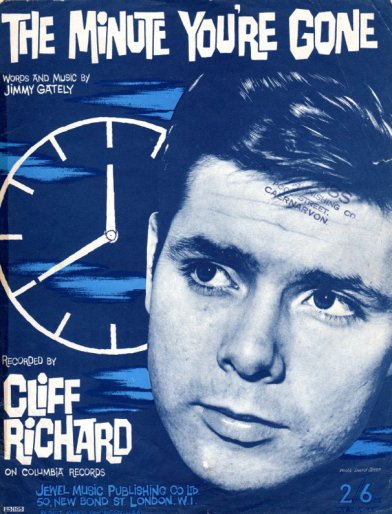
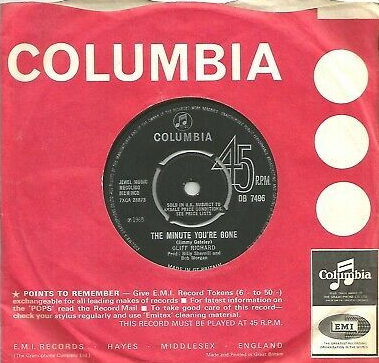
192. ‘The Minute You’re Gone’, by Cliff Richard

A fraction over two years since we last heard from him, Cliff’s back. What’s changed in his absence? Well… There’s been Merseybeat, for a start. The Beatles, The Pacemakers, The Searchers reinvented pop music, then The Animals and the Stones brought the blues and The Kinks brought the rock, and recently we’ve started going all jazzy, folky and a touch Baroque…

cliff-richard-7744-mm

The Minute You’re Gone, by Cliff Richard (his 8th of fourteen #1s)

1 week, from 15th – 22nd April 1965

So, has Cliff emerged from the most fertile and fast-moving period in popular music history, and taken anything from it? Has he borrowed a funky new sound from all those new kids on the block? Has he bollocks.

If anything he’s regressed. He sounded old-fashioned before; now he sounds positively pre-historic. For this latest chart-topper, Cliff’s gone… brace yourselves… country. Lilting guitars, a tinkling saloon-bar piano, backing singers last heard on a Frankie Laine record. That weird, uber-C & W whale-noise guitar in the background, last heard in ‘Rose Marie’. In 1955. ‘The Minute You’re Gone’ was recorded in Nashville, and it’s clear that Cliff dived whole-heartedly into the scene over there. I can imagine him buying his own Stetson and spurs just for the occasion, and throwing the odd ‘Howdy’ into conversation.

The minute you’re gone I cry, The minute you’re gone I die… To be honest, it took me several listens before I actually paid attention to the words… Before you walk out of sight, I’m like a child all alone at night… And I’m not sure it was worth bothering… I stare into emptiness… So on and so forth.

It’s not a terrible song. The chords are in the right place, there are verses, a bridge, a chorus… In the hands of a different singer I might have enjoyed this much more. The original singer, Sonny James, put a bit more OTT emotion into it. The very first UK chart-topper – the one and only Al Martino – lent it some of his customary gravitas. The only thing that stops Cliff’s version from finishing bottom of the ‘The Minute You’re Gone’ league table, is a sub-karaoke version by Irish grannies’ favourite Daniel O’Donnell.

Cliff-Richard-The-Minute-Youre-Gone

Back in 1963, I described the Mersybeat invasion as a comet that slammed into the musical landscape. A comet that killed off all the musical dinosaurs that had clogged up the charts of the early sixties. Only the very strongest would survive its sudden impact – Elvis, Roy Orbison, and Sir Cliff. Britain’s very own musical cockroach…

Harsh? A bit, maybe. It was an exaggeration to claim in my intro that Cliff had been ‘absent’ in recent years. He may not have scored a #1 since ‘Summer Holiday’, but every one of his singles, both with The Shadows and, like this one, without them, had gone Top 10. Don’t look at this record as a comeback; Cliff hadn’t been anywhere.

Who was buying his records, though? Surely not the same kids that were going wild for The Beatles and The Stones? Their mums, maybe? Their grans? I always complained about how seldom Cliff, Britain’s first rock ‘n’ roll star, actually rocked. Even as far back as his first chart-topper: the cheesy and insipid ‘Living Doll’. But maybe that was a masterstroke of foresight by him and his management. You can’t lose something you never had. Sell out from the very start…

Since starting this countdown, I’ve changed my opinion on many things. I now know that pre-rock music was far from boring, that Elvis didn’t actually invent sex, that ‘Rock Around the Clock’ didn’t open the floodgates, that instrumentals can actually be great… And yet I can’t say I’ve heard anything to convince me that Sir Clifford of Richard isn’t one of the blandest, squarest, middle-of-the-roadest artists in history…

Next!

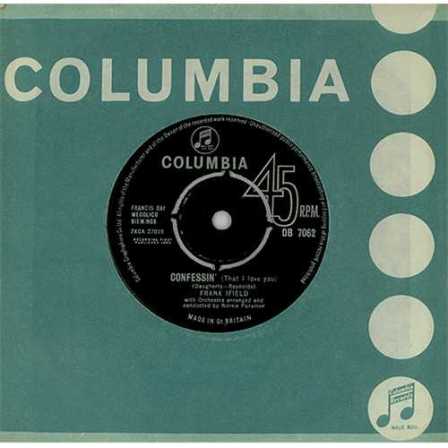
153. ‘Confessin’ (That I Love You)’, by Frank Ifield

In my last post, I indulged in a bit of metaphor-making and compared the Merseybeat wave that was sweeping the charts to a meteor – a mop-topped meteor that flattened all the musical dinosaurs who were clogging the charts. Except, as beautiful as that image is, reality gets in the way here. We briefly have to return to the old ways. The corpse, it seems, is still twitching.

im-confessin-that-i-love-you-featuring-frank-ifield

Confessin’ (That I Love You), by Frank Ifield (his 4th and final #1)

2 weeks, from 18th July – 1st August 1963

Frank Ifield, after dominating the latter half of 1962, still had enough in the tank to claim one final #1 single. The three he’s had so far have ranged from dull (‘The Wayward Wind’) to demented (‘Lovesick Blues’), but none have been very good. Can ‘Confessin’’ save the day?

It starts with a smooth rhythm – a bossanova? – and, naturally, a harmonica. And then the syrupy tones of ol’ Frank. I’ve said it before but it bears repeating – for all his many faults, this guy could sing. I’m confessin’ that I love yo-ooou, Tell me do you love me to-ooo, I’m confessin’ that I need you, Honest I do… Need you ev’ry moment…

It’s a lot more understated than his previous chart-toppers, even his trademark yodelling works here, in that it fits in with the lilting rhythm of the song and doesn’t just sound like him showing off. I kind of like it… I mean, I’ve forgotten it pretty much as soon as it’s done, and the lyrics are a kind of nothingy mulch about how much he loves a girl, and how he hopes she returns his feelings: I’m afraid someday you’ll leave me, Saying can we still be friends… To suggest that it has redeemed the chart-topping career of Yodelling Frank, however, would be a step too far.

If I’ve learned anything over my past four Ifield-based posts, it’s that this will be an old song done up to suit modern ears. It’s what Frank did. And in fact, ‘Confessin’ (That I Love You)’ dates further back than any Ifield #1 has done so far. It’s had the treatment from pretty much everyone, many of whom we’ve met before on this countdown: Tony Bennett, Rosemary Clooney, Doris Day, Perry Como, Frankie Laine, Kay Starr, Dean Martin and Johnnie Ray, as well as others like Judy Garland and the wonderfully named Chester Gaylord, who had the original hit way back in 1930.

FRANK_IFIELD_CONFESSIN+(THAT+I+LOVE+YOU)-294599

It’s a perfectly nice record, but one that I doubt would have come anywhere near the top of the charts had it been Ifield’s first release. It definitely needed the goodwill and borrowed lustre of his earlier, much bigger hits to drag it to the summit. Way, way back – when I wrote about Frankie Laine’s follow up to the monster-hit ‘I Believe’ – I invented the idea of a shadow-hit, a hit record kind of like those tiny birds that hang out picking the flies off hippos, and this is definitely what’s happening here.

And so ends the chart-topping career of Frank Ifield. He burned brightly but oh-so briefly – his four #1s squeezed into just under a year. I must admit I made a grave error when I got excited about Elvis doing four-in-a-year and struggled to find any other act that had managed it… Our Frank was hiding right here under our very noses. But that kind of sums up his career and his legacy, as I’d say he’s been pretty much forgotten. He was bulldozed from collective memory by The Beatles et al, and now rarely gets mentioned… He had one more Top Ten hit following this, and has been inducted into both the Australian Music Hall of Fame and, more importantly, the Coventry Music Wall of Fame. In the eighties he contracted pneumonia, which left him unable to yodel… He’s still going, though, aged eighty-one.

Frank Ifield, then, ladies and gentlemen. First Australian to top the UK charts, the Great Yodeller, forgotten superstar of the 1960s… A round of applause, please. And onwards.

https://www.youtube.com/watch?v=h_WnqnfLU1c

Follow along, and listen to every #1 covered so far, on my Spotify playlist:

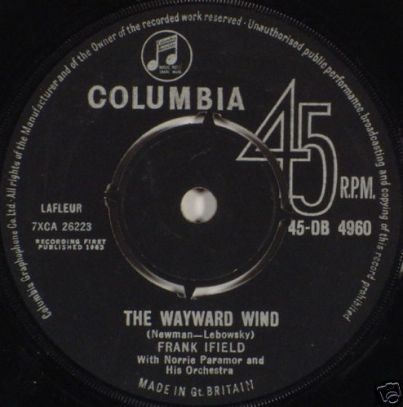
147. ‘The Wayward Wind’, by Frank Ifield

I have to admit – I’m struggling to ‘get’ Frank Ifield, Britain’s pop-idol du jour in 1962-3. We’ve arrived at Pt. III of his chart-topping quadrilogy (that’s a word, right?) and still the key to his success is eluding me.

FRANK-IFIELD-88-600x417

The Wayward Wind, by Frank Ifield (his 3rd of four #1s)

3 weeks, from 21st February – 14th March 1963

At the very least ‘The Wayward Wind’ is an improvement on Ifield’s last #1, the demented ‘Lovesick Blues’. Largely because the yodelling (Oh God, the yodelling…) is kept to a minimum. Instead we get a harmonica riff (that sounds suspiciously like it’s from an early-Beatles B-side…) and the story of a wanderer:

Oh the wayward wind, Is a restless wind, A restless wind, That yearns to wander… And I was born, The next of kin, Ah, the next of kin, To the wayward wind… It was originally, you may have guessed from those lyrics, a Country & Western song from the fifties – the rest of the lyrics are all about ‘railroad tracks’ and ‘border towns’. Which means it’s the third hit running in which Frank Ifield and his producers have taken an old song and tarted it up to fit in with the sound of the time – i.e. the soon-to-explode ‘beat movement’.

It’s probably the best of Ifield’s three chart-toppers; though that is very, very faint praise indeed. I like the way that strings and cymbals come in on the verses as the ‘wayward wind’ – it’s a nice effect. And we make it almost a minute into the song before the first yodel: made me a sl-a-a-a-eeee-ave…! Frank clearly couldn’t help himself. Maybe it was an actual affliction – yodelling Tourettes? – and he did it even when talking…? He saves it for that line and that line only, though, for which we can all be grateful.

690a_12

Like all of Ifield’s hits, ‘The Wayward Wind’ isn’t a song I’d ever heard before. The one good thing about his year in the sun is that all these tunes are completely new to me. There is at least a novelty value to his work. It was quite the popular tune, however, especially in the mid-to-late fifties. Our old friend Jimmy Young did a version (which makes complete sense, thinking about it – this could be ‘The Man from Laramie’ Pt. II) along with Patsy Cline, Sam Cooke and The Everly Brothers. The Beatles included it in their early live shows (I knew it – that harmonica!)

Let’s look at this as a throwback. In fact, let’s view the entire career of Frank Ifield as a throwback. He sings nicely, properly (your gran would have liked him, no doubt) with good enunciation. He was the final Pre-Rock star, the successor to the likes of Jimmy Young, Guy Mitchell and Frankie Laine, and his sudden popularity was the final twitch of a corpse that had been trampled over by rock ‘n’ roll and that was about to be completely buried by beat groups.

But, at the end of the day, this isn’t a very good record. Solid at best. Competent. Maybe his final chart-topper will unlock the mystery of Frank Ifield’s success? Maybe… Anyway, to finish… I’ve really held off mentioning this, but hey… ‘The Wayward Wind’ sounds, to me, like a euphemism for a fart.

On that note…

139. ‘I Remember You’, by Frank Ifield

For the 3rd post in a row, we have somebody new at the top of the charts. Mr. Frank Ifield is going to burn very brightly, and very briefly, across British pop in 1962-63 and he kicks things off here with a big ol’ seven-week stay at #1.

p021yt5y

I Remember You, by Frank Ifield (his 1st of four #1s)

7 weeks, from 26th July – 13th September 1962

Let’s get down to business, then. What is this new and rather sudden singing phenomenon all about? On first listen… I’m not sure. There’s a nice, rolling C&W rhythm, and a lot of harmonica. This is a record that is harmonica-heavy. I remember you-oooh… You’re the one who made my dreams come true, A few, Kisses ago…

He’s got a distinctive voice, does Frank Ifield. It’s a good voice; but not what I’d call a particularly enjoyable voice. He has a tendency to launch into extremely high notes at the end of each line, for a start. Then there’s the way he takes the phrase out of the blue, and adds about eight extra syllables onto the end. Wiki describes Ifield as a ‘singer and guitarist who often incorporated yodelling’, but I wouldn’t describe what he’s doing here as ‘yodelling’ exactly. It’s more that he’s just fannying about when he should be getting on with singing the song.

Singing style aside, I’m not terribly sure what this song is about, either. He ‘remembers’ a girl, but that’s because he just kissed her. When my life is through, And the angels ask me, To recall, The thrill of them all… That’s a strange thing to think, as you kiss the love of your life – that you’ll remember it on your deathbed. Or is it extremely romantic? Kind of? Contrast these very lightweight lyrics with those of Ray Charles in the previous chart-topper. Big difference.

FRANK_IFIELD_I+REMEMBER+YOU+-+2ND-571711

If you’re getting the feeling that I’m not terribly into this record, then you’d be right. This is the first time I’ve ever heard it and, to be honest, it’s average. Even the music is a weird kind of Americana: a British interpretation of Country & Western (Ifield was British-Australian). You can imagine him on a music-hall stage, perched on a wooden fence, chewing a bit of straw. Howdy pardner…! But – and this might just be me – I’m also getting slight Merseybeat vibes. Maybe it’s the way his sentences run on – You’re the one who said I love you too, Yes I do, Didn’t you know…. – or maybe it’s the chord progression. The harmonica ‘riff’ which I complained about at the start kind of reminds me of ‘Please Please Me’ by The Beatles. The Merseybeat explosion is less than a year off, and the bands that would lead it were already around and making music, and so perhaps it’s not so far-fetched to be hearing the sounds already creeping through.

The end of ‘I Remember You’ sounds pretty cheesy and cheap, and I, personally, was glad that we got there in just over two minutes. If ‘I Can’t Stop Loving You’ was a Champions League kind of record; then this is solidly League One. The Scunthorpe United of chart-topping singles. It’s a cover of an old forties standard – which means that the blame can’t be heaped wholly at Frank Ifield’s door and that the people of 1962 would perhaps have already known the song, giving it a head start in its bid for the top. Yet, I remain unconvinced that this is what the charts needed. And why on earth it stayed at #1 for seven weeks, selling over a million copies in the process, is a real mystery. Maybe it shouldn’t be, though: bland and accessible sells – always has, always will.

I’ll hold off on any Frank Ifield biography for now – this is just the beginning of a big twelve months for him, and we’ll be hearing a lot more from him very, very soon. For now, let’s leave the bio at him being (half) Australian, and thus the first in a very long line of Aussie chart-toppers. To be at the head of a list that contains Kylie, The Seekers, Olivia Newton-John and Peter Andre is a proud achievement indeed…