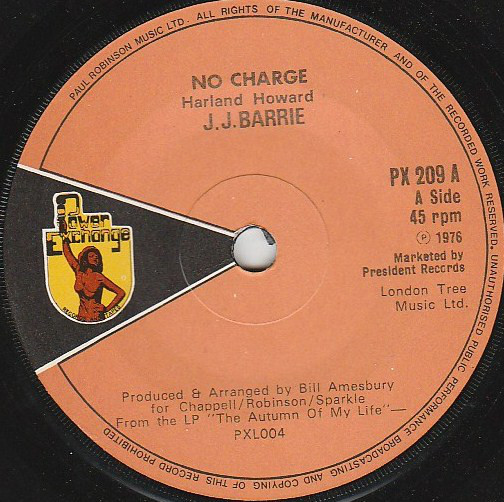
389. ‘No Charge’, by J. J. Barrie

I do like approaching a song I’ve never heard before. The anticipation. The tension. The wondering… What will this next #1 bring?

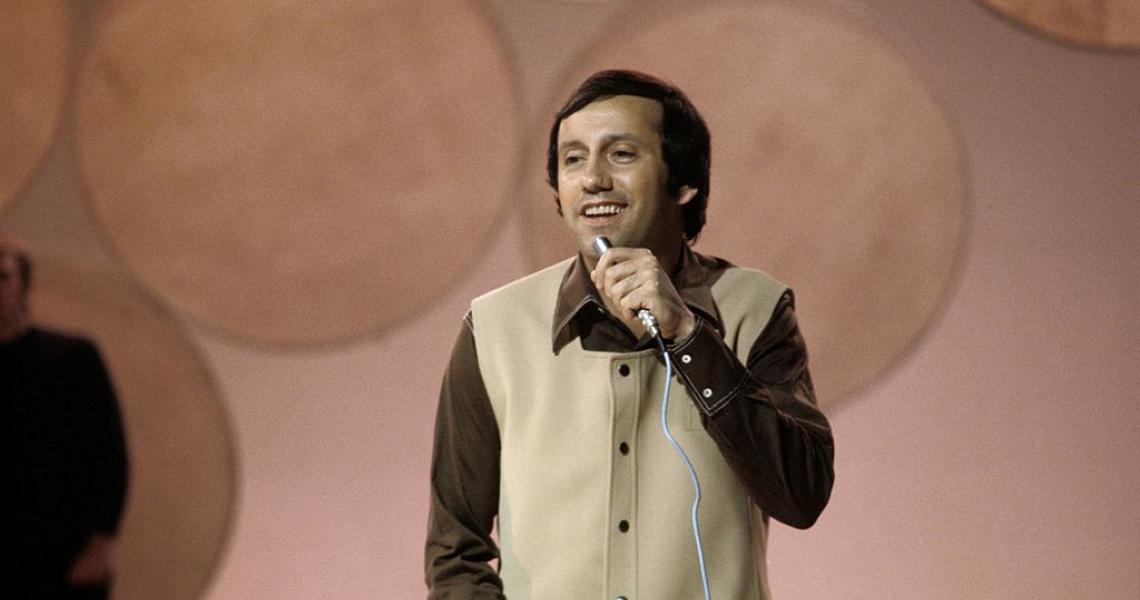
No Charge, by J. J. Barrie (his 1st and only #1)

1 week, from 30th May – 6th June 1976

My anticipation starts to sour the second I press play. This is, I can confirm, a country and western number. A honky-tonk piano leads us in. And then, oh dear, there’s talkin’. Now our little boy came up to his momma in the kitchen this evening, While she was fixing supper… The boy has itemised his chores for the week: $1 for taking out the trash, $2 for raking the yard, an eye-watering $5 dollars for mowing the lawn… Total load: $14.75…

Where is this song going next, I wonder. Is this presumptuous little brat going to get a clip around the ear? No. He is not. (That would have been a song I could have got behind.) Instead, mum turns the list over, and begins to write: For the nine months I carried you, Growing inside me… No charge… For the nights I’ve sat up with you, Doctored and prayed for you… No charge…

In the background, a gospel-lite singer is hammering home the message: When you add it all up, The full cost of my love is ‘no charge’… while the queasy feeling in my stomach grows, and grows. This is painful. Truly painful. Lines like: For the toys, food and clothes… And even for wiping your nose… thump down your ears. Is it meant to be funny? Is it meant to be touching? Is it meant to prescribed by pharmacists to induce vomiting?

Mum finishes writing, and looks at her son. Please, I think, throw a tantrum or something, you little shit. Save this song from its saccharine conclusion. But, no. He has tears in his eyes as he tells his ma that he sure does love her. He writes ‘paid in full’ in great big letters. You see, as J. J. Barrie informs us: When you add it all up, The cost of real love’s ‘no charge’…
This is, in case that write-up was a little too ambiguous, a truly awful piece of music. At a stroke one of the Top 3 worst songs we’ve met on this countdown, if not the winner. I have a high tolerance for cheese, for silliness, for camp throwaway pop… ‘No Charge’ is neither cheesy, nor silly nor camp. It is teeth-clenchingly earnest. There are no tongues in cheeks here. Barrie sounds like a preacher. The backing singer sounds like she’s singing the holiest of hymns. The strings are deadly serious, too. They all seem to believe, unconditionally, in the crap they are serving up. Maybe if it were sung by a woman, by the mum in the song, then, maybe, maybe, it would work better. As it is, it’s a smug story of motherhood as seen and interpreted by a smug-sounding man.

All songs, thankfully, must end. Phew. That was horrendous. J. J. Barrie is a certified one-hit wonder in the UK. I know nothing of his career beyond this single, and have no desire to investigate.* This wasn’t the original version of ‘No Charge’, which had been taken to #39 (and #1 on the Country charts) in the US by Melba Montgomery (great name, at least!) in 1974. Barrie is still alive, still living in Canada, but hasn’t recorded any new music since the ‘80s.

Looking forward, trying to block out the horrors we have just witnessed, I’m one more chart-topper away from a recap! And at least choosing a ‘Worst Chart-topper’ won’t be too difficult this time around.

*That was until I found out he discovered that he recorded a single with Nottingham Forest manager Brian Clough, ‘You Can’t Win ‘Em All’, in 1980. (Go on, click the link. It is every bit as bad as you imagine!)
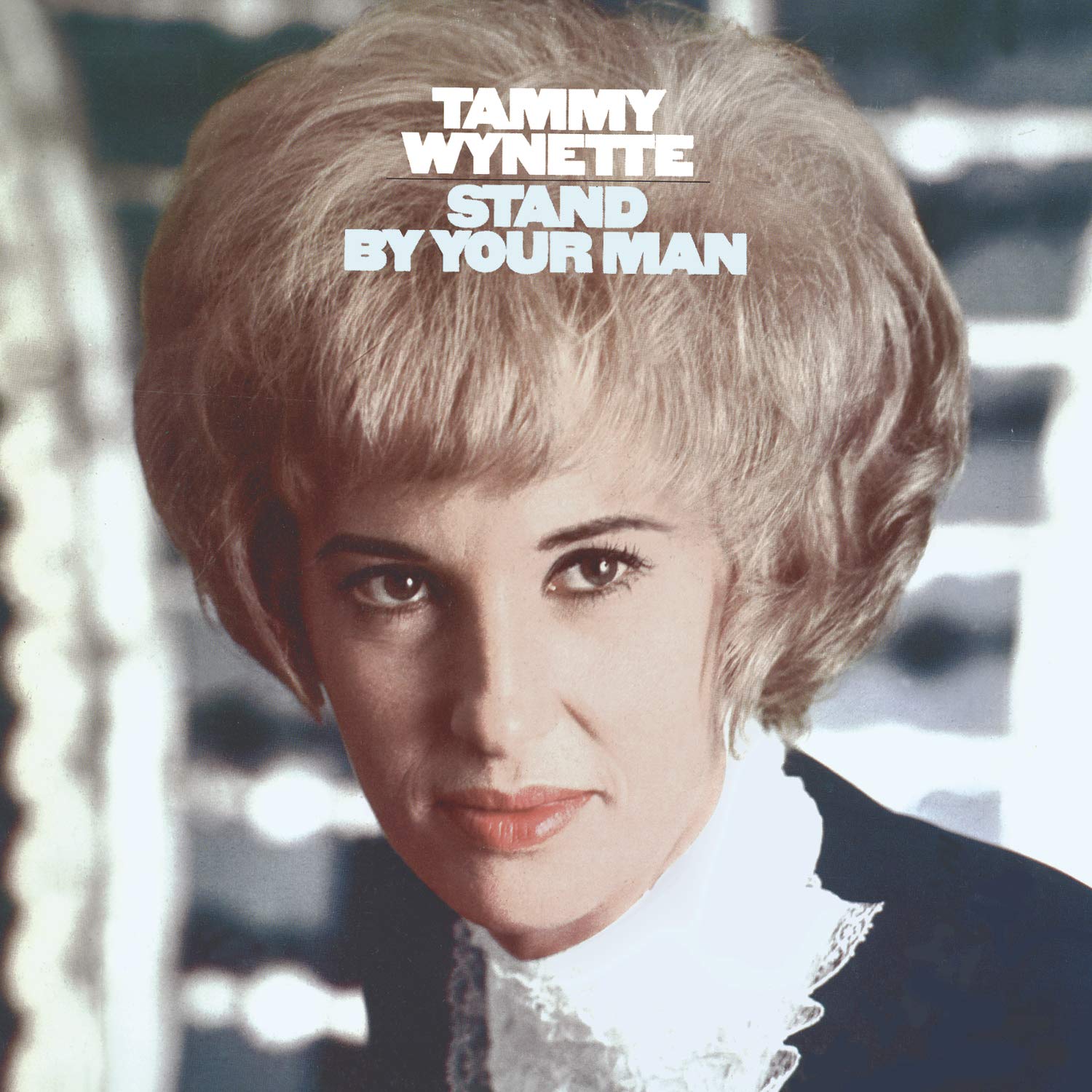
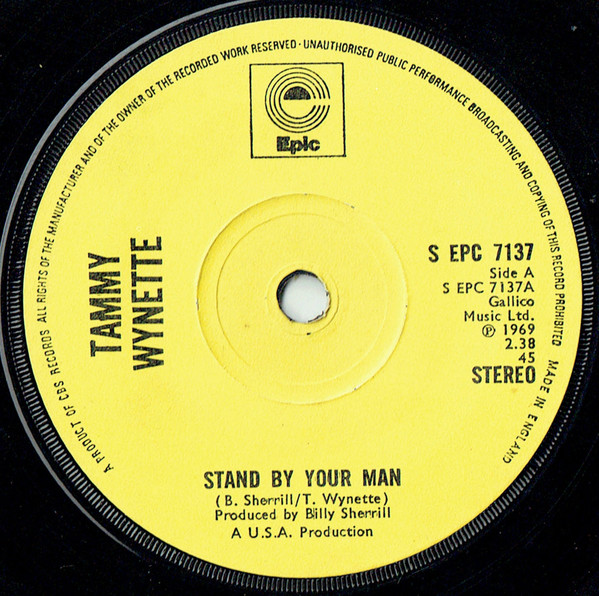
370. ‘Stand by Your Man’, by Tammy Wynette

Sometimes it’s hard, To be… A woman… Let me ask you: Is there a better opening line out there?

Stand by Your Man, by Tammy Wynette (her 1st and only #1)

3 weeks, from 11th May – 1st June 1975

Then there’s the twang and the tremble in Tammy Wynette’s voice as she gives her piece of marital advice… Giving all your love, To just, One man… ‘World-weary’ doesn’t even begin to describe it. This is some proper, old-school, Nashville Country & Western, where life is tough and men just don’t appreciate you.

You’ll have bad times, And he’ll have good times… Oh Tammy, honey… Doing things that you don’t understand… Her husband stays out late, wasting his time in gambling and carousing and other manly pursuits, while Tammy pines at home. I love the clanging, reverbing guitars as the chorus clicks into gear: Stand by your man! Give him two arms to cling to… And somethin’ warm to come to… When nights are cold and lonely…

It’s a ridiculous sentiment, really, especially to 2021 ears. ‘Stand by Your Man’ would have sounded old-fashioned in 1975, or even in 1968 when it was recorded (feminist movements of the time certainly thought so.) If you love him, You’ll forgive him… No, Tammy! If your good-for-nothing husband’s staying out all night, drinking and fornicating, you change the locks and come at him with a rolling-pin! And if that doesn’t work, you divorce him. (Of course, Wynette’s other signature hit is ‘D-I-V-O-R-C-E’, although in that song she is the one being divorced…)

But then, if you think about it, to most women in the sixties, who lived in the conservative parts of America where country music is the defining sound, divorce wouldn’t have been an option. It would have meant disgrace, scorn and opprobrium. So this record would have resonated with many a put-upon wife, left with little option other than standing by her man. Wynette always argued that stand by your man wasn’t the most important line in the song. She pointed people’s attention to: ‘cause after all, he’s just a man… (Ouch!)

Why was this record hitting #1 now, in the spring of 1975? It had featured in a Jack Nicholson film a few years before, but I can’t find any other reason. Then again, I could ask that question about every C&W hit. They come along, every so often, standing out like a sore thumb. Kind of like reggae, it’s a genre that pops up every now and again, without changing very much, and the strings and echoey backing guitars are the same ones we heard in the fifties, on monster country hits like ‘Rose Marie’.

Tammy Wynette was one of the genre’s biggest stars – the ‘First Lady of Country’, no less – with seventeen #1s on the Billboard Country charts. This, being one of only three chart appearances here, doesn’t tell her full story at all. (Though a parody of one of her other hits will be featuring in this countdown very soon…) She died in 1998, but not before making one of the greatest music comebacks of all time, with the KLF, and the ancients of Mu Mu on ‘Justified and Ancient’ in the early ‘90s… Tammy, stand by the JAM…

350. ‘The Streak’, by Ray Stevens

Oh Lordy. Did anyone order a country rock, spoken word, novelty song about a sprinting nudist…? Anyone? Anyone?

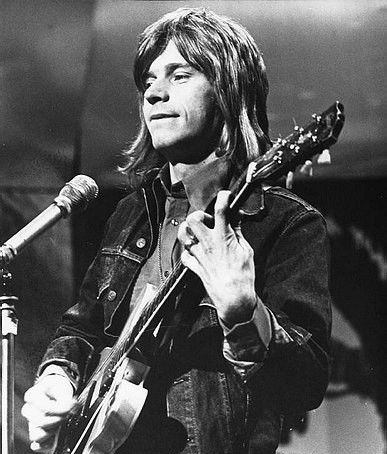
The Streak, by Ray Stevens (his 1st and only #1)

1 week, from 9th – 16th June 1974

No punches pulled: this is a song that makes your teeth clench. The mix of sound effects and voice acting, not to mention liberal use of a banjo, does not make for a relaxing listen. Then there’s a wheeee noise that SongFacts describes as a: ‘zipppp kazoo sound.’ Eeesh! It is a story told by two characters: a roving news reporter, and a slack-jawed yokel who, for some unspecified reason, is being followed by a streaker.

Oh yes they call him ‘the streak’, Fastest thing on two feet… Off he goes, around the supermarket, through the gas station, over to the basketball stadium… He’s just as proud as he can be, With his anatomy, He goin’ give us a peek… The yokel is appalled by ‘The Streak’, but the same can’t be said for his wife Ethel… No matter how much of a warning her husband gives her, she always ends up catching a glimpse…

I don’t want to sound like a po-faced prude, but… This song isn’t very funny. Its closest chart-topping companion would be Benny Hill’s ‘Ernie’, but at least that was witty and warm, and just plain old silly. ‘The Streak’, though, is brash, in your face, and just plain old irritating. The lowest point is the canned laughter – actual canned laughter – as if the producers deep down knew that it wasn’t in any way hilarious and needed to convince themselves.

Some of the lines are kind of clever, I guess: he’s always makin’ the news, wearing just his tennis shoes… and I do like the image of ol’ Ethel disobeying her husband to have a glance. By the end, she’s made her choice and has stripped off too. Ethel you shameless hussy! (Her husband’s words, not mine, and apparently mis-heard by many for something much ruder…)

I wasn’t around, but apparently there was a streaking craze in the mid seventies. In March ’74 alone there was a streaker at an Arsenal Vs Man City match, that Wikipedia debatably describes as ‘the first instance of streaking in English football’, and a streaker at a cricket test between Australia and New Zealand. Meanwhile, a ‘streaking epidemic’ was hitting US college sports. There was even a streaker at the 1974 Oscars! Clearly the world was ready for a hit single about running in the nude. And Ray Stevens delivered… I dunno, maybe you had to be there.

Stevens had been around since the fifties – a country singer-songwriter who flipped between serious and comedic singles at random. His two biggest hits before this had been ‘Ahab the Arab’ – a US #5 in 1962 – and the primary school hymn ‘Everything Is Beautiful’ – an actual Billboard #1 in 1970. An eclectic range, to put it mildly…

But back to ‘The Streak’. The main problem with this is that it is obnoxious. I’ve said it before – some novelties are novelties by accident, through experiment, trial and error. ‘Mouldy Old Dough’, for example, or even ‘Telstar’ – a glorious, weird outlier in the history of the charts. Other novelties set out from the start to amuse, entertain or, more often than not, annoy. Did anyone who bought ‘The Streak’ actually listen to it more than twice? Probably not. But there it is: a transatlantic #1 hit.

305. ‘Maggie May’ / ‘Reason to Believe’, by Rod Stewart

And so we welcome to the stage a true rock icon, a man who sells albums and fills stadiums to this day. Sir Rod Stewart. (I’m assuming he’s a ‘Sir’. Sort it out, Queenie, if he isn’t.)

image

Maggie May / Reason to Believe, by Rod Stewart (his 1st of six #1s)

5 weeks, from 3rd October – 7th November 1971

This was his very first solo single release to make the charts. Straight to the top with a bullet, with what is his most famous song? I don’t think I’ve ever heard the ‘single’ version of ‘Maggie May’, which is a full two minutes shorter than the extended version I grew up with. It’s the same intro, albeit condensed, a confident acoustic riff, then two emphatic drumbeats announcing that the story is ready to begin. Wake up Maggie, I think I got something to say to you…

Young Rod has been seduced by an older woman, spent a summer with her, and is now starting to wake up to the harsh realities of their relationship. It’s late September and I really should be back at school… ‘Maggie May’ is famously based on Stewart’s encounter with a real woman, at a Jazz festival when he was sixteen. Getting away from the slightly predatory story – imagine if the genders were reversed – the lyrics capture perfectly the voice of a callous teen, coupled with some corny rhymes: I laughed at all your jokes, My love you didn’t need to coax… And then the classic: The morning sun when it’s in your face really shows your age… Harsh!

He loves her, but wishes he’d never seen her face. We’ve all been there. Young Rod sounds like a bit of a tearaway – his options post-Maggie are either becoming a roadie or making a living out of playing pool… I’m sure he’ll be fine, and get over the heartbreak. Anyway, the whole song is basically him rehearsing what he’s going to say to Maggie. He hasn’t broke it off just yet! It hinges on the opening and closing lines: I think I’ve got something to say to you… and I’ll get on back home, One of these days…

Unfortunately, the single version cuts the best verse, the one with the: You turned into a lover and mother what a lover you wore me out! line. Maybe that would have been too ripe for daytime radio. Then comes the solo, and the mandolin outro, one of the Celtic-sounding elements that often pop up in Rod Stewart’s music. It’s an undeniable classic, one that – cliched but true – still sounds fresh today. One that no amount of terrible pub karaoke versions can ruin. And while the woman may have been real, her name wasn’t ‘Maggie May’ – she was a famous Liverpudlian prostitute. I’m sure the actual ‘Maggie’ was delighted by the comparison…

ROD_STEWART_REASON+TO+BELIEVE+-+SOLID-689258

It’s been a long old while since we had a double-‘A’ hit the top of the charts – not since Louis Armstrong in 1968. On the flip we have Rod’s cover of ‘Reason to Believe’, a song I’m certain I’ve never heard before. It opens with a lonesome piano, before the vocals come in. Both these songs are very much focused on Stewart’s voice. Which is fair enough, as he does have one of the best.

If I listen, Long enough, To you… I’d find a way, To believe, That it’s all true… In ‘Maggie May’, he was trying to convince himself to leave someone. In this song, he’s trying to talk himself into staying, despite knowing that his lover lied: straight faced, while I cried… He needs a reason to believe in her. The two songs work well together, both in terms of the sound and the lyrical theme.

A fiddle gives this record the country feel that the mandolin gave ‘Maggie May’. Then midway through, we’re left with just the voice. Someone like you, Makes it hard to live, Without, Somebody else… It’s a nice song, that slowly grows on the listener; but it’s no ‘Maggie May’. Technically, ‘Reason to Believe’ was the song first pushed to radio when the disc was released, but the song on the other side quickly won through. Maybe it was because The Carpenters had released a version of the song the year before – a classic Carpentersy-country version – while the folky original had been recorded in 1965, by Tim Hardin, that the label thought ‘Reason…’ might have caught people’s attention quicker.

For, while this was Rod Stewart’s first charting single, it wasn’t his first attempt at a solo career. He’d been releasing singles since 1964, and had spent the sixties busking, playing session gigs and jumping between bands. Then came The Jeff Beck Group, in which he met Ronnie Wood, and then The Faces (basically The Small Faces minus lead singer Steve Marriott), with whom he was having hits alongside his solo work in the early seventies. After this huge five-week #1 smash there will be no looking back for Rod – he’ll go on to become one of the decades’ biggest stars, on either side of the Atlantic, and we’ll be meeting him plenty more times in the months to come.

294. ‘I Hear You Knocking’, by Dave Edmunds

And so we arrive at a song I know very well – a song I’ve loved for a long time. It’s one of my earliest memories of popular music, this song – so early that I have no idea how it got to be there, buried in my consciousness.

0ba342e82e864d007e7e89610152248d

I Hear You Knocking, by Dave Edmunds (his 1st and only #1)

6 weeks, from 22nd November 1970 – 3rd January 1971

I love the choppy guitar, and the fried vocals. The trippy effects in the background, too, that sound like weird sea-creatures calling to one another across the deep. And I love the fact that at heart it’s just a straight-up, chugging, no frills rock ‘n’ roll number. You went away and left me, Long time ago, And now you’re knockin’, On my door…

It’s a sassy song – the singer telling his ex to get the hell out with their sweet words. I hear you knockin’, But you can’t come in… Go back where you been! She left him, though he begged her not to, and Edmunds still isn’t over it. Though he later reveals that this all happened in ’52, when he told her that I would never go with you… Which is both contradictory to what he sang two verses earlier, and a hell of a long time to hold a grudge…

Who cares. Careless lyrics aside, this is a rocking record. Our second whiff of glam at the top of the charts – after ‘Spirit in the Sky’ – and a bit of a throwback. (Over the chorus, Edmunds starts shouting out the names of some fifties rock ‘n’ roll stars – Chuck Berry! Fats Domino! – to leave us in no doubt about to whom this song owes a debt.) Something that sounds like a steam train gets added to the insistent rhythm, and then we get the piece de resistance of the whole record: the single, clanging note from a honky-tonk piano. Dung! Next verse!

71wOD2SwYUL._SL1024_

Despite ‘I Hear You Knocking’ sounding like it just crawled out of a Louisiana swamp, Dave Edmunds is actually Welsh. He had had one UK Top 10 with his blues band Love Sculpture, and this was his first, and by far his biggest, solo hit. It’s a staple of 70s Compilations, which is probably where first I heard it as a kid. ‘I Hear You Knocking’ was first recorded in the mid-fifties, by Smiley Lewis (Edmunds also shouts his name out during the solo) and then Fats Domino. Edmunds himself just recently retired from touring in his mid-seventies.

I do love this song, but am struggling to write much more about it. Really though – it’s not the sort of song that needs much writing about. If this record were a person, it’d be a doer, not a thinker. It gets you tapping your feet, and shaking your shoulders, rather than working your brain. I’d simply suggest that you click on the link below and get doing the same…

Actually, one thing that’s worth noting here is how long this, and so many other records, have spent at the top this year. ‘I Hear You Knocking’ got six, as did Elvis and Freda Payne. Mungo Jerry got seven, Edison Lighthouse five. If you look a little further, to the tail end of 1969, Rolf Harris also got six, while The Archies spent eight weeks up there! Not sure what this signifies, other than the fact that we are in the company of some monster hits at the moment – and that they’re going to keep on coming (and staying).

Listen to every number one so far on my Spotify playlist.

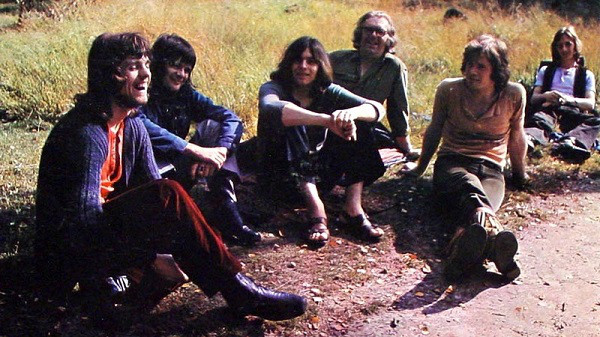
292. ‘Woodstock’, by Matthews Southern Comfort

As far as I know, I have never, ever heard this song before. I know Woodstock, the music festival, obviously, and I know Southern Comfort, the whisky flavoured liqueur that I haven’t drunk since an unfortunate incident when I was nineteen… Combining these two things in my mind, I begin to picture a Country & Western, smoke-tinged ballad…

A-507569-1425942931-2837.jpeg

Woodstock, by Matthews Southern Comfort (their 1st and only #1)

3 weeks, from 25th October – 15th November 1970

…and I’m not a million miles away. It’s a soft record – a soft voice, uber-soft rock – a comfy blanket that wraps itself around you and lulls you to sleep in its echoey rhythm. We are stardust, We are golden, And we’ve got to get ourselves, Back to the garden… The singer is a hitchhiker, on his way to Woodstock. His companion is a child of God, off to join a rock and roll band, looking to set his soul free.

It’s a song for fans of imagery. He feels like a cog, stuck in something turning… At one point he dreams of bombers in the sky that turn into butterflies above our nation, which works both as a trippy picture and as a ‘make love not war’ kind of statement. The garden could be the farm where Woodstock was held, or it could be the Garden of Eden, with the singer hoping for a return to innocence. It’s a melancholy sounding song, though; not one that sounds terribly hopeful. The sixties are over, after all, and the hippy dream has died. Contrast ‘Woodstock’ with the hope of If you’re goin’, To San Francisco, Be sure to wear, Some flowers in your hair… and All you need is love… from just three years ago.

Actually, maybe this #1 officially marks the end of the sixties. 1970 has wandered around without really knowing where it’s going – a year of eclectic chart-toppers. This record could be the gunshot that puts us out of our misery, that leads us into a bold new decade, ten months late… Or not. I have to confess that midway through my first listen to this song, I checked how long was left and my heart sank to see a full minute and a half remaining…

MATTHEWS_SOUTHERN_COMFORT_WOODSTOCK+-+1ST-493335

It’s a bit limp. A little Simon & Garfunkel, a little Eagles, a little Fleetwood Mac, a little meh… I do like the sinister, mournful reverbing solo, though. That bit can stay! Matthews Southern Comfort were a British band, led by singer Iain Matthews, who had previously been in folk band Fairport Convention. He did not, to the best of my knowledge, play at Woodstock. Neither did Joni Mitchell, the writer of this song, which surprised me. She based the lyrics on what she heard from her then boyfriend, Graham Nash of The Hollies (Crosby, Stills & Nash also did a version.) Mitchell’s original – listen here – isn’t as warm or as chart-friendly as Matthews’.

It’s cool that Joni Mitchell has a number one single by proxy, and that one of the biggest pop culture moments of the twentieth century gets a belated mention at the top of the pop charts, but I can’t really warm to this song. It’s just floated past me… And, actually, if you want a proper taste of the Woodstock Music and Arts Fair, then you would do well to hang around and catch our next number one single…

Follow my Spotify playlist with all the #1 singles so far here.

287. ‘Yellow River’, by Christie

I do like it when we get to a song I’ve never heard before. ‘Yellow River’ does not ring a bell, and I even had to check whether Christie was male, female, or band. (They’re a band.)

A-292125-1410102409-4570.jpeg

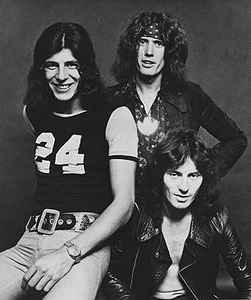
Yellow River, by Christie (their 1st and only #1)

1 week, from 31st May – 7th June 1970

There’s been a bit of a country-rock feel to the top of the charts over the past year or so. CCR, Bobbie Gentry, The Stones went to a Honky Tonk and The Beatles even got in on it the act with ‘Get Back’. And of course Lee Marvin was a-wanderin’ under the stars…

Lyrically, ‘Yellow River’ treads the same path (gettit?) as ‘Wandr’in’ Star’. The singer has been at war, but he’s now packing up and heading out. Put my gun down, The war is won, Fill my glass high the time has come, I’m goin’ back to the place that I love, Yellow River… while an insistent, chugging rhythm carries us along. Yellow River is the place he loves, and there’s a girl there waiting for him because, well, there has to be a girl waiting in a song like this.

It’s melancholy, but it’s also catchy. I’m tapping my feet as I write and I can’t help it. It’s growing on me. At first I wrote it off as inoffensive and a tad lightweight, but there’s something there. I especially like the yearning in the bridge: Got no time for explanations, Got no time to lose, Tomorrow night you’ll find me sleepin’ underneath the moon…

I also like the yee-hah! guitars that drag us along, and the hint of banjo in the fade-out. It sounds like the poppy love-child of Creedence and The Eagles. The verdict is in: I like it, more than I initially thought. And, putting it in context, this isn’t the first ‘soldier-at-war’ themed #1 that we can perhaps attribute to the cultural impact of Vietnam. Think ‘Distant Drums’, or even ‘Two Little Boys’.

61R0vIvtAVL._SL1280_

Christie were an English band named after their lead singer Jeff Christie. He wrote ‘Yellow River’ for The Tremeloes, but they turned it down. Christie recorded it for themselves and they enjoyed their sole week at the top of the charts. They had one further Top 10, the similarly chugging ‘San Bernadino’. And, despite me having genuinely never heard ‘Yellow River’ before writing this post, it has been covered by artists as renowned as R.E.M. and Elton John.

One more thing, before we go. We’ve just reached the end of a thirteen-song stretch of one-time chart-toppers. From Zager & Evans in August ’69 through to Christie in June 1970, that’s almost a year’s worth of artists grabbing their sole #1 single. We won’t meet any of them again. I called it a record when we had eleven in a row a while back, but thirteen surely has to be a record. We shall see…

282. ‘Wand’rin’ Star’, by Lee Marvin

The seventies’ second number one… is not what I was expecting. Not by a long stretch.

5b18b0aba7b32184792db93d93f58a7a

Wand’rin’ Star, by Lee Marvin (his 1st and only #1)

3 weeks, from 1st – 22nd March 1970

For a start, it’s got one of the longest intros to a number one single, surely, ever. A gentle, countryish rhythm, some horse hooves clip-clopping, and lots of humming. For a full minute and fifteen seconds. They hum through an entire chorus and verse! Apparently the radio-edit was shorter, but it seems that the single version was the full four and a half minutes, with the added humming. I can’t find a shorter version anywhere.

Finally the vocals come in. And my, what a voice. Chiselled straight from granite, like a statue come to life. A series of deep vibrations, rather than actual words. I… Was born… Under a wand’rin’… Star… The singer is a traveller, one born to roam. Wheels are made for rollin’, Mules are made to pack, I’ve never seen a sight that didn’t look better lookin’ back… Harmonicas trill in the background, while the slight rhythm carries, and on. The wagon keeps headin’ west…

‘Wand’rin’ Star’ is a showtune, that much is clear from the first listen (it’s the backing singers that give it away) and Lee Marvin an Oscar-winning actor. He sung (whispered, grunted, grumbled… I can think of so many better verbs for his performance than plain old ‘sung’) this in the character of Ben Rumson, a gold prospector, in the movie version of ‘Paint Your Wagon’.

To be fair to Marvin, he perks up a little in the verses. I especially like the third, in which he appeals to anti-social people everywhere: Do I know where hell is? Hell is in ‘Hello’… Heaven is ‘Goodbye’ forever, It’s time for me to go… He’s happiest alone, heading somewhere new. Home is a place best dreamt of. There’s something quite romantic in the song’s cynicism.

In the following chorus, he lets the final ‘star’ flop out of his mouth, as if he’d like to go back to sleep, and you presume that’s that. But no, the song keeps plodding along, Marvin keeps chewing his tabaccy. It’s almost a lullaby – parents of the time could have used this record, and Marvin’s spectacularly sonorous voice, to get their babies to sleep.

Lee+Marvin+Wandrin+Star+-+Solid-585856

‘Wand’rin’ Star’ could have been a hit in the early-fifties, for someone like Frankie Laine. That’s the kind of territory we’ve temporarily slipped back into. The musical version of ‘Paint Your Wagon’ did debut in 1951, in fact, though the movie version had been released just the year before this single hit #1. It is apparently a ‘not very good film’, though one I’ve never seen, which didn’t make a lot of money. The soundtrack, though, made up for it. If you’ve ever wondered what Clint Eastwood would sound like singing a song called ‘I Talk to the Trees’ then check it out (he’s got a surprisingly light voice!)

Lee Marvin stuck to the acting after this, never releasing another single. Which means we’ve had two one-hit wonders in a row! He passed away in 1987, with full military honours thanks to his service in WWII. To be fair: an Oscar, a #1 single, several military medals… a life well-lived. ‘Wand’rin’ Star’ has an equally interesting postscript, including a cover version by Julian Clary (if you don’t know who he is then please, please follow this link) and being played at Joe Strummer’s funeral.

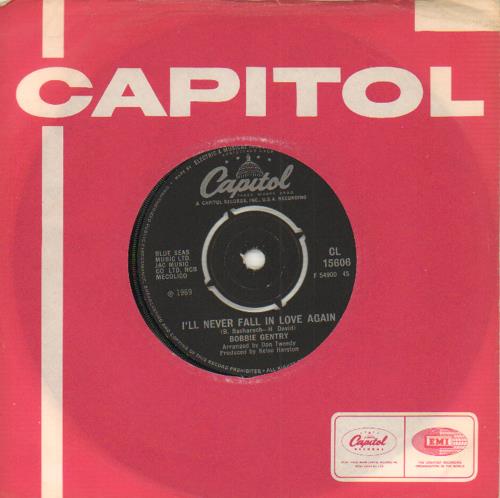
278. ‘I’ll Never Fall in Love Again’, by Bobbie Gentry

After all the in-your-face sex and apocalyptic predictions of the past few #1s, it’s nice to hear the gentle piano and bass intro of ‘I’ll Never Fall in Love Again’. The musical equivalent of closing your eyes and taking a deep breath.

bobbie10

I’ll Never Fall in Love Again, by Bobbie Gentry (her 1st and only #1)

1 week, from 12th – 19th October 1969

Not that this record is all sweetness and light, though. The title kind of gives that away. What do you get when you fall in love…? A guy with the pin to burst your bubble… Bobbie is convinced that she’s done with love. That’s what you get for all your trouble…

I love her voice – all tired and husky. It lends a perfect edge to possibly the best rhyming couplet ever to feature in a #1 single: What do you get when you kiss a guy…? You get enough germs to catch pneumonia, After you do he’ll never phone ya… Bacharach and David – racking up another UK chart-topper here – added the line after Burt had been hospitalised with the flu. It does make sense when you realise that this is a B&D number, with its gently soaring melody. They had written it for a musical called ‘Promises, Promises’, and Dionne Warwick had had the hit version of this song in the States.

You could add ‘I’ll Never Love Again’ to our run of recent cynical number ones – crushing the closing months of the swinging sixties – but for one line: So for at least, Until tomorrow… Who knows? She might just meet the man of her dreams tomorrow morning… And I’d argue that there’s something very late-sixties-positive about a young female artist singing about her love life in a matter-of-fact way: I’ve been there and glad I’m out… Women’s Lib reaching the top of the charts right here.

BOBBIE_GENTRY_ILL+NEVER+FALL+IN+LOVE+AGAIN+-+4+PRONG-654324

The fact that Bobbie Gentry is a woman is worth noting in itself. She’s the sole female chart-topper of 1969. In fact, in the past three years, only Bobbie, Mary Hopkin, Sandie Shaw and Petula Clark have topped the singles charts as solo females (Esther Obarim, Nancy Sinatra and Jane Birkin did so by duetting with men.) It really is surprising how few women topped the charts throughout the sixties, compared to later decades… I would work out the percentage, if I had any kind of mathematical ability.

Bobbie Gentry is also another artist whom I racially-profiled as a kid… Add her to the list along with Chris Farlowe and Georgie Fame. She isn’t black, she’s another white singer with a bit of soul in her voice, an American Dusty. My first exposure to her was through the superb ‘Ode to Billie Joe’, which was her biggest US hit – a gothic novel in a four-minute pop song – which shockingly only reached #13 in the UK… As nice as ‘I’ll Never Fall in Love Again’ is, it’s no ‘Ode to Billie Joe’.

But it is nice. Better than nice. It’s a great, late-sixties pop song with a hint of country. Bobbie Gentry has become very reclusive in her later years, not recording, performing or giving interviews since 1982. She lives to this day, people believe, in Memphis. And with that, we reach the penultimate number one single of the 1960s…

276. ‘Bad Moon Rising’, by Creedence Clearwater Revival

Yee-hah! Break out the moonshine, we’re off down the Bayou for a rowdy rock ‘n’ roll shindig with CCR!

CCR_Evening-Standard_Hulton-Archive_Getty1

Bad Moon Rising, by Creedence Clearwater Revival (their 1st and only #1)

3 weeks, from 14th September – 5th October 1969

I love me some Creedence. And I love that they are the unlikely owners of a UK #1 single. Perhaps the most American band ever; that didn’t hold them back from hitting it big on the other side of the Atlantic. And while it does feel a bit odd that CCR was able to top the charts here; it does make sense that they’d do so with what’s probably their catchiest single.

Catchy, but also terrifying. Zager and Evans kicked us off down an apocalyptic path with our last #1, ‘In the Year 2525’, and John Fogerty and co. keep it up here. I see a bad moon rising, I see trouble on the way, I see earthquakes and lightning, I see bad time today… Something terrible is on its way… Rivers are overflowing, hurricanes are a-blowing. This song has possibly the biggest contrast between melody and lyrics of any chart-topping single. The tune: rough and ready rockabilly. The lyrics: Don’t go round tonight, It’s bound to take your life… There’s a bad moon on the rise…

It’s a short and sweet record, one that breezes in and out in just over two minutes. Apparently it was inspired by a scene involving a hurricane in an old movie, but Fogerty also claims to have written it on the day that Richard Nixon was elected president. For a decade that has been so swinging, so iconic, we’re heading for a sour and cynical finish. Maybe we have to look beyond the charts for the answer here –this is a product of a world where a whole generation of Americans were dying in Vietnam, men were landing on the moon, and Kennedys were getting shot…

R-14237895-1570471606-1206.jpeg

By the final verse, things are getting very intense. Hope you’ve got your things together, Hope you are quite prepared to die… It’s all a bit much, and then we crash to an end. We open our eyes and breathe a sigh of relief that we’re all still here. The end hasn’t arrived, yet… Over and out from Creedence Clearwater Revival. Sadly this is their only #1 single, though we should just be glad that they managed even one. In their home country, they had far more hit singles – ‘Proud Mary, ‘Green River’, ‘Travellin’ Band’, ‘Lookin’ Out My Back Door’ and this record all hit #2 in 1969 / 70. Yet a Billboard #1 eluded them…

I love this track, in all its swamp rocking, apocalyptic glory. But, if you do find it all a bit much, a bit depressing, you can just do what John Fogerty does occasionally in concert: change the words of the chorus to There’s a bathroom on the right…

If the world were ending, you could do a lot worse than soundtracking it with this playlist: