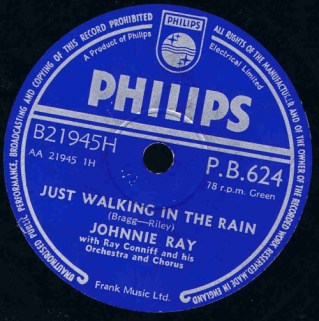
52. ‘Just Walkin’ in the Rain’, by Johnnie Ray

R-832873-1374063649-1755.jpeg

Just Walkin’ in the Rain, by Johnnie Ray (his 2nd of three #1s)

7 weeks, from 16th November 1956 to 4th January 1957

And, just like that, we zoom to the end of 1956. And we are reacquainted with another artist whom we haven’t seen for a while…

The last time we met Johnnie Ray, he was snatching a week at number one with the superb ‘Such a Night’. I voted it as ‘Best Record So Far’ in an earlier recap, it was that good. But that was almost three years ago, in the spring of ’54. Ray stood out like a sore thumb – a groaning, pleading, cavorting thumb – amongst the frightfully proper records that were topping the charts back then. Now we’re in somewhat more relaxed, ever-so-slightly more liberal times, it’s no surprise that Johnnie’s back.

The first thing that hits you, as the needle drops, is the whistling. It’s a whistly record. The first record featuring whistling to top the UK Singles Chart. And it’s another simple record – just Ray’s voice, his backing singers, and a guitar. It crossed my mind that it might be a pastiche of ‘Singin’ in the Rain’, as the two songs do bear some similarities. ‘Singin’ in the Rain’s depressed, heartbroken brother perhaps?

Just walkin’ in the rain, Gettin’ soakin’ wet, Torturin’ my heart, By trying to forget…

The way Ray delivers that little ‘by’ is a thing of beauty. He barks it out, angry, heartbroken. You really believe him. As before, his voice makes the whole record. It’s not a regular voice, nor a technically perfect voice, but it is unmistakeable: raspy and croaky – he really does sound like man who’s been up all night, walking in the rain.

Anyway, his walk is a form of water-based therapy, perhaps, as he tries to get over his departed lover. Or maybe it’s water-torture, as there’s a masochistic edge to proceedings: People come to windows, They always stare at me, Shake their heads in sorrow, Sayin’ who can that fool be? He knows they’re watching, but he continues anyway. Lyrically, we are at a crossroads, in terms of male-recorded #1s. These the are self-flagellating lyrics that we have heard many, many times before, about how much pain he is in (see also ‘Here in My Heart’, ‘Outside of Heaven’, ‘Answer Me’, ‘Give Me Your Word’, I could go on…) BUT, unlike in those songs, there is no chance of a positive outcome here. Ray never mentions any hope that his love will return. He’s simply trying to forget. This, then, is more of the sugar-coated cynicism that started creeping into our chart topping records with ‘Why Do Fools Fall in Love’ back in the summer.

By the end of the song, Johnnie is weepin’ and a-wailin’ in superbly melodramatic fashion. I said it before, and I’ll say it again: it’s a crime that he gets looked over in the pantheon of rock ‘n’ roll pioneers/superstars. I can’t sing his praises highly enough. This is a great record (not as great as ‘Such a Night’, but still great). Of course, as I also mentioned in his earlier post, his being erased from the History of Pop Music had a lot to do with his homosexuality. And I did notice, the eagle-eared guy that I am, how there are no pronouns in this song. No hint as to the gender of his lost love….

johnnie-ray-just-walking-in-the-rain-1956-78

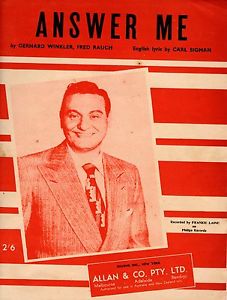
Johnnie Ray will appear one more time in this countdown – fairly soon, in fact – and so I will stop myself from going on too much about how amazing he was. (Though he was) And to finish I’ll address something that’s been bugging me for a while. At the top of each post I always include a picture of the record I’m going to be writing about. And they all look the bloody same. Black vinyl with a little disc circle of colour in the middle (and even that dash of colour is predictable: Phillips records are always blue, Capitol are black, Decca are navy…) I can never seem to find a picture of the record sleeve and, when I do (the jpg that headers Johnnie Ray’s earlier entry, ‘Such a Night’, for example) they are just as bland as the disc. You may have noticed that I sometimes include a picture that looks like it could be the record sleeve -I’ve included the one for ‘Just Walkin’ in the Rain’ above. That’s actually the sheet-music cover, a relic from the days before everyone had gramophones – they would buy the score and learn to play it themselves at home. There were even sheet-music charts before the NME started the record chart upon which this countdown is based. Even more frustratingly, it seems that LPs and EPs did get colourful covers in the 50s; it was only singles that were left to languish in boring, beige paper slips.

Anyway, the point of mentioning this is… I know it looks dull and I wish I could do something about it. I can’t wait for the days when artists and labels actually care about standing out on the shelves, and start including pictures of the band or, shock horror, an artistically though-out design on the cover. Though I fear that may be several years off…

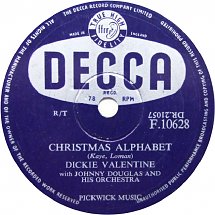
40. ‘Christmas Alphabet’, by Dickie Valentine

dickie-valentine-christmas-alphabet-decca-78-s

Christmas Alphabet, by Dickie Valentine (his 2nd of two #1s)

3 weeks, from 16th December 1955 to 6th January 1956

And so we come across something I never considered when I started this blog: the fact that I will, every so often, have to listen to Christmas songs on repeat. When it most emphatically isn’t Christmas. No matter. ‘Tis a burden I shall bear stoically.

The very first Christmas song to hit #1 in the UK is based around a simple concept – an acrostic poem as hit single. C is for the candy trimmed around the Christmas tree, H is for the happiness with all the family… All the way to the final S which is for Ol’ Santa who makes every kid his pet, Be good and he’ll bring you everything in your Christmas alphabet… Repeat. Done. Note that I am not referring to it as the very first ‘Christmas Number One’, as that wasn’t a ‘thing’ until the ’70s and, technically, Al Martino, Frankie Laine and Winifred Atwell have all already had one.

It’s kind of cute on first listen, but quickly becomes so sugary sweet that you begin to fear diabetes. As I mentioned at the time of his 1st number one, Dickie Valentine still sings like an American crooner (apart from when his ever-so-proper English accent sneaks through in the line about the ‘tree so tawl’). And while this little ditty is a world away from any kind of rock ‘n’ roll – from the record which bookended this song’s stay at the top, for example – he is cementing his image as the first British teen idol.

dicky-valentine

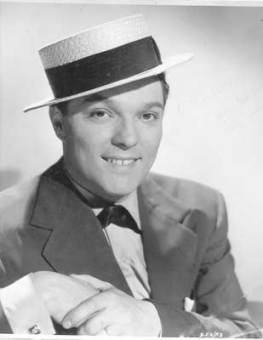
A quick look at the career of Mr. Valentine – which we should do now, as we won’t be hearing from him again – proves this to be true. He made his name singing with big bands, then by impersonating singers such as Frankie Laine and Johnnie Ray. His marriage in 1954 caused hysteria among his young fans, though it clearly didn’t kill his career. An image search throws up lots of cheeky grins, often accompanied by a boater-hat and a bow-tie – a definite ‘cheeky-chappie’. He scored the first and last #1s of 1955 but, like so many of these early chart-toppers, his recording career died a death in the ’60s, and he himself died the most rock ‘n’ roll death of all the artists featured so far: in a car crash aged just 41.

To finish, I do have a little anecdote about Dickie Valentine – and it’ll perhaps be my most tenuous link to any of the artists featuring in this rundown. Years ago (we’re talking early high school, here) I had a friend whose family loved going on cruises. I’ve never understood the appeal of cruises myself, but I suppose that’s irrelevant here. My friend mentioned a cruise they’d been on in which each cabin had – for some reason – a live feed of the ship’s ballroom that passengers could tune into any time of the day or night. My friend was watching it one night – disco night – when an old man, unimpressed by the DJs more modern tastes, walked past the camera and shouted ‘Play some Dickie Valentine!’. I have NO IDEA why my friend told me this uninteresting story; or indeed why I have remembered it to this day. I’d never heard of Dickie Valentine at the time; neither, presumably, had my friend. I suppose it is quite a funny name (‘Hur, hur… Dickie…’). But of all the things in life I’d have been better off remembering… The mind is a strange, strange thing.

26. ‘Let’s Have Another Party’, by Winifred Atwell

R-5006820-1381952789-2495.jpeg

Let’s Have Another Party, by Winifred Atwell (her first of two #1s)

5 weeks, from 3rd Dec. 1954 to 7th Jan. 1955

I wrote in the intro to my last post that Rosemary Clooney was finally getting our pulses racing – or our toes tapping, at least – and here comes Winifred Atwell to keep up the momentum.

It’s another piano-led song. Well, I say ‘piano-led’; it’s nothing but piano. Winnie and her piano, bashing out a selection of boogie-woogie and ragtime standards in extremely short order. According to Wikipedia we are getting classics such as ‘Broken Doll’, ‘Lily of Laguna’ and the ‘Sheik of Araby’ served up with a verse here, a snatch of chorus there, then on to the next one. I don’t recognise any of the featured tunes – though I’m pretty sure one of them was played by an ice-cream van in days of childhood yore.

It’s jaunty enough, but the effect of squeezing so many different tunes into a couple of minutes means it’s a bit of an odd listen. They’re all played in the same ragtime tempo, so there are no segues: it’s straight from one song into another with no time to draw breath, before we screech to a halt with dum-didley-dum-dum… dum-dum. But hey, it’s the first medley to top the charts, and off the top of my head, I’m not sure if there will be another one until Jive Bunny in thirty-five years’ time. On Spotify, the track is listed as having a Part I and Part II, the former being all of these old hits strung together while the latter is a much-more sedate number, even featuring a bit of guitar. I think, though I’m unable to confirm, that only the first part counts as the record that hit #1. Maybe Part II was the B-side.

1954-winifred-atwell-lets-have-another-party-1353313393-view-0

Anyway, all of this nonsense about which part is blah blah blah pales wildly into insignificance when it is revealed that Ms. Atwell was… black! Born in Trinidad & Tobago, before moving to the States and then to London, she becomes, a little over two years into their existence, the first black artist to hit the top of the charts. It’s a big moment, and worth taking a moment to reflect on this happening at a time when, say, landlords could stick a ‘No Blacks’ sign in their windows with impunity and, in the USA at least, Winifred Atwell wouldn’t have been allowed on the same public transport as her fellow chart-toppers. Just because this is the frothiest of throw-away records shouldn’t render it any less significant.

In fact, it’s almost ironic that she achieved this historic landmark with a medley full of old music-hall hits. The sort of hits that were big in even less enlightened times. The sort that might have been sung by men in black-face, to howls of laughter (seriously, Google ‘Lily of Laguna’ to see just what kind of song it is…) In a way, she is reclaiming them, and making them popular on her own terms.

And with that, I’ll descend from my high-horse, and conclude by saying that we will be hearing from Winfred Atwell again soon. She was huge in the early to mid-1950s (played for the Queen, didn’t you know!), and definitely seemed to have a winning formula. Hey, if it ain’t broke… ‘Let’s Have Another Party’ was the follow-up (somewhat inevitably) to ‘Let’s Have a Party’, and was followed up by another medley, the wonderfully titled ‘Let’s Have a Ding-Dong’. All good, (very) old-fashioned fun!


15. ‘Answer Me’, by Frankie Laine

frankie-laine-answer-me-philips-78-s

Answer Me, by Frankie Laine (his 3rd of four #1s)

8 weeks, from 13th November 1953 to 8th January 1954 (including 1 week joint with David Whitfield, from 11th to 18th December 1953)

There’s something rather familiar about this record…

Having read the previous post, you know what this song is all about: heartbroken guy, on his knees, turning to the Lord as a last resort… all very melodramatic. This sticks very close to the structure of the David Whitfield version – it’s exactly the same length – but I must admit I like this version better. There’s just something about Laine’s voice: warm, beckoning, a voice I want to listen to, a voice I trust. Unlike Whitfield’s plummy whining.

Musically, this version is also a little less overwrought than its predecessor. The guitar strums that play us in are very reminiscent of ‘I Believe’, and the violins have been replaced by an organ and backing singers. It’s still pretty dull, don’t get me wrong, but it’s just that little bit more listenable. It’s got an American gloss, all glittery lapels and perfect teeth, that David Whitfield’s reserved, BBC World Service delivery was lacking. And the ending is still a bit much, though Laine holds it back until the final line rather than belting out the whole last chorus.

s-l300 (2)

We’re now a year into this countdown, believe it or not, and out of the past 37 weeks, Mr. Frankie Laine has been at number one for 28 of them. In many ways it is impossible to compare the charts of today with those of the early ’50s – in terms of how the data is collected, in terms of what data is included, in terms of how wide-ranging the chart data is – but if anyone does think that today’s streaming dominated charts are dull, slow-moving and dominated by the same handful of artists, I would suggest you tell them to thank their lucky stars they weren’t around in the autumn of 1953. Not only are the same artists dominating here; the same songs are, too.

In lieu of mentioning having anything new to say about the song, I thought I might give a little shout out here to the conductors. The ‘what’, you say? The conductors! Almost every chart-topping record by a solo act, as you may have noticed from the pictures I post at the start of every entry, has been conducted by someone and their orchestra.

So far, Monty Kelly has conducted the orchestra for ‘Here in My Heart’, Harold Mooney for ‘Comes A-Long A-Love’, Hugo Winterhalter did both Eddie Fisher’s chart-toppers, Mitch Miller was Guy Mitchell’s go-to guy for both of his, Johnny Douglas did the ‘accompaniment’ for ‘That Doggie in the Window’ (apparently it didn’t warrant a full-blown orchestra) while Stanley Black guided David Whitfield through ‘Answer Me’. Mr. Paul Weston, though, has been the most prolific so far: Jo Stafford’s ‘You Belong to Me’, as well as the Frankie Laine trio of ‘I Believe’, ‘Hey Joe’ and now ‘Answer Me’ coming under his baton. Only the Stargazers (presumably because they played their own instruments) and Perry Como haven’t had orchestral accompaniment. Mantovani got the credit as conductor for ‘Moulin Rouge’ because it was an instrumental.

If haven’t included these conductors in the titles of my blog posts it’s because, well, they aren’t included anywhere else. Most listings of UK Singles Chart #1s – Wikipedia and the Official Chart Company included – don’t mention them. And so I won’t either. I understand it from the point of view that the conductor is neither playing an instrument nor singing the song, and that if the conductor gets a credit then so should the violinist, the trombonist, the harpist etc. etc. But, at the same time, Paul Weston has been heavily involved in four number one singles so far – with more to come, presumably – totalling 30 weeks at the top. That would already be enough to make him joint 7th (with Justin Bieber) for most combined weeks at number one! It seems a little harsh that he is forever banished from the chart history books…

1. ‘Here In My Heart’, by Al Martino

Picture the scene. It’s November 1952. It’s cold. Smoggy. A real pea-souper. You’ve just popped down to Smiths and bought a copy of New Musical Express, the hot music magazine that’s been hitting newsstands these past few months.

What’s this? A chart? Of the top selling singles in the country? There’s Nat King Cole, and Rosemary Clooney. Bing Crosby’s at number four. Vera Lynn has three songs in the top ten! (And people say the charts these days are dominated by a few big names…)

You think it’d be a cracking idea to pass by the record store on your way home and pick up the number one record on this chart, which you’ve never heard before, but by golly you’ll have to watch your step. How you wish they’d hurry up and sort out all the piles of rubble in the street, it’s been seven blinking years since VE day!

Back home, you pull the record from it’s sleeve. ‘Here in my Heart’, by Al Martino. Some new crooner from the States. His first disc, apparently. The needle crackles and pops.

al-martino-here-in-my-heart-capitol-78-s

Here in My Heart, by Al Martino (his 1st and only #1)

9 weeks, from 14th November 1952 to 16th January 1953

Al Martino had no idea, I presume, that his debut single was going to be the first ever UK Number One. I assume that the NME hadn’t been advertising it for weeks: 12 records wanted for the first ever record retailers chart! Can you be the Top-Seller!? Can anyone stop Vera Lynn??

But ‘Here in my Heart’ is the perfect song to have topped the first ever chart. From the minute the intro kicks in, it’s clear that this is a song not ready to settle for second place. A ten second crescendo peaks with Al belting out the title… Here in his heart, he’s lonely…

It’s old-fashioned, sure, but that doesn’t make it unlistenable. The strings (or, rather, the full-blown orchestra) aren’t that far removed from an Adele or a Sam Smith record. The strangest thing about it is actually Martino’s voice. He enunciates every syllable in a way that you just don’t hear anymore, outside musical theatre. Surely, you know, I need your love, so badly… And the way in which, at the start of the song at least, he delivers the second half of each line in a much subtler way, compared to the bombastic first halves, is quite effective. I can imagine my Gran (God rest her) praising the record as one in which you can actually make out the words. Unlike any record released post 1967. Incidentally, my Gran would have been nineteen when this record hit number one. We are talking here about a seriously long time ago.

A-266267-1129103707.jpeg

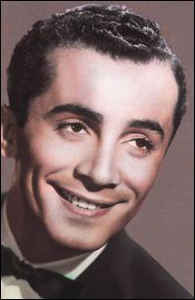
Looking at pictures of Al Martino in the 1950s, he looks like a standard Italian-American, rat-pack crooner. Louche, grinning, eyes that suggest he’s done a bit of living… But whereas Sinatra, Davis, et al delivered their lines with the minimum of fuss, Martino is going for it here. Nothing is left on the bench. If he belted out the closing line – Please be mine, and stay here… in… my…………… heart ‘neath his lover’s window, she would have no choice but to shout ‘Oh yes, Al. Yes!’

I’d never really heard of Al Martino, beyond it being the name of the guy who had the first ever UK Number One. But, to give him his due, ‘Here in My Heart’ still holds record for the joint-seventh longest stay at the top of the UK charts. Plus, he starred in both The Godfather and The Godfather Part III (singing the theme for the former), and had a huge hit in the mid-70s with ‘Spanish Eyes’ – one of those songs that you think you’ve never heard until you hear it. And one which holds a special place in my heart as the second ever song I mastered on the keyboard (and by ‘mastered’, I mean I made it sound vaguely recognisable), aged eleven. The first ever song I mastered was Rock Around the Clock, the guitars and drums of which sound a world away from this, the first ever UK chart topper.