258. ‘Hey Jude’, by The Beatles

Buckle up and make yourselves comfortable, cause we’ve hit our longest number one single yet. One of the longest ever. Seven minutes and ten seconds of Beatlesy goodness.
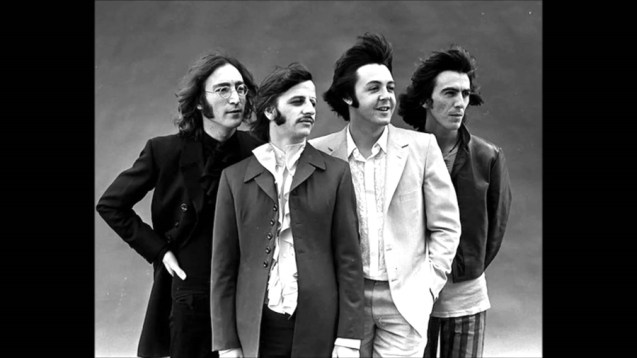
0007362_900

Hey Jude, by The Beatles (their 15th of seventeen #1s)

2 weeks, from 11th – 25th September 1968

It starts off in beautiful simplicity. Just Paul and a piano. Hey Jude, Don’t make it bad… Take a sad song, And make it better… You’re there, in the studio. You can picture his face as he sings. Remember, To let her into your heart, Then you can start, To make it better…

I love the way the instruments are slowly added into the mix. Before you know it there’s a tambourine, a guitar, then backing vocals and Ringo’s drums. Hey Jude, Don’t be afraid, You were made to, Go out and get her… It sounds like an encouragement to a friend, to go and get the girl he loves, but it was inspired by John’s separation from his first wife Cynthia. Paul wrote it to comfort their son Julian (Julian – Jules – Jude). John, however, claimed that it was about him, and that the song’s lyrics were Paul’s blessing to him and Yoko Ono. Others still – mainly McCartney’s exes – have claimed that it was written about them. Who knows? A great song means something different to everyone.

And this is a great song. I’ve always liked the bridge best: And anytime you feel the pain, Hey Jude, Refrain…  It’s almost, without wanting to sound hopelessly pretentious, spiritual. Pop music as hymn. If I were religious, I’d go to churches where they sang ‘Hey Jude.’ I gave Paul McCartney a hard time in my post on ‘Hello, Goodbye’, and I stand by that, but here… His voice grows ever more soulful. It’s something else – it’s undeniable.

Just over three minutes in we reach the bit that means this record will live on for ever more. When the waves finally lap over the last bit of unsubmerged land left on earth, the final sound man hears will probably be the coda of ‘Hey Jude’. Na-na-na… Nananana! Nananana… Hey Jude! It lives on at karaoke nights, in pubs, outside pubs, in football stadiums… And you can see why. It isn’t hard to remember some ‘nananana’s. Whatever language you speak. Nananana.
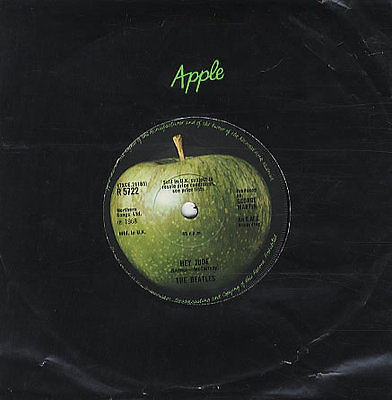
271312379723

(‘Hey Jude’ was the 1st single released on The Beatles’ own Apple Label)

I had forgotten – having not actually listened to ‘Hey Jude’ properly for years, how crazy Paul goes over the coda. He riffs, he scats, he howls and yells. By the end he sounds as if he’s properly lost it. This was recorded at a particularly difficult time in The Beatles’ history: John spending all his time with Yoko, Ringo temporarily leaving the band… Maybe he was just letting some frustrations out.

The song starts to fade a full minute and a half before it actually ends. Does it really need to be over seven minutes long? Probably not. But at the same time: why the hell not? By this point in their careers, The Beatles could do whatever they wanted. ‘Hey Jude’ is a full two minutes forty seconds longer than the previous ‘Longest #1 Single’ title-holder, The Animal’s ‘The House of the Rising Sun’. You could play the shortest #1 – Adam Faith’s ‘What Do You Want’ – almost five times before ‘Hey Jude’ plays once. As far as I’m aware, it is still the 4th longest #1 single ever, and won’t be displaced as the longest until 1998, when Oasis will release their cover version… sorry, their completely different song… ‘All Around the World.’

And so we reach the end, finally, as the nananas fade and we are left to return to everyday life. ‘Hey Jude’ is a song that has entered the fabric of British life, of our national identity even… Paul McCartney plays it at most of his concerts, as a tribute to his long-dead song writing partner. It’s only right that it hit number one, but it seems wrong that it stayed at the top for just a fortnight. In the US it tied for the longest-ever run, at nine-weeks. That seems more appropriate. A long old run in pole position, for a long old song… Na-na-na-na!

Listen to all the previous, much shorter, #1 singles here:
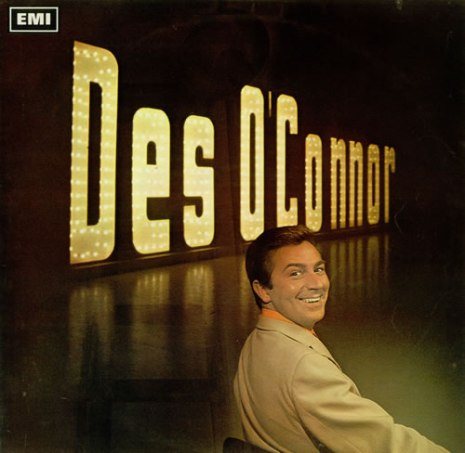
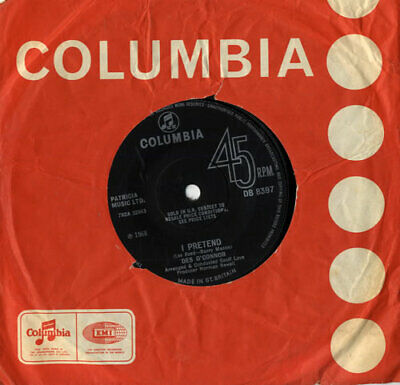
253. ‘I Pretend’, by Des O’Connor

Oh dear. I thought we were past this… I thought we had waded through the easy-listening swamp and made it out alive… I was wrong. Des O’Connor sticks out an arm and drags us back in…

DES_OCONNOR_CARELESS+HANDS+-+1ST-443540

I Pretend, by Des O’Connor (his 1st and only #1)

1 week, from 24th – 31st July 1968

If I’ve learned one thing from the two hundred fifty three songs I’ve covered so far it’s that no matter the leading sounds of the day – be they rock ‘n’ roll, Beat, baroque, or folk – you are never more than seven feet away from an easy-listening #1. It is the genre that never dies, mainly because it isn’t a genre at all. It can adapt, morph, mimic and ultimately survive, like the cockroaches that will rule following the apocalypse.

And I have nothing against easy-listening. Nothing at all. I am here for every single one of these chart-topping hits. I approach each one with an open-mind. I loved Petula Clark’s ‘This Is My Song’, and enjoyed Engelbert’s ‘The Last Waltz’, but this… This does nothing for me. This is bland. Where’s the hook? I’m trying to find something to grab hold of, something to appreciate, but find myself clutching at thin air.

It’s a velvety, cutesy, saccharine fart of a record. Something about how the the lady he loves is cheating on him, so till then I’ll just pretend… Blah, blah, blah who cares? One day our love must end, Till then I’ll just pretend… He’s literally sitting alone, pretending that his wife is still in love with him, simpering over an empty chair, while she’s out gallivanting. God’s sake man, have some self-respect…

Des-OConnor-I-Pretend-UK-7-vinyl-single

I have never heard this record before. I truly wonder if anyone has listened to this song in the past twenty years. Is this the most forgotten #1 ever? Maybe that’s because it’s surrounded by monster hits by The Beatles, Stones, Cliff and more. Maybe. But, tellingly, ‘I Pretend’ sneaked a week at the top after an eleven-week climb – a disc that slipped in to pole position when nobody was looking. (It did also spend a full year on the chart, though, so there clearly was an audience for it…)

To be fair, Des O’Connor was – even years later when I was a kid – a household name in the UK. He had a fanbase. He hosted chat shows and game shows throughout the sixties, seventies, eighties and nineties. He was warm, family-friendly, slightly too tanned… A kind of male Cilla Black, though her music was much more credible. I was amazed to just find out that he’s still alive… I could have sworn he’d died years ago.

Apparently he’s in pretty poor health, though, so let’s wish him the very best. His one and only number one single may be terrible, and completely out of place in mid-1968, but it’s one more number single than most of us will manage. Next up, I believe, normal service will be resumed.

240. ‘Let the Heartaches Begin’, by Long John Baldry

I start to fear the worst when I press play on this latest #1, and find that it begins with a soft and swaying intro… The type of intro that we’ve heard at least five times too often in recent posts. The type of intro that Engelbert Humperdinck would have licked his lips at…

Dzna6QlWkAEahw1

Let the Heartaches Begin, by Long John Baldry (his 1st and only #1)

2 weeks, from 22nd November – 6th December 1967

But no, this record is a cut above the run-of-the-mill, middle-of-the-road, so-so-ness that has made up so much of the past year’s chart-topping material. That becomes clear the second that Long John Baldry’s voice comes in, all smoky and croaky. It reminds me of Chris Farlowe – another British singer that you would think was American.

I can hear the guitars start to play… The first verse is innocuous enough. Boy’s lost girl etc. etc. It does nothing to prepare you for the soaring beauty of the chorus… So let the heartbreaks begin, I can’t help it, I can’t win… It’s a sad song – the title makes that pretty obvious – but it’s also kind of uplifting.

It’s the sort of chorus that makes you wish it wouldn’t finish, and that makes you count the seconds through the next verse until it returns. And Baldry’s voice… When he pauses for the Anymore… at the end of the final chorus you can actually picture him crying. (Apparently he was quite drunk when he recorded the song…)

As with Chris Farlowe, it’s really hard to imagine that voice coming out of the man in the picture above. But it did. And ‘Long John’ Baldry is a brilliant stage name, isn’t it? Anything combining rock stars and pirates is bound to be pretty badass. It was an appropriate name, too, as he measured six foot seven in height!

XD7_1026

I’m getting lots of different notes from this record. It’s got a strong 1967, easy-listening vibe, but it’s also yet another British soul hit in the tradition of Farlowe and Fame, and following hot on the heels of the The Foundations. It’s also forward-facing – this could easily be an early-seventies Rod Stewart record, especially when the acoustic guitar comes in on the second verse. Which makes sense, as both Stewart and Elton John played with Baldry before they hit the big time. Long John would never reach similar heights, but his #1 does feel like a bit of a marking post…

It’s also a perfect winter hit, and it makes perfect sense that it hit the top spot as the nights drew in and folks huddled around their fireplaces. And it’s perfect that I’m publishing this just before Christmas. Grab your loved one – even though it’s a song about heartbreak, literally, but hey – a mug of something mulled, and enjoy. Long John enjoyed quite the life beyond ‘Let the Heartbreaks Begin’, including time in a mental health institution and saving Elton John from suicide (he’s who ‘Someone Saved My Life Tonight’ is about.) And, apparently, he had a brief romantic relationship with Dave Davies from The Kinks. A biography worth reading! He passed away in 2005.

Before we go, I’d like to wish a very merry Christmas to every one of you UK #1s Blog readers. I hope that it is both merry and bright! Next up, before the New Year… a recap!

237. ‘The Last Waltz’, by Engelbert Humperdinck

The Summer of Love is over. The VWs are rolling back home. People are sobering up and cutting their hair. Squeezing back into starchy old suits rather than baggy tie-dye. And the top of the UK singles charts reflects this. Engelbert is back; and he has no time for hippies.

Engelbert Humperdinck

The Last Waltz, by Engelbert Humperdinck (his 2nd and final #1)

5 weeks, from 6th September – 11th October 1967

‘The Last Waltz’ is indeed a waltz. Any hope that it might just be a misleading title is crushed in the opening bars. I wonder should I go, Or should I stay, The band had only one more song to play… We’re in a dancehall, and it’s time for the final song of the night. Engelbert’s out on the pull, but hasn’t had any luck. Until… I saw you out of the corner of my eye, A little girl alone and so shy…

Immediately I like this more than his earlier #1, the dreary ‘Release Me’. It’s just got a little more of a swagger, more of a wink in its eye, a certain je ne sais quoi… It also sounds a lot more contemporary, with a touch of the swinging sixties buried in amongst all the schmaltz. It’s the la-lalalalala-lalas, I think, that shimmer in an oh so sixties way. They remind me of Jackie Trent’s ‘Where Are You Now (My Love)’ from a couple of years back.

And then comes the chorus, and it is undeniable. I had the last waltz with you, Two lonely people together… Engelbert croons like the fate of the world depends on it. And the way he powers through the I fell in love with you… line is spectacular. The last waltz should last forever… Classy.

ENGELBERT_HUMPERDINCK_(SINGER)_THE+LAST+WALTZ-511473

In the end, however, it hasn’t lasted. They’ve split up (though the tense keeps switching between past and present in a way that doesn’t make it immediately obvious.) And so they have truly had their last waltz. I know it’s pure and utter cheese but – keep this secret, will you? – I kind of like it. And I really like the way he doesn’t go for the all-out big finish. He just allows it to slide away with some more lalalas.

So. Just what should 1967 be remembered for? For the Summer of Love? Or for blockbuster easy-listening hits like this? Or an uncomfortable mix of both? Engelbert Humperdinck’s two chart-toppers – one in the spring, one in the autumn – straddle the year like pillow-lipped bookends. After this the hits kept coming for a while, before he settled into a life of Vegas-residencies and TV specials. In 1996 he recorded the song ‘Lesbian Seagull’ for the soundtrack of ‘Beavis and Butthead Do America’. In 2012 he represented the UK at the Eurovision Song Contest. Clearly, despite his multi-decade success, he isn’t a man that takes himself too seriously. Let’s leave him here. Engelbert Humperdinck. The ultimate housewives’ choice. The man, the myth, the name…

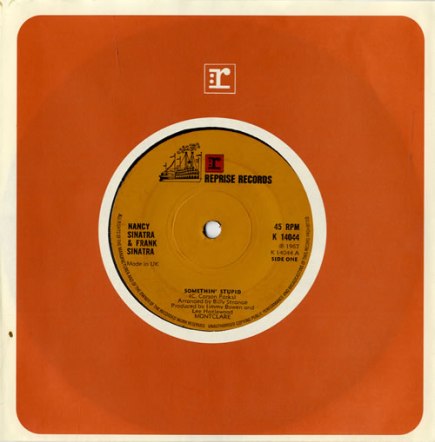
231. ‘Somethin’ Stupid’, by Nancy Sinatra & Frank Sinatra

We are still stuck in the seventh circle of easy-listening hell, it seems. In calendar terms, it’s now getting on for a good half-year of dullness…

R-1373325-1414604339-5769.jpeg

Somethin’ Stupid, by Nancy Sinatra (her 2nd and final #1) & Frank Sinatra (his 3rd and final #1)

2 weeks, from 13th – 27th April 1967

And I have to admit that I thought this latest chart-topper would be better. It’s a song I know, one that’s ingrained in popular culture, and one which had a second wind thanks to a certain ex-Take That singer and an Australian actress when I was at high-school, but one that I’d never really paid much attention to.

The main problem with it, I think, is that Frank and Nancy both sound pretty bored. I know I stand in line until you think you have the time to spend an evening with me… Strings swirl and Latin guitars strum, much like they did in Petula Clark’s ‘This Is My Song’. And if we go someplace to dance I know that there’s a chance you won’t be leaving with me… It’s a wordy song, and the lines are well constructed – the alliteration in the see it in your eyes you still despise the same old lies… one is great, to give credit where it’s due. And the hook of ‘I love you’ being a stupid thing to say is cute.

But beyond that I’m left feeling a bit underwhelmed. Especially remembering how fierce Nancy sounded on ‘These Boots…’, and knowing the swagger that Frank was capable of. Both recorded far, far better songs in their careers. Perhaps they felt they had to meet in the middle, cancelling one another out. It certainly sounds like they’re holding back.

Or maybe they’re just feeling uncomfortable singing, as father and daughter, a duet clearly written for a pair of lovers… I mean, it could, maybe, be seen as song in which the father is lamenting how little time his kid spends with him… I practise every day to find some clever lines to say to make the meaning come true… That could speak of a strained inter-generational relationship, right? Of course, lines like The time is right, Your perfume fills my head… would be more difficult to sell in that way… Nancy has, apparently, gone on record to say she thinks it’s sweet that people refer to this as ‘The Incest Song.’

FRANK_SINATRA_SOMETHING+STUPID-560726

By the end we have some very-sixties horns thrown into the mix, and the pair are mumbling I love you… over the fade-out. It doesn’t end with a bang. It’s not the worst disc from our half-year of easy-listening (hello, Engelbert), but it’s not the best either (hello, Petula). It’s a shame that both Nancy and Frank are bowing out of their chart-topping careers with this slice of meh.

Perhaps the big problem with this duet – and this has just come to me – is that it’s not a duet. They sing each and every line together. A duet should have a bit more give and take, call and response, you know? Nancy especially is relegated to little more than breathy backing vocalist here. Anyway, she was about to go on to make some of the best recordings of her career, with a more suitable partner: Lee Hazlewood. Here’s a link to their version of ‘Jackson’, proving that boy could she pull off a duet, under the right circumstances.

And what of her dad? A star since the late 1930s, now into his fifties. One of the legendary figures of 20th Century popular music. He isn’t very well-represented by his three UK chart-toppers, to be honest. The bland and now forgotten ‘Three Coins in the Fountain’, the much more famous, but hated by Frank himself, ‘Strangers in the Night’, and now this limp duet with his daughter. But he wasn’t done yet. In a couple of years he will record the biggest hit of his whole career, ‘My Way’, and he’ll go on scoring Top 10s through to his version of ‘New York, New York’ in 1979, aged sixty-four. If only that could have been his final chart-topper… They were still playing that as the ‘lights-up’ song in nightclubs when I was a kid!

230. ‘Release Me’, by Engelbert Humperdinck

An unassuming intro leads us, soft and gentle, into a swaying lullaby of a latest chart-topper. Please release me, Let me go, For I don’t love you, Anymore…

ftcms_a4559c7c-d05f-11e8-9a3c-5d5eac8f1ab4

Release Me, by Engelbert Humperdinck (his 1st of two #1s)

6 weeks, from 2nd March – 13th April 1967

Sigh. What has happened to the charts in recent weeks? We’ve gone from the pinnacle of the swinging sixties to the easy-listening doldrums… Jim Reeves, Tom Jones, Petula Clark (who’s fab, but still…) and now this. A new level of schmaltz.

I have found a new love dear… And I will always want her near… The one redeeming thing about this record is that it’s not a love song. It should be; but it’s really a break-up plea. Which gives it a slightly OTT, unintentionally comic feel. Especially with lines like Her lips are warm while yours are cold… (Ouch!) Such is the strength of the plea, I’m assuming he’s singing to his wife, and needs a divorce. Otherwise, why doesn’t he just dump her…? Or is he just too much of a gentleman to do a caddish thing like that?

When the backing singers come in, it really is a step too far. So let’s tune out for a moment, and focus on the most interesting thing about this record (apart from the singer’s name, but we’ll get to that in a bit.) ‘Release Me’, famously, held The Beatles’ ‘Penny Lane’ / ‘Strawberry Fields Forever’ double-‘A’ off the top-spot. For a fortnight, one of the most innovative and respected pop singles ever was outsold by just one disc. Engelbert’s.

ENGELBERT_HUMPERDINCK_(SINGER)_RELEASE+ME-302426

He turns it up a notch or two for the final chorus. We move from crooning to belting. He gives the final So….. some real welly. It goes without saying that, yes, he sings it well. I feel I’ve written that quite a lot recently. And frankly, it’s not enough to save this one. It’s like saying that a footballer kicks a ball well. He’s still got to find the goal! And the slow pace and pure blandness of this record means it’s one that bobbles well wide of the post.

Unlike ‘This Is My Song’, which just sounded old, ‘Release Me’ was a (fairly) old song. First written and released in 1949, and given the treatment by Patti Page, The Everly Brothers and Dean Martin among others. It goes without saying that Humperdinck’s version is the best-known. It was, inevitably, the highest-selling single of 1967.

And what of the elephant in the room? That name. Engelbert Humperdinck was a stage name, his real one being Arnold Dorsey. But, amazingly, it is an actual name. Engelbert Humperdinck I was a German composer from the turn of the century. Humperdinck II just wholesale borrowed the name – which seems cheeky to me. He was managed by the same guy as Tom Jones, and ‘Release Me’ was his breakthrough hit. His post-sixties career is pretty interesting, but I’ll hold off on the full bio as, joy of joys, he has another huge chart-topper coming up shortly…

Follow along with this handy playlist:

229. ‘This Is My Song’, by Petula Clark

This next #1 has an intro that really sets a scene. A laundry-strung alley in old Napoli. Candles. Red-chequered tablecloth. The strings flutter. The guitar is lightly-plucked. When the moon hits your eye like a big pizza-pie…

83692aecd543105978cc66e31f402c81

This Is My Song, by Petula Clark (her 2nd and final #1)

2 weeks, from 16th February – 2nd March 1967

Nope. Wrong song. This one goes: Why is my heart so light, Why are the stars so bright…? Questions, questions. I’m sure you’ve already guessed why. Why is the sky so blue, Since the hour I met you…? Petula’s in love. And so she runs through various clichés: Flowers are smiling, stars are shining… We know we’re getting a big ol’ chorus, but she builds up to it very slowly, keeping us waiting… I know why the world is smiling… It hears the same old story, Through all eternity…

Finally it comes. Love… This is my song… It’s a chorus made for movie-soundtracks. It’s outrageously cheesy, but undeniable. Don’t try to argue with it. Just let yourself get swept along by it. The world, Cannot be wrong, If in this world, There is you… It’s timeless stuff. By the solo, with its Bierfest horn section, I’m sold. I love it. Here is a song, My serenade to you…

Of the last six chart-toppers, half could be described as sentimental schmaltz. ‘Distant Drums’, ‘The Green, Green Grass of Home’, and now this. But ‘This Is My Song’ is different. I’m not sure how, but it is. Somewhere in there, buried deep in the swaying, woozy rhythm, the spirit of the sixties remains. Somehow, it manages to be quite sexy, in amongst all the cheese…

Petula-Clark-This-Is-My-Song

I may be biased. Petula Clark was one of my first true loves, ever since ‘I Couldn’t Live Without Your Love’ – to which ‘This Is My Song’ was the follow-up – featured on a ‘60s Hits cassette on heavy-rotation in my parents’ car. Not that I listen to her very often now, but… This is a woman who was a child star – a ‘singing sweetheart’ and mascot to WWII troops, whose hit first records were released in the 1940s, who first charted alongside the likes of Vera Lynn and Doris Day, whose two #1s – ‘Sailor’ and this – bookend the swinging sixties, who caused scandal in the USA by (gasp!) touching Harry Belafonte on the arm, who is as comfortable singing in French, German or Italian as she is in English, and who still performs to this day, aged eighty-six! (She’s currently playing in ‘Mary Poppins’ in the West End.) She is, to apply an over-used but in this case completely appropriate term, a legend.

Meanwhile, the story of this record is almost as interesting. It is not, though it sounds it, based on an old Neapolitan folk tune. It had been written just the year before, for the soundtrack of the film ‘A Countess From Hong Kong’, by one Charlie Chaplin. Yep, that Charlie Chaplin. The film was set in the thirties, and so Chaplin wanted a song that would invoke the sound of that time. I’d say he managed it. To give it that period finish, he also wanted Al Jolson to record it. Except – small problem – Jolson had died in1950. So, he asked Petula Clark to record it instead. Clark, apparently, hated the lyrics…

Anyway, I enjoyed that. And if you didn’t enjoy this one, if you thought it was just a bit too much, too overblown and old-fashioned, just you wait till you hear what’s up next…

227. ‘The Green, Green Grass of Home’, by Tom Jones

It’s become a bit of theme recently – every so often we take a pause from pop music’s race into the future to enjoy a good, old-fashioned ballad. First with Ken Dodd, then Jim Reeves, and now Tom from the Valleys.

tom-jones8

Green, Green Grass of Home, by Tom Jones (his 2nd of three #1s)

7 weeks, from 1st December 1966 – 19th January 1967

A soft, swaying intro precedes a tale of a man returning home, from a long time away. The old home town looks the same, As I step down from the train… And doesn’t Tom sing it well? There’s something in the Welsh waters… Why are they such good singers? Why is it Welsh Male Voice choirs, and not Geordie Male Voice choirs?

He runs towards his long-lost love, Mary: Hair of gold, And lips like cherries… And then he heads home: There’s that old oak tree, That I used to play on… It’s a heart-warming song for Christmas. One for all the family. Yes, it’s good to touch, The green green grass of home… Like most Tom Jones songs, it helps if you’re a bit drunk. I love the saloon-bar piano, that really adds a ‘last-call’ vibe. And, also like most Tom Jones songs, it’s a karaoke classic. Not quite ‘Delilah’, but getting there.

I love a song that tells a story, verse by verse. Just where has this man been all this time…? And ‘Green, Green Grass of Home’, like all good stories, has one hell of a twist. We break for a spoken-word interlude, in which the singer reveals that it was all a dream. And, who’s that? Why it’s the guard… And there’s a sad, old padre, On and on we’ll walk at daybreak, Again I’ll touch, The green green grass of home… Yep, plot twist: he’s getting executed.

TOM_JONES_GREEN,+GREEN+GRASS+OF+HOME-303646

I love it. Either he’s been wrongfully convicted, which only increases the power of the earlier verses, or you’ve spent the last two minutes sympathising with a murderer. The little piano riff to end is this song’s version of a ‘badoom-tish.’ And I’m similarly in two minds about this record as a whole. On the one hand, it’s mawkish, sentimental mush. On the other, it’s a great one for belting out in the shower.

And to be fair, this was a mega-hit. Seven weeks at #1 is longer than any record in the past three and a half-years, since The Beatles’ ‘From Me to You’. And, as I mentioned earlier, I doubt that this disc being released over the festive season hurt its chances. The idea of a ‘Christmas Number One’ wasn’t really a thing this early in the charts, but I do wonder if the success of ‘Green, Green Grass of Home’ set the tone for later, similarly saccharine, festive hits.

As for Sir Tom, similar to his first #1, ‘It’s Not Unusual, I think we have to look at him as existing separately from his chart contemporaries. His other big sixties hits included ‘What’s New Pussycat?’ and ‘Help Yourself’ – nothing baroquey or folky, or Beat-poppy about them. But… If you’re never in fashion you’ll never be out of fashion. Maybe it’s this refusal to follow trends that’s allowed him all his comebacks: his Prince covers in the eighties, and his huge resurgence when I was in high-school. Looking back, how on earth did a near sixty-year old man singing ‘Sex Bomb’ become such a thing…? And he will hit the top-spot once more, briefly, in forty-two years’ time. Which, unsurprisingly, is by far the biggest gap between #1 singles, ever.

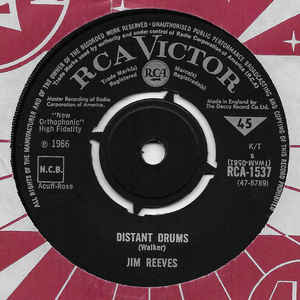
224. ‘Distant Drums’, by Jim Reeves

What to make of this, then…? Just as we were getting into a groove at the top of the charts – a rocking, modish, soulful groove with cool and forward-facing #1s following similarly cool and forward-facing #1s – The Kinks, The Blue Flames, Chris Farlowe and ‘Eleanor Rigby’, a curveball is thrown our way.

C1sLy+PlIFS._SL1000_

Distant Drums, by Jim Reeves (his 1st and only #1)

5 weeks, from 22nd September – 27th October 1966

Gentle drums, a swaying rhythm, a crooner’s voice… I hear the sound, Of distant drums, Far away, Far away… It’s the sort of country-ish ballad that was ten-a-penny in the late fifties and early sixties. (I’d perhaps call this one country-calypso, if that’s at all possible…) But it’s a sign of how far popular music has come in a very short time that ‘Distant Drums’ sticks out like a sore thumb in late 1966.

It’s a sentimental song, about a man who hears the distant drums of war… Then I must go, And you must stay… And so he begs his beloved to marry him before he gets shipped off: Let’s share all the time we can before it’s too late… If you love me Mary, Marry me… (Gettit? ‘Mary’ – ‘Marry’?) It’s sweet. Old-fashioned. Your gran would love it. I am certain, even without checking, that Daniel O’Donnell has covered this.

Why on earth it spent over a month at the top of the charts I do not know. But there’s no need to make a big fuss about it. Yes, it’s nothing like the brilliant hits that went right before, but I’m not a snob. There’s room for all in this parish. Jim Reeves sings it beautifully, in a very understated way. And it’s worth noting that exactly one year ago, Ken Dodd was at the top of the charts – for five weeks as well, no less – with the similarly saccharine ‘Tears’. And as with Doddy, ‘Distant Drums’ was, despite the strong competition, the biggest-selling single of the year! Maybe there was something in the autumn air…

R-7280842-1437917201-5702.jpeg

Or maybe it was because, as I’ve just discovered, Jim Reeves was dead. We have our third ever posthumous #1! But, unlike Buddy Holly and Eddie Cochran’s swansongs, Reeves had been dead for a while… A light aircraft crash, in a storm, in July 1964. Well over two years before this record hit the top spot… A bit late for a tribute, then. One other explanation is timing: that the song’s theme suddenly became prescient with escalation of the Vietnam War. Jim Reeves – ‘Gentleman Jim’ as he was known – had had plenty of chart hits before this one, both alive and dead, and so perhaps it isn’t a huge shock that one would catch the public’s imagination like this.

Whatever the reason, it means we get a little interlude in our rundown of the nation’s biggest selling songs. I’m not going to pretend that hearing this song has been a highlight of my day. If it had come in, say, 1962, in a version by Frank Ifield, I would have probably had far less patience with it… Moving on, then, without any further ado…

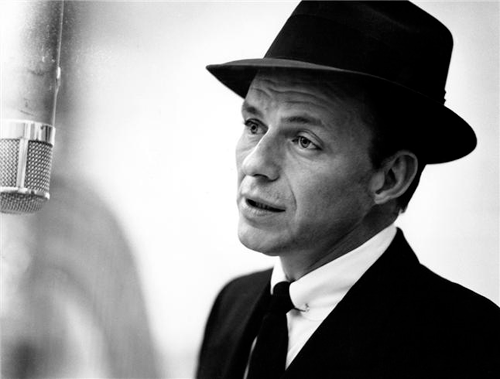
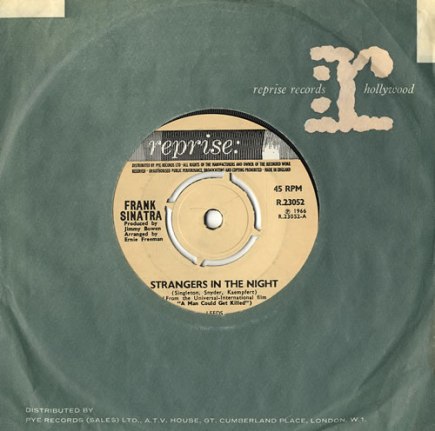
216. ‘Strangers in the Night’, by Frank Sinatra

After the all-out nihilism of ‘Paint It, Black’, it’s time for a slight change of pace. A fifty year old crooner – a legend, even by this point in his career – with a song about the joys of a chance meeting.

frank-sinatra1

Strangers in the Night, by Frank Sinatra (his 2nd of three #1s)

3 weeks, from 2nd – 23rd June 1966

Soaring strings, a gentle sway, and Ol’ Blue Eyes… Strangers in the night, Exchanging glances, Wond’ring in the night, What were the chances… It’s timeless, traditional pop. A similar, if much classier, version of Ken Dodd’s mega-hit ‘Tears’ from the previous year. A record that might have been #1 in 1946, 56, 66, 76… you get the drift. By this point in his career, a good twenty years since he graduated from teen-idol status, Sinatra was not about to reinvent himself as a folk singer.

Strangers in the night, Two lonely people, We were strangers in the night… And, yes, there’s something in the sweep of the violins and the softness of the horns, that conjures up an image of two people, in New York, entering a darkened bar for last orders… By the end of the song, they’ve been together for years. Things turned out alright, you see, for strangers in the night.

Frank Sinatra is a weird proposition for me. He’s old, too old even for my parents to have listened to him. He released his first single in 1939, and he would be a hundred and four were he still around today. And yet, the songs are there. They reach you anyway, regardless of whether you grew up hearing him. ‘Fly Me to The Moon’, ‘New York, New York’, ‘My Way’… He’s also a weird proposition for me as I’m not convinced that he was all that great a singer. I mean, he obviously was – the way he holds the yooouuuuu before the chorus here is good – but at the same time he talks his way through certain lines. The Ever since that night… line, for example.

FRANK_SINATRA_STRANGERS+IN+THE+NIGHT+-+4PR-555761

We have heard from Frank before in this countdown – going on twelve years ago, when he took ‘Three Coins in the Fountain’ to the top. Now, twelve years between #1 hits is a long time in any era of the charts; but this gap, straddling rock ‘n’ roll and the beat revolution, is particularly impressive. And this is the Sinatra that everybody knows, the Sinatra that wannabes cover on talent shows… the vast majority of his best known hits come from the sixties. Try naming one of his bobby-soxer hits from the early forties…

I love the pause, before we sweep into the final verse of ‘Strangers in the Night’. It’s cinematic, cocky Sinatra. And then perhaps the most famous bit of this song: do bee do bee dooo, da-da-da-da, yayayaya… So famous that it apparently inspired ‘Scooby Do.’ He sounds like your uncle, drunk at a wedding, forgetting the words… And then it hits you. That’s why Sinatra was, and still is, so popular. Because drunk uncles at weddings can just about pull off an impression!

Sinatra, though, hated this song. He couldn’t stand the record that returned him to the top of the charts after a decade. And he wasn’t ever subtle about it, either. It was ‘a piece of shit’ and ‘the worst fucking song (he’d) ever heard.’ You wonder, then, if the do-bee-do skat is simply him giving up. (Which makes the whole song even more glorious, if you ask me…)

Whatever the reason – the quality of the song, the iconic doo-be-doos, Sinatra’s vehement hatred of it – ‘Strangers in the Night’ became one of his biggest hits, one of his signatures, a song that he would have to bite the bullet on and perform every night for the rest of his life. I’d also suggest that his daughter hitting the tops of charts around the world just a few months earlier wasn’t bad publicity, either. Not that it matters. An artist of Sinatra’s stature needs to feature in this countdown. And I’m glad that he does.

Catch up here: