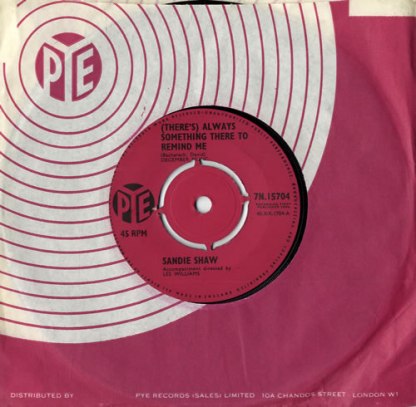
180. ‘(There’s) Always Something There to Remind Me’, by Sandie Shaw

This next chart-topper is a record that you can date pretty much instantly. Pretend, for a second, that you haven’t been following this countdown, and that you don’t know we are currently in October 1964. Just drop the needle, and listen. You know, straight away – it’s just got that mid-sixties vibe…

hqdefault

(There’s) Always Something There to Remind Me, by Sandie Shaw (her 1st of three #1s)

3 weeks, from 22nd October – 12th November 1964

There are soft, warm horns, and a little cha-cha-cha, bossanova beat. The ting of a typewriter reaching the end of a line. And a warm, playful voice… I walk along the city streets you used to walk along with me… Cute and glamorous – it kind of sounds like a French person singing in English (not that Sandie Shaw is French in any way – she’s Dagenham born and bred.)

It’s a song about a lost love, about how small things – streets and cafes – can remind you of the ones that got away. Oh how can I, Forget you, When there is always something there to remind me…? But, at the same time, it’s not a sad song. I’m not really sure what ‘kind’ of song it is…

It straddles lots of borders: it’s a bit of a ballad, a bit of a torch song, a bit of a standard pop song with a rock song looking to burst through. Listen to all the instruments involved: the horns, the orchestral strings, the twangy, Shadows-esque guitars. Plus the way Shaw sings – soft and lovelorn in the verses; shouty for the chorus. And then there’s the woah-waoh-waaaaa! and the cascading piano that bookmark either end of the violin solo.

There’s a lot going on here, but I like it. ‘(There’s) Always Something There to Remind Me’ is another song I knew – I could have sung the chorus – but had never listened to in any detail. It’s another Bacharach & David number (they’re starting to rack up) and I love the completely pointless brackets in the title. I like it because it doesn’t know, and probably doesn’t care, what kind of song it is. Everything’s been chucked in and given a good mix, and the end result is a classy little #1 hit.
SANDIE_SHAW_(THERES)+ALWAYS+SOMETHING+THERE+TO+REMIND+ME-560281

The only bit that jars is the I was born to love you, And I will never be free… line, because this might have been the swinging sixties, but girls were still expected to pine after their want-away men. Still, Shaw just about sells it with vocals that are both spunky and a little vulnerable.

Sandie Shaw herself is, to me anyway, super-sixties. Just the name, without knowing anything about her, and its playful alliteration dates it to within a couple of years (her real name was Sandra.) And pictures of her taken in late ’64, when this was sitting atop the charts, show a foxy, mascaraed, chunky-fringed girl (she was but seventeen) in knee-high floral dresses. You can easily picture her racing around swinging London town on the back of a scooter, bouncing from glamorous party to glamorous party, from Carnaby Street to King’s Cross.

But… perhaps this tune is actually a victim its era. It’s a good record – a sad song with an upbeat vibe – and yet it pales a little in comparison to some of the era-defining records that have topped the charts recently. A nice song lost among the greats? Our next post is a recap, and so we’ll be able to wade back through all the recent #1s, and really sort the downright brilliant hits from the simply very good. Until then…

Follow along with this Spotify playlist:

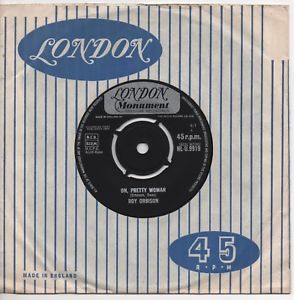
179. ‘Oh, Pretty Woman’ by Roy Orbison

In comes an intro that isn’t messing around… Sturdy, confident drums… Then Dun-dun-dun-dun-dun… An intro that builds – a layer added with every repetition – until it morphs into a chain-link of a riff.

0002611_oh-pretty-woman-roy-orbison-bill-dees-recorded-by-roy-orbison_550

Oh, Pretty Woman, by Roy Orbison (his 3rd and final #1)

2 weeks, from 8th – 22nd October / 1 week, from 12th – 19th November 1964 (3 weeks total)

And then in comes that voice. The Big O. Reigning it in a little compared to his last, full on operetta of a #1 single, ‘It’s Over’Pretty woman, Walkin’ down the street, Pretty woman, The kind I’d like to meet…  Now, let’s pause for just a second. That ‘I’d’ right there, twenty seconds in, makes or breaks this song. ‘I’d like to meet…’ suggests that he’s been a little unlucky in love. Make it ‘I like to meet…’ as some sources do claim, and the singer suddenly becomes a player, a predator, and the song a little icky. I’m going to trust that it’s an ‘I’d’…

Anyway. Roy’s just hanging out, chilling, watching the girls go by. Pretty woman… I don’t believe you, You’re not the truth, No-one could look as good as you… And then a spoken Mercy! that is truly sublime. Pretty woman, Won’t you pardon me, Pretty woman, I couldn’t help but see… That you look lovely as can be, Are you lonely, Just like me…? He may be ogling and approaching passers-by, but he’s a perfect gentleman about it. Plus, he’s lonely. There’s a tenderness to this song that lifts it above other stalker-anthems like ‘I’m Walking Behind You’ and ‘Every Breath You Take.’

Then, though, Roy does something that even he probably can’t get away with. The grrrrrooooowwwwllllll. Let’s pretend the growl never happens, OK? We get to the bridge – a real fifties rock ‘n’ roll throwback – that seals this record’s place among the greats. Pretty woman, Stop a while, Pretty woman, Talk a while… while the drums roll, and a piano tinkles.

As with ‘It’s Over’, ‘Oh, Pretty Woman’ stands out against the musical landscape of 1964. It could have been a hit five years earlier, or ten years later. I’m not sure you could say the same of ‘Do Wah Diddy Diddy’. The Roy Orbison renaissance (the Roynaissance, if I may) of ’64 is probably the most pleasant surprise in a spectacular year of pop music. Though to be honest, he hadn’t been anywhere, and had been scoring big hits throughout the early sixties. It’s just that none of them had made it to the top of the charts.

s-l300 (3)

We get to the climax of the song, and an already brilliant song is elevated even further. The rules of pop music never applied to Roy Orbison, and he bends them to great effect here. He serves us a cliff-hanger, similar to the one he dishes up at the end of ‘Running Scared’. The woman doesn’t stop, and he’s left disappointed. He slows it down, in his trademark talking-singing-freestyling style: Don’t walk away, Hey…. OK… If that’s the way it must be, OK… Then another moment of perfection – But, wait… Cut to the same drumbeat that opened the song. What’s that I see…? She’s turned around. She’s coming back! Of course she’s coming back. Was there a woman alive who could resist the Orbison charm?

I, as I’m sure you’ve realised, love this record. It’s a Rolling Stone Top 500, Rock n Roll Hall of Fame kind of record. A song that nobody can say a bad word about. I love Roy Orbison too, and still remember getting his greatest hits as a Christmas present back as a kid. Perhaps with the exception of Elvis, no other star of the fifties and sixties had an identifiable image like Roy Orbison. Dark suit, dark glasses, guitar, quiff. It’s up there with Michael Jackson’s hat and glove, and Madonna’s pointy bra. You may think it’s superficial; but it’s a hallmark of the very best pop stars.

Following this, Orbison suffered some pretty lean years in terms of chart hits, and some unimaginable tragedies: he lost his wife and his two eldest sons in the space of two years. But, as with all the greats he came back – The Travelling Wilburys, ‘You Got It’ and all that. And then, just as his comeback was picking up speed, and in a twist befitting one of his greatest ballads, he had a heart-attack and died, in 1988, aged just fifty-two. He’s a legend – plain and simple. The songs that defied convention, the operatic voice, and the dark glasses. The Big O.

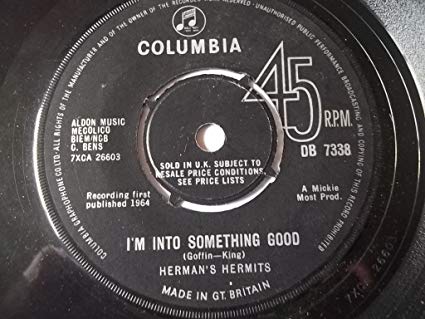
178. ‘I’m Into Something Good’, by Herman’s Hermits

After the gritty garage riffing of The Kinks’ ‘You Really Got Me’, it’s time for something different. Proving just how much of a golden age this was for British pop music, our next chart-topper is the complete opposite of the last; but is equally brilliant.

8e09292fb5bc6321d8f350a845d3dbc0.377x377x1

I’m Into Something Good, by Herman’s Hermits (their 1st and only #1)

2 weeks, from 24th September – 8th October 1964

In fact, I might be as bold as to claim that we are in the midst of the strongest ever run of UK #1 singles. Ever. In history. Past and present. Starting with, and including, Cilla’s ‘You’re My World’ back in June, the past nine chart-toppers have all been solid eight (or more) out of tens. No duds, no slip ups. And all have been wildly different sounding discs.

This one kicks off with a gently rumbling piano and a softly chugging riff. The sound of someone pulling their curtains open one morning to see the sun, and flowers, and butterflies, and frolicking lambs. Someone’s clapping; someone’s shaking a tambourine. Like I said, a world away from ‘You Really Got Me’. Except… It’s another song about falling head over heels for someone.

Woke up this morning, Feeling fine, There’s something special on my mind, Last night I met a new girl in the neighbourhood… is how it starts, and then it goes on to explain how the singer and the new girl danced, walked home, and how he asked to see her next week. Something tells me I’m into something good…

Ok, yes. It’s very PG. Herman’s Hermits were all about holding hands and going steady, whereas I’ll bet The Kinks were looking to get straight behind the bike shed for a bit of a fumble. But as a description of a first, teenage crush it works well. The lead singer, Peter Noone (AKA Herman) was literally just sixteen years old when this hit the top spot, which may explain how he could convincingly sell such a cutesy, starry-eyed song without it coming off as cheesy.

As a direct contrast to Noone’s grinning delivery, I love the deadpan backing singers. Whether they meant it, or whether they really were just extremely monotone singers, it works – it sounds like they’re very much over their friend’s romantic mooning, and would like him to shut up. Plus, the gentle piano-slash-guitar riff with the ooo-weee-ooos is giving me strong Beach Boys vibes.

7107RA+fIFL._SX425_

Which kinda makes sense, as the original songwriters – a pair no less distinguished than Gerry Goffin and Carole King – wrote it with the melodies of Brian Wilson in mind. This is yet another Beat song originally written by American bands and/or songwriters. It may have been The British Invasion, but it was heavily funded by the US. And it’s another hit that claims to have featured Jimmy Page as a session guitarist. Seriously, pretty much every #1 at the moment seems to have claimed a ‘featuring J. Page’ credit. He (probably) didn’t play on this one.

Another theme that I’ve noticed cropping up recently, and one that reaches its peak with this record, is how brilliant the band names were during the Beat era. From the cool (‘The Dakotas’, ‘The Animals’) to the quirky (‘The Kinks’) to the pun-tastic (‘The Beatles’ – ubiquity really has stopped people from realising how clever a name that is) to the downright silly (‘Manfred Mann’ and now ‘Herman’s Hermits’) – this truly was a great time to form, and name, a band.

Herman’s Hermits would go on to score hits right through until disbanding in 1970. In the US they would hit #1 with ‘classics’ such as ‘Mrs. Brown You’ve Got a Lovely Daughter’ and ‘I’m Henry VIII, I Am’, in which they camped up their Britishness in a manner so appalling that these records never saw the light of day in the UK. File them alongside Dick Van Dyke’s chimney-sweep and Daphne’s brothers from ‘Frasier’. No, back home their sole chart-topper was this paean to a first crush, one of the cutest #1 singles ever. He asked to see her next week, and she told him he could… Aww. Bless.

Follow along with this handy playlist:

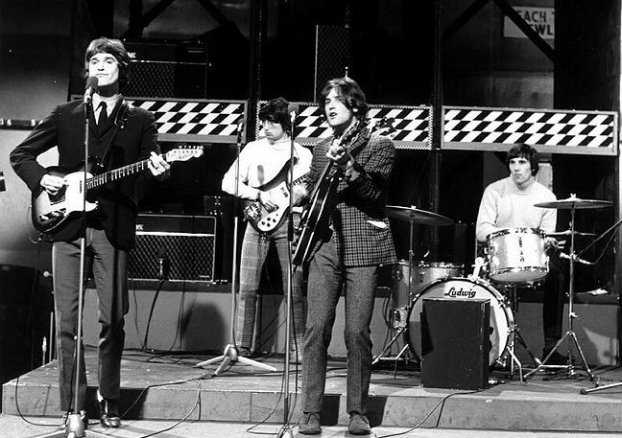
177. ‘You Really Got Me’, by The Kinks

Chart-topper No. 177, AKA The One Where Heavy Metal is invented. Or so the history books would have you believe…

DeZB8dhW4AAJjaL

You Really Got Me, by The Kinks (their 1st of three #1s)

2 weeks, from 10th – 24th September 1964

It’s easy to see why ‘You Really Got Me’ has gone down in the annals as the first metal/hard rock song (let alone #1 hit). There hasn’t been a chart-topper yet that has relied so heavily on its riff. Da-da-da-dun-da, Da-da-da-dun-da … Two sharp blasts from Dave Davies’ guitar kick us off, and it doesn’t let up until the very end. Da-da-da-dun-da, Da-da-da-dun-da…

Girl, You really got me goin’, You got me so I don’t know what I’m doin’ … Lyrics that rival the riff for brutal simplicity. You really got me now, You got me so I can’t sleep at night… The band called it a ‘love song for street kids’, and you can understand the sentiment. Poetry it ain’t; but the message comes across loud and clear. It’s a simple, yet intense, song. An intensely simple song. With that dense, monotonous riff dragging all along in its wake.

And the solo, when it arrives, is definitely the hardest rocking twenty seconds or so to feature at the top of the UK charts. And I don’t just mean up to now – I mean ever. Pure, unadulterated ROCK doesn’t often make it to the top of the charts and this solo, even listening to it fifty-five years on, still has the power to grab you by the balls. Ray Davies screams, and his brother goes wild.

My favourite bit, though, of this whole record, is how the choruses build into that oh yeeaahhh! moment, where the whole band join in and propel us into that unforgettable hook: You really got me, You really got me, You really got me…! It’s at this point that you realise you’re also listening to the first true power-pop record, too, with the vocals and the riff coming together to punch out the tune. Plus, you could argue that this is one of the first garage rock discs, too, in its simplicity and its rough-round-the-edges charm.

the-kinks-you-really-got-me-1964

Whatever genre this is – metal, garage rock, power-pop – it’s an undeniable classic. Few bands have announced themselves to the world like The Kinks did with this disc. And, like all great songs, a mythology has grown around ‘You Really Got Me’… Allegedly, the lead guitar was played by a then session-musician Jimmy Page (it wasn’t). Also allegedly, you can hear Ray Davies telling his brother to ‘fuck off’ in the drum fill just before the solo (I’ve really tried, but can’t). And then there’s the story of how the band achieved that gritty, crunchy guitar sound – by ripping the amplifier open.

I’ve listened to this song seven or eight times now in writing this, and I could listen to it seven or eight more. It’s perfect: short, sharp and sexy. It really feels as if every #1 we come across at the moment is raising the stakes – whether it’s The Honeycombs stamping on Joe Meek’s staircase, The Animals and The Stones bringing the blues, or The Beatles killing off Merseybeat in the outro to ‘A Hard Day’s Night’. Look back one year, to the days of Frank Ifield, Cliff, even Gerry & The Pacemakers, and it feels (and sounds) more like ten.

Weirdly, despite the fact that this may well be The Kinks’ biggest, best-known hit; it really doesn’t sound like them. The follow-up to this was ‘All Day and All of the Night’ (basically ‘You Really Got Me’ Pt. II), but after that they went in all kinds of different directions: Beat, music hall, folk, as well as pure pop. They have two more #1s to come, though, so let’s save all that for another day.

To end… I have a confession to make. This is such a classic, timeless, influential record that… and I think this just goes to show how irresistible this song truly is… I love even the Van Halen cover version…

176. ‘Have I the Right?’, by The Honeycombs

What’s that? What’s this? Why, it’s the sound of Merseybeat being fed through an electronic blender…

the_honeycombs_have_i_the_right_ep_spain_500_49412

Have I the Right?, by The Honeycombs (their 1st and only #1)

2 weeks, from 27th August – 10th September 1964

This is a Beat-pop song, with everything in the right place: verses, choruses, a solo. Lyrics about love. Have I the right to hold you, You know I’ve always told you, That we must never, ever part… Some whoah-oahs. But… Something doesn’t sound quite right. And by ‘not quite right’ I don’t mean it sounds ‘wrong’ – far from it. I mean it sounds… completely unique.

Take the drums for a start. They are deep and bouncy, and echoey. The drummer might well be in a completely different room from the rest of the band. In the chorus, as they pound out on every note, they sound like one of those huge Japanese drums, echoing across a misty forest.

Then there are the jabs of electronic keyboard that pierce the end of every line in the verses, like a ray-gun in a cheapo fifties ‘B’-movie. The guitar too is sharp, and clean as a knife; but again there’s something kooky about it, as if you were listening to pop music from a different but not too distant dimension. These two instruments combine on the solo and then, perhaps midway through, you realise what this song reminds you of: the one and only, the era-defining, blast from the future that was ‘Telstar’.

That particular #1 was produced by the legendarily maverick Joe Meek, and so was this. All three of his chart-toppers – this, ‘Telstar’ and John Leyton’s ‘Johnny Remember Me’ – were recorded in his apartment in Islington. All three are unique songs; but all contain recognisable characteristics. They’re drenched in overdubbing, they’re tweaked and tucked, they twang with reverb, and they are just all a little bit weird.

Here, for instance, is just one of the tales from the recording of ‘Have I the Right?’ Those drums I mentioned earlier? They were enhanced, not digitally, but by members of The Honeycombs stamping their feet on the stairs outside the studio. A tambourine was thumped against a microphone. And then, for the finishing touch, the tape was sped up. So much for the misty Japanese forest…

HONEYCOMBS-HAVE-I-THE

This record isn’t quite ‘Telstar’ – how could you recreate one of the most innovative and forward-gazing pop songs ever recorded? But it is still a brilliant #1. And in some ways, maybe, this is actually the more impressive feat. Here, Meek had to use his powers in the confines of a ‘regular’ mid-sixties pop song; while on ‘Telstar’ he was allowed to completely let loose… When we get to the chorus – Come right back, I just can’t bear it, I got some love and I need to share it… The lyrics look normal on paper – a little basic even. It’s the sound, and the propulsive, endearingly home-made feel of this song that makes it what it is.

Joe Meek, while never actually featuring in any of his chart-topping hits, was the main star of all three. From the gothic melodrama of ‘Johnny…’, to the space-age transmission of ‘Telstar’, to this piece of electronically blended Merseybeat. And, as is befitting one of pop music’s greatest innovators, he was an extremely eccentric character. His Wikipedia entry ranges from the bizarre (his belief that he could communicate with the dead, including through the meows of a cat), to the sad (he struggled through long-term drug addiction), to the downright tragic (he shot his landlady, and then himself, in 1967 after a depression brought on by the drugs, impending plagiarism lawsuits and the fear that he was about to be outed as gay.)

Under all this, The Honeycombs – understandably – have to play second fiddle. This was their debut hit and, although Meek produced several of their follow-ups, they struggled to match the success of ‘Have I the Right?’ Their second most successful single could only hit #12, and they broke up in 1967 after several line-up changes. Perhaps the most remarkable thing about them is that their drummer and founding member – Honey Lantree – was a woman.

Let us celebrate, then, this progressive sounding chart-topper, ‘Have I the Right?’, with a progressive bunch of people at the helm: a gay producer, a female-drummer, and a bunch of guys stamping on the stairs…

Follow along here:

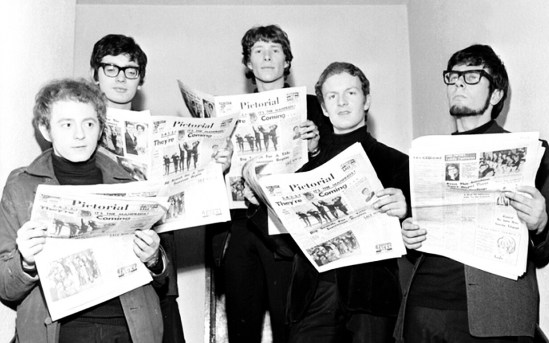
175. ‘Do Wah Diddy Diddy’, by Manfred Mann

‘Pop Music’… an ultra-generic term, but hey… What’s the first thing that pops (gettit?) into your head when you hear that term? Feel-good, catchy hits. Bubble-gum and bright colours. Popular songs that sell loads of copies. And yet, many, if not most, pop songs are more complex than that. Look at the songs to have hit #1 in 1964, and you’ll find a lot of bittersweet emotion: ‘Needles and Pins’, ‘Anyone Who Had a Heart’, ‘A World Without Love’, two songs titled ‘It’s Over’ and ‘It’s All Over Now’. Plus a song about a boy driven to ruin in a gambling den-slash-whorehouse. Only one – ‘Glad All Over’ – could potentially have filled all the ‘feel-good, catchy, bubblegum’ criteria this year so far. Make that two, now.

ManfredMann01

Do Wah Diddy Diddy, by Manfred Mann (their 1st of three #1s)

2 weeks, from 13th – 27th August 1964

There she was, Just a-walkin’ down the street, Singin’… Do wah diddy diddy dum diddy doo…! I forgot to add one more requirement to the ‘Pop Music’ manifesto – a memorable hook. And has there ever been a more memorable hook than Do wah diddy diddy dum diddy doo? Add it to the wopbopaloomas, the ramalamadingdongs and the zig-ah-zig-ahs of pop lore. As usual, I took a pre-post listen to this song, and tried to jot down some notes. But I found I didn’t write very much. I was too busy enjoying what is a great little pop song.

We come to a goofy call-and-response section: She looked good… (looked good…) She looked fine…( looked fine…) And I nearly lost my mind… And then it’s the bridge – another great bridge in an era of absolutely superb middle-eights. Woah-oh-woah, I knew we were falling in lo-o-o-ve… coupled with a twangy, rock ‘n’ roll throwback guitar. And we finish with, of course, a happy ending: with the loved-up couple together every single day, singing… You know exactly what they were singing: Do wah diddy diddy…

Musically, we can still hear the slow disintegration of the Merseybeat sound, now with organs, and maracas, and deep, bouncy, almost synthetic sounding drums. We’re approaching what I would think is peak-sixties, and this is a very sixties-sounding disc. And I’m looking at what I’ve written so far, and thinking it’s a pretty short post for a pretty high-quality song… But at the same time, ‘Do Wah Diddy Diddy’ is pretty close to pop perfection; and pop don’t need no analysing. That’s not really what pop music is for.

Manfred-Mann-Do-Wah-Diddy-Diddy-b-w-What

Plus, Manfred Mann will be chart staples for the entirety of the 1960s, managing what many of their Beat contemporaries couldn’t – to adapt their sound and score hits (including two more chart-toppers) all the way through to 1969. So I can’t even pad this post out with a career round-up.

This record made them the first non-Liverpudlian/Mancunian US chart-toppers during the British Invasion of 1964. In actual fact, though, ‘Do Wah Diddy Diddy’ was a cover. US girl group The Exciters had had a minor hit on the Billboard Hot 100 with it earlier in the year. Give that version a listen here. It’s a sign of the song’s strength, I’d say, that it works just as well in the hands of a female vocal group as it does in the hands of a raucous Beat-combo, and sounds as if it was originally written for them both. A stone-cold pop classic.

174. ‘A Hard Day’s Night’, by The Beatles

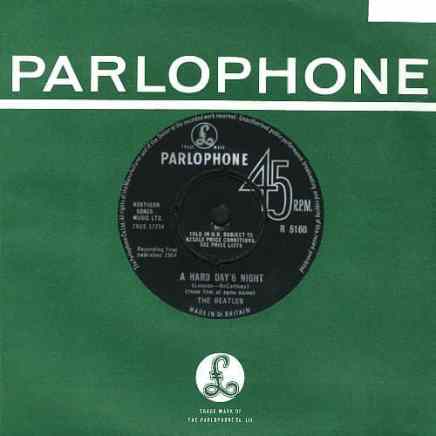
Has there ever been a more memorable, yet concise, intro in the history of pop? One chord. Literally just one chord. But I’d bet anyone with even a passing interest in popular music would be able to identify it.

The_Beatles_Hard_Day_s_Night_1964_l

A Hard Day’s Night, by The Beatles (their 5th of seventeen #1s)

3 weeks, from 23rd July – 13th August 1964

I’d also wager that entire theses have been devoted to this chord… (*Edit* Check out a 2004 report entitled “Mathematics, Physics, and ‘A Hard Day’s Night’” if that’s your thing.) As chords go, it’s quite a complicated one, with George Harrison playing an F and a G, while Paul McCartney adds a D on the bass, plus lots of other bits of wizardry from George Martin. Try the Wiki entry on the song for more detail. I didn’t really understand…

To the actual song, then. The intro fades, and we race into the first verse. It’s been a hard day’s night, And I’ve been working like a dog… And what’s that in the background, setting the frantic pace… Bongos?? Sure sounds like it. It’s been a hard day’s night, I should be sleepin’, Like a log…

Coming hard on the heels of two R&B chart-toppers, ‘House of the Rising Sun’ and ‘It’s All Over Now’, this sounds a bit light. Perhaps even a bit dated. So 1963… The But when I get home to you, I find the things that you do… line sounds like the climax to a cheesy sitcom theme. (‘One Foot in the Grave’, maybe…)

But the bridge comes in, and blasts all these doubts away. When I’m home, Everything seems to be right… Insistent cowbell, and the way that Paul half-screams Tight… Yeah! It’s actually a pretty filthy song. When he gets home to his girl, he finds the things that she does, make him feel alright… Who knows, maybe she’s just fetching him his pipe and slippers… Then scream! And solo. I love a scream before a solo. It’s second only to shouting the guitarist’s name in my list of ‘Brilliant Ways to Introduce a Solo’.

uk_a-hard-days-night_single

Actually, listening properly to ‘A Hard Day’s Night’ for the first time in years, it feels like this is actually four songs in one. You’ve got the intro, the cheesy verses, the intense bridge, then the outro… The jingly, jangly, echoey outro that sounds as if it’s coming from a year or two in the future. It kills of Beatles Mk I, and suddenly this record doesn’t sound lightweight, or like a re-tread of their previous hits. Those last five seconds basically announce that Merseybeat is dead; but that The Fab Four will continue setting the tone for the next few years. Everyone knows that The Beatles were ‘very good’; but it’s tiny moments like this that confirm it.

This song was, of course, from a film of the same name, all about the boys carousing their way around London, getting up to all sorts of hi-jinks. It was their first feature film appearance and, whaddya know, it’s one of the most influential music-movies ever made. Even their films turned out that way. They simply had the Midas touch.

Interestingly, what with this disc being released at the height of Beatlemania, as part of the soundtrack to the biggest film of the year, it didn’t enter the charts at #1. Entering the chart at the top was a big deal back then – Elvis had done it twice, Cliff once… That’s it. It seems natural to assume that The Beatles would have done so too in pretty short order. But they never did. ‘A Hard Day’s Night’ entered at #3, before climbing. They would have to wait until ‘Get Back’, their penultimate #1 in 1969, to hit the summit in release week… I say ‘interesting’; but maybe it’s just me. A strange quirk, anyway. Onwards.

173. ‘It’s All Over Now’, by The Rolling Stones

Lock up your daughters, the headlines screamed. It’s The Rolling Stones! And with a discordant, clanging intro – an intro that strongly hints at this being a band about to get up to no good – here they are.

chron1964

It’s All Over Now, by The Rolling Stones (their 1st of eight #1s)

1 week, from 16th – 23rd July 1964

Once the intro is out of the way, the song settles down into a jaunty, chugging rhythm. There’s a natty little bassline and jazzy drum-fills. In my previous post I billboarded this as Pt. II of the Great British Blues Invasion, following on from ‘The House of The Rising Sun’. But ‘It’s All Over Now’ sounds a little lightweight compared to The Animals’ record – a song that could have rattled the gates of hell. Anything would feel lightweight after that, to be fair.

Well baby used to stay out, All night long, She made me cry, She done me wrong… Lyrically this #1 follows a well-trodden path – the brave-face-on-a-break-up theme we’ve heard in discs like ‘That’ll Be the Day’, ‘Who’s Sorry Now’ and ‘Needles and Pins’ to name but a few. Except this is The Stones, authors of feminist anthems like ‘Heart of Stone’ and ‘Under My Thumb’, and so the barbs are aimed a little lower and hit a little harder than those fired by, say, The Searchers.

Well, She used to run around, With every man in town, Spending all my money… At this point we arrive at a momentous occasion in our countdown – the first genuine swear word!… Playing her half-assed game. (I know it’s nothing shocking in this day and age, but I bet the BBC weren’t playing it at the time.) She put me out, It was a pity how I cried, Tables turn and now, Her turn to cry…

51nBOTurhML._SX355_

It’s a slightly sloppily written song: note the ‘cried’ being rhymed with ‘cry’, while the line about ‘every man in town’ is also recycled in the final verse. It wasn’t originally a Stones song either, as it had been released, in the US at least, in a much more soulful, funkier version by Bobby Womack & The Valentinos. In this sense, then, it is a Stones song – the ominous, passive-aggressive, arrogance of this version is all them. It’s a song with swagger. The Stones were here, with added swearing and no time for heartache.

We reach the solo – a manic, disjointed effort from Brian Jones which I don’t think would win any technical awards but which sums up the early-Stones perfectly. This and the solo from Elvis’s ‘Devil in Disguise’ were the two solos I wanted to learn guitar in order to play, aged sixteen. (I still haven’t got round to it…) Mick Jagger squawks and squeals in the background, in a manner we just haven’t heard over the past hundred and seventy two #1s. Then we fade to black with the same clanging chords from the intro, but only after Jagger has promised that he won’t be taken for that same old clown. Because he used to love her; but it’s all over now.

There we have it. Two debut number ones. Both of which managed only a solitary week at the top of the UK singles charts; but both of which changed the direction of British pop as we know it. The bad boys were on top! Listen to ‘It’s All Over Now’ and then ‘I Like It’ by Gerry and The Pacemakers and tell me who you think would win in a fight… One thing’s for sure – pop music was evolving at an astonishing rate in the mid-sixties and we can now safely declare that – barely a year after it broke through – Merseybeat is dead, trampled under Jagger, Richards, Jones and co’s wedge-heeled brogues.

Listen to every #1 so far in this handy playlist:

172. ‘The House of the Rising Sun’, by The Animals

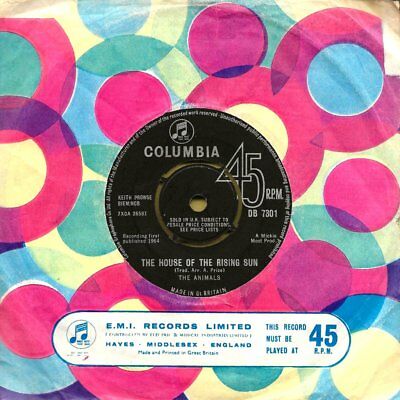
What have we here, then? A riff kicks in – and keeps on kicking for the next four and a half minutes – beckoning us towards a song about a whorehouse-slash-gambling den. Is this the moment in which the ‘and roll’ is dropped, and ‘rock’ strikes out on his own, with a capital R, O, C and K?

via-abkco-records-b8dfd84a5f29dc9250e2a8cc1c62a10fe6b81eab-s800-c85

The House of the Rising Sun, by The Animals (their 1st and only #1)

1 week, from 9th – 16th July 1964

It’s an ominous, minor-key intro. Nothing good is going to come of it. And when the vocals start, the mood darkens further. There is, A house, In New Orleans… They call the Rising Sun… (I’ve always liked the flamboyant way that the singer pronounces ‘New Orlay-ons’ in his sonorous voice.) And it’s been the ruin, Of many a poor boy, And God, I know, I’m one…

A young man, son of a tailor-woman and a gambler, heads into the latter-day Sodom and Gomorrah that is The Big Easy, and comes unstuck. How exactly he comes unstuck isn’t elaborated on – it is still only 1964, after all – but you can imagine. Cards, booze, women… If this were a movie, then the frenzied organ solo at the midway point would be the soundtrack to his descent into depravity.

Then comes a word of warning: Oh mother, Tell your children, Not to do what I have done… Except, the singer can’t heed his own advice – can’t resist the temptation of New Orleans: I got one foot on the platform, The other foot on the train, I’m going back to New Orleans, To wear that ball and chain… The organ grows more and more intense, the vocals wracked and howling – a voice that could cause avalanches. It’s completely different to Roy Orbison’s approach in the preceding #1, but it’s every bit as impressive. And the final, drawn-out horror movie chord that the song ends on is, frankly, terrifying.

This is something different… Every so often we arrive at #1s which feel like a level-up – chart-topping discs that raise the stakes (gambling pun very much intended). ‘Rock Around the Clock’, ‘Great Balls of Fire’, ‘How Do You Do It?’… and now this. After ‘House of the Rising Sun’ has blasted your eardrums, The Beatles and their Merseybeat chums sound like school kids. The Animals were men. The name alone is raw, and untamed. It’s also the longest number one single so far by some distance. The Animals didn’t edit their singles for nobody!

The-Animals-The-House-Of-The

They were a five-piece from Newcastle, and the lead singer with the voice of a wolf was one Eric Burden, a man who started smoking aged 10, fell in love with an older woman aged 13, and who preferred drinking ale to going to school (they breed them tough in the north-east.) He is, allegedly, The Eggman of ‘I Am the Walrus’ fame, due to an incident involving amyl nitrate and a fried breakfast… I really want to read his autobiography. Besides this disc, The Animals gave us two more ‘Best of the 60s’ perennials – ‘Please Don’t Let Me Be Misunderstood’ and ‘We’ve Got to Get Out of This Place’. They weren’t ones for shortening their song titles either…

‘House of the Rising Sun’ has an equally interesting, and hard-edged history. Sources differ, but it seems certain that the song is as old as the 17th century. It originated either in England or France. The lyrics were originally about a woman led astray; The Animal’s version was the first to reverse the gender.

If this record hitting #1 is a game-changer – giving us pure, southern R&B at the top of the hit parade – then it has to be viewed as the first of a two-parter. While this is a seminal record; The Animals chart career didn’t last. Our next, bluesy chart-topper may not be as well-known, but the group that recorded it are perhaps the most famous rock ‘n’ roll band in history…

171. ‘It’s Over’, by Roy Orbison

Out of nowhere, the Big ‘O’ is back. Enough of this new-fangled ‘Beat’ nonsense, he says. It’s been a little too happy at the top of the charts recently; a little too much positivity going round. Roy is here to change all that.

roy-orbison---monument---color1-e23f5a1e868942826513ded7cdd783370ff3fda4-s800-c85

It’s Over, by Roy Orbison (his 2nd of three #1s)

2 weeks, from 25th June – 9th July 1964

This isn’t any kind of reinvention. Orbison hasn’t updated his sound to keep up with the kids. Last we heard from him, over three and a half years ago, it was with ‘Only the Lonely’. Now, ‘It’s Over’. And if you held any hopes that that might just be a misleading title, then the opening line crushes them. A guitar gently strums… Your baby doesn’t love you, Anymore…

And so we embark on a song absolutely drowning in melodramatic heartbreak. Roy O excelled at this kind of OTT emoting. Lines like: All the rainbows in the sky, Start to weep and say goodbye… and Setting suns before they fall, Echo to you ‘That’s all, that’s all’… are both ridiculous and perfect. While in the build-up to the chorus, when he sings She says to you, There’s someone new, Were throu-ou-ough… and then, just for good measure, another We’re through! Goosebumps.

I had never heard of a ‘bolero’ before researching this song, but it’s a term that’s been used to describe what Orbison was doing in ballads like these. A bolero being, in Latin music, a piece that ‘builds’; and in pop music a song that builds to a climax without the traditional verse, bridge, chorus structure. Not that ‘It’s Over’ is strictly a bolero. There is a latin flavour to the insistent guitars, and the occasional castanets, but there is a reset halfway through, after the first three It’s overs… For a true taste of Orbison-bolero, check out the equally sublime ‘Running Scared’.

By the end of the song, you’ve come to a startling realisation. The Big ‘O’ is bloody loving all this heartbreak. For a start, this song is written in the 2nd person – he’s singing about another person’s despair. He’s the angel of heartbreak swooping in through some poor guy’s bedroom window, as his wife slams the door behind her, singing And you’ll see lonely sunsets, After all… And then we get to the climax. It’s over, It’s over, It’s over! But it’s not. Oh no. Pause. One final breath. And Jeezo. That last It’s Over! No chart-topper, before or since – and bear in mind that we’re on around 1300 by now – has had as dramatic and emphatic an ending as chart-topper #171.

s-l300 (1)

As I wrote above, this was Roy Orbison’s 2nd number one after a near four year wait. Under normal circumstances, a four year gap between chart-toppers is nothing special. But for him to span these four years, which saw Elvis kill off what remained of rock ‘n’ roll and The Beatles et al launch a musical revolution, is pretty impressive. His contemporaries at the top when ‘Only The Lonely’ was there were Ricky Valance, Cliff and Johnny Tillotson. And he’s done it without compromise. This record is The Big ‘O’ doing what The Big ‘O’ does best, and for its two minutes and forty-seven seconds you could be forgiven for forgetting that anything has changed. Back when The Beatles and The Pacemakers landed on the charts, I compared them to a meteor, killing off all the musical dinosaurs. But I forgot about Roy Orbison. I now have a mental image of him coolly lifting the meteor up with one arm, stepping out from under it and dusting himself off. And re-adjusting his shades, of course.

Interestingly, he’s the first American-that-isn’t-Elvis-Presley to top the charts since Ray Charles in July 1962. The Beat revolution has been, up to now, a strictly British affair. But that’s going to start slowly changing. As for Roy, it’s certainly not over. Not yet. He’s got one final #1 left in the tank, and it might just be his signature song.

Follow along with my Spotify playlist: