350. ‘The Streak’, by Ray Stevens

Oh Lordy. Did anyone order a country rock, spoken word, novelty song about a sprinting nudist…? Anyone? Anyone?

The Streak, by Ray Stevens (his 1st and only #1)

1 week, from 9th – 16th June 1974

No punches pulled: this is a song that makes your teeth clench. The mix of sound effects and voice acting, not to mention liberal use of a banjo, does not make for a relaxing listen. Then there’s a wheeee noise that SongFacts describes as a: ‘zipppp kazoo sound.’ Eeesh! It is a story told by two characters: a roving news reporter, and a slack-jawed yokel who, for some unspecified reason, is being followed by a streaker.

Oh yes they call him ‘the streak’, Fastest thing on two feet… Off he goes, around the supermarket, through the gas station, over to the basketball stadium… He’s just as proud as he can be, With his anatomy, He goin’ give us a peek… The yokel is appalled by ‘The Streak’, but the same can’t be said for his wife Ethel… No matter how much of a warning her husband gives her, she always ends up catching a glimpse…

I don’t want to sound like a po-faced prude, but… This song isn’t very funny. Its closest chart-topping companion would be Benny Hill’s ‘Ernie’, but at least that was witty and warm, and just plain old silly. ‘The Streak’, though, is brash, in your face, and just plain old irritating. The lowest point is the canned laughter – actual canned laughter – as if the producers deep down knew that it wasn’t in any way hilarious and needed to convince themselves.

Some of the lines are kind of clever, I guess: he’s always makin’ the news, wearing just his tennis shoes… and I do like the image of ol’ Ethel disobeying her husband to have a glance. By the end, she’s made her choice and has stripped off too. Ethel you shameless hussy! (Her husband’s words, not mine, and apparently mis-heard by many for something much ruder…)

I wasn’t around, but apparently there was a streaking craze in the mid seventies. In March ’74 alone there was a streaker at an Arsenal Vs Man City match, that Wikipedia debatably describes as ‘the first instance of streaking in English football’, and a streaker at a cricket test between Australia and New Zealand. Meanwhile, a ‘streaking epidemic’ was hitting US college sports. There was even a streaker at the 1974 Oscars! Clearly the world was ready for a hit single about running in the nude. And Ray Stevens delivered… I dunno, maybe you had to be there.

Stevens had been around since the fifties – a country singer-songwriter who flipped between serious and comedic singles at random. His two biggest hits before this had been ‘Ahab the Arab’ – a US #5 in 1962 – and the primary school hymn ‘Everything Is Beautiful’ – an actual Billboard #1 in 1970. An eclectic range, to put it mildly…

But back to ‘The Streak’. The main problem with this is that it is obnoxious. I’ve said it before – some novelties are novelties by accident, through experiment, trial and error. ‘Mouldy Old Dough’, for example, or even ‘Telstar’ – a glorious, weird outlier in the history of the charts. Other novelties set out from the start to amuse, entertain or, more often than not, annoy. Did anyone who bought ‘The Streak’ actually listen to it more than twice? Probably not. But there it is: a transatlantic #1 hit.

349. ‘Sugar Baby Love’, by The Rubettes

I described the previous chart-topper – ABBA’s glorious ‘Waterloo’ – as a ‘sugar rush’ of a song. It is replaced now at the top of the charts by what I’ll call a ‘sugar overdose’ of a song.

Sugar Baby Love, by The Rubettes (their 1st and only #1)

4 weeks, from 12th May – 9th June 1974

Why does ‘Waterloo’ work, while this doesn’t? Both songs are constructed from the same ingredients: power chords, sturdy drums, backing vocals and a big glance back to the pop of the early sixties. But ‘Waterloo’ leaves you soaring, and ‘Sugar Baby Love’ leaves you feeling icky. I am not a songwriter; but if I was I bet I’d be forever chasing and missing that fine, fine line between ‘catchy’ and ‘cheesy’.

This record starts promisingly enough, with ‘Twist and Shout’ Aaaahs that overlap and ascend. But then, fifteen seconds in, a falsetto so high and piercing that it knocks you sideways arrives. Sugar baby love, Sugar baby lo-ove, I didn’t mean to make you blue… The singer is trying to suck up to his sweetheart, trying to apologise for an unspecified misdemeanour. If was them, I’d have stuck to a letter or a phone-call. You can imagine someone performing this outside a girl’s bedroom window at night – and hopefully getting the police called on them.

Yes, All lovers make, The same mistakes, As me and you… It is another sad milepost on glam rock’s descent into the hands of rock ‘n’ roll tribute acts. In 1974, Slade went harder, Bolan went experimental (and started missing the Top 10), while Bowie was starting to look towards soul sounds on ‘Young Americans’. The Rubettes know what side they’re on, though: the backing singers keep up a persistent shoo-waddywaddy, shoo-waddywaddy throughout (though Showaddywaddy themselves turned this track down when it was offered to them!)

And yet, I do have a very high-tolerance for cheesy pop. I can’t hate this song, no matter what it represents. My feet are tapping along quite happily. However, I have an extremely low tolerance for spoken word sections in pop songs and, of course, ‘Sugar Baby Love’ has to go there. People, Take my advice, If you love someone, Don’t think twice… **shudder**

The Rubettes were a group basically put together to promote this record, which had been recorded by session musicians (shades of Alvin Stardust). It had been written for the soundtrack of a rock ‘n’ roll, jukebox musical that never saw the light of day. Which means that singer Paul Da Vinci (not his actual name), whose falsetto makes such a statement in the intro, was never actually a member of the band. They had a few other hits, with titles like ‘Juke Box Jive’, which sound like filler from the ‘Grease’ soundtrack, and still tour to this day in various iterations, thanks to a big court case twenty or so years ago where all the members tried to get The Rubettes name for themselves… If I were them I’d have been fighting to become disassociated from it…

348. ‘Waterloo’, by ABBA

And entering, stage right: some genuine pop music legends.

Waterloo, by ABBA (their 1st of nine #1s)

2 weeks, from 28th April – 12th May 1974

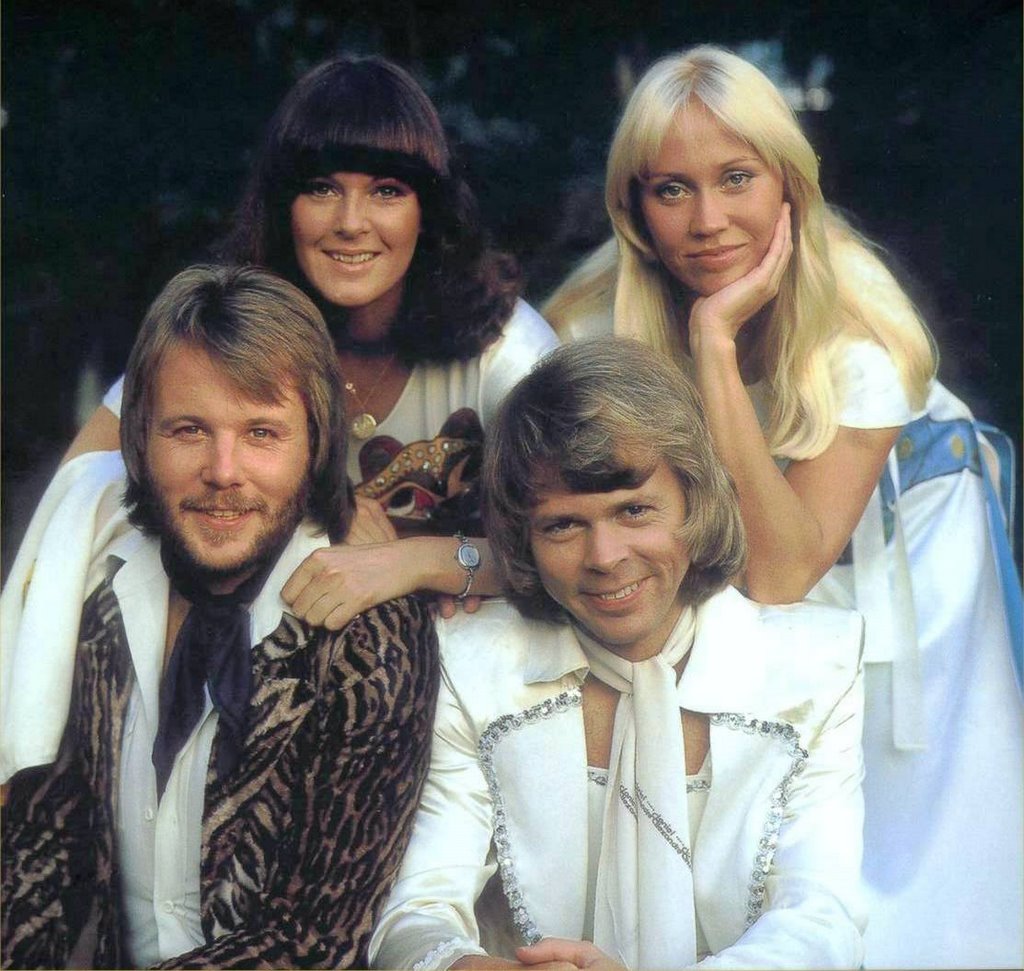
Are ABBA the best pop group ever? Like, pure pop? Well, they get my vote. I will not hear a bad word spoken against them. And these days, you don’t often hear much bad spoken about ABBA – they’ve shaken off the image that they were fit only for gay bars and hen nights, and have assumed their rightful place in the pantheon. Everyone loves ABBA. But… I’m writing as if wrapping up their final chart-topper; not introducing their first. To business!

It is perfect, the manner in which Benny, Bjorn, Agnetha and Anni-Frid shoot out the blocks on their first #1. ‘Waterloo’ is not a record that takes its time to reveal its charms. It’s a wham, bam, thankyou ma’am sort of pop song. It won the Eurovision Song Contest, for God’s sake: a feat not often achieved through subtle means. The churning bass, the thumping piano… My, my! At Waterloo Napoleon did surrender…

For a band that specialised in camp melodrama, this opening line – comparing their love for someone to an 19th Century military leader’s last stand – is as camp and melodramatic as it comes. Oh yeah! And I have met my destiny in quite a similar way… Cue one of the catchiest choruses ever recorded: Waterloo! I was defeated you won the war, Waterloo, Promise to love you for ever more… (A big part of this song’s success, I think, is the way they pronounce the title in their Swedish accents: Wardahloo! With added emphasis on the ‘ooh’.)

It’s pointless looking for the hook here. The entire song is a two minute forty eight second long hook. The ridiculous saxophone licks, the woah-woah-woahs, the pounding piano ‘n’ drum intros to each chorus, something the band admits were ripped straight from Wizzard’s ‘See My Baby Jive’. ‘Waterloo’ is a huge, unashamed sugar rush of a song. Perfect, perfect pop.

In 1815, Napoleon Bonaparte was defeated once and for all, and exiled to the south Atlantic. In 1974, Agnetha and Anna-Frid give in and admit their love. As they put it in the song’s best line: So how can I ever refuse? I feel like I win when I lose! (The writers of ‘Mamma Mia – The Musical’ clearly gave up on trying to shoe-horn a song about a two-hundred year old battle into the story, and stuck in at the very, very end, as an encore.)

As a kid, this was my favourite track on ‘ABBA Gold’. It is no longer my favourite ABBA song, but it is the perfect first chart-topper for the band. They would go on to reach much greater heights of subtlety and sophistication; though it’s debatable whether they wrote a catchier hit. Meanwhile, it was also voted as the greatest Eurovision song for the contest’s 50th anniversary.

This hit proved to be a bit of a false start for ABBA, though. They struggled to follow ‘Waterloo’ up, in the UK at least, and we’ll have to wait almost two more years for their next #1. Once that arrives, however, there will be no looking back. It feels like we’ve entered a new phase in our journey through the chart-toppers… It’s the mid-seventies, and we’ve finally met the decade’s greatest band!

347. ‘Seasons in the Sun’, by Terry Jacks

From one mawkishly sentimental #1, to another…

Seasons in the Sun, by Terry Jacks (his 1st and only #1)

4 weeks, from 31st March – 28th April 1974

Let’s not pull any punches: this record is seen by many as one of the worst songs, ever. And I can understand why. From the opening riff, both ominous and irritating, to the nursery rhyme lyrics that don’t quite scan: Goodbye to you, My trusted friend, We’ve known each other since we were nine or ten…

It’s the swan-song of a dying man, a man who has lived quite a life: drinking, carousing, chasing girls… The self-confessed black sheep of the family. He lies upon his deathbed, smelling spring in the air, hearing children playing outside. There’s a verse for his friend, his father, and his daughter Michelle.

Jacks’ voice is perhaps the biggest problem here. It’s reedy, and at times sounds like bad impression of Kermit the frog. But it’s far from being the only problem… There’s an early key-change, and then another, and another, and another, until you’re left wondering if the song might continue until it’s reached a key that only dogs can hear. And then there are lines like: we skinned our hearts and skinned our knees… and like: but the stars we could reach were just starfish on the beach…

‘Seasons in the Sun’ is in many ways a terrible song. Saccharine, cloying, cheesy, simplistic… throw all these adjectives at it and they stick in the sentimental gloop. But I’ve never been able to hate it. I quite like this record. In reflective moments I picture myself singing it on my own deathbed… I find the Goodbye papa, It’s hard to die, When the birds are singing in the sky… line very moving, and a reminder of our own great insignificance in the grand scheme of things. The birds don’t give a shit if you live or die – they’ll go on singing regardless. And Jacks was inspired to write his version of the lyrics when one of his friends was diagnosed with terminal leukaemia, so that’s very sad.

In the right hands this could be a powerful song. Unfortunately the only other version I can think of is Westlife’s – a version we will meet atop the charts one day – and they are certainly not ‘the right hands’. The very first version had come in the early sixties as ‘Le Moribund’, in French, sung by Jacques Brel. In it the singer is ‘dying’ from a broken heart, and he sarcastically dedicates the final verse to the girlfriend that cheated on him. It sounds so unlike ‘Seasons in the Sun’ that you wouldn’t instantly connect them.

The first English version was recorded by folk act The Kingston Trio. It’s just as strident as Brel’s. Meanwhile, the Beach Boys were working on a version at the same time as Terry Jacks and his wife. Sadly it never saw the light of day. But what’s this I’ve found…? A demo version? By Nirvana? With Kurt Cobain mumbling, and making up half the lyrics, including a line about ‘foggy turds’…? Still not convinced they’re the right hands, but I like it…

Terry Jacks doesn’t quite make it as a one-hit wonder – his follow up to this chart-topper made #8. He lives in his native Canada, where he semi-retired from the music industry in the eighties, enjoying many a season in the sun, and where he has won several awards for his environmental campaigning.

346. ‘Billy – Don’t Be a Hero’, by Paper Lace

There are two things that never bode well at the start of a new #1 single: a marching band drumbeat, and whistling. And what do we have here… A new #1 single that begins with a marching band drumbeat and whistling.

Billy – Don’t Be a Hero, by Paper Lace (their 1st and only #1)

3 weeks, from 10th – 31st March 1974

Before starting this blog, I never for a moment suspected that songs about soldiers going to/coming back from war would be such a prominent sub-genre of #1s. I count four: ‘Lay Down Your Arms’, ‘Distant Drums’, ‘Two Little Boys’, ‘Yellow River’, and that’s just off the top of my head. Now make that five…

The marching band came down along Main Street, The soldier blues fell in behind… The song is sung not from the soldier’s POV, nor from his fiancé’s, but from that of a nameless observer. He sees the lovely fiancé begging her boy not to go: Billy, don’t be a hero, Don’t be a fool with your life… Come back and make me your wife…

To cut a long story short, or at least to paraphrase the second verse, Billy is just too darn heroic. He volunteers to ride out on a special, incredibly dangerous mission. The song doesn’t have to specify what happens next… There’s one obvious connection to make here, as there is with nearly all the ‘#1s about war’ – Vietnam. This hit the top as US involvement in the war was drawing to an end, and after most popular support for the conflict had died away.

And tellingly, when his fiancé gets the letter telling her of Billy’s death, and that she should be proud of him, she doesn’t get it framed, or keep it under her pillow… I heard she threw that letter away… Cue marching band, whistling, and a fade-out. It’s actually quite powerful, and it’s a shame the rest of the song sounds like something a window-cleaner would whistle while he works.

Away from songs about soldiers, other similar chart-topping subgenres include ‘men in prison/on death row’ and ‘men who die in car/plane crashes’. I say similar, because all three involve blokes doing brave, strong, manly things while their sweethearts pine all doe-eyed after them, and all three lend themselves to mawkish, sentimental ballads. ‘Billy – Don’t Be a Hero’ isn’t the worst of them, but it’s not the best either.

Paper Lace were a covers band from Nottingham, who had been around since the late sixties. They entered ‘Opportunity Knocks’ – the same talent show that gave us Peters & Lee – and were given this song to record as a result. (See, 2nd rate MOR, made for TV chart-toppers weren’t invented by ‘Pop Idol’ and ‘X Factor’!) They would have a handful more hits, one of which – ‘The Night Chicago Died’ – hit #1 in the US. (‘Billy…’ was also a US #1, but for a completely different band: Bo Donaldson & The Heywoods.) ‘Billy’ was Paper Lace’s biggest UK hit, and while it does have some nice glam-guitar flourishes to keep it sounding quite current, it commits the crime of fading without a final, rousing go at the chorus. Meh.

(The version in the video below and the version in my Spotify playlist differ, and I have no idea which is the original.

345. ‘Jealous Mind’, by Alvin Stardust

This next number one kicks off, and instantly reminds me of another chart-topper from not so long ago. The chugging, fuzzy guitars that lead us in were last heard on 10cc’s ‘Rubber Bullets’. Musically, this is very mid-seventies soft-glam. It’s nice.

Jealous Mind, by Alvin Stardust (his 1st and only #1)

1 week, from 3rd – 10th March 1974

Then the singing starts, and it instantly reminds me of another chart-topper from much longer ago. Buddy Holly lives! If he’d made it to the seventies, and gone glam, he might have sounded a bit like this. Why is it I must know, The things you’re doin…? A-ah-hu-ho-ho, It’s just my jealous mind…

Seriously, the hiccup is spot on. A-ah-hu-ho-ho… It’s not an easy thing to mimic, the Buddy Holly hiccup – believe me, I’ve tried. For the rest of the record it’s not just Holly that Alvin Stardust harks back to – I get Elvis, early-Cliff and Eddie Cochran. It’s a fifties rock ‘n’ roll hit, set to a glam rock beat. I should love it…

But something’s lacking. The riff is fun, the solo is furious, the vocals are very singable… It’s just a little… gimmicky? Is that it? It’s definitely lacking a special ingredient, whatever that might be, to make this great. It’s not helped by Stardust’s get-up, the black leather and the outrageous quiff. He looks like an Elvis impersonator, before they were a thing. Plus, his name sounds like a rip-off of Gary Glitter…

When you delve into the Alvin Stardust back-story, you begin to understand why. For a start, he was an actual rock ‘n’ roller in the early sixties. He went by his first stage-name, Shane Fenton, with his band The Fentones. Their biggest hit, ‘Cindy’s Birthday’, made #19 in 1962. The big Mersey bands put paid to the Fentones, Fenton slipped into obscurity. Years later, a bloke called Peter Shelley created a persona called ‘Alvin Stardust’, based on David Bowie’s ‘Ziggy Stardust’, who was in turn based on the real British rock ‘n’ roller Vince Taylor. All very meta… Shelley cut a record as Stardust, ‘My Coo-Ca-Choo’, then got stage fright when the song took off and started climbing the charts. He needed a new ‘Alvin Stardust’, pronto, and turned to Fenton.

So, seeing pictures of Alvin Stardust Mk II, all leathered and quiffed up, looking old enough to know better, suddenly makes sense. He was well over thirty when he scored his first and only #1. But there’s something romantic about it, this jobbing singer finally making it after all that time. His short burst of fame in the mid-seventies didn’t last too long but, amazingly, Stardust had a third-wind in 1981, with the #4 hit ‘Pretend’ and a fourth one in ’84 with two #7 hits, one of which was aptly titled ‘I Feel Like Buddy Holly’. That’s some staying power: a real rock ‘n’ roll limpet. (Personally, I would have liked them to have kept changing Alvin Stardusts with every album, like a regenerating Doctor Who, as a weird experiment in pop.)

Away from the interesting back-story, though, I still can’t find much to love about this record. It’s another nail in the glam-rock coffin. Watered-down glam, a fifties homage, a last-minute relaunch of a washed up star…. But hey, ho. Worse things, worse people, have topped the charts. Moving on.

Follow along with my playlist below…

344. ‘Devil Gate Drive’, by Suzi Quatro

Hey, Y’all wanna go down to Devil Gate Drive….!? Well come on!! Or not. I mean, it’s fine. Whatever…

Devil Gate Drive, by Suzi Quatro (her 2nd and final #1)

2 weeks, from 17th February – 3rd March 1974

Suzi Q’s first #1, ‘Can the Can’, properly rocked, properly dripped with spiky attitude, and her second starts promisingly, with that yelled intro and the same glitter-glam drumbeat. A deep voice intones Welcome to the dive… and the anticipation peaks.

It’s a song about a dive bar, a dance hall, a brothel, a strip club… all of the above? There are chugging guitars, a barroom piano and some revving motorbikes for that peak ‘73/’74 sound. Well at the age of five they can do that jive, Down at devil gate drive… And at the age of six they can get their kicks, Down at devil gate drive… Someone call social services, this does not sound like a reputable establishment…

According to Suzie, and the song writing team of Nicky Chinn and Mike Chapman, ‘Devil Gate Drive’ doesn’t refer to an actual place. It’s any place you go to as a kid, to misbehave and piss off your parents… Well your momma don’t know where your sister done go, She goes down to the drive, She’s the star of the show… In which case, my ‘Devil Gate Drive’ was the woods behind my house where we shared cigarettes and bottles of Buckfast.

This is a fun record, a great rocker, extending the pretty long run of decent #1s that we’re on. But… It’s a bit gimmicky, a bit of a pantomime, compared to ‘Can the Can’. I feel that Quatro is camping it up a bit here, playing up her leather-clad image for the cameras. It’s another song in which glam-rock takes a tiny step towards self-parody.

Though, to be honest, glam rock will soon be a thing of the past, and I’ll miss it when it’s gone. What I won’t give for a glam-rock smash when I’m ploughing through the #1s from, say, 2016. Just because this isn’t T. Rex doesn’t mean it’s not still a solid seven out of ten chart-topper.

Similarities can be drawn between this and the previous #1, Mud’s ‘Tiger Feet’. There’s the songwriters for a start – the aforementioned ‘Chinnichap’ team. And then there’s the faux-live feel of the recording. It sounds as if Suzi and her band are performing this live, at the Dive, especially when she announces: Come on boys, Let’s do it one more time for Suzie! and her boys take it home.

Suzie Quatro won’t have any further UK #1s, but she’ll continue to record, perform and inspire pretty much every woman who has picked up a guitar since. She continued to get hits throughout the seventies, as well as scoring a recurring role in ‘Happy Days’ as the fabulously named Leather Tuscadero, which finally gave her some fame in her native US. I’ll leave you with a line from her follow-up to this disc, ‘The Wild One’ (a song that might just be better than either of her #1s): I’m a blue-eyed bitch, And I wanna get rich, Get outta my way, Cos I’m here to stay… And if that isn’t rock ‘n’ roll, then I quit.

343. ‘Tiger Feet’, by Mud

It’s mid-January, mid-seventies, three day weeks and coal shortages and all that (I wasn’t there, but it sounds pretty grim). So along came Mud, to save the day!

Tiger Feet, by Mud (their 1st of three #1s)

4 weeks, from 20th January – 17th February 1974

‘Tiger Feet’ is a relentlessly happy song. It is a big dumb puppy of a record that bounds in and refuses to get off until you start dancing. I’ve loved it since I was a kid, and I’m not going to go all snobby on it now. Some records need thinking about, need chin stroking and serious analysis. Others don’t.

All night long, You’ve been lookin’ at me, You know you’re the dance hall cutie that you long to be, You’ve been layin’ it down, You got your hips swingin’ out of bounds, And I like the way you do what you’re doin’ to me… That first verse sums it all up, in roughly ten seconds. A girl dances, a boy likes what he sees. Add in the backing cheers, whoops and hollers that make it sound as if this was recorded in someone’s front room on the New Year’s Eve just past, and you’ve got a classic.

It’s symptomatic of the route that glam rock has taken in the past year or so, through Wizzard and Gary Glitter, and now this ‘at the hop’ spoof from Mud. The genre is becoming little more than a fifties tribute act, characterised by the Elvis stylings of Mud’s lead singer Les Gray. It’s cheap, and tacky, but damn it if it isn’t catchy. It was written by glam rock songwriters du jour Nicky Chinn and Mike Chapman, who have already scored #1s with The Sweet and Suzi Quatro.

One thing’s always troubled me about this song, though, even as a child. If you were to pick a part of the body to compare to a tiger… why the feet? That’s neat, That’s neat, That’s neat… I really love your tiger feet! Tigers have claws and stripes and sharp teeth – tons of cool body parts. Anyway, whatever, I’m getting dangerously close to serious analysis, and I promised not to.

But if you really did want to don your thinking caps, there’s definitely an argument for connecting the grim economic situation of the mid-1970s with the increasing popularity of bubblegum hits like this (and I’m aware that I won’t be the first to spot this.) It’s pure escapism, for people who have bigger things to worry about. In turn, ‘Tiger Feet’ became one of the defining hits of the decade. Any cheap ‘Best of the 70s’ compilation has to feature it, by law, while it’s one of those songs that a drama set in the seventies will always turn to as background scene-setting.

Mud had been around as a band since the mid-sixties and, like most of the genre’s big stars, they jumped on the glam rock bandwagon and rode it hard. They will feature twice more in this rundown but, without giving the game away, I won’t be giving their following chart-toppers as much leeway as I gave this one. Because this is great. Inside everyone, there is an eight-year-old who thinks ‘Tiger Feet’ by Mud is the best song ever written. Go on, indulge them.

Remembering Alma Cogan

I’ve covered 342 #1 singles since starting this blog. Some have been classics, some have been terrible, some have been by the most famous acts in pop music history, some have been by acts unknown to me until that moment… One of the singers I have been happiest to discover on my journey, is the singer of the 35th UK #1 single, Alma Cogan.

Born in East London in 1932, she went from singer-in-residence at a hotel, to the biggest British female star of the fifties. ‘The Girl with the Giggle in Her Voice’ – a nickname she earned after bursting into laughter during an early recording session – with huge frocks and a healthy pair of lungs – to listen to her early hits is to lose yourself in unpretentious pop perfection. Of which ‘Dreamboat’, her one and only chart-topper, is perhaps the perfect example.

(You can read my original post on it here.) Voted Outstanding British Female Singer by NME readers four times between 1956-1960, she scored hits throughout the decade by covering standards such as ‘Mambo Italiano’ and ‘Why Do Fools Fall in Love?’, ‘Little Things Mean a Lot’ and ‘Hernando’s Hideaway’. Being a popular singer in the fifties and early sixties meant that she also recorded her fair share of novelties – ‘Never Do a Tango with an Eskimo‘ – and showtunes. But she sings them with such a twinkle in her eyes that you forgive even her cheesiest moments. Here she is, belting out ‘As Long as He Needs Me’ from ‘Oliver!’ (Apparently the part of Nancy was written with Cogan in mind, and she does have a fantastic cockney rasp in her voice, compared to other more stage-school actresses who have played the role.)

The swinging sixties killed off her chart-topping days, as they did to many stars of the fifties. But there is a fascinating coda to Alma Cogan’s career – her friendship with The Beatles…

Cogan’s star was waning and the Fab Four’s was on the rise, but they would still meet at the same TV recordings. She was the first person that Paul played ‘Yesterday’ to, and she allegedly had an affair with John. She also tried to relaunch herself back into the charts by covering some of the bands hits – her ‘Eight Days a Week’ is a particular moment of overblown brilliance.

For whatever reason, she couldn’t seem to reignite her singles career – in the UK at least – and died tragically young from cancer in 1966. She was just thirty-four. Which terrifies me, as I am thirty-four and I have neither enjoyed a decade-long singing career nor had an affair with a Beatle… Just what have I done with my life?

Here’s one of Alma Cogan’s later TV performances – a cover of ‘The Tennessee Waltz’ – as introduced by her (supposed) lover John Lennon. They do flirt quite heavily in this clip, I must say…

And if that doesn’t leave with a smile on your face, then I don’t know what medication to recommend…

Alma Cogan, 19th May 1932 – 26th October 1966