345. ‘Jealous Mind’, by Alvin Stardust

This next number one kicks off, and instantly reminds me of another chart-topper from not so long ago. The chugging, fuzzy guitars that lead us in were last heard on 10cc’s ‘Rubber Bullets’. Musically, this is very mid-seventies soft-glam. It’s nice.

Jealous Mind, by Alvin Stardust (his 1st and only #1)

1 week, from 3rd – 10th March 1974

Then the singing starts, and it instantly reminds me of another chart-topper from much longer ago. Buddy Holly lives! If he’d made it to the seventies, and gone glam, he might have sounded a bit like this. Why is it I must know, The things you’re doin…? A-ah-hu-ho-ho, It’s just my jealous mind…

Seriously, the hiccup is spot on. A-ah-hu-ho-ho… It’s not an easy thing to mimic, the Buddy Holly hiccup – believe me, I’ve tried. For the rest of the record it’s not just Holly that Alvin Stardust harks back to – I get Elvis, early-Cliff and Eddie Cochran. It’s a fifties rock ‘n’ roll hit, set to a glam rock beat. I should love it…

But something’s lacking. The riff is fun, the solo is furious, the vocals are very singable… It’s just a little… gimmicky? Is that it? It’s definitely lacking a special ingredient, whatever that might be, to make this great. It’s not helped by Stardust’s get-up, the black leather and the outrageous quiff. He looks like an Elvis impersonator, before they were a thing. Plus, his name sounds like a rip-off of Gary Glitter…

When you delve into the Alvin Stardust back-story, you begin to understand why. For a start, he was an actual rock ‘n’ roller in the early sixties. He went by his first stage-name, Shane Fenton, with his band The Fentones. Their biggest hit, ‘Cindy’s Birthday’, made #19 in 1962. The big Mersey bands put paid to the Fentones, Fenton slipped into obscurity. Years later, a bloke called Peter Shelley created a persona called ‘Alvin Stardust’, based on David Bowie’s ‘Ziggy Stardust’, who was in turn based on the real British rock ‘n’ roller Vince Taylor. All very meta… Shelley cut a record as Stardust, ‘My Coo-Ca-Choo’, then got stage fright when the song took off and started climbing the charts. He needed a new ‘Alvin Stardust’, pronto, and turned to Fenton.

So, seeing pictures of Alvin Stardust Mk II, all leathered and quiffed up, looking old enough to know better, suddenly makes sense. He was well over thirty when he scored his first and only #1. But there’s something romantic about it, this jobbing singer finally making it after all that time. His short burst of fame in the mid-seventies didn’t last too long but, amazingly, Stardust had a third-wind in 1981, with the #4 hit ‘Pretend’ and a fourth one in ’84 with two #7 hits, one of which was aptly titled ‘I Feel Like Buddy Holly’. That’s some staying power: a real rock ‘n’ roll limpet. (Personally, I would have liked them to have kept changing Alvin Stardusts with every album, like a regenerating Doctor Who, as a weird experiment in pop.)

Away from the interesting back-story, though, I still can’t find much to love about this record. It’s another nail in the glam-rock coffin. Watered-down glam, a fifties homage, a last-minute relaunch of a washed up star…. But hey, ho. Worse things, worse people, have topped the charts. Moving on.

Follow along with my playlist below…
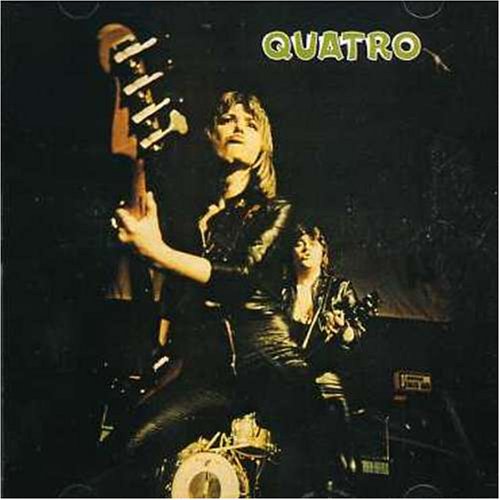
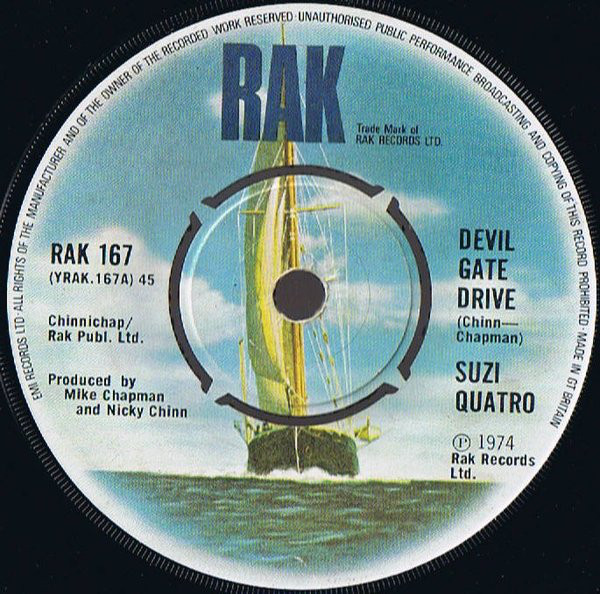
344. ‘Devil Gate Drive’, by Suzi Quatro

Hey, Y’all wanna go down to Devil Gate Drive….!? Well come on!! Or not. I mean, it’s fine. Whatever…

Devil Gate Drive, by Suzi Quatro (her 2nd and final #1)

2 weeks, from 17th February – 3rd March 1974

Suzi Q’s first #1, ‘Can the Can’, properly rocked, properly dripped with spiky attitude, and her second starts promisingly, with that yelled intro and the same glitter-glam drumbeat. A deep voice intones Welcome to the dive… and the anticipation peaks.

It’s a song about a dive bar, a dance hall, a brothel, a strip club… all of the above? There are chugging guitars, a barroom piano and some revving motorbikes for that peak ‘73/’74 sound. Well at the age of five they can do that jive, Down at devil gate drive… And at the age of six they can get their kicks, Down at devil gate drive… Someone call social services, this does not sound like a reputable establishment…

According to Suzie, and the song writing team of Nicky Chinn and Mike Chapman, ‘Devil Gate Drive’ doesn’t refer to an actual place. It’s any place you go to as a kid, to misbehave and piss off your parents… Well your momma don’t know where your sister done go, She goes down to the drive, She’s the star of the show… In which case, my ‘Devil Gate Drive’ was the woods behind my house where we shared cigarettes and bottles of Buckfast.

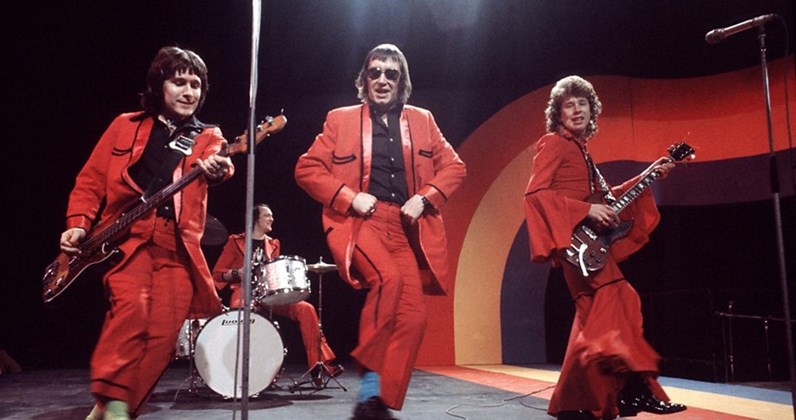
This is a fun record, a great rocker, extending the pretty long run of decent #1s that we’re on. But… It’s a bit gimmicky, a bit of a pantomime, compared to ‘Can the Can’. I feel that Quatro is camping it up a bit here, playing up her leather-clad image for the cameras. It’s another song in which glam-rock takes a tiny step towards self-parody.

Though, to be honest, glam rock will soon be a thing of the past, and I’ll miss it when it’s gone. What I won’t give for a glam-rock smash when I’m ploughing through the #1s from, say, 2016. Just because this isn’t T. Rex doesn’t mean it’s not still a solid seven out of ten chart-topper.

Similarities can be drawn between this and the previous #1, Mud’s ‘Tiger Feet’. There’s the songwriters for a start – the aforementioned ‘Chinnichap’ team. And then there’s the faux-live feel of the recording. It sounds as if Suzi and her band are performing this live, at the Dive, especially when she announces: Come on boys, Let’s do it one more time for Suzie! and her boys take it home.

Suzie Quatro won’t have any further UK #1s, but she’ll continue to record, perform and inspire pretty much every woman who has picked up a guitar since. She continued to get hits throughout the seventies, as well as scoring a recurring role in ‘Happy Days’ as the fabulously named Leather Tuscadero, which finally gave her some fame in her native US. I’ll leave you with a line from her follow-up to this disc, ‘The Wild One’ (a song that might just be better than either of her #1s): I’m a blue-eyed bitch, And I wanna get rich, Get outta my way, Cos I’m here to stay… And if that isn’t rock ‘n’ roll, then I quit.

343. ‘Tiger Feet’, by Mud

It’s mid-January, mid-seventies, three day weeks and coal shortages and all that (I wasn’t there, but it sounds pretty grim). So along came Mud, to save the day!

Tiger Feet, by Mud (their 1st of three #1s)

4 weeks, from 20th January – 17th February 1974

‘Tiger Feet’ is a relentlessly happy song. It is a big dumb puppy of a record that bounds in and refuses to get off until you start dancing. I’ve loved it since I was a kid, and I’m not going to go all snobby on it now. Some records need thinking about, need chin stroking and serious analysis. Others don’t.

All night long, You’ve been lookin’ at me, You know you’re the dance hall cutie that you long to be, You’ve been layin’ it down, You got your hips swingin’ out of bounds, And I like the way you do what you’re doin’ to me… That first verse sums it all up, in roughly ten seconds. A girl dances, a boy likes what he sees. Add in the backing cheers, whoops and hollers that make it sound as if this was recorded in someone’s front room on the New Year’s Eve just past, and you’ve got a classic.

It’s symptomatic of the route that glam rock has taken in the past year or so, through Wizzard and Gary Glitter, and now this ‘at the hop’ spoof from Mud. The genre is becoming little more than a fifties tribute act, characterised by the Elvis stylings of Mud’s lead singer Les Gray. It’s cheap, and tacky, but damn it if it isn’t catchy. It was written by glam rock songwriters du jour Nicky Chinn and Mike Chapman, who have already scored #1s with The Sweet and Suzi Quatro.

One thing’s always troubled me about this song, though, even as a child. If you were to pick a part of the body to compare to a tiger… why the feet? That’s neat, That’s neat, That’s neat… I really love your tiger feet! Tigers have claws and stripes and sharp teeth – tons of cool body parts. Anyway, whatever, I’m getting dangerously close to serious analysis, and I promised not to.

But if you really did want to don your thinking caps, there’s definitely an argument for connecting the grim economic situation of the mid-1970s with the increasing popularity of bubblegum hits like this (and I’m aware that I won’t be the first to spot this.) It’s pure escapism, for people who have bigger things to worry about. In turn, ‘Tiger Feet’ became one of the defining hits of the decade. Any cheap ‘Best of the 70s’ compilation has to feature it, by law, while it’s one of those songs that a drama set in the seventies will always turn to as background scene-setting.

Mud had been around as a band since the mid-sixties and, like most of the genre’s big stars, they jumped on the glam rock bandwagon and rode it hard. They will feature twice more in this rundown but, without giving the game away, I won’t be giving their following chart-toppers as much leeway as I gave this one. Because this is great. Inside everyone, there is an eight-year-old who thinks ‘Tiger Feet’ by Mud is the best song ever written. Go on, indulge them.

Remembering Alma Cogan

I’ve covered 342 #1 singles since starting this blog. Some have been classics, some have been terrible, some have been by the most famous acts in pop music history, some have been by acts unknown to me until that moment… One of the singers I have been happiest to discover on my journey, is the singer of the 35th UK #1 single, Alma Cogan.

Born in East London in 1932, she went from singer-in-residence at a hotel, to the biggest British female star of the fifties. ‘The Girl with the Giggle in Her Voice’ – a nickname she earned after bursting into laughter during an early recording session – with huge frocks and a healthy pair of lungs – to listen to her early hits is to lose yourself in unpretentious pop perfection. Of which ‘Dreamboat’, her one and only chart-topper, is perhaps the perfect example.

(You can read my original post on it here.) Voted Outstanding British Female Singer by NME readers four times between 1956-1960, she scored hits throughout the decade by covering standards such as ‘Mambo Italiano’ and ‘Why Do Fools Fall in Love?’, ‘Little Things Mean a Lot’ and ‘Hernando’s Hideaway’. Being a popular singer in the fifties and early sixties meant that she also recorded her fair share of novelties – ‘Never Do a Tango with an Eskimo‘ – and showtunes. But she sings them with such a twinkle in her eyes that you forgive even her cheesiest moments. Here she is, belting out ‘As Long as He Needs Me’ from ‘Oliver!’ (Apparently the part of Nancy was written with Cogan in mind, and she does have a fantastic cockney rasp in her voice, compared to other more stage-school actresses who have played the role.)

The swinging sixties killed off her chart-topping days, as they did to many stars of the fifties. But there is a fascinating coda to Alma Cogan’s career – her friendship with The Beatles…

Cogan’s star was waning and the Fab Four’s was on the rise, but they would still meet at the same TV recordings. She was the first person that Paul played ‘Yesterday’ to, and she allegedly had an affair with John. She also tried to relaunch herself back into the charts by covering some of the bands hits – her ‘Eight Days a Week’ is a particular moment of overblown brilliance.

For whatever reason, she couldn’t seem to reignite her singles career – in the UK at least – and died tragically young from cancer in 1966. She was just thirty-four. Which terrifies me, as I am thirty-four and I have neither enjoyed a decade-long singing career nor had an affair with a Beatle… Just what have I done with my life?

Here’s one of Alma Cogan’s later TV performances – a cover of ‘The Tennessee Waltz’ – as introduced by her (supposed) lover John Lennon. They do flirt quite heavily in this clip, I must say…

And if that doesn’t leave with a smile on your face, then I don’t know what medication to recommend…

Alma Cogan, 19th May 1932 – 26th October 1966

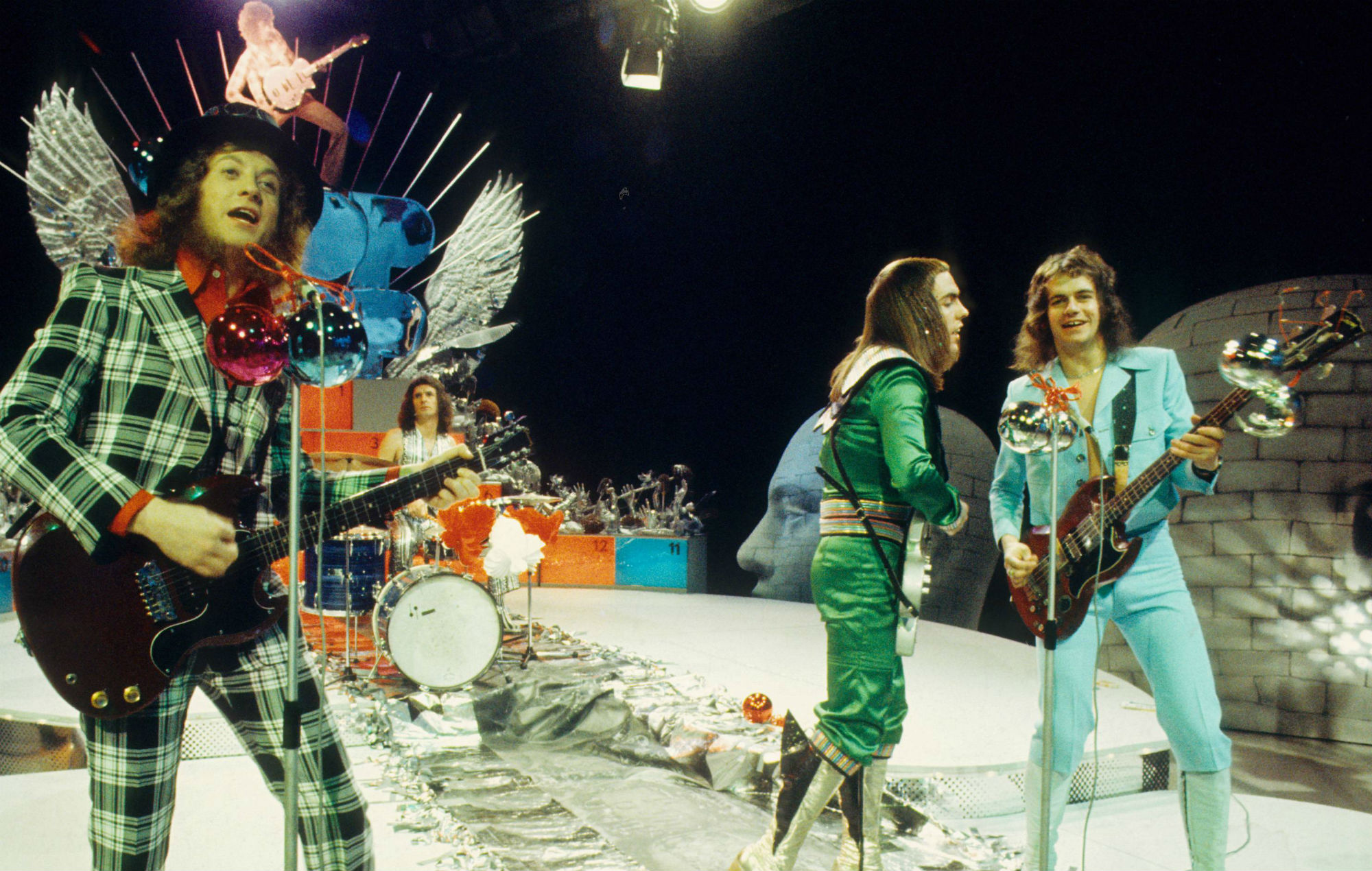
341. ‘Merry Xmas Everybody’, by Slade

OK everyone. On three. A-one, two… It’s CHRRRIIISSTTTMMAAAAASSSSSS!

Merry Xmas Everybody, by Slade (their 6th and final #1)

5 weeks, from 9th December 1973 – 13th January 1974

Yep, despite me sitting down to write this in real world October; our journey through the charts has us at Christmas 1973. Slade, the biggest band in the land have written an instant festive classic… Was there any way this wasn’t going to smash straight in at the top of the charts?

For the first time ever, two consecutive #1s have entered at the very top. (This won’t happen again until 1989!) All three of Slade’s chart-topping discs this year have debuted there. And they’ve saved their biggest one for last. The one that sold half a million copies in its first week on sale. Are you hanging up the stocking on your wall, It’s the time that every Santa has a ball…

To be honest, this song long since became muzak; I know all the words but never actually pay attention to them. Sitting down now and concentrating, you notice some clever touches. The ‘fairies’ sobering Santa up (pretty sure they’d be elves, but who am I to disagree with Slade?), the hints to the nativity and having room to spare inside. And of course, granny telling you that the old songs are the best but, presumably after a sherry or three, she’s up and rock ‘n’ rolling with the rest…

Musically, ‘Merry Xmas Everybody’ (the ‘s’ in Xmas should technically be back to front; but Microsoft Word cannot cope with Slade’s anarchic handwriting) sounds a bit subdued next to Slade’s more raucous earlier hits, ‘Cum on Feel the Noize’, ‘Take Me Back ‘Ome’ and the like. Maybe they dialled it back a bit, to ensure that it appealed to the widest possible audience; but it means it lacks a little something. It does mean, though, that we get some nice Beatlesy backing vocals and the brilliant What will your daddy do when he sees your momma kissing Santa Claus, a-ha…. bridge. Apparently Holder had written it in the sixties, long before Slade existed, which may explain the retro sound.

It must have sounded great when it first came out. Most Christmas standards up to then were either novelties, hymns or classics sung by Bing Crosby. But can anyone born in the UK, inside the last fifty years, actually remember the first time they heard this song? It’s just there. Each and every Christmas, on a loop. This, and the other big Christmas hit that was released in 1973, kicked off the idea of the Christmas #1 single, meaning that we perhaps have this to blame for Cliff’s Christmas efforts, Mr. Blobby, Bob the Builder, and all the horrible X-Factor winners’ singles… Dammit Slade, what did you do??

I could happily never hear this song again. It is Slade’s least enjoyable #1, and that’s not just because it’s a Christmas song. After this they turned away from commercial glam-pop and went heavier. The hits that immediately followed – ‘Everyday’, ‘The Bangin’ Man’ and ‘Far, Far Away’ – are for my money ten times better than this one. But hey ho.

Plus, the record I alluded to earlier, the other Christmas hit by a glam rock band from 1973, Wizzard’s ‘I Wish It Could Be Christmas Everyday’ is a better song, and one that I can still stomach when it starts coming on in the supermarket right about, hmmm, now. It only made #4. But. I love Slade, and don’t want to end my final post on them with a whimper. It’s lucky, then, that the band didn’t let this one end without one final moment of brilliance. It’s now pretty much enshrined in British law that Christmas hasn’t officially started until Noddy Holder has announced it at the top of his voice.

How much do Slade make from this record? About half a million pounds a year, it’s estimated. It was re-released in the early eighties, then again in the late nineties, and has made the charts every year since 2006 thanks to downloads and streaming. Last year, it reached #19. In a month or so it will start its latest ascent up the charts. It is a song that will probably outlive each and every one of you reading this. Slade’s legacy, for better or worse…

Enjoy (almost) all the #1s from 1973, and beyond, before we launch headfirst into ’74…

340. ‘I Love You Love Me Love’, by Gary Glitter

Anyone fancy a slow dance under the mistletoe, with Gary Glitter…?

I Love You Love Me Love, by Gary Glitter (his 2nd of three #1s)

4 weeks, from 11th November – 9th December 1973

While that mental image takes its time to fade… We settle into a woozy, oozy, slightly boozy, electronic sax riff. (Do electronic saxes exist? If they do, then that’s what leading us on this romantic mystery.) The trademark Glitter drums are there, but slowed right down. They lumber, they plod, they drag you down into the treacle.

Gary’s girl’s parents don’t like him much… We’re still together after all that we’ve been through, They tried to tell you I was not the boy for you, They didn’t like my hair, The clothes I love to wear… Or maybe they were just good judges of character, Gary? Once again, it’s proving difficult for me to judge the man’s music without remembering what he was deep down…

It’s glam rock, but stuck in quicksand, or on strong, strong Quaaludes. I’m not sure I like it all that much, but it’s kind of mesmerising. By the end, it’s basically smothered you into submission. The distorted saxophones and the over-dubbed guitars give me hints of Wizzard but, if they were going for what Wizzard achieved with ‘Angel Fingers’, they’ve fallen well short. In fact, I think we can pinpoint here the exact moment that glam rock started edging from Bowie and Bolan to Mud and Showaddywaddy’s fifties pastiches.

I love you love, You me love me too love, I love you love me love… Adding to the hypnotic effects is that chorus, that title. ‘I Love You Love Me Love’… I mean… It’s like a magic eye picture. You stare at it, trying to work out what it means, where the comma should be, but you go around in circles… ‘I Love You, You Love Me… Love?’

Whatever. You can bet that boys and girls around the country were sidling up to one another in school gyms around the nation at the Christmas dances of 1973, for a shuffle and a snog to this disc. This record entered the charts at number one and, if you’ve been paying attention, you’ll know how rare an occurrence that was back then. It means Glitter joins Elvis, Cliff, The Beatles and Slade. We might want to forget he ever existed; but we have to note how big he was in this moment.

He has one more chart-topper to come in the new year, before we can move past this slightly awkward elephant in the room. ‘I Love You Love Me Love’ was the 6th best-selling single for the entirety of 1973, despite only being released in early November… But you won’t be hearing it on a radio anytime soon. (Though, if you did enjoy this song, as I think I did – I still can’t quite make my mind up about it – and want a guilt-free means of enjoying it, Joan Jett does a pretty faithful cover, with a video that is peak-1985.)

339. ‘Daydreamer’ / ‘The Puppy Song’, by David Cassidy

I was a bit underwhelmed by David Cassidy’s first #1 – his cover of ‘How Can I Be Sure’ – to the extent that I gave it a ‘Meh’ Award. But no hard feelings, Dave – I approach this double-‘A’ with open ears.

Daydreamer / The Puppy Song, by David Cassidy (his 2nd and final #1)

3 weeks, from 21st October – 11th November 1973

I do like his committed yet breathy delivery, the way he commits to every, single, sy-lla-ble. I remember April, When the sun was in the sky… I was worried when I pressed play and was presented with the lightest, tinkliest seventies soft-rock intro. But by the time we get to the chorus it’s turned into a nice, swaying pop song, with more than a hint of Bacharach and David to it: I’m… Just… A… Daydreamer, Walking in the rain…

Back in the spring he was in love; now he wanders after rainbows. You get the feeling he’ll be alright, though… Life is much too beautiful, To live it all alone… as he saunters off after that pot of gold. I would like another extra little hook to sell it to me properly. As it is, I quite like it – he won’t be winning another ‘Meh’ award for this one.

Another reason why this disc won’t be getting described as ‘Meh’ is thanks to the song on the flip-side. I have to admit, before listening to it, I feared the worst. The aural scars from the last chart-topper to feature the word ‘Puppy’ still linger. But I needn’t have worried, ‘The Puppy Song’ is a fun, music-hall tune.

If only I could have a puppy, I’d call myself so very lucky… He wants a pup, one to take everywhere and share a cup of tea with (dog’s don’t drink tea, David!) I know that he, No he’d never bite me… Part of me does wonder if the ‘puppy’ is going to be a metaphor – Cassidy’s ‘ding-a-ling’ as it were – but nope. It’s simply a song about wanting a friend.

It’s just as lightweight as ‘Daydreamer’; but more fun. David sounds like he’s enjoying himself, scatting and ad-libbing away. Come the end his friends have joined him for a good old fashioned knees-up… We, We’d be so happy together, Yodelly-odelly-odelly-oh! It’s a song so catchy and good-natured that I can even forgive the slight forays into yodelling.

Though it sounds like a relic from the 1920s, ‘The Puppy Song’ dates from as recently as 1969, when Harry Nilsson featured it on his first album. He had written it for another earlier chart-topper, Miss Mary Hopkin, who also included it on an album. Neither of these three versions stray very far from one another, but think I like the goofiness of Cassidy’s version best.

So, David Cassidy’s brief UK chart-topping career ends on a bit of a high with two very different sounding songs (though I do like the fact that they are both almost exactly the same length). He’d have one further Top 10 hit, though the truth was he struggled with his teen-idol status, and longed to be taken more seriously. The hysteria that followed him around was never to his liking, and it culminated in the death of a fourteen-year-old fan in a stampede at one of his shows in London. He quit touring and acting in 1975, focusing more on recording the music he wanted to. I remember him as a fixture on chat shows and light-entertainment growing up, but it seems he never really managed to feel at ease with himself and his public image. He died from liver-failure in 2017.

Which suddenly turns the silliness of ‘The Puppy Song’ into a tears-of-a-clown moment… Maybe he wasn’t enjoying himself very much at all when he recorded it. Maybe he really did just want a friend? A bit of a downer to end on, maybe. But then, the pop music business often isn’t as happy as the executives would have us believe. RIP David.

338. ‘Eye Level’, by The Simon Park Orchestra

And now, in a change to the scheduled programming, something slightly different. Don’t adjust your sets.

Eye Level, by The Simon Park Orchestra (their 1st and only #1)

4 weeks, from 23rd September – 21st October 1973

Well, it wouldn’t be the early 1970s if there wasn’t a random instrumental just around the corner, waiting to spend a month on top of the charts… From the Royal Scots Dragoon Guard, to Lieutenant Pigeon, to this. I mean, it’s pleasant enough. It’s very grand, almost Baroque… When it gets into its full sway I feel like I’ve just been announced at the court of Louis XIV.

There must be a story behind this getting to #1 – it’s not your everyday kind of chart-topper. In fact, the game is given away by the song’s sub-title: ‘Original Theme From ‘Van Der Valk’’. ‘Van Der Valk’ being a popular detective drama set in the Netherlands, which ran for five series over twenty years. In fact, it just got remade for ITV this spring! How have I never heard of this show until today? (Apparently there was *outrage* among fans of the original when the 2020 remake changed the theme tune…)

I quite like this, to be honest. It’s very lush, dense, and proper. It makes you stand up straight while you listen to it. It doesn’t sound much like the theme to a detective show should, but hey ho. My biggest disappointment is that it ends with a whimper, when it feels like it should have built to something much bigger, and more elegant.

Simon Park and his orchestra seem to have appeared from nowhere after being chosen to perform ‘Eye Level’. It had been released the year before to little fanfare, before a re-release following the TV programme’s success sent it flying to the top. It is an official million-selling single, and there aren’t too many of those around. Credit where it’s due. The orchestra went on to release a few more singles, and soundtracked a few more movies and shows.

One of those little diversions, then, that come along every so often on our journey through the charts. Nice enough; if a little out of place. Moving on…

Follow along, TV theme tunes and all, with my playlist…

337. ‘Angel Fingers’, by Wizzard

Back to business. Last time out, thanks to teen idol supreme Donny Osmond, we endured a throwback to the soppy ballads of the 1950s. This time out, we have another trip back to the future. Imagine yourself in an American diner, waitresses in pink polka-dots and beehives, frothy milkshakes and burgers on the menu, a Wurlitzer flashing in the corner just waiting for you to drop a dime in and spin the latest smash-hit platter. And then Roy Wood rolls up, all wild hair and glitter, astride his hog. Yes, this is the fifties, Wizzard-ified.

Angel Fingers, by Wizzard (their 2nd and final #1)

1 week, from 16th – 23rd September 1973

First of all, let’s just appreciate motorcycle effect. It means two of the past three chart-toppers have featured heavy revving. It’s clear that artists were having a lot of fun in the studio, throwing whatever the hell they fancied into the mix. Secondly, isn’t this just the most gorgeous, layered, swaying and swooping, pastiche of late fifties, early sixties pop? With a big, big nod to one man in particular – Phil Spector.

As I was lying in my bedroom fast asleep, Filled with those famous teenage pictures that you keep… The singer, Roy Wood, or the character that Wood happens to be assuming for the next four and a half minutes, is a rock ‘n’ roll singer who loves a girl. But she is distracted by teen idol after teen idol (to give this hit its full title: ‘Angel Fingers (A Teen Ballad)’. Will Dion still be so important to you on your wedding day…?

He plans to ride over the café, on his bike, to prove his love. Maybe pick up a guitar and join a rockin’ band. Finally make it big, or maybe just get her to notice him. As with Wizzard’s first #1 – ‘See My Baby Jive’ – the lyrics aren’t really what you’re here for. You want the whole package, the melodies, the fevered imaginings of Roy Wood’s brain condensed into pop perfection. How it lingers, Angel fingers, That’s why I fell in love, With you…

Actually, to call this a mere ‘pastiche’ is unfair. This hangs together as a brilliant song in its own right. Just because it tips its hat to what went before doesn’t detract. It also sounds completely original. ‘Angel Fingers’ gets a bit lost and forgotten, I think, coming between ‘See My Baby Jive’ and Wizzard’s huge Christmas smash. And that’s not fair. I think it might hold together even better than SMBJ – the sensory overload is still there, all the saxophones and drum tracks and French horns cascading over one another, fighting for air time – but it always pulls back before it gets too much.

My two favourite bits are the piano flourishes that start and finish the solo, that I call the ‘Red Dwarf’ bit, for reasons that will be obvious to anyone who has ever watched the show. And then there’s the layered, doo-wop, Beach Boys ending that fades into those French horns, again. Oh baby, it’s perfect. It’s glam, it’s rock ‘n’ roll, it’s doo-wop, it’s Spector, it’s teeny-bopper pop… It’s the entire history of the UK singles chart thus far, in four and a half minutes.

Wizzard only released eight singles before calling it a day in 1975. Two of them reached number one, another was one of the best Christmas songs ever recorded. By that point, Roy Wood had been a member of three hugely influential bands: The Move, Electric Light Orchestra, and the Wizz. Following the split, he went solo, working on projects with bands ranging from Doctor and the Medics, to the Wombles, along with whatever guise he was recording under himself. He produced for many other artists, and tried, unsuccessfully, to have Elvis record one of his songs. He was, is, a genius, and one of those who makes sure this trawl through every #1 single, past every terrible Donny, Dawn or Dana record, remains so much fun.