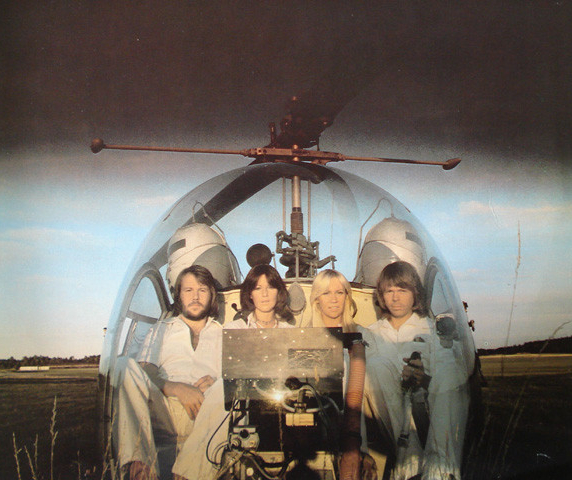
Already we reach the mid-point of ABBA’s chart-topping run! Their fifth #1, coming from the same album (‘Arrival’) as both ‘Dancing Queen’ and ‘Fernando’. Hit packed!
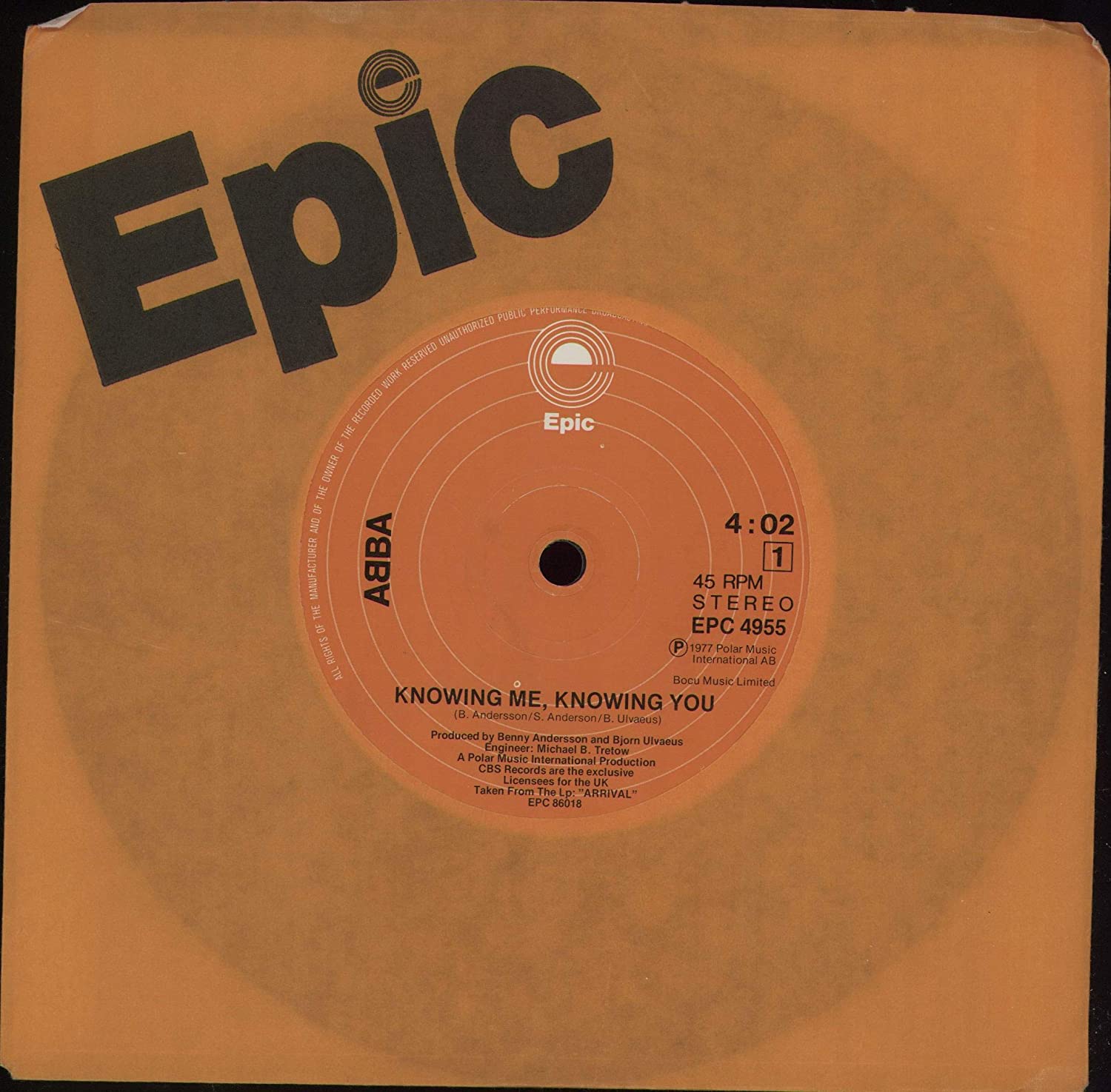
Knowing Me, Knowing You, by ABBA (their 5th of nine #1s)
5 weeks, from 27th March – 1st May 1977
Speaking of ‘Fernando’, the intro to this record sounds like a leftover from that recording session – acoustic guitars and a hint of pan-pipes. Fear not, though, for straight away that funky bass-line comes to our rescue and actually, the nearest comparison from the band’s earlier hits is to ‘SOS’. Power chords and actual hard rock guitars.
No more, Carefree, Laughter, Silence ever after… I’ve mentioned ABBA’s unique brand of English before, and I do love these rhymes that you can see coming from a mile off. Then we get a bit emo: Walkin’ through an empty house, Tears in my eyes… We are a long way from ‘Mamma Mia’s camp exclamations, or ‘Dancing Queen’s affirmation.
Knowing me, Knowing You, There is nothing we can do! It’s a break-up song, but at least it sounds like it’s mutual. A conscious uncoupling, if you will, and the intricate male backing vocals in the chorus do make it sound like a conversation. Breaking up is never easy I know but I have to go… Meanwhile the image of empty rooms in which children used to play is a powerful one.
In fact, it’s an early example of the sorts of songs ABBA would go on to make in the 80s, after their imperious phase and their disco phase. It doesn’t hit as hard as, say, ‘One of Us’, though; because the band had yet to go through their famed break-ups. Agnetha and Bjorn were still together, while Benny and Frida wouldn’t get married until 1978. Perhaps, then, we can say it’s a fictional story about a break up; while those later hits were documentaries.
I have seen ‘Knowing Me, Knowing You’ on top of several ‘ABBA – Ranked’ articles over the years, which has always surprised me a bit. It’s a cracker of a chorus (I mean, it’s ABBA, duh), but it’s never been my favourite. I have, for example, never really understood the song’s signature hook: the a-haaaaa. What does it mean? What does it signify? Meanwhile, Brits of a certain age will never now be able to listen to this song without picturing Alan Partridge.
Maybe it’s because those writers didn’t want to choose the obvious singles, or maybe the song’s slightly low-key vibe makes it a hipsters’ choice. (Though ‘SOS’ is the true hipster’s favourite ABBA single.) It is not as instant as their earlier #1s, but still a classic. Few bands have runs like ABBA did in the mid-to-late seventies. ‘Knowing Me, Knowing You’ gave them their 4th chart-topper, and their seventeenth week at #1, in little over a year. And they will be back soon enough…
At the end of my last post, I claimed that I had never heard this song before. I also offered a prayer that it might break our recent run of bland soft-rock…
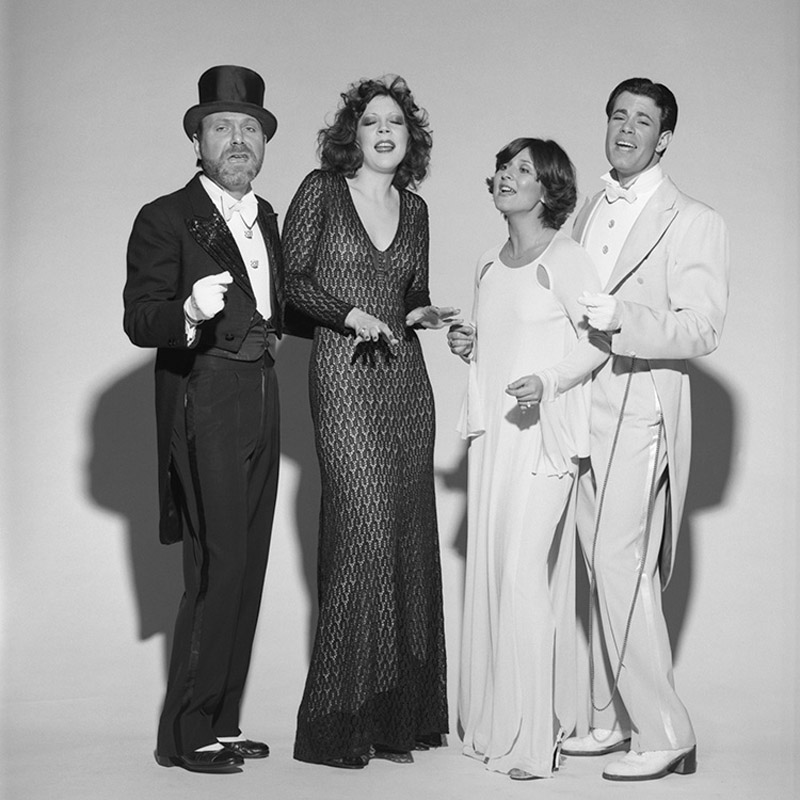
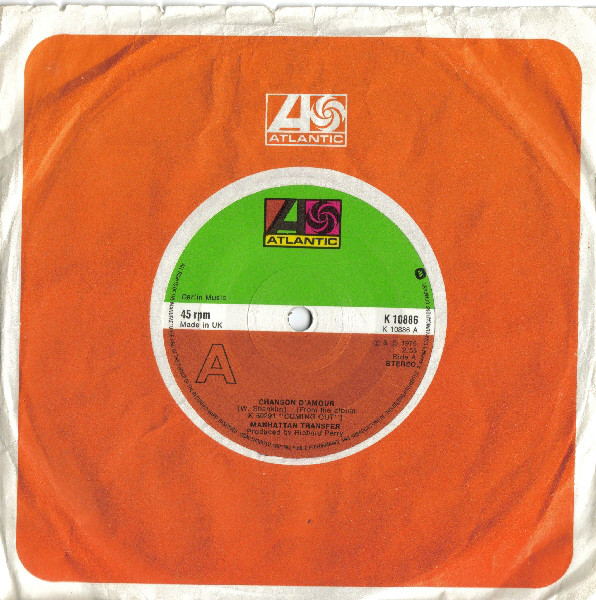
Chanson d’Amour, by The Manhattan Transfer (their 1st and only #1)
3 weeks, from 6th – 27th March 1977
Well, I can state that I have heard this song before – somewhere, sometime long forgotten. Or, maybe it’s just that this sounds like a standard, a melody that we all have running through us. As for whether it ups the tempo…? It does, a bit.
I like it, though; for it immediately has a boozy, saucy, pub singalong feel to it. A rolling piano, accordions… Chanson d’amour, Play encore… I also like it because, while half the lyrics are French, they are at my level of French – i.e. very basic high school. Chanson d’amour, Je t’adore… And then there’s an inane refrain: rah-ta-rah-ta-dah…
Actually, so bad is the French that I feel qualified to pick them up on it. The pronunciation is well off, coming out more like Chanson d’amooor, Joo t’adooor… Safe to say there were no actual French people involved in the making of this record. But it’s fun. It kind of sounds like Edith Piaf having a singalong, half-cut on Pernod, down an East End boozer.
There’s another saxophone solo. Make that two in a row and throw in a comment about London buses. (This one grates less than ‘When I Need You’, but I still would have preferred them to stick to the piano, or the accordion.) Then we roll to a gentle finish, and I’m left to wonder what on earth this record was doing at the top of the charts in early 1977. It’s completely pointless, but catchy and – praise be! – fun.
Manhattan Transfer were a band from New York, around since the late sixties. They did swing, jazz, a cappella stuff and largely stayed away from the charts until this hit smashed out of nowhere. They are still a going concern, still with three long-term members. ‘Chanson d’Amour’, meanwhile, was first written and recorded in the late fifties, by Art and Dotty Todd. Going off on a complete tangent… the Todd’s had also recorded the original version of another UK #1 single: ‘Broken Wings’, which was one of the very earliest chart-topping singles back in 1953, for The Stargazers. (Never thought I’d be mentioning them again!)
Viewed in this way, then, the record makes more sense. We can slot it in amongst the rock ‘n’ roll revival records – some covers, some originals – that have been peppering the charts for a few years now (Showaddywaddy, the Rubettes, etc.) Meanwhile, perhaps the definitive version of ‘Chanson d’Amour’ came from the cast of ‘Are You Being Served’, in the show’s final episode. Come to think of it, that’s probably how I knew this song… From post-Sunday lunch re-runs as a child.
When I Need You, by Leo Sayer (his 1st of two #1s)
3 weeks, from 13th February – 6th March 1977
We’re really hitting a slow and slushy moment in chart history. It must have been great at school discos, I suppose, with no shortage of last-dance tunes in which to snag your latest crush. But it doesn’t make for a very exciting listen forty odd years later.
It’s got all the instruments we’ve come to expect: gentle guitars, tinkly percussion, a glossy echo to everything. (Plus, this record has a secret weapon – more on that in a moment.) When I need you, I just close my eyes and I’m with you… Leo Sayer’s missing his girl while he works away from home… For some reason that I can’t quite place, I’m enjoying this more than the last-but-one chart topper, David Soul’s equally smoochy ‘Don’t Give Up On Us’. I think it’s the slightly funkier rhythm. If this one was sped up – a lot – it could be a disco classic.
I also like the emphatic It’s cold out, Just hold out… line. Plus, Leo Sayer’s voice has got a lot more oomph to it than Soul’s. He lets loose, in a fashion, for the fade-out. But, before that, we come to the secret weapon… the sax solo! Unleashed from out of the blue! They’re something we’ll have to get used to as the ’80s loom, but they’ve never sat well with me. Done well they’re fine; done badly they sound like the soundtrack to a bad date, or a porno.
It is sometimes hard to focus on the lyrics in songs like this, as they’re usually of the don’t leave me baby hold me baby variety. But, on closer inspection, on listen three or four, as Leo talks about closing his eyes and touching love while on the phone to his girl, and beseeching her to ‘do as he does’… I begin to wonder… Is this record actually about phone sex??
Or am I grasping to make it more interesting than it is? ‘When I Need You’ was the follow-up to the dorky but super catchy ‘You Make Me Feel Like Dancing’, which I would have much preferred as a #1. As it stands, this makes it four slow and soft #1s in a row, and five out of the last six. It’s not something that you say every day, but thank God for Showaddywaddy! Looking to the next chart-topper on my list, a record I have never heard before, I offer a silent prayer that it might be up-tempo.
Leo Sayer had been scoring hits since 1973, and had peaked at #2 three times before this one took him all the way. He will be back on top, but not for twenty-nine years, when he’ll feature on a remix of one of his seventies hits. That’s one of the longest gaps between number ones, ever. Meanwhile, ‘When I Need You’ has been covered by the great and the good of easy listening: Cliff, Julio Iglesias, Luther Vandross, Celine Dion… Leonard Cohen wasn’t as impressed by it, though – he sued Sayer for plagiarising his song ‘Famous Blue Raincoat”.
Time for a proper show tune! The first, unless I am mistaken, since Shirley Bassey way back in 1961?
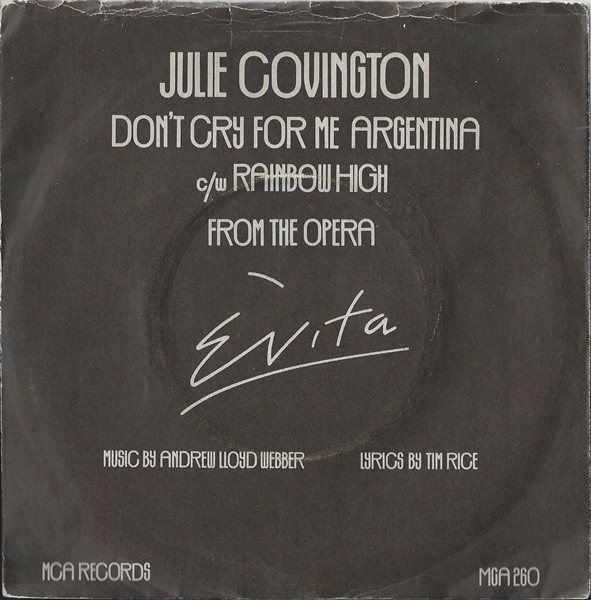
Don’t Cry For Me Argentina, by Julie Covington (her 1st and only #1)
1 week, from 6th – 13th February 1977
It’s a long one, too. Five and a half minutes, with nearly a whole minute of portentous introing before Julie Covington actually sings. It won’t be easy, You’ll think it strange… Gosh she sings it proper. When I try to explain how I feel… Musical theatre really stands out against pop songs, belted out as they are with cut-glass diction, aiming for the back row.
We’re approaching two and a half minutes, and still no appearance of the chorus. I have never seen ‘Evita’, neither on stage nor on screen, but I can sing this chorus. (I’ll show my age by saying I’m more familiar with Madonna’s version, which made #3 in 1996.) Come on Julie, love… Don’t cry for me Argentina, The truth is I never left you… It’s a love song, with all the usual trimmings, but about a country!
Show tunes also sound a bit strange divorced from their play, plonked into the singles chart. Who is she, and why is she singing about Argentina? Amazingly, this record was released well before ‘Evita’ debuted on the West End. Nobody had seen the show… and yet there was enough interest in this record to get it to the top of the charts!
To be honest, that first chorus was a bit underwhelming. I’m waiting for her to go around again, to really belt it out for the finale. While we wait – cause this is a record that isn’t afraid to take its time – a little bit of history. ‘Evita’, the musical by Andrew Lloyd-Webber, tells the story of Eva Perón, First Lady of Argentina between 1946 and ’52 and, since her death, official ‘Spiritual Leader of the Argentine Nation’ (with a fair few allegations of fascism thrown in from those who were against her).
Finally, a full four minutes in, and were back at the chorus. I’m ready for Ms. Covington’s big finale. But it never materialises… The orchestra does the soaring, we could be back in the charts of 1954, and I’m left a little bored. What a strange #1 hit… Bring back Dame Shirley. She’d have belted the life out of this.
Julie Covington never actually played Eva Perón on stage – she turned the role down – and when the show finally opened Elaine Paige took the part. Covington was a fixture on the West End stage throughout the seventies and eighties, but doesn’t seem to have done much in recent decades. Andrew Lloyd-Webber’s show tunes will be back, though – off the top of my head I can think of at least two more chart-toppers penned by him.
As this is the 400th (!) number one, I had planned to take stock, to see where we stood in the musical landscape. Except, this is a completely random one-week wonder that has no bearing on the real sound of the mid-seventies. In an ideal world, we could tell the story of British popular music tastes through every hundredth chart-topper. Number 100 would have been Elvis… (It wasn’t, it was Anthony Newley’s clipped and clicky ‘Do You Mind’), 200 would have been The Beatles… (It was! ‘Help’.) 300 would have been something glam… (Instead it was Tony Orlando’s sex-pest anthem ‘Knock Three Times’.) And 400 would have been a disco classic… Instead we aren’t crying for Argentina. Funny old things aren’t they, music charts…?
And it is onwards into 1977. Officially the late seventies! Bring it on!
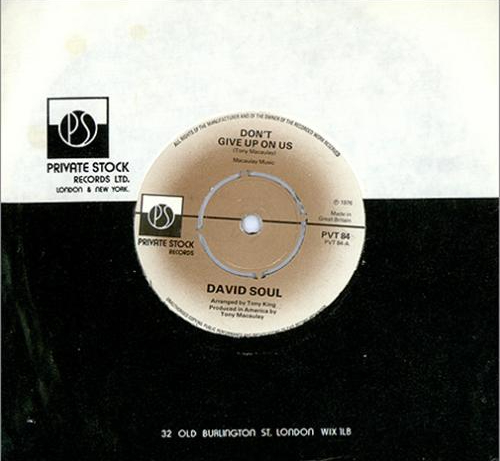
Don’t Give Up On Us, by David Soul (his 1st of two #1s)
4 weeks, from 9th January – 6th February 1977
Actually… I’m tempted to write the entire year off after thirty seconds of this next number one. It’s been creeping up on us, slowly but surely, with Demis Roussos, Chicago, Johnny Mathis… I fear the soft-rock years may officially be upon us.
In fact, I think this record has the exact same gloopy, doopy backing track from Johnny Mathis’s Christmas #1. They sure sound similar. Though David Soul’s voice has nowhere near the gravitas that Mathis had. Don’t give up on us baby, Don’t make the wrong, Seem right… It’s a decent voice, but a very soppy one.
I want to get a foothold on this song, a way in to appreciating it, but I can’t. It’s a puff of smoke. There’s nothing actually there. It’s a ‘check your watch’ kind of song, in that you start to wonder how long it’s going to go on for… Pulses are raised slightly come the middle-eight: I really lost my head last night… though you struggle to imagine the singer of this song being capable of any strong emotions… and then we get the blandest solo you could ever imagine, featuring a mish mash of guitars, strings and a French horn.
And then there’s a key change! Of course. Is there a more divisive trick in the songwriters’ handbook than the key change? Some make you punch the air and shout ‘YES!’; others make you wish the song would just end right there and then. No prizes for guessing which camp this record falls into…
Before coming to this record, I knew David Soul as being famous for his role in ‘Starsky and Hutch’, though I needed to check which one he was (Hutch). Soul’s record career came slap bang in the middle of the show’s four series run. So, he had the exposure and was perhaps always going to score a huge hit. But ‘Starsky and Hutch’ was a cop show, in which the two main characters used their wits and traded blows to catch the bad guys. They were cool, bad-ass. Yet, it is hard to think of another song that is as far away from being cool, or bad-ass, as ‘Don’t Give Up on Us’ is.
I just wish it had a bit more – a lot more! – life about it, is all. And glancing down the list of up and coming #1s for the year – including one more from Hutch – I worry that this might become a recurring wish. Not that there aren’t plenty of classics to come, though. So come on – think positive! I won’t give up on 1977 yet… (see what I did there?)
For the third time this decade, and for the fifth time in all, the Christmas number one is an actual Christmas song. The previous two, from Slade and Mud, were very seventies, very glam. This one, though, could have been #1 at any point in chart history.
When a Child Is Born (Soleado), by Johnny Mathis (his 1st and only #1)
3 weeks, from 19th December 1976 – 9th January 1977
Let’s split this record in two, and start with the good half. It’s got that ‘classic standard’ feel to it, a sweeping melody of the kind that you think you must have always known. When the backing singers come in with the ah-ah-ah-aaahhs it’s quite sweet. Plus, Johnny Mathis sings it like the professional crooner that he is. A ray of hope, Flickers in the sky…
On to the bad bits… And let’s start with those lyrics. It’s all winds of change, silent wishes, brand new morns and rosy hews. It feels churlish to complain about soppy lyrics in a religious, Christmas-themed song. What kind of lyrics is it supposed to have? Except, I’m not religious, and it’s April. So there.
Plus, the production is very floaty, glossy, mid-seventies MOR goop. And there’s a stinker of a spoken section: The world is waiting, Waiting for one child… Black, white… yellow?No-one knows… It is what it is. I’m not going to knock it any more. Mathis means well, and I have fond memories of my late grandmother singing this by the tree after a sherry or three.
I had assumed that ‘When a Child Is Born’ would have been an old, old tune from the mists of time. But the melody, ‘Soleado’, was written for an Italian singer in 1972, while the English lyrics followed a few years later. It’s a skill, I guess, to write a song that sounds so timeless. Johnny Mathis had been around for a lot longer, releasing his first singles in the mid-fifties. He followed this up with ‘Too Much, Too Little, Too Late’, his first US #1 for almost twenty years. Some impressive longevity there. He’s still with us, aged eighty-five, having released his most recent album in 2017.
You will all be thrilled to hear that the 1970s, the decade of the Christmas #1, is not done with the festive tunes just yet. But that is some way off. Up next, we launch head-first into 1977, which marks the singles chart’s quarter century!
Listen to all the #1s from 1976, and from every year before, with this playlist:
In my last post, I wrote about how Chicago had forced me to take soft-rock seriously, to appreciate the subtlety, and the craft. ‘If You Leave Me Now’ was such a lovely, well-made song that it was beginning to work…
Under the Moon of Love, by Showaddywaddy (their 1st and only #1)
3 weeks, from 28th November – 19th December 1976
But here come Showaddywaddy to undo all their good efforts. There goes subtlety, flying out the window. In comes thumping, rollicking, primary-coloured rock ‘n’ roll. The 1950s, reimagined by a toddler on a sugar high. Without seeing a picture of the band, you can instantly imagine the comedy quiffs, and the colourful teddy-boy suits.
Let’s go for a little walk…! Under the moon of love…! I offer you these lyrics as lead singer Dave Bartram delivers them, with an emphatic exclamation mark after each line, after each word even: Let’s! Sit! Down and talk! Under the moon of love…! He’s having a great time with this song, which means the listener – as long as they’re willing to leave their musical snobbishness at the door – enjoys themselves by the same measure.
I hate the concept of ‘guilty pleasures’. But, yes. ‘Under the Moon of Love’ is prime guilty pleasures material. ‘If You Leave Me Now’ is an objectively better piece of music, but I am enjoying this record ten times more. It’s fun, dammit! What I wouldn’t give for Showaddywaddy to invade the po-faced charts of 2021!
You were lookin’ so lovely… (Uh-huh-huh)… Because nothing says late-fifties doo-wop-slash-rock-n-roll like a well-placed ‘uh-huh-huh’… Under the moon of love! If you were being unkind, you could claim this as the final nail in glam rock’s coffin, the final fart of the corpse. The sound that can be dated right to the very start of this decade, in ‘Spirit in the Sky’ and ‘I Hear You Knocking’s fried guitar, through the huge-hitters like T Rex, Slade, Wizzard and The Sweet, down through Mud’s dancing, Gary Glitter’s prancing and The Rubettes’ falsettos. To this silly slice of rock ‘n’ roll revival.
Though to be fair, Showaddywaddy had been around since glam’s heyday, when their debut ‘Hey Rock and Roll’ peaked at #2. Since then they had revived Buddy Holly’s ‘Heartbeat’, and Eddie Cochran’s ‘Three Steps to Heaven’, while this, their only #1, kicked off a run of seven straight Top 5 hits lasting well into 1978, long after most of the big glam acts had fallen from the charts. They are still a-rocking to the this day, after a few line-up changes, on the oldies circuit.
As well as Eddie Cochran, they brought back the Kalin Twins’ ‘When’, and ‘Blue Moon’. But perhaps ‘Under the Moon of Love’ was the one that went all the way to the top simply because it wasn’t a big hit first time around. It was originally recorded by Curtis Lee in 1961, making #46 on the Billboard 100. It’s slightly better, in the way that originals usually are, while it was produced by an up and coming chap called Phil Spector.
Finally, Showaddywaddy’s turn at the top means we’ve now had a seven-piece (Pussycat), and two eight-pieces (Chicago and Showaddywaddy) atop the charts. Late ’76 seeing a reinvention of the term ‘big band’. But that run is about to come to an end, for the year’s final chart-topper is by a solo act. And I know it’s April, but we’re about to get a little festive…
The term ‘soft rock’ is one that makes me squirm. It’s not my favourite genre – I like my rock to, well, rock (*devil horns emoji*) – and soft rock can feel like rock ‘n’ roll with all the fun stripped away. But, as the late seventies loom, it is a genre we may have to get used at the top of the charts.
If You Leave Me Now, by Chicago (their 1st and only #1)
3 weeks, from 7th – 28th November 1976
Anyway, I say that soft rock is ‘often’ no fun – dull, earnest and very vanilla – but not ‘always’. For sometimes there are soft rock hits like this one. ‘If You Leave Me Now’ is a record that makes you feel as if you are being dipped in a vat of warm, melted chocolate. It is a big hug of a song, possibly the ultimate last-dance-of-the-night disc.
If you leave me now, You’ll take away the biggest part of me… the singer croons, but not in a Bing Crosby way. A creamier, more modern style of crooning. Then, prepare your falsettos: Ooh-ooh-ooh no, Baby please don’t go… There are soft horns, and strings, and a guitar being gently plucked.
The singer is pleading with his lover, not to be rash, or hasty. Not to do what they’ll regret in the morning. A love like ours is love that’s hard to find… How could we let it slip away…? He’s trying to lull his partner into staying, by stupefying her with this impossibly gentle, lush music. It’s a lullaby, really, for want of a better description.
Which means I shouldn’t be enjoying this song, not really. I should find it slow, and dull. But, while it hasn’t made me a fully converted soft-rock, MOR fan; you can’t deny a record this well-made and performed. What makes it even more impressive, is that with this type of music it is so easy to overdo the schmaltz (think Engelbert doing his worst on ‘Release Me’, or even Pussycat laying the cheese on a bit thick in the previous #1). Chicago pitch it just right, and create a classic of the genre.
I’m sure I recall an advert from ten/fifteen years back, in which an animated cherry lip-synced to this song. Or I may have dreamt it, and urgently need said dream analysed by a professional. If the advert does exist, then it’s a sign of how ‘If You Leave Me Now’ has softly slipped ‘tween the sheets of our shared consciousness. I’d bet most people could sing along to the chorus on this one, and I’d also wager it’s still on heavy-rotation on Magic and Smooth FM. It’s been covered by our friends Brotherhood of Man, the Isley Brothers, and Boyz II Men, twice.
Chicago were – are – from Chicago, Illinois. I love the confidence of that: screw it, we’ll just name ourselves after our hometown, which just happens to be the 3rd biggest city in the country. I know very little about them, other than that their albums are almost all titled as numbers (this was off ‘Chicago X’, their tenth album). As of 2018, they are a ten-piece with three original members still hanging on in there, on album XXXVII.
To finish, I’d like to note the fun coincidence of having a song named after a US state knocked off top spot by a band named after a US city. How cool’s that? That’s the sort of analysis you won’t be getting anywhere else. Onwards…
Following on from ‘Dancing Queen’ is a daunting task, but someone had to do it. In the autumn of 1976, that task fell to Pussycat, and their sole #1 record, ‘Mississippi’.
Mississippi, by Pussycat (their 1st and only #1)
4 weeks, from 10th October – 7th November 1976
It’s a gentle intro, a slice of soft country rock, that puts me in mind of the Eagles at their blandest, or Matthews Southern Comfort’s ‘Woodstock’ from earlier in the decade. In the past year or so, country and western has become something of an established presence at the top of the charts, from Tammy Wynette to J.J. Barrie to this…
But when the vocals come in, we move from country to schmaltzy. Well you can hear a country song from far, When someone plays a honky-tonk guitar… It’s a tribute to country music, an ode to the genre, and a love-letter to the USA’s most famous river. Mississippi, I remember you… Whenever I should go away, I’ll be longing for the day…
It’s the sort of song that you start to forget before it’s even finished. It’s very gentle, a pleasant enough stroll down the middle of the road, but it’s a bit dull. It makes you yearn for ABBA… But that’s not fair. We can’t go comparing songs to what went before! It is too long, though. I’ll state that with conviction. Times were four and a half minutes was record-breaking; now it seems to be the standard.
By the end, the band are bemoaning the fact that rock ‘n’ roll took over from C&W. The country song forever lost its soul, When the guitar player turned to rock and roll… Except, that’s patently not true. Rock ‘n’ roll was born from country (and jazz and the blues) – rock ‘n’ roll is country – plus here we are, with a country song at number one… So it can’t be that dead. We flutter to a finish, and I remain underwhelmed.
Pussycat were a Dutch band – which perhaps explains the schlager-heavy feel that this record has (they also, perhaps inevitably, recorded a version in German.) They were a seven piece, with what looks like three girls and four boys… (To be fair, they all have long hair and frills in the pictures I can find!) The best way I can describe them is like looking at a picture of ABBA after you’ve had a blow to the head. Still, they officially make 1976 the year of the mixed-gender pop group, after Brotherhood of Man and our aforementioned Swedes.
‘Mississippi’ was written by the band with the Bee Gees ‘Massachusetts’ in mind, and you can really hear the influence. Plus, it gives us our second #1 single named after a US State (and I’m happy to hear suggestions of others to come/that I’ve missed). They scored one more minor hit in the UK following this, but remained big in the Netherlands well into the ‘80s.
To finish, I think I have to crown ‘Pussycat’ as the worst band name to feature on this blog. It’s just… a ‘no’ from me. And Spotify seems to agree, as they have erroneously grouped this group’s back-catalogue with a trip-hop group of the same name, who’s last album was titled ‘Sexy Bondage Domination’…
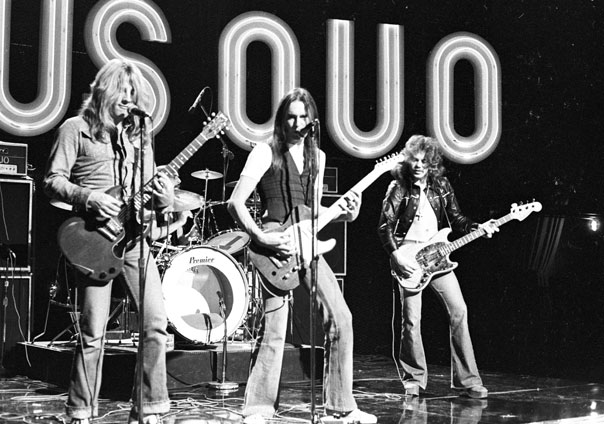
Status Quo. The Quo. Just ‘Quo’. Hated, adored, never ignored… Or is that Manchester Utd? (The single that they released with Status Quo will not be coming anywhere near this Top 10, rest assured…)
Usually with my Top 10s I include any single released, and charted, by an act in the UK. Except, Quo have been around since 1962, charting since 1968. They’ve released a hundred singles over the past fifty-five years! For them, then, I’m only counting singles that made the Top 20.
Where to begin? Maybe some facts and figures. Status Quo have 400 weeks on the singles chart (but only one week at #1!), 500 on the albums, and have played Wembley Arena and on Top of the Pops more than any other act. Speaking of Top of the Pops…
10. ‘Jam Side Down’, reached #17 in 2002
Disclaimer: I’m not really including this as Status Quo’s 10th best single. I include it as I have very clear memories of watching TOTP in a friend’s bedroom – Wiki tells me it was the 16th August 2002 – and sixteen year old me being amazed that Status Quo were still on it. In the Top 20. Look at them! They were old men! The tune is pretty catchy, with that trademark Quo chug, and the lyrics silly enough: My bread keeps landin’ jam side down, Say you’ll be there to spread love around… Also on TOTP that evening were Darius Danesh, the legendary Bowling for Soup and an up and coming act called Coldplay. Wonder what happened to them?
9. ‘Down the Dustpipe’, reached #12 in 1970
Here they are looking a bit fresher-faced. This is perhaps the purest slice of Quo in this countdown. A two-minute blast of raw boogie-woogie, and the first hit to feature their trademark sound… which was still coming through loud and clear on Top of the Pops thirty-two years later!
8. ‘The Anniversary Waltz Part 1’, reached #2 in 1990
Status Quo do Jive Bunny. There are days when I think this might be the best piece of music ever recorded… And then there are days when I see sense. Quo lost their way a bit in the late-eighties, but still kept having those hits. And there is something about them doing a medley of old rock ‘n’ roll covers – ‘Lucille’, ‘No Particular Place to Go’, ‘Great Balls of Fire’ and more – that ticks a box for me. I love all their covers, ‘Mess of Blues’, ‘Somethin’ Bout You Baby I Like’ et al, but couldn’t in good conscience feature any more of them. Just think… This hot mess of a record came dangerously close to being their 2nd ever #1 single!
7. ‘Marguerita Time’, reached #3 in 1984
A complete cheese-fest that only Francis Rossi liked. Apparently it contributed to bassist Alan Lancaster quitting the band the following year! Yes, it is a million miles from the hard-rocking Quo of the seventies. Yes, there is a ropey synth-riff. Yes, it features actual yodelling. But there is not a week goes by when the lyric: Let’s have a drink, It’s Marguerita time… doesn’t pop into my head, usually around 5pm on a Friday.
6. ‘Again and Again’, reached #13 in 1978
Not one of their biggest or better-known hits, but I love the bluesy riff in this one. Plus, the chorus is peak Quo. Chugging guitars… Again Again Again Again Again Again Again Again, Why don’t do you do it, Why don’t you do it again…? Who said they were a limited and repetitive band…?
5. ‘Ice in the Sun’, reached #8 in 1968
Released as The Status Quo, when they were still a very sixties psychedelic rock act, this is the first Quo song I became aware of as a very little lad. It was on a ’60s Best Of’ cassette that had heavy rotation in my parents’ mustard yellow Ford Escort. It’s a very busy song, with lots of effects and, looking back, some fairly trippy lyrics. ‘Pictures of Matchstick Men’ is probably the better-known of their two sixties hits, but I’ve always liked this one more. Two interesting facts: ‘Ice in the Sun’ was co-written by rock ‘n’ roller Marty Wilde, and it was the Quo’s final hit in the USA!
To the Top 4, and it’s the big seventies hits… but in what order?
4. ‘Down Down’, reached #1 in 1975
Their only #1 single, but one of their hardest-rocking records. Is it just me, or is there something almost punk-like in the tight, fizzy, riff? The video above has a funky little outro that the single version don’t. Read my original post on it here.
3. ‘Paper Plane’, reached #8 in 1972
Another tight, thrashy rocker. ‘Paper Plane’ gave the band their first Top 10 since the psychedelic sixties, and it set the template for Quo from now until the end of time. Though they wouldn’t always be as frantic as this… I have no idea what the song is about, but I do like how it evolves from riding a butterfly to riding a paper plane to riding a Deutsche car… Possibly the least hippy-sounding hippy anthem ever.
2. ‘Rockin’ All Over the World’, reached #3 in 1977
There are some who might argue that this marks the beginning of the end of Status Quo – less of the hard-rock and more of the boogie-woogie cover versions that they flogged to death in the ’80s. And they may have a point. (Though to be honest, I’ve loved this song since I was wee, and didn’t discover that it was a John Fogerty cover for several decades.) But when a tune is as jubilant as this, who cares? When a tune is able to open Live Aid – see above – and get everyone jumping from the off, then it must be alright.
1. ‘Caroline’, reached #5 in 1973
You might struggle to think of a Status Quo riff (or you might struggle to distinguish one from the other…) Except this one. I love the way the entire first minute of the record is devoted to the riff building, adding guitars, drums and bass. No nonsense, heads down, rock the flip out. ‘Caroline’ is another favourite from my childhood, and is possibly the main reason that, to this day, I can’t shrug off the grip of three-chord, three minute rock ‘n’ roll. There are times in life when nothing but Status Quo will do, and this is their finest moment.





 The UK Number Ones Blog