Remembering Winifred Atwell

In my ‘Remembering’ bits, I like to draw people’s attention back to artists from the dawn of the charts, from posts published long before anyone was actually reading this blog. Back we go, then, to 1954…
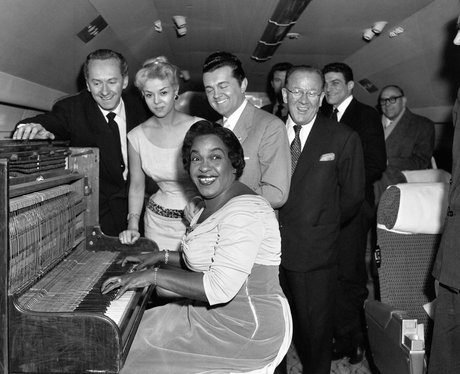
Winifred Atwell is a significant figure in the British charts as, when she scored her first #1 in late ’54 (a Christmas #1 before that was something worth noticing), she became the first black artist to do so. ‘Let’s Have Another Party’ – a medley of old music hall tunes – stayed at the top for five weeks. It is very of its time, but still a fun listen. You can read my original post here.

Some of the melodies in that record date from the the 1920s, so we are really looking a century back in time from our modern-day vantage point. Anyway, Winifred Atwell had arrived in the UK in 1946, from Trinidad via the USA, and had been accepted into the Royal Academy for Music, where she achieved the highest grades possible. She supported herself by playing boogie-woogie tunes in clubs around London, where she was spotted and signed.

Between 1952 and ’59, she scored fourteen Top 20 hits in the UK, many with wonderful titles such as ‘Flirtation Waltz’ and ‘Let’s Have a Ding-Dong!’ (You could say she was a suggestive performer, in that she released no less than five singles beginning with the word ‘Let’s…’) She did the Royal Variety, where she was invited to play privately for the Queen, who requested ‘Roll Out the Barrel’. (Ma’am does love a good knees-up!) On stage she would often start off by playing classical pieces on a grand piano, before switching to a battered old piano bought in a market for fifty shillings – her ‘other’ piano, which was credited on her records and which travelled the world with her – to bash out some ragtime tunes.

Her 2nd number one, ‘The Poor People of Paris’ is interesting – not because it sounds much different from her first – but because it featured as sound engineer a young Joe Meek, who would go on to produce three seminal sixties #1s (and who I did a post on a year or so back.) In the background, hovering above Winny’s piano, is a high-pitched whine which I thought, and pondered in my original post, might have been a Theramin, but which I have since read was probably a musical saw. Either way, you can hear the embryonic beginnings of ‘Telstar’ here, in the video below:

And this live performance, from a couple of years later, has Atwell banging away on her famous ‘other’ piano (I love her winks at the camera…)

By 1958, when this was filmed, her hit-scoring days were almost over – killed stone-dead, as so many artists’ careers were, by rock ‘n’ roll and then the swinging sixties. Still, Atwell remained a popular figure on TV variety shows and in concert. She moved to Australia, where she was a huge star, and where she lived until her death on this day in 1983. Her final performances, quite sweetly, were on the organ in her parish church.

Despite her music now sounding incredibly quaint, and her dressing like your aunt at a wedding, Winifred Atwell’s legacy lives on. Keith Emerson spoke of her influence on his music, while David Bowie also reminisced about hearing her rags on the radio as a boy. But the biggest example has to be Sir Elton John, who cites Atwell as one of the main reasons behind him wanting to learn piano.

Winifred Atwell, 27th February 1914 – 28th February 1983

45. ‘The Poor People of Paris’, by Winifred Atwell

winifred-atwell-the-poor-people-of-paris-decca-78-s

The Poor People of Paris, by Winifred Atwell (her 2nd of two #1s)

3 weeks, from 13th April to 4th May 1956

Listening to a recording of Winifred Atwell playing the piano, I can’t help but picture her smiling. She must never have stopped smiling. Her 2nd #1, just like her first, is a spectacularly perky piece of music.

Unlike her first chart-topper, however, this isn’t a medley. It’s the one tune, blasted through in barely two minutes. It wouldn’t have felt out of place as one of the songs on ‘Let’s Have Another Party’, though. And by that I mean that it sounds exactly the same. The same ragtime style, the same boogie-woogie piano, and the same frenetic pace. As jaunty as both songs have been, I won’t be rushing to try out her Greatest Hits… I can guess what it will sound like.

Actually, there is one little moment of note here, musically. Midway through, as Atwell returns for a second run-through of the melody, a strange sound begins playing over her piano. It sounds like it could be an extremely high voice – a super-soprano, maybe – or someone whistling. Or that weird box (a Theremin, or a Moog synthesiser?) that’s used to make sound effects in Sci-Fi B movies. To me it’s a very sixties kind of sound, and I’m surprised to hear it popping up on a chart-topper this early – if that indeed is what it is. I’ve had a quick look online, but can find no answer to what the sound is…

c79de306b5573c71087ddd8fc38cd7fe

In lieu of writing any more about this record (Miss Atwell certainly got it over with in a manner that suggests she was bursting for the toilet, so we’ll keep it similarly brief) let’s look at the song in general. ‘The Poor People of Paris’ is a French song – quel surprise – recorded most famously by Edith Piaf as ‘La Goulante du Pauvre Jean.’ When it came time for the track to be adapted into English the man who did so misheard the ‘Jean’ from the French title as ‘gens’: hence the poor people of Paris. Tsk tsk. Us Anglophones and our terrible attempts at French, eh? He needn’t have bothered with his adaptation either, really, as pretty much everybody after Madame Piaf recorded the song as an instrumental.

I am glad that we’re seeing Winifred Atwell here again, don’t get me wrong. That a black woman could score not one but TWO #1s, and a score of other hits, at this time remains impressive. But the first time was always going to be the more significant and the choice of songs for the ‘Let’s Have Another Party’ medley made it very interesting. This record, however, just feels a little throwaway. Atwell’s legacy lives on in much more recent chart-topping singles though, as she was a big influence, apparently, in Elton John learning the piano.

On a final note… Do any other British chart-toppers include a capital city in their title? There must be one but – and I’m doing this completely off the top of my head here – I can’t think of any. All I can get is ‘New York, New York’ (neither a #1, nor a capital city), ‘London’s Calling’ (capital city – yes, #1 hit – no) and, um, Berlin. The band. You know, from ‘Top Gun’. Do comment if you can do any better than me on this…

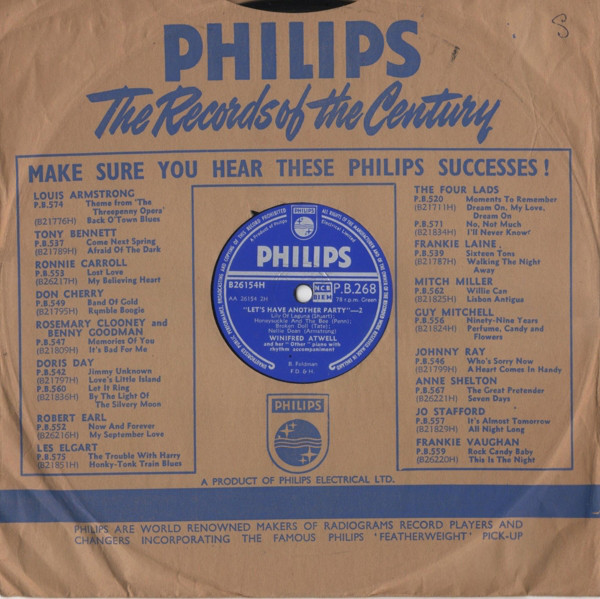
26. ‘Let’s Have Another Party’, by Winifred Atwell

R-5006820-1381952789-2495.jpeg

Let’s Have Another Party, by Winifred Atwell (her first of two #1s)

5 weeks, from 3rd Dec. 1954 to 7th Jan. 1955

I wrote in the intro to my last post that Rosemary Clooney was finally getting our pulses racing – or our toes tapping, at least – and here comes Winifred Atwell to keep up the momentum.

It’s another piano-led song. Well, I say ‘piano-led’; it’s nothing but piano. Winnie and her piano, bashing out a selection of boogie-woogie and ragtime standards in extremely short order. According to Wikipedia we are getting classics such as ‘Broken Doll’, ‘Lily of Laguna’ and the ‘Sheik of Araby’ served up with a verse here, a snatch of chorus there, then on to the next one. I don’t recognise any of the featured tunes – though I’m pretty sure one of them was played by an ice-cream van in days of childhood yore.

It’s jaunty enough, but the effect of squeezing so many different tunes into a couple of minutes means it’s a bit of an odd listen. They’re all played in the same ragtime tempo, so there are no segues: it’s straight from one song into another with no time to draw breath, before we screech to a halt with dum-didley-dum-dum… dum-dum. But hey, it’s the first medley to top the charts, and off the top of my head, I’m not sure if there will be another one until Jive Bunny in thirty-five years’ time. On Spotify, the track is listed as having a Part I and Part II, the former being all of these old hits strung together while the latter is a much-more sedate number, even featuring a bit of guitar. I think, though I’m unable to confirm, that only the first part counts as the record that hit #1. Maybe Part II was the B-side.

1954-winifred-atwell-lets-have-another-party-1353313393-view-0

Anyway, all of this nonsense about which part is blah blah blah pales wildly into insignificance when it is revealed that Ms. Atwell was… black! Born in Trinidad & Tobago, before moving to the States and then to London, she becomes, a little over two years into their existence, the first black artist to hit the top of the charts. It’s a big moment, and worth taking a moment to reflect on this happening at a time when, say, landlords could stick a ‘No Blacks’ sign in their windows with impunity and, in the USA at least, Winifred Atwell wouldn’t have been allowed on the same public transport as her fellow chart-toppers. Just because this is the frothiest of throw-away records shouldn’t render it any less significant.

In fact, it’s almost ironic that she achieved this historic landmark with a medley full of old music-hall hits. The sort of hits that were big in even less enlightened times. The sort that might have been sung by men in black-face, to howls of laughter (seriously, Google ‘Lily of Laguna’ to see just what kind of song it is…) In a way, she is reclaiming them, and making them popular on her own terms.

And with that, I’ll descend from my high-horse, and conclude by saying that we will be hearing from Winfred Atwell again soon. She was huge in the early to mid-1950s (played for the Queen, didn’t you know!), and definitely seemed to have a winning formula. Hey, if it ain’t broke… ‘Let’s Have Another Party’ was the follow-up (somewhat inevitably) to ‘Let’s Have a Party’, and was followed up by another medley, the wonderfully titled ‘Let’s Have a Ding-Dong’. All good, (very) old-fashioned fun!