I have to admit my heart sinks each time I see an EP coming along. It’s hard enough writing about double-‘A’s (in fact, it can be hard writing about some of the standalone number ones…), but when it’s four songs to get through? Cancel my three o’clock…
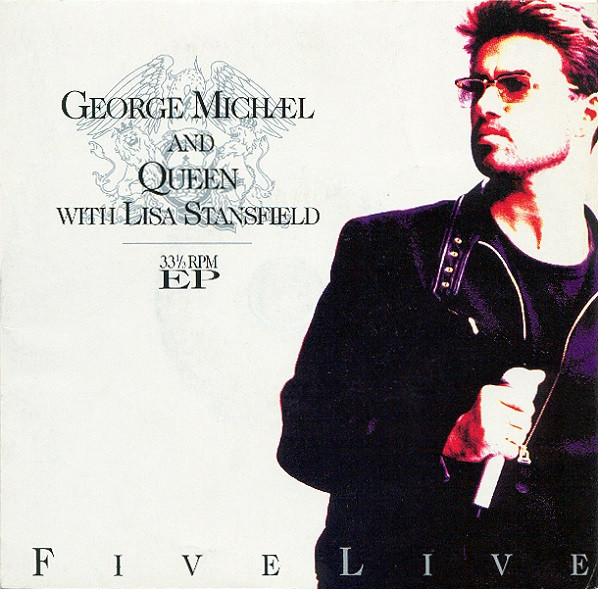
Five Live E.P., by George Michael (his 5th of seven #1s) & Queen (their 5th of six #1s) with Lisa Stansfield (her 2nd and final #1)
3 weeks, from 25th April – 16th May 1993
Luckily for me, the final EP to top the British singles chart has five whole tracks to get through! Five live tracks (hence the name) by George Michael, with assistance from Queen on two of them, and Lisa Stansfield on one. Let’s not tackle them in order, but take the two Queen covers first, recorded at the famous Freddie Mercury Tribute Concert a year earlier.
First up, George has a good old crack at ‘Somebody to Love’. It’s a thankless task, trying to do Freddie Mercury, singing one of his signature songs. But GM gives it a bloody good go. It might be the most impressive vocal performance of all seven of his solo #1s, especially given that it was recorded live. It’s a straightforward cover, but a decent one. And it takes to number one a Queen song that should, like many of their post-Bo Rap singles, have got there first time around. One wonders if this was where Brian May got the idea to start touring again, eventually, with the likes of Paul Rodgers and Adam Lambert.
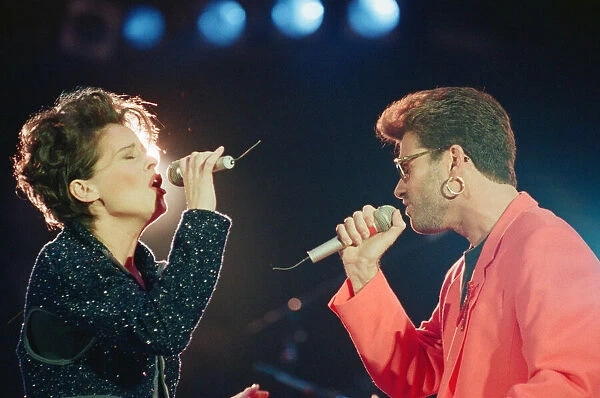
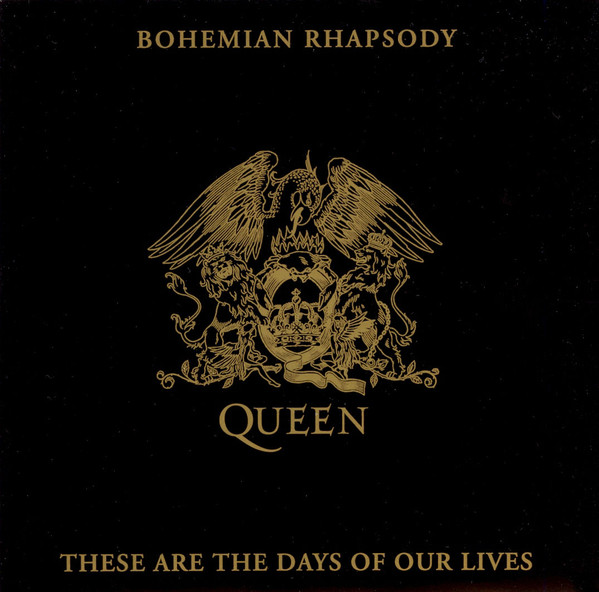
The other Queen cover is ‘These Are the Days of Our Lives’, the track that had made #1 in the immediate wake of Mercury’s death. George is joined by Lisa Stansfield, who he welcomes on stage remarking that she hasn’t any hoover or curlers (presumably referring to her performance of ‘I Want to Break Free’ earlier that night, and not just being sexist…) Again it’s fine, excellently sung – particularly by Stansfield, who didn’t really get to show off her vocal chops on ‘All Around the World’. I don’t imagine it was easy going on stage with George Michael in full flow and holding your own, but she manages. Yet this track isn’t as enjoyable, because a) it was #1 barely a year before and b) it’s not as good as ‘Somebody to Love’ in the first place.
The three other tracks are George Michael solo efforts, recorded in March 1991, again at Wembley (from the same tour that gave us his ‘Don’t Let the Sun Go Down on Me’ duet with Elton John). According to the records, he covered both Adamski’s ‘Killer’ and The Temptations’ ‘Papa Was a Rolling Stone’, but both tracks are hard to, well, track down. Luckily on the British version of the EP he used a shortened, medley version, and again it’s… OK. You’d need a good ear to hear these tracks as a medley, but it works.
However, I refer you back to my comments on Michael’s earlier live #1: live versions being rarely better than the originals and, unless you were actually at the concert, the crowd noises are little more than a distraction. It’s like modern-day shaky camera phone footage, but better produced. Still it was for charity, which is always good, benefiting the Mercury Phoenix Trust, an AIDS fund set up by the remaining members of Queen, their manager Jim Beach, and Mercury’s former partner Mary Austin.
Did we need a fifth track though, making this the longest record to ever make #1 (a milestone that is now almost impossible to break)? Not really. This is where we tip into real self-indulgence, something that George Michael was always prone to, with a cover of ‘Calling You’, originally recorded by soul singer Jevetta Steele for the film ‘Bagdad Café’. I hadn’t heard of it, although the crowd’s reaction suggests that some of them had, at least. And in fairness it did win the Best Original Song Oscar for 1988. The vocals are amazing, from both George and his backing singers, especially again considering it was recorded live. But… It does go on. It unfolds at a snail’s pace, over five minutes. My patience is well and truly tried.
The history of EPs – longer than singles but shorter than LPs – on the UK singles chart is hard to pin down. In the sixties, their heyday, they sold very well and had their own chart. Between the 70s and 90s they fell out of fashion, but could chart alongside the singles. We’ve had three earlier EP #1s, from Erasure, The Specials and Demis Roussos. ‘Five Live’ was the last one to make the top, and maybe this sprawling beast of a record helped to kill them off. Nowadays the closest we’ve got to an EP is a Maxi-CD, or a digital bundle, but since the download/streaming era individual tracks can simply chart in their own right. The same fate has also befallen the double-‘A’ record, though we’ve still got a few more of them to come before then…

 The UK Number Ones Blog