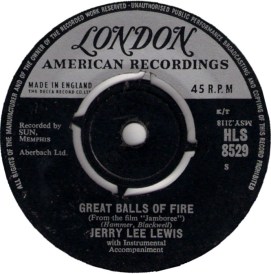
66. ‘Great Balls of Fire’, by Jerry Lee Lewis

jerry-lee-lewis-great-balls-of-fire-1957

Great Balls of Fire, by Jerry Lee Lewis (his 1st and only #1)

2 weeks, from 10th – 24th January 1958

My usual writing process for this blog – in case you’ve ever found yourself wondering – is to preview the next song after I finish writing a post. I listen once, take notes and can thus get straight into writing when I return. Except, upon lining ‘Great Balls of Fire’ up in Spotify and pressing play, my ability to take notes suddenly disappeared. I felt frozen, tied to the tracks, zapped by a Taser… This record seriously impairs your ability to think.

And I mean that in the best way possible. It’s not that it’s dumb, or monotonous, or anything like that. It’s just an absolute blitz, an assault on the senses, a two-minute blast which takes rock ‘n’ roll up another notch. I think everyone’s pretty familiar with the opening salvo:

You shake my nerves and you rattle my brain, Too much love drives a man insane, You broke my will, But what a thrill, Goodness Gracious Great Balls of Fire…!

Jerry Lee then sets off on what is basically GBH of a piano – he stabs, he pounds, he slides his fingers down the keys (a ‘glissando’, apparently, though that sounds far too delicate a term for the noises made here). He goes from high to low seemingly at random – though obviously not ‘at random’, you know what I mean – poking and prodding away. You hope he at least bought the piano a drink afterwards.

I mentioned in my post about The Cricket’s ‘That’ll Be the Day’ that we were entering a new phase in rock ‘n’ roll, one in which the kids were taking centre stage away from oldies like Guy Mitchell and Johnnie Ray. This record’s arrival at the top of the chart confirms it. Ol’ Johnnie may have dialled up the raunch on the wonderful ‘Such a Night’, but even that pales in comparison with ‘Great Balls…’ Lewis doesn’t just make the old pre-rock stars sound dated; this makes 1st generation rock ‘n’ roll, ‘Rock Around the Clock’ for example, sound slow and babyish. And it is an absolute palate cleanser – the tangiest of sorbets – after the schmaltzy ‘Mary’s Boy Child’ which preceded it!

Is this a lyrically shocking record? There are a few choice lines: Kiss me baby – Mmmh, feels good…! I wants to love you like a lover should…! C’mon baby, you drive me crazy! Not truly top-shelf stuff, but we are still in January 1958. No, actually I think the most outrageous thing about this record is the piano-playing. We get to the solo and it is an all-out attack – you can really picture Lewis standing hunched over the keys, as he did so famously, thumping and sweating away. It’s great to have both a completely piano-led rock ‘n’ roll number, as 1957 was a bit guitar heavy, and to tick another ‘Legend of Rock’ off our list. ‘The Killer’ won’t be back at the top of the charts again. In fact, he would only return to the UK Top Ten on two occasions following this. His career stuttered when he married his thirteen-year-old cousin (marrying thirteen-year-olds will do that to a career…), but he is still a-hoppin and a-bobbin to this day, aged eighty-two.

jerryleelewis22

Unlike Elvis and Buddy Holly, Lewis is not someone whose back-catalogue I’m terribly familiar with. I first truly became aware of ‘Great Balls of Fire’, as most people of my age surely did, through that scene from ‘Top Gun’ (Take me to bed or lose me forever!). Though I actually danced on stage to a ‘version’ of this song in a school play long before that – when I was but ten years old. The song was really a pastiche of loads of different rock ‘n’ roll standards, called ‘Surfin’ The Web’, but I’m sure I remember the line: ‘You shake my mouse and you rattle my keys…’ (It was the mid-nineties, when computers were still enough of a novelty that you could write comedic songs about them). I played a character called Rocky Rom: a doll competing against lots of other dolls for a boy’s attention. Rocky was a total brat, but he was the toy du jour, and quite confident of getting chosen. He didn’t, obviously. A tatty old teddy bear with one eye got the pick – it’s who you are inside that counts, kids.

A song truly has entered the public consciousness, you’d have to say, when it’s getting ripped off for primary school plays forty-odd years later.

Recap: #31 – #60

And so, we should take a moment, I suppose, to pause and recap. To breathe. We’re sixty number ones in by now, and well into the rock ‘n’ roll era.

One thing we should note is that the first thirty #1s came over the course of two years and five months; while the most recent thirty have all come in just under two years. The turnover of number one singles is speeding up slightly. More change at the top of the charts, I suspect – rightly or wrongly – is a symptom of younger people buying records. Younger people want new things, go off older things quickly, and want their fingers on the pulse of what’s cool and hip and happening. Older people don’t mind being the last to discover a song, one that’s already been out for months.

And going by the most recent run of #1 singles, as I mentioned in my last post, the kids are finally shaping what tops the charts. Gone are the days when Vera Lynn and David Whitfield were getting there (and staying there for weeks and weeks on end) causing you to wonder if anybody under fifty was actually listening to music.

The last thirty records have certainly been a mixed lot – a lot more mixed than the thirty that preceded them… ‘eclectic’ would be the word I’d choose if pressed. We’ve veered from mambos, to tangoes; from Country ballads to film scores (lots of film scores, actually); from the birth of the teenager to the first whiff of doo-wop; from big band through to a healthy dollop of rock ‘n’ roll. I’ve also enjoyed listening to this thirty much more than I did the previous.

All of which means I’m finding it hard to find a way into this recap… Maybe this will be the way as we mine through chart history. Sometimes you’ll strike a seam and one particular style of music will gush forth: Pre-Rock in the early fifties, Merseybeat in the mid-sixties, Disco in the late seventies and Bubblegum Pop in the late nineties. But that’s pure speculation. There is, however, a definite feeling that the shackles are off, that people want a bit of zip and swagger in their music, and that not everything needs to be taken super seriously. The long-awaited demise of the THIS IS THE END OF THE SONG!!! style of concluding a hit single is perhaps the most telling indicator of this. Artists are free to fade, to cut it short… to just stop their songs without signposting it from a mile off!

And so the handful of old-fashioned songs that have still made it to the top of the charts recently have really stood out as relics. ‘No Other Love’ by Ronnie Hilton, Dickie Valentine’s ‘Christmas Alphabet’ and Jimmy Young’s version of ‘Unchained Melody’ all fall into this category. Even Doris Day’s ‘Que Sera Sera’ sounded a bit naff, though it’s an undeniable classic.

Then there have been the songs – ballads the lot of them – that have combined the old-fashioned, earnest, lovelorn approach with a hint, the merest whiff, of rock ‘n’ roll. Tab Hunter’s ‘Young Love’, Pat Boone’s ‘I’ll Be Home’ and, worst of all, ‘It’s Almost Tomorrow’ by The Dream Weavers. It is to this latter disc that I bestow the honour of this recap’s ‘Meh’ Award, for being the most forgettable of the last thirty.

I also must choose a ‘WTAF’ Award winner – for the record that comes out of nowhere and smacks you around the chops with its weirdness. I did briefly consider Kay Starr’s ‘Rock and Roll Waltz’, for it’s odd juxtaposition of rock ‘n’ roll lyrics to a, well, waltz. But I quite liked that – it was cute. No, there can only be one winner this time… Take a bow, Anne Shelton for your military-march rendition of ‘Lay Down Your Arms’, performed with all the grace and subtlety of a middle-aged aunt at half past Hogmanay (not that that’s necessarily a bad thing, but still.)

Before we get onto the best and the worst, mention should be made of the fact that even British stars are now rock and rolling with the best of them. In the previous recap I pointed out that all the fun, all the flirty and saucy, the cool and the catchy records were by Americans while the staid and stuffy ones were by the Brits. Well, what with Tommy Steele, Lonnie Donegan and Alma Cogan, the Brits have well and truly caught up, if not taken over. Which fills you with pride, don’t it? Men aren’t hanging around all doe-eyed either – a la Eddie Fisher and David Whitfield – pining for their lost loves no more.

OK, so. The Worst. It’s hard, this time. There really haven’t been that many terrible records. In the first recap I could have gladly chosen five! Let’s see… there was Eddie Calvert’s repressed rendition of ‘Cherry Pink and Apple Blossom White’, which paled horrifically in comparison to Perez Prado’s cover (which will feature in my ‘Best Of’ very soon, don’t worry). There was Jimmy Young’s equally repressed version of ‘Unchained Melody’ too. But these two records are saved by the fact that they are, at heart, good songs. Given better treatment they can scrub up into something wonderful. Nope: the worst of chart-toppers 31 through 60 is… ‘The Man From Laramie’, again by Jimmy Young (sorry Jimmy, I’m clearly still not over those long childhood car-journeys) for being stiff, cheesy and, worst of all, unconvincing. That it was a hit single at all seems strange; that it was a month-long number one seems bizarre.

And the best…? Honourable mentions for the seminal ‘Rock Around the Clock’, the swaying ‘A Woman in Love’, for the sherbet-dib-dab-in-pop-song-form that was ‘Rock-A-Billy’ and the tortured rasp of ‘Just Walkin’ in the Rain’. But my top three are – and Goddam it’s been hard to separate them – ‘Dreamboat’, by Alma Cogan, ‘Why Do Fools Fall in Love’, by Frankie Lymon & The Teenagers and ‘Cherry Pink and Apple Blossom White’ by Perez ‘Prez’ Prado and His Orchestra. ‘Dreamboat’ and ‘Why Do Fools…’ are perfect expressions of the perfect pop song BUT I was very familiar with both songs prior to starting this blog. I was aware of their brilliance; they didn’t take me by surprise. So… the award must go to ‘Prez’ Prado, for waking the UK up in the spring of ’55 and recording by far the sexiest record we’ve heard yet. Huh! Hah! Ooh!

In case you’ve lost track, these are our award winners thus far:

The ‘Meh’ Award for Forgetability: 1. ‘Hold My Hand’, by Don Cornell. 2. ‘It’s Almost Tomorrow’, by The Dream Weavers.

The ‘WTAF’ Award for Being Interesting if Nothing Else: 1. ‘I See the Moon’, by The Stargazers. 2. ‘Lay Down Your Arms’, by Anne Shelton.

The Very Worst Chart-Toppers: 1. ‘Cara Mia’, by David Whitfield with Mantovani & His Orchestra. 2. ‘The Man From Laramie’, by Jimmy Young.

The Very Best Chart-Toppers: 1. ‘Such a Night’, by Johnnie Ray. 2. ‘Cherry Pink and Apple Blossom White’, by Perez ‘Prez’ Prado & His Orchestra.

I did think that my favourite might have come from that burst of rock ‘n’ roll which characterised the tail-end of the last thirty number ones but, while I love the style of the music, none of them have been utter, outright classics. They’ve all been of a particular style of rock ‘n’ where the voice and lyrics are everything and the other elements that contribute so much to what rock ‘n’ roll is (the drums, the guitar, the attitude) are dialled way back. That will change, I’m sure, as we delve deeper into this first era of rock.

On with the show…

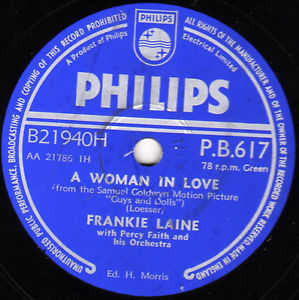
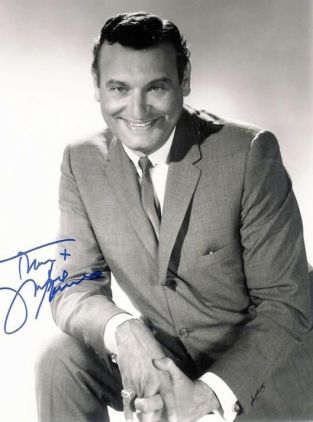
51. ‘A Woman in Love’, by Frankie Laine

s-l300 (2)

A Woman in Love, by Frankie Laine (his 4th and final #1)

4 weeks, from to 19th October to 16th November 1956

Look who’s back!

Almost three years since we last saw him, Frankie Laine is back at the top of the charts for one final hurrah. And it’s not too much of an exaggeration to say that this is something of a re-invention.

I think this is the very first ‘big band’ #1 we’ve seen. It’s from the film version of ‘Guys and Dolls’, and I think it might be a tango, or a foxtrot (I ain’t no dancer). Either way, it begins with a bang, and then it starts swinging. Frankie Laine is a-swingin’.

Your eyes are the eyes of a woman in love, And oh how they give you away… Why try to deny, You’re a woman in love, When I know very well, When I say…

Who is this woman head over heels with? Well, Frankie of course. At least that’s what he thinks: Those eyes are the eyes of a woman in love, And may they gaze ever more into mine…

Contrast these lyrics with Laine’s last chart-topping single from December ’53. ‘Answer Me’ was all about him pleading for a sign that his lover was still, well, in love with him. In ‘A Woman in Love’ he doesn’t need any reassurance, any prayers answered. He knows she’s hot for him. The times they are a-changing.

And then we have one of the best musical interludes that we’ve heard so far in this countdown. The previous chart-toppers haven’t really gone in for solos, but this one does. The whole band gets stuck into a swinging little thirty seconds. There is a lot of swagger in this record. I’m quite enjoying sticking one-word labels on these recent #1s: Pat BooneCrooner, Anne SheltonTwee, Frankie Laine – Swagger! We’ve had an eclectic run of songs hitting the top spot recently, perhaps the most varied run of this countdown so far, but in a way they’ve all been very of their time. Popular music right on the cusp of the rock ‘n’ roll invasion.

The only thing that spoils this record is the finale. Frankie may have re-invented himself, but he still loves a big ending: Crazily, ga-aze, e-ever mo-ore into MIIIIIIINNNNEEE! Every time I hear an ending like that it sounds more and more old-fashioned. I can’t imagine there’ll be many more, though. Surely. But, overall, this is a small complaint. It’s a great song. Laine’s voice is as warm and as listenable as ever. He and Doris Day should have recorded a duet (*edit* they did – ‘Sugarbush’ back in 1952).

06cab955448883c79c5103ab82addae5--arthur-godfrey-singer

And so we bid farewell to perhaps the biggest of all the pre-rock stars. Four number one singles adding up to 32 (thirty-two!) weeks at the top. That’s pretty darn impressive, and leaves him at 5th place in the all-time list behind only…. I’ll give you a few seconds to guess… Elvis, The Beatles, Cliff and The Shadows. And, actually, I’m harping on about this being a ‘re-invention’ and a ‘comeback’ for Laine, but he hadn’t been anywhere. In the three years between his 3rd and 4th #1s he had still racked up a whole pile of top ten hits. He was huge. ‘A Woman in Love’ would, though, be his penultimate top ten single in the UK.

One final thought… This track made Frankie Laine the artist with the most UK #1s at this point. With four. It’s noticeable that we haven’t yet met an artist who has scored, or will even go on to score, more than four. These early charts were a very egalitarian place – songs only got to the top because they were… I don’t want to say ‘good’ because, well… let’s say: ‘universally popular’. The days of super-star idols, of huge fan-base acts whose every release races to the top of the charts – your Take Thats, Westlifes, Spice Girls – are still not upon us. But they will be sooner than you might think, and their arrival has a lot to do with this new-fangled thing called rock ‘n’ roll.

32. ‘Stranger in Paradise’, by Tony Bennett

tony-bennett-stranger-in-paradise-philips-78-s

Stranger in Paradise, by Tony Bennett (his 1st and only #1)

2 weeks, from 13th to 27th May 1955

I don’t know this song, or do I?

The opening melody sounds very familiar – familiar in a film score-ish, symphonic way. The sort of music you might here in a lift, or on a held call. Then the lyrics kick in and I’m not so sure I do know this song after all. But that melody… Are we listening to the first ever sample to top the charts? I didn’t think that was a thing until the late ’80s.

Take my hand, Tony croons. I’m a stranger in paradise… Lost in a wonderland… Starry eyed… The lyrics are all standard-issue mid-fifties. At first. Then things take an interesting turn. The singer is in love, unrequited, and can but stare from afar at his love. He is a mortal, and his love is an angel. He saw her face and ascended out of the common place, into the rare, somewhere in space… He hangs suspended, until he knows his love cares, and that she will answer his fervent prayer. It’s all quite cerebral. Probably the most complex song, lyrically, to have topped the charts so far.

It’s a well-constructed, immaculately sung, beautifully polished record. It’s no throwaway flash in the pan, yet to me it lacks something. Perhaps it just can’t step out from the shadow of the raunchy mambo that preceded it. File it under ‘Pleasant, But Dull’ – a record that I can understand others enjoying, but that I fail to really get myself. But boy, did others enjoy this record back in the spring of 1955! In the week that Mr. Bennett ‘ascended’ to the top, there were no fewer than five other versions of ‘Stranger in Paradise’ in the singles chart (by now a Top 20). The Four Aces, Bing Crosby, Tony Martin and Don Cornell all had a go. Eddie Calvert even parped a version out on his trumpet.

This is something that I fail to grasp about these early charts… While multiple hits by the same artist clogging up the charts (Sheeran! Bieber!) can be frustrating, it is ultimately an indicator of their popularity. But who needs six versions of the same bloody song? It’s not as if one version was ska, one version death metal – I’m confident that the Don Cornell version sounds pretty much like all the others. Anyway, Tony Bennett won the ‘Stranger in Paradise’ race, and it at least meant that a musical legend ticked a UK #1 off his bucket list. A still active legend too. He recently hit ninety, and released his most recent studio album in 2015. The year before that he released a duets album with Lady Gaga. And so, though we are wading through the mists of time (chart-history wise), we have a direct link here to the modern day. That’s quite cool.

1152686

I was about to leave it there, but I still had a nagging feeling that there was more to this song than I had realised. I know that melody – doo doo doo dooby dooby doo – and the lyrics are a little bit too weird to exist only for the benefit of this one hit record. And so it emerges… ‘Stranger in Paradise’ is from the musical ‘Kismet’, which is in turn adapted from the music of 19th Century Russian composer Alexander Borodin. Hence the outré lyrics, hence the familiar melody…

I want to like this song: it’s music for grown-ups. But I also want to read all seven volumes of ‘A la Recherche du Temps Perdu’ and learn Italian. Some things just aren’t going to happen.

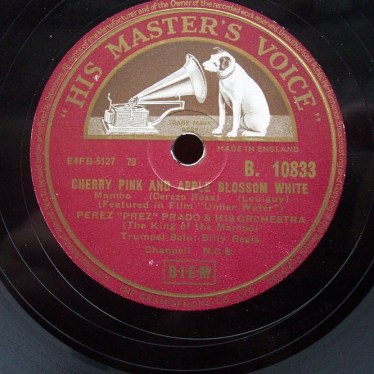
31. ‘Cherry Pink and Apple Blossom White’, by Perez ‘Prez’ Prado & His Orchestra

s-l1000

Cherry Pink and Apple Blossom White, by Perez ‘Prez’ Prado & His Orchestra (his 1st and only #1)

2 weeks, from 29th April to 13th May 1955

What a way to kick off the next thirty!

I’ve given instrumentals a hard time so far in this rundown. The lack of any lyrics creates a barrier, for me, between the song and the listener. You can listen to a Mantovani record and think “Isn’t that a nice melody”, but the fact that there are no words to tie it to a particular feeling or experience in your life means that the record is that step further removed from you. Like a film beautifully acted but in a language you cannot understand.

Having said all that… I’m going to prove myself massively wrong with this post. The fourth instrumental to top the UK Singles chart is also, by far, the sexiest record to top said singles charts. And there are no words. Well – there are no words aside from ‘Huh!’, ‘Hah!’ and ‘Oooh’. Which is a large part of this track’s said sexiness.

Following on from ‘Mambo Italiano’ (which wasn’t really a mambo, but hey), the UK was clearly in some sort of Latin fever in early 1955. Though perhaps not, as a quick glance at the chart for the week Perez ‘Prez’ hit the top shows only one other record that sounds vaguely Latino… A different version of ‘Cherry Pink and Apple Blossom White’ (which we’ll meet very soon at the top of the charts). But, for the purposes of this narrative, let’s say that the UK – finally casting off the shackles of rationing and wartime rubble – wanted to shake some booty and, while perhaps not quite ready for straight up rock ‘n’ roll, turned to some equally raunchy mambo. Further evidence towards my idea that rock ‘n’ roll didn’t just arrive with ‘Rock Around the Clock’ – it was slowly filtering in through Rosemary Clooney’s giggle, Winifred Atwell’s boogie and Johnnie Ray’s yelps. And Perez ‘Prez’ Prado’s trumpet.

Except the trumpet that makes this record isn’t being played by the man on the credits. We’ll get to that in a second. First – this record has perhaps the most intense intro we’ve heard yet. Basically it’s BOOM BOOM BOOM BOOM BOOM BOOM BOOM on a load of trumpets and cymbals, before the rhythm kicks in. The lead trumpet was played by a man called Billy Regis, who absolutely makes this record by drawing out one note in particular over and over again, by sliding it down then up in a manner that sounds a little bit drunk, a little bit woozy, and that, most importantly, would allow a couple in a Southend ballroom to draw that little bit closer for a second, before the main melody jumped back in.

R-582429-1341876426-2330.jpeg

Prado was more of a conductor, I guess, and it is his ‘Huhs’ and ‘Hahs’ that can be heard as he exerts his charges to squeeze every drop of sexiness from their instruments (that sounded ruder than I intended – you know what I mean). There are also some other trumpets (I guess they are trumpets) playing notes so low that it’s almost obscene. I recognise them from Lou Bega’s classic cover of ‘Mambo No.5’, from another golden age of Latin music in the UK charts, which we won’t be getting to for a long, long time. Incidentally, Perez Prado recorded the original version of that song, too.

But the final word has to go to Billy Regis, whose trumpet ends the record. He reimagines the bombastic ending – from which so many earlier chart-toppers have suffered – and it works so much better without lyrics. THIS IS THE END OF THE SONG becomes DOOO DOOO (pause) DOOOOOOOOO, and it again allows Janet and John from Southend to draw close and to feel one another’s bodies, taught and trembling from two and a half minutes of intense mambo.

‘Huh!’ and, indeed, ‘Hah!’

Recap: #1 – #30

A quick recap, as we hit thirty. Thirty number ones in a little under two and a half years. The prehistoric chart toppers.

Perhaps the most impressive thing about these super old #1s has been that very few of them have sounded terrible to my 21st Century ears. With the notable exceptions of David Whitfield (sorry David, but nope) and Vera Lynn (who already was from another era), they haven’t sounded too old-fashioned.

Whether I’d want to listen to that many of them ever again is another matter, however. Our very first chart-topper was the bombastic and ever-so earnest ‘Here in My Heart’, and it kind of set the template for a lot of what followed. Frankie Laine, Eddie Fisher and Tennessee Ernie Ford have spent the best part of a year at the top, in total, with overwrought and slightly silly sounding declarations of love and faithfulness. Even swingin’ Sinatra was guilty with his dull first number one ‘Three Coins in the Fountain’. Still, you have to admire their honesty. They were putting it all out there – hearts on sleeves.

It has actually been the ladies who have brought the glamour and, dare we say, the sexiness to the party. Jo Stafford, Kay Starr and Kitty Kallen all hit the top with fun, laidback slithers of fifties jazz-pop. Recently, Rosemary Clooney has taken it to another level with her breezy giggle and girl-band fervour on ‘This Ole House’ and ‘Mambo Italiano’.

And then there have been the anomalies (for what would a record chart be without those songs that make you go ‘What the actual…?’) Stand up and take a bow ‘I See the Moon’, by the Stargazers, for taking the newly conceived, first time ever, ‘WTAF’ prize.

I’m also going to christen an award for the most forgettable of the past 30 chart toppers – the not terrible but not great – the tracks that I’ve already forgotten existed… The ‘Meh’ Award. Honourable mentions for ‘Softly, Softly’ by Ruby Murray, and ‘Give Me Your Word’, the two most recent number ones, but… Take a bow, Don Cornell, with your perfectly average ‘Hold My Hand’. It really was a… Well, I’ve forgotten what it was. Which is why it won.

I’ve also made a lot of the difference so far between the UK recorded hits and those by US artists. And this is perhaps the most obvious, socio-economic, ‘lets get serious for a minute here’ point to be made from looking at the ‘pre-rock’ charts. That the US stars just had that extra level of glamour, of confidence, of razzmatazz, compared to the stuffier and more staid UK stars. And, yep, in the early ’50s the US was the daddy. Relatively undamaged by war (casualties aside), economy booming, disposable income growing; while Brits were still queuing for butter and nylons, and living in prefab houses. This clearly comes through in the records we’ve heard: compare and contrast Guy Mitchell’s swagger with David Whitfield’s clipped, repressed delivery; compare even the most basic, 1954-by-numbers song from Doris Day with old Vera Lynn (sorry to keep picking on you, Vera…) But, as I noted recently, by early ’55 things were starting to shift: Dickie Valentine and Ruby Murray were two young British singers who hit the top while sounding like Americans.

Anyway, I’ll conclude each of these round-ups by choosing the very best and very worst of the past 30 so…

Let’s start with the worst. I’ve given Vera Lynn a hard enough time, so I won’t choose ‘My Son, My Son’. And the Stargazers first number one ‘Broken Wings’ was pretty morose, but in some ways it was shit in a specifically British way – all Hammond organs and posh vocals – that it was kind of endearing. Nope, the first award for ‘Worst #1’ goes to… ‘Cara Mia’ by David Whitfield and Mantovani’s orchestra, for dragging popular music back to the 1890s. 10 weeks at the top isn’t any sort of vindication, either.

Let’s end on a high, though. The best ones – and there are more good #1s to choose from than there are terrible #1s, believe it or not. Honourable mentions for Perry Como and his ‘papayas’, for ‘I Believe’ as the record-setting juggernaut that it was… But my top 3 are: ‘Mambo Italiano’, by Rosemary Clooney’, for perfectly straddling the line between cool and crazy. ‘Look at that Girl’ by Guy Mitchell, for being the most perfectly conceived pop song that we’ve heard so far (these are ‘pop’ charts after all). And the winner is, the best chart topper from this bunch of early, early hits… *fanfare*… ‘Such a Night’, by Johnnie Ray, for being two minutes of SEX on vinyl (gay sex, no less), and for all the pearls that would have been clutched by concerned mothers when their sons and daughters dropped that record onto their turntables. Here’s to more of that sort of thing in the next 30 UK #1s!

On with the show…

25. ‘This Ole House’, by Rosemary Clooney

R-803732-1160416687.jpeg

This Ole House, by Rosemary Clooney (her first of two #1s)

1 week, from 26th Nov. to 3rd Dec. 1954

Now this is more like it! After an incredibly sedate run of number ones – seriously, nothing since early-May of this year has been enough to get even a toe tapping – we are rocking and a-rolling!

You probably know this song. I certainly knew of it, for a couple of reasons. One is that Shakin’ Stevens revived it in the early ’80s. The other is that I can recall, way back in the mists of time, reading an ‘Oor Wullie’ comic (link provided for non-Scottish readers) in which this song was playing at a party, the words changed to something suitably Scottish (‘This ole house ain’t got no lino’, perhaps). My grandparents kept piles of old ‘Oor Wullie’ annuals lying about, and so have no idea whether it was a new-ish comic strip parodying the Shaky version, or a vintage comic parodying this version. Amazing, isn’t it? Anyone who tries to tell you that the charts don’t matter, and that the songs which make number one don’t form the backdrop to our lives, is very, very wrong. Anyway. You will know this song, I assure you – it’s got a sort of nursery rhyme feel to it and goes a little something like this:

            * raucous piano, or maybe a harpsichord (???) or an organ *

        This ole house once knew his children, This ole house once knew his wife, This ole house was home and comfort as they fought the storms of life, This ole house once rang with laughter, This ole house heard many shouts, Now he trembles in the darkness when the lightnin’ walks about…

Yes, it’s the tale of a lonely old man. Clooney then goes on to detail the repair work that this house needs – the floor, the hinges, the windowpane, even the shingles (I’m pretty confident that this is the only #1 hit to reference shingle). But he needn’t bother, this lonely old man, as he: Ain’t gonna need this house no longer, He’s getting ready to meet the saints…

This is a strange ole song. In a musical landscape of mopey, flowery, boringly chaste love-songs this is a best-selling song about a man sitting in his dilapidated house, waiting for the sweet embrace of death. The piece de resistance is the line: Oh his knees are a-gettin shaky, But he feels no fear or pain, ‘Cause he sees an angel peekin’, Through a broken windowpane…

Like, seriously. WTF? – as they most certainly didn’t say in 1954. I love it. It’s weird, morbid, almost sadistic. It’s quite modern, in a way, the juxtaposition of upbeat music with some with very downbeat, depressing lyrics. It’s interesting, anyway, and a lot better than some of the guff we’ve had to listen to recently. The gulf between this record and ‘My Son, My Son’ – its predecessor at #1 – is what makes a singles chart so interesting. The next chart-topper can always be something completely different.

thisolehouse1

Rosemary Clooney’s voice is standard, mid-1950s American. Polished, glossy, accessible. She even throws in a Westlife style key-change after the twangy piano solo which, if I’m not mistaken, is the first we’ve heard in this rundown. I, for my sins, love a good key-change. And we must mention her brilliantly deep-voiced backing singer – with his ain’t a-gonna need this house no longer, ain’t a-gonna need this house no more – who adds an even more bizarre edge to an already pretty bizarre record.

This was Clooney’s first of two number ones, the second of which will be coming up very shortly indeed. And, I can tell you now, it’s another cracker!

23. ‘Hold My Hand’, by Don Cornell

don-cornell-hold-my-hand-vogue-coral

Hold My Hand, by Don Cornell (his first and only #1)

4 weeks, from 8th Oct to 5th Nov / 1 week, from 19th to 26th Nov 1954 (5 weeks total)

So this is the Kingdom of Heaven? Is this is the sweet promised land? While angels tell of love, don’t break the spell of love. Hold my hand.

Right. Listen. This is the problem with a lot of these early number ones. It’s not that they are too old-fashioned, or too slow, or simply too boring (though plenty of them have been too old-fashioned, too slow and simply too boring) … It’s that most of them take this bizarrely extravagant approach to describing basic romantic feelings.

This is a song about asking someone to hold your hand. And I get that in 1954 there were strict limits on how suggestive you could get with your lyrics but… This is a three-minute extended metaphor explaining how holding someone’s hand can bring forth angels, plant you in the Garden of Eden, bring on the rapture, blah, blah, blah. It doesn’t mean anything.

Musically we’re accompanied by violins and a strumming guitar. I’ll let you know when this changes. And… I’m running out of things to write. Next!

No, that’s a bit harsh. This is Don Cornell’s moment. We won’t be hearing from him again. But, and I’m really sorry to say this Don, you are also part of the problem…

This song has a pretty playful, cheeky lilt to it, written in snappy little couplets. The line: This is the secret of what bliss is… is quite cute when you say it out loud. And at one point ‘portal’ is rhymed with ‘immortal’, which is clever. Guy Mitchell would have made a good job of this song. Sinatra would have given this number a little nod and a wink (it’s a much more Sinatra-y song than ‘Three Coins in the Fountain’) Cornell, though, maintains a firm baritone, and never quite relaxes into the song.

don_cornell

The name Don Cornell sounds like that of a small-time gangster and, going by pictures from the time, he may well have been a (pretty smiley) small-time gangster. The same goes for Al Martino, Perry Como, Frank Sinatra (naturally) … Half the number one singles over the first two years of the UK charts seem to have been recorded by Italian-Americans. In fact, out of the eighteen acts to have topped the charts by November 1954, twelve were American. And I think this is historically significant – we weren’t just importing US-made music; Britain – war-ravaged, austerity-hit, nylon-rationed, Blitz-broken Britain – was importing American escapism in all it’s glitzy, white-teethed, suave glory. We were being sold the American dream, record by record.

https://www.youtube.com/watch?v=5g5OG3r8IkY

22. ‘Three Coins in the Fountain’, by Frank Sinatra

s-l300 (2)

Three Coins in the Fountain, by Frank Sinatra (his first of three #1s)

3 weeks, from 17th Sept to 8th Oct 1954

From a one-hit wonder to a… lots-of-hits wonder?

We’ve flirted with fame so far in this countdown – Doris Day is a household name, Johnnie Ray, Perry Como and Frankie Laine were very big in their day. But this is different. This is Sinatra.

I feel I should give him a fanfare, or something. Maybe emboss this post with a gold border (does WordPress run to such extravagances?) When I scan down my list of Number Ones, certain artists stand out. Artists that I should perhaps put a little more effort into introducing. You know who I mean: Elvis, the Beatles, the Stones, Michael Jackson, Madonna, Busted… The biggies.

But then, these stars don’t need no intro, really. Everyone knows who they are. Frank Sinatra died when I was twelve. His last real chart presence was twenty years before that. His music is old. But still your average Joe off the streets could have a stab at naming three of his hits: you’ve got your ‘My Way’, your ‘New York, New York’, your ‘Fly Me to the Moon’… Your ‘Three Coins in the Fountain’?

Has anyone listened to ‘Three Coins in the Fountain’ since 1954? I certainly wouldn’t have heard it, had it not popped up on this list. And, to be honest, it’s a very low-key first appearance for Ol’ Blue Eyes. It’s not a very Sinatra-y song.

It starts with a flourish of cymbals, which makes it sound as if it’s from a film soundtrack (it was). And then, musically, it’s nothing that we haven’t heard before. Maybe that’s the problem – twenty-two songs in and, with a few notable exceptions (for better or for worse) they’re starting to merge into a gloopy, sentimental mush.

Three coins in the fountain, Each one seeking happiness, Thrown by three hopeful lovers, Which one will the fountain bless?

The song tells the story of three lovelorn young men, chucking coins into the Trevi Fountain. I do like the fact that we get a bit of a story, in amongst the usual trite lines. The line: Three coins in the fountain, Through the ripples, how they shine, is a particularly nice one, painting a picture of a summer’s night in Rome.

Sinatra keeps us in suspense. Who will be the lucky lover? Just one wish will be granted, One heart will wear a Valentine, Make it mine, Make it mine, Make it mine! But we never find out. The song ends on a cliffhanger. It’s probably for the best – keep ’em wanting more, eh?

0337_05071

Personally, I don’t think this song suits Sinatra’s voice. When you think of Sinatra you think of the laid-back delivery, the knowing eye, the glass of brandy in hand… This number is a little too earnest, and I don’t think he’s giving it his all. The line: Which one will the fountain bless? is particularly awkward. This was a strange time for Sinatra, career-wise: he was no longer a teen-idol but hadn’t yet gone down the Vegas residency, Rat-Pack road. ‘Three Coins in the Fountain’ encapsulates this strange mid-career limbo quite well.

And that’s it, really. I feel I should write more… This is Frank Sinatra, for God’s sake. But it’s a lacklustre song. Which begs the question: why was this one of only three chart toppers for the guy? Hitting the top-spot is often a question of timing, I suppose, and plenty of other acts have also reached #1 with efforts far from their best.

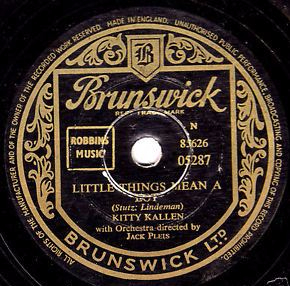
21. ‘Little Things Mean a Lot’, by Kitty Kallen

s-l300-1.jpg

Little Things Mean a Lot, by Kitty Kallen (her first and only #1)

1 week, from 10th to 17th Sept 1954

And so we arrive at mid-September, eight and a half months into 1954, and we have had but five number ones this year. In my capacity as a fully qualified chart geek, I have the means by which to compare and contrast this with other years. And, for example, by this point in 1953 we had had 10 #1s. By the 10th September 2000 (the year with the highest turnover of chart toppers in chart history) we’d had an unbelievable 30 #1s! And in 2017 we were back down to 10 #1s. Interesting? I’ll let you be the judge of that.

Anyway, the 6th number one of 1954 takes a low-key approach. Kitty Kallen has a dusky voice, and little in the way of accompaniment aside from a – thankfully understated – violin and something that tinkles (a timpani?). Oh, and there’s a trumpet. Still, though, this is a nice respite after the fervour of ‘Such a Night’ and the mini-operetta that was ‘Cara Mia’.

Lyrically, the idea is that small signs of affection are more important than grand gestures: Give me you arm as we cross the street… Call me at six on the dot… Touch my hair, as you pass my chair… Little things mean a lot… This girl don’t need diamonds or pearls, champagne, sables or such. No, Sir. Cos honestly honey, they just cost money. And since we’ve had song after song full of strangely metaphorical approaches to describing love – seeing little birds, talking to stars – as well as the usual soppy stuff – hearts melting, longing or breaking – this is an interesting detour. It’s cute and knowing, and quite ahead of its time. Modern love songs go in for a lot of the ‘savouring the little moments’ kind of stuff: sitting on the grass, drinking wine out the bottle, holding your loved one’s hair back as they puke (c.f. James Arthur, 2016). Perhaps we can class this record as ahead of its time.

Kitty Kallen 1944 Metronome Archive Photos

The only time that Kallen gets serious is for what is as close as the song gets to a chorus: Give me your hand when I’ve lost the way, Give me a shoulder to cry on… And she is guilty of singing these lines in a THIS IS THE IMPORTANT BIT SO I’M SINGING A BIT LOUDER way that literally everyone seems to be doing in 1954. But at least the ending is sedate: repeat the title, bit of trumpet, fade. Nice

And so that was Kitty Kallen’s first and only UK Number One. I like that – one song, one week. Done. Your name goes down in history. Had she stalled at #2 – perfectly respectable, that, a number two hit – I might never have heard of her. Not that she’s the first – we’ve already covered Jo Stafford’s and Lita Roza’s solitary weeks at the summit – and she won’t be the last. But, unlike Stafford and Roza, this was Kallen’s only ever UK hit. Ladies and Gentlemen, we have our first one-hit wonder. She was much more popular in the US, this being her fourth number one over there. It was her last, though. ‘Little Things Mean a Lot’ seems to have been pretty much it for Miss Kallen. And it almost goes without saying by this point that she died at the grand old age of ninety-six, just two years ago.