In my ‘Remembering’ bits, I like to draw people’s attention back to artists from the dawn of the charts, from posts published long before anyone was actually reading this blog. Back we go, then, to 1954…
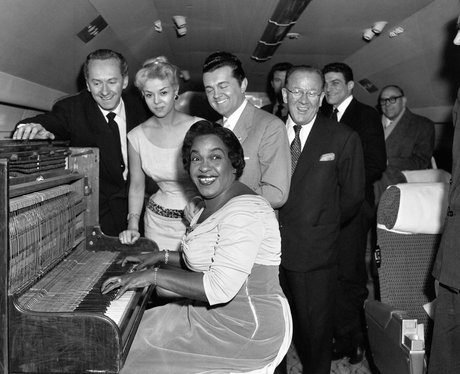
Winifred Atwell is a significant figure in the British charts as, when she scored her first #1 in late ’54 (a Christmas #1 before that was something worth noticing), she became the first black artist to do so. ‘Let’s Have Another Party’ – a medley of old music hall tunes – stayed at the top for five weeks. It is very of its time, but still a fun listen. You can read my original post here.
Some of the melodies in that record date from the the 1920s, so we are really looking a century back in time from our modern-day vantage point. Anyway, Winifred Atwell had arrived in the UK in 1946, from Trinidad via the USA, and had been accepted into the Royal Academy for Music, where she achieved the highest grades possible. She supported herself by playing boogie-woogie tunes in clubs around London, where she was spotted and signed.
Between 1952 and ’59, she scored fourteen Top 20 hits in the UK, many with wonderful titles such as ‘Flirtation Waltz’ and ‘Let’s Have a Ding-Dong!’ (You could say she was a suggestive performer, in that she released no less than five singles beginning with the word ‘Let’s…’) She did the Royal Variety, where she was invited to play privately for the Queen, who requested ‘Roll Out the Barrel’. (Ma’am does love a good knees-up!) On stage she would often start off by playing classical pieces on a grand piano, before switching to a battered old piano bought in a market for fifty shillings – her ‘other’ piano, which was credited on her records and which travelled the world with her – to bash out some ragtime tunes.

Her 2nd number one, ‘The Poor People of Paris’ is interesting – not because it sounds much different from her first – but because it featured as sound engineer a young Joe Meek, who would go on to produce three seminal sixties #1s (and who I did a post on a year or so back.) In the background, hovering above Winny’s piano, is a high-pitched whine which I thought, and pondered in my original post, might have been a Theramin, but which I have since read was probably a musical saw. Either way, you can hear the embryonic beginnings of ‘Telstar’ here, in the video below:
And this live performance, from a couple of years later, has Atwell banging away on her famous ‘other’ piano (I love her winks at the camera…)
By 1958, when this was filmed, her hit-scoring days were almost over – killed stone-dead, as so many artists’ careers were, by rock ‘n’ roll and then the swinging sixties. Still, Atwell remained a popular figure on TV variety shows and in concert. She moved to Australia, where she was a huge star, and where she lived until her death on this day in 1983. Her final performances, quite sweetly, were on the organ in her parish church.
Despite her music now sounding incredibly quaint, and her dressing like your aunt at a wedding, Winifred Atwell’s legacy lives on. Keith Emerson spoke of her influence on his music, while David Bowie also reminisced about hearing her rags on the radio as a boy. But the biggest example has to be Sir Elton John, who cites Atwell as one of the main reasons behind him wanting to learn piano.

Winifred Atwell, 27th February 1914 – 28th February 1983

 The UK Number Ones Blog