Cover Versions of #1s – Nick Cave & The Villagers

The final two covers for the week, and we’re slowing the pace, ending on a chilled note…

‘The Carnival Is Over’, by Nick Cave & The Bad Seeds – 1986 album track

(Originally a #1 in November 1965, by The Seekers)

I didn’t have much positive to say about The Seekers’ two 1965 #1 singles, the second of which was the dirgey ‘The Carnival Is Over’. But if you want someone to take a dirge, and make it even gloomier, yet make it completely their own, then look no further than Nick Cave. Based on an old Russian folk song, and given some sixties-folk lyrics by Dusty Springfield’s brother Tom, it sold a million for Australia’s biggest band of the decade. Fellow Aussie Cave and his Bad Seeds recorded it for a covers album twenty years later – ‘the song sort of haunted my childhood’, Cave has been quoted as saying. (Until five minutes ago, I had no idea that Boney M had also recorded a version… And I had no idea that Boney M had ever sounded so miserable. Nobody can make this tune sound fun!)

‘The Wonder of You’, by The Villagers – 2017

(Originally a #1 in July 1970, by Elvis Presley)

Despite being described as an ‘indie-folk project’ on their Wikipedia page, and despite it sounding ready made for a Starbucks playlist, I have liked this version of ‘The Wonder of You’ by The Villagers ever since hearing it on the soundtrack to HBO series ‘Big Little Lies’. It is the polar opposite of Elvis’s bombastic version – lo-fi and intimate, with just a hint of old-style rock ‘n’ roll around the edges. In the show, it soundtracks an abusive husband getting flung to his death down a flight of stairs during an Elvis-themed PTA night at a primary school… (I mean, if that description doesn’t make you want to watch something, then I don’t know what will!)

I hope you enjoyed my second annual cover versions week. Normal service will be resumed in a few days, with our 377th chart-topping single.

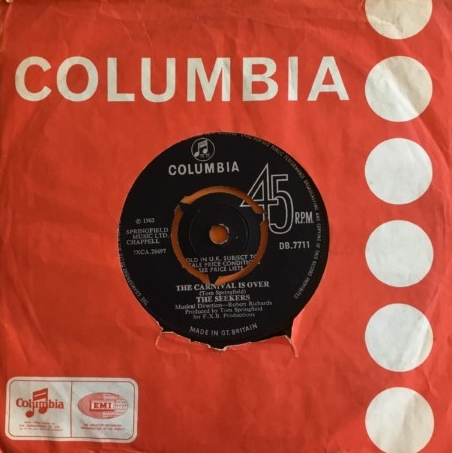
206. ‘The Carnival Is Over’, by The Seekers

Another dose of easy-listening, faux-folk from Australia’s biggest band? (That wasn’t a question – you’re getting it whether you like it or not.)

1965_music_seekers_03

The Carnival Is Over, by The Seekers (their 2nd and final #1)

3 weeks, from 25th November – 16th December 1965

I just about managed to see the positive side of The Seekers’ first number one, ‘I’ll Never Find Another You’, for all it’s tweeness. But I think I’ll have to draw the line here… The term ‘dirge’ has cropped up once or twice in recent entries – The Beatles experimented with it in the background on ‘Ticket to Ride’, while ‘I Got You Babe’, for all its cuteness, was propped up with a pretty flat bass rhythm. ‘The Carnival Is Over’, though, is A Dirge, plain and simple.

The beat plods, the backing vocals are lifeless. You can almost picture the coffin being lowered into the ground. You start wishing they’d just get on with it… Say goodbye, My own true lover, As we sing, A lover’s song, How it breaks it my heart to leave you, Now the carnival is gone… Judith Durham, the lead singer, is once again on fine Sunday school teacher round the campfire form. Don’t get me wrong, she sings it very well; but it’s painfully proper.

It’s a song about two lovers, Pierrot and Columbine. Has Columbine fallen in love with a traveller? A handsome stranger who set up camp for a week or two? It’d have to have been a sailing carnival, thanks to the line about ‘harbour lights’… So maybe not. Or is ‘the carnival’ a metaphor for love, a love that’s no longer? Though the carnival is over, I will love you ‘till I die…

This record follows the same formula as The Seekers’ first #1, in that it was written and produced by Tom (brother of Dusty) Springfield. The melody was borrowed from an old Russian folk song, and once you learn that you think ‘Yes!’, this tune would make complete sense when bellowed out by a sturdy serf, gathering hay on the steppe. Not so much as a hit single in 1965. Yes, yes, yes it’s part of the folk-rock movement that’s become huge this year, but it’s a spectacularly lifeless song. You just want to shake them by the shoulders and tell them to liven it up a bit.

Apparently Springfield was inspired to write the lyrics after seeing the Rio carnival. Which seems hard to believe, as this record doesn’t exactly scream samba and piña coladas on the beach. In the bridge, there is an attempt at livening things up, with a nifty Spanish guitar riff. But that’s it. Plus the bridge also has a line about kisses ‘sweet as wine’, which is a metaphor I’ve never understood, what with most wines not being sweet at all. It should be ‘sweet as sherry’ is all I’m saying.

Scan-from-2019-05-22-04_05_28-PM-2-500x510

And so we plod to a close. That’s that for The Seekers at the top of the UK charts. They would have three further Top 10 singles before splitting in 1968. They’ve reformed twice since then, and still perform to this day, minus Durham who retired in 2013. They were huge in their homeland, and were even voted ‘Australians of the Year’. I can see why, too, what with US and UK acts dominating since the dawn of rock ‘n’ roll, it’s always nice to feel a local connection to a successful artist.

One more thing to say about ‘The Carnival Is Over’ – it was a spectacularly high-selling record. Late 1965 seems to have been a high point for record sales as, after Ken Dodd’s ‘Tears’ had become the 3rd best-selling single of the decade, this disc also did well over a million. At last count it was sitting at No. 30 in the best-sellers of all time list. Not bad for a dirge. I’m clearly in the minority…