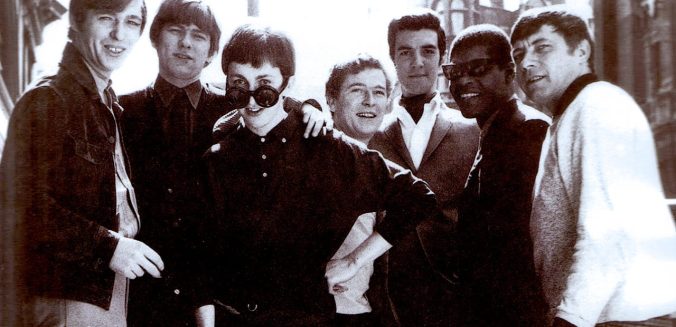
354. ‘When Will I See You Again’, by The Three Degrees

As if to confirm that our last helping of disco-soul – George McCrae’s ‘Rock Your Baby’ – wasn’t a fluke, here’s another slice. Go on, you know you want to…

When Will I See You Again, by The Three Degrees (their 1st and only #1)

2 weeks, from 11th – 25th August 1974

This is an impossibly glitzy record – you can’t help imagine a shimmering disco ball slowly spinning above The Three Degrees as they sing – and, as with our previous #1, it’s supremely glossy. Back in the fifties, I used to write that American singers sounded so polished and mature, so sexy, next to our gurning music hall stars. So it is again. We were dancing like loons to ‘Sugar Baby Love’; they were coolly shimmying to records like this.

Hoooo…. Haaaa… Precious moments…. It’s a reboot of the classic sixties girl-groups – The Shirelles, The Ronettes and, of course, The Supremes. When will I see you again…? Lyrically, this is very close to ‘Will You Still Love Me Tomorrow’, with the singers asking if what’s just passed is the real thing or just a fling. When will we share precious moments…? It’s such a perfect pop song, so well put together, so smooth and silky, that I’m struggling to pick it apart. Maybe it’s one that simply needs listening to, and appreciating, and I can shut up. Post over.

It’s also a record that gets better as it progresses. I like it when lead singer Sheila Ferguson gets insistent: Are we in love, Or just friends… Is this my beginning, Or is this the end…? Enter a funky brass section, on top of the swirling strings, which I feel shouldn’t work but which does, wonderfully.

Apparently Ferguson really didn’t like ‘When Will I See You Again’ when it was first offered to the group. “I thought it was ridiculously insulting to be given such a simple song, and that it took no talent to sing it,” she said later. Not the first, nor the last, example of a singer not knowing a hit song even if it jumped up and bit them on the behind.

I’m amazed at how few big hits The Three Degrees enjoyed in the UK. This was the biggest of just five Top 10s. In the US – and this truly has me flabbergasted – this record reached #2… and then they never had a hit again! I didn’t know much about them, but The Three Degrees just sound like such a classic pop group. I’d have had them up there with the aforementioned sixties girl groups in terms of hit singles.

Still, as I’ve said before, if you’re gonna have a limited number of hits, you better make ‘em good ones. This is definitely a ‘good one’. It is also, by all accounts, one of Prince Charles’s favourite songs – the group performed it for him, in Buckingham Palace, for his thirtieth birthday. The man has taste. The Three Degrees are still a going concern, with one of the ladies whom you can hear on this record: Valerie Holiday. Of the other two, Fayette Pinkney, a founding member of the group, passed away in 2009, and Sheila Ferguson went solo in the ‘80s. There have been fifteen members in total but, for obvious reasons, only three at one time…

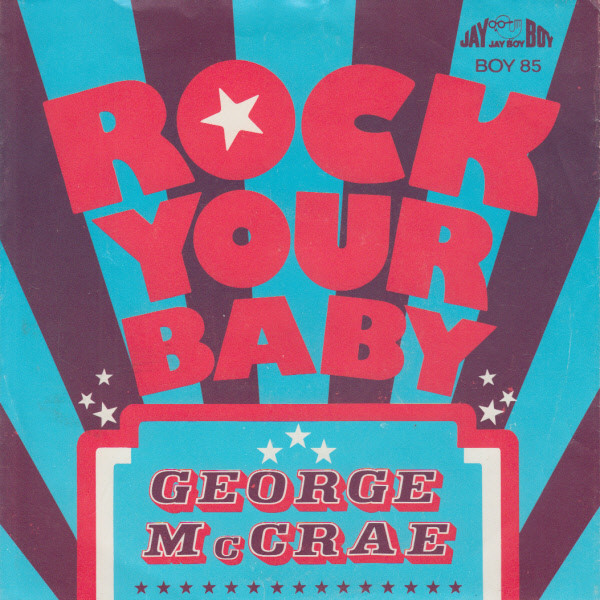
353. ‘Rock Your Baby’, by George McCrae

This next #1 arrives like a fluffy cloud, a soft pillow upon which you might rest your head after a long day. Satin bedsheets. Rose petals scattered. A heavy-breathed Sexy…. Smooth. As silk.

Rock Your Baby, by George McCrae (his 1st and only #1)

3 weeks, from 21st July – 11th August 1974

Woman, Take me in your arms, Rock your baby… The voice sounds as if it’s coming from on high, slightly out of focus, drenched in echo. Is he singing about dancing, or sex? Dancing then sex? There’s nothing to it, Just say you wanna do it… I’d go with sex. Especially with that chucka-chucka rhythm nudging us along, like the soundtrack to a classic, moustaches and chest-hair porno.

There’s not a huge amount to this record. It floats in then floats out. Chilled, funky, and soulful. Kids today would call it a ‘mood’. George McCrae’s voice is honeyed and high-pitched, especially when he reaches for the falsetto at the end of the Now let your lovin’ flow, Real sweet and slow… line. (Ok, there’s no way this song isn’t about sex…)

This is soul with a capital S, the sound that had been dominating US pop music for years, and that had made headway in the UK charts in the late sixties/early seventies, before getting turfed out the way by glam. But it’s back, baby. The backing track existed before the lyrics, recorded by a member of KC and the Sunshine band and using a drum machine when that was a very experimental thing to do. McCrae came along, added his vocals and scored a huge debut hit around the world.

But wait. A. Second. Calling this ‘soul’ isn’t telling the whole picture. ‘Rock Your Baby’ is something else too. One of those watershed moment that come along every so often, when a #1 single points to the future. A five letter future: D. I. S. C. O. The five most sneered upon letters in pop music…?

Not that I’ve got anything against disco. I’m really looking forward to writing posts on some of the decades later, cheesier disco hits. And I’ve nothing against this song. It’s cool, and catchy. Get this track down your headphones this while walking along the street and you won’t be able to stop swaggering. It sounds so much more grown-up, so much more sophisticated, when compared to the year’s earlier chart-toppers from Gary Glitter and – as much as do I love it – Mud. This is a disc your cool older sister would have been listening too while you were still blasting ‘Tiger Feet’.

George McCrae struggled to follow-up this monster hit – it was #1 everywhere – but he’s still alive and still performs, in his mid-seventies. Press play, then, and enjoy the sound of the summer of ’74. As we pass the midway point of the year, popular music gently ticks over into a new era…

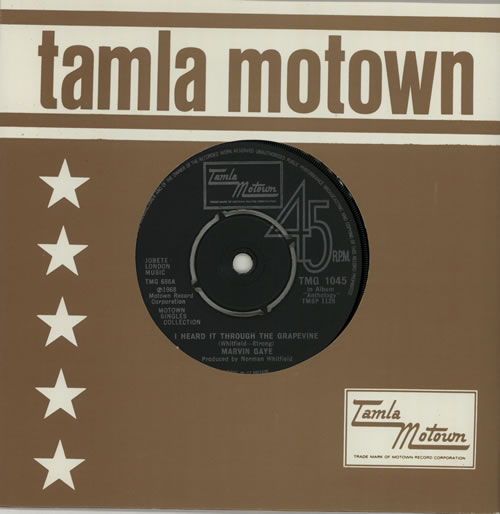
268. ‘I Heard It Through the Grapevine’, by Marvin Gaye

Attention. Attention. We have a stone-cold classic coming right up. Marvin Gaye is here, and he has been hearing things, through the grapevine…

marvin-gaye

I Heard It Through the Grapevine, by Marvin Gaye (his 1st and only #1)

3 weeks, from 26th March – 16th April 1969

Has there been a cooler intro so far? A sexy, slinkingly slow build up, with a tickle of cymbal and a subtle riff: doo-do-do-doo… It’s dripping with attitude. And then Gaye’s voice, a husky falsetto. Ooh, I bet you’re wond’rin how I knew, Bout your plans to make me blue…

The singer has heard second-hand that his girlfriend is about to do the dirty on him. I heard it through the grapevine, Not much longer would you be mine… the backing singers chant, like the gossiping whisperers that have brought the news to him. The premise of the song is kind of flawed – surely the gossip would be that she is cheating on him, not that she’s just planning to – but shhh! Who cares? We’re in Greatest Pop Songs of all time territory here.

What I especially like about this song is that we are unsure how the singer really feels about the situation. Is he sad? (I know a man ain’t supposed to cry, But these tears I can’t keep inside…) Or angry? (It took me by surprise, I must say…) Or just disappointed? (You could have told me yourself, That you love someone else…) Or is he all of these things?

‘I Heard It Through the Grapevine’ is a Motown record, only the 3rd to hit the top of the UK charts, after ‘Baby Love’ and ‘Reach Out I’ll Be There’, and the last one of the 1960s, the decade synonymous with the label’s sound. But, at the same time, it’s a lot subtler than earlier Motown hits – far less bubble-gum. There’s an edge to it. It’s instant, but it’s also layered. I know I write this fairly often, about other huge hits, but it still rings true… This would have been a hit at any time. It transcends time and place.

MARVIN_GAYE_I+HEARD+IT+THROUGH+THE+GRAPEVINE-346057

Or if you want to distil it down to a simple, one-word description: it’s cool. You want to know what cool sounds like? You put ‘I Heard it Through the Grapevine’ on. Marvin Gaye had been a recording artist since the start of the sixties, and a big star in the US for years before this became his biggest hit. In the UK, though, he hadn’t been higher than #16. Following this, he would become a routine visitor to the Top 10, throughout the seventies and early eighties, solo or with either of his favoured duetting partners, Diana Ross and Tammi Terrell. It all culminated in his huge ‘Sexual Healing’ comeback in 1982…

Until he was shot, dead, a year later. By his dad. We’ve met some pretty tragic characters in our journey through the charts so far, but this is up there with the worst of them. His father was a disciplinarian, a Christian minister, and yet a cross-dresser, with a very complicated relationship with his artistic, world famous, and possibly gay, son. Marvin stepped in to break up a confrontation between his parents, and was killed by a shot from the gun he had given his father a few months earlier.

Tragic stuff. And also tragic in its own way is the fact that this is Gaye’s one and only chart-topping single. No ‘It Takes Two’, or ‘What’s Goin’ On’, or the aforementioned ‘Sexual Healing’… Just this. But what a chart-topper it is. If you’re only going to do it once, then do it in style. Meanwhile, ‘Marvin Gaye’ will hit #1 many years from now, as the title of a song. Which I just realised answers a question I posed in my post on ‘Lady Madonna’, about #1s which reference chart-topping artists in their titles… Till then, then…

260. ‘With a Little Help From My Friends’, by Joe Cocker

I recently did a series of posts on cover versions of #1 songs – previous chart-toppers that had been reimagined in different ways by different artists. ‘Different’ being the important word – a good cover version should bring something new to the table. What’s the point in releasing a karaoke version of the original? And while we have had plenty of cover versions hit number one already, this one takes the concept to another level.

Joe Cocker

With a Little Help From My Friends, by Joe Cocker (his 1st and only #1)

1 week, from 6th – 13th November 1968

The Beatles’ version of ‘With a Little Help From My Friends’ had been released the year before, on the ‘Sgt. Pepper’s Lonely Hearts Club’ LP. Joe Cocker, a British blues-rocker who had been around for a few years without enjoying much chart success, took it and made it his own. It’s slower, heavier, longer, downer and dirtier… Re-acquaint yourself with the original here, then settle in for the Cocker treatment.

It begins with a distant organ, as if you were standing outside a church before evensong. It’s an ominous build-up… You’re ready for something to happen. Then wham. Guitar! Proper hard-rock guitar. Hendrix and Clapton kind of guitar. The type of guitar that’s been nowhere near the top of the charts before. It’s bombastic, and outrageous. It makes you want to make devil-horns and punch the air.

The lyrics are the ones you know. What would you do, If I sang out of tune, Would you stand up and walk out on me…? But it sure isn’t Ringo singing it. Cocker’s voice is husky, and soulful. He delivers the lines late, squeezes the words in before the next one comes along. The backing singers, so important in any version of this song, sound like a gospel choir: How do I feel at the end of the day…? Are you sad because you’re on your own?

The best bit is the bridge – the Do you need anybody… bit. The guitars go super heavy and crunchy, like a motorbike revving up. The second time around, especially, when Cocker howls and the backing singers soar and we launch into the final minute of a mini rock-opera. I know we’ve had a lot of soul number ones in recent years – The Small Faces, Chris Farlowe, Long John Baldry and more – but this takes it to the next level.

s-l400

It kind of sounds a bit like a jamming session, or at least a live version, and that really adds something to the song. They captured lightning here. They would never have been able to re-record this exactly the same – it’s too raw, too intense. It lacks the polish of a regular #1 single, but you’re oh so glad that it somehow managed to have its week in the top spot

As I mentioned, it’s another long number one. You wait years for a #1 single that lasts longer than five minutes, then three come along at once. And that’s not all that links this to the previous two #1s. We’ve now had a number one recorded by The Beatles (‘Hey Jude’) replaced by one that was produced by a Beatle (‘Those Were the Days’) replaced in turn by a number one written by The Beatles. In case you’ve lost count, this is the fourth Beatles cover to reach the top in the past five years. They may have been reaching the end of their career as a band, but their grip on the charts wasn’t weakening.

We end in a frenzy of organs and guitars, as Cocker ad-libs over the fade-out. Phew. It’s not a subtle re-interpretation, I will admit, but for me it works. I knew this record by reputation, but it’s been great to give it an in-depth listen. ‘With a Little Help From My Friends’ is a song that will pop up another two times in this countdown, and I don’t think it’s giving too much away to say that neither of the upcoming covers are fit to lick this one’s boots…

Joe Cocker will only have one more Top 10 hit, until the early-eighties when he will record ‘Up Where We Belong’ with Jennifer Warnes for the soundtrack to ‘An Officer and a Gentleman.’ From Sheffield, but sadly no relation to Jarvis Cocker, he was still scoring Top 20 albums in the ‘00s and the 2010s. He died in 2014.

254. ‘Mony Mony’, by Tommy James & The Shondells

When I first listened to this song – the preliminary listen after writing my last post – I jotted down three words that immediately came to mind. Exuberant. Throbbing. Soulful. Welcome then, to an exuberantly throbbing, soulful record.

mainTOMMYJA

Mony Mony, by Tommy James & The Shondells (their 1st and only #1)

2 weeks, from 31st July – 14th August / 1 week, from 21st – 28th August 1968 (3 weeks total)

It’s another number one with that 1968 sound – that fusion of Beat pop, Motown and soul that’s cropped up a few times now, in records by Love Affair, The Union Gap, The Foundations and now The Shondells. An American sound, to my ears, even though two out of the four bands just listed were British.

This one starts off with a chugging riff, like a car struggling to start or a tribe banging drums in the jungle. There are handclaps, and some nonsense lyrics: Here she comes now sayin’ Mony Mony, Well shoot ‘em down turn around come on Mony… It’s a record that can’t wait to get to the chorus: You, Make, Me, Feel, So, Good…! and the accompanying call-and-response Yeah! Yeah! Yeahs!

Just who, or what, is ‘Mony Mony’? I imagine the song as a slightly more raucous update on ‘Oh, Pretty Woman’, in which Roy Orbison saw a hottie walking down the street. Apparently, though, Tommy James was inspired to write it by a billboard in Manhattan that read M.O.N.Y, and was advertising a bank (the Mutual of New York.) So, not quite as sexy an origin story…

But they took the acronym and ran with it, and with lines like You gotta toss and turn and feel alright, yeah… it’s safe to assume that they weren’t thinking about the bank’s mortgage services. I love the funky little piano breakdown, before it rises into the final chorus and fade out, with what sounds like a Gospel choir joining in with the yeahs. It sounds like an amazing party right there in the recording studio.

TOMMY_JAMES_&_THE_SHONDELLS_MONY,+MONY-385692

I really enjoyed this song – a chorus that I knew from ‘Best of the 60s’ compilations, but which it’s been great to get to know in detail. It’s nearly three minutes long – a perfectly average runtime for a pop song – but it feels far too short. It’s a record that you can’t help tapping your feet to, a disc that is simply in love with being alive. Amazingly, it was Tommy James & The Shondells only Top 30 hit in the UK. They had two #1s in their native US (they were formed in Michigan) neither of which were ‘Mony Mony’, but for some reason never seemed to catch on over the pond.

Tommy James and co. will, though, enjoy one more #1 by proxy, when Tiffany’s cover of their 1967 hit ‘I Think We’re Alone Now’, reaches the top in 1988. In the US, her version of ‘I Think We’re Alone Now’ replaced at #1 Billy Idol’s live-version of… you guessed it… ‘Mony Mony’. How’s that for symmetry…

Listen to every #1 so far here:

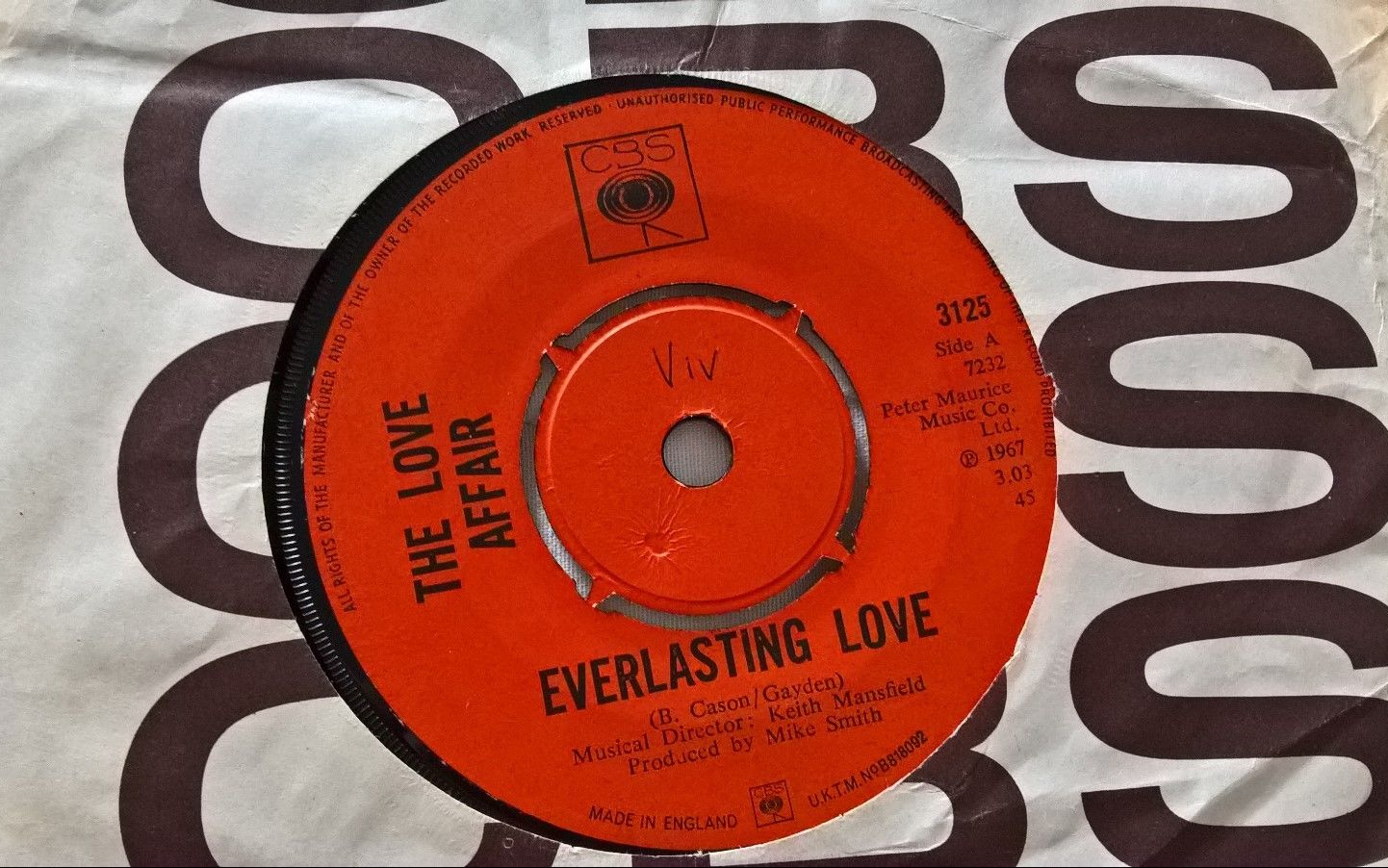
243. ‘Everlasting Love’, by The Love Affair

As the new year chimes ring, the musicologists of Britain gather to ponder what the ‘sound of’ the coming year will be. The BBC even runs a ‘Sound Of’ poll every January – recent winners including Adele, Sam Smith and, um, 50 Cent. Anyway… the point being that if you were to wonder what the ‘sound of’ 1968 might be, you could do worse than checking out this next #1.

AFF

Everlasting Love, by The Love Affair (their 1st and only #1)

2 weeks, from 31st January – 14th February 1968

Because ‘Everlasting Love’ sounds very sixties – you could place it straight away – but it also sounds fresh and new, an update on what’s gone before. It’s soulful, with heavy hints of Motown, and a loveable garage feel to it. And it’s a record that blasts in at full speed…

We soar on drums, and horns, and then a very funky bass riff. Hearts go astray, Leaving hurt when they go… The singer has ended things too early with his love, and now he’s begging to be taken back. Open up your eyes, Then you’ll realise, Here I stand with my, Everlasting love… It’s the hit single equivalent of someone standing drunk under your window at 2am… Need you by my side, Girl to be my bride…

But whereas someone singing drunkenly under your window at 2am is rarely a pleasant experience, ‘Everlasting Love’ is a lot of fun. It’s a relentless disc, one that grabs you and brings you along with it, never once letting up. You could accuse it of being cheesy, and a little saccharine, but you can’t get a word in. So you give up and just enjoy the ride. It’s that kind of song. It’s basically one big chorus from start to finish.

The most interesting bits of the song are musical – the little fills in-between lines. The blasts of horn, the bass and the drum rolls, and the snatch of what sounds like a flute and a triangle (I’m probably very wrong about that) before the glorious fade-out. ‘Everlasting Love’ was originally recorded in a Motown style by Robert Knight, in the US. Listen to his version here – it’s good, but doesn’t have anywhere near as much Ooomph as the Love Affair version.

the-love-affair-uk-cbs-45-everlasting-love-1st-issue-1967-ex_40826652

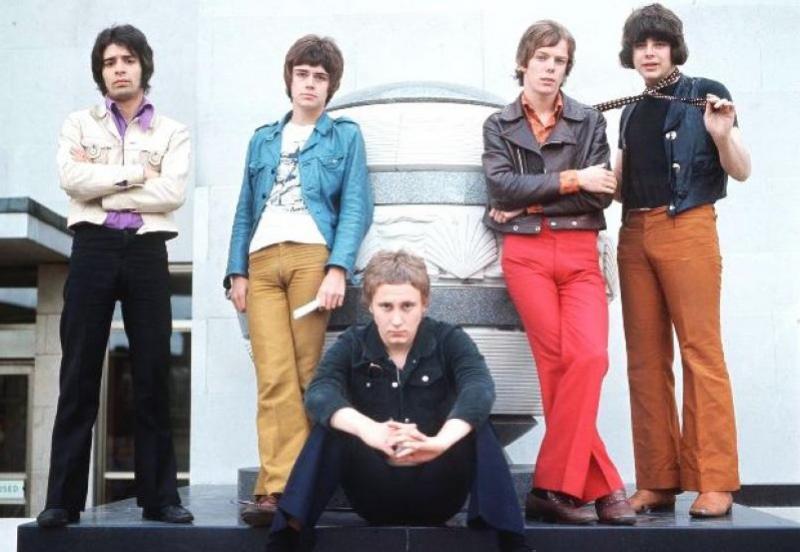
The Love Affair were yet another British soul group, following in the steps of Georgie Fame, The Foundations and The Small Faces. I listed the Small Faces last there as Love Affair’s lead singer, Steve Ellis, sounds a lot like Steve Marriot. The band later admitted that Ellis was the only member to actually feature on this recording – all the instruments were played by session musicians. Controversy! But, we are not here to judge how ‘real’ a record is. We are here to enjoy, and this is a very enjoyable record regardless of who played on it.

Love Affair had a few more Top 10s – this was their first big hit – before fading from view as the decade ended. Ellis left in 1969 and the rest split up in the early seventies. ‘Everlasting Love’ has made more of a lasting impression – it’s been a Top 40 hit, in a variety of versions, in the ‘60s, ‘70s, ‘80s, ‘90s and ‘00s. Sadly, it seems that it couldn’t be revived in the 2010s…

So, after a bit of a false start from Georgie Fame and two infamous serial killers, 1968 is a go-go. I can’t quite explain it, but there’s something very forward-facing and modern sounding about this disc, something that says ‘Welcome to the late-sixties!’ And I’m here for it!

240. ‘Let the Heartaches Begin’, by Long John Baldry

I start to fear the worst when I press play on this latest #1, and find that it begins with a soft and swaying intro… The type of intro that we’ve heard at least five times too often in recent posts. The type of intro that Engelbert Humperdinck would have licked his lips at…

Dzna6QlWkAEahw1

Let the Heartaches Begin, by Long John Baldry (his 1st and only #1)

2 weeks, from 22nd November – 6th December 1967

But no, this record is a cut above the run-of-the-mill, middle-of-the-road, so-so-ness that has made up so much of the past year’s chart-topping material. That becomes clear the second that Long John Baldry’s voice comes in, all smoky and croaky. It reminds me of Chris Farlowe – another British singer that you would think was American.

I can hear the guitars start to play… The first verse is innocuous enough. Boy’s lost girl etc. etc. It does nothing to prepare you for the soaring beauty of the chorus… So let the heartbreaks begin, I can’t help it, I can’t win… It’s a sad song – the title makes that pretty obvious – but it’s also kind of uplifting.

It’s the sort of chorus that makes you wish it wouldn’t finish, and that makes you count the seconds through the next verse until it returns. And Baldry’s voice… When he pauses for the Anymore… at the end of the final chorus you can actually picture him crying. (Apparently he was quite drunk when he recorded the song…)

As with Chris Farlowe, it’s really hard to imagine that voice coming out of the man in the picture above. But it did. And ‘Long John’ Baldry is a brilliant stage name, isn’t it? Anything combining rock stars and pirates is bound to be pretty badass. It was an appropriate name, too, as he measured six foot seven in height!

XD7_1026

I’m getting lots of different notes from this record. It’s got a strong 1967, easy-listening vibe, but it’s also yet another British soul hit in the tradition of Farlowe and Fame, and following hot on the heels of the The Foundations. It’s also forward-facing – this could easily be an early-seventies Rod Stewart record, especially when the acoustic guitar comes in on the second verse. Which makes sense, as both Stewart and Elton John played with Baldry before they hit the big time. Long John would never reach similar heights, but his #1 does feel like a bit of a marking post…

It’s also a perfect winter hit, and it makes perfect sense that it hit the top spot as the nights drew in and folks huddled around their fireplaces. And it’s perfect that I’m publishing this just before Christmas. Grab your loved one – even though it’s a song about heartbreak, literally, but hey – a mug of something mulled, and enjoy. Long John enjoyed quite the life beyond ‘Let the Heartbreaks Begin’, including time in a mental health institution and saving Elton John from suicide (he’s who ‘Someone Saved My Life Tonight’ is about.) And, apparently, he had a brief romantic relationship with Dave Davies from The Kinks. A biography worth reading! He passed away in 2005.

Before we go, I’d like to wish a very merry Christmas to every one of you UK #1s Blog readers. I hope that it is both merry and bright! Next up, before the New Year… a recap!

239. ‘Baby, Now That I’ve Found You’, by The Foundations

When I first scanned down my big long list of number ones and saw that ‘Baby, Now That I’ve Found You’ by The Foundations was coming up, I started imagining what it would sound like. I do that with bands and songs that I’ve not heard much before. And I pictured a Detroit four-piece – like The Four Tops, or The Temptations – and lots of vocal harmonies.

the-foundations-feature

Baby, Now That I’ve Found You, by The Foundations (their 1st and only #1)

2 weeks, from 8th – 22nd November 1967

But no. The Foundations were British. And, while I could have sang at least half the chorus of ‘Baby, Now That I’ve Found You’, the rest of the song sounds quite different to how I’d imagined. It is uplifting, and catchy. It soars upwards on line after ascending line. There are strong hints of Motown in there. But it’s a record that owes just as much, if not more, to British soul – the Georgie Fames, Chris Farlowes and The Spencer Davis Groups that have been popping up over the past couple of years.

Baby, Now that I’ve found you I can’t let you go, I’ll build my world around you, I need you so… It could be a Motown recording, if the production were a little slicker, and the vocals a little more polished. But it’s down to Earth-ness, it’s rough around the edges-ness – dare we say its Britishness? – is a big part of this record’s charm. Especially in the bridge, when the drums go all rocky, and the voices all come together like its last orders down the pub: Now you told me that you wanna leave me, Darling I just can’t let you… Clem Curtis, the lead singer, gives it his all.

R-3778913-1397040218-5925.jpeg

It’s a fun song, a catchy interlude that makes 1967 an even more eclectic year in terms of its chart-topping singles. It was the debut single of The Foundations, who are a band that deserve a bit of attention drawn their way. They were the first inter-racial band to have a #1 in the sixties, their members coming from the West Indies, the UK and Sri Lanka. Plus there were – I think – nine people in the band when ‘Baby, Now That I’ve Found You’ was released (I know there are only eight in the picture above, but I’m going on what I’ve read…) That’s a big pop group in anyone’s books, but not a record… The Temperance Seven also numbered nine members back when they hit top spot back in 1961. The Foundations’ oldest member was thirty-eight; the youngest just eighteen.

From the sounds of it, they found it very difficult to keep a band of that size and with that wide an age-range together. They only released ten singles before splitting up in 1970 – the second biggest of which was the even catchier ‘Build Me Up Buttercup’, which would reach #2 in 1968.

To be honest, if a year or so ago somebody had asked me about ‘British soul in the 1960s’ I would have had to politely shrug. But having now written posts on all these hits that have kept on cropping up at the top of the charts for almost three years now, I feel I should hang my head in shame. British soul was a big part of the sixties-sound, that seems to have been overshadowed by the likes of Merseybeat, folk and flower-power… Maybe it’s because, like me, people just assume the songs and the bands were American. Hopefully if you were as oblivious as I was then you too have enjoyed discovering this fascinating sub-genre. And hopefully the British soul hits keep on coming!

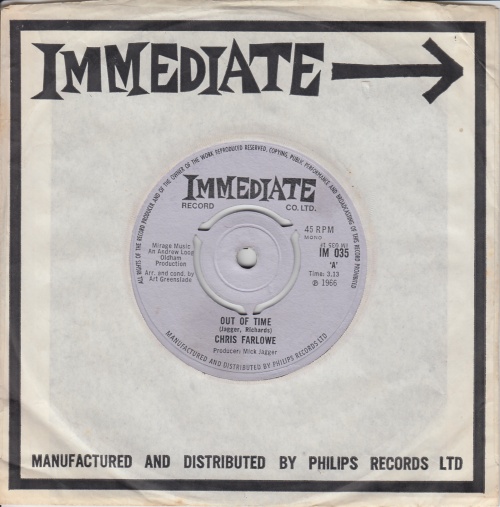
220. ‘Out of Time’, by Chris Farlowe

Amidst all the great pop being produced in the mid-sixties, two acts inevitably stand out above the rest. The Beatles and The Stones. Lennon & and McCartney, Jagger & Richards. Trading blows at the top of the charts. But John and Paul could always boast one original claim: that, on top of the ten #1 singles they have appeared on, they had written three more for other artists. ‘Bad to Me’, ‘A World Without Love’, and ‘Michelle’… Until now.

p01bqs74

Out of Time, by Chris Farlowe (his 1st and only #1)

1 week, from 28th July – 4th August 1966

For it is with much fanfare that we announce Mick and Keef as official ‘Chart-Topping Songwriters For Other Artists’, as Chris Farlowe takes ‘Out of Time’, from The Stones’ ‘Aftermath’ album, to the very summit of the hit parade! For a long time, I must admit, I did not know this was a Stones original. Which is strange, as the lyrics are straight from page one of the Rolling Stones’ songbook.

You don’t know what’s going’ on, You’ve been away for far too long, You can’t come back, Think you are still mine… A patronising, slightly threatening approach to women? Ladies and Gentlemen – The Rolling Stones! (See also ‘Under My Thumb’, ‘Heart of Stone’, ‘Stupid Girl’.) You’re out of touch my baby, My poor, old-fashioned baby… Baby, baby, baby, You’re out of time… It’s a song about a miscommunication: the girl was under the impression her BF would wait for her while she was away; BF was under no such illusion. And yes, he’s a dick, no disputing, but calling somebody ‘obsolete’ while you dump them is pretty bad-ass.

Chris Farlowe has one hell of a voice. It’s soulful and husky. He sounds like he smoked at least twenty a day. Maybe the reason that I went for so long without realising that ‘Out of Time’ wasn’t his song is down to the fact that he completely owns this record. He sounds like he’s having a ball. He sings it with a cocky confidence, a knowledge that there will be twenty more girls where this last one came from… I love the drawn-out sneer in the ‘tiiiiiimeee’, the ‘Ha!’ and the ‘Yeah!’ before the final chorus, and the way they call ‘Is everybody ready?’ before launching into an encore. (Some sources suggest that that is Mick and Keith themselves on the backing vocals…)

CHRIS_FARLOWE_OUT+OF+TIME+-+1ST+-+3PR-77306

Compared to The Stones’ version (which you can listen to here), and even though Mick Jagger produced this cover, Farlowe’s is a very different beast. Soaring strings, crashing Wall of Sound drums, and swooping, doo-wop backing singers accompany him. The original is much more stripped back: all organs and finger clicks. It’s also much harsher: switch ‘old-fashioned’ for ‘discarded’, and add a verse about how the girl has ‘had her day.’ Farlowe’s version is more likeable, way more over the top, making it easier not to notice how unpleasant the song is. The Rolling Stones leave you in no doubt…

Chris Farlowe featured on the first sixties compilation I ever heard, as young boy, on a cassette in my parents’ car. It was his version of ‘Handbags and Gladrags’, which came before Rod Stewart, and then The Stereophonics, did it to death. And I remember thinking distinctly, even as an eight year old, that he had a voice and a half. Why he wasn’t bigger than he was is a strange one. He had had one, minor hit before this, and his biggest hit after ‘Out of Time’ was ‘Handbags…’ which only made #33. And I have to admit, while listening to him sing in the car as a kid, and for years afterwards, I imagined him to be black. Racial profiling by voice? Maybe. As you can see from the picture up there, he is most definitely white.

His sound is – I’m starting to notice – very 1966, coming hot on the heels of The Spencer Davis Group’s couple of #1s, and Georgie Fame. All white boys doing soul. And that, like most hot sounds of the sixties, didn’t last long. Flower power is coming. Maybe Farlowe just couldn’t adjust. He still tours, with jazz bands and Van Morrison, and was included in the 50th Anniversary celebrations of England’s Football World Cup win (‘Out of Time’ was at #1 the week of the final against West Germany.)

Follow along with this handy playlist:

219. ‘Getaway’, by Georgie Fame & The Blue Flames

Following on from The Kink’s ‘Sunny Afternoon’, and we are keeping up with the summery theme. For what could be more summery than a little getaway…?

georgie-fame-and-the-blue-flames-1965-resize-1-1280x620

Getaway, by Georgie Fame (his 2nd of three #1s) & The Blue Flames (their 2nd and final #1)

1 week, from 21st – 28th July 1966

Gotta go, I hope you’re ready cos, Take a look outside… Georgie sings… We’ll leave the city folk, They’ll have to stay… he persuades… Don’t have to pack a thing, Just get away… It’s not as soulful, or as funky, as his previous number one, ‘Yeh Yeh’. It’s a simple enough acoustic riff, with a brass section for back-up. It’s cute. It’s catchy enough. It makes sense when you discover that it was written, initially, as an advertising jingle for a brand of petrol.

A lot of the song, around thirty percent I’d guess, is Fame chanting gotta go over the jaunty rhythm. Dig a little deeper into the remaining lyrics, though, and it turns out that his ‘getaway’ isn’t going to be a particularly luxurious one. I know a little place… A kind of pretty place… But it sounds charming: sun, sea and a bit of peace and quiet. I suppose it speaks to a time when young people didn’t have as much freedom, and perhaps could only truly ‘getaway’ once they were married…

georgie-fame-blue-flames-getaway-1966_360_a14c4c905930e91eb7f8b67044e08e6d

Musically, there are two things of note. There’s an organ solo, which places this song firmly in the mid-sixties. And every few lines a horn gives out a low parp, the sort of sound that usually follows a clown’s pratfall, which lends an (unintentionally?) comic air to the record. Apart from that, there doesn’t seem to be that much to it. It’s a nice enough diversion. Both of Georgie and The Blue Flames’ #1s have been a little off the beaten path compared to the dominant sound of the time. I like that – he was doing his thing and, clearly, people were digging it.

Another point to note – this hit is referred to as both ‘Getaway’ and ‘Get Away’, with different vinyl pressings having one title or the other. The Official Charts list it as one word so that’s what I’m going with… And I’m struggling to write much more about this chart-topper, to be honest. It’s nice. The end.

Plus, Georgie Fame will be making one more appearance at the top of the charts in a year or so, minus his Blue Flames (it is a really cool name for a backing band, isn’t it: The Blue Flames), so we can skip the bio bit. Anyway, I know that I’m publishing this in late October, but close your eyes and imagine that it’s high-summer, as it was when this disc hit the top of the charts. Close your eyes and, for two minutes thirty-one seconds, getaway.