164. ‘Anyone Who Had a Heart’, by Cilla Black

Alright, chuck? What’s your name and where d’you come from? Me name’s Cilla, and I’m from Liverpool.

1962 and ’63 were barren years in terms of women reaching number one in the UK. 1963 had precisely zero female #1s, while 1962 had just the one – Wendy Richard popping up as the featured artist on Mike Sarne’s ‘Come Outside’ (and she didn’t even sing on that record!) No, if we are counting #1 discs sung solely by women we have to look all the way back to Helen Shapiro’s ‘Walkin’ Back to Happiness’ from October 1961! No pressure then, Cilla…

00849490_1024x1024

Anyone Who Had a Heart, by Cilla Black (her 1st of two #1s)

3 weeks, from 27th February – 19th March 1964

This is a dramatic record. Right from the opening chords. Dun… Dun Dun… It’s the sort of song sung onstage, in a movie, while a murder is being committed in the wings. We’ve got a jabbing piano, cascading strings, and those rolling drums that are fast becoming the sound of the mid-sixties. Anyone who ever loved, Could look at me, And know that I love you…. It’s the song of a spurned lover. One who demands better. Knowing I love you… so, Anyone who had a heart, Would take me in his arms and, Love me too…

Writing the words out like that, though, cannot convey the brilliantly stop-start, woozy way that they come at the listener – loud then quiet, soft then angry. The pauses before the ‘so’ and the ‘who’ in the chorus are perfect, as is the whispered What am I to do… before the gorgeous horn solo.

It is a slice of supreme balladry – a seriously classy record. And when you discover, as I just did, that it was written by Burt Bacharach and Hal David, then that makes complete sense. It’s their 4th UK chart-topper so far. And the soaring ending – with the Anyone who had a heart would love me too… lines emphasised by drumbeats on each word, and Yeah Yeahs from the backing singers, is possibly the most sixties thing we’ve heard yet in this countdown.

Cilla-Black-–-Anyone-Who-Had-A-Heart

The only unconvincing thing about this record is… sorry Cilla… the voice. Technically, it’s great. But, for me, it sounds just a little young. Anyone who had a heart would love me too… is a difficult line to sell, and in the hands of a twenty-year old Cilla Black it sounds a little bratty. You don’t like me so you must have something wrong with you… My first instinct is to ask: Did Dusty ever sing this? Dusty would have done it justice. And she did. It’s not her finest effort, and I’m not sure about the guitars in place of the piano, but still… Nobody conveys stoic heartbreak like Ms. Springfield. On top of this, the song was originally recorded by Dionne Warwick, who also gave a more grown-up rendition.

But, still, this single launched Cilla Black as one of the biggest British female singers of the decade. Her take on ‘Anyone Who Had a Heart’ was the biggest selling song by a woman for the entirety of the 1960s! She was, as many people know (and as she kept reminding us for years to come), best mates with The Beatles, coming up through the same club circuit as they did. John Lennon introduced her to Brian Epstein, and the band even accompanied her during her audition for Parlophone.

Maybe what I’m mistaking for brattishness was actually the reason Cilla Black became so popular – her genuine girl-next-door, cheeky charm. She’ll top the charts again very soon and so we’ll hold off talking about what was to come for our Cilla for now. It is interesting to note, though, that both she and the last woman to top the charts, the aforementioned Wendy Richard, went to on to be better known for their TV work than their singing. More on that later…

Listen to every #1 so far with this handy playlist:

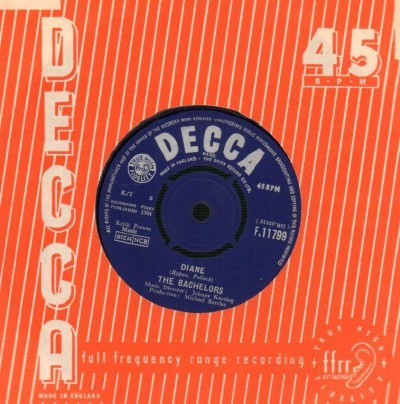
163. ‘Diane’, by The Bachelors

Ladies and Gentlemen! ‘Diane’, by The Bachelors, is the UK’s one hundred and sixty-third number one single… Nope. Me neither.

The-Bachelors-signed-music-memorabilia-singer-legend-autograph-I-Believe-Ramona-Sound-of-Silence-Diane-Conleth-Cluskey,-con-dec-declan-john-stokes.jpg.opt600x374o0,0s600x374

Diane, by The Bachelors (their 1st and only #1)

1 week, from 20th – 27th February 1964

It’s been a good long while since we arrived at a chart-topper that I’d never, ever heard before. Yodeller par excellence Frank Ifield’s version of ‘Confessin’ was probably the last. But even before pressing play, I can kind of predict what we’re heading for here. ‘Diane’, by ‘The Bachelors’ doesn’t, to me, scream rock ‘n’ roll abandon.

And yup, the intro has a strong whiff of barbershop quartet: Smile for me-e-e-e…. My Diane… Close harmonies, and long drawn out notes. But no sooner has this opener swooped to a close than in comes a lilting country rhythm. I’m in heaven, When I see you smile, Smile for me, My Diane… It’s a song about a woman, called Diane, and how much a boy loves her. She lights the road home. No matter where he roams etc. etc. (Has there ever been a non-country and western song featuring the word ‘roam? I don’t think so…)

The Beat-invasion may have had a strong chokehold on the charts at this time, but other songs could still poke through. This had a solitary week at the top, and I have the feeling that that was because there was little in the way of competition – a default #1 because, well, something has to be number one. It’s cute, and pleasant enough, but…

I’m not too sure what to make of it. Maybe it’s insignificant enough for me to simply make nothing of it. It’s a country-ish, barbershop-ish (I do like the ah-oh-oh-ohs!) little ditty that I have to admit I was singing along to by the fourth listen. Actually, I’ve just realised that I’m also getting hints of Cliff – in both the swaying guitars last heard in ‘Summer Holiday’ and the band’s name (Bachelors, get it?)

7M_1085

Who exactly were these Bachelors? Well, they were Irish, which makes them the very first Irish act to top the British charts, preceding U2 and Boyzone, and the other Irish chart-dominators of the eighties and nineties. So that’s something. There were three of them – Conleth, Declan and John, and they made a decent mid-sixties career out of re-interpreting old tunes from the 1920s and ‘30s in a vaguely Beat-ish way. ‘Diane’ was originally written as the theme song to a 1927 silent movie, for example. Slim Whitman, Jim Reeves and Vic Damone all did their own versions at one time or another. The lads also scored hits with covers of songs like ‘I Believe’ and ‘Hello Dolly!’ While other Beat groups were looking forward; The Bachelor-boys were looking back.

Nothing dates this song, though, as much as the ending. Back in the dark and distant Pre-Rock days almost every song ended with a huge, soaring climax that had been signposted a mile off. And The Bachelors here do their best to recapture those halcyon days. The song slows down, the singer revs up and… Smile for meeeeeee, My… Di….AAAAAAANE! We finish all misty-eyed for the days of Al Martino and David Whitfield.

I don’t begrudge this song its week on top of the charts; but at the same time I’m not terribly sad that we won’t be hearing from The Bachelors ever again. Interestingly, not only does this record give us our first Irish #1, it also sees the name Diane (or variants thereof) sprint into the lead as the name featured in the most chart-topping singles. With two. This, and Paul Anka’s ‘Diana’. We’ve also had a Joe, a Rose Marie, a Hernando, a Josephine, a Mary, a Cathy, a Laura, a Johnny and a Michael, all on one chart-topper each. Not something I ever thought I’d keep an eye on but, now that I have done, it’s kind of fascinating. Which name will be the winner? And who’d have thought that a Josephine would have topped the charts before, say, a Sue or a Jenny?

162. ‘Needles and Pins’, by The Searchers

The Searchers return for a second run at the top. And if their first #1 – ‘Sweets For My Sweet’ – was a cute little slice of Beat-pop; then this is next-level stuff entirely. This baby is a classic!

The_Searchers_1965-resize

Needles and Pins, by The Searchers (their 2nd of three #1s)

3 weeks, from 30th January – 20th February 1964

We start with a simple, chiming riff. In my previous post on The Searchers, I mentioned that they had a sound slightly removed from frenetic Merseybeat – a bit more sedate, a bit more melancholic – a sound that wouldn’t sound out of place on Indie records of the 1980s. Well, that sound is back here.

Lyrically, too, this is a more complex record than the likes of ‘Do You Love Me’ and other such pub-singalongs. And no, ‘Needles and Pins’ doesn’t refer to waking up with a dead arm; it’s about the feeling you get when you see a lost love. One that did you wrong. I saw her today, I saw her face, It was a face I loved, And I knew, I had to run awa-y…

It’s also a song about bruised pride… Because of all my pride, The tears I gotta hide… and a song with an air of revenge about it: Let her go ahead, And take his love instead, And one day she will see, Just how to say please, And get down on her knees, Yeah that’s how it begins, She’ll feel those needles and pins, Hurtin’, Hurtin’… This is one grown-up love song. It’s like the sophisticated older brother of discs like our last chart-topper, ‘Glad All Over’, looking down his nose at his younger siblings’ silly little songs.

I wish I had the musical vocabulary to describe the chord structures and the key and whatever it is that gives this record its ‘mood’. Whatever it is that makes this song so good. But then again, if I could dissect it and pinpoint it’s genius maybe it would lose some of its magic. It’s a sad-sounding song about a sad-sounding break-up; and it’s superb. By the final verse, it’s reached a bit of a crescendo. Two voices – the lead singer (Mike Pender) and a high-pitched back-up which just adds to the emotion. Oh, needles and pins… And those drum-fills. Oh those drum-fills.

the-searchers-needles-and-pins-7-45_44502391

I’ve been kind of surprised, listening to them all in a row, how cheesy (for want of a better word) these early Beat #1s have been. Musically they’ve been a huge step forward but, in lyrical terms, records like ‘From Me to You’, ‘Bad to Me’, and ‘I Like It’ haven’t moved on much from the 1950s.

‘Needles and Pins’ is different. Though I was shocked to find out that it is actually a cover. It’s a song I’ve loved for a long time and have assumed for years was a Searcher’s original. But no. It’s a Jack Nitzsche and Sonny Bono song, originally recorded by Jackie DeShannon in 1963. I feel betrayed… I really do. This – and I realise that this is a bold statement to make – is the first pop song I ever loved. I must have been maybe seven, and it was on a sixties mix-tape (which I’m sure I’ve mentioned before) in our family car. It would be playing on a Sunday evening as we drove home from dinners at my grandparents, along dark roads under orange streetlights. A melancholy scene for a melancholy song.

Actually, that’s another thing that has surprised me – just how many of these early Beat chart-toppers were covers. Since Gerry & The Pacemakers kicked the movement off in April ’63, I make this six covers out of eleven (I’m counting ‘You’ll Never Walk Alone’ in this, though it isn’t your average Beat-pop number). I just assumed these boys with guitars were all writing their own songs. How wrong I was!

Anyway, the ‘Needles and Pins’ story doesn’t end with The Searchers. It’s classic status is confirmed by the fact it’s been covered by The Ramones and Tom Petty. It’s a song so good that it might just give you needles and pins! (Though I’ve always said ‘pins and needles’ – I guess that didn’t scan quite as well…)

Follow along with my Spotify playlist:

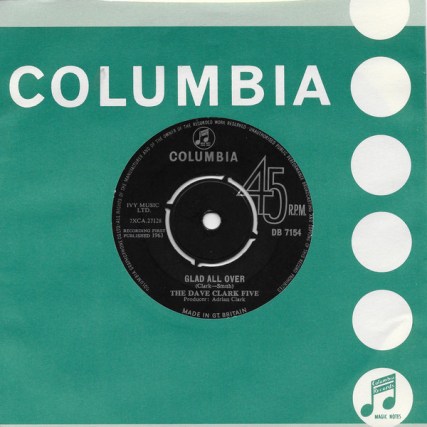
161. ‘Glad All Over’, by The Dave Clark Five

And so we launch head-first into 1964. Suddenly we are in the mid-sixties! Doesn’t time fly! And kicking off the new year are some newbies at the top of the UK singles charts: The Dave Clark Five.

mezzanine_296

Glad All Over, by The Dave Clark Five (their 1st and only #1)

2 weeks, from 16th – 30th January 1964

Interestingly, none of the acts that topped the charts in 1963 were one-offs. Every single one of them had hit #1 previously, or would go on to hit #1 again. But the very first chart-topping act of 1964 are… drum roll… one #1 wonders!

Anyway, this a barnstorming way to start off. We get a thumping, grinding drum-beat designed to blow away any lingering new year hangovers, which is quickly joined by a bass and a stabbing saxophone. Then the singer (Mike Smith, not Dave Clark) jumps in: You say that you love me, All of the time, You say that you need me, You’ll always be mine…

The beat then morphs into an insistent, irresistible galloping-horse rhythm that will last for the whole song. And then comes a chorus that pretty much everyone knows: And I’m feelin’… Glad all over…Yes, I’m a-… Glad all over…!

It’s an non-stop sledgehammer of a song, with large swathes of call-and-response and a key-change that is pointless trying to resist. Other girls may try to take me away… (you can just pictures the girl’s eyes rolling at this point)… But you know, It’s by your side, I will stay… It’s a fun disc. File it under ‘unsophisticated’. This and The Tremeloes’ ‘Do You Love Me’ from a few posts ago would make a great drunken-1am-singalong double-header.

R-5972494-1481232145-4446.jpeg

Like ‘You’ll Never Walk Alone’, this is also a huge football, and rugby, crowd song – the call and response bits work perfectly – and is usually played after a home-team scores (Crystal Palace started it when ‘Glad All Over’ was still in the charts and lots of other teams followed suit). It was last seen in the UK charts a couple of years ago when Glasgow Rangers fans did a mass-download campaign. In fact, I’d have to say that this is just the latest in a run of chart-toppers that have entered the public consciousness like few previous #1s have. From ‘Sweets For My Sweet’ through ‘Do You Love Me’, plus the recent Beatles chart-toppers… I’ll bet most people on the streets could sing a line or two from all of these songs, even today. Just goes to show how much the music from this era lingers on.

Since we’ll never hear from them again on this countdown – just who were The Dave Clark Five? Well, you’ll be shocked to discover that there were five of them, and that they were ‘led’ by one Dave Clark, who also drummed on all their hits. They were from Tottenham, in North London, and were at the vanguard of the ‘Tottenham Sound’ -which I’m not sure sounded any different to the Mersey-sound, or any other variety of Beat-band sound, but hey – they were representing. As I mentioned, this was their one and only #1; but they scored Top 10s throughout the sixties before splitting up in 1970.

There you have it then. 1964 is off and running with a boisterous pop number. I don’t go in for previews very often in these posts, but I have to mention here that ’64 is going to be a stellar year for chart-topping singles. One of the very best… if not the best… years in terms of #1 quality. Over the course of the next twenty-two hits we’ll hear some classics, meet some legends, and have a generally pretty ‘groovy’ time (that’s how people talked back in the sixties…)

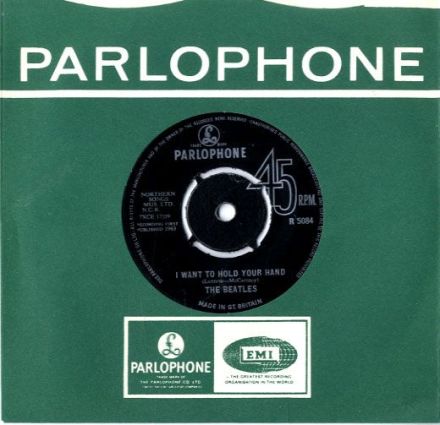
160. ‘I Want To Hold Your Hand’, by The Beatles

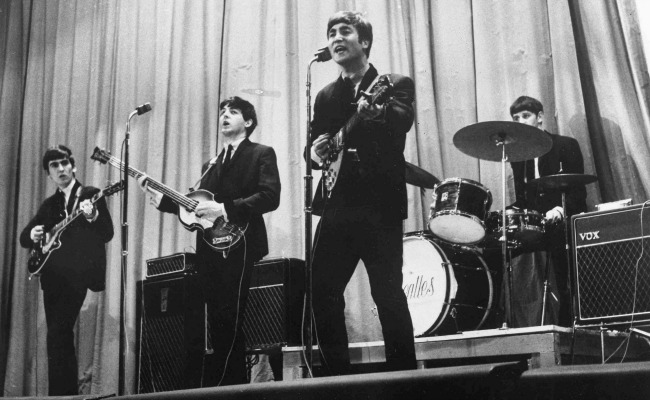
Oh yeah I’ll, Tell you somethin’, I think you’ll understand… Well, what you need to understand is that we end 1963 with the biggest band of the year. Three #1s spread out over a staggering eighteen weeks! The band that would go on to become the biggest band of the decade and then the biggest band of all time.

the beatles john lennon george harrison ringo starr paul mccartney 1280x1024 wallpaper_www.wallpapername.com_64

I Want to Hold Your Hand, by The Beatles (their 3rd of seventeen #1s)

5 weeks, from 12th December 1963 – 16th January 1964

And what a cheesy wonder this song is. When I wrote about ‘She Loves You’, I mentioned that it was quite a sophisticated pop song, with a pseudo-3rd person narrative and melancholy chord progressions. Well, all that sophistication was dumped at the studio door when the lads turned up to record ‘I Want to Hold Your Hand.’

Oh please, Say to me, You’ll let me be your man, And please, Say to me, You’ll let me hold your hand… It’s so twee, so innocent. Can I be your boyfriend? I just really, really, really want to… hold your hand. I’ve listened to it several times now, scouring the lyrics for a hint of double-entendre, but no. And when I touch you… promising… I feel happy inside… Oh. It’s as chaste and vanilla a record as you’ll find.

This is not to suggest that I don’t like it. Who doesn’t like this record? It’s probably been proven, by a team of crack scientists, that it’s impossible for a fully-functioning human being to dislike this record. You’ve got that intro, for a start. Dun-dan-ding, Dun-dan-ding… And some quality drum fills from Ringo. And that twangy guitar – George Harrison’s, I’m guessing. And some clapping (Yes, clapping!) My personal highlight, though, is the Everly Brothers’ harmonising on the ‘Ha-a-a-a-a-nd’.

beatles-the-i-want-to-hold-your-hand-this-boy-r-5084-decca-pressing-77189-p

Nope, we’re pretty close to pop-perfection here. It’s not quite in the same league as ‘She Loves You’, but it’s pretty, pretty, pre-tty good. The greatest threat to songs like ‘I Want to Hold Your Hand’ is ubiquity – the fact that most people have heard them three hundred times already. You have to remind yourself that The Beatles were re-inventing pop music as they went here, have to imagine yourself as a sixteen-year-old in the winter of 1963, hearing this for the first time…

I think this might become a theme whenever a Beatles disc crops up on this countdown but, hey: some statistics. The band replaced themselves at #1 with this disc (‘She Loves You’ having returned to #1 after seven weeks, remember) becoming only the second ever act to do this. (Plus, The Shadows replaced themselves with records on which they were the featured, not the lead, artists, so…) ‘I Want to Hold Your Hand’ is their biggest selling record worldwide, having sold 12 million copies.

It also holds an important place in pop-music folklore. Bob Dylan famously thought that they were singing I get high… when they were actually singing I can’t hide… and was shocked to find out that they had never smoked weed. And it was so good that it made Brian Wilson and Mike Love convene a special Beach Boys meeting to discuss the threat The Beatles posed to their position as America’s #1 band. (I love that – pop music meets military strategy.)

In the end, even Sgts Wilson and Love couldn’t hold back the British Invasion. ‘I Want to Hold Your Hand’ was their 1st US #1 a few weeks after it hit the top back home. It was part of the all-Beatles Billboard Top 5 in April ’64. Suddenly they were HUGE. Bigger even – some might have said – than Jesus himself…

Follow along with my Spotify playlist:

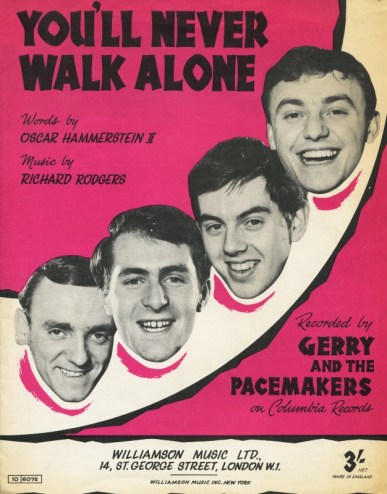
159. ‘You’ll Never Walk Alone’, by Gerry & The Pacemakers

Gerry and his gang make it three number ones in a year – three in ‘63. A feat that not many acts manage. But this is a disc light-years away from their first two chart-toppers.

gerry-and-the-pacemakers-youll-never-walk-alone-1963-8

You’ll Never Walk Alone, by Gerry & The Pacemakers (their 3rd and final #1)

4 weeks, from 31st October – 28th November 1963

It starts very simply. When you walk… A voice, a piano, a sparse drumbeat, and a bass… Through a storm, Hold your head up high, And don’t be afraid, Of the dark… Yup, we are definitely a long way from ‘I Like It’.

It’s a motivational song – a ‘never-give-up’ number about holding onto your dreams, even in your darkest hour. And Gerry Marsden certainly sells it here, building in confidence as the song progresses with his slightly rough-round-the-edges scouse crooning, and an affecting tremble in his voice. Walk on, Through the rain, Though your dreams be tossed, And blown…

Then the violins kick in, and the band and George Martin pull out all the stops to make sure there isn’t a spine left untingled. Walk on… Walk on… With hope in your heart, And you’ll never walk alone…. It’s a classic, an anthem. There’s a quick drop following the first chorus and then BOOM – we’re back for a big ol’ finish.

What on earth, though, were Gerry and The Pacemakers doing recording a version of ‘You’ll Never Walk Alone’ in the first place? It’s such a weird trio of chart-toppers: ‘How Do You Do It?’ – perky Beat-pop, ‘I Like It’ – perky Beat-pop, ‘You’ll Never Walk Alone’ – umm… It’s from a Rodger’s & Hammerstein musical, ‘Carousel’, first performed in 1945 as their follow-up to ‘Oklahoma!’ In the show, the song is sung by the lead-female character’s sister to comfort her following her death of her husband.

However, in the UK, and much of Europe, ‘You’ll Never Walk Alone’ has become completely disassociated from the original musical, and even from Gerry & The Pacemakers. Ask your average youngster in the street today if they know the song and they’ll probably say ‘yes – it’s the Liverpool Football Club song.’ It’s a record – more so than any of the other chart-toppers that we’ve covered so far – that has, for better or worse, taken on a completely new role in the decades since its release. At every Liverpool home game, just as the players run out onto the pitch, you’ll hear that piano and Gerry Marsden’s husky tones. Then, just as it arrives at the big finish, the P.A system will cut out and the crowd will take it home.

Gerry-The-Pacemakers-Youll-Never-Walk-Alone

Legend has it that in the early sixties the P.A. would play the Top 10 ahead of each match at Anfield. For four weeks in November 1963, ‘You’ll Never Walk Alone’ was the last song played due to it being atop the charts. But even after it was knocked off the top and dropped out the charts, the crowd kept singing it. The Pacemakers were hometown lads, after all, and the lyrics and melody of the song do lend themselves to being sung en-masse at a football match. So it stuck. ‘You’ll Never Walk Alone’ is the Liverpool FC song now. It’s sung at every game. It’s carved above the gates at Anfield. Liverpool supporters sign off from message boards and forums with ‘YNWA’.

But… Football being a tribal game, this means that any supporter of a club that isn’t LFC has to, basically, hate this song. Especially those who grew up in the seventies and eighties, when the buggers were winning everything. I would never particularly choose to listen to this song, as I’m not a Liverpool fan. It’s left ‘You’ll Never Walk Alone’ in a very weird position in British popular culture – a song that everybody knows; but one that only a select portion of the population will actively enjoy. And, amazingly, I’ve only just scratched the surface here. The song will top the charts again, and will become indelibly connected to two of the biggest tragedies in recent British history. All that for another day…

Away from football, ‘YNWA’ (those Liverpool fans might be on to something here) has been recorded by everyone who’s everyone: Elvis, through Roy Orbison, to Susan Boyle. It would literally take half an hour for me to type out all the artists who’ve done their take in the song. Gerry and The Pacemaker’s version remains, in the UK at least, the definitive one. But I’ve not answered my initial question from several paragraphs back… Why on earth did they take such a big step away from their Merseybeat roots, and so early in their careers? Could it have, perhaps, been their downfall? You can’t imagine The Beatles ever recording a showtune, can you? It was the band’s last #1, and they would only have three further Top 10s. By 1965 their chart-careers would be over. It’s a huge collapse (similar to the way Liverpool threw away the league title at Crystal Palace a few seasons ago… I couldn’t resist…)

Still, three #1s from their first three singles was an unprecedented achievement at the time, and one that wouldn’t be matched for over twenty years. They split up in 1966, with Gerry going into cabaret and children’s entertainment.

Before we finish, I have one big problem with this record (and it’s nothing to do with football). I’ve mentioned ‘The big finish’ a couple of times now; but the song doesn’t actually have one. The song build and builds, and builds, for two minutes and twenty seconds, and is crying out for a huge, epic, grandiose finish. But they bottle it. In the middle of the last ‘never’, Gerry pauses, the soaring violins fall away, and the song ends with a bit of an anti-climax. It’s a strange decision. I don’t know if it was Marsden’s, another band member’s, George Martin’s or maybe even Rodger’s or Hammerstein’s back in the forties. But for me it doesn’t work. It leaves me feeling a little flat. I’ll leave it to the crowd at Anfield to give this song the big finish that it deserves.

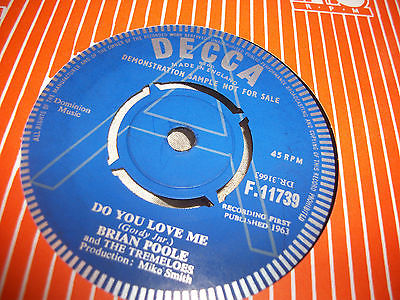
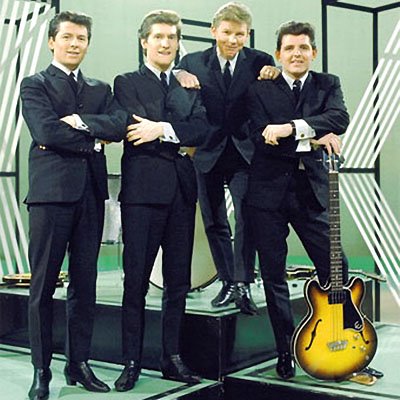
158. ‘Do You Love Me’, by Brian Poole & The Tremeloes

Our next chart-topper is, perhaps, a bit of a come-down after we scaled such euphoric heights with ‘She Loves You’. I suppose that is a hard act to follow. But The Tremeloes’ debut at the top isn’t without its merits.

Brian-667382

Do You Love Me, by Brian Poole (his 1st and only #1) & The Tremeloes (their 1st of two #1s)

3 weeks, from 10th – 31st October 1963

For the second chart-topper in three we get an intro that builds… You broke my heart, ‘Cos I couldn’t dance, You didn’t even want me around… in a way that strongly signals that this is a song about to explode (imagine a huge sign saying ‘Up-tempo Pop Song Ahead – 10 seconds’)… But now I’m back, To let you know, That I can really shake ‘em down… It might, off the top of my head, be the very first ever spoken intro we’ve heard on this countdown.

Anyway, the singer clearly went off and had some dancing lessons, or at least a shot or two of tequila, and he’s returned to let his girl know that he can, indeed, cut some shapes. The rest of the song’s lyrics are pretty nonsensical – standard dance music catchphrases from the fifties and sixties: do the mashed potato, you can do the twist, shake it up, shake it down, a little bit of soul now, do you like it like this… And of course, the big question, over and over: Do you love me? Do you love me? Do you love me? Now that I can dance….? (Watch me now!)

I used to work in the bar of a bowling alley (as you do), and every Saturday night we’d have a live DJ (hi, DJ Brian) and this was, without fail, one of the last songs he’d play every week. Because there is no better song for yelling along to at the top of your voice, when it’s just past midnight and you’re drunk in a bowling alley, than ‘Do You Love Me’. Take the ‘Now that I can dance’ line, and the layered, ascending ‘Daaaaannnnn Daaaannnnnn Dannnnnnccceeee!’ I will find it impossible to dislike any song that employs this device. They could shove it in the middle of ‘God Save the Queen’ (the national anthem that is; not the Sex Pistols one) and it would work.

201417730734

This was, as perhaps you know, originally a Motown record, released one year before by The Contours. It had been a US #1, but hadn’t charted in the UK. I’ve put a link in for comparing and contrasting purposes. For what it’s worth – as with ‘Sweets for my Sweet’ a few posts ago – I like the Motown original a shade better as a song (the tempo is slightly slower, and I think it’s a song that works more effectively with a vocal group rather than with an instrument-playing band). But… The Tremeloes’ version does have an irresistible madcap energy to it – the last chorus, where all the band members yelp and yell over and under one another, is possibly the rawest five seconds of any chart-topper thus far.

The Tremeloes, and Brian Poole, were the first Beat chart-toppers not to come from the North-West of England (they were from Dagenham, just outside London). This was their second hit, and they would go on to score hits – with or without their lead singer Brian Poole – throughout the sixties. We’ll be meeting them one more time, with a record that’s the polar opposite of this. Though, I do have to say, ‘Do You Love Me’ is a record that wins you over by the end. It would have won me over quicker, I suspect, if I’d had a few before writing this post. ‘Do You Love Me’, if you’ll allow me a moment of metaphor, is like a sloppy, untrainable puppy that’s just made a mess of a houseplant. You want to hate it, and maybe get rid of it, but one look at its loveable eyes and everything’s forgiven.

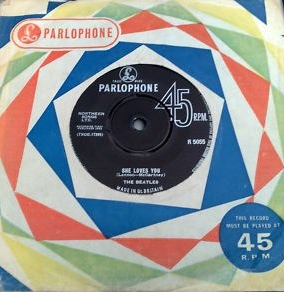
157. ‘She Loves You’, by The Beatles

The record with which The Beatles went stratospheric. Woooosh. That’s them. Off they go. This next song takes everything that was good about their debut chart-topper ‘From Me to You’, everything good about this burgeoning Merseybeat movement, puts it in a rocket, sets engines to warp, and…

beatles1963_650

She Loves You, by The Beatles (their 2nd of seventeen #1s)

4 weeks, from 12th September – 10th October / 2 weeks, from 28th November – 12th December 1963 (6 weeks total)

Take the opening drum roll for a start. It takes up less than a second of the song – it is literally a drum roll – but it sets the frantic pace that grips this record and propels it right the way through. And then in thumps the chorus. You’ve heard it, you’ve heard it again, you’ve heard it in German – but it bears repeating: She loves you, Yeah yeah yeah, She loves you, Yeah yeah yeah, She loves you, Yeah, yeah, yeah, yeah… That is it. That is all there is to it. But there’s a manic energy in those ‘Yeahs’ that even today gives you goose-bumps.

Lyrically this is step up from songs like ‘Sweets For My Sweet’ and ‘I Like It’ – a little more complex. It’s about a man convincing his friend that his sweetheart still loves him: She said she loves you! And you know that can’t be bad… She said she loves you! And you know you should be glad… While the second verse shows that the friend has actually been a bit of a dick: She said you hurt her so, She almost lost her mind… And the final verse is a bit of a lecture: You know it’s up to you, I think it’s only fair, Pride can hurt you too, Apologise to her… What all this means, most importantly, is that it’s not a traditional ‘Love Song’. This is a ‘Rock Song’, with all the yelling and thrashing that that entails. There’s a strong hint of The Everly Brothers in the way that the ‘Bads…’ and ‘Glads…’ at the end of the lines in the bridge split into a high note and a low note. And then those ‘Ooohs’. Oh those ‘ooohs’.

One thing I’ve noticed about ‘She Loves You’ after repeated listens (I’m up to six as I write this paragraph, and I’m far from sick of it yet) is how melancholy the chord structures are, especially in the verses. It’s something The Beatles were excellent at early in their careers, combining the majors and the minors, from ‘P.S I Love You’, through ‘All My Loving’ to the pinnacle of sad-pop, ‘Help!’ If you stripped away the frantic drums, and the ‘Yeah Yeah Yeahs’, and the ‘Ooooohs’ from ‘She Loves You’ – you’d have a sad old song on your hands.

beatles-she-loves-uk-1st-small-font_360_01f0ec61cab2e77d016a4df3fa275ae8

But that’s a big ‘If’. The unhinged energy of this song, the madcap beat and tempo, are a huge part of its charm. It’s unsubtle, it’s cheesy, it’s glorious. It’s Sledgehammer Pop! Actually no, we don’t need another sub-category. I am, though, going to add ‘She Loves You’ to my oh-so-select list of ‘Time Capsule Pop’ records – the discs that need buried in the ground for all eternity so that the aliens can see what all the fuss was about, can see exactly why humans went crazy for this thing called ‘popular music.’ I invented the category for The Everly’s ‘Cathy’s Clown’, and then retrospectively added Johnnie Ray’s ‘Such a Night’, The Crickets ‘That’ll Be the Day’ and Jerry Lee’s ‘Great Balls of Fire.’ ‘She Loves You’, then, becomes the fifth disc in the pod. And I’d say that, while they will better this disc with some of their later chart-toppers (fifteen still to come, folks!), they will never sound more like The Beatles than they do here. This is the Beatlest Beatles #1 single.

Some facts and figures, before I go. ‘She Loves You’ is the band’s biggest seller in the UK. It is the 9th biggest selling hit ever. It was also #1 in the US, where it was part of the famous all-Beatles Top 5 on the Billboard 100 in early 1964. This was ‘Beatlemania’ – bigger than Sinatra in the forties and Elvis in the fifties. This was HUGE. Back in the UK, ‘She Loves You’ dipped down from the top-spot for an amazing seven weeks before returning to the top in late-November. Even today, no record has had a longer gap between stays at number one, without being re-released. It knocked ‘Bad to Me’ – another Beatles composition – off the top and was then itself finally knocked off the summit by ‘I Want to Hold Your Hand’. The charts of autumn ’63 were well and truly owned by The Fab Four. We are in the presence of greatness, here.

I have one personal story to tell involving ‘She Loves You’. Back fifteen years or so ago, I went to see McFly in concert (another of the best bands ever, fight me!) and midway through they announced that they were going to play a song that they’d just written backstage that very night. The twelve-year-old girls screamed. They then launched into a cover of ‘She Loves You’. The twelve-year-old girls still screamed. To this day I still wonder how many of them didn’t work it out…

Follow, and listen to every #1 so far, with this Spotify playlist:

156. ‘Bad to Me’, by Billy J. Kramer with The Dakotas

A crooning little intro has us fearing the worst as the needle drops on our latest chart-topper … If you ever leave me, I’ll be sad and blue… A guitar strums plaintively… Don’t you ever leave me, I’m so in love with you… But it’s an intro that you know is going somewhere – something in that last ‘you…’ just brims with promise – and yes, the guitar, clear as a bell, kicks in and we’re off into another solid Beat #1.

kramer-centre-with-his-second-band-the-dakotas-in-the-1960s-518505

Bad to Me, by Billy J. Kramer with The Dakotas (their 1st of two #1s)

3 weeks, from 22nd August – 12th September 1963

The birds in the sky would be, Sad and lonely, If they knew that I’d lost my, One and only… And if, as this song unfolds, you get the feeling that it all sounds very familiar – something in the chord progressions and the notes that Billy J. Kramer leaves hanging in the air – then you’d be on to something. For the next seven years of the UK pop charts there will be two main categories of number one single: those recorded by The Beatles, and those written by The Beatles (or, rather, by Lennon & McCartney). Hot on the heels of their 1st #1 as performers, ‘Bad to Me’ is their first #1 as writers.

That’s not to say that Billy J. and his Dakotas don’t make this song their own. The band is crisp and tight, and Kramer’s voice is strong too. I like the flip and the little groan as he takes us through the But I know you won’t leave me cos you told me so… line. He treads a fine line between singing properly but not crooning. He doesn’t have as strong an accent as, say, John Lennon or Gerry Marsden; but he doesn’t sound like Perry Como either. In fact, we’re five #1s into the Merseybeat revolution and I don’t think I’ve struggled to make out a single line. We await the deterioration of diction in pop music – possibly the late-twentieth century’s greatest crime, according to my late Grandma – with bated breath. My money’s on Jagger.

Anyway, I like this song. We’ve got piano, some nice harmonies, and some standard Merseybeat drums. We even get my favourite type of guitar solo: one that mimics the verses note for note. It’s lazy; but works every time. And… done. A song that wasn’t completely unfamiliar to me; but one to which I had never really paid much attention. I’ll add it to my playlists.

BILLY-J-KRAMER-THE-DAKOTAS-Bad-To

With this disc we keep up our run of young whippersnappers topping the charts (Kramer had just turned twenty when this reached the summit.) However we break our run of Liverpudlians! Billy J was from Bootle but the Dakotas were from all the way over in Manchester. (Still, we manage to keep it in the North-West of England, for now.) Their partnership was something of a marriage of convenience: Kramer needed a band and Brian Epstein persuaded The Dakotas to leave their original singer and team up with him. They debuted with another Beatles cover – ‘Do You Want to Know a Secret?’ – which had hit #2 earlier in the year.

Two more things to mention before we wrap up. If you’re thinking “Hey, with a name like Billy J. Kramer there’s no way he wasn’t going to be a rock star!” then you’d be sorely misguided. His real name was William Howard Ashton – a Vicar’s name if ever there was one. And secondly… ‘Bad to Me’, when you think about it, is a very misleading song title when you consider that the whole entire song is about how the girl is not bad to him. It’s as if ‘Why Do Fools Fall in Love?’ was just called ‘In Love.’ Something to mull over, as I leave it there for now.


155. ‘Sweets For My Sweet’, by The Searchers

Everybody back aboard the Merseybeat bus, for a trip that’s going to take us well into 1964. The initial beat-bands to top the charts – Gerry & The Pacemakers and The Beatles – are now joined by another bunch of Liverpudlians.

Searchers

Sweets For My Sweet, by The Searchers (their 1st of three #1s)

2 weeks, from 8th – 22nd August 1963

I can’t imagine another time when one sound monopolised the top of the charts in such a fashion. From now – early August 1963 – to the middle of February 1964, every UK #1 will have a Merseybeat flavour to it. And we kick off with this one, and a chorus that most will know…

Sweets for my sweet, Sugar for my honey, Your first sweet kiss, Thrills me so… It’s a step back from the frenetic tempo of ‘From Me to You’ and ‘How Do You Do It?’, the guitars here chime rather than rattle; the drums roll rather than thump. There’s a hint of a chugging little riff buried in there too. In fact, I’d say that musically this is a step ahead of the earlier beat chart-toppers. I’m getting hints of The Byrds in the guitars and The Beach Boys in the ‘oooh-eeeh-oooh’ backing vocals. In fact, I can hear the foundations of ‘80s indie in that chiming solo that follows the choruses. You tell me that that doesn’t sound like something the Stone Roses might have come out with.

On the flip side… there’s always a flip side… the lyrics here are a step back from the cheeky charms of John Lennon and Gerry Marsden. They were giving us little vignettes about running fingers through hair, and kisses that would keep you satisfied… relatable stuff. The Searchers still sing in scouse accents but are giving us: If you wanted that star that shines so brightly, To match the stardust in your eyes, Darling I would chase that bright star nightly, And try to steal it from the sky… And then there’s some nonsense about the Sandman, like it was still 1954 or something.

The-Searchers-Sweets-For-My-Sweets-UK

There’s a good reason for this. I said that the chorus should be familiar to all, but to American readers it might be more famous in the form of The Drifters 1961 original. (Yes, I too was slightly surprised to find out that it was a cover, and that in fact all The Searchers’ chart-toppers would be covers.) These lyrics work well in the hands of The Drifters. But 1963 is a long way, musically, from ’61. Times have changed, and if you came out with these lyrics in a playground in Liverpool you’d probably get beaten up.

The Searchers were, like the bands that went immediately before them in establishing this new sound at the top of the charts, a four-piece, young (early twenties) and, of course, from the north-west of England. They will hit the top spot twice more in very short order, and next time it will be with a much better song…!

That’s not to be too harsh on ‘Sweets For My Sweet’, it’s a perfectly good pop song. It’s just a bit… Cheesy? Simplistic? Trite? Maybe it’s a victim of time. If The Drifters had taken it to #1 two years earlier I might have loved it. One thing’s for sure, though, when that perfect little drum roll at the end, which is so mid-sixties, pops up you are just about ready to forgive all the sins that went before.

Follow the official playlist for the blog at….