322. ‘Clair’, by Gilbert O’Sullivan

For the first time in three hundred and twenty-two #1 singles… I find one that is not on Spotify. At least not in my ‘region’. I realise that this may be of no interest to anyone but me, but damn it if it hasn’t ruined the #1s Blog Playlist I attach at the foot of every post!

mw293952

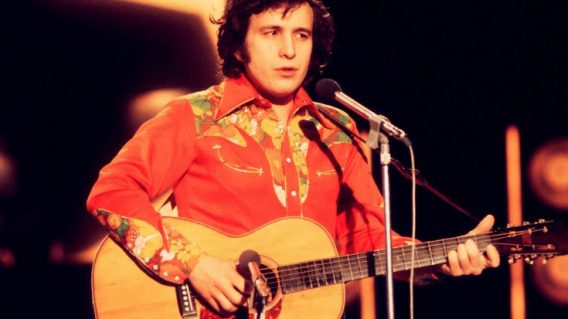
Clair, by Gilbert O’Sullivan (his 1st of two #1s)

2 weeks, from 5th – 19th November 1972

Actually, the fact that this isn’t on Spotify might be quite telling. Spotify might be on to something… Let me explain. First up, we have whistling. Whistling in pop records rarely leads to good things. (There are notable exceptions, I will admit, but still.) Clair, The moment I met you, I swear, I felt as if something somewhere, Had happened to me… The tune is jaunty but bittersweet, the production very soft-focus. It’s easy-listening – the softest of seventies soft-rock.

Who is Clair? Must be his girlfriend, right? A guy called Gilbert writes a song about a girl called Clair. Words mean so little, When you look up and smile… Yadda-yadda-yadda… I don’t care what people say to me, You’re more than a child… Wait a second. Plot twist. Why in spite of our age difference, Do I cry, Each time I leave you…

Ah… she’s his daughter. Which kind of excuses the cutesy shlock factor. He’s written a love song to his daughter. Aw… But no. The mystery of ‘Clair’ continues to unravel. Nothing means more to me than hearing you say, I’m going to marry you, Will you marry me Uncle Ray…? What now? Who’s Uncle Ray?? I give up, and resort to Wiki.

GILBERT_OSULLIVAN_CLAIR-347660

Where I discover that ‘Clair’ was the child of O’Sullivan’s producer, and Ray is Gilbert. He would sometimes babysit his friend/producer’s daughter. He has written a chart-topping single about a child he sometimes babysat for. Process that over the horrible harmonica solo…

It’s clever, I guess. It’s like a murder-mystery novel that keeps you guessing till the end. And it ends with a flourish – I quite like the lines in the final verse in which he’s trying to put Clair to bed: Get back into bed, Can’t you see that it’s late, No you can’t have a drink… It’s quite modern, like today’s beanie-hat wearing singer-songwriters picking lyrics out of the mundane. If Tom Walker wrote a song about babysitting, it might sound a bit like ‘Clair’.

But the final verse can’t redeem the song as a whole. It’s pretty terrible (and crucially, if you miss the bit about babysitting, it sounds super, super creepy…) And just to rubber-stamp this song’s terribleness, the real-life Clair giggles on the final note, like a doll in a horror movie. Oh Clair…

Gilbert (Raymond) O’Sullivan – I assume that he was going for a pun on ‘Gilbert & Sullivan’ with his stage name? – is an Irish singer-songwriter who had been scoring hits since a couple of years before his first #1. ‘Alone Again (Naturally)’ had been his biggest hit earlier in the year: a #3 in the UK and huge #1 on the Billboard 100. He’ll have one more chart-topper in early ’73, with a song I already know and that I can confirm is much better than this.

One final note: ‘Clair’ was at #1 for the twentieth anniversary of the UK Singles Chart. We have covered two decades’ worth of chart-topping singles, plus a diversion or two, in just over two and a half years, since my first post on Al Martino’s ‘Here in My Heart’! Well done to everyone who has been keeping up!

Listen to every other UK #1, here

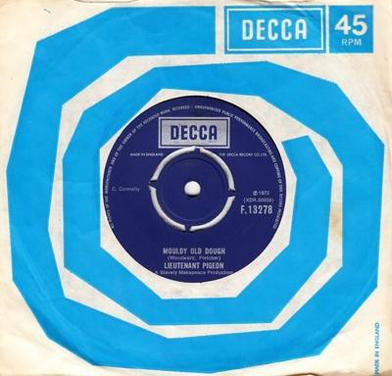
321. ‘Mouldy Old Dough’, by Lieutenant Pigeon

I’ve heard of this song before – for better or for worse – but don’t think I’d ever heard it, in full, until now. And boy, is it strange…

lieutenantpigeon000

Mouldy Old Dough, by Lieutenant Pigeon (their 1st and only #1)

4 weeks, from 8th October – 5th November 1972

It starts with a military drum beat, and for a second I’m worried that we’re getting 1972’s second pipes ‘n’ drums #1 single. Then we get a flute, and I’m picturing an orange march. Then we get a boozy, woozy, synthesised rock ‘n’ roll piano, and we’re in a crowded German beerhall.

Two immediate points of reference jump out at me. There’s Chicory Tip’s similarly stomping ‘Son of My Father’ from a few months back. And then there’s the work of Joe Meek a decade ago: The Tornados, and ‘Have I the Right?’ and so on. There’s a lot of similarities there, but they don’t fully explain what the hell is going on here.

‘Mouldy Old Dough’ is an instrumental, save for the title being growled by what sounds like a very old man with no teeth. Apparently the line Dirty old man… is also buried in there, deep within the soupy mix, but I can’t make it out. It is so rough and ready, this record. It sounds like an old demo that was burnt, buried in a shallow grave, then dug up years later, released and sent to the top of the charts…

download

Have you ever eaten durian? It’s a huge spiky fruit, really popular in south-east Asia, with a smell somewhere between sweaty socks and rotten onions. Apparently, though, if you can get past the stench the actual flesh of the fruit is quite nice. I’ve never been able to get past the stink but feel that ‘Mouldy Old Dough’ might be the durian fruit of #1 singles. Get past your initial doubts and reservations, your initial what the hell?, and by the third or fourth listen you start to find something charming buried deep within its relentless, plodding, churning beat.

The backstory of Lieutenant Pigeon only adds to the record’s charm. They were an experimental band from Coventry, fronted by Rob Woodward, and featuring his mum, Hilda, on piano. She’s basically the star of this record, as it’s her melancholy piano line that holds it all together. ‘Mouldy Old Dough’ was recorded in their living room (what I mistook for synths is just poor sound insulation!) When asked what it was all about, Rob admitted that he had no idea… Despite being the composer. Honest. I like it. The follow-up to this, ‘Desperate Dan’, made #17 and after that the charts were a Pigeon-free zone… The Woodwards are still the only mother and son combo to ever top the UK singles chart.

And isn’t that nice? Lieutenant Pigeon still record and release music to this day, mainly online, while Hilda died twenty years back. She was fifty-eight when this record hit the top of the charts, and she’s still in the Top 10 oldest people to feature on a number one single. By the end the marching beat has transformed into a glam-rock stomp as we fade out. As weird as this record sounds – and it does sounds pretty darn weird – it still somehow fits in with the styles of the time…

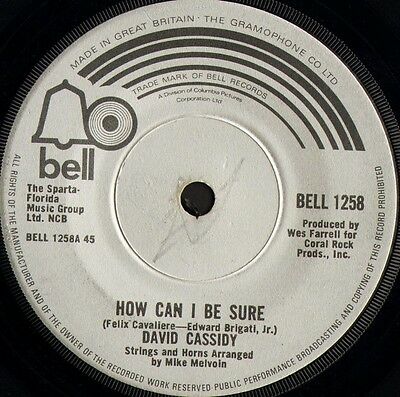
320. ‘How Can I Be Sure’, by David Cassidy

Unluckily for David Cassidy, I arrive at his first UK chart-topper – ‘How Can I Be Sure’ – and instantly think of Dusty Springfield’s version of the same song. It’s a version that I’ve known for years, and it puts young Cassidy at a bit of a disadvantage…

nintchdbpict000368494384

How Can I Be Sure, by David Cassidy (his 1st of two #1s)

2 weeks, from 24th September – 8th October 1972

…for which singer would want to be compared against Dusty? But hey. I’ll try to keep an open mind. This version opens a little gently: echoing guitars backed by an annoying ting – like a typewriter reaching the end of a line – before settling into a French accordion’s sway. Whenever I, Whenever I am away from you… I wanna die, Because you know I wanna stay with you…

Dramatic, right? Except this record never quite reaches the levels needed to sell the lyrics. How can I be sure? I really, really, really, really wanna know… He loves someone, but is overcome with self-doubt. Do they really love him back? How can he ever know? And that’s before you add in the ‘alibi’, who’s going around spreading nasty rumours about him… It’s just a shame that he sings it, for the most part, in a crooning style, never really letting loose. He sings it nicely, and enunciates his words wonderfully, but I’m not sold.

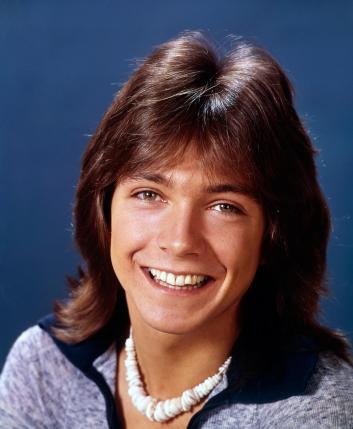
At least it’s not too sickly saccharine. I still have the aftertaste of ‘Puppy Love’ in the back of my throat… In my mind (and remember this all came a decade before I was born), Cassidy was the main rival of Donny Osmond, with the two pre-eminent teen-idols of the day competing to see who had the whitest smile and the most perfectly set hair. Both came from a showbiz family too, though Cassidy’s was the made-for-TV ‘Partridge Family’. In reality, Cassidy was a decade older than Osmond, so they would surely have been competing for different audiences, and by 1972 he had been photographed nude on the cover of ‘Rolling Stone’ by Annie Liebovitz and had been reported to have taken – shock horror – recreational drugs.

s-l400

So, David 1 Donny 0, if indeed it was a competition at all. You would, after all, have to go to some lengths to make a worse record than ‘Puppy Love’. At the same time, I’m struggling to have a strong opinion on this song. It’s fine. It’s nice enough. It’s no Dusty. It’s the perfect proof of a truly great singer, when they can take lyrics that sound a little trite in the voice of another, and give them meaning… But I do like the ending here, as the lines How can I, How can I, How can I… tumble and cascade over one another, like a wonky soundtrack in a circus big-top.

‘How Can I Be Sure’ had been around for a few years by the time David Cassidy recorded his version. It was originally a hit for The Young Rascals in 1967 – their version is meh – before Dusty in 1970 and David two years after that. And we’ll hold off on a full Cassidy bio, as he has another #1 to come in a year or so. Though, I have to admit that, until a few seconds ago, I had no idea that he passed away a few years ago…

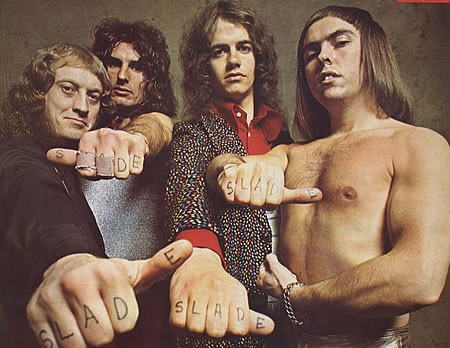
319. ‘Mama Weer All Crazee Now’, by Slade

Slade’s third chart-topper in well under a year – a mean feat that not many other artists can boast of. And it enters with all the swagger you’d expect from a band well on their way to being the biggest in the land. As Noddy sums it up in the intro: Awooooooooo!

R-678569-1179609837.jpeg

Mama Weer All Crazee Now, by Slade (their 3rd of six #1s)

3 weeks, from 3rd – 24th September 1972

The riff could never be described as sophisticated, or revolutionary, but it’s perfect in its own way. A riff that does the DJ’s job for him, by announcing ‘Here’s the latest single from Slade…’ Meanwhile the drums are deep and beefy and the bass kicks. We’re all set up for a good time.

Similarly, the lyrics aren’t going to change the world; but they are a statement of intent. Holder is at his sneery, husky best as he announces: I don’t want to, Drink my whisky like you do… The kids are going to do things their own way. I don’t need to, Spend my money but still do… Did someone say ‘teenage rebellion?’ Think ‘Son of My Father’, but in the simplest, Sladest terms.

I said mama, But we’re all crazy now… the band hollers as mum bangs on the bedroom door, wondering what this noise is. A year so ago, the top of the charts was full of easy-on-the-ears, grown-up pop – ‘I’m Still Waiting’ and ‘Woodstock’. But 1972 has seen the #1 spot reclaimed by the kids: teeny boppers and glam rockers. It’s like the fifties all over again, but with more make-up.

R-6483389-1420314229-8008.jpeg

Is ‘Mama Weer All Crazee Now’ a little basic? Probably, but that’s the point. It’s a song about having nothing but a good time. Another drop now, come on… I want the lot now, come on… About being young and reckless and not giving two shits. Jim Lea, the bassist, was inspired to write it after looking out on Wembley Arena after the band had played a gig, and surveying a hall full of broken seats and empty bottles. Plus he wanted a chorus – a chant, even – that the audience could sing back to them at full volume.

The record ends with that line repeated over and over, until it’s reduced to a stutter: Ma-ma-ma-ma-ma-ma-woooooooo! Glorious nonsense. (Isn’t that the perfect description for glam rock?) Actually, I’ve just had an idea, a way of categorising the glam rock acts of the early seventies, using British supermarkets as gradients (Apologies to any non-British readers who will have no idea what I’m on about, please skip ahead if you like…) If Bowie was Harrod’s Glam, then T. Rex were Waitrose Glam. Slade? Slade were Tesco glam: no frills and popular across the land. And LIDL Glam? That was Mud.

Anyway, nothing wrong with being the Tesco of glam. Whenever I’m back in the UK, Tesco’s one of the first places I go. And it didn’t hold Slade back any. ‘Mama…’ was their 3rd of six #1s, and the last not to enter at the top of the charts. Very, very few records entered at #1 before the mid-nineties. Slade will go on to do it three times. Enjoy the video below, then, as the sound of a band just about to go stratospheric…

318. ‘You Wear It Well’, by Rod Stewart

In which Rod Stewart scores his second number one single, by releasing a song that sounds suspiciously like his first. I mean, ‘Maggie May’ had been such a huge hit, his now-signature song, that you can’t blame him for trying to re-bottle lightning.

c1lq-28tuss-_sl1000_1

You Wear It Well, by Rod Stewart (his 2nd of six #1s)

1 week, from 27th August – 3rd September 1972

Not that it’s a rip-off (can you even rip-off your own song?), but it’s similar enough to sound like an off-cut from the same recording session. The intro meanders, as it did in ‘Maggie May’, before two drumbeats – dun dun – signify that we’re ready for the song proper to get underway.

I had nothing to do, On this hot afternoon, But to settle down and write you a line… Rod’s reminiscing about a woman he once loved. Who knows, maybe it’s Maggie…? He’s been meaning to call her, but thinks a handwritten letter would tug the old heartstrings a bit more effectively. You wear it well, A little old fashioned but that’s alright…

He reminisces about basement parties, her radical views, a birthday gown he bought her in town… Then he lays on the charm: Madame Onassis got nothing on you… It’s another wordy ballad, a little more electric than acoustic this time, while the fiddle from ‘Reason to Believe’ – the flip-side of his first #1 – makes another appearance to add some homespun charm. To be honest, I’m struggling to get into ‘You Wear It Well’. It’s a bit plodding, and the words sometimes get lost in the mix.

-688033

When you look the lyrics up, though, you see that there are some nice touches. The fact that he didn’t call because he’s in Minnesota and, y’know, that’d be a bit pricey, and the line: My coffee’s gone cold and I’m getting told, That I gotta go back to work… While at the end Rod hopes that she’s still at the same address. It’s not a record without charm; you just have to give it a few listens and dig a little deeper to find it.

But, you’d have to admit that if he had been trying to recapture the magic of his debut chart-topper then he’s not quite managed it. It’s strange to think that of all Rod Stewart’s big seventies hits which didn’t make the top of the charts – ‘You’re In My Heart’, ‘Tonight’s the Night’, ‘Hot Legs’ – ‘You Wear It Well’ did.

A short post, then. A nice enough song, and a nice enough addition to 1972’s parade of chart-toppers. It seems that to hit #1 in the summer of ’72 your record either had to be glammed up to the eyeballs, soppy teenybopper fluff, or an acoustic ballad. Let’s spin the tombola and see what pops up next…!

Follow my #1s playlist on Spotify:

317. ‘School’s Out’, by Alice Cooper

Aw, hell yeah! School heartthrob Donny Osmond finds himself elbowed out the way by school bad boy, and shock-rocker supreme, Alice Cooper. No more mister nice guy indeed!

D5rMk28WAAAr1nl

School’s Out, by Alice Cooper (their 1st and only #1)

3 weeks, from 6th – 27th August 1972

The charts of 1972 continue to swing wildly: acoustic ballad to glam to teeny bopper pap to this. Some anarchic hard rock. And it’s a great record, right from the start. The riff rings out, loud and clear, before the drums and the bass are added. (There are three songs that I cannot tell apart for the first five seconds or so: this, ‘Born to Be Wild’ by Steppenwolf, and Iggy Pop’s ‘The Passenger’. They don’t even sound that similar, so I’m not really sure why I have this problem…)

Vince Furnier said in an interview that in ‘School’s Out’ he was trying to capture the last three minutes of the school year which, along with Christmas morning, is the best moment of a child’s life: the nervous tension, the excitement, the sense that wonderful chaos is just around the corner. I’d say he managed it. Well we got no choice, All the girls and boys, Make all the noise, Cos they’ve found new toys…

There are famously no real punk-rock #1s… Is this, then, the first and only punk #1, several years before anyone knew what ‘punk’ was? It soon becomes clear that this isn’t just a song about two months of sun and no homework; it’s an anarchist’s manifesto. School’s out for summer… then it’s out for ever… then it’s been blown to pieces. The playground chants in between the verses move from No more pencils… To We might not come back at all…

R-15604226-1594390979-2958.jpeg

The best bit is the second verse, with its word-play: Well we got no class, And we principles… and the so dumb its actually pretty clever last line: We can’t even think of a word that rhymes! And then there’s the final verse – perhaps the heaviest moment in a #1 single so far – where the lead guitar squeals, and the drums beat out a pounding, tribal rhythm, as if the kids have rounded up all the teachers for a ritual sacrifice. Morality campaigner Mary Whitehouse managed to get it banned from featuring on ‘Top of the Pops’, an act for which Furnier sent her a bouquet of flowers in thanks for the free publicity.

‘School’s Out’ was the breakthrough hit for Alice Cooper, who had been seen as a bit of a novelty act until then with all their make-up and on stage pyrotechnics (they were friends of Arthur Brown). And actually, maybe ‘School’s Out’ still suffers from being seen as a novelty song, when in actual fact it’s a great hard rock track. The band would score a few more Top 10s off the back of this, before ‘Alice Cooper’ became Vince Furnier’s solo act. His biggest hit will arrive many years later: ‘Poison’ coming oh so close to the top in 1989.

In the end the bell rings, everybody cheers and then we all get sucked into a blackhole, a cool effect that caps off a startlingly fresh sounding #1 single. OK, in the end it might not quite be ‘punk’, but I’ll bet it felt amazing blasting this record out on the final day of 1972’s summer term. And speaking as a teacher, I have to say that this song speaks more to me now than it ever did as a kid…

316. ‘Puppy Love’, by Donny Osmond

Oh man. It seems that for every great song we get at the moment, there’s a bloody awful one coming right up behind. ‘Metal Guru’ – transcendent, ‘Vincent’ – beautiful, ‘Take Me Back ‘Ome’ – gritty… ‘Puppy Love’… Oh…

5ef4de88e533c9dd50033fb8bf65da15

Puppy Love, by Donny Osmond (his 1st of three #1s)

5 weeks, from 2nd July – 6th August 1972

Well, we all know how this one goes, don’t we? I’m not sure how, because it’s not a song you will ever hear on the radio these days, but ‘Puppy Love’ has still somehow seeped into our collective conscience. And it’s a record that sets its stall out from the start – from the opening seconds you are left with no doubt that this song will be as saccharine and cloying as the title suggested.

The intro soars and pirouettes, like they used to in the fifties, before wee Donny goes for it: And they called it, Puppy love, Oh I guess they’ll never know, How a young heart really feels, And why I love her so… His voice doesn’t sound real. I don’t mean that it’s touched up with autotune, or any other kind of modern-day trickery. I mean that it’s impossible to imagine an actual human being sounding this soppy.

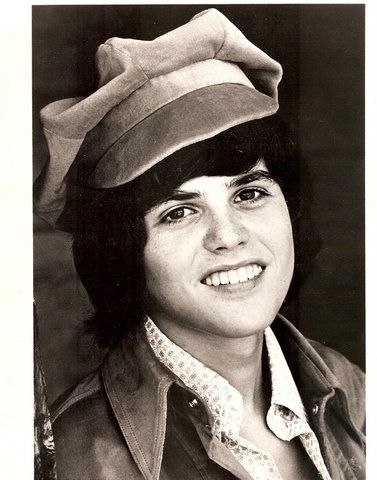
And they called it, Puppy love, Just because we’re in our teens… The song’s premise being that ‘puppy love’ is what you call the sort of chaste, pecks-on-the-cheeks-and-notes-passed-in-class crush you get in Year 6. While Donny is quite adamant that his love is for real, that he and his girl should be taken seriously: How can I, Oh how can I tell them, This is not a puppy love…? Which means, you realise with a shudder, that lil’ Donny – just look at those eyes up there! – is actually a randy little horn-dog.

I am clearly not the target of this song. I am not a thirteen year old girl from the early 1970s, for a start. But it is terrible. If you wanted to write a cheesy pastiche of a fifties pop hit, you’d write a song that sounds a lot like ‘Puppy Love’. The bit where the music drops off and Donny pleads: Someone, Help me, Help me please… is simultaneously one of the most annoying moments in a #1 single, and yet quite funny. If you don’t think too much, it is just about possible to get swept away by the stupid melodrama of this record.

donny-osmond-puppy-love-mgm

This is actually quite a significant moment at the top of the charts, I’d say. Of course, Donny Osmond is not the first teen-idol to trouble the hit parade, or the #1 spot. And ‘Puppy Love’ is not the first piece of schmaltz to catch the public’s imagination. But having the two thrown together so shamelessly? It feels very post-sixties. Very glam, in a way. A complete triumph of looks over substance. Though ‘Puppy Love’ was a much older song (almost older than Osmond himself) having been recorded by Paul Anka in 1960, making #33. Having listened to Anka’s version, it’s actually a relief to return to this cover…

Donny Osmond was fourteen when this hit top spot, making him the joint-youngest chart-topper, tied with Helen Shapiro. But for God’s sake, listen to Shapiro’s ‘You Don’t Know’ and compare it with this drivel. They do say girls mature quicker than boys… Would tweenage girls still fall for someone like Osmond in 2020? Probably, if their version of ‘Puppy Love’ was Tik-Tok friendly. I remember being at high school (so not that long ago) when the legendary S Club Juniors took a version of it back into the Top 10. And actually, my first thought when I saw the picture of Osmond above was that he looked just like a 2010 Justin Bieber. Which goes to show: a cute white boy with a bowl-cut always has, and always will, sell…

315. ‘Take Me Back ‘Ome’, by Slade

As great as our last chart-topper ‘Vincent’ was, you wouldn’t want to listen to it every day. Thank God, then, for Slade, getting us back into a hard-rocking, glam-boogying groove.

Slade 00

Take Me Back ‘Ome, by Slade (their 2nd of six #1s)

1 week, from 25th June – 2nd July 1972

Their first number one, ‘Coz I Luv You’, was great but, as I noted at the time, it didn’t sound like the Slade that would go on to grab the charts by the balls. Their second chart-topper, though, sounds 100% like Slade. We’ve got Noddy hollering, a nasty riff, and some

Imagine the scene: closing time at a pub in Wolverhampton. Last orders, in more ways than one. Noddy needs a girl for the night, so he gets a wooing. Came up to you one night, Noticed the look in your eyes, Saw you was on your own, And it was alright… He has a way with words to rival Mungo Jerry and their attempts on ‘Baby Jump’: You and your bottle of brandy, Both of you smell the same… Is she really as rough as she sounds, or is he just a brute? Either way, I love the complete and utter lack of glamour.

So take me back home, Take me back home, And we can find plenty to do, And that will be alright… It’s an unsophisticated song. The hook is simply Holder drawing out his ‘all-rights’ in a sneery way. But, it’s great. I kept thinking that the riff sounded familiar, and then I realised that it simply sounds like 50% of Oasis’s mid-nineties output. (They always get the Beatles comparisons, but to me they ripped Slade off just as much. Anyway, more on Oasis in twenty years or so.)

SLADE_TAKE+ME+BAK+OME+-+WIDE-686833

By the second verse, the handclaps have turned into terrifying horse-whips, increasing the glam-stop even further. And by the third verse, the girl’s boyfriend, who’s twice the size of Noddy, has turned up. I didn’t stay around to say goodnight… But it was alright… We fade out with Holder trying to punch through brick walls with his voice, then doing his best Marc Bolan stutter.

So Slade are a-go. Although I’d rank ‘Take Me Back ‘Ome’ more alongside the Stones’ bluesy numbers from the sixties, ‘Honky Tonk Women’, ‘Little Red Rooster’ and the like, than  the pure glam that was to come. Few #1s have been as low-down and dirty as this. But, I like that this came just two weeks after T. Rex’s final chart-topper, ‘Metal Guru’, and that it feels like a passing of the glam-rock flame. Slade were now poised to become the biggest band in the country, and we’ll hear a lot more from them in the next year and a half.

314. ‘Vincent’, by Don McLean

From the glorious, life-affirming swagger of ‘Metal Guru’… to one of the saddest #1 singles ever recorded.

mclean-american-pie-getty--735x413

Vincent, by Don McLean (his 1st of two #1s)

2 weeks, from 11th – 25th June 1972

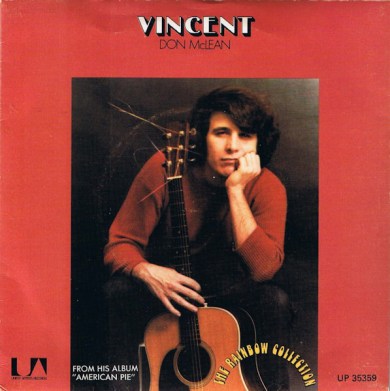
The ‘Vincent’ in question is the Dutch artist Vincent Van Gogh, who lived and painted in the late 19th century, to little recognition and with failing mental health until severe poverty and depression led to him shooting himself. Not the cheeriest of topics to start with, even before we get to the song itself, and certainly not the usual territory of pop singles.

It’s also one of the most articulate and descriptive chart-topping singles yet. Don McLean takes Van Gogh’s most famous works and turns them into lyrics: Starry, starry night, Paint your palette blue and grey, Look out on a summer’s day, With eyes that know the darkness in my soul…

It’s just a voice, an acoustic guitar, and some light, light backing touches. The gist of the song is that the singer sympathises with Vincent, that he recognises something of himself in the artist’s struggle (this was written before McLean hit the big time with ‘American Pie’), and that perhaps Vincent was the sane one after all. If people know one thing about Vincent Van Gogh, it’s that he cut off his ear and sent it to his brother. But that’s not all that he was. Now I understand, What you tried to say to me, And how you suffered for your sanity… It works also in the voice of Van Gogh’s brother, Theo, who was entwined in Vincent’s life, and who suffered equally under his brother’s illness. It’s strong stuff.

I love the idea that Van Gogh was too pure, too good for this ordinary world. It comes to a height midway through, as McLean describes the day Van Gogh committed suicide: For they could not love you, But still your love was true, And when no hope was left inside on that starry, starry night, You took your life as lovers often do… Some artistic license there, as he shot himself in a wheat field during the day, but it’s a powerful image – that he could have died on a night like the one in his most famous painting. But I could have told you Vincent, That this world was never built for one as beautiful as you… There’s also an urban legend that ‘Vincent’ was played to rapper Tupac on his death-bed, after he had suffered the same fate as Van Gogh. It was, apparently, his favourite song.

R-1456931-1342348675-5628.jpeg

It ends on a gut-punch. Each previous verse has ended on the hope that: They did not listen, They did not know how… Perhaps they’ll listen now…. On the final note, however, this changes to: They were not listening, They’re not listening still, Perhaps they never will… The idiots will always outnumber us. We’re all doomed…

Acoustic singer-songwriter type music is far from being my favourite genre. It’s all too easy to sound clever and profound as long as you sing softly enough and don’t plug your guitar in. Especially in the past few years, every male solo artist to hit the charts seems to have a beard, a beanie hat and observations to make. (I blame Ed Sheeran, personally, but then I’d happily blame all the world’s problems on Sheeran.) However, when a song is written and performed as beautifully as this, with a genuine message and genuine emotion, it’s very powerful. Don McLean had made his name just a few months before with ‘American Pie’, another song built around the death of a cultural icon. You have to wonder if ‘Vincent’ would have been such a big hit had ‘American Pie’ not come along first (it had reached #2 in the UK), especially as this sounds so out of place in a chart dominated by glam and bubblegum, though you’d hope it would have.

Last winter, in those final, blissful pre-coronavirus days, I visited the Van Gogh Museum in Amsterdam. If you have the chance to go one day, do! It displays his pictures in chronological order, and gives the background to his circumstances and mental state at the time of painting. When you get to the end, and see his very last works, it’s genuinely affecting. Maybe this song wouldn’t be hitting me so hard, had I not been there? Who knows. Under the museum is buried a time-capsule containing Vincent’s paintbrushes, and the sheet music to this song. Tens of thousands walk above it every year, to see the work of a once-ignored painter. People did listen, eventually.

313. ‘Metal Guru’, by T. Rex

I do love the fact that whenever a T. Rex #1 comes along, it usually whacks something terrible out of the top spot. ‘Get It On’ deposed ‘Chirpy Chirpy Cheep Cheep’, ‘Telegram Sam’ ended The New Seekers’ attempts to teach the world to sing. Now this, T. Rex’s final (!) UK chart-topper ends five long weeks of bagpipes.

359c31ba10d7bd50a4c4f0558f61ab4f

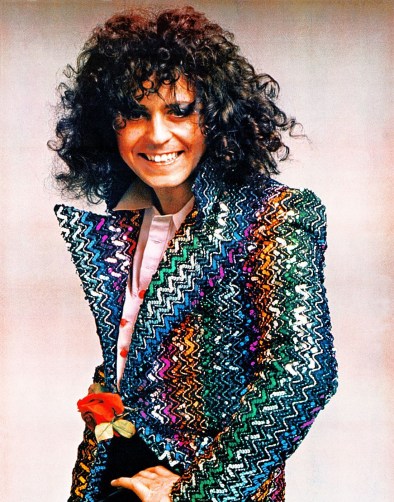
Metal Guru, by T. Rex (their 4th and final #1)

4 weeks, from 14th May – 11th June 1972

And while we wipe a tear at the thought of never hearing Bolan’s boys again in this countdown, are we consoled by the fact that perhaps they saved their best for last…? It’s a record that soars in from on high, one that starts right in the thick of the action: Woah-oah-oah-oah… Yeaaaaaaahhhh!!!

Everything you want from a T. Rex song is present and correct. Stomp and swagger? Check. An irresistible, bubblegum hook? Check. Nonsense lyrics? Check. Metal guru, Is it you… Sitting there in your armour plated chair, Oh yeah… There’s as much point in asking what a ‘Metal Guru’ is as there was in enquiring about a ‘Telegram Sam’. Apparently, it is Marc Bolan’s idea of a God, on his throne. All alone without a telephone, Aw yeah…

And, as usual, in amongst all the madness, there’s a gem or two. Who wouldn’t want to have a silver-studded, sabre-toothed dream? Bolan’s delivery is imperious: camp, floaty, playful. He’s at the height of his powers, and you can imagine this being played at the end of a concert, the final song in the second encore, as the tired and emotional crowd sing and sway along.

R-475934-1149151136.jpeg

I called this their best #1, as it’s everything that makes T. Rex great, distilled and concentrated into the perfect two-point-five minute pop song. The sound is beefier than their earlier chart-toppers – just listen to the cascading drums, for example – as if glam rock were being mixed and produced by Phil Spector. (If the thought of a Glam-Rock Spector does nothing for you, then you are dead inside.) At the same time, ‘Metal Guru’ is so short and throwaway, so quick and effortless, that you could almost call it disposable. And yet – isn’t that the essence of glam? It’s not to be taken seriously; all sugar and little substance…

Has there been any other band that has had four consecutive number ones of such high quality. ‘Hot Love’, to ‘Get it On’, to ‘Telegram Sam’, to this. The Beatles, for sure, and maybe the Stones. Away from the very top of the charts, their run of ten hits from late 1970 to mid 1973 is superb. The likes of ‘Jeepster’, ‘20th Century Boy’, and ‘Children of the Revolution’ – all of which charted no lower than #4. They were the biggest band in the land, by far, and Bolan was the rock ‘n’ roll idol of his day – a position which he was born to fill.

I’ll do a T. Rex Top 10 soon, so will go easy on the bio for now. Suffice to say, the glory days didn’t go on much longer – glam rock wasn’t built to last – and Bolan started taking lots of drugs and rubbing people up the wrong way. Not that he lost the ability to write brilliant pop songs – some of the smaller hits from 1975-77 are great – but he certainly fell from his pedestal. He was just starting to get it together, working with up and coming punk acts and fronting his own TV series, when the car he was travelling in with his girlfriend Gloria Jones slammed into a tree in South London. He died instantly, aged just twenty-nine. And who knows – perhaps he went on up to meet the big Metal Guru in the sky…?

Follow my playlist below for all the #1s so far: