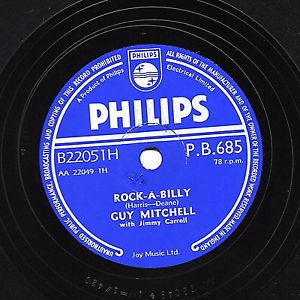
58. ‘Rock-A-Billy’, by Guy Mitchell

s-l300 (2)

Rock-a-Billy, by Guy Mitchell (his 4th and final #1)

1 week, from 17th – 24th May 1957

Part 58, in which Guy Mitchell scores his latest UK #1 single with a rockabilly record entitled… ‘Rock-a-Billy.’ Imagine if Eminem were to release a song called ‘Rap’, or Ed Sheeran were to record one called ‘Bland Shite’ – that’s where we are right now. This is a record that does exactly what it says on the tin.

It’s another fast-paced chart topper – not quite as frantic as ‘Cumberland Gap’, but then what is? – that rolls along on jaunty guitars and a Winifred Atwell-esque piano. While lyrically it takes the term ‘generic’ to new levels. This is a song about a man and his love for rock ‘n’ roll music, to which the chorus goes:

Rockabilly, rockabilly, rockabilly, rock… Rockabilly, rockabilly, rock, rock, rock… Rockabilly, rockabilly, rockabilly, rock… Rockabilly, rockabilly… Rock! Rock!

Anyone who claims that modern pop is dumbed-down nonsense; point them in the direction of this record. The verses aren’t much more highbrow. There’s some silliness about the history of rockabilly music – it came from Tennessee, spread on out to the lone prairie – and then a lot of advice on how to dance to this crazy new music:

From the moment that you feel this crazy beat, You gotta lose control of your two left feet, Give me mountain juice, Turn me loose, Leave me wave my arms about…

It’s the latest song in a growing list where I’ve had to look the lyrics up online, rather than transcribe them by simply listening to them, as Guy Mitchell does a good bit of growling and slurring. (Actually, if you listen to his first chart-topper, back in 1953, and now this, Mitchell’s voice does have a harder edge – perhaps he was altering it to fit the style of the time? Or maybe he was just getting older?) Plus… is that reference to ‘mountain juice’ the first mention of alcohol, of drugs, of any kind of intoxicant in a UK Number One Single? I think it might just be… We truly are rockin’ and rollin’!

However, although I’m bandying terms like ‘generic’ and ‘silliness’ around, I wouldn’t want anyone to think for a second that I don’t like this song. It’s great. It’s dumb. It’s fun. I like it like how I like sherbet dib-dabs: I know there are ‘better’ foodstuffs to shove down my gullet, but I know I wouldn’t enjoy them half as much. It is a song that I dare anyone to dislike, a song that’s programmed to hit all the most primal happiness receptors in your brain. It’s got four key-changes, for God’s sake! The best bit of all is the bridge, which strangely comes right at the end, and which is positively life-affirming: You know what rockabilly’s all about, You know it’s gonna make you sing and shout, You know you’re gonna act like a crazy fool, Who cares? It’s cool! Yes, dance people! Dance like no one’s watching. Guy says so!

1100-86

We have to bid farewell to Mr. Mitchell here, following this short encore at the top of the charts. And I have to admit that I’ll miss searching for pictures of his handsome face to add to these posts. His first chart-topper was… interesting, but the subsequent three – ‘Look at That Girl’, ‘Singing the Blues’ and now this – can legitimately go down as classics of the early rock ‘n’ roll/pop crossover. Few, if any, artists can claim to have been as consistently popular throughout the 1950s as Guy Mitchell: he had his first US Top 10 single in 1950 and his last in 1959. And we leave him here as the man with the joint most UK #1s, a record which he’ll hold for a couple more years.

Anyway, I’m on my seventh listen of ‘Rock-a-Billy’ as I type this sentence, and with every listen I like it more. I’d better stop before I begin claiming that it’s the best song ever recorded. One final thought, though: it’s telling that the biggest stars of this fledgling ‘rock age’, at least in UK chart terms, were Guy Mitchell and Johnnie Ray – two already very established artists who jumped on the rockin’ bandwagon and started scoring huge hits once again. A case of mass-appeal, perhaps? The kids liked the cool new music, while mum and dad trusted good ol’ Guy to keep it respectable? More respectable than arrivistes like Elvis, Chuck and Little Richard at least? Not that this will last long, but still. An interesting mini-era in rock music: the oldies outselling the upstarts.
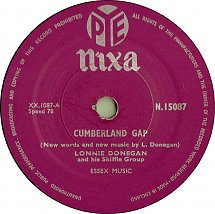
57. ‘Cumberland Gap’, by Lonnie Donegan & His Skiffle Group

lonnie-donegan-cumberland-gap-pye-nixa-78-s

Cumberland Gap, by Lonnie Donegan & His Skiffle Group (their 1st of three #1s)

5 weeks, from 12th April – 17th May 1957

I take it all back, what I said in my last post: we are rockin’ and a-rollin’ again. In a very British kind of way. With a very American song.

I’ll explain all that in a minute, but let me start by mentioning the fact that this is a blistering little record. Two minutes of lean, mean, frantic rock. Or more specifically, skiffle. For which read: ‘British Rock ‘n’ Roll’. I’ve mentioned it before, and I’ll no doubt mention it again, but this is the best thing about a countdown of records based on sales alone: that songs like ‘Cumberland Gap’ can follow on from songs like ‘Young Love’. One follows the other, like night follows day; polar opposites of one another but somehow eternally linked.

The guitar starts lightly, then grows, along with the bass and the drums, before Lonnie Donegan’s voice comes in. Singing about something called ‘the Cumberland Gap’. I say ‘something’, because whatever it is isn’t immediately clear from all his squealing and squawking: Well the Cumberland Gap, Cumberland Gap, Fifteen miles on the Cumberland Gap… The Cumberland Gap, Ain’t nowhere, Fifteen miles from Middleburgh…

Note that it’s Middleburgh, not Middlesbrough. We’re in the US, here – with all the yee-hahs and yodels that that entails. But then we take a strange turn, and it all goes a bit East-End music-hall: Well I got a girl, Six feet tall, Sleeps in the kitchen with her feet in the hall… Two old ladies, Sittin’ in the sand, Each one wishin’ that the other was a man…

What this girl and these old women have to do with the ‘Cumberland Gap’ isn’t expanded upon, and Donegan doesn’t hang around either. The lyrics are replaced by straight up screams and a frenetic solo. The song ends with a verse that is just da-dee-dee-dees and a mumbled something about how much he loves ya baby, and then the song title is repeated several times – loud, then quiet, then VERY LOUD and then boom. Done. Phew! You can see why some learned types have referred to this as the first ever punk record.

lonniedonegan1_2398941k

I have to admit – I’m not sure that I love this record. It’s a bit much. But I do love that it spent five weeks at the top of the UK Singles Charts in the spring of 1957. That the public’s taste in music had evolved enough to allow a song which is essentially a lot of screaming and mumbling such an extended moment in the sun. And I take back what I said about rock being dead, deader than dead. It’s obviously not. I overreacted.

Before I finish, I had to find out what in God’s name the Cumberland Gap actually is. Turns out it’s a mountain pass, located at the convergence of Kentucky, Virginia and Tennessee, which allowed old American frontiersmen such as Daniel Boone to pass across the Appalachian Mountains and conquer the wilderness that was The Wild West. Add this, then, to the list, alongside ‘The Man from Laramie’, ‘Hey Joe’, Slim Whitman and Tennessee Ernie Ford, as the latest piece of Americana to find a place at the top of the charts. Was it exoticism? Was it envy? Why were we so obsessed with America? Perhaps we still are.

However, knowing what the Cumberland Gap is has gone no distance in helping me work out what the hell this song is about. As a song it had been around since at least the mid-to-late 19th Century as a folk ditty. Wikipedia mentions lyrics about ‘taking naps’ in the Cumberland Gap, and ‘raising hell’ in the Cumberland Gap, but nothing about six-feet tall women. Perhaps Donegan added those verses himself, and in doing so created the perfect fusion of American rockabilly and British silliness.

We’ll hear from Lonnie Donegan again, and soon. So I won’t delve too deeply into his back-story. ‘Cumberland Gap’ was only his fourth hit single in a chart career that would stretch deep into the sixties and which would bring great success. It is worth noting, though, that he was born in Glasgow and so, after having had an Italian, a Cuban, a Trinidadian and tons of Americans already top the charts, the 57th UK #1 single goes to a Scot.

56. ‘Young Love’, by Tab Hunter

s-l300 (1)

Young Love, by Tab Hunter (his 1st and only #1)

7 weeks, from 22nd February – 12th April 1957

I’ve been bigging up the arrival of rock ‘n’ roll to the top of the UK charts for so long – especially back when we were plodding through all those dreary, brow-furrowingly earnest pre-rock ballads – that this next statement goes against every instinct I have…

By the time it got to the top of the UK charts, rock ‘n’ roll was over. Finished. Defunct. Obsolete.

I recently claimed that the rock era began on 11th January 1957, when bona fide teen-idol Tommy Steele sneered his way to a week at the top. I’m now claiming that the rock era ended on 22nd February 1957, when this limp little record grabbed a scandalous seven weeks at the top.

Because, by God this is bland! That this made it into the record books before Elvis, before Buddy Holly, before Jerry Lee and all the rest doesn’t make sense. It is a rock ‘n’ roll record – there’s a guitar riff and solo, drums, oohs and aahs and all the rest. Plus, the lyrics are all about two kids falling in love for the first time. And it’s called ‘Young Love’!

They say for every boy and girl there’s just one love in this whole world, And I-I-I know I’ve found mine… Young love, First love, Filled with true devotion…

But it’s delivered in such a soppy way that I refuse to acknowledge this as any kind of rock and/or roll. Tab Hunter’s voice is deep and sonorous, but in pictures he looks like the all-American boy next door: rosy-cheeks, blonde curls, blue eyes, church on Sundays, part-time job in the gas station. Your mum would have liked him as much as she would have disliked Tommy Steele. I can imagine a young Cliff Richard taking notes as he planned his assault on stardom a couple of years later (and there are a lot of similarities between Hunters voice here and Cliff’s on, say, ‘Living Doll’). And note the role-reversal – now it’s the Americans giving us staid and boring while the Brits grin and wink! Fittingly, this was #1 on the day my mum was born. I say ‘fittingly’, because she has just about the blandest taste in music going (and is a huge fan of Sir Clifford of Richard).

maxresdefault

And that’s about it. The shortest entry yet. At least, that was going to be it… Until I did my customary Wikipedia-based research about Tab Hunter. Turns out this American-as-apple-pie captain-of-the-school-football-team was – dum dum dum – gay! Is gay, he’s still alive, aged eighty-six. He had to cover it up for most of his career, obviously, and had fake flings with Debbie Reynolds and Natalie Wood among others to throw the newspapers off the scent. Which adds a bittersweet layer to his one and only UK chart topping single, and the lines about boys and girls falling in love.

I’ve listened to ‘Young Love’ several times now, trying to find something to like about – I usually love me a bit of rock ‘n’ roll – but I can’t do it. It’s insipid. And so that’s it. Rock is dead. If it ever existed. Obviously, the top of the pop charts is never the place to look for cutting edge music, but I’m surprised there wasn’t a bit more of an explosion, with some real rockers, before the sell-out began. Or maybe I should just accept that lines were always blurred, that rockabilly merged with blues which had merged with jazz which had merged with the music of the cotton fields to create rock ‘n’ roll over several decades, and not in an afternoon. No more attempting to pinpoint the birth of a musical movement to a particular record.

Anyway, in my next post… The moment skiffle was born!

(Edit: Tab Hunter sadly passed away shortly after this post was published. The Guardian published this obituary, touching on some of the themes mentioned above.)

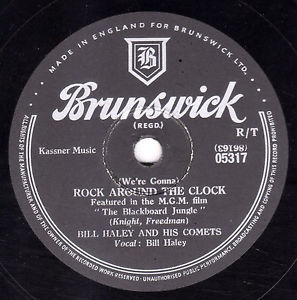
39. ‘(We’re Gonna) Rock Around the Clock’, by Bill Haley & His Comets

s-l300 (1).jpg

(We’re Gonna) Rock Around the Clock, by Bill Haley and His Comets (their 1st and only #1)

3 weeks, from 25th November to 16th December 1955 / 2 weeks, from 6th to 20th January 1956 (5 weeks total)

This is it. Strap yourselves in! A new era begins right… Now!

1, 2, 3 o’clock, 4 o’clock rock! 5, 6, 7 o’clock, 8 o’clock rock! 9, 10…

You know how it goes. Everyone does! Put your gladrags on, join me hon’…

It is undoubtedly ‘rockier’ than anything that’s gone before. Earlier chart toppers have featured guitars and drums – I’ve been surprised by just how many – but none have used the instruments in this way. The guitars stab at the listener, the double bass twangs and the drums bang out a very frisky rhythm. There are lyrics about dancing (more than just dancing…?) and never going to bed, while there’s also a pretty aggressive saxophone solo.

There are two things to consider here, both of which affect how I approach this seminal record. To my cynical modern ears, first of all, it sounds pretty tame, a bit of a nursery-rhyme, a bit babyish. Sixty-three years have done a lot to blunt its edge. Much in the same way that nobody in 2018 is going to be truly disturbed while watching ‘Psycho’, or truly terrified by ‘The Exorcist’, nobody is quite going to get the visceral thrill that this record must have provided when bored sixteen year olds across the land lowered the needle and heard that gunshot-drum intro.

Of course, ploughing my way through the thirty-eight earlier #1s, through the David Whitfields, the Eddie Calverts and the Vera Lynns, has undoubtedly helped this record to stand out. I can understand why this would have been thrilling to the kids and alarming to their parents. I can picture Aunt Marjorie clutching at her pearls. I get why it was so big; why it was the UK’s 1st million-selling record.

ip_2718995

But. Yes, now for the ‘buts’… There’s the well-trodden argument that ‘rock ‘n’ roll’ in this form was already just weak R&B, diluted for a white audience. And Bill Haley wasn’t exactly a shock-rocker. He was in his thirties by the time ‘Rock Around the Clock’ became a hit – plump and very white, with a weird-looking curl of hair stuck to his forehead. The rest of his Comets were similarly plain.

Plus, there’s the fact that this wasn’t a new song, at least not by the time it hit #1. It had been released almost a year earlier, hitting the lower reaches of the chart. Then it was re-promoted and crawled its way to the top, taking longer than any of this year’s other chart-toppers to get there. It certainly didn’t arrive at the top out of nowhere. And, it goes without saying, this wasn’t the first rock ‘n’ roll hit single. Number one singles don’t tell the whole story of the charts.

And, just to cap off my attempt to single-handedly destroy the reputation of this much-admired record, I’ve always thought The Comet’s follow-up single, ‘Shake, Rattle and Roll’ was much heavier, much more in the true spirit of ROCK (fists clenched!) with it’s misogynistic references to women, it’s sax-slash-guitar riff, and its genuinely raunchy lyrics: I’m a one-eyed cat, creepin’ in a seafood store (a very abstract innuendo, but think about it…) It was a cover of an even more raucous rhythm and blues hit, but only reached #4. Compare and contrast here.

So, in summary, this wasn’t the first rock ‘n’ roll record, or even the first hit rock ‘n’ roll record. It wasn’t the first release of the song, it hit the top in the UK nearly two years after it’s first recording, and Bill Haley recorded better, heavier rock songs. But… But, but, but. This is the one that everyone remembers. The times they were a-changing. Something has to represent this new musical wave, this spirit of teen rebellion, and this record is it. At least until Elvis comes along.

One final note. Back in the mid-nineties, when I had a short-lived attempt at learning the keyboard, this was one of the very first songs I could play. At least, I could play the intro. Just about. And this, perhaps more than anything, signals that we are in new territory here. I wasn’t learning ‘I Believe’, or ‘Rose Marie’. And yes, ‘Rock Around the Clock’ is a stupidly easy song to play – the intro is the same note played nine times in a row – but it is also a song that everyone knows. The mist is clearing, we are emerging from the pre-rock swamp, and an increasing number of these #1 singles are going to be songs that I, you, people, know.