845. ‘The Masses Against the Classes’, by Manic Street Preachers

The new millennium. The 21st century. The two thousands. The noughties. Here we go. Off with a bang.

The Masses Against the Classes, by Manic Street Preachers (their 2nd and final #1)

1 week, from 16th – 23rd January 2000

Could it be any more Manic to combine rushing punk rock, some of the most instant chord progressions of this entire year’s run of #1s, and extracts from Noam Chomsky and Albert Camus? All in a song named after a quote by Victorian-era Prime Minister William Gladstone.

Whatever you make of the their politics (the sleeve art for this was literally the Cuban flag), you can hopefully admire the way the Manics unashamedly used it in creating some of the day’s best rock music. Their first chart-topper ‘If You Tolerate This…’ referenced the Spanish Civil War, but the band had also received criticism from some of their die-hard fans for allegedly selling out with a softer, more pop-leaning sound.

Which means that ‘The Masses Against the Classes’ works as a socialist anthem, but also as a middle finger to those that accused them of discarding their punk roots. Hello it’s us again… sneers James Dean Bradfield, after a distorted rip-off of the Beatles’ ‘Twist and Shout’… We’re still so in love with you… Success is an ugly word, Especially in your tiny world… It all culminates, as the guitars splinter and distort, with that Camus quote: A slave begins by demanding justice, And ends by wanting to wear a crown… Which, if you think about it, is the best description of toxic fandom going.

For such an influential genre, punk rock has been very poorly served at the top of the charts. Which makes sense, for what could be less punk than having commercial success? I have at various points argued for ‘School’s Out’, ‘Pretty Fly (For a White Guy)’, and even Mr. Blobby, being the most punk number ones. Add to that stellar list, then, ‘The Masses Against the Classes’. Punk aside, it’s just nice to hear some freaking guitars back at the top of the charts!

Not this record’s success indicates in any way that the year 2000 is going to see a rock resurgence after the pop-heavy late-nineties. Sorry, things are going to stay just as poppy over the course of this year’s forty-two chart-toppers (a record turnover of #1s). The Manic Street Preachers were one of the few guitar acts that could break through to the top at this time, and they did so by releasing in dead mid-January, and by publicly deleting the single from production on the Monday it was released (which is also very punk, to be fair).

All this also means that it stands out as a bit of an oddity in the Manics’ back-catalogue. One of their two #1s, that very few casual listeners could sing the chorus to. There are far better known songs by the band that didn’t make it so high in the charts, but then isn’t that the way with so many acts? They would go on scoring Top 20 hits until the early 2010s, and are releasing their 15th studio album later this month. I feel a Manic Street Preachers’ ‘Best of the Rest’ is a post I’ll be doing soon enough…

The only video made was this live version, recorded in Cardiff on the Millennium’s Eve…

The studio version…

661. ‘Should I Stay or Should I Go’, by The Clash

Last week, in a recap of the past thirty chart toppers, I made a lot of just how eccentrically the charts have been behaving over the past year or two. And happily, they show no signs of becoming predictable quite yet…

Should I Stay or Should I Go, by The Clash (their 1st and only #1)

2 weeks, from 3rd – 17th March 1991

For yes, we must sound the ‘random re-release’ klaxon one more time: The Clash score their sole UK #1. And once again, as with ‘The Joker’, it’s Levi’s Jeans we have to thank for giving this classic tune a new lease of life (the ad team knew how to pick them!)

We open with a nonchalantly cool intro. Two guitars have a little call-and-response, before a bass guitar so jagged it almost rips your speakers in two. It’s a simple riff, so easy and familiar that my immediate response is to dredge the memory banks to recall if it’s a cover version. It isn’t, but Mick Jones based it, knowingly or otherwise, on ‘Little Latin Lupe Lu’, a sixties garage-band classic.

The whole thing is loveably ramshackle, and a world away from the polished dance hits that have been the sound of the early 1990s. The guitars crackle, Joe Strummer sneers, and the band holler and screech the backing vocals in Spanish. The main lyrics meanwhile, tell the story of a toxic relationship: It’s always tease, tease, tease, You’re happy when I’m on my knees… and the chaotic ‘chorus’, such as it is, does its best to portray the frenzy of a conflicted mind.

The singer’s happy to remain, no matter the torture doled out, but by the end of the song we’re left none the wiser over whether he stays or goes. (I struggle to see how this helped to advertise jeans, but who am I to question…?) I’d call this record pretty poppy for The Clash, as well as assuming it was one of their early singles. But it was the 3rd release from their 1982 album ‘Combat Rock’, making #17 at the time. And despite coming five years after the band’s sixth and final studio album, this re-release was their first Top 10 hit, let alone their first number one.

Over the past few months, rock music has started to creep back in to the upper reaches of the charts (hurray!) If we start with ‘The Joker’s classic rock, then five of the past twelve #1s have been rock of one kind or another: indie rock (The Beautiful South), heavy metal (Iron Maiden), progressive rock (Queen) and now this. Is ‘Should I Stay or Should I Go’ more classic rock? Or is it garage? Or is it our first real punk rock #1, a decade and a half too late…? Or should we simply not care, and just revel in proper rock ‘n’ roll enjoying its new-found moment in the sun?

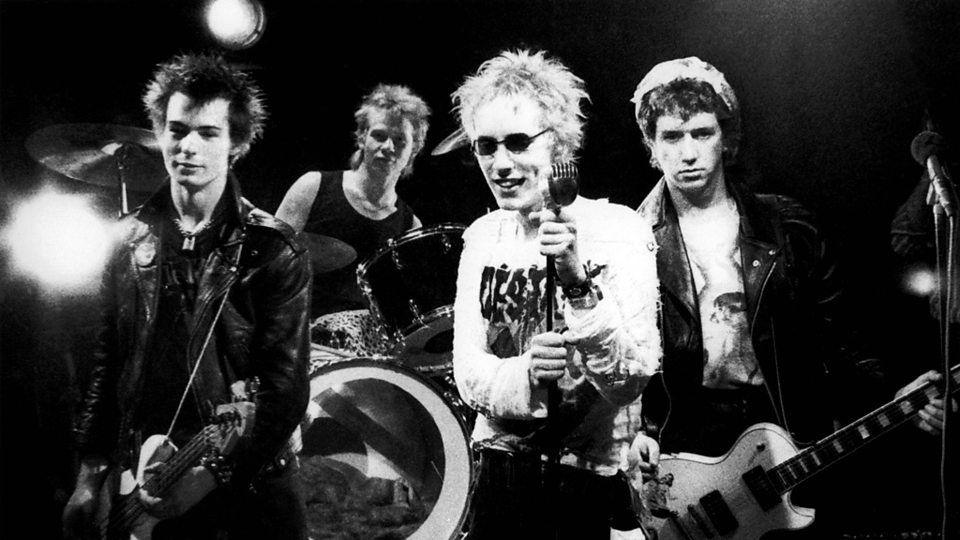
Should Have Been a #1…? ‘God Save the Queen’, by The Sex Pistols

I’ve done a few of these posts before: songs what should have been #1s, for a variety of reasons. Songs that missed top spot because of inconsistencies in chart compilation methods (‘Please Please Me’), songs that were way better than an act’s actual chart toppers (‘Crazy Horses’), songs that are just really, really good (Wizzard). Here, though, we arrive at a record which many allege was kept from reaching number one in the charts because the moral fibre of the British nation depended on it…

‘God Save the Queen’, by The Sex Pistols – #2 in June 1977

June 1977 marked Queen Elizabeth II’s Silver Jubilee. Royal tours were planned, street parties were to be held, bunting was being strung from lampposts, Rod Stewart was keeping things sedate and acoustic at the top of the charts… But a gang of snotty, upstart kids calling themselves The Sex Pistols and playing an aggressively simple new style of rock music called ‘punk’ had other ideas.

They had only had one chart hit: ‘Anarchy in the UK’ which reached #38 at the end of 1976. But they had a reputation – which was probably more important than the music – having caused outrage when they called a TV host a ‘dirty sod’ and a ‘fucking rotter’ during a live interview. (Legend has it they were booked last-minute as a replacement for Queen, as Freddie Mercury had a dentist’s appointment. They were then plied with alcohol and goaded into saying something salty.)

In March 1977 they added Sid Vicious to their line-up, after original bassist Glen Matlock left following one argument too many. ‘God Save the Queen’ was one of only two songs Vicious stayed sober long enough to play on. Meanwhile, the conservative press and commentariat were working themselves into quite the tizz at this bunch of louts: “My personal view on Punk Rock is that it’s disgusting, degrading, ghastly, sleazy, prurient, voyeuristic and nauseating. I think most of these groups would be vastly improved by sudden death,” opined a Tory at the time.

Come the release of their second single, the band were already on their third record label. ‘God Save the Queen’ (she ain’t no human bein’) wasn’t written with the jubilee in mind, according to lead-singer Johnny Rotten (named for his rotten teeth), but the band’s manager Malcolm McLaren couldn’t pass up on the publicity. He organised a flotilla down the Thames, with the Pistols playing the song outside Westminster, and which ended in eleven arrests being made.

By that point, the band were riding high in the charts, with ‘God Save the Queen’ having risen from #11 to #2 just in time for Liz’s big day. The BBC had banned it, some magazines refused to acknowledge the song’s existence – preferring to mark its position on the charts with a dash – and various record stores refused to stock it. Virgin, the Pistol’s new label, were selling twice as many copies of ‘God Save the Queen’ as they were of Rod Stewart’s incumbent chart-topper. However, the BMRB, the company behind chart compilation, ordered that for one week and one week only… shops couldn’t sell their own records. No matter how many copies Virgin Records sold, they wouldn’t count.

Should it have been a #1, if every single had been counted? Possibly. Will anyone ever prove it? Probably not. It’s a bit like the Loch Ness Monster… The last thing the tourist industry of Inverness want is definitive proof that there’s no Nessie. The last thing ageing punks want is proof that they weren’t really denied a chart-topper. It is a hundred times more punk to believe you were silenced. Listening today, forty-five years on, ‘God Save the Queen’ sounds raw and thrilling, but lyrically pretty tame. I love the way Rotten rolls the word ‘Mo-ron’ around, and the refrain of No Future! is fairly iconic. (‘No Future’ was the song’s original title.) Essentially, it’s not so much an attack on the Queen as it is on Britain’s rigid class system: a fascist regime. However, there are far more shocking songs on their debut album, ‘Never Mind the Bollocks (Here’s the Sex Pistols)’ – try ‘Bodies’ and its tale of a teenage abortion for a start.

Then again I wasn’t around in 1977. Maybe punk was genuinely thrilling, or terrifying, depending on your viewpoint. And for an older generation who had gone through the war, rock ‘n’ roll, the swinging sixties, and David Bowie’s drag, perhaps these uncouth, uncivil, ill-mannered upstarts were the final straw. I never thought to ask my grandpa what he made of The Sex Pistols, before he passed away… Though he would get very exercised at the sight of men with stubble, earrings and untucked shirts, so I can probably imagine where he stood on Rotten, Vicious and co.

The Pistols enjoyed several more Top 10 hits after this huge breakthrough, but by January 1978 they had disbanded. By February 1979, Sid Vicious had been accused of murdering his girlfriend Nancy, and had died of a heroin overdose. They burned brightly but briefly, a fleeting menace to the establishment. As I write this, Queen Elizabeth has just celebrated her 95th birthday, and will celebrate 70 years on the throne next year. While the Sex Pistols have long since disintegrated, only briefly reforming for money-spinning tours in the decades since their heyday. Last I heard, Johnny Rotten was wearing MAGA-hats, and endorsing Brexit, still winding everyone up in his role as the grandfather of punk.