Never Had a #1… Depeche Mode

This week, in a break from our regular schedule, I’m going to be celebrating some acts with plenty of Top 10 hits to their name. Household names, the lot of them. But acts that, for whatever reason, have never made it to pole position.

In fact, the acts I’m going to cover – two bands, two soloists; three whose careers began in the ’80s and stretch to the present day, one who was present on the very first chart way back in 1952 – are perhaps the unluckiest pop stars around. They are the bands and artists who have managed the most Top 10 hits without ever making number one. As recompense for their bad luck, I’ll present to you the three records from each band/artist that came closest…

First up… Well, I kind of gave that away in the title:

Depeche Mode – 14 Top 10 hits between 1981 and 2005

‘People Are People’ – #4 in 1984

None of Depeche Mode’s biggest hits are the tunes you’d expect. No ‘Enjoy the Silence’, no ‘Just Can’t Get Enough’ or ‘Personal Jesus’. ‘People Are People’ was the lead single from their fourth album, and their joint biggest hit (they’ve never risen above #4). The clanking irons and booming cannons that intro this record are almost too ‘eighties’ for me, but they are certainly striking. Interestingly, I’d have thought that this was from a few years later, when the synths in the charts got harsher and tinnier. This record, then, was a trendsetter, a nod towards a Pet Shop Boys, SAW future. The lyrics are the sort that are sadly always going to be prescient: I can’t understand, What makes a man, Hate another man, Help me understand…

‘Barrel of a Gun’ – #4 in 1997

Deep in the midst of the Britpop years, Depeche Mode were on their 9th album, and the lead single was this moody, churning, paranoid beast. It takes a chorus that could have been by Oasis, mixes it with Nine Inch Nails, and some grungy leftovers, and a hip-hop beat for good measure, to create an very unlikely hit single.

‘Precious’ – #4 in 2005

The Mode’s final Top 10 single (to date… who knows?) is also their joint highest charting. By the mid-00s, synth-pop was making a comeback thanks to acts like the Killers, Goldfrapp, the Bravery and more, and Depeche Mode were the granddaddies. Perhaps that’s why they managed such a late career flourish (or perhaps it was the fact that singles sales were in the toilet in 2005). It’s a low-key, melancholy track, written by Martin Gore to his children as an apology for his impending divorce.

Another unlucky artist is up tomorrow, and we’re going right back to the dawn of the British singles chart…

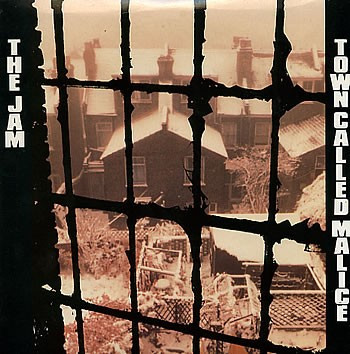
495. ‘Town Called Malice’ / ‘Precious’, by The Jam

Straight in at number one with the lead-single from their final album… The Jam do Motown.

Town Called Malice / Precious, by The Jam (their 3rd of four #1s)

3 weeks, 7th – 28th February 1982

We’ve been treated to some iconic intros in recent weeks: ‘Under Pressure’, ‘Don’t You Want Me’, ‘The Model’… ‘Town Called Malice’ is right up there too. It’s not really a riff, more an explosion of exuberance, a technicoloured smile with a jaunty bassline and a cheesy organ. I know it’s The Jam, because it’s a well-played classic, but it sounds a world away from their earlier #1s.

This being Paul Weller and The Jam, however, things aren’t as rosy as they sound. The title perhaps gives it away, and a quick google of the lyrics (sorry Paul, but they are quite hard to make out) reveals a deeply downtrodden song. Malice is a town where people dream of rosy days and the quiet life, where decisions have to be made: buy beer or clothes for the kids. Some of it is darn near poetic: Rows and rows of disused milk floats stand dying in the dairy yard, And a hundred lonely housewives clutch empty milk bottles to their hearts…

When he starts to sing about Sunday’s roast beef, I get a huge sense that this is an early-eighties take on Ray Davies’ suburban odes from a generation earlier. Weller wrote it based on his childhood in Woking, a commuter town outside London. Funnily enough, this middle-eight is the most modern-sounding bit of the song, as we go from The Supremes to The Specials’ ska tones. And at its core – which wasn’t always the case with The Kinks – I think ‘Town Called Malice’ is optimistic. It’s up to us to change, A town called Malice… Life may be shit, but you still have to live it as best you can.

Despite being as biting as ever, The Jam do sound happier than they did in 1980. Success puts distance between you and any hardships you’ve endured, and maybe that left them feeling free to experiment with different sounds. It’s certainly a sneak-preview of the soulful sounds that Weller would push to the forefront with The Style Council. And in my mind this song will forever be associated with the scene in ‘Billy Elliot’, where he dances across the rooftops of County Durham (though, much like the contrast between ‘Malice’s melody and lyrics, Billy was dancing in frustration, rather than joy…)

For the second post in a row, we have a double-‘A’ to write about. I’m not sure how much airplay ‘Precious’ got, but the history books have it at #1 and so we must give it a spin. If ‘Town Called Malice’ was a departure for The Jam, then ‘Precious’ is a giant leap. I’d describe it as ‘disco-funk’. There are chucka-chucka guitars, there are horns… I’m half-waiting for Weller to shout ‘Shaft!’ It’s another moment where you can see that The Jam were nearing the end of their shelf-life.

Not that it’s bad. Or that bands shouldn’t try new things. But when you’ve gone from punk to funk in barely five years, it’s clear that the confines of a three-piece, guitar, bass ‘n’ drums band are not enough to satisfy the members’ creativity. Like ‘Malice’, the lyrics are very hard to make out, but unlike ‘Malice’, I feel no compulsion to look them up. This record is a groove, a mood. There’s a short single edit and a longer album version, towards the end of which things go very acid, with a free-styling saxophone.

It all adds to the fact that this has been a brilliantly eclectic start to 1982, with all four number ones (six songs, if you count the two double-‘A’s) bringing something very different to the top of the charts. And for all this talk of the end nearing for The Jam, they have one more #1 to come: their very last release. They’ll be going out on top, then, one of the decade’s most distinct and successful bands. Until then…