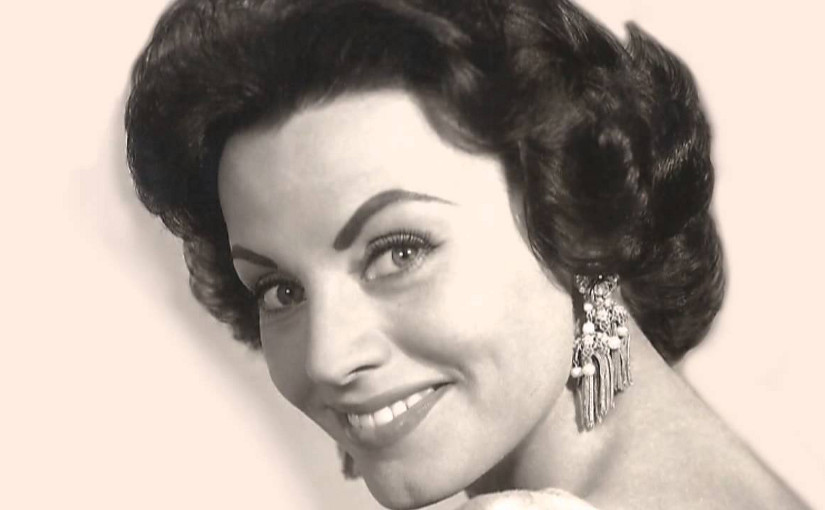
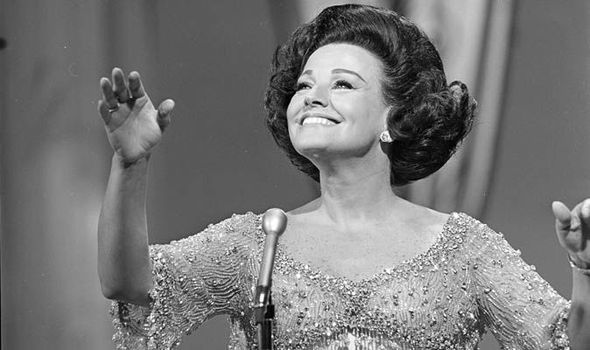
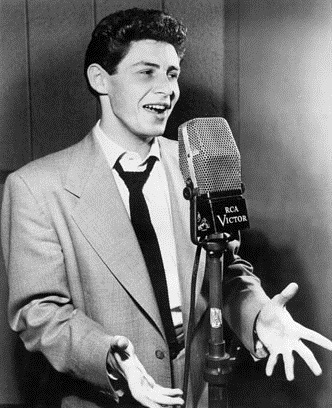
Remembering Johnnie Ray and Del Shannon

It’s been a while since I did a ‘Remembering’ post, so here’s two for the price of one. Two big stars of the pre-Beatles age, both of whom died within a couple of weeks in February 1990.
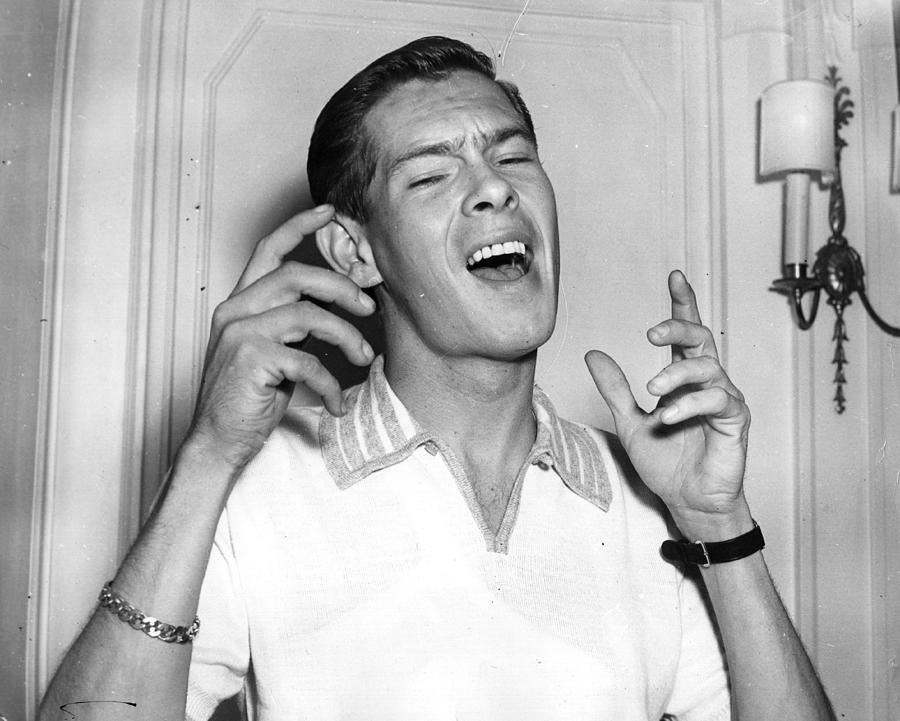
Before starting this blog, I knew Johnnie Ray by name and not much else. He after all is referenced in the opening line of ‘Come On Eileen’ (Poor old Johnnie Ray…) But I will now be forever grateful to him, for making the earliest years of the charts bearable, when it sometimes felt like one po-faced ballad after another, after another. His first #1 was the incredibly steamy (by 1954 standards) ‘Such a Night’, and he had a seven-week run with the whistle-tastic ‘Just Walkin’ in the Rain’ before ending things with the zippy ‘Yes Tonight, Josephine’. All three are well worth a listen if you’ve not heard them before, and proof that pop music could be fun in the prehistoric era. Below I’ll highlight a few of my other favourites of his.

Released in 1951, before Britain even had a singles chart, we can assume that ‘Cry’ would have been a multi-week number one. The missing link between Sinatra and Elvis, Ray’s wonderfully histrionic performance shows why he was known as the ‘Nabob of Sob’ and the ‘Prince of Wails’, surely two of pop music’s best nicknames. His exaggerated, stagey way of singing may have been linked to the fact that he was partially deaf.

‘Ain’t Misbehavin’ is a standard, recorded by everyone from Louis Armstrong and Ella Fitzgerald, to Robson & Jerome. And while I’ll admit to not having heard every version, I’d suggest that you’d struggle to find a performance more committed than Johnnie Ray’s. The man was the epitome of the phrase ‘sing it for the back row’.

Fond of a whistle, Ray made #10 with ‘You Don’t Owe Me A Thing’ in early 1958, a perfect example of how rock ‘n’ roll was making its presence felt in records that weren’t actually rock songs.

By the early 1960s, like so many fifties stars, Ray’s career had tailed off. It’s surprising that he managed to have a career in the first place, after he was arrested for soliciting an undercover policeman in a public toilet in 1951. Rumours about Ray’s sexuality continued, but didn’t seem to harm his sales until another arrest in 1959. He was openly bisexual to many in the music industry, and married a woman named Marilyn Morrison in 1952, who claimed she would ‘straighten him out’. They separated after a year.

Ray also had problems with alcohol, which worsened in the sixties. He would sporadically tour small venues and appear on television in the States, while commanding much larger audiences in the UK and Australia (where he remained most popular) right up until his death from liver failure on February 24th 1990. He was sixty-three.

Del Shannon scored his sole chart-topper a few years after Ray’s time at the top. And what a chart-topper it was. ‘Runaway’ is possibly the most inventive, most exciting, most propulsive #1 of that supposedly fallow period between Elvis and The Beatles. It made top spot in the summer of 1961, and features an innovative Musitron solo, making it arguably the first electronic hit. But even if that solo was played on a clapped out old piano it would take nothing from the record’s innate quality. Anyway, I discussed all this in more detail in my post on ‘Runaway’ here.

‘Runaway’ is so good that it tends to completely overshadow anything Del Shannon released afterwards. But ‘Little Town Flirt’ is another great slice of malt shop pop, making #4 in early 1963. He had a good line in heartbreak, and woman shaming, usually singing about runaways and flirts, and in ‘Hats Off to Larry’ he indulges in a bit of schadenfreude as his ex is dumped and left as heartbroken as he had been.

Shannon had a style, and came pretty close to shamelessly ripping himself off on some records (check out how close ‘Two Kinds of Teardrops’ is to ‘Little Town Flirt!) But on ‘So Long Baby’ he managed to recycle the energy of ‘Runaway’ into a deranged oompah beat and create a #10 hit that sounds both frivolous and terrifying.

Like Johnnie Ray, Del Shannon’s career slowed down towards the end of the sixties and into the seventies as he battled alcoholism. He worked with Tom Petty and Dave Edmunds, and by the ’80s he had sobered up and started something of a comeback. He worked with Jeff Lynne, and was touted as a replacement for Roy Orbison in The Travelling Wilburys. Sadly, though, he shot himself on February 8th 1990, apparently after having a negative reaction to the Prozac he was taking for depression. He was just fifty-five.
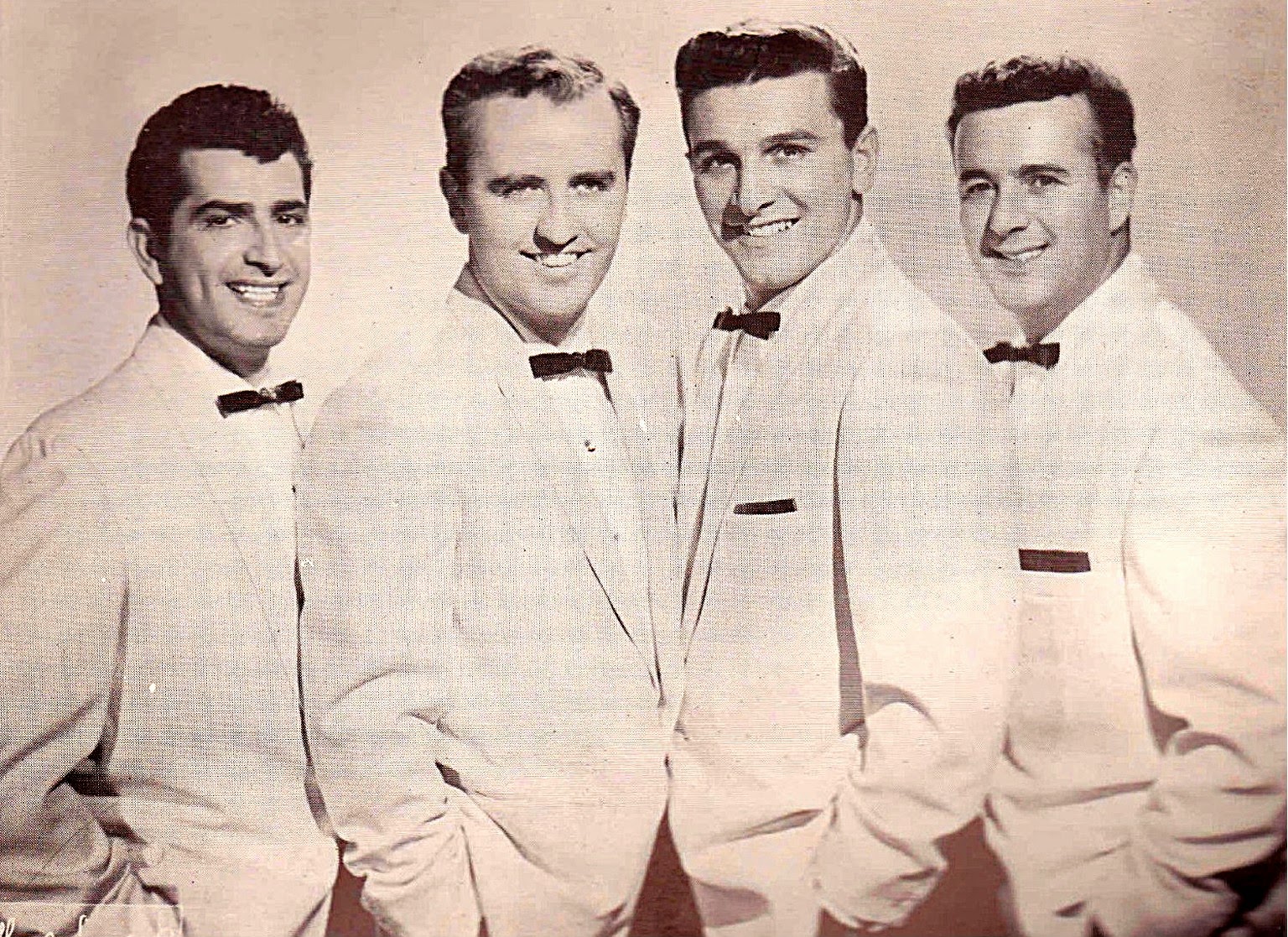
Random Runners-Up: ‘Love Is a Many Splendored Thing’, by The Four Aces

For the fourth part of this Random Runners-Up series, we’re going back almost as far as it’s possible to go. In chart terms, at least. To the mists of November 1955… It’s over five years since I wrote my posts on the fifties number ones, discovering that for every hot slice of rock ‘n’ roll there were three rather stodgier slices of big-lunged balladry. But if you’re a more recent visitor to these pages, I would recommend a journey back to the dawn of the charts as an interesting counterpoint to the #1s we’re covering now.

‘Love Is a Many Splendored Thing’, by the Four Aces

#2 for 2 weeks, from 25th November – 9th December 1955 (behind ‘Rock Around the Clock’)

Anyway, on to the #2 at hand. And interestingly, this very record was held from top spot by ‘Rock Around the Clock’, the first rock and/or roll number one. Which goes to prove that there was no instant rock revolution; more a smattering of guitar-led hits that slowly started to break up the heavy crooning. In fairness, ‘Love Is a Many Splendored Thing’ has quite a springy bass line, but aside from that it’s a big, beefy pre-rock ballad. A dramatic intro, strings, vocal harmonies, and a lead singer who croons like his life depends on it.

I am familiar with this song, as a version of it famously plays during the opening scene of ‘Grease’, while Sandy and Danny frolic on a beach. I’d bet most people are familiar with the title line at least, from a variety of pop culture references. Away from the soaring chorus, things are slightly less memorable, and we have some classic 1950s metaphors for love: It’s the April rose, That only grows, In the early spring…

It sounds very dated, not to mention that the recording needs a remastering or two. But it’s hard to dislike a song that is belted out with such conviction. My memories of writing about the ‘50s number ones are lots of songs like this, about flowers, sunshine and morning dew, sung with operatic conviction. None of which would work for a modern audience. When did we all become so cynical…? (And thank God we did…)

The Four Aces were a four-piece from Pennsylvania, who enjoyed decent chart success on either side of the Atlantic until, like so many pre-rock acts, 1957 or so. ‘Love Is a Many Splendored Thing’ meanwhile was the theme to a movie of the same name, and won the Oscar for Best Original Song in 1956. It was recorded by a plethora of famous names following this success, as was the style of the time, including Eddie Fisher, Doris Day, Nat King Cole, Bing Crosby, Andy Williams, Sinatra, and Connie Francis (in Italian), among others.

Our final #2 is up tomorrow! It’s the turn of the eighties, and another soundtrack classic…

Random Runners-Up: ‘Cloud Lucky Seven’, by Guy Mitchell

My third randomly selected #2 for the week brings us all the way back to the early weeks of 1954. Before Elvis, before the Beatles, before colour TV and motorways, there was Guy Mitchell…

‘Cloud Lucky Seven’, by Guy Mitchell

#2 for 1 week – 12th – 19th February 1954, behind ‘Oh Mein Papa’

I have a huge soft-spot for Guy Mitchell. Not only did he have a hunky, all-American boy next door vibe going on – see the pic above! – but during the early months of this blog, as I trawled through many overwrought and overblown, and often quite dull, pre-rock #1s, Mr. Mitchell would regularly pop up with something a bit more sprightly.

‘Cloud Lucky Seven’ came right in the middle of Mitchell’s four chart-topping singles, and is a pre-rock hit by-numbers. It’s almost unbearably jaunty, the backing singers sound like drunken relatives at a wedding, and there are horns. Boy, are there horns… It’s a bit jazz, a bit swing, very music-hall, and with no hint at the rock ‘n’ roll revolution that’s just around the corner.

What saves it from sounding ridiculous to modern ears is Guy himself. He isn’t, to be honest, the best technical singer. He’s no Al Martino, or Eddie Fisher, but his voice has a throaty, homely charm. He sounds like he’s having fun, as if he’s well-aware that he’s singing a load of tosh (see also ‘She Wears Red Feathers’) and being paid handsomely to do so.

Lyrically, the song is about love as clouds (that’s another pre-rock trick: love as birds chirping, fluffy clouds, twinkly stars…) Cloud one is where you land when you meet that special someone, while cloud lucky seven is the cloud nearest heaven… Which means… This is actually a song about getting laid?? Those pre-rockers were just as horny as those that came later, they just had to hide it behind bizarre metaphors involving clouds. Which means, as he belts out that there’s one more cloud to go…! it’s not only the best bit of the song; but you can almost hear the knowing wink. Guy, you sly dog, you!

Two more #2s to come…

Remembering Rosemary Clooney

Another short trip back to the earliest days of the charts, when big-lunged men such as Al Martino, David Whitfield and Frankie Laine were dominating the #1 position with earnest declarations of love and faith. Elvis hadn’t arrived yet, Sinatra wasn’t the teen heart-throb of a decade before… The charts needed some sexiness, some fun…

Thank God for the girls, then. Girls like Rosemary Clooney. I’ve already posted on Kay Starr and Winifred Atwell, two contemporaries of Clooney, who brought a jazzy playfulness to their chart-topping records. But Miss Clooney, who scored Britain’s 25th and 28th #1 singles, went a step further, and brought mad-cap craziness to the pop charts.

First up came ‘This Ole House’, in November ’54. A raucous, honky tonk piano-led tale of a rundown house whose elderly inhabitant is waiting to meet the saints… There can have been very few hit songs to reference oiling hinges and fixing shingle… Here she is performing it live, and with slightly more restraint, in the ’80s.

Then just weeks later, she was back with an even better hit. Clooney was of Irish/German extraction, but that didn’t stop her hamming up an invented Italian side. The lyrics are basically nonsense, with nods to Italian, Spanish, Mexican and Neapolitan. (Sample lyric: Hey mambo, no more a-Mozzarella…) Again the energy and playfulness really stood out next to its dully earnest contemporaries. (See also her earlier hit ‘Botch a Me’ if you like the cod-Italian vibes.) ‘Mambo Italiano’ lives on in a way that few pre-rock hits do. It was remixed back into the charts in the early ’00s, and sampled more recently by Lady Gaga and Iggy Azalea.

Rosemary Clooney’s career trajectory was pretty standard for a post-war pop star. From singing with big bands, to a record label, to big hits and on to TV and films – her most famous one probably being ‘White Christmas’ alongside Bing Crosby. What wasn’t so standard was Clooney’s sleeping pill and tranquilliser dependency that developed through the sixties, that ended with her in psychoanalytic therapy for eight years.

She survived, though, came back and continued to record throughout the remainder of her life. Her final performance came just six months before she died of lung cancer in 2002. One of the pall bearers at her funeral was her nephew, George.

Rosemary Clooney, May 23rd 1928 – June 29th 2002

Remembering Kay Starr

On this day three years ago, one of our earliest chart-toppers passed away: Kay Starr, smoky voiced pre-rock chanteuse.

kay-starr-cropped

Born in 1922, on a Native-American Reservation, Katherine Laverne Starks parents were a sprinkler fitter and a chicken raiser, and she was singing with bands in Texas from the age of ten, to earn a few extra dollars for her family. (Sounds like the sort of story you might invent, were you challenged to invent a story from Depression-era America…) She sang with big bands through the thirties and forties, before going solo and recording two of my favourite pre-rock n roll #1 singles.

Back when I was working my way through the first fifty or so UK chart-toppers, before Elvis, Buddy, Jerry Lee et al came along, I did find it a bit of a slog at times. Painfully earnest crooners (Eddie Fisher, David Whitfield), irritating novelties (‘That Doggie in the Window’, ‘I See the Moon’) and staid instrumentals (Eddie Calvert, Mantovani) plodded by, one after the other. It was the hidden gems, such as Kay Starr, that made the journey more bearable.

She popped up as early as chart-topper number three, in January 1953, with the sprightly, sassy ‘Comes A-Long A-Love’ – a record that was a whole lot of fun, and one that proved a lot of my preconceptions about the pre-rock era wrong.

And then we had to wait a while for her second, and final, #1. A record that Starr was, apparently not too keen on, but that gave her a hugely unexpected hit: ‘Rock and Roll Waltz’. The story of a teenager (though Starr was thirty-two when she recorded it) who comes home to find her parents trying to waltz to one of those new-fangled rock ‘n’ roll discs. It hit the top in the spring of 1956, just before Elvis went stratospheric with ‘Heartbreak Hotel’, and can perhaps be counted as one of the first rock ‘n’ roll chart-toppers, even if it is poking slight fun at the genre…

(I’ve linked to an 1980s TV performance, as it’s a lot of fun and shows Ms Starr still swinging in her sixties. Follow the link above to hear the original.)

And that was that for Kay Starr on the UK charts. She only ever charted five singles here, though she would have presumably had more had the charts begun before November 1952. In the US she was much more prolific, with fifteen Top 10 hits between 1949 and 1957. ‘Wheel of Fortune’ was the biggest, but she also had big duets with fellow UK chart-topper Tennessee Ernie Ford. In later years she toured with Pat Boone, and Tony Bennett.

I think the reason that Kay Starr stood out amongst the other pre-rock stars is that there is such a sparkle in her voice – it flirts, flitters and then suddenly goes all husky-sexy. Billie Holiday apparently claimed that Starr was the only ‘white woman who could sing the blues’. It’s a great voice, but not ‘proper’ like her cut-glass contemporaries. She could have succeeded as a rock ‘n’ roll singer like Connie Francis or Brenda Lee, had she been born a decade later.

Kay-starr-729243

Kay Starr, July 21st 1922 – November 3rd 2016

Behind the #1s – Paul Weston

Taking a break from the usual proceedings, I’m going to use this week to take a look at the folks behind some of the 210 #1s we’ve heard so far. The writers, the producers and, in the case of our first post, the conductors…

In the early days of the charts, when big productions and even bigger voices were all the rage, any self-respecting chart-topper needed an orchestra to back up them up. On the 45s of the time, nearly every #1 is assigned to both a lead artist and an orchestra. ‘Here in My Heart’, by Al Martino, with Orchestra under the direction of Monty Kelly… ‘Outside of Heaven’, by Eddie Fisher with Hugo Winterhalter’s Orchestra and Chorus…

al-martino-here-in-my-heart-capitol-78-s

Perhaps for reasons of convenience, the Official Singles Chart don’t list the orchestra, or it’s conductor, for any of the early chart-toppers. Which is strange, I suppose, as in modern times we have no problem with crediting ‘featured’ artists on a dance or rap track. Maybe it’s because we don’t actually hear their voices… Whatever the reason, several men have missed out on their moment in the record books. Winterhalter and Kelly, Frank Cordell, Stanley Black, Harold Mooney, Mitch Miller…

paul_weston

I’ve chosen Paul Weston as the frontman for this piece, though, thanks largely to his work with Frankie Laine. Weston was a Massachusetts born musician, who had been a pianist in a dance band, before becoming a song-writer and music director at Capital, and then Colombia Records. He conducted and arranged all three of Laine’s 1953 hits: ‘I Believe’ (still the song with the most weeks at #1 in the UK, sixty-five years on), ‘Hey Joe!’ and ‘Answer Me’. He also conducted on Jo Stafford’s ‘You Belong to Me’, Britain’s 2nd  ever chart-topper. Stafford and Weston had married not long before recording the song.

hqdefault

Paul Weston with his wife, Jo Stafford

If Paul Weston were actually credited with his work on #1 singles, he would sit at joint 10th place in the all-time weeks at the top of the UK singles chart list with 29 weeks’ worth of chart-toppers, tied with ABBA and Take That, and one week behind Drake. Later in the 1950s he went on to do TV work, helped to start up the Grammy Awards, and worked for Disney. He passed away in the mid-nineties.

One conductor who did get credited on his hit records was the Italian, Annunzio Paulo Mantovani who, like all the best pop stars, went by just the one name: Mantovani. He was popular enough to score a solo, instrumental number one single in 1953: The Song from ‘The Moulin Rouge’, which had been a big hit in the cinemas that year. This success, and his subsequent fame is, I’m guessing, why he is the only conductor to be credited by the Official Charts Company, for his orchestral accompaniment on David Whitfield’s overwrought ‘Cara Mia’ in 1954.

mantovani-663032

Mantovani, doing his thing

Conductors and their orchestras became less essential once rock ‘n’ roll arrived, but they still occasionally popped up on the more bombastic number ones. The last one I can think of was Shirley Bassey’s ‘Climb Ev’ry Mountain’ / ‘Reach for the Stars’ double-‘A’ side from 1961, which was credited, on the vinyl at least, to Geoff Love and His Orchestra.

To the conductors, then, and their batons, which shaped the sound of the singles chart’s earliest years.

Remembering Eddie Fisher

I’m starting out a new feature today, remembering some of the biggest stars that we have met so far. The only requirements needed to feature here are that we have already covered your chart-topping careers on this countdown, and that you are dead…

On this day, then, nine years ago, Eddie Fisher – the King of pre-rock ‘n’ roll – passed away, aged 82. The first artist to score multiple #1 singles in the UK. An artist whose two chart-toppers came in the blink of an eye, in the first eight months of the singles chart’s existence. Numbers 4 and 10.

eddie-fisher-getty-hero-improvedcrop

First came the sombre ‘Outside of Heaven’, in which he stood outside the house of the girl he once loved. You can read my original post here. It’s sedate, proper… traditional.

Then came the equally sombre ‘I’m Walking Behind You’ – a duet with Sally Sweetland – in which he followed his ex to church on her wedding day. Again it’s sedate, proper, traditional… and pretty darn creepy when you listen carefully.

I struggled to really get his chart-topping singles when I originally wrote about them, and still do. He had a good voice, they were well-constructed songs… They were just so old-fashioned. Old-fashioned sounding even among their contemporaries, and incredibly old-fashioned when compared to where we are now in the countdown – slap bang in the middle of the swinging sixties (amazingly, given the way pop music has changed, we’re only actually thirteen years down the line in real time…)

What the songs do offer is an interesting glimpse into how music sounded before rock ‘n’ roll came along, and Fisher – along with Frankie Laine, Guy Mitchell, Johnnie Ray – was one of the biggest male stars of the late forties / early fifties. Only one of his singles failed to make the UK Top 10, while he enjoyed 25 (!) US Top 10s, including 4 #1s.

fa8866f2820f2b82a295d63679695579

He had quite the life outside of the recording studio, too. That is, yes, him with Elizabeth Taylor, his second wife (he was number four of eight for her). He left his first wife, Debbie Reynolds – Taylor’s best friend! – for her. It was quite the scandal, and proof that misbehaving pop stars weren’t a rock ‘n’ roll invention. He was married five times in total, and had four children over the course of them. The oldest of whom was the late, Star Wars great, Carrie Fisher.

So, if you can, take a moment out of your day, click on the links, and transport yourself back to 1953, when Eddie Fisher was crooning his way to the top of the charts and was, for a short time, the man with the most UK #1 singles in history.

Photo of Eddie Fisher

Eddie Fisher, August 10th 1928 – September 22nd 2010