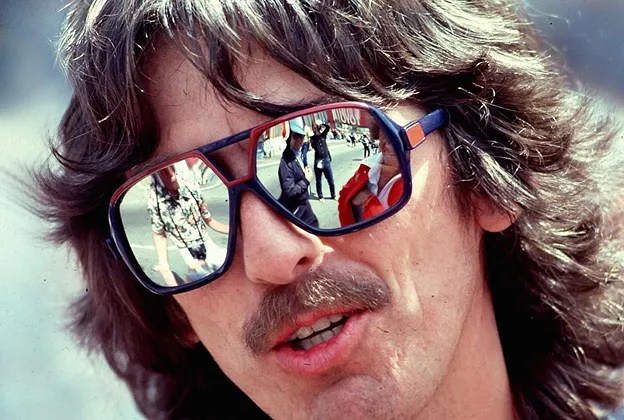
918. ‘My Sweet Lord’, by George Harrison

In the only occasion two posthumously released records (by two different artists) have made #1 consecutively, George Harrison replaces Aaliyah

My Sweet Lord, by George Harrison (his 2nd and final #1)

1 week, from 20th – 27th January 2002

It would feel odd to review the song, as I already did so five years ago: ‘My Sweet Lord’ having spent five weeks at #1 in 1971. So, I’d rather direct you towards my original post, despite the fact that I was a bit harsh on it. I claimed it ‘doesn’t really go anywhere’ and, while I get what I meant, I now realise that that is entirely the point of the song. It’s a euphoric chant, a mantra, an incantation. It is a beautiful song, despite my complete irreligiosity. In my book, it is by far the best solo-Beatle number one.

Harrison had died from cancer in November 2001, and thus ‘My Sweet Lord’ was given a rerelease. It means that the line I really wanna see you Lord, But it takes so long, My Lord… now hits differently, assuming that it originally referred to a religious awakening. But it is a fitting, and obvious tribute.

And it is the fact that it was a deliberate release, as a tribute, that means I’m featuring this as the 918th number one single, and not a belated return for the 296th. Like ‘Bohemian Rhapsody’ before it, again rereleased following the death of its creator, ‘My Sweet Lord’ becomes only the second song to return to #1 in a rerelease (though BoRap was paired with ‘These Are the Days of Our Lives’).

This is something that needs clarifying as we move further into the 21st century. Soon there will be a series of Elvis rereleases making the top of the charts, and again they’ll be treated as ‘new’ number ones. However, when ‘Three Lions’, and then two Christmas perennials, return to number one later in the century they will not be gifted such special status as they are simply a case of the original hit returning to the charts. In fact, the streaming era has basically killed off the idea of the rerelease, as (almost) everything is now on permanent release via your streaming platform of choice.

Hope that makes sense. Anyway, let’s just enjoy this classic re-appearing at number one, completely out of place in the early ‘00s soundscape. It is also worth noting this fact: ‘My Sweet Lord’ remains one of only two truly solo UK #1s that any of the four Beatles enjoyed during their lifetimes!

917. ‘More Than a Woman’, by Aaliyah

We start 2002 with two posthumous number ones, almost like how at the Oscars they do an ‘In Memorandum’ segment. Which pop stars did we lose in the past year?

More Than a Woman, by Aaliyah (her 1st and only #1)

1 week, from 13th – 20th January 2002

Well, we had lost prodigal R&B star Aaliyah in a plane crash back in August, aged just twenty-two. ‘More Than a Woman’ was her first single to be released in the UK since her death, and is a very modern, very of the moment slice of American pop.

It’s cut from the same cloth as earlier Destiny’s Child and Jennifer Lopez #1s, with an almost classical riff playing over a staccato beat. One reviewer at the time described it as ‘Baroque liquid funk’, which is a great description, if a little over the top. It does though, have a bit more beef to it than DC and J-Lo. I especially like the dirty, squelchy synths, which elevate this above some of the other US recent R&B tracks I’ve struggled to enjoy, and which take centre-stage in an extended, funky fade-out.

I was going to accuse this record of not having a real hook, but the more I play it the more it grows on me. And I’ll admit that the strange, slightly off-kilter chorus has stayed in my brain ever since it was in the charts. It’s oddly catchy. In the very ‘of its time’ video, Aaliyah and her backing dancers work it in what looks to be the inside of a combustion engine, and the churning pistons fit the thick and deliberate beat nicely.

Although this probably only got to number one as a tribute, it isn’t hard to imagine ‘More Than a Woman’ spending a January week at #1 even with Aaliyah alive and well. She had been a regular chart presence since her debut in 1994, aged just fifteen. (She was R Kelly’s protégé, something that’s come under more scrutiny since his offences came to light). Her biggest song, ‘Try Again’, had been her only US #1, and only previous British Top 10 hit, in 2000.

She was also a long-time collaborator with Timbaland, meaning that this is the first chart-topping appearance for one of the 2000’s defining producers. After ‘More Than a Woman’, for sadly obvious reasons, the hits dried up for Aaliyah. Her legacy seems to be one of what might have been, for an experimental and talented artist who had already been dubbed the ‘Princess of R&B’.

In part two of our posthumous double-header, she was replaced at the top by another recently deceased artist, whose legacy had long since been established…

693. ‘Living on My Own’, by Freddie Mercury

It feels like we’ve been bidding farewell to Freddy Mercury for a while now. From the re-release of ‘Bohemian Rhapsody’, paired with ‘These Are the Days of Our Lives’, in the weeks following his death, to George Michael’s tributes on the ‘Five Live EP’, to this.

Living on My Own, by Freddie Mercury (his 1st and only solo #1)

2 weeks, from 8th – 22nd August 1993

And of the three, this remix of his minor 1985 hit is the tribute that Freddie himself might have enjoyed the most. On the one hand it is a shame that his solitary solo number one isn’t a blistering rocker; but then he was a musician who never let himself be restricted within one genre. ‘Living on My Own’ is updated nicely for the early-mid nineties, with a chilled out house beat, by a production trio called No More Brothers and, although it was still listed on the charts as the 1985 original, it was undoubtedly this remix that sent it to #1.

I say that Freddie would have liked this version and, presumptuous as that might be, if you listen to the original, from his ‘Mr. Bad Guy’ solo album, then it was already much more dance than rock. The lyrics, meanwhile, are very personal: Sometimes I feel I’m gonna break down and cry, Nowhere to go, Nothing to do with my time… I get lonely… They’re based heavily on quotations from Greta Garbo (which feels very Freddie Mercury…) and each chorus ends on the positive mantra: Got to be some good times ahead… Though knowing how soon it all would end, that line is tinged with sadness.

I will also give a shoutout to an earlier remix – which I initially thought was the chart-topping version – by Julian Raymond. This is my favourite of the three versions, with a faster, industrial beat, more of Mercury’s trademark yodelling, alongside a frenetic piano line. It was commissioned as part of the ‘Freddie Mercury Album’, released in November 1992 to mark the 1st anniversary of his death, but never released as a single.

The video to the 1993 version of ‘Living on My Own’ was the same as the 1985 one, and featured footage of a Drag Ball held for Mercury’s 39th birthday party. I love this quote: “Because of the garishly costumed homosexuals and transvestites celebrating a decadent, raucous party in the video clip, the BBC long refused to broadcast the music video on its channels.” Good old Beeb, always ready to ban those garish homosexuals…

I hadn’t realised quite how well Freddie Mercury’s solo career – while nothing compared to Queen’s discography – had been ticking along since the mid-80s, when he made the Top 10 with ‘Love Kills’. The ‘Living on My Own’ remix was his seventh, and final, Top 20 hit, and a huge smash across Europe. (Especially in France, where it did a Bryan Adams and stayed at #1 for fifteen weeks! Bryan or Freddie… I know who I’d rather have clogging up the number one spot…)

With this we can finally bid farewell to Freddie Mercury. Three number one singles in his lifetime, two after his death, and one well-intentioned tribute in-between. For my money, he is the greatest frontman of all time. Not only could he rock with the very best; he could do opera, musical theatre, pop, disco, camp ditties about girls with fat bottoms… And he sounds just as at home here, on a house track released two years after his death, as he does anywhere.