5. ‘Don’t Let the Stars Get in Your Eyes’, by Perry Como with The Ramblers

perry-como-with-the-ramblers-dont-let-the-stars-get-in-your-eyes-1953
Don’t Let the Stars Get in Your Eyesby Perry Como with the Ramblers (Como’s 1st of two #1s)

5 weeks, from 6th February to 12th March 1953

One of my biggest chart bugbears, back when I started chart-watching, was one-week number ones. In the late ’90s and early ’00s it seemed like there were a never ending parade of songs waiting to shoot straight in at number one, only to be replaced by another brand new song a week later, as if record companies had worked it all out beforehand in some sort of dastardly pact. And I assumed that it never used to be that way, that ye olden charts were creaky, slow moving things where records languished at the top for weeks and months. Which is true to an extent – Al Martino had nine weeks, and wasn’t alone in having that length of stay, while later in 1953 we’ll reach the song which still holds the record for most weeks at number one…

But what we have here is a fourth new chart topper in as many weeks. It turns out that the record buying public of the pre-rock era were just as fickle as those in 1999! Perry Como, though, did halt the turnover and kept this jaunty little tune at the top for a month and a bit. That’s star quality shining through.

This track is a welcome relief after it’s overwrought predecessor. Perky guitars, a lively brass section, and tongue-twister lyrics: Love blooms at night in daylight it dies don’t let the stars get in your eyes or keep your heart from me for some day I’ll return and you know you’re the only one I’ll ever love delivered in just the one breath. This seems to have been a thing, a gimmick almost (at least it seems gimmicky to modern ears), as Kay Starr was at it in ‘Comes A-Long A-Love’. It’s not vocal gymnastics of the Mariah Carey kind; more lyrical gymnastics, if such a thing can exist.

We’ve also heard similar lyrics already in this countdown, in that Como is telling his sweetheart not to forget about them, or to stray, while away. The best bit of it all, though, is the trumpet solo. At least I think they’re trumpets; I really can’t tell one brass instrument from the other. Anyway, they put me in mind of the oompah band at a German Bierfest.

The one downside to the song is the backing singers, The Ramblers. They’re just a bit… barbershop, in that they are basically there to repeat verbatim the line that Como just sang. In case some one missed it? I don’t know. And their one bit of improvisation is to sing what sounds like pa-pa-papaya between lines. Are they imitating the trumpets? Is it just gibberish? Are they actually singing about papayas?

600x600

Perry Como (American! Died aged 88! The run continues!) is the biggest name to top the chart so far. I’d say, at least. Both of the female chart toppers were new to me, Al Martino was known to me solely as the singer of the first ever UK #1, and Eddie Fisher had entered my consciousness due to his ladykilling (the romantic type of ladykilling, that is). Perry Como was a big star and I could have named his biggest hit (‘Magic Moments’, fact fans) without looking it up. And after looking up his discography it’s clear that if the the charts had begun earlier he would have racked up a load more hits – he was scoring US #1s throughout the ’40s. Now, in 2018, he’s no longer a household name, a Sinatra or Presley, I wouldn’t have thought. Very few of these stars from sixty-odd years ago are, I suppose.

4. ‘Outside of Heaven’, by Eddie Fisher

eddie-fisher-outside-of-heaven-his-masters-voice

Outside of Heaven, by Eddie Fisher (his 1st of two #1s)

1 week, from 30th January to 6th February 1953

We wanted heartbreak, and boy do we get it here…

Eddie Fisher passes by the house where his sweetheart lives, and stands outside the church where she is getting married. He is ‘outside of heaven’ – literally, if you count a church as the place where God resides, and metaphorically, as his version of heaven would be at the dining room table eating his wife’s stew. Kinda clever, when you think about it.

This is what I imagined the pre-rock number ones to sound like. And I don’t like it very much. The sultry Jo Stafford and the saucy Kay Starr give way, for a week, to some very over the top moping. I pass your house, with misty eyes, there stands the gate to paradise, but you don’t hear the heart that cries, outside of heaven… Or if that’s not melodramatic enough for you: On your wedding day, I stood in the crowd, I could hardly keep, from crying out loud… It’s comparable to ‘Here in My Heart’, as it’s operatic and dramatic, like it could be the closing song in the first act of a Rogers & Hammerstein. But whereas Al Martino sang with enough power to carry the day, Fisher doesn’t have the voice. The ending especially – why was I meant, to walk alone, outside of heaven…? makes your hairs stand on end, and not in a good way. In the song’s favour, as far as I’m concerned, is that it does feature a guitar solo – the first #1 to do so. However, it’s possibly one of the least dynamic solos ever recorded – it sounds like the guitarist is scared to get his instrument too worked up, as if it might bite.

So, a pause, to take stock… If the first four chart toppers are anything to go by, female artists in early 1953 were allowed to be fun, playful, even a little bit sexy. But the record buying public wanted stoically heartbroken men: sad and lonely and not afraid to sing about it. Very loudly.

Eddie_Fisher_-_still

Perhaps this song is even more of a disappointment as I had heard of Eddie Fisher, and his reputation as something of a shagger. He was married five times – to Debbie Reynolds (with whom he fathered Carrie Fisher) and Elizabeth Taylor (he was husband number four of eight for her) amongst others. Taylor was Reynold’s close friend, and he married her not long after her previous husband had died in an air crash. Juicy stuff… So maybe I had hoped he’d be singing something a little funkier, a little more rousing, than this. But – and this is a big but that should be applied to many of the acts in this list – BUT, songs that are most successful in the charts are not always the most representative of an artist’s entire oeuvre (cf. Chuck Berry, 1972). Perhaps I’m being unfair on Eddie. He has one further number one coming up soon – let’s hope it’s a balls-to-the-wall rocker.

A couple more observations: Eddie Fisher was, again, an American. We still await our first ever British #1. And he lived to the ripe old age of eighty-two, passing away just seven years ago. Who will be the first chart topper to die tragically young…?

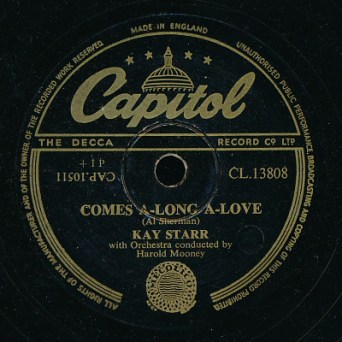
3. ‘Comes A-Long A-Love’, by Kay Starr

R-3253615-1392841568-2094.jpeg

Comes A-Long A-Love, by Kay Starr (her 1st of two #1s)

1 week, from 23rd to 30th January 1953

Snazzy! And jazzy! I really thought – and more fool me – that these pre-Rock ‘n’ Roll hits would be dull, twee, chaste… one step up the danceability chart from hymns, basically. How wrong I was. It wasn’t all bluebirds over the white cliffs of Dover.

Though bluebirds do feature in this song, they do so as a symbol of being in love and suddenly becoming aware of the world around you. Birds! Flowers! The sun! Comes A-Long A-Love suddenly though you never sang you’re always singing… Comes A-Long A-Love suddenly chimes you never heard begin a-ringing… The lyrical message being that falling in love will make you a better, livelier person.

Kay Starr’s voice is in complete contrast to the Jo Stafford record that went before. It’s husky, then sing-songy, she pauses where you least expect it and then rushes through tongue twister lines phrases like petty little things no longer phase you, which I’ll bet you can’t say five times fast. You might even say she’s flirting with the listener… And, yes, a quick search shows Ms. Starr was quite the little minx (that’s what they called them in those days). Those eyebrows! What didn’t they suggest! This song could be seen as a challenge – she’s daring you not to fall in love with her.

kay-starr-cropped

But again, it’s another song that paints love in a positive light. Three number ones in and nobody’s had their heart broken… Even lonely old Al Martino was hopeful that his lover would say ‘yes’. That’s something I’m going to look out for: the first ever reference to heartbreak in a UK number one hit. And, again, Kay Starr enunciates so damn well. This isn’t an easy song to sing, but she makes it sound like she’s ad-libbing her way through it. I’ve got to hand it to these old-timers, before the days of auto-tune, because they really could sing. Gran was right all along…

Some bits do jar, slightly. Starr uses ‘Mister’, and ‘Brother’, in a way that you wouldn’t these days. And the aforementioned reference to being in love and seeing bluebirds is a bit of a Disneyfied image. It must have been easy for songwriters, at the birth of modern pop music – love is great, you see bluebirds, do-bee-do – before people discovered cynicism. So far, though, all three number ones have been recorded by American artists. Perhaps that explains the saccharine sentiments! As everyone knows, Americans are sickeningly positive. How brilliant would it be, then, if the first UK recorded #1 turned out to be a piece of proto-Morrissey miserabilism…

One final thing I’ve noticed, while looking up these first three UK chart toppers, is how long they all lived. Jo Stafford died in 2008, aged ninety. Al Martino died in 2009 at eighty-two. Kay Starr died in November 2016, having reached a grand old innings of ninety-four. That means two of them outlived Michael Jackson, who wouldn’t have his first number one hit for another twenty-eight years. They were made of sterner stuff in those days, mind.

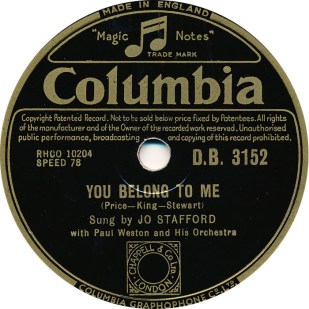
2. ‘You Belong to Me’, by Jo Stafford

jo-stafford-you-belong-to-me-1952-78
You Belong to Me, by Jo Stafford (her 1st and only #1)

1 week, from 16th to 23rd January 1953

On first listen, this sounds like the music that used to play between scenes in Dad’s Army. January 1953 was less than eight years after the end of World War II, I suppose, but this song just sounds so old. On the other side of the coin – this was less than fifteen years before Sgt Peppers! It’s genuinely amazing to think of how much popular music changed in such a short time.

However, without wanting to go off down that road just yet – this is a fairly nice, sedate little after-hours number. In complete contrast to the first chart topper, this is a track that holds back. A guitar strums, and some saxophones (trumpets?) flutter between the lines. Imagine a smoky club, little tables, couples whispering sweet nothings, gangsters and their molls quaffing champagne in the booths that line the walls. Though a quick image search of Jo Stafford brings up some fairly prim and proper pictures of her in buttoned-up blouses. None of her draped across a piano for the benefit of rowdy mobsters, unfortunately.

The premise of the song is that, no matter where her lover travels – the pyramids along the Nile, the market place in old Algiers, the jungle wet with rain – he should remember that he belongs to her and that, naturally, she will be alone and pining until his return. This being 1953, I’m guessing that he’s travelling the world as part of the military, rather than simply on a jolly, and that might explain the song’s popularity in the day’s of National Service, and the Korean War.

Jo_Stafford_color_photo_1948

Despite the song’s understated quality and the jazz-bar feel, though, Stafford is still enunciating the lyrics like she’s being graded on her diction. That’s what is immediately standing out as I listen to these early number ones. Sure they sound dated, and they have a simplistic take on romance (think about it, how many modern pop songs are about simply being in love, requited or otherwise?) but what comes across most is how clear the lyrics are. Rock and roll must’ve ruined the way folks sang!

While this was a one-week number one, the song actually hung in doggedly at number two for the whole of Al Martino’s run at the top. It could have all been so different! But at least Jo can hold claim to being the first ever female singer to top the UK charts, though she never did so again.

Intro

Join me as I listen to every UK Number 1 single since the charts began. Each and every song to have claimed the top spot since 1952: classics, novelties, long-forgotten hits, one-week wonders and pole-position hogging juggernauts…

I’ve been a chart geek since I was eleven or twelve – recording the rundown to tape on a Sunday afternoon, writing down the top ten, top twenty, even the top forty in a secret notebook when I should have been outside doing something better with my time. But the one position that fascinated me more than any other was, naturally, the Number One spot. Fair enough, really. It’s the pinnacle. It’s validation. Every Friday, and before that every Sunday, and before that every Tuesday, the most popular song the past week is announced and you cannot argue with the results. You might hate a particular song, you might think it’s the worst abomination ever committed to vinyl, or cassette, or CD, or compressed into an MP3 format, but you cannot argue its popularity.

And I know my charts – the artist with most #1s, the artist with the second most #1s, the song with the longest stay at #1, the song with the longest non-consecutive stay at #1, the biggest ever sales at #1, the lowest ever sales at #1, the shortest #1 by length, the longest #1 by length… I got it all down.

But, I realised: I know the titles, and the lengths, and the weeks at the top, of songs that I’ve never actually heard. And so, this blog was born. I will listen to every single UK Number 1 single, from the first published chart to the present day, and write about them. Simple.

Enjoy