715. ‘Cotton Eye Joe’, by Rednex

We’ve just ticked over the exact midway point of the nineties, as we head into 1995. One of the most renowned years in British music, during which Britpop, and some of the nation’s best-loved bands, went mainstream. And yes, we will get to all that… But kicking off the year we have something much less fondly remembered.
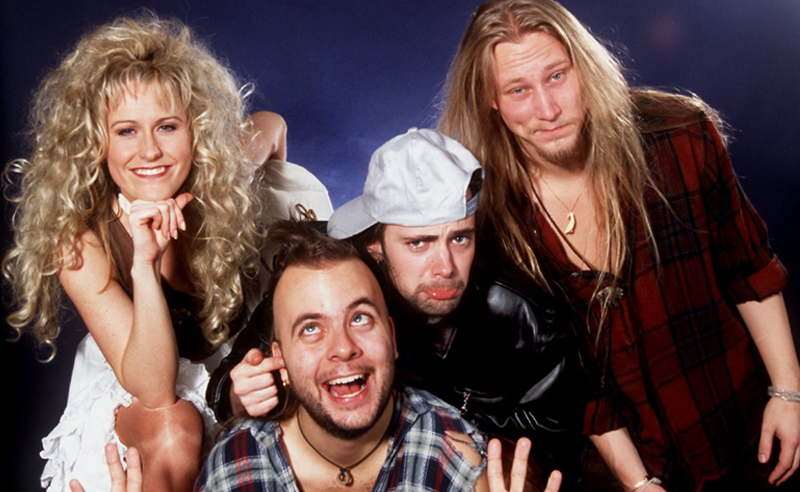
Cotton Eye Joe, by Rednex (their 1st and only #1)

3 weeks, from 8th – 29th January 1995

This jaw-clenchingly, skin tighteningly bad piece of techno-bluegrass can only be explained as a hangover from the festive period, from New Year’s parties full of people too drunk to care what was blasting out over the stereo… Oh, who can I kid? By now it’s clear that the British public need no excuse to send utter dross to the top of the charts. ‘Cotton Eyed Joe’ is shit – so shit it was guaranteed to be massive.

It was a perennial at my school discos, but I didn’t like it aged nine and haven’t chosen to hear it for the better part of thirty years. You need a strong stomach to listen to it even now: the mix of banjos, fiddles and heavy synths makes me feel very tense, something the horse and gunshot sound effects don’t do much to alleviate, while the aggressive chanting makes me wonder if hell is actually being locked in an eternal barn dance.

The video builds on this theme – I’m genuinely not sure if they were going for something funny, or for something more like a horror movie. The Rednex all play straggly-haired, yellow-teethed, rat-fondling hillbillies, who appear to be subjecting a younger, prettier girl to a never-ending ride on a bucking bronco. I don’t say this at all lightly, but I would take ‘Mr Blobby’ over this scary mess.

Rednex were Swedish (not American, sadly) and had stage names like Bobby Sue and Ken Tacky. ‘Cotton Eye Joe’ was their first hit, and in the UK they would manage only one more of note: ‘Old Pop in an Oak’ which made #12. In Sweden they remained successful well into the 2000s, scoring chart-toppers there as late as 2008! The mind boggles… The album that their two biggest hits came from was titled ‘Sex and Violins’, which is possibly the only funny thing the band ever put their name to.

Sad thing is, the history behind ‘Cotton Eye Joe’ is quite interesting. It pre-dates the US Civil War, probably originating among black slaves in the cotton fields. Proposals for what the phrase means vary from someone being drunk, to someone with milky cataracts, to the contrast between black skin and white eyeballs. It was first published in 1882, and has been recorded in country, polka, and trad-Irish versions, as well as featuring in the movie ‘Urban Cowboy’.

All that history has been obliterated by the Rednex version, which became a worldwide hit and which we will all be hearing until our dying days. It even made the charts in the US, which was unusual for a Eurodance track, and became a sports event/kids’ party standard. In recent years, some sports teams have stopped playing it in their stadiums due to the song’s potentially racist origins. Usually I’m not a fan of cancel culture, but I’ll make an exception if it means never hearing this particular chart-topper ever again…
714. ‘Stay Another Day’, by East 17

Every good guy needs a bad guy. Every superhero a nemesis. And the cutest, cleanest-cut boyband of the day needed some rough east London lads as their foils…

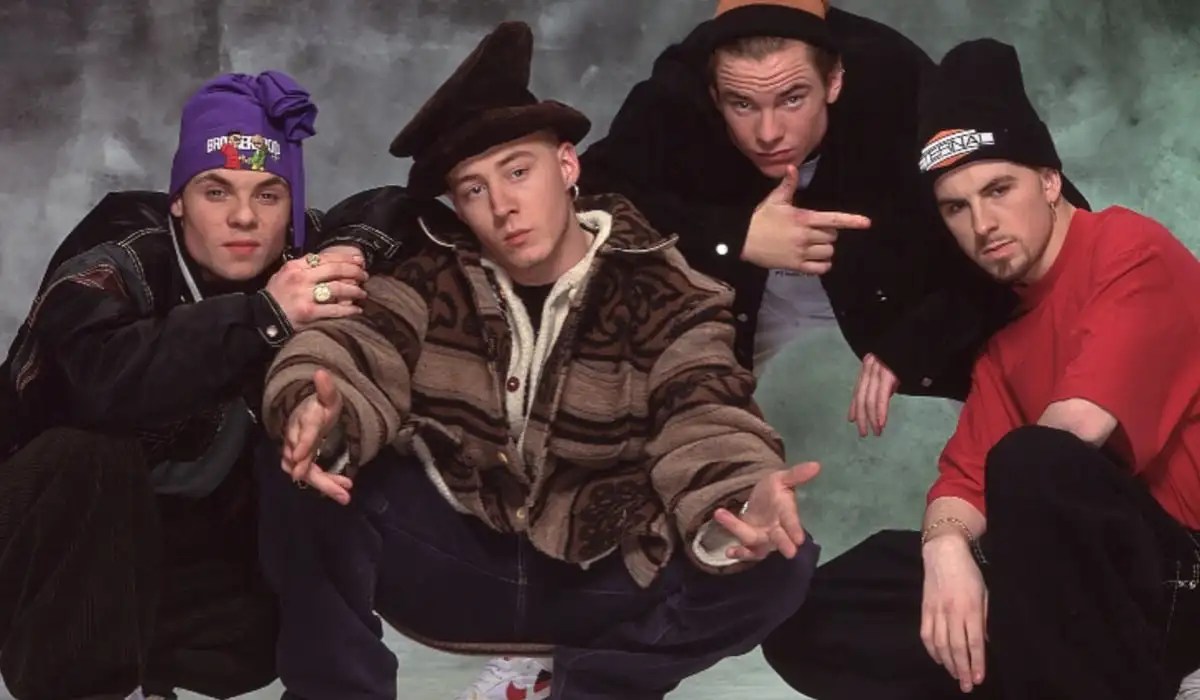
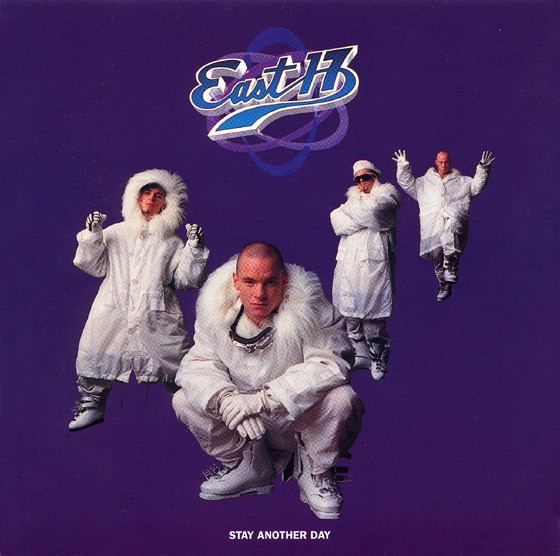
Stay Another Day, by East 17 (their 1st and only #1)

5 weeks, from 4th December 1994 – 8th January 1995

Take That have dominated the charts of 1993-1995 like few acts ever do: they’re on five number ones in our countdown – and it’ll very soon be eight – having stuck to a winning pop formula. East 17 meanwhile had been ticking along since mid-1992, scoring five Top 10 hits packed with edgier dance and hip-hop touches, yet not coming close to matching Gary and the boys’ success.

Though the one thing East 17 can lay claim to that Take That can’t is a Christmas number one. A classic Christmas number one at that. A record… I’m just going to stick my neck on the line right now… better than any Take That ever released. (Yes, including that one…) And, ironically, to score their only number one they momentarily dropped the bad-boy posturing, and out-Barlowed Barlow himself; recording a sophisticated, grown-up ballad the likes of which Take That’s chief songwriter would have jumped at.

Baby if you’ve got to go away, Don’t think I could take the pain, Won’t you stay another day… It’s a ballad, of course, and on first listen the lyrics are standard weepy, break-up fare. The four voices meld together in an almost a cappella way – a nod to Christmas hits past? – led by a painfully young sounding Brian Harvey. It’s touching, but when you learn that Tony Mortimer actually wrote it following his brother’s suicide, then lyrics the might on the surface sound simplistic Oh don’t leave me alone like this… hit ten times harder, and elevate the song much higher.

The only controversy that surrounds this record is whether or not it’s a Christmas song. So pressing an issue is it that YouGov polls have been conducted on the subject (the ‘no’s had it, with a slim majority). I’d have to say it is though. It clearly ends in a hail of church bells, that were tacked on once the song had been slated for a festive release. Plus the video has snow in it! Luckily the fact that it now gets filed away with the other festive favourites for ten and a half months of the year means it’s not been done to death. Unlike some other boyband ballads from the mid-nineties…

Speaking of the video… It’s both iconic (those white parka jackets) and yet terrible (pretty much everything else – the dodgy green screen, the floating dancer, the white gloves…) But even that can’t ruin the song. East 17 would continue until the end of the decade – scoring a further six Top 10s – with their fair share of sackings, drama and drug-related controversies. Take That, it’s fair to say, won the war, if there ever was one. Though I was very surprised to learn that if you look beyond British shores, East 17 actually sold more records worldwide, thanks to their popularity in Europe and Australia. And recording one of the best ever boyband singles ever probably helped too.

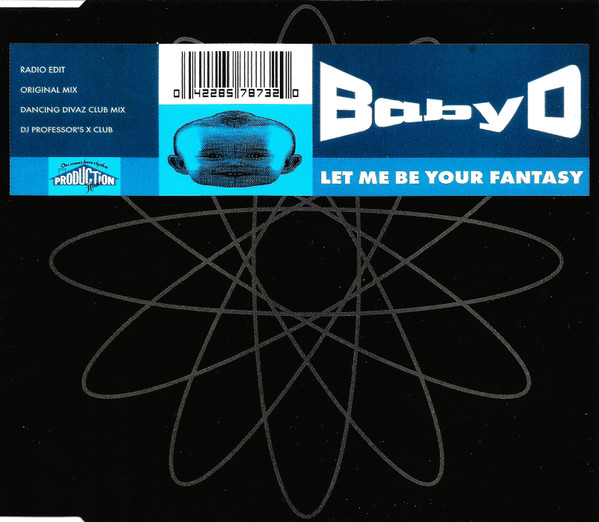
713. ‘Let Me Be Your Fantasy’, by Baby D

I know very little about dance music. I can just about tell my techno from my chillout, but you may have noticed from my previous posts on dance #1s that I play pretty fast and loose with the terminology. So indulge me while I throw around some ideas that may be complete nonsense…

Let Me Be Your Fantasy, by Baby D (their 1st and only #1)

2 weeks, from 20th November – 4th December 1994

‘Let Me Be Your Fantasy’ might be the most ‘hardcore’ dance chart-topper yet. The beat is either ‘house’, if we’re looking backwards, or ‘garage’ if we’re looking forwards. Is it maybe even the first ‘drum ‘n’ bass’ number one? I’ll also throw in the suggestion that it also incorporates ‘jungle’, if only because I think it sounds fun.

I could list dance sub-genres all day long (Wikipedia also suggests ‘breakbeat’ and ‘happy hardcore’) but to be honest, they mean little to me and probably mean as much to you. Let me give the quotation marks a rest, and describe what ‘Let Me Be Your Fantasy’ makes me feel… Well, it’s atmospheric – I like what sounds like a robot breathing in the mellow breaks between the verse – and the vocals are impressive. They’re the part of the song that feels the most familiar: a dance hit helmed by a large-lunged diva a la Black Box, or Snap!. Here the singer is Dorothy ‘Dee’ Galdes (presumably the ‘D’ in Baby D) and she has a wonderfully light-yet-full-bodied voice.

It’s another step towards the dance music that was dominating the charts when I came of age in the later part of the decade – dance music that had moved away from samples and novelty raps, dance music that had the confidence to strip things back, to drop the beats per minute, to let things breathe. This record is similar in that way to 1994’s other ‘cool’ dance hit by Tony Di Bart, rather than the more novelty offerings from Doop and Whigfield.

But I’ll also take that word ‘cool’, strengthen it into ‘cold’, and use it to describe how this song leaves me feeling. It’s not my thing, and as much as I try I can’t move past detached admiration as I listen and critique – much like I would an artefact in a museum – and I move on without particularly wanting to hear it again. I will always, sorry to say, enjoy the inane cheesiness of a 2 Unlimited song more…

Baby D had been around since the late eighties, and had scored a handful of minor hits earlier in the nineties. ‘Let Me Be Your Fantasy’ had been around since 1992, when it made #76 and become something of a lost classic. Until it was ‘found’, re-released, and it reached #1. Baby D followed it up with a couple of #3 hits before fading. Their last hit was a remix of this, their biggest hit, that made #16 in 2000. Their keyboard player, Terry Jones, took a slight change in direction and went on to write and produce for the Backstreet Boys, Eternal, and Peter Andre…

712. ‘Baby Come Back’, by Pato Banton ft. Ali & Robin Campbell of UB40

I thought it was about time… Time for our semi-regular blast of nineties reggae!

Baby Come Back, by Pato Banton (his 1st and only #1) ft. Ali & Robin Campbell of UB40 (their only solo #1s)

4 weeks, from 23rd October – 20th November 1994

Bookending 1994 are two reggae number ones, both covers of sixties classics. Back in January, Chaka Demus & Pliers reinvented ‘Twist and Shout’ for the beach bars of Montego Bay, and now Pato Banton has updated The Equal’s 1968 #1 ‘Baby Come Back’, with a little help from British reggae royalty.

It’s probably more ska than reggae, given the higher tempo and the short, sharp horn blasts (and the prevalence of two-tone black and white in the video), but it barrels along happily enough. It’s lively and enjoyable, without doing anything spectacular to the source material. It certainly isn’t as drastic a reimagining as Chaka Demus & Pliers, though it is nice that it is based one of the very first chart-toppers to have had a reggae influence (it made number one just months before the first ‘official’ reggae #1: Desmond Dekker’s ‘Israelites’). My favourite part of this version is the surf guitar playing the distinctive riff from the original.

Like ‘Twist and Shout’, one of the main updates is the addition of a various raps and toasts from Pato Banton. Come back man! Don’ leave me! Bring back me CD collection! Banton was a British singer and toaster from Birmingham, who had been active since the early eighties. He had appeared on UB40’s 1985 album ‘Bagariddim’, which presumably led to the Campbell brothers repaying the favour here. They take chorus duty, and score their fourth #1 in total, though the only one they’d ever manage away from their band. After this, Banton scored a couple more minor hits before seeming to slip off the radar. He released his last album in 2008.

In the course of his toasting, Banton does manage to slip in a cheeky drug reference of the sort that might have seen this record whacked with a BBC ban, had they known what he was on about. Come back, Yes with me bagga sensi… ‘Sensi’ being short for ‘sinsemilla’ – a cannabis plant that is seedless, and therefore much stronger than normal ganja.

Other than that, there’s not an massive amount to write home about here. It’s a fun record that breezes by nicely. Quite why it became the 4th highest selling single of 1994, I’m not totally sure. Though if writing this blog has taught me anything, it’s to never be surprised by the enduring popularity of reggae.

711. ‘Sure’, by Take That

Any act that racks up twelve number ones is going to have some chart-toppers that are better remembered than others… May I present to you, then, Take That’s all-but-forgotten #1.

Sure, by Take That (their 5th of twelve #1s)

2 weeks, from 9th – 23rd October 1994

I’m ‘sure’ I’ve heard this somewhere – the sure, so sure hook in the chorus was familiar – but the rest was a surprise. A pleasant surprise at that. The intro fools you, with lullabying chords suggesting that a syrupy ballad is on its way. But then everything goes a bit funky: with a squelchy bass, and lots of horns and scratchy turntables. If Take That’s previous hits had relied on retro, disco influences – ‘Relight My Fire’ and ‘Everything Changes’ – then ‘Sure’ sees the band turn to modern, American R&B.

Though, in fairness, this new jack swing beat had been around for a while, so they were actually quite late to the party. Still, it’s a solid pop song, and boybands are always at their most bearable when they’re keeping things upbeat. The lyrics are a bit PG, compared to similar acts – it’s been well over three years since Color Me Badd wanted to sex us up. Though there is a reference here to Gary Barlow’s relationship checklist: It’s got to be social, compatible, sexual, irresistible… (Take That’s big ‘rivals’ East 17 were a lot steamier on hits like ‘Deep’, but then they weren’t scoring #1 after #1. Definitely something to be said for keeping it family-friendly.)

Speaking of Mr Barlow, I do wish he’d relinquished lead vocal duty for this one. As fun a song as it is, he just doesn’t convince as a sexy alpha on the record, or when the lads cut a slick dance routine in the video. I’ve written in my previous posts on Take That that he clearly had ambitions above ‘boyband star’ – ambitions that will come to fruition with their next number one – and on the basis of their first five chart-toppers he was clearly the dominant force. Possibly too dominant. Small wonder Robbie wanted to break free…

‘Sure’ was the lead single from the band’s third album, and so was guaranteed to be a massive hit. It got the epic, seven-minute video treatment too. Though in truth half the video tells a very dull story in which the boys babysit a little girl while also trying to get ready for a house party. (Skip forward three and a half minutes if you just want to hear the actual song.) And yet, like I said in the intro, this record feels forgotten among their more famous hits. None more so than their sixth chart-topper: a genuinely huge pop-culture moment, coming along very soon.

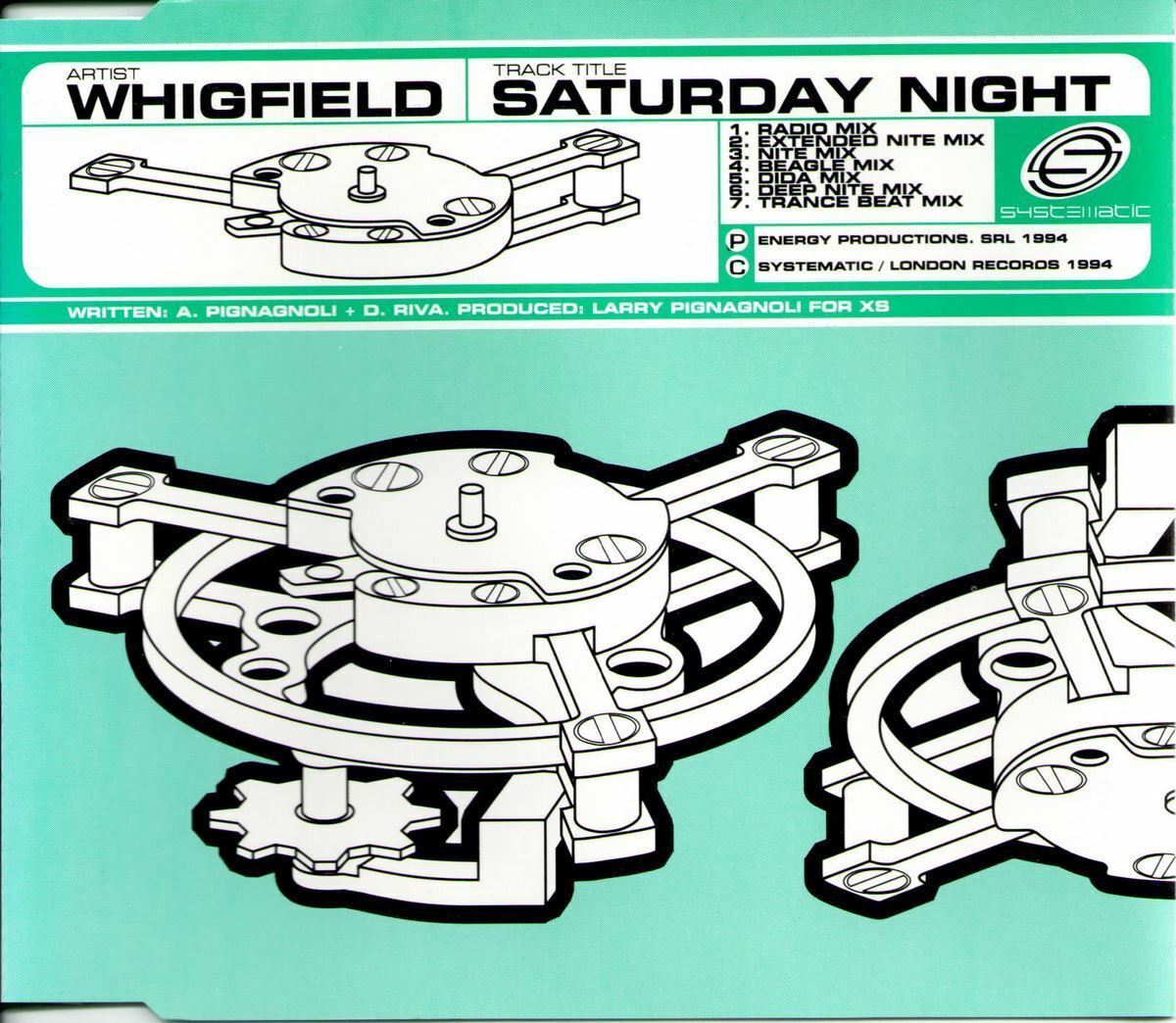
710. ‘Saturday Night’, by Whigfield

After fifteen weeks of ‘Love Is All Around’, I’m sure the nation (including Wet Wet Wet themselves) was happy for literally anything to come along and give us a new number one…

Saturday Night, by Whigfield (her 1st and only #1)

4 weeks, from 11th Sept – 9th Oct 1994

Well, here with the dictionary definition of the phrase ‘careful what you wish for’, is Danish beauty Whigfield, and her ode to the penultimate night of the week. I innocently thought I’d enjoy hearing this tune again, cheese that it is, while assorted memories of primary school discos came flooding back…

But, alas. It’s a bit crap. The first ten seconds are the most interesting. The famous di-di-da-da-da intro and the quacking synths. Here we go, I think, nostalgia central. Except, as ever, nostalgia ain’t what it used to. The remaining four minutes of ‘Saturday Night’ are repetitive and dull. The banal lyrics – Saturday night and I like the way you move… It’s party time and not one minute we can lose… Be my baby… and some la-di-dahs to fill the gaps… – the banal beat, the banal quacking. I notice that as part of the current ‘the nineties were the best decade ever’ movement, there are attempts to cast this as a ‘90s dance classic, up there with ‘Rhythm Is a Dancer’ and ‘Ebeneezer Goode’. But it’s really not.

Not that it’s terrible either. It’s a novelty, but not the most offensive kind. It’s biggest relevance, in chart terms, is in being the ultimate post-summer holiday hit. Presumably played in bars across the continent all summer, it smashed straight in at number one when finally released at the start of September. Oh, and there’s the fact that in entering at #1, Whigfield became the first act to have their debut single do so.

As with Alice Cooper, and Marilyn Manson (two artists to whom I didn’t expect to be drawing a comparison today) people make the mistake of referring to Whigfield as the singer rather than the band (or ‘musical project’ as Wikipedia refers to them). The singer, Sannie Charlotte Carlson, was Danish, and the producers were Italian. Carlson, though, was the very pretty star of the show. I’m sure the video, in which she prances around in a towel, getting ready for a big night out, did the song’s chances no harm. Whigfield would go on to have just two further Top 10 hits, though Carlson continues to record and perform.

I think another reason writing this post didn’t bring about a warm Proustian glow is that my repeated plays of ‘Saturday Night’ have reminded me of the dance routine. Interestingly, Carlson doesn’t do the dance in the video, and the craze seems to have stemmed from her backing dancers when she performed on Top of the Pops. However it started though, it quickly caught on, and the social anxiety that came from the being nine-years-old and the only person in the school who couldn’t do it properly remains to this day (see also: ‘The Macarena’).

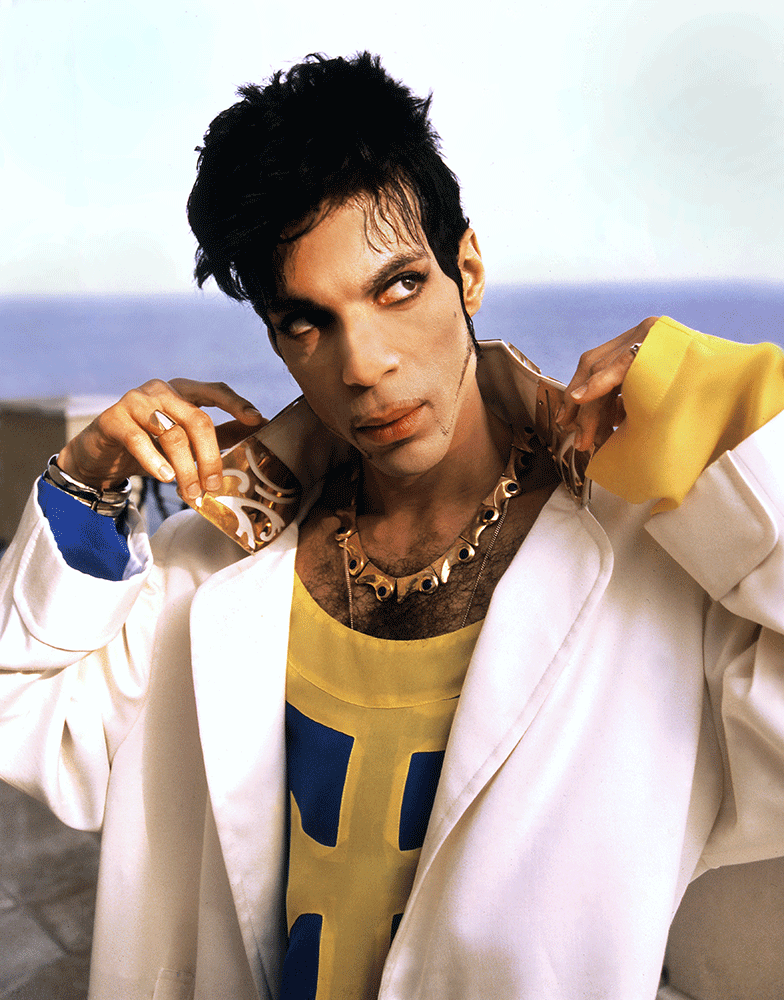
705. ‘The Most Beautiful Girl in the World’, by Prince

The list of superstar artists with underwhelming singles chart records is long, and complex. There’s Led Zeppelin, who simply didn’t bother releasing them. There’s Chuck Berry, whose ding-a-ling made number one two decades after he’d helped invent rock and roll. There’s Stevie Wonder, whose two chart-toppers don’t begin to do his talent justice…

The Most Beautiful Girl in the World, by Prince (his 1st and only #1)

2 weeks, from 17th April – 1st May 1994

Then there’s Prince – the star with possibly the biggest disparity between talent and number one hits. Not that he has a terrible overall chart record in the UK: seventeen Top 10 hits is nothing to be sniffed at. But only this one chart-topper (the 2nd biggest hit of his long career, apparently…)

And I’m just going to come out and say it… For ‘The Most Beautiful Girl in the World’ to be Prince’s only #1 is as big a travesty as ‘My Ding-A-Ling’. It might even be bigger. At least Berry’s novelty is dumb fun. This is syrupy, over-produced tripe, with some queasy lyrics… It’s plain to see, You’re the reason that God made a girl… The fact that the song debuted on the 1994 Miss USA pageant speaks volumes.

As I listen, all I can think of is all the brilliant Prince tunes that came and went without making #1… And not only is this dull, it’s disappointingly chaste. This from a man who recorded songs like ‘Soft and Wet’, ‘Cream’, and ‘Sexy MF’. There’s a spoken-word portion, as in all the worst love songs, in which Prince semi-raps: And if the stars ever fell, One by one from the sky…

It leads on to the most enjoyable bit of the song though, in which Prince provides his own backing vocals in a deep voice before launching back into his more famous falsetto. The song’s odd sound effects – tears dripping, clocks ticking, birds twittering – are interesting too. These moments are where we come closest to the fun, creative-chameleon Prince, who’s sorely missing from the rest of this sludge.

Of course, ‘The Most Beautiful Girl in the World’ isn’t technically a ‘Prince’ song. It came at the start of his ‘Love Symbol’ period, AKA the time he was known as ‘The Artist Formerly Known as Prince’, as part of a rebellion against his Warner Brothers contract. He felt they were holding him back, insisting that he chill out and release albums more sporadically. Interestingly, this single – one of his most successful – was released on a small, independent label, rather than Warner Bros. The corresponding album didn’t see the light of day for another year and a half, and is still involved in a lawsuit over plagiarism involving ‘The Most Beautiful Girl in the World’ and an Italian song called ‘Takin’ Me to Paradise’.

Prince does already have two other chart-toppers to his name as a songwriter. Two classics: Chaka Khan’s ‘I Feel for You’ and Sinead O’Connor’s ‘Nothing Compares 2 U’. And of course there’s ‘Purple Rain’, ‘When Doves Cry’, ‘Kiss’… So many that I might have to do a post on Prince’s nearly-number-ones. All these hits kick this one into the long grass… And yet. The charts often don’t play nice…

704. ‘Everything Changes’, by Take That

For their fourth #1 in nine months, Take That once again take turns at lead-vocal duty. We’ve had two Garys, one from Mark, and now a Robbie…

Everything Changes, by Take That (their 4th of twelve #1s)

2 weeks, from 3rd – 17th April 1994

Which gives a fairly throwaway pop song, a chart-topper more because of the band singing it than because of any innate quality the song might have, some significance. For here is the voice of the biggest British star of the coming decade… Though you might not have realised it at first, given the strange American accent he puts on for the album version’s intro…

On the single edit that bit is cut out, and we are rushed straight into another disco-tinged piece of retro-pop; the skinnier, sickly brother of ‘Relight My Fire’. I did wonder if ‘Everything Changes’ might have been a cover, as nobody under the age of sixty has ever used the term ‘taxicab’, but no – it’s a Gary Barlow (plus guests) writing credit. I guess they just needed the extra syllable to make it scan…

It’s perfectly serviceable pop. There’s nothing wrong with it (if we overlook the dated sax solo…) but neither is there much particularly memorable about it, apart perhaps from the for-ev-er… hook. There’s a reason why it was the fifth and final single from the band’s second album. There’s also a reason why it still made number one for a fortnight despite everyone already owning a copy of said album: Take That were bloody huge by this point.

While it might not have been his first lead vocals on a Take That single (I have little inclination to go back through their discography and check) it was definitely Robbie Williams’ first lead vocals on a #1. On their previous three, he very much took a back-seat. It felt strange to see him dancing gamely behind Barlow and Owen, knowing that he would go on to be bigger than any of them. But then, at the time, his departure was unexpected, and nobody would have bet on him having the success that he did.

Anyway, we’re getting ahead of ourselves. They’ve got a few more hits, and a few more chart-toppers, before he strikes out alone. And of the Take That #1s that have gone before, I’m starting to think I was a bit harsh on ‘Pray’… It’s head and shoulders above their other chart-toppers so far – as fun as ‘Relight My Fire’ was, and as strange as ‘Babe’ was. Quite possibly one of their very best…?

699. ‘Babe’, by Take That

I wrote in my last Take That post of the band’s obvious desire to be more than just teenyboppers, that their cover of ‘Relight My Fire’, and the involvement of Lulu, was proof of them aiming to become Britain’s biggest act, bar none. ‘Babe’, their third number one in under six months is another step in that direction…

Babe, by Take That (their 3rd of twelve #1s)

1 week, from 12th – 19th December 1993

It was also a clear bid for Christmas #1, entering the chart in pole position the week before the big day. But this isn’t the cosy, festive love song you might expect. No sleigh bells and novelty jumpers here. It’s the tale of a lost love, opening with dramatic strings, a disconnected phone call, and a slightly creepy first person narrator. I come to your door, To see you again, But where you once stood, Was an old man instead…

I like a song that tells a story, and that’s what this five-minute epic (another epic!) does. Mark Owen – on lead duties this time – gets her number, and calls. He manages to find out where she now lives, goes down her street… It’s pretty overwrought, with some clunky lines (You held your voice well, There were tears I could tell…), and the unanswered phone call at the beginning and end is pure melodrama.

But, while you can pick holes, this is above and beyond your usual boyband fare. Come the last verse, as she answers the door, the singer sees a little boy: He had my eyes, He had my smile… Plot twist! Why she ran away with his child, clearly never wanting to hear from him again, is not explained – but I’ll give Take That the benefit of the doubt and assume they wanted this sinister ambiguity. I hear more than a hint of menace when the singer announces I tell you I’m back again…

The video suggests that he’s been away at war, but I’m not so sure. I like the creepier reading. It builds to an almost hard rocking climax, before disintegrating into thin air, and a dialling tone. Like I said, it was clearly a bid for Christmas number one, an achievement that would have capped off Take That’s breakthrough year. And when it entered at number one the week before, all bets would have been off…

Except… Blobby, Blobby, Blobby and all that. The pink and yellow one became the first act in twenty-five years to return to the top, and the rest was history. Take That never did get their Xmas #1, though there will be a boyband classic at the top this time next year. Perhaps the fact that it is quite a dark song, which isn’t about cuddling up with your loved one by the fire, also hurt it in the end. ‘Babe’ goes down as an interesting sidebar in Take That’s career: not one of their biggest or best-loved hits, but another sign that they were here for the long run.

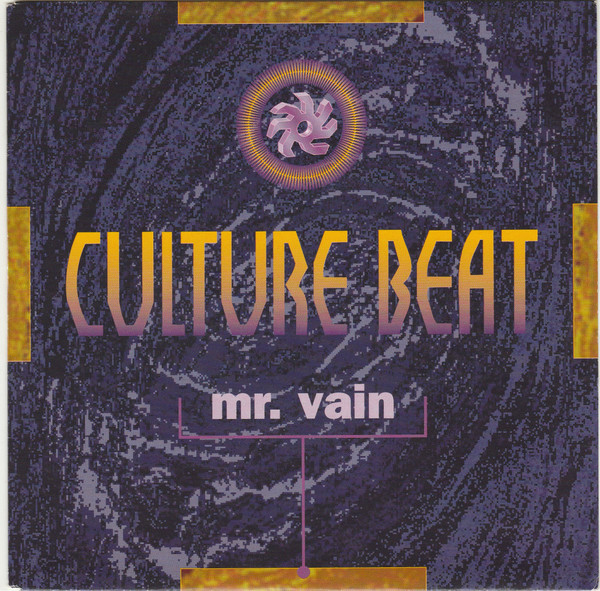
694. ‘Mr. Vain’, by Culture Beat

The intro to our next number one kicks in, and I’m struggling to tell if it sounds like something we’ve already met in our journey through the early 90s, or if it was simply copied into ubiquity in the years that followed…

Mr. Vain, by Culture Beat (their 1st and only #1)

4 weeks, from 22nd August – 19th September 1993

On the one hand, ‘Mr. Vain’ is cheesy, throwaway Eurodance – the soundtrack to many a summer holiday in Ibiza (the 1990s is littered with dance hits that made the higher reaches of the charts in early autumn, after everyone had returned home from a fortnight in the Med). On the other, it’s an astute slice of dance-pop so of its time it could be in a museum.

It follows a tried and tested formula: one girl who sings, one boy who raps, over a throbbing beat. It’s amazing how successful this was, over and over again, between 1990 and 1994. Snap!, 2 Unlimited, Culture Beat… ‘Mr. Vain’ is a both a cheap and cheerful rehash of ‘Rhythm Is a Dancer’, especially in the portentous intro, and a slightly less stupid take on ‘No Limit’, with its techno riff and juddering drum machine. It takes what was great about both those records, and creates a streamlined, optimised dance hit – perhaps the epitome of its genre.

Call him Mr Raider, Call him Mr Wrong… Away from the pulsing beat, there are lyrics that just beg to be chanted en masse. I know what I want and I want it now… A decade later, when I started going to nightclubs, this record would still get a regular spin, and girls would pick out their own personal ‘Mr. Vain’ among the strobes and the dry ice. Meanwhile, Mr. Vain responds in the rapped verses: Call me what you like, As long as you call me time and again…

I’m going to take bets on where Culture Beat were from. Place your chips…. There’s no way they were British – the thought didn’t even cross my mind, given that this is dictionary-definition Eurodance. I was tempted to go Dutch, or maybe Belgian… But no. They were a German creation, of course, from a producer with two rent-a-voices, keeping up a grand tradition that stretches all the way back to Boney M. For ‘Mr. Vain’, though, the large-lunged vocals are from a Brit – Tanya Evans – while the rap is supplied by an American – Jay Supreme.

They’d had a couple minor hits previously, but this one sent them into the stratosphere: a number one in eleven countries across Europe, setting them up for a year or so of follow-up Top 10s. In Germany their success lasted the better part of a decade, until a remake of their biggest hit, ‘Mr Vain Recall’, in 2003. Culture Beat remain a going concern, presumably touring festivals across central Europe every summer, with a completely different line-up, Evans and Supreme having left way back in 1997.